1
Management of Insect Pests of Food
Legumes in West and Central Asia and
North Africa
M. El Bouhssini et al.M. El Bouhssini et al.
Insect speciesInsect species CropCrop Regions where the pest causes economicRegions where the pest causes economic
damagedamage
Aphis fabaeAphis fabae Faba beanFaba bean West Asia and North AfricaWest Asia and North Africa
Acyrthosiphom pisumAcyrthosiphom pisum Forages/LegumesForages/Legumes West Asia and North AfricaWest Asia and North Africa
Aphis craccivoraAphis craccivora Faba beanFaba bean Nile Valley countriesNile Valley countries
Sitona spp.Sitona spp. Lentil/faba beanLentil/faba bean West Asia and North AfricaWest Asia and North Africa
Liriomyza cicerinaLiriomyza cicerina ChickpeaChickpea West Asia and North AfricaWest Asia and North Africa
Helicoverpa armigeraHelicoverpa armigera Chickpea
North Africa, West Asia, Nile valleyNorth Africa, West Asia, Nile valley
countriescountries
Key pests of legumes and their geographical
distribution
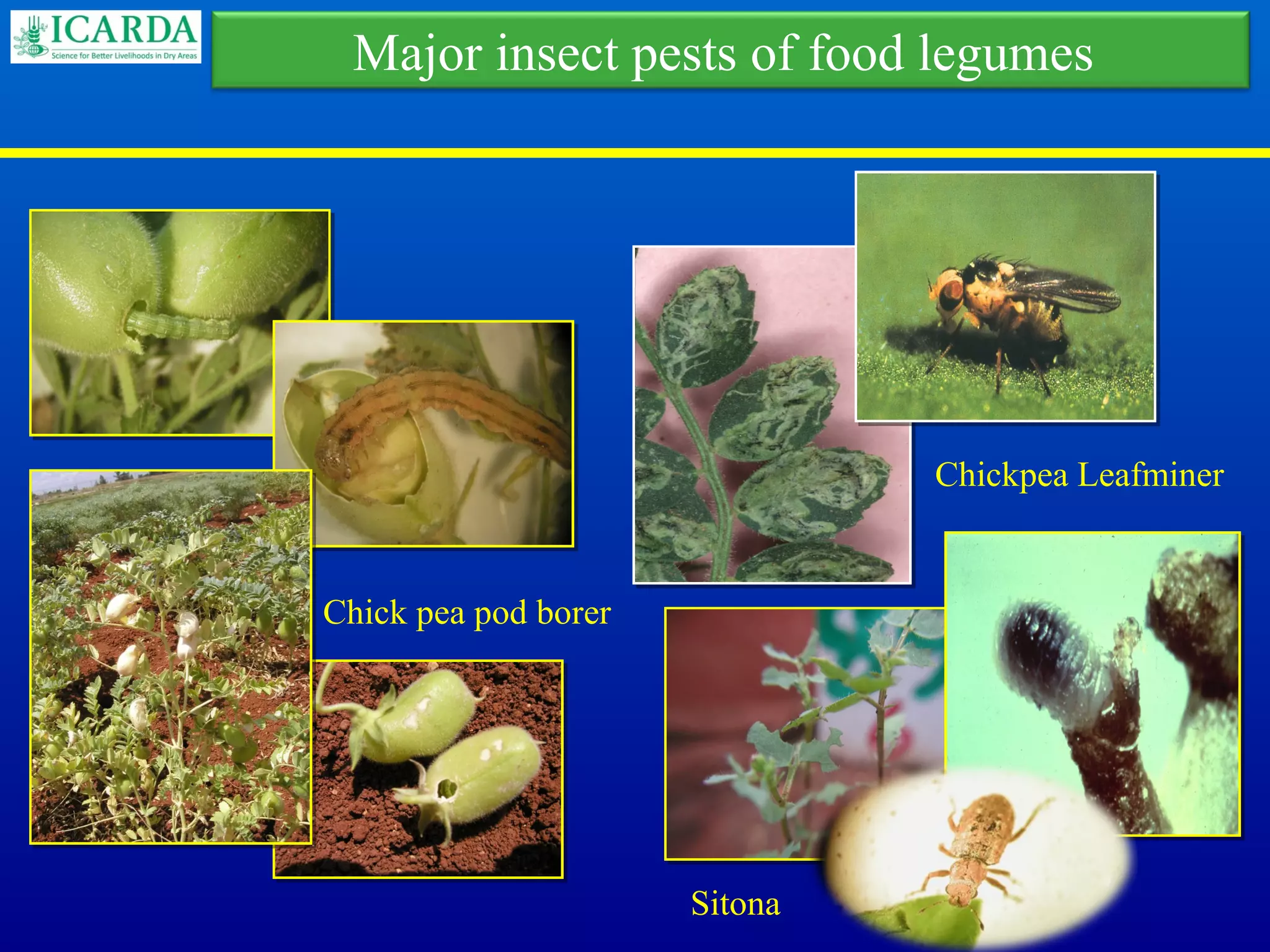
Major insect pests of food legumes
Chick pea pod borer
Chickpea Leafminer
Sitona
Yield loss caused by Chickpea leaf miner in
Morocco
Average % yield loss caused by chickpea Leaf miner in Morocco (two locations), 2014 & 2015
HPR is the IPM foundation
ICARDA Gene Bank Holdings
(December 2014)
Mostly landraces and unique set of wild relatives
Crop No Crop No
Faba bean BPL 3268 Pisum 6113
Aegilops 4382 Trifolium 5173
Barley 29722 Vicia 6228
Bread wheat 14556 Faba bean 6761
Durum wheat 19797 Chickpea 15046
Primitive wheat 913 Lentil 11877
Wild Hordeum 2239 Wild Cicer 270
Wild Triticum 1607 Wild Lens 600
Lathyrus 4220 Range &
pasture
6394
Medicago annual 8706 Others 305
Total 148,177
FIGS is based on:
-Selection pressure
-Co-evolution
-Adaptation
For pests, select germplasm from environments that
favor the development of pest populations
Focused Identification of Germplasm Strategy
200 chickpea accessions from the ICARDA gene bank, selected
using FIGS, were evaluated for resistance to Leaf miner under
field conditions in Morocco in 2014 and 2015. Two accessions (IG
6461 & IG 70556) confirmed resistance to this pest with rating of
3 in the 1-9 visual damage score.
New sources of resistance to Leafminer
Screening for Resistance to Chickpea Pod borer
375 Kabuli chickpea accessions, selected from the
ICARDA genebank using FIGS, were evaluated for
resistance to Pod borer in the field at Annoceur and Allal
Tazi using summer planting. All the accessions tested
were susceptible.
Combine resistance to Leaf miner and Ascochyta blight
Top research priority
First five crosses for Leaf
miner resistance were made
at Tel Hadya (ICARDA main
station) in 1999:
ILC 3805/ ILC 3397, ILC 3805/ ILC 5309, ILC 5901/ ILC 3397, ILC
5901/ ILC 5309, and ILC 3397/ ILC 5309
ILC 5901 and ILC 3805=Resistant, ILC 5309=moderately
susceptible, ILC 3397=Susceptible
Breeding for Resistance to CLM
Late planting has been used to allow for high
infestation by Leaf miner
Screening for Resistance to CLM
Seven chickpea breeding lines, FLIP 2005-1C, FLIP 2005-2C,
FLIP 2005-3C, FLIP 2005-4C, FLIP 2005-5C, FLIP 2005-6C, and
FLIP 2005-7C resistant to chickpea leaf were registered in the
Journal of Plant Registrations (2007).
International nursery of 40 lines assembled and distributed to
partners
Progress in HPR to CLM
In 2008 six crosses were made for developing RIL
populations for Leaf Miner resistance:
 
ILC5901XILC3805
ILC5901XILC5309
ILC5901XILC3397
ILC3805XILC5309
ILC3805XILC3397
ILC5309XILC3397
New crosses made for CLM
SSR markers associated with LM
resistance in chickpea
•QTL analysis identified three QTLs
on linkage group LG2 (TA37), LG3
(TA34) and LG5 (H4F03) explaining
maximum 22% of LDS variation.
•Unmapped marker (NCPRG48) was
strongly linked to LDS explaining
55.3% of the variation.
3.66.56.6
Average infestation score
RSS
a: homozygous allele type
b: homozygous allele type
h: heterozygous allele type
SSR primer: NCPRG48
QTLs for CLM Resistance
Oxalic acid (mg/100 g leaves)
Damagescore
Concentration of Oxalic Acid mg/100 g leaves
Damage score scale (1-9): 1 = no damage and 9 = mines observed on all the leaflets.
Damage by CLM/Oxalic acid
• Botanical pesticides such as neem oil.
• Parasitoids: conservation and enhancement through diversified
cropping system and the use of flowering medicinal plants as strips
between chickpea fields.
• Early planting date (winter)
IPM of Leaf miner
Efficacy of different insecticides against Leaf miner
on Chickpea
% reduction of leaflets infestation by insecticides over the check
We tested a number of biological and chemical insecticides against Chickpea leaf miner. The
experiment was conducted at Marchouch Station, using the susceptible variety Garbanzo. The
application of insecticides was made three times; the first one on May 4 when 50% of the
leaflets were infested, the second spray on May 18 and the third one on June 3.
Encouraging results with the Mentha pulegium, Ocimum basilicum
and Eucalyptus globulus oils. Mentha pulegium oil was the most
effective (100% mortality) for the two methods of application:
contact toxicity (Topical method) with 30 µl/ ml 3 h after
application and for the larvicidal activity with 45 µl/ml 24 h after
application.
Botanical pesticides
Effect of seed dressing insecticide on % infestation of nodules by Sitona larvae ,
Douyet Station, 2015
The experiment conducted at Douyet Station. Two different planting dates: December 11, 2014
for the first date and December 30, 2014 for the second date. We tested the seed treatment
Celest ®Top (a.i. Difenoconazole + Fludioxonil+ Thiamethoxam) with three doses (1.5 cc, 2
cc, 2.5 cc), in addition to untreated check, for the control of nodule damaged by Sitona larvae.
Effect of sowing date and seed treatment on Sitona weevil
infestations
The experiment was conducted at Marchouch Station using the local variety Bakria. We tested
the seed dressing pesticide Celest ®Top (a.i. Difenoconazole + Fludioxonil+ Thiamethoxam) for
the control of the pea aphid on lentil. Three doses (1.5 cc, 2 cc, 2.5 cc), in addition to untreated
check.
Effect of sowing date and seed treatment on pea
aphid infestations
Effect of seed treatment on lentil population of Pea aphid ,
Marchouch Station, 2015
% reduction of Pea aphid over check
Acknowledgements
Collaborators:
-ICARDA
-NARS Partners (Scientists & students)
Funding:
-CRP Grain Legumes
- OCPF
- EU/IFAD
THANKS

Management of Insect Pests of Food Legumes in West and Central Asia and North Africa

  • 1.
    1 Management of InsectPests of Food Legumes in West and Central Asia and North Africa M. El Bouhssini et al.M. El Bouhssini et al.
  • 2.
    Insect speciesInsect speciesCropCrop Regions where the pest causes economicRegions where the pest causes economic damagedamage Aphis fabaeAphis fabae Faba beanFaba bean West Asia and North AfricaWest Asia and North Africa Acyrthosiphom pisumAcyrthosiphom pisum Forages/LegumesForages/Legumes West Asia and North AfricaWest Asia and North Africa Aphis craccivoraAphis craccivora Faba beanFaba bean Nile Valley countriesNile Valley countries Sitona spp.Sitona spp. Lentil/faba beanLentil/faba bean West Asia and North AfricaWest Asia and North Africa Liriomyza cicerinaLiriomyza cicerina ChickpeaChickpea West Asia and North AfricaWest Asia and North Africa Helicoverpa armigeraHelicoverpa armigera Chickpea North Africa, West Asia, Nile valleyNorth Africa, West Asia, Nile valley countriescountries Key pests of legumes and their geographical distribution
  • 3.
    Major insect pestsof food legumes Chick pea pod borer Chickpea Leafminer Sitona
  • 4.
    Yield loss causedby Chickpea leaf miner in Morocco Average % yield loss caused by chickpea Leaf miner in Morocco (two locations), 2014 & 2015
  • 5.
    HPR is theIPM foundation
  • 6.
    ICARDA Gene BankHoldings (December 2014) Mostly landraces and unique set of wild relatives Crop No Crop No Faba bean BPL 3268 Pisum 6113 Aegilops 4382 Trifolium 5173 Barley 29722 Vicia 6228 Bread wheat 14556 Faba bean 6761 Durum wheat 19797 Chickpea 15046 Primitive wheat 913 Lentil 11877 Wild Hordeum 2239 Wild Cicer 270 Wild Triticum 1607 Wild Lens 600 Lathyrus 4220 Range & pasture 6394 Medicago annual 8706 Others 305 Total 148,177
  • 7.
    FIGS is basedon: -Selection pressure -Co-evolution -Adaptation For pests, select germplasm from environments that favor the development of pest populations Focused Identification of Germplasm Strategy
  • 8.
    200 chickpea accessionsfrom the ICARDA gene bank, selected using FIGS, were evaluated for resistance to Leaf miner under field conditions in Morocco in 2014 and 2015. Two accessions (IG 6461 & IG 70556) confirmed resistance to this pest with rating of 3 in the 1-9 visual damage score. New sources of resistance to Leafminer
  • 9.
    Screening for Resistanceto Chickpea Pod borer 375 Kabuli chickpea accessions, selected from the ICARDA genebank using FIGS, were evaluated for resistance to Pod borer in the field at Annoceur and Allal Tazi using summer planting. All the accessions tested were susceptible.
  • 10.
    Combine resistance toLeaf miner and Ascochyta blight Top research priority
  • 11.
    First five crossesfor Leaf miner resistance were made at Tel Hadya (ICARDA main station) in 1999: ILC 3805/ ILC 3397, ILC 3805/ ILC 5309, ILC 5901/ ILC 3397, ILC 5901/ ILC 5309, and ILC 3397/ ILC 5309 ILC 5901 and ILC 3805=Resistant, ILC 5309=moderately susceptible, ILC 3397=Susceptible Breeding for Resistance to CLM
  • 12.
    Late planting hasbeen used to allow for high infestation by Leaf miner Screening for Resistance to CLM
  • 13.
    Seven chickpea breedinglines, FLIP 2005-1C, FLIP 2005-2C, FLIP 2005-3C, FLIP 2005-4C, FLIP 2005-5C, FLIP 2005-6C, and FLIP 2005-7C resistant to chickpea leaf were registered in the Journal of Plant Registrations (2007). International nursery of 40 lines assembled and distributed to partners Progress in HPR to CLM
  • 14.
    In 2008 sixcrosses were made for developing RIL populations for Leaf Miner resistance:   ILC5901XILC3805 ILC5901XILC5309 ILC5901XILC3397 ILC3805XILC5309 ILC3805XILC3397 ILC5309XILC3397 New crosses made for CLM
  • 15.
    SSR markers associatedwith LM resistance in chickpea •QTL analysis identified three QTLs on linkage group LG2 (TA37), LG3 (TA34) and LG5 (H4F03) explaining maximum 22% of LDS variation. •Unmapped marker (NCPRG48) was strongly linked to LDS explaining 55.3% of the variation. 3.66.56.6 Average infestation score RSS a: homozygous allele type b: homozygous allele type h: heterozygous allele type SSR primer: NCPRG48 QTLs for CLM Resistance
  • 16.
  • 17.
    Damagescore Concentration of OxalicAcid mg/100 g leaves Damage score scale (1-9): 1 = no damage and 9 = mines observed on all the leaflets. Damage by CLM/Oxalic acid
  • 18.
    • Botanical pesticidessuch as neem oil. • Parasitoids: conservation and enhancement through diversified cropping system and the use of flowering medicinal plants as strips between chickpea fields. • Early planting date (winter) IPM of Leaf miner
  • 19.
    Efficacy of differentinsecticides against Leaf miner on Chickpea % reduction of leaflets infestation by insecticides over the check We tested a number of biological and chemical insecticides against Chickpea leaf miner. The experiment was conducted at Marchouch Station, using the susceptible variety Garbanzo. The application of insecticides was made three times; the first one on May 4 when 50% of the leaflets were infested, the second spray on May 18 and the third one on June 3.
  • 20.
    Encouraging results withthe Mentha pulegium, Ocimum basilicum and Eucalyptus globulus oils. Mentha pulegium oil was the most effective (100% mortality) for the two methods of application: contact toxicity (Topical method) with 30 µl/ ml 3 h after application and for the larvicidal activity with 45 µl/ml 24 h after application. Botanical pesticides
  • 21.
    Effect of seeddressing insecticide on % infestation of nodules by Sitona larvae , Douyet Station, 2015 The experiment conducted at Douyet Station. Two different planting dates: December 11, 2014 for the first date and December 30, 2014 for the second date. We tested the seed treatment Celest ®Top (a.i. Difenoconazole + Fludioxonil+ Thiamethoxam) with three doses (1.5 cc, 2 cc, 2.5 cc), in addition to untreated check, for the control of nodule damaged by Sitona larvae. Effect of sowing date and seed treatment on Sitona weevil infestations
  • 22.
    The experiment wasconducted at Marchouch Station using the local variety Bakria. We tested the seed dressing pesticide Celest ®Top (a.i. Difenoconazole + Fludioxonil+ Thiamethoxam) for the control of the pea aphid on lentil. Three doses (1.5 cc, 2 cc, 2.5 cc), in addition to untreated check. Effect of sowing date and seed treatment on pea aphid infestations Effect of seed treatment on lentil population of Pea aphid , Marchouch Station, 2015 % reduction of Pea aphid over check
  • 23.
    Acknowledgements Collaborators: -ICARDA -NARS Partners (Scientists& students) Funding: -CRP Grain Legumes - OCPF - EU/IFAD
  • 24.

Editor's Notes

  • #3 Another major consideration in dry areas and CWANA is environmental poverty and the increasing trend in the prevalence of abiotic stresses particularly drought and salinity. In addition to the serious loss in biodiversity.
  • #5 using four susceptible varieties
  • #7 To date, ICARDA genebank holds 148,177 accessions with unique sets of landraces and wild relatives and material collected for dry areas.
  • #9 Chickpea Leaf miner
  • #20 in a RCBD design with three repetitions
  • #22 The local variety Defes was sown following the Split Plot design with 4 replicates.
  • #23 in randomized complete block Design RCBD with four replications