Management of pests through
agronomic practices
Kommireddy Poojitha
Sr. M.Sc. (Agri.)
PALB 6192
1st seminar on
• Introduction
• Agronomic practices
• Research papers
• Advantages and disadvantages
• Conclusion
• Future line of work
Sequence Of Presentation
PEST
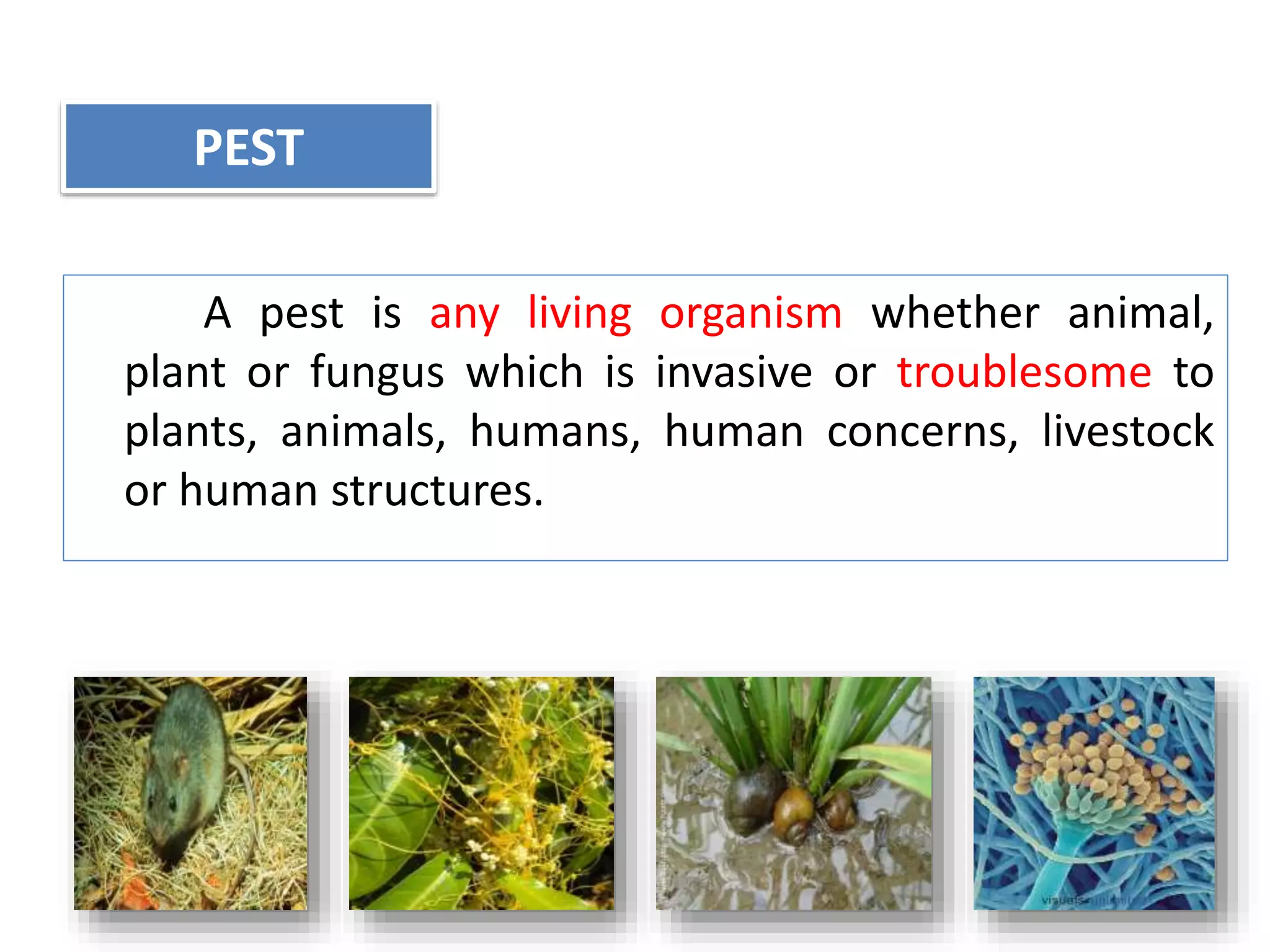
A pest is any living organism whether animal,
plant or fungus which is invasive or troublesome to
plants, animals, humans, human concerns, livestock
or human structures.
Four main group of pests
1. Weeds – undesirable plants
2. Invertebrates – insects, mites, snails, slugs
3. Disease agents or pathogens – fungi, bacteria,
viruses, nematodes, mycoplasmas
4. Vertebrates – birds, reptiles, rodents, and other
mammals
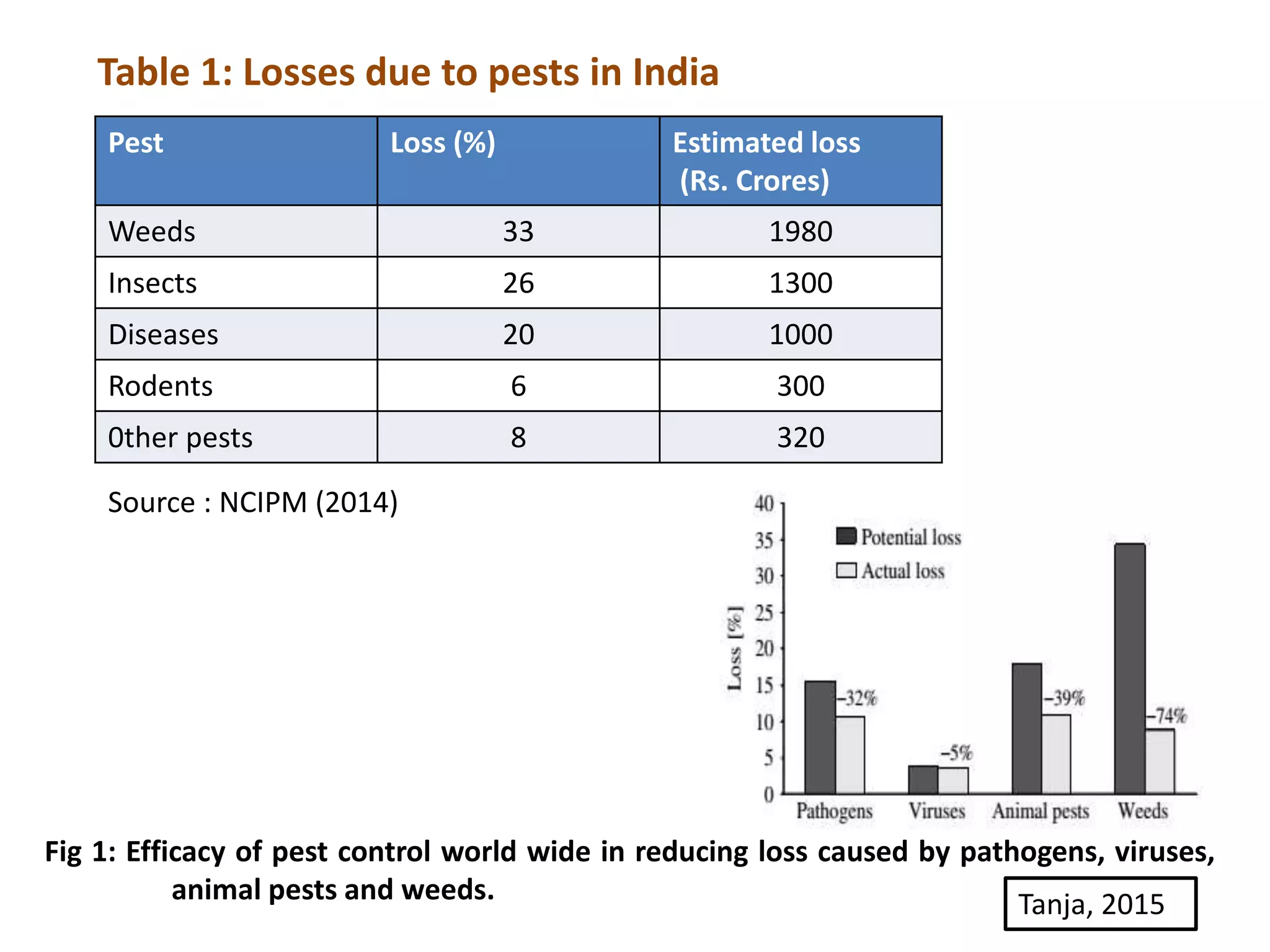
Table 1: Losses due to pests in India
Fig 1: Efficacy of pest control world wide in reducing loss caused by pathogens, viruses,
animal pests and weeds.
Pest Loss (%) Estimated loss
(Rs. Crores)
Weeds 33 1980
Insects 26 1300
Diseases 20 1000
Rodents 6 300
0ther pests 8 320
Tanja, 2015
Source : NCIPM (2014)
Management:
 Way to keep pests below the levels where they can
cause economic damage
 Management does not mean eradicating pests. It
means finding tactics that are effective and
economical and that keeps environmental damage to
a minimum
Methods to manage pests
• Agronomic /Cultural Method
• Mechanical Method
• Physical Method
• Biological Method
• Chemical Method
• Integrated Method
Agronomic practices
Agronomic practices are the steps that
farmers incorporate into their farm management
systems to improve soil quality, enhance water use,
manage crop and improve the environment through
better management.
• Agronomic practices include : improved varieties,
land preparation, planting material, planting time,
weed management, water management, earthing-up,
harvesting.
Selection of varieties
Crop Variety Resistant to
Rice ADT 48, Swarnamukhi, Pothana Yellow stem borer
PTB 33, MTU 1032, BPT 4358 BPH
Ratna, jaya, MTU 7414 Blast
IR 20, IR 54, MTU 9992 BLB
Sorghum SPV 86, SPV 462 Shoot fly
CSH 7, CSH 8, SPV 17 Stem borer
SPV 191, CSH 5 Ergot
N 13, CSV 5, BH 4-1-4 Striga
Cotton Bt varieties Lepidopteran pests
Narasimha, H 8 Leaf hopper
HG 9, G 27 Bacterial blight
Wheat Lerma rojo Rust
Table 2: List of crop varieties resistant to pests
List of crop varieties resistant to pests
Crop Variety Resistant to
Sugarcane CO 6907, CO 7219 Red rot
CO 290, CP 36-13 Striga
Maize DHM 1, DHM 103, Ganga II Downy mildew
Bajra WCC 75, HB 1, HB 5 Green ear
Ragi Ratnagiri, GPU 28 Blast
Sunflower KBSH 1, LSH 1 Downy mildew
Groundnut Vemana Early and late leaf spot
Mustard RC 781, PR 10 White rust
Red gram BRG 5, ICPL 87119, ICP8863 Wilt
Chickpea ICCC 37, ICCV 4, Avrodhi wilt
Black gram Teja, LBG 752, Pant-30 Yellow mosaic
Green gram LGG 407 Yellow mosaic
Lucerne LLC 6, LLC 7 Dodder
Anon., 2012
Summer ploughing
Deep Ploughing of field in hot summer months
(May – June), exposes the hibernating larvae and
pupae to hot sun rays as well as to the predatory
birds.
Helps to kill weeds and disease causing
organisms by exposing them to the summer heat.
Soil solarization
It is a method of heating the surface soil by using
plastic sheets placed on moist soil to trap solar
radiation and there by increasing the soil
temperature (Katan, 1981)
Table 3: Effect of period of solarization on population and dry weight of
weeds (60 DAS) on seed yield of soybean
Period of solarization Weed density
per m-2
Weed dry weight
(g per m-2)
Seed yield
(kg ha-1)
Control 122.9 a 69.6 a 831 a
Solarization for 3 weeks 43.6 b 46.1b 1391 b
Solarization for 4 weeks 40.1 b 32.2 b 1403 b
Solarization for 5 weeks 38.8 b 32.1 b 1473 b
Singh et al., 2007Madya Pradesh
Fig 2: Effect of soil solarization with chicken manure on control of Fusarium
wilt and yield of sweet basil
Gamliel et al., 2000Israel
1) Non-treated;
2) solarization;
3) Solarization + chicken manure 1 kg/m2;
4) Methyl bromide (50 g/m2)
Seed treatment
Seed treatment refers to the application of
fungicide or insecticide or biocontrol agent or a
combination of them to seeds so as to disinfect and
disinfest them from seed-borne or soil-borne
pathogenic organisms and storage insects.
Table 4: Influence of seed treatment against leafhoppers on cotton (4 WAS)
Treatment Dosage
Leafhopper population
(No. / 3leaves)
Per cent over
control
Acephate 75 SP 10 g kg-1 0.7 87.04
Carbosulfan 20 EC 10 ml kg-1 2.6 38.90
Imidacloprid 49 FS 10 ml kg-1 2.4 55.56
Monocrotophos 36 WSC 10 ml kg-1 2.3 57.40
Triazophos 40 EC 10 ml kg-1 1.7 68.52
Monocrotophos spray 1120 ml ha-1 3.9 30.83
Untrea ted check(UTC) - 5.4 -
C.D (0.05) 0.24
Sathyan et al., 2016Tamil Nadu
Time of sowing
 Crop escapes the incidence of pest by altering time
of sowing
 Principle : sowing crop at a particular time when the
climate is not favorable for build up of pest
Crop Pest Method Reference
Cucurbits Red pumpkin beetle Early sowing PAU, 1999
Cotton Jassids Early sowing PAU, 1999
Chickpea Fruit borer Early sowing Yadava et al., 1983
Sorghum Shoot fly Early sowing Jotwani, 1979
Table 5: Effect of time of sowing on reduction of pest incidence
Table 6: Effect of sowing dates on larval population of H. armigera
and % pod damage and grain yield (kg/ha) of chickpea.
Treatment Larvae/mrl
(H. armigera)
% Pod damage Grain yield (kg/ha)
October 07 1.74 11.5 1855
October 17 1.85 12.00 1610
October 27 2.08 33.17 1540
November 07 2.27 35.90 1498
November 17 2.95 39.05 1450
November 27 4.09 45.52 1030
December 06 5.09 55.12 612
Parmar et al., 2015MP, India
Table 7: Effect of different dates of sowing on per cent disease index of
white rust and staghead of mustard (pooled data of 2013 & 2014)
Date of sowing Per cent white rust
index
Per cent staghead Yield (kg/ha)
Oct 1 27.9 6.2 1006
Oct 15 29.9 6.7 958
Nov 1 41.9 10.1 840
Nov 15 46.2 11.7 781
Dec 1 48.2 12.2 747
Dec 15 49.9 12.8 703
C.D (0.05) 3.5 1.7 33
Gopi et al., 2016Sikkim
Soil amendments
Soil amendments are materials you add to soil to
improve its physical or chemical properties.
 Also called a soil conditioner.
 Types
i. Organic soil amendments : Green manuring, Brown
manuring, Compost
ii. Inorganic soil amendments : Lime, Sulphur,
Gypsum
Fig 3: Effect of duration of the period of liming on the disease index of clubroot
disease on Chinese cabbage.
Hiroharu et al., 2002Japan
Table 8: Effects of marigold and sunhemp incorporation on number
of Meloidogyne incognita and grain yield of cowpea and
soybean.
Treatment Cowpea Soybean
Number of
M. Incognita
per 200 g of soil
Grain yield
(t/ha)
Number of
M. Incognita
per 200 g of soil
Grain yield
(t/ha)
African Marigold 1.86 1.92 2.95 2.41
Sunhemp 2.06 1.95 3.22 2.49
Control 61.50 0.93 50.90 0.31
L.S.D. (0.05) 1.22 0.17 0.77 0.14
Adekunle, 2011Nigeria
Note : Sunhemp, Marigold are 8 weeks old at the time of incorporation
Marigold : α-terthienyl ; Sunhemp : junceine, trichodesmine
Table 9: Effect of brown manuring on weed density, yield and economics of
maize
Treatment Weed density
(no.m-2) at 60
DAS
Weed
control
efficiency
(%)
Grain
yield
(t ha-1)
B:C
ratio
Mechanical weeding by hand hoe at 20
and 35 DAS
19.82 80.5 5.67 2.43
PE Alachlor 1kg ai ha-1 + mechanical
weeding at 35 DAS
18.48 81.5 5.75 2.70
Intercropping Dhanicha and in situ
incorporation at 35 DAS
25.66 74.8 4.56 2.16
Brown manuring 24.15 75.8 4.61 2.37
PE Alachlor 1kg ai ha-1 + brown manuring 10.52 89.7 7.23 3.61
Un-weeded check 101.65 - 3.19 1.71
LSD (P=0.05) 5.4 - 0.31
Ramachandran et al., 2012Tamil Nadu
Brown manure crop : Diancha
Table 10: Population of Crematogaster subnuda and incidence of stalk borer
in sugarcane under trash mulch and weeds
Treatment Ant population/clump Incidence of stalk borer
(%)
With trash cover 2.40 12.47
Without trash cover 0.16 24.65
CD (P=0.05) 0.68 3.36
With weeds 1.20 7.80
Without weeds 0.16 24.65
CD (P=0.05) 0.56 2.64
Srivastava (2008)Lucknow
Mulching
Table 11: Allelopathic effects of sorghum on weed density, weed dry weight
and yield of cotton
Treatment Total weed
Density /m2
Total weed
dry weight
(g/m2)
Seed cotton
yield
(kg ha-1)
Sorghum mulch @ 3.50 t/ha 14.0 (62.11) 24.67 246.57
Sorghum mulch @ 7.00 t/ha 13.75 (42.1) 23.70 272.18
Sorghum mulch @ 10.50 t/ha 13.0 (41.1) 20.13 352.84
control 23.75 (-) 45.79 160.89
L.S.D. (0.05) 2.57 3.28 26.71
Indrajith et al., 2009Punjab
Sorghum- Sorgoleone
Table 12: Average larval density of Herpetogramma bipunctalis in two cultivars of
Amaranthus hypochondriacus planted in different densities.
Variable Cultivar - Density
Hyp 280 – LD
(28 plants/m2)
Hyp 280 – HD
(38 plants/m2)
Hyp Artasa – LD
(28 plants/m2)
Hyp Artasa – HD
(38 plants/m2)
Total larvae
0.29
0.16 0.63 0.37
Larvae in stems 0.16 0.11 0.32 0.23
Larvae in
panicles
0.14 0.05 0.32 0.13
Grain yield
(kg/ha)
546.6 791.1 1550.3 2201.1
Selene et al., 2017La Pampa, Argentina
Plant density
Earthing-up
• A technique used where the soil surrounding
a plant is mounded against the main stem
• Helps in controlling
Early shoot borer in sugarcane (Khan, 1968)
Potato tuber moth in potato (Shelton, 1979)
Intercropping
 The practice of intercropping can reduce pest
problems by making it more difficult for the pest to
find a host crop
 Intercropping with legumes smothers the weeds and
also provides habitat for beneficial organisms
Table 13: Effect of intercropping on the incidence of early shoot borer and yield
of sugarcane
Cropping pattern
Per cent early shoot
borer incidence
(cumulative of
30,60 & 90 DAP)
Per cent control
over sugarcane
sole crop (%)
Cane yield
(t/ha)
Sugar yield
(t/ha)
Sugarcane + Green gram 9.50
a
63.16 91.19 11.83
Sugarcane + Black gram 12.32
a
52.22 80.81 10.37
Sugarcane + Cowpea 12.44
a
51.76 82.59 10.53
Sugarcane + Dhaincha 12.70
a
50.76 90.55 11.72
Sugarcane + Soybean 14.65
b
43.20 83.39 10.78
Sugarcane sole crop 25.79
c
----- 76.61 9.81
C.D. (0.05) 3.15 ----- 5.45 0.80
Thirumurugan et al., 2005Melalathur, TN
Table 14:Grain yield of maize (t/ha) planted in the various treatment
combinations
Treatment Maize yield
(t/ha)
Maize monocrop (no nitrogen) 1.5
Maize + nitrogen 2.2
Maize + mulch 2.1
Maize + Desmodium uncinatum 5.8
Maize + mulch + nitrogen 3.4
Maize + D. uncinatum + nitrogen 5.9
Fig 4: Striga hermonthica counts in each plot at 10 weeks after crop emergence
Charles et al., 2013Nairobi, Kenya
Nitrogen : 120 kg/ha
Allelochemicals : Isoflavanones
C-glycosylflavones.
Nutrient management
 Both the type and amount of fertilizer can have a
significant impact on a crop susceptibility to pests
Table 15: Effect of different nutrients on pest incidence
Nutrient Pest /pathogen Reaction of host Reference
Nitrogen Bollworms in cotton Increases Butter et al., 1989
Phosphorus &
Potassium
White fly in cotton Decreases Butter et al., 1996
Lime & Sulphur Root borer in sugarcane Decreases Kund et al., 1994
Nitrogen Alternaria solani in potato Decreases Barclay et al., 1972
Silicon Pyricularia grisea in rice Decreases Zhang et al., 2006
Fig 5: Influence of silicon fertilization and benomyl foliar spray on rice blast
incidence.
Zhang et al., 2006Florida, USA
Irrigation management
• Method and amount of irrigation influences the pest
population by altering the microclimate of crop
 Flooding controls weeds in rice
 Drip irrigation controls weeds
by 45-70% in different crops
Table 16: Influence of water level in rice field on the population build up of the
brown plant hopper, Nilaparvata lugens
Treatments Per cent damaged
hills
Average No. of
nymph/plant
Average No. of
adult/plant
Moisture at field
capacity level
0.54 0.30 0.33
Normal level 1.34 1.72 1.45
Immersing stem and
leaf sheath level
2.49 3.83 2.26
S.Em. ± 0.08 0.06 0.06
C.D. at 5 % 0.282 0.370 0.268
Desai et al., 2016Navsari
Table 17: Mean number of diamondback moth larvae + pupae in head
of cabbage subjected to timed irrigation treatments
Sampling
dates
No. of diamondback moths per six plants
Sprinkler irrigation Drip
irrigationEvening
intermittent
20:00-23:30 hours
Evening
continuous
20:00-22:00 hours
Daytime
continuous
15:00-17:00 hours
10 June 0.3 0.3 0.7 7.0
16 June 5.0 12.3 15.0 38.3
23 June 4.3 7.0 11.3 15.7
29 June 2.0 3.3 8.0 21.7
7 July 3.3 5.3 4.7 16.3
13 July 4.3 3.3 5.3 17.3
Total 19.2a 3l.5ab 45.0b 116.3c
% reduction 83.5 72.9 61.3 -
John et al., 2012United states
Trap cropping
 Planting of a second crop in the vicinity of principal
crop to divert a pest, which would otherwise attack
the principal crop (Vander Meer, 1981)
Trap crop may or may not be harvestable.
 Principle:
Insects are attracted to plant volatiles
Insects have differential host preference
Trap crop Main crop Pest controlled
Marigold Tomato Helicoverpa
Cabbage Mustard DBM
Castor Groundnut Spodoptera
Table 18: Trap crops used for pest management
Fig 6: Number of leaf footed bugs on trap crops and main crop
Cullman, 2012Alabama
Crop rotation
• This strategy is very effective against pests that over
winter as egg or larvae and against pests that have
limited ability to disperse
Eg : Corn root worms
• Also manages weeds, nematodes and soil borne
pathogens
Table 19: Effect of crop rotation on weed density, weed dry weight and grain
yield of rice in wheat rice cropping system
Crop rotation Total weed
density (m2)
Total weed dry
weight (g m-2)
Grain yield (t ha-1)
wheat-fallow-DSAR 32.5 a 25.0 a 2.7
wheat-fallow-PudTR 27.8 b 16.5 b 2.4
wheat-sorghum-DSAR 26.7 b 15.5 b 3.3
wheat-sorghum-PudTR 22.1 c 10.7 c 3.2
Muhammad et al., 2010Faisalabad
DSAR – Direct Seeded Aerobic Rice
PudTR – Puddled Transplanted Rice
Fig 7: Incidence of Rhizoctonia root rot on sugar beet as influenced by crop
rotation with Brassica sps
Mustard residue incorporation
Mustard residue removal
Bare soil (summer ploughing)
Natacha et al., 2009France
Diseaseincidence(%)
Border crops
• 2-4 rows of crop grown along the border of main
crop is referred as “Border crop”
• It acts as barrier for incidence of pests
 Growing of safflower, cacti which are thorny in
nature restricts the entry of wild boars up to 50-70%
Table 20: Effect of barrier crops on mosaic disease incidence and yield of
chilli
Treatments Disease incidence
(60 DAT)
Yield (kg/ha) % increase over
control
Maize without insecticide 13.6 1549 153.5
Sorghum without insecticide 14.7 1525 149.6
Sunflower without insecticide 17.8 1412 131.1
Metasystox to maize 11.8 1624 165.8
Metasystox to sorghum 14.0 1592 160.6
Metasystox to sunflower 13.6 1475 141.4
Control 26.8 611 ---
C.D (0.05) 2.1 95
Anandam et al., 2002Tirupati, AP
Removal of crop residues and alternate hosts
 Crop residues harbour insect pupae, fungal innoculum
– Stem borer over winters in rice stubbles
– Scale insect in sugarcane trash
– Collar rot of groundnut
 Insects and pathogens survive on alternate hosts
when there is no crop in the field
– Rice stem borer on Echinochloa sps, Panicum sps
– Black rust of wheat on Agropyron repens
– Gram caterpillar on amaranthus, datura
Advantages:
 No extra cost
 No costly inputs
 No special equipment
 Minimum chance for biotype selection
 No health hazards – ecologically sound
 No harmful effects on non target organisms
 Good component of IPM
Disadvantages:
 It is a preventive strategy, which often needs to be implemented before
the pest level is known, or damage is observed
 Timing decides success
 No complete control of pests
 Requires proper planning
Conclusion
 Early sowing of crop is advantageous to escape pest
attack in crops like chickpea, mustard, sorghum,
cotton.
 Nutrients can reduce pest incidence to an
acceptable level at which further control by other
practices are more successful and less expensive.
 Treating trap crops with insecticides at peak activity
of pests is an effective strategy to reduce pest
populations on main crop.
 Crop rotation with non host crops significantly
reduces the soil borne pests.
Future line of work
• Development of varieties resistant to pests and
diseases with high yield potential.
• More research is needed in order to find the
nutrients or nutrient combinations which can help
to reduce pest severity.
• It is also necessary to find the best integrated pest
management approaches.
Management of pests through  agronomic practices

Management of pests through agronomic practices

  • 1.
    Management of peststhrough agronomic practices Kommireddy Poojitha Sr. M.Sc. (Agri.) PALB 6192 1st seminar on
  • 2.
    • Introduction • Agronomicpractices • Research papers • Advantages and disadvantages • Conclusion • Future line of work Sequence Of Presentation
  • 3.
    PEST A pest isany living organism whether animal, plant or fungus which is invasive or troublesome to plants, animals, humans, human concerns, livestock or human structures.
  • 4.
    Four main groupof pests 1. Weeds – undesirable plants 2. Invertebrates – insects, mites, snails, slugs 3. Disease agents or pathogens – fungi, bacteria, viruses, nematodes, mycoplasmas 4. Vertebrates – birds, reptiles, rodents, and other mammals
  • 5.
    Table 1: Lossesdue to pests in India Fig 1: Efficacy of pest control world wide in reducing loss caused by pathogens, viruses, animal pests and weeds. Pest Loss (%) Estimated loss (Rs. Crores) Weeds 33 1980 Insects 26 1300 Diseases 20 1000 Rodents 6 300 0ther pests 8 320 Tanja, 2015 Source : NCIPM (2014)
  • 6.
    Management:  Way tokeep pests below the levels where they can cause economic damage  Management does not mean eradicating pests. It means finding tactics that are effective and economical and that keeps environmental damage to a minimum
  • 7.
    Methods to managepests • Agronomic /Cultural Method • Mechanical Method • Physical Method • Biological Method • Chemical Method • Integrated Method
  • 8.
    Agronomic practices Agronomic practicesare the steps that farmers incorporate into their farm management systems to improve soil quality, enhance water use, manage crop and improve the environment through better management. • Agronomic practices include : improved varieties, land preparation, planting material, planting time, weed management, water management, earthing-up, harvesting.
  • 9.
    Selection of varieties CropVariety Resistant to Rice ADT 48, Swarnamukhi, Pothana Yellow stem borer PTB 33, MTU 1032, BPT 4358 BPH Ratna, jaya, MTU 7414 Blast IR 20, IR 54, MTU 9992 BLB Sorghum SPV 86, SPV 462 Shoot fly CSH 7, CSH 8, SPV 17 Stem borer SPV 191, CSH 5 Ergot N 13, CSV 5, BH 4-1-4 Striga Cotton Bt varieties Lepidopteran pests Narasimha, H 8 Leaf hopper HG 9, G 27 Bacterial blight Wheat Lerma rojo Rust Table 2: List of crop varieties resistant to pests
  • 10.
    List of cropvarieties resistant to pests Crop Variety Resistant to Sugarcane CO 6907, CO 7219 Red rot CO 290, CP 36-13 Striga Maize DHM 1, DHM 103, Ganga II Downy mildew Bajra WCC 75, HB 1, HB 5 Green ear Ragi Ratnagiri, GPU 28 Blast Sunflower KBSH 1, LSH 1 Downy mildew Groundnut Vemana Early and late leaf spot Mustard RC 781, PR 10 White rust Red gram BRG 5, ICPL 87119, ICP8863 Wilt Chickpea ICCC 37, ICCV 4, Avrodhi wilt Black gram Teja, LBG 752, Pant-30 Yellow mosaic Green gram LGG 407 Yellow mosaic Lucerne LLC 6, LLC 7 Dodder Anon., 2012
  • 11.
    Summer ploughing Deep Ploughingof field in hot summer months (May – June), exposes the hibernating larvae and pupae to hot sun rays as well as to the predatory birds. Helps to kill weeds and disease causing organisms by exposing them to the summer heat.
  • 12.
    Soil solarization It isa method of heating the surface soil by using plastic sheets placed on moist soil to trap solar radiation and there by increasing the soil temperature (Katan, 1981)
  • 13.
    Table 3: Effectof period of solarization on population and dry weight of weeds (60 DAS) on seed yield of soybean Period of solarization Weed density per m-2 Weed dry weight (g per m-2) Seed yield (kg ha-1) Control 122.9 a 69.6 a 831 a Solarization for 3 weeks 43.6 b 46.1b 1391 b Solarization for 4 weeks 40.1 b 32.2 b 1403 b Solarization for 5 weeks 38.8 b 32.1 b 1473 b Singh et al., 2007Madya Pradesh
  • 14.
    Fig 2: Effectof soil solarization with chicken manure on control of Fusarium wilt and yield of sweet basil Gamliel et al., 2000Israel 1) Non-treated; 2) solarization; 3) Solarization + chicken manure 1 kg/m2; 4) Methyl bromide (50 g/m2)
  • 15.
    Seed treatment Seed treatmentrefers to the application of fungicide or insecticide or biocontrol agent or a combination of them to seeds so as to disinfect and disinfest them from seed-borne or soil-borne pathogenic organisms and storage insects.
  • 16.
    Table 4: Influenceof seed treatment against leafhoppers on cotton (4 WAS) Treatment Dosage Leafhopper population (No. / 3leaves) Per cent over control Acephate 75 SP 10 g kg-1 0.7 87.04 Carbosulfan 20 EC 10 ml kg-1 2.6 38.90 Imidacloprid 49 FS 10 ml kg-1 2.4 55.56 Monocrotophos 36 WSC 10 ml kg-1 2.3 57.40 Triazophos 40 EC 10 ml kg-1 1.7 68.52 Monocrotophos spray 1120 ml ha-1 3.9 30.83 Untrea ted check(UTC) - 5.4 - C.D (0.05) 0.24 Sathyan et al., 2016Tamil Nadu
  • 17.
    Time of sowing Crop escapes the incidence of pest by altering time of sowing  Principle : sowing crop at a particular time when the climate is not favorable for build up of pest Crop Pest Method Reference Cucurbits Red pumpkin beetle Early sowing PAU, 1999 Cotton Jassids Early sowing PAU, 1999 Chickpea Fruit borer Early sowing Yadava et al., 1983 Sorghum Shoot fly Early sowing Jotwani, 1979 Table 5: Effect of time of sowing on reduction of pest incidence
  • 18.
    Table 6: Effectof sowing dates on larval population of H. armigera and % pod damage and grain yield (kg/ha) of chickpea. Treatment Larvae/mrl (H. armigera) % Pod damage Grain yield (kg/ha) October 07 1.74 11.5 1855 October 17 1.85 12.00 1610 October 27 2.08 33.17 1540 November 07 2.27 35.90 1498 November 17 2.95 39.05 1450 November 27 4.09 45.52 1030 December 06 5.09 55.12 612 Parmar et al., 2015MP, India
  • 19.
    Table 7: Effectof different dates of sowing on per cent disease index of white rust and staghead of mustard (pooled data of 2013 & 2014) Date of sowing Per cent white rust index Per cent staghead Yield (kg/ha) Oct 1 27.9 6.2 1006 Oct 15 29.9 6.7 958 Nov 1 41.9 10.1 840 Nov 15 46.2 11.7 781 Dec 1 48.2 12.2 747 Dec 15 49.9 12.8 703 C.D (0.05) 3.5 1.7 33 Gopi et al., 2016Sikkim
  • 20.
    Soil amendments Soil amendmentsare materials you add to soil to improve its physical or chemical properties.  Also called a soil conditioner.  Types i. Organic soil amendments : Green manuring, Brown manuring, Compost ii. Inorganic soil amendments : Lime, Sulphur, Gypsum
  • 21.
    Fig 3: Effectof duration of the period of liming on the disease index of clubroot disease on Chinese cabbage. Hiroharu et al., 2002Japan
  • 22.
    Table 8: Effectsof marigold and sunhemp incorporation on number of Meloidogyne incognita and grain yield of cowpea and soybean. Treatment Cowpea Soybean Number of M. Incognita per 200 g of soil Grain yield (t/ha) Number of M. Incognita per 200 g of soil Grain yield (t/ha) African Marigold 1.86 1.92 2.95 2.41 Sunhemp 2.06 1.95 3.22 2.49 Control 61.50 0.93 50.90 0.31 L.S.D. (0.05) 1.22 0.17 0.77 0.14 Adekunle, 2011Nigeria Note : Sunhemp, Marigold are 8 weeks old at the time of incorporation Marigold : α-terthienyl ; Sunhemp : junceine, trichodesmine
  • 23.
    Table 9: Effectof brown manuring on weed density, yield and economics of maize Treatment Weed density (no.m-2) at 60 DAS Weed control efficiency (%) Grain yield (t ha-1) B:C ratio Mechanical weeding by hand hoe at 20 and 35 DAS 19.82 80.5 5.67 2.43 PE Alachlor 1kg ai ha-1 + mechanical weeding at 35 DAS 18.48 81.5 5.75 2.70 Intercropping Dhanicha and in situ incorporation at 35 DAS 25.66 74.8 4.56 2.16 Brown manuring 24.15 75.8 4.61 2.37 PE Alachlor 1kg ai ha-1 + brown manuring 10.52 89.7 7.23 3.61 Un-weeded check 101.65 - 3.19 1.71 LSD (P=0.05) 5.4 - 0.31 Ramachandran et al., 2012Tamil Nadu Brown manure crop : Diancha
  • 24.
    Table 10: Populationof Crematogaster subnuda and incidence of stalk borer in sugarcane under trash mulch and weeds Treatment Ant population/clump Incidence of stalk borer (%) With trash cover 2.40 12.47 Without trash cover 0.16 24.65 CD (P=0.05) 0.68 3.36 With weeds 1.20 7.80 Without weeds 0.16 24.65 CD (P=0.05) 0.56 2.64 Srivastava (2008)Lucknow Mulching
  • 25.
    Table 11: Allelopathiceffects of sorghum on weed density, weed dry weight and yield of cotton Treatment Total weed Density /m2 Total weed dry weight (g/m2) Seed cotton yield (kg ha-1) Sorghum mulch @ 3.50 t/ha 14.0 (62.11) 24.67 246.57 Sorghum mulch @ 7.00 t/ha 13.75 (42.1) 23.70 272.18 Sorghum mulch @ 10.50 t/ha 13.0 (41.1) 20.13 352.84 control 23.75 (-) 45.79 160.89 L.S.D. (0.05) 2.57 3.28 26.71 Indrajith et al., 2009Punjab Sorghum- Sorgoleone
  • 26.
    Table 12: Averagelarval density of Herpetogramma bipunctalis in two cultivars of Amaranthus hypochondriacus planted in different densities. Variable Cultivar - Density Hyp 280 – LD (28 plants/m2) Hyp 280 – HD (38 plants/m2) Hyp Artasa – LD (28 plants/m2) Hyp Artasa – HD (38 plants/m2) Total larvae 0.29 0.16 0.63 0.37 Larvae in stems 0.16 0.11 0.32 0.23 Larvae in panicles 0.14 0.05 0.32 0.13 Grain yield (kg/ha) 546.6 791.1 1550.3 2201.1 Selene et al., 2017La Pampa, Argentina Plant density
  • 27.
    Earthing-up • A techniqueused where the soil surrounding a plant is mounded against the main stem • Helps in controlling Early shoot borer in sugarcane (Khan, 1968) Potato tuber moth in potato (Shelton, 1979)
  • 28.
    Intercropping  The practiceof intercropping can reduce pest problems by making it more difficult for the pest to find a host crop  Intercropping with legumes smothers the weeds and also provides habitat for beneficial organisms
  • 29.
    Table 13: Effectof intercropping on the incidence of early shoot borer and yield of sugarcane Cropping pattern Per cent early shoot borer incidence (cumulative of 30,60 & 90 DAP) Per cent control over sugarcane sole crop (%) Cane yield (t/ha) Sugar yield (t/ha) Sugarcane + Green gram 9.50 a 63.16 91.19 11.83 Sugarcane + Black gram 12.32 a 52.22 80.81 10.37 Sugarcane + Cowpea 12.44 a 51.76 82.59 10.53 Sugarcane + Dhaincha 12.70 a 50.76 90.55 11.72 Sugarcane + Soybean 14.65 b 43.20 83.39 10.78 Sugarcane sole crop 25.79 c ----- 76.61 9.81 C.D. (0.05) 3.15 ----- 5.45 0.80 Thirumurugan et al., 2005Melalathur, TN
  • 30.
    Table 14:Grain yieldof maize (t/ha) planted in the various treatment combinations Treatment Maize yield (t/ha) Maize monocrop (no nitrogen) 1.5 Maize + nitrogen 2.2 Maize + mulch 2.1 Maize + Desmodium uncinatum 5.8 Maize + mulch + nitrogen 3.4 Maize + D. uncinatum + nitrogen 5.9 Fig 4: Striga hermonthica counts in each plot at 10 weeks after crop emergence Charles et al., 2013Nairobi, Kenya Nitrogen : 120 kg/ha Allelochemicals : Isoflavanones C-glycosylflavones.
  • 31.
    Nutrient management  Boththe type and amount of fertilizer can have a significant impact on a crop susceptibility to pests Table 15: Effect of different nutrients on pest incidence Nutrient Pest /pathogen Reaction of host Reference Nitrogen Bollworms in cotton Increases Butter et al., 1989 Phosphorus & Potassium White fly in cotton Decreases Butter et al., 1996 Lime & Sulphur Root borer in sugarcane Decreases Kund et al., 1994 Nitrogen Alternaria solani in potato Decreases Barclay et al., 1972 Silicon Pyricularia grisea in rice Decreases Zhang et al., 2006
  • 32.
    Fig 5: Influenceof silicon fertilization and benomyl foliar spray on rice blast incidence. Zhang et al., 2006Florida, USA
  • 33.
    Irrigation management • Methodand amount of irrigation influences the pest population by altering the microclimate of crop  Flooding controls weeds in rice  Drip irrigation controls weeds by 45-70% in different crops
  • 34.
    Table 16: Influenceof water level in rice field on the population build up of the brown plant hopper, Nilaparvata lugens Treatments Per cent damaged hills Average No. of nymph/plant Average No. of adult/plant Moisture at field capacity level 0.54 0.30 0.33 Normal level 1.34 1.72 1.45 Immersing stem and leaf sheath level 2.49 3.83 2.26 S.Em. ± 0.08 0.06 0.06 C.D. at 5 % 0.282 0.370 0.268 Desai et al., 2016Navsari
  • 35.
    Table 17: Meannumber of diamondback moth larvae + pupae in head of cabbage subjected to timed irrigation treatments Sampling dates No. of diamondback moths per six plants Sprinkler irrigation Drip irrigationEvening intermittent 20:00-23:30 hours Evening continuous 20:00-22:00 hours Daytime continuous 15:00-17:00 hours 10 June 0.3 0.3 0.7 7.0 16 June 5.0 12.3 15.0 38.3 23 June 4.3 7.0 11.3 15.7 29 June 2.0 3.3 8.0 21.7 7 July 3.3 5.3 4.7 16.3 13 July 4.3 3.3 5.3 17.3 Total 19.2a 3l.5ab 45.0b 116.3c % reduction 83.5 72.9 61.3 - John et al., 2012United states
  • 36.
    Trap cropping  Plantingof a second crop in the vicinity of principal crop to divert a pest, which would otherwise attack the principal crop (Vander Meer, 1981) Trap crop may or may not be harvestable.  Principle: Insects are attracted to plant volatiles Insects have differential host preference Trap crop Main crop Pest controlled Marigold Tomato Helicoverpa Cabbage Mustard DBM Castor Groundnut Spodoptera Table 18: Trap crops used for pest management
  • 37.
    Fig 6: Numberof leaf footed bugs on trap crops and main crop Cullman, 2012Alabama
  • 38.
    Crop rotation • Thisstrategy is very effective against pests that over winter as egg or larvae and against pests that have limited ability to disperse Eg : Corn root worms • Also manages weeds, nematodes and soil borne pathogens
  • 39.
    Table 19: Effectof crop rotation on weed density, weed dry weight and grain yield of rice in wheat rice cropping system Crop rotation Total weed density (m2) Total weed dry weight (g m-2) Grain yield (t ha-1) wheat-fallow-DSAR 32.5 a 25.0 a 2.7 wheat-fallow-PudTR 27.8 b 16.5 b 2.4 wheat-sorghum-DSAR 26.7 b 15.5 b 3.3 wheat-sorghum-PudTR 22.1 c 10.7 c 3.2 Muhammad et al., 2010Faisalabad DSAR – Direct Seeded Aerobic Rice PudTR – Puddled Transplanted Rice
  • 40.
    Fig 7: Incidenceof Rhizoctonia root rot on sugar beet as influenced by crop rotation with Brassica sps Mustard residue incorporation Mustard residue removal Bare soil (summer ploughing) Natacha et al., 2009France Diseaseincidence(%)
  • 41.
    Border crops • 2-4rows of crop grown along the border of main crop is referred as “Border crop” • It acts as barrier for incidence of pests  Growing of safflower, cacti which are thorny in nature restricts the entry of wild boars up to 50-70%
  • 42.
    Table 20: Effectof barrier crops on mosaic disease incidence and yield of chilli Treatments Disease incidence (60 DAT) Yield (kg/ha) % increase over control Maize without insecticide 13.6 1549 153.5 Sorghum without insecticide 14.7 1525 149.6 Sunflower without insecticide 17.8 1412 131.1 Metasystox to maize 11.8 1624 165.8 Metasystox to sorghum 14.0 1592 160.6 Metasystox to sunflower 13.6 1475 141.4 Control 26.8 611 --- C.D (0.05) 2.1 95 Anandam et al., 2002Tirupati, AP
  • 43.
    Removal of cropresidues and alternate hosts  Crop residues harbour insect pupae, fungal innoculum – Stem borer over winters in rice stubbles – Scale insect in sugarcane trash – Collar rot of groundnut  Insects and pathogens survive on alternate hosts when there is no crop in the field – Rice stem borer on Echinochloa sps, Panicum sps – Black rust of wheat on Agropyron repens – Gram caterpillar on amaranthus, datura
  • 44.
    Advantages:  No extracost  No costly inputs  No special equipment  Minimum chance for biotype selection  No health hazards – ecologically sound  No harmful effects on non target organisms  Good component of IPM Disadvantages:  It is a preventive strategy, which often needs to be implemented before the pest level is known, or damage is observed  Timing decides success  No complete control of pests  Requires proper planning
  • 45.
    Conclusion  Early sowingof crop is advantageous to escape pest attack in crops like chickpea, mustard, sorghum, cotton.  Nutrients can reduce pest incidence to an acceptable level at which further control by other practices are more successful and less expensive.  Treating trap crops with insecticides at peak activity of pests is an effective strategy to reduce pest populations on main crop.  Crop rotation with non host crops significantly reduces the soil borne pests.
  • 46.
    Future line ofwork • Development of varieties resistant to pests and diseases with high yield potential. • More research is needed in order to find the nutrients or nutrient combinations which can help to reduce pest severity. • It is also necessary to find the best integrated pest management approaches.

Editor's Notes

  • #17 FS: flowable conc. For seed treatment
  • #27 Seed rate