CORN CROP DISEASES
A PRESENTATION TO IPM COURSE/FFS
PARTICIPANTS
BY
MR. ALLAH DAD KHAN
PROVINCIAL COORDINATOR IPM KPK FOR MINFAL
PAKISTAN
SEED AND SEEDLING DISEASES
SYMPTOMS:



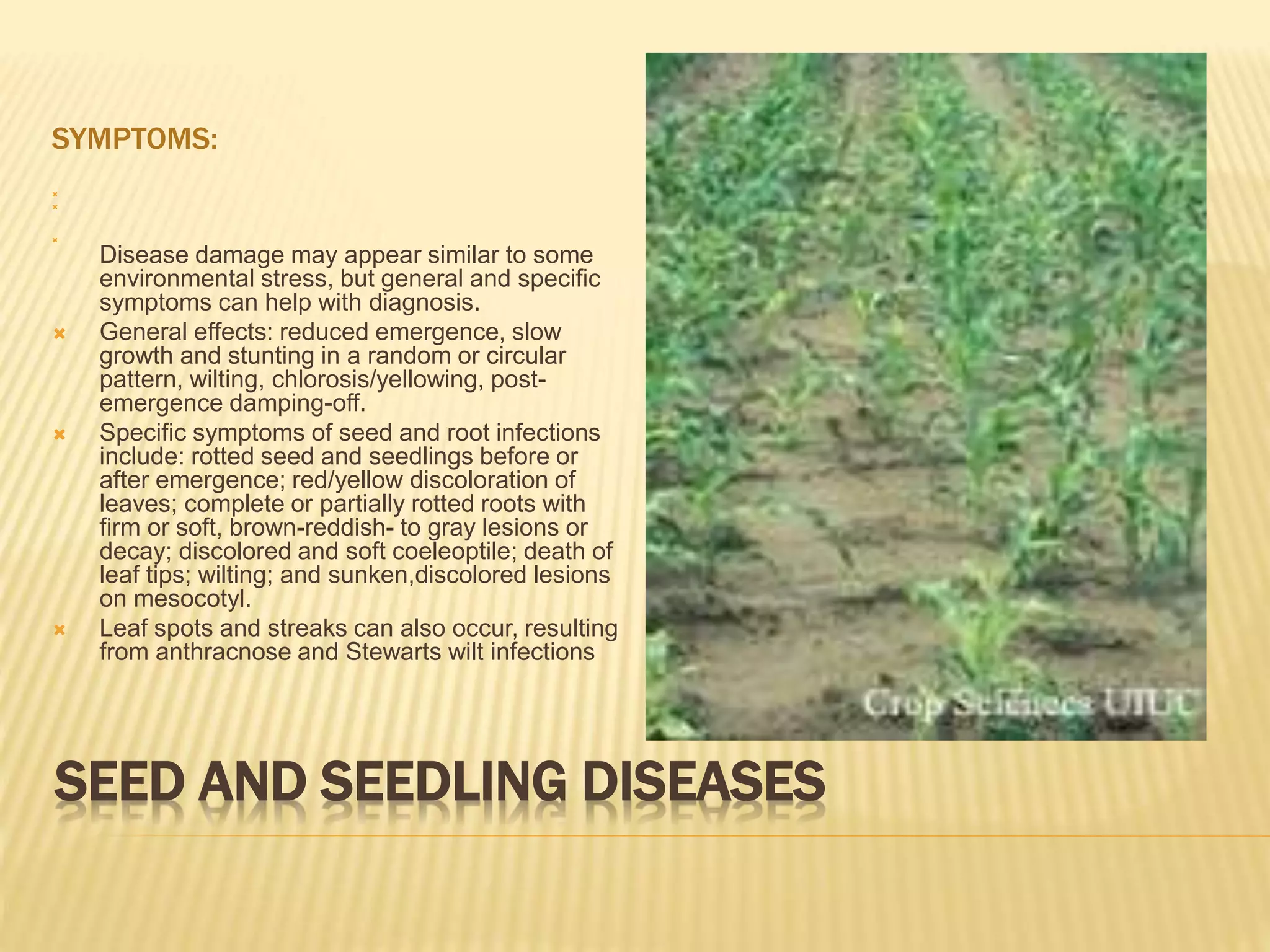
Disease damage may appear similar to some
environmental stress, but general and specific
symptoms can help with diagnosis.
 General effects: reduced emergence, slow
growth and stunting in a random or circular
pattern, wilting, chlorosis/yellowing, post-
emergence damping-off.
 Specific symptoms of seed and root infections
include: rotted seed and seedlings before or
after emergence; red/yellow discoloration of
leaves; complete or partially rotted roots with
firm or soft, brown-reddish- to gray lesions or
decay; discolored and soft coeleoptile; death of
leaf tips; wilting; and sunken,discolored lesions
on mesocotyl.
 Leaf spots and streaks can also occur, resulting
from anthracnose and Stewarts wilt infections
SEED AND SEEDLING DISEASES
PATHOGEN INVOLVED:· DISEASE MANAGEMENT:PLANT
 Some common genera of `fungal'
pathogens that cause one or more of
the symptoms noted above are
Stenocarpella (Diplodia), Pythium,
Rhizoctonia, Fusarium, Colletotrichum,
and Penicillium.
 Two bacterial pathogens that can
affect corn seedlings are Erwinia
[=Pantoea] (Stewart's Wilt) and
Pseudomonas (holcus spot).
 The source of these pathogens is soil,
infested residue remaining from
previous years crops, or infested seed.
 Nematodes can also damage corn
seedlings, especially in sandy soils.
 into soil greater than 50-55°F.
 Use seed treated with
fungicides. However, these
chemicals are most effective
for about 2 weeks after
planting depending on soil
water content and
temperature.
 The primary fungicidal seed
treatments used are of two
main groups
FUSARIUM STALK ROT
SYMPTOMS
 Similar to Diplodia and
Gibberella stalk rots
 Inner stalk will have a light
pink discoloration, but no
black specks (fungal fruiting
bodies) will be present in or
on the stalk
 Ears may be small and lower
nodes may be shredded or
break
 Eventually, the stalks may die
and lodge
FUSARIUM STALK ROT
PATHOGENS INVOLVED DISEASE MANAGEMENT
 Fusarium moniliforme, F.
proliferatum, and F.
subglutinans (a fungus)
 These fungi are found
wherever corn is grown
 Overwinters in crop residue
 Use hybrids that are
resistant to other stalk rot
diseases.
 Minimize all crop stresses
 Control insects
 Use proper plant population
BACTERIAL STALK ROT
SYMPTOMS
 Symptoms are similar to those
of Pythium stalk rot
 One or more of lowest
internodes will turn tan to
brown and become water
soaked, soft, or slimy and
there may be a foul odor
 Upper leaves wilt and a soft
rot can occur at the base of
the whorl, and this may
spread rapidly down the plant
and cause lodging
BACTERIAL STALK ROT
PATHOGEN INVOLVED DISEASE MANAGEMENT
 Erwinia chrysanthemi pv.
zeae (bacterium)
 Wide host range, including
monocots as well as dicots
 Infection sites are stomata,
hydathodes, or the wounds of
leaves or stalks
 Overwinters in stalk residue
on the soil surface line
 May be transmitted by larvae
of the maize borer
 Incorporate soil debris with
fall plowing
 Avoid flooding and
excessive overhead
irrigation
ANTHRACNOSE STALK ROT
SYMPTOMS
 Symptoms usually most apparent
just before crop maturity
 Uniform or blotchy, shiny, black
color on the outer stalk
 Inner stalk may also be black
and systemically infected, or may
not have any discoloration
 Several internodes of the plant
may be rotted and easily crushed
with finger pressure
 The plant above or below the ear
may die and lodging may result.
ANTHRACNOSE STALK ROT
PATHOGEN INVOLVED DISEASE MANAGEMENT
 Colletotrichum graminicola
(a fungus)
 It is the same that causes
the Anthracnose leaf blight
disease
 The only common stalk rot
pathogen that can cause a
leaf blight disease
 Overwinters in corn residue
 Use disease resistance
hybrids
 Maintain balanced fertility
 Reduce plant stress
 Control the corn borer
CHARCOAL ROT
SYMPTOMS
 Symptoms may first appear
similar to Fusarium,
Diplodia, & Gibberella stalk
rot
 A key sign of charcoal rot is
gray or black discoloration
in the inside the rind due to
the presence of many tiny,
black sclerotia (can be
seen with hand lens)
 Plant may die and lodge
CHARCOAL ROT
PATHOGEN INVOLVED DISEASE MANAGEMENT
 Macrophomina phaseolina
(a fungus)
 Has a very wide host range
that include sorghum and
soybean.
 Infects soybeans more
often than corn in the
Midwestern U.S.
 The pathogen overwinters
on host crop residue
 Use hybrids resistant to
Diplodia and Gibberella
stalk rot.
 Minimize early senescence
of stalk tissue
 Reduce moisture stress
DOWNY MILDEW OF MAIZE
SOUTHERN CORN LEAF BLIGHT
SYMPTOMS:
 Common lesions are
elongated, tan lesions
between veins on leaves
 Different isolates of this
pathogen will cause lesions of
different sizes
 Race O causes long, tan,
lesions that have brown
borders on leaves.
 Lesions will develop
differently on various inbreds
and hybrids
SOUTHERN CORN LEAF BLIGHT
PATHOGEN INVOLVED: DISEASE MANAGEMENT:
 Cochliobolus heterostrophus
(=Bipolaris maydis) (a fungus)
 Overwinters in corn residue
 Especially prevalent in areas with
a warm, humid climate
 Three races known of this
pathogen: race O, race T, and race
C
 Race T and race C are known to
be specifically virulent to corn with
cytoplasm male-sterile T and
cytoplasm male-sterile C,
respectively. Since the switch from
cytoplasm male sterile T to normal
cytoplasm corn, race T is not
considered to be a threat.
 Use of resistant hybrids
 Crop rotation
 Tillage may be helpful
Maize crop diseases A Lecture by Mr Allah Dad Khan

Maize crop diseases A Lecture by Mr Allah Dad Khan

  • 2.
    CORN CROP DISEASES APRESENTATION TO IPM COURSE/FFS PARTICIPANTS BY MR. ALLAH DAD KHAN PROVINCIAL COORDINATOR IPM KPK FOR MINFAL PAKISTAN
  • 4.
    SEED AND SEEDLINGDISEASES SYMPTOMS:    Disease damage may appear similar to some environmental stress, but general and specific symptoms can help with diagnosis.  General effects: reduced emergence, slow growth and stunting in a random or circular pattern, wilting, chlorosis/yellowing, post- emergence damping-off.  Specific symptoms of seed and root infections include: rotted seed and seedlings before or after emergence; red/yellow discoloration of leaves; complete or partially rotted roots with firm or soft, brown-reddish- to gray lesions or decay; discolored and soft coeleoptile; death of leaf tips; wilting; and sunken,discolored lesions on mesocotyl.  Leaf spots and streaks can also occur, resulting from anthracnose and Stewarts wilt infections
  • 5.
    SEED AND SEEDLINGDISEASES PATHOGEN INVOLVED:· DISEASE MANAGEMENT:PLANT  Some common genera of `fungal' pathogens that cause one or more of the symptoms noted above are Stenocarpella (Diplodia), Pythium, Rhizoctonia, Fusarium, Colletotrichum, and Penicillium.  Two bacterial pathogens that can affect corn seedlings are Erwinia [=Pantoea] (Stewart's Wilt) and Pseudomonas (holcus spot).  The source of these pathogens is soil, infested residue remaining from previous years crops, or infested seed.  Nematodes can also damage corn seedlings, especially in sandy soils.  into soil greater than 50-55°F.  Use seed treated with fungicides. However, these chemicals are most effective for about 2 weeks after planting depending on soil water content and temperature.  The primary fungicidal seed treatments used are of two main groups
  • 6.
    FUSARIUM STALK ROT SYMPTOMS Similar to Diplodia and Gibberella stalk rots  Inner stalk will have a light pink discoloration, but no black specks (fungal fruiting bodies) will be present in or on the stalk  Ears may be small and lower nodes may be shredded or break  Eventually, the stalks may die and lodge
  • 7.
    FUSARIUM STALK ROT PATHOGENSINVOLVED DISEASE MANAGEMENT  Fusarium moniliforme, F. proliferatum, and F. subglutinans (a fungus)  These fungi are found wherever corn is grown  Overwinters in crop residue  Use hybrids that are resistant to other stalk rot diseases.  Minimize all crop stresses  Control insects  Use proper plant population
  • 8.
    BACTERIAL STALK ROT SYMPTOMS Symptoms are similar to those of Pythium stalk rot  One or more of lowest internodes will turn tan to brown and become water soaked, soft, or slimy and there may be a foul odor  Upper leaves wilt and a soft rot can occur at the base of the whorl, and this may spread rapidly down the plant and cause lodging
  • 9.
    BACTERIAL STALK ROT PATHOGENINVOLVED DISEASE MANAGEMENT  Erwinia chrysanthemi pv. zeae (bacterium)  Wide host range, including monocots as well as dicots  Infection sites are stomata, hydathodes, or the wounds of leaves or stalks  Overwinters in stalk residue on the soil surface line  May be transmitted by larvae of the maize borer  Incorporate soil debris with fall plowing  Avoid flooding and excessive overhead irrigation
  • 10.
    ANTHRACNOSE STALK ROT SYMPTOMS Symptoms usually most apparent just before crop maturity  Uniform or blotchy, shiny, black color on the outer stalk  Inner stalk may also be black and systemically infected, or may not have any discoloration  Several internodes of the plant may be rotted and easily crushed with finger pressure  The plant above or below the ear may die and lodging may result.
  • 11.
    ANTHRACNOSE STALK ROT PATHOGENINVOLVED DISEASE MANAGEMENT  Colletotrichum graminicola (a fungus)  It is the same that causes the Anthracnose leaf blight disease  The only common stalk rot pathogen that can cause a leaf blight disease  Overwinters in corn residue  Use disease resistance hybrids  Maintain balanced fertility  Reduce plant stress  Control the corn borer
  • 12.
    CHARCOAL ROT SYMPTOMS  Symptomsmay first appear similar to Fusarium, Diplodia, & Gibberella stalk rot  A key sign of charcoal rot is gray or black discoloration in the inside the rind due to the presence of many tiny, black sclerotia (can be seen with hand lens)  Plant may die and lodge
  • 13.
    CHARCOAL ROT PATHOGEN INVOLVEDDISEASE MANAGEMENT  Macrophomina phaseolina (a fungus)  Has a very wide host range that include sorghum and soybean.  Infects soybeans more often than corn in the Midwestern U.S.  The pathogen overwinters on host crop residue  Use hybrids resistant to Diplodia and Gibberella stalk rot.  Minimize early senescence of stalk tissue  Reduce moisture stress
  • 15.
  • 17.
    SOUTHERN CORN LEAFBLIGHT SYMPTOMS:  Common lesions are elongated, tan lesions between veins on leaves  Different isolates of this pathogen will cause lesions of different sizes  Race O causes long, tan, lesions that have brown borders on leaves.  Lesions will develop differently on various inbreds and hybrids
  • 18.
    SOUTHERN CORN LEAFBLIGHT PATHOGEN INVOLVED: DISEASE MANAGEMENT:  Cochliobolus heterostrophus (=Bipolaris maydis) (a fungus)  Overwinters in corn residue  Especially prevalent in areas with a warm, humid climate  Three races known of this pathogen: race O, race T, and race C  Race T and race C are known to be specifically virulent to corn with cytoplasm male-sterile T and cytoplasm male-sterile C, respectively. Since the switch from cytoplasm male sterile T to normal cytoplasm corn, race T is not considered to be a threat.  Use of resistant hybrids  Crop rotation  Tillage may be helpful