Prepared By: Hardeep Singh
MANAGEMENT
INFORMATION
SYSTEM
Prepared By: Hardeep Singh
Definition
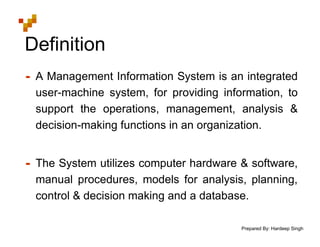
• A Management Information System is an integrated
user-machine system, for providing information, to
support the operations, management, analysis &
decision-making functions in an organization.
• The System utilizes computer hardware & software,
manual procedures, models for analysis, planning,
control & decision making and a database.
Prepared By: Hardeep Singh
MIS
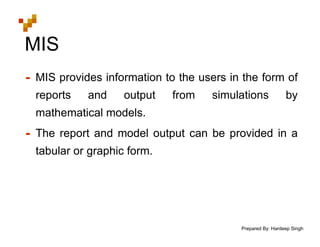
• MIS provides information to the users in the form of
reports and output from simulations by
mathematical models.
• The report and model output can be provided in a
tabular or graphic form.
Prepared By: Hardeep Singh
Management Reporting Alternatives
• MIS provide a variety of information products
to managers which includes 3 reporting
alternatives:
O Periodic Scheduled Reports
O Exception Reports
O Demand Reports and Responses
Prepared By: Hardeep Singh
Management Reporting Alternatives
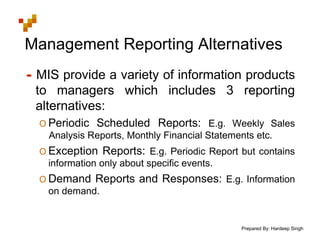
• MIS provide a variety of information products
to managers which includes 3 reporting
alternatives:
O Periodic Scheduled Reports: E.g. Weekly Sales
Analysis Reports, Monthly Financial Statements etc.
O Exception Reports: E.g. Periodic Report but contains
information only about specific events.
O Demand Reports and Responses: E.g. Information
on demand.
Prepared By: Hardeep Singh
MIS Model
Organizational
Problem
Solvers
Report
Writing
Software
Mathematical
Models
MIS
Database
Data Information
Environment
Prepared By: Hardeep Singh
MIS Model…
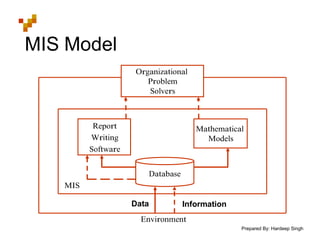
• Both data and information are entered from the
environment.
• Database contains the data provided by the subsystem.
• The database contents are used by software that produces
periodic and special reports as well as mathematical models
that simulate various aspects of the firm’s operations.
• The software outputs are used by persons who are
responsible for solving the firm’s problems.
Prepared By: Hardeep Singh
COMPONENTS OF MIS
INPUT
DATA TO
BE
ARRANGED
PROCESSOR
CLASSIFY,
SORT,
SUMMARIZE,
CALCULATE
OUTPUT
ARRANGED
DATA
(Information)
INFORMATION
SLICED TO
MANAGEMENT
SYSTEMS
Prepared By: Hardeep Singh
Process
Net contribution of many
individual processes
in the MIS design.
Conversion of Inputs into Outputs
Prepared By: Hardeep Singh
Inputs
• Sales in units by each salesman for a
period.
• Estimated sales in units of competitors.
• Economic conditions & trends.
Prepared By: Hardeep Singh
Outputs
• Sale by Product
• Sales by Salesman
• Sales by Region, Salesman & Products.
• Sales Trend Analysis
• Sales Forecasts
Prepared By: Hardeep Singh
MIS Characteristics
• Management Oriented/directed
• Business Driven
• Integrated
• Common Data Flows
• Heavy Planning Element
• Subsystem Concept
• Flexibility & Ease of Use
• Database
• Distributed Systems
• Information as a Resource
Prepared By: Hardeep Singh
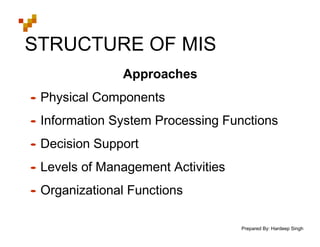
STRUCTURE OF MIS
Approaches
• Physical Components
• Information System Processing Functions
• Decision Support
• Levels of Management Activities
• Organizational Functions
Prepared By: Hardeep Singh
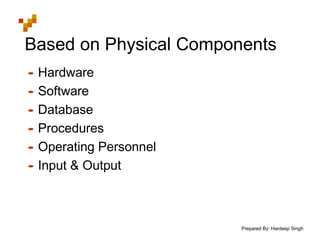
Based on Physical Components
• Hardware
• Software
• Database
• Procedures
• Operating Personnel
• Input & Output
Prepared By: Hardeep Singh
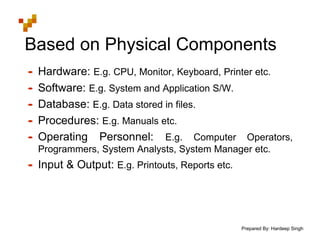
Based on Physical Components
• Hardware: E.g. CPU, Monitor, Keyboard, Printer etc.
• Software: E.g. System and Application S/W.
• Database: E.g. Data stored in files.
• Procedures: E.g. Manuals etc.
• Operating Personnel: E.g. Computer Operators,
Programmers, System Analysts, System Manager etc.
• Input & Output: E.g. Printouts, Reports etc.
Prepared By: Hardeep Singh
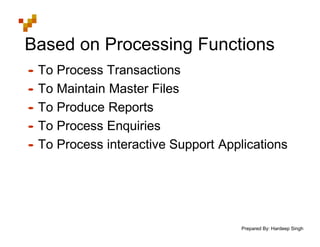
Based on Processing Functions
• To Process Transactions
• To Maintain Master Files
• To Produce Reports
• To Process Enquiries
• To Process interactive Support Applications
Prepared By: Hardeep Singh
Based on Processing Functions
• To Process Transactions: E.g. Making a purchase or a
sale of a product.
• To Maintain Master Files: E.g. For preparing an
employee’s salary, required data items are Basic Pay,
Allowances, Deductions etc.
• To Produce Reports: For e.g. Specific or Adhoc reports
• To Process Enquiries: For e.g. Regular or Adhoc
enquiry.
• To Process interactive Support Applications: E.g.
Applications designed for planning, analysis and decision
making.
Prepared By: Hardeep Singh
Based on Output For Users
• Transaction Documents or Screens
• Preplanned Reports
• Preplanned Inquiry Responses
• Adhoc Reports & Inquiry Responses
• User-machine Dialog Results
Prepared By: Hardeep Singh
MIS Support for Decision Making
• Structured / Programmable Decisions
• Unstructured / Non-Programmable Decisions
• Semi-Structured Decisions
Prepared By: Hardeep Singh
MIS Support for Decision Making
• Structured / Programmable Decisions:
O Decisions that are repetitive, routine and have a definite
procedure for handling them.
O For e.g. Inventory reorder formula, Rules for granting
Credit.
• Unstructured / Non-Programmable Decisions:
O Non-routine decision in which the decision maker must
provide judgment, evaluation, and insights into the
problem definition.
O For e.g.
• Semi-Structured Decisions:
O Decision where only part of the problem has a clear cut
answer provided by an accepted procedure.
Prepared By: Hardeep Singh
Based on Management Activities
LEVEL COMMENTS
Strategic Planning
Management Control &
Tactical Planning
Operational Planning &
Control
Deals with long range considerations.
Definitions of Goals, Policies & General
Guidelines Charting Course for Organization.
Determination of Organizational Objectives
It has medium term planning horizon.
Acquisition of resources, Acquisition Tactics,
Plant Location, New Products.
Establishment & Monitoring of Budgets
It is related to short-term decisions for current
operations. Effective & efficient use of existing
facilities & resources to carry out activities within
budget constraints
Prepared By: Hardeep Singh
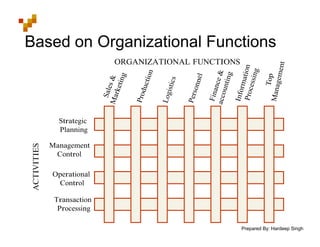
Based on Organizational Functions
ACTIVITIES
ORGANIZATIONAL FUNCTIONS
Strategic
Planning
Management
Control
Operational
Control
Transaction
Processing
Prepared By: Hardeep Singh
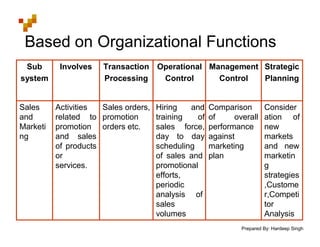
Based on Organizational Functions
Sub
system
Involves Transaction
Processing
Operational
Control
Management
Control
Strategic
Planning
Sales
and
Marketi
ng
Activities
related to
promotion
and sales
of products
or
services.
Sales orders,
promotion
orders etc.
Hiring and
training of
sales force,
day to day
scheduling
of sales and
promotional
efforts,
periodic
analysis of
sales
volumes
Comparison
of overall
performance
against
marketing
plan
Consider
ation of
new
markets
and new
marketin
g
strategies
,Custome
r,Competi
tor
Analysis
Prepared By: Hardeep Singh
EDP and MIS
• EDP:
O These systems process mostly clerical and supervisory
type of applications related to record keeping, processing
of large volume of data and generation of authentic and
accurate reports for operational management.
O These systems offer cost reduction by saving upon
manpower and time resource.
O These serve as information source to operational
management and assist in operational control and
planning.
O Application Uses: Payroll, Inventory control, Production,
Costing, Purchase and Logistics.
Prepared By: Hardeep Singh
An Example
• A typical EDP application for ledger accounting that
consists of modules for data storage of account
vouchers and generation of accounting reports
such as ledgers, trial balance, profit & loss account
etc. The primary objective of the application is book
keeping.
• The motive of this application is to ease the clerical
functions and assist in operational control.
Prepared By: Hardeep Singh
EDP/MIS/DSS
• EDP was first applied to the lower operational
levels of the organization to automate the
paperwork.
• Characteristics:
O A focus on data, storage, processing and flows at the
operational level.
O Efficient transaction processing.
O Scheduled and optimized computer runs.
O Integrated files for related jobs.
O Summary reports for management.
O EDP level of activity in many firms has become an
efficient facility for transaction processing.
Prepared By: Hardeep Singh
EDP/MIS/DSS…
• MIS:
O An information focus, which is aimed at middle
managers.
O A structured information flow.
O Integration of EDP by business functions.
O Inquiry and report generation with a database.
O When controls are incorporated in an EDP application,
then these are upgraded to MIS applications.
Prepared By: Hardeep Singh
EDP/MIS/DSS…
• DSS:
O It is focused higher in the organization with an
emphasis on the following characteristics:
• Decision focused
• Aimed at top managers and executive decision
makers.
• Emphasis on flexibility, adaptability and quick
response.
• User initiated and controlled.
• Support for the personal decision making styles of
individual managers.
Prepared By: Hardeep Singh
Pitfalls in MIS Development
• Organization does not have a reliable management system
• Organization has not defined its mission clearly
• Organization’s objectives have not been specified
• Management lacks interest in MIS development process &
relies solely on MIS development’s specification.
• Communication gap exists between MIS development team
and the management
• MIS development team is incompetent
Prepared By: Hardeep Singh
MIS AS A COMPETITIVE ADVANTAGE
• Barriers to Entry
• Distribution Channels
• Switching Costs
• Lower Production Costs
• Product Differentiation
• Quality Management
• The Value Chain

Management information system

  • 1.
    Prepared By: HardeepSingh MANAGEMENT INFORMATION SYSTEM
  • 2.
    Prepared By: HardeepSingh Definition • A Management Information System is an integrated user-machine system, for providing information, to support the operations, management, analysis & decision-making functions in an organization. • The System utilizes computer hardware & software, manual procedures, models for analysis, planning, control & decision making and a database.
  • 3.
    Prepared By: HardeepSingh MIS • MIS provides information to the users in the form of reports and output from simulations by mathematical models. • The report and model output can be provided in a tabular or graphic form.
  • 4.
    Prepared By: HardeepSingh Management Reporting Alternatives • MIS provide a variety of information products to managers which includes 3 reporting alternatives: O Periodic Scheduled Reports O Exception Reports O Demand Reports and Responses
  • 5.
    Prepared By: HardeepSingh Management Reporting Alternatives • MIS provide a variety of information products to managers which includes 3 reporting alternatives: O Periodic Scheduled Reports: E.g. Weekly Sales Analysis Reports, Monthly Financial Statements etc. O Exception Reports: E.g. Periodic Report but contains information only about specific events. O Demand Reports and Responses: E.g. Information on demand.
  • 6.
    Prepared By: HardeepSingh MIS Model Organizational Problem Solvers Report Writing Software Mathematical Models MIS Database Data Information Environment
  • 7.
    Prepared By: HardeepSingh MIS Model… • Both data and information are entered from the environment. • Database contains the data provided by the subsystem. • The database contents are used by software that produces periodic and special reports as well as mathematical models that simulate various aspects of the firm’s operations. • The software outputs are used by persons who are responsible for solving the firm’s problems.
  • 8.
    Prepared By: HardeepSingh COMPONENTS OF MIS INPUT DATA TO BE ARRANGED PROCESSOR CLASSIFY, SORT, SUMMARIZE, CALCULATE OUTPUT ARRANGED DATA (Information) INFORMATION SLICED TO MANAGEMENT SYSTEMS
  • 9.
    Prepared By: HardeepSingh Process Net contribution of many individual processes in the MIS design. Conversion of Inputs into Outputs
  • 10.
    Prepared By: HardeepSingh Inputs • Sales in units by each salesman for a period. • Estimated sales in units of competitors. • Economic conditions & trends.
  • 11.
    Prepared By: HardeepSingh Outputs • Sale by Product • Sales by Salesman • Sales by Region, Salesman & Products. • Sales Trend Analysis • Sales Forecasts
  • 12.
    Prepared By: HardeepSingh MIS Characteristics • Management Oriented/directed • Business Driven • Integrated • Common Data Flows • Heavy Planning Element • Subsystem Concept • Flexibility & Ease of Use • Database • Distributed Systems • Information as a Resource
  • 13.
    Prepared By: HardeepSingh STRUCTURE OF MIS Approaches • Physical Components • Information System Processing Functions • Decision Support • Levels of Management Activities • Organizational Functions
  • 14.
    Prepared By: HardeepSingh Based on Physical Components • Hardware • Software • Database • Procedures • Operating Personnel • Input & Output
  • 15.
    Prepared By: HardeepSingh Based on Physical Components • Hardware: E.g. CPU, Monitor, Keyboard, Printer etc. • Software: E.g. System and Application S/W. • Database: E.g. Data stored in files. • Procedures: E.g. Manuals etc. • Operating Personnel: E.g. Computer Operators, Programmers, System Analysts, System Manager etc. • Input & Output: E.g. Printouts, Reports etc.
  • 16.
    Prepared By: HardeepSingh Based on Processing Functions • To Process Transactions • To Maintain Master Files • To Produce Reports • To Process Enquiries • To Process interactive Support Applications
  • 17.
    Prepared By: HardeepSingh Based on Processing Functions • To Process Transactions: E.g. Making a purchase or a sale of a product. • To Maintain Master Files: E.g. For preparing an employee’s salary, required data items are Basic Pay, Allowances, Deductions etc. • To Produce Reports: For e.g. Specific or Adhoc reports • To Process Enquiries: For e.g. Regular or Adhoc enquiry. • To Process interactive Support Applications: E.g. Applications designed for planning, analysis and decision making.
  • 18.
    Prepared By: HardeepSingh Based on Output For Users • Transaction Documents or Screens • Preplanned Reports • Preplanned Inquiry Responses • Adhoc Reports & Inquiry Responses • User-machine Dialog Results
  • 19.
    Prepared By: HardeepSingh MIS Support for Decision Making • Structured / Programmable Decisions • Unstructured / Non-Programmable Decisions • Semi-Structured Decisions
  • 20.
    Prepared By: HardeepSingh MIS Support for Decision Making • Structured / Programmable Decisions: O Decisions that are repetitive, routine and have a definite procedure for handling them. O For e.g. Inventory reorder formula, Rules for granting Credit. • Unstructured / Non-Programmable Decisions: O Non-routine decision in which the decision maker must provide judgment, evaluation, and insights into the problem definition. O For e.g. • Semi-Structured Decisions: O Decision where only part of the problem has a clear cut answer provided by an accepted procedure.
  • 21.
    Prepared By: HardeepSingh Based on Management Activities LEVEL COMMENTS Strategic Planning Management Control & Tactical Planning Operational Planning & Control Deals with long range considerations. Definitions of Goals, Policies & General Guidelines Charting Course for Organization. Determination of Organizational Objectives It has medium term planning horizon. Acquisition of resources, Acquisition Tactics, Plant Location, New Products. Establishment & Monitoring of Budgets It is related to short-term decisions for current operations. Effective & efficient use of existing facilities & resources to carry out activities within budget constraints
  • 22.
    Prepared By: HardeepSingh Based on Organizational Functions ACTIVITIES ORGANIZATIONAL FUNCTIONS Strategic Planning Management Control Operational Control Transaction Processing
  • 23.
    Prepared By: HardeepSingh Based on Organizational Functions Sub system Involves Transaction Processing Operational Control Management Control Strategic Planning Sales and Marketi ng Activities related to promotion and sales of products or services. Sales orders, promotion orders etc. Hiring and training of sales force, day to day scheduling of sales and promotional efforts, periodic analysis of sales volumes Comparison of overall performance against marketing plan Consider ation of new markets and new marketin g strategies ,Custome r,Competi tor Analysis
  • 24.
    Prepared By: HardeepSingh EDP and MIS • EDP: O These systems process mostly clerical and supervisory type of applications related to record keeping, processing of large volume of data and generation of authentic and accurate reports for operational management. O These systems offer cost reduction by saving upon manpower and time resource. O These serve as information source to operational management and assist in operational control and planning. O Application Uses: Payroll, Inventory control, Production, Costing, Purchase and Logistics.
  • 25.
    Prepared By: HardeepSingh An Example • A typical EDP application for ledger accounting that consists of modules for data storage of account vouchers and generation of accounting reports such as ledgers, trial balance, profit & loss account etc. The primary objective of the application is book keeping. • The motive of this application is to ease the clerical functions and assist in operational control.
  • 26.
    Prepared By: HardeepSingh EDP/MIS/DSS • EDP was first applied to the lower operational levels of the organization to automate the paperwork. • Characteristics: O A focus on data, storage, processing and flows at the operational level. O Efficient transaction processing. O Scheduled and optimized computer runs. O Integrated files for related jobs. O Summary reports for management. O EDP level of activity in many firms has become an efficient facility for transaction processing.
  • 27.
    Prepared By: HardeepSingh EDP/MIS/DSS… • MIS: O An information focus, which is aimed at middle managers. O A structured information flow. O Integration of EDP by business functions. O Inquiry and report generation with a database. O When controls are incorporated in an EDP application, then these are upgraded to MIS applications.
  • 28.
    Prepared By: HardeepSingh EDP/MIS/DSS… • DSS: O It is focused higher in the organization with an emphasis on the following characteristics: • Decision focused • Aimed at top managers and executive decision makers. • Emphasis on flexibility, adaptability and quick response. • User initiated and controlled. • Support for the personal decision making styles of individual managers.
  • 29.
    Prepared By: HardeepSingh Pitfalls in MIS Development • Organization does not have a reliable management system • Organization has not defined its mission clearly • Organization’s objectives have not been specified • Management lacks interest in MIS development process & relies solely on MIS development’s specification. • Communication gap exists between MIS development team and the management • MIS development team is incompetent
  • 30.
    Prepared By: HardeepSingh MIS AS A COMPETITIVE ADVANTAGE • Barriers to Entry • Distribution Channels • Switching Costs • Lower Production Costs • Product Differentiation • Quality Management • The Value Chain