INFORMATION SYSTEM
MANAGEMENT
What is MIS ?
Management Information System is a computer based
information system which is basically concerned with processing
data into information which is then communicated to the
various departments in an organization to support the
operations, the management and the decision making function
in the organization.
MANAGEMENT
⬥ MANAGEMENT is the effective utilization of human and
material resources to achieve the enterprise objective.
⬥ It is a process consisting of the five basic functions:
1. Planning
2. Organising
3. Staffing
4. Directing
5. Controlling
3
INFORMATION
⬥ Information: Information, in MIS, means the processed data
that helps the management in planning, controlling and
operations.
⬥ Data means unstructured raw facts, observations or
unevaluated messages in isolation. Data involves facts and
figures.
⬥ Information on the other hand is like a finished product.
4
SYSTEM
⬥ A system is an orderly grouping of interdependent
components linked together according to a plan to achieve a
specific objective.
⬥ Human body is a system composed of various parts, which are
working together towards a common objective , that is to live.
5
6
INFORMATION SYSTEM
⬥ An information system is an organized
combination of people, hardware, software,
communications network, and data resources
that collects, transforms, and disseminates in an
organization.
7
CHARACTERISTICS OF MIS
⬥ System Approach
⬥ Management Oriented
⬥ Management Directed
⬥ Need Based
⬥ Future Oriented
⬥ Integrated
8
CHARACTERISTICS OF MIS
⬥ Common Data Flows
⬥ Strategic Planning
⬥ Heavy planning element
⬥ Computerized
⬥ User friendly
9
ROLE OF MIS IN BUSINESS ORGANISATION
⬥ MIS provides accurate, relevant and validated
information to all the departments in the
organisation.
⬥ MIS converts data form internal and external
sources to information.
⬥ This information is used for making effective
decisions
10
DESIGN AND DEVELOPMENT OF MIS
1. Identify the information needs at all levels of
management
2. List the objectives of MIS and anticipated
benefits.
3. Identify the system constraints(internal and
external).
4. Determine the information needs and
resources.
11
5. Develop the alternative conceptual design and
selecting one.
6. Preparing the conceptual design report.
12
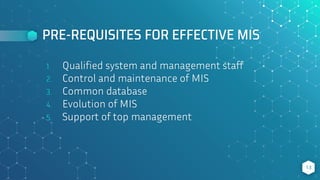
PRE-REQUISITES FOR EFFECTIVE MIS
1. Qualified system and management staff
2. Control and maintenance of MIS
3. Common database
4. Evolution of MIS
5. Support of top management
13
COMPONENTS OF MIS
⬥ People
⬥ Business Procedures
⬥ Data
⬥ Hardware
⬥ Software
14
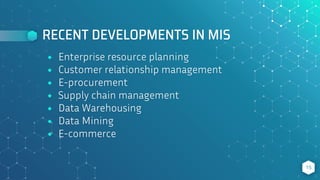
RECENT DEVELOPMENTS IN MIS
⬥ Enterprise resource planning
⬥ Customer relationship management
⬥ E-procurement
⬥ Supply chain management
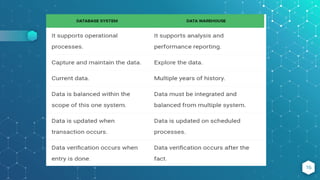
⬥ Data Warehousing
⬥ Data Mining
⬥ E-commerce
15
16
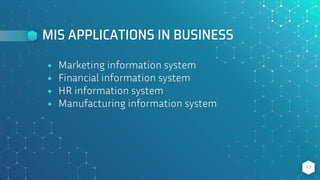
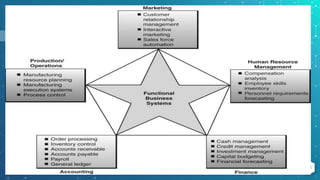
MIS APPLICATIONS IN BUSINESS
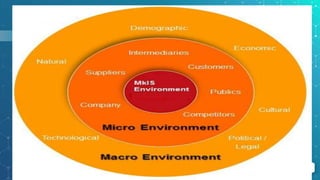
⬥ Marketing information system
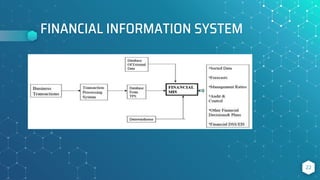
⬥ Financial information system
⬥ HR information system
⬥ Manufacturing information system
17
18
⬥ CRM
⬥ SCM
⬥ ERP
19
20
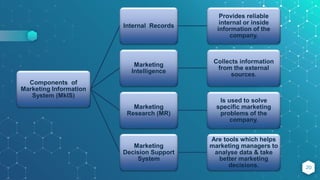
Components of
Marketing Information
System (MkIS)
Internal Records
Provides reliable
internal or inside
information of the
company.
Marketing
Intelligence
Collects information
from the external
sources.
Marketing
Research (MR)
Is used to solve
specific marketing
problems of the
company.
Marketing
Decision Support
System
Are tools which helps
marketing managers to
analyse data & take
better marketing
decisions.
21
FINANCIAL INFORMATION SYSTEM
22
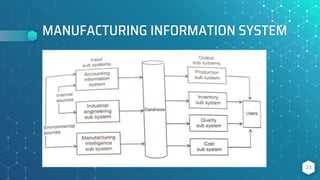
MANUFACTURING INFORMATION SYSTEM
23
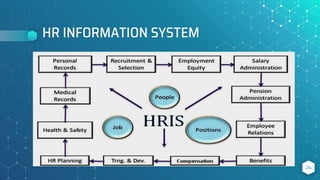
HR INFORMATION SYSTEM
24
25
26
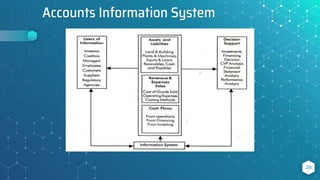
Accounts Information System
27
Accounts Information System
28
INFORMATION RELATED
CONCEPTS
“
30
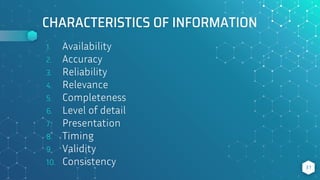
CHARACTERISTICS OF INFORMATION
1. Availability
2. Accuracy
3. Reliability
4. Relevance
5. Completeness
6. Level of detail
7. Presentation
8. Timing
9. Validity
10. Consistency 31
DATA Vs INFORMATION
32
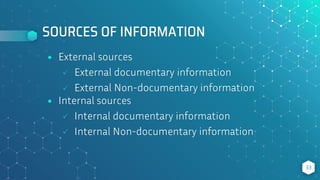
SOURCES OF INFORMATION
⬥ External sources
 External documentary information
 External Non-documentary information
⬥ Internal sources
 Internal documentary information
 Internal Non-documentary information
33
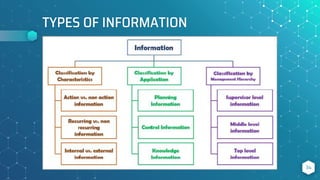
TYPES OF INFORMATION
34
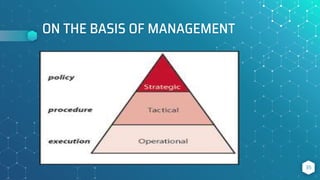
ON THE BASIS OF MANAGEMENT
35
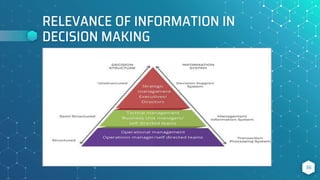
RELEVANCE OF INFORMATION IN
DECISION MAKING
36
SIMON’S DECSION MODEL
37
⬥ Intelligence which deals with the problem
identification and the data collection on the
problem.
⬥ Design which deals with the generation of
alternative solutions to the problem at hand.
⬥ Choice which is selecting the 'best' solution
from amongst the alternative solutions using
some criterion.
38
⬥ Q1. Define MIS and its Concept with label
diagram.
⬥ Q2. Define functions of MIS.
⬥ Q3. Discuss relevance of Information different
level of Management for decision making. Also
discuss types of decision at different level of
management for decision making.
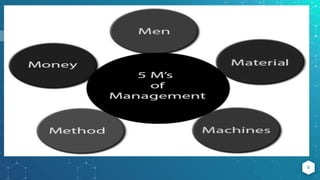
⬥ Q4. Compare component of MIS with 5 M's of
Management.
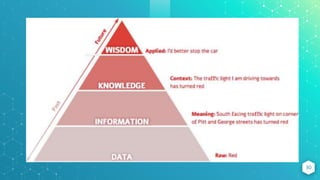
⬥ Q5. Discuss Data, Information, Knowledge and
Wisdom. 39

Theory Information System Management BBA

  • 1.
  • 2.
    What is MIS? Management Information System is a computer based information system which is basically concerned with processing data into information which is then communicated to the various departments in an organization to support the operations, the management and the decision making function in the organization.
  • 3.
    MANAGEMENT ⬥ MANAGEMENT isthe effective utilization of human and material resources to achieve the enterprise objective. ⬥ It is a process consisting of the five basic functions: 1. Planning 2. Organising 3. Staffing 4. Directing 5. Controlling 3
  • 4.
    INFORMATION ⬥ Information: Information,in MIS, means the processed data that helps the management in planning, controlling and operations. ⬥ Data means unstructured raw facts, observations or unevaluated messages in isolation. Data involves facts and figures. ⬥ Information on the other hand is like a finished product. 4
  • 5.
    SYSTEM ⬥ A systemis an orderly grouping of interdependent components linked together according to a plan to achieve a specific objective. ⬥ Human body is a system composed of various parts, which are working together towards a common objective , that is to live. 5
  • 6.
  • 7.
    INFORMATION SYSTEM ⬥ Aninformation system is an organized combination of people, hardware, software, communications network, and data resources that collects, transforms, and disseminates in an organization. 7
  • 8.
    CHARACTERISTICS OF MIS ⬥System Approach ⬥ Management Oriented ⬥ Management Directed ⬥ Need Based ⬥ Future Oriented ⬥ Integrated 8
  • 9.
    CHARACTERISTICS OF MIS ⬥Common Data Flows ⬥ Strategic Planning ⬥ Heavy planning element ⬥ Computerized ⬥ User friendly 9
  • 10.
    ROLE OF MISIN BUSINESS ORGANISATION ⬥ MIS provides accurate, relevant and validated information to all the departments in the organisation. ⬥ MIS converts data form internal and external sources to information. ⬥ This information is used for making effective decisions 10
  • 11.
    DESIGN AND DEVELOPMENTOF MIS 1. Identify the information needs at all levels of management 2. List the objectives of MIS and anticipated benefits. 3. Identify the system constraints(internal and external). 4. Determine the information needs and resources. 11
  • 12.
    5. Develop thealternative conceptual design and selecting one. 6. Preparing the conceptual design report. 12
  • 13.
    PRE-REQUISITES FOR EFFECTIVEMIS 1. Qualified system and management staff 2. Control and maintenance of MIS 3. Common database 4. Evolution of MIS 5. Support of top management 13
  • 14.
    COMPONENTS OF MIS ⬥People ⬥ Business Procedures ⬥ Data ⬥ Hardware ⬥ Software 14
  • 15.
    RECENT DEVELOPMENTS INMIS ⬥ Enterprise resource planning ⬥ Customer relationship management ⬥ E-procurement ⬥ Supply chain management ⬥ Data Warehousing ⬥ Data Mining ⬥ E-commerce 15
  • 16.
  • 17.
    MIS APPLICATIONS INBUSINESS ⬥ Marketing information system ⬥ Financial information system ⬥ HR information system ⬥ Manufacturing information system 17
  • 18.
  • 19.
  • 20.
    20 Components of Marketing Information System(MkIS) Internal Records Provides reliable internal or inside information of the company. Marketing Intelligence Collects information from the external sources. Marketing Research (MR) Is used to solve specific marketing problems of the company. Marketing Decision Support System Are tools which helps marketing managers to analyse data & take better marketing decisions.
  • 21.
  • 22.
  • 23.
  • 24.
  • 25.
  • 26.
  • 27.
  • 28.
  • 29.
  • 30.
  • 31.
    CHARACTERISTICS OF INFORMATION 1.Availability 2. Accuracy 3. Reliability 4. Relevance 5. Completeness 6. Level of detail 7. Presentation 8. Timing 9. Validity 10. Consistency 31
  • 32.
  • 33.
    SOURCES OF INFORMATION ⬥External sources  External documentary information  External Non-documentary information ⬥ Internal sources  Internal documentary information  Internal Non-documentary information 33
  • 34.
  • 35.
    ON THE BASISOF MANAGEMENT 35
  • 36.
    RELEVANCE OF INFORMATIONIN DECISION MAKING 36
  • 37.
  • 38.
    ⬥ Intelligence whichdeals with the problem identification and the data collection on the problem. ⬥ Design which deals with the generation of alternative solutions to the problem at hand. ⬥ Choice which is selecting the 'best' solution from amongst the alternative solutions using some criterion. 38
  • 39.
    ⬥ Q1. DefineMIS and its Concept with label diagram. ⬥ Q2. Define functions of MIS. ⬥ Q3. Discuss relevance of Information different level of Management for decision making. Also discuss types of decision at different level of management for decision making. ⬥ Q4. Compare component of MIS with 5 M's of Management. ⬥ Q5. Discuss Data, Information, Knowledge and Wisdom. 39