STROKE
Joginder Singh
Radiological Technologist
Department of Radiodiagnosis and imaging
PGIMER, CHANDIGARH
 Definition
 Stroke Symptoms
 Risk factors
 Classification of stroke
 Investigations
 Stroke treatment
 How to prevent stroke
Outline
Also called: CVA, cerebrovascular accident
What is a stroke?
A stroke occurs when a blood
vessel in the brain ruptures
and bleeds, or when there’s a
blockage in the blood supply
to the brain.
The rupture or blockage
prevents blood and oxygen
from reaching the brain’s
tissues.
 The loss of blood flow to the brain damages tissues
within the brain.
 Symptoms of a stroke show up in the body parts
controlled by the damaged areas of the brain.
 The sooner a person having a stroke gets care, the
better their outcome is likely to be. For this reason,
it’s helpful to know the signs of a stroke so you can
act quickly.
Stroke symptoms
 A stroke requires immediate medical attention. If you
think you or someone else is having a stroke, call 911
or local emergency services right away. Prompt
treatment is key to preventing the following outcomes:
 Brain damage
 Long-term disability
 Death
 It’s better to be overly cautious when dealing with a
stroke, so don’t be afraid to get emergency medical
help if you think you recognize the signs of a stroke.
CONTI.. PGI HELPLINE CONTACT NO
+917087009500
 Diet
 An unbalanced diet can
increase the risk of stroke.
This type of diet is high in:
 salt
 saturated fats
 trans fats
 cholesterol
Risk factors for stroke
Inactivity
Inactivity, or lack of exercise,
can also raise the risk of stroke.
 Heavy alcohol use
 The risk of stroke also increases with heavy alcohol use.
 Heavy alcohol use can raise blood pressure levels. It can also
raise triglyceride levels, which can cause atherosclerosis. This is
plaque buildup in the arteries that narrows blood vessels.
Tobacco use
 Using tobacco in any form also raises the risk of stroke,
since it can damage the blood vessels and heart.
 Nicotine also raises blood pressure.
CONTI..
Blood tests
Blood tests can determine:
Blood sugar levels
whether patient have an
infection
Platelet counts
how fast blood clots
Cholesterol levels
An ECG can determine heart
conditions that may have led to
a stroke, such as a prior heart
attack or atrial fibrillation.
Investigation
NEURO IMAGING
 Computed tomography (CT) of
the head:
 NCCT of the head done to detect
a stroke from a blood clot or
bleeding within the brain.
 To improve the detection and
characterization of stroke, CT
angiography (CTA) may be
performed.
 Images that detect blood flow,
called CT perfusion (CTP), may be
obtained at the same time.
 The combination of CT, CTA and
CTP can help physicians decide on
the best therapy for a patient
experiencing a stroke.
 Diffusion MRI is more useful
than a CT scan for diagnosing
acute ischemic stroke within
12 hours of a person’s first
stroke symptom. In a large
study review, it was found
that ischemic stroke was
accurately detected 83% of the
time by MRI versus 26% of
the time by CT.
MRI
Classification
of Stroke
Stroke
Primary Ischemic
(80% of strokes)
Primary hemorrhagic
(20% of strokes)
Thrombotic (50%) Embolic (30%)
Subarachnoid
hemorrhage (5%)
Intra Cerebral
hemorrhage (15%)
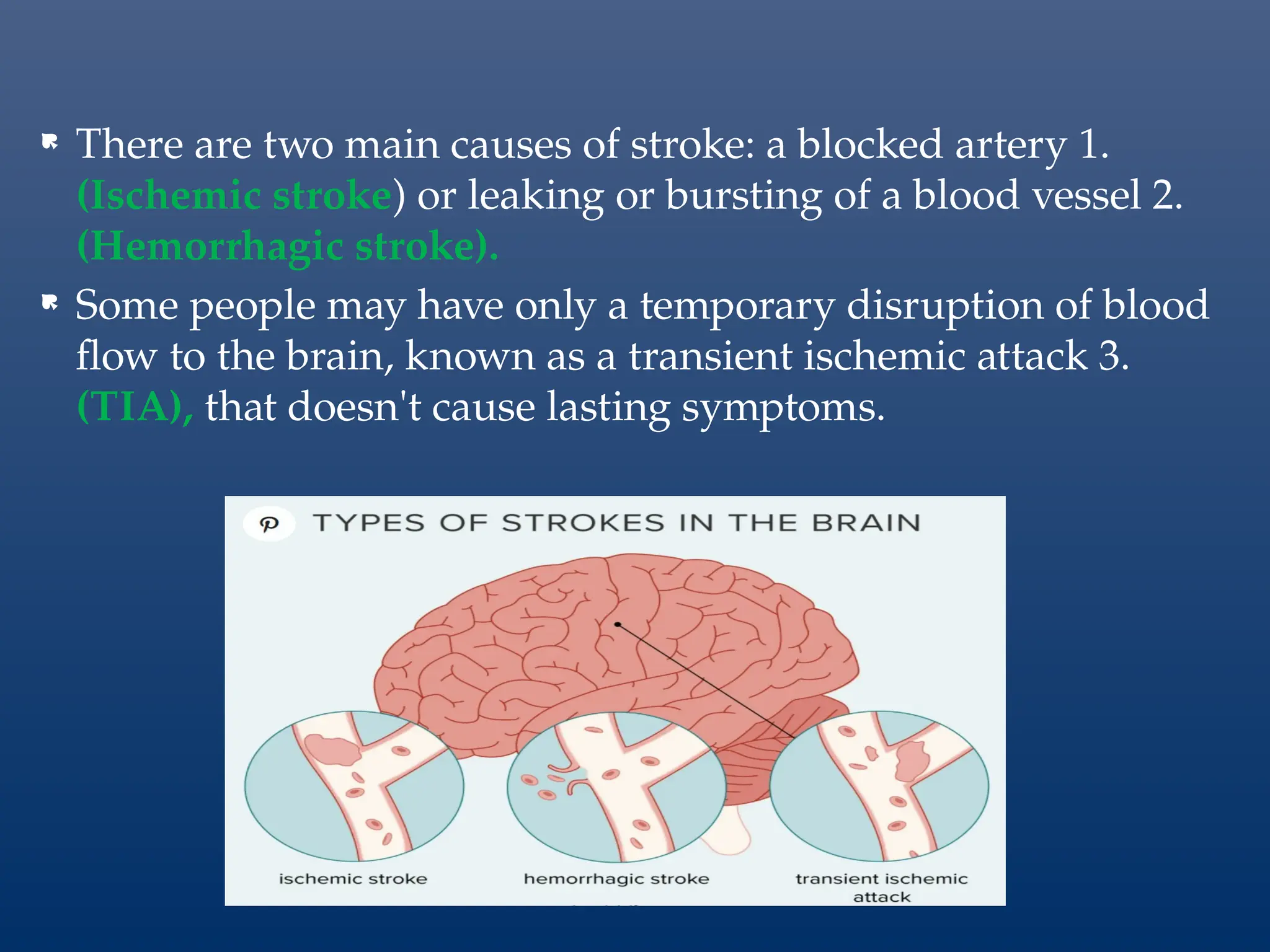
 There are two main causes of stroke: a blocked artery 1.
(Ischemic stroke) or leaking or bursting of a blood vessel 2.
(Hemorrhagic stroke).
 Some people may have only a temporary disruption of blood
flow to the brain, known as a transient ischemic attack 3.
(TIA), that doesn't cause lasting symptoms.
 This is the most common type of stroke.
 It happens when the brain's blood
vessels become narrowed or blocked,
causing severely reduced blood flow
(ischemia).
 Blocked or narrowed blood vessels are
caused by fatty deposits that build up in
blood vessels or by blood clots or other
debris that travel through the
bloodstream, most often from the heart,
and lodge in the blood vessels in the
brain.
 80 percent Source of strokes are
ischemic strokes.
Ischemic stroke
 There are two types of blockages that can lead to ischemic stroke:
A Cerebral embolism and Cerebral thrombosis.
Types of Ischemic stroke
A cerebral embolism (often
referred to as embolic stroke)
occurs when a blood clot forms in
another part of the body — often
the heart or arteries in the upper
chest and neck — and moves
through the bloodstream until it
hits an artery too narrow to let it
pass.
The clot gets stuck, and stops the
flow of blood and causes a stroke.
 Cerebral thrombosis
(often referred to as
thrombotic stroke)
occurs when a blood
clot develops at the
fatty plaque within
the blood vessel.
 A transient ischemic attack, often called a TIA or mini stroke,
occurs when blood flow to the brain is blocked temporarily.
 Symptoms are similar to those of a full stroke. However,
they’re typically temporary and disappear after a few minutes
or hours, when the blockage moves and blood flow is restored.
Transient ischemic attack (TIA)
 A blood clot usually causes a TIA. While it’s not
technically categorized as a full stroke, a TIA serves as a
warning that an actual stroke may happen. Because of this,
it’s best not to ignore it.
 More than one-third of people who experience a TIA and
don’t get treatment have a major stroke within a year. Up
to 10 to 15 percent of people who experience a TIA have a
major stroke within 3 months.
Transient ischemic attack (TIA)
 Hemorrhagic stroke occurs
when a blood vessel in the
brain leaks or ruptures. Brain
hemorrhages can result from
many conditions that affect
the blood vessels.
Hemorrhagic stroke
 An intracerebral hemorrhagic
stroke is the most common
type of hemorrhagic stroke. It
happens when the tissues
surrounding the brain fill with
blood after an artery bursts.
 About 20 percent of strokes
are hemorrhagic.
Types of hemorrhagic stroke
The two types of hemorrhagic strokes are Intracerebral and Subarachnoid:
 A subarachnoid hemorrhagic stroke is less
common. It causes bleeding in the area
between the brain and the tissues that cover
it.
Stroke
Treatment
 Proper medical
evaluation and
prompt treatment are
vital to recovering
from a stroke. “Time
lost is brain lost.”
Treatment for stroke depends on
the type of stroke:
 Since a blood clot or blockage in the brain causes these stroke
types, they’re largely treated with similar techniques.
 They can include:
 Clot-breaking drugs
 Thrombolytic drugs can break up blood clots in your brain’s
arteries, which still stop the stroke and reduce damage to the
brain.
 One such drug, tissue Plasminogen activator (tPA), or
Alteplase IV r-tPA, is considered the gold standard
Trusted Source in ischemic stroke treatment.
 This drug works by dissolving blood clots quickly.
 People who receive a tPA injection are more likely to recover
from a stroke and less likely to have any lasting disability as a
result of the stroke.
Ischemic stroke and TIA
Anticoagulants
 These drugs reduce your blood’s ability to clot.
 The most common anticoagulant
is warfarin (Coumadin, Jantoven).
 These drugs can also prevent existing blood
clots from growing larger.
 These medications prevent blood clots
by making it more difficult for the
blood’s platelets to stick together. The
most common antiplatelet drugs include
Aspirin and clopidogrel (Plavix).
 The drugs can prevent ischemic strokes.
They’re especially important in
preventing secondary stroke.
 If you’ve never had a stroke before, only
use aspirin as a preventive medication if
you have a high risk of atherosclerotic
cardiovascular disease (e.g., heart attack
and stroke) and a low risk of bleeding.
Anti platelet drugs
 Statins help lower high blood cholesterol levels.
 These drugs prevent the production of an enzyme that can
turn cholesterol into plaque — the thick, sticky substance
that can build up on the walls of arteries and cause strokes
and heart attacks.
 Common statins include:
 rosuvastatin (Crestor)
 simvastatin (Zocor)
 atorvastatin (Lipitor)
Statins
 High blood pressure can cause pieces of plaque
buildup in your arteries to break off. These pieces can
block arteries, causing a stroke.
 As a result, managing high blood pressure with
medication, lifestyle changes, or both can help prevent
a stroke.
Blood pressure drugs
 During this procedure, a
Surgeon inserts a catheter
into a large blood vessel
inside your head. They
then use a device to pull
the clot out of the vessel.
 This surgery is most
successful if it’s
performed 6 to 24 hours
after the stroke begins.
Mechanical thrombectomy
 If a Surgeon finds
where artery walls
have weakened, they
may perform a
procedure to inflate the
narrowed artery and
support the walls of
the artery with a stent.
Stents
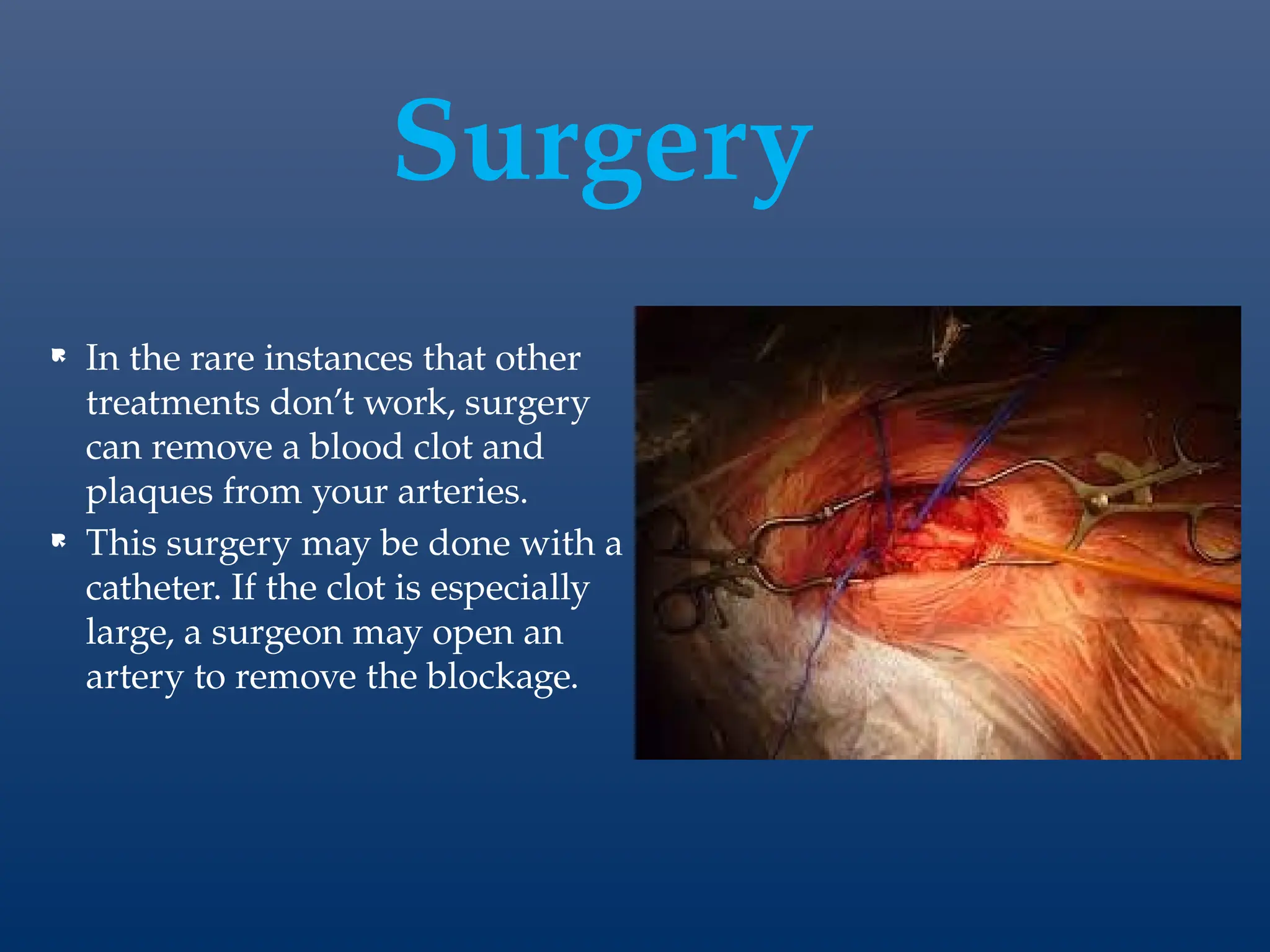
 In the rare instances that other
treatments don’t work, surgery
can remove a blood clot and
plaques from your arteries.
 This surgery may be done with a
catheter. If the clot is especially
large, a surgeon may open an
artery to remove the blockage.
Surgery
 Unlike with an ischemic stroke, having a hemorrhagic stroke,
the treatment goal is to make your blood clot. Therefore, you
may be given medication to counteract any blood thinners you
take.
 May also be prescribed drugs that can:
 Reduce blood pressure
 Lower the pressure in your brain
 Prevent blood vessel constriction
Medications
Hemorrhagic stroke
 During this procedure,
Surgeon guides a long tube to
the area of hemorrhage or
weakened blood vessel. They
then install a coil-like device
in the area where the artery
wall is weak. This blocks
blood flow to the area,
reducing bleeding.
Coiling
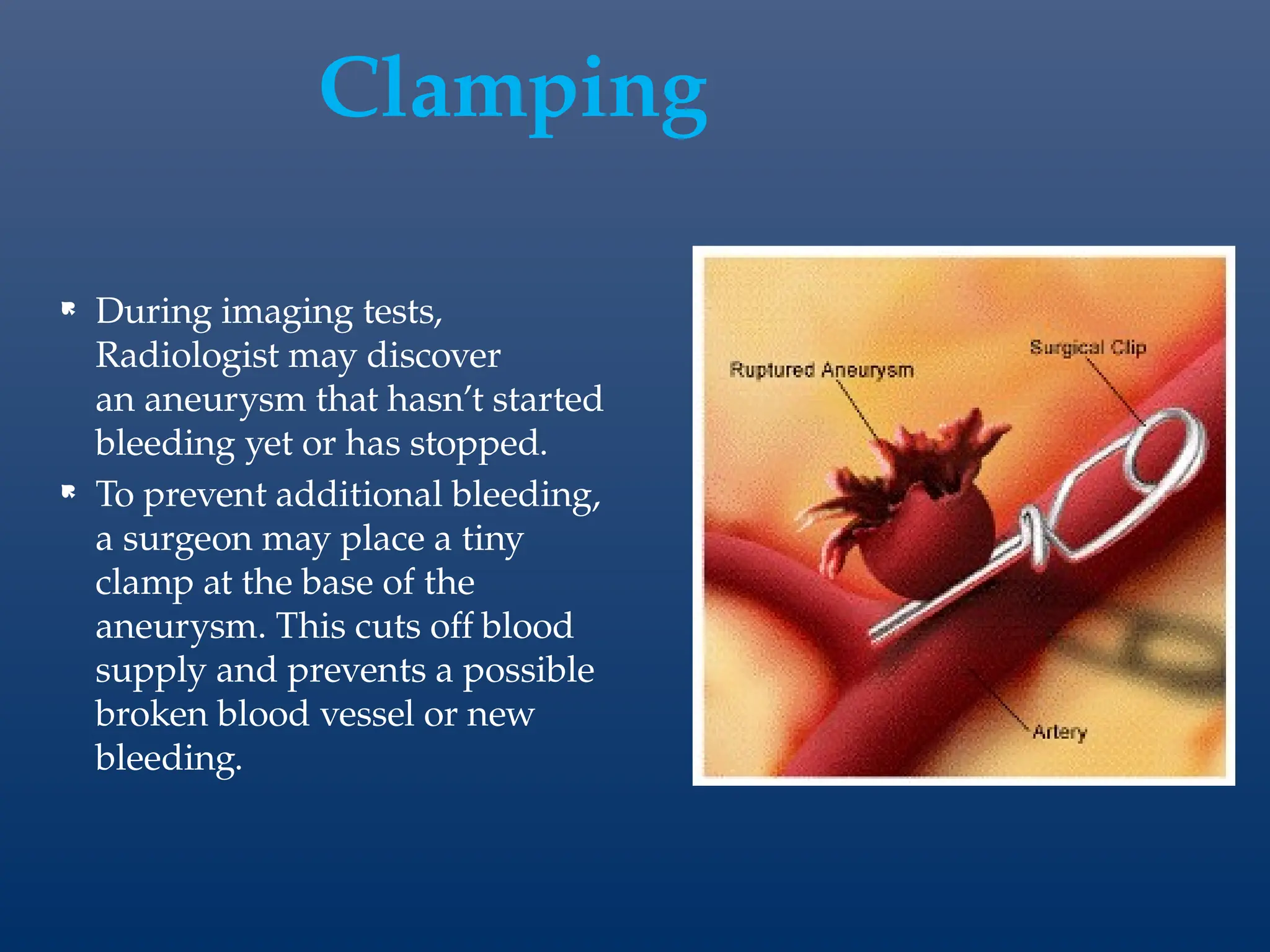
 During imaging tests,
Radiologist may discover
an aneurysm that hasn’t started
bleeding yet or has stopped.
 To prevent additional bleeding,
a surgeon may place a tiny
clamp at the base of the
aneurysm. This cuts off blood
supply and prevents a possible
broken blood vessel or new
bleeding.
Clamping
 If your Surgeon sees that an
aneurysm has burst, they
may do surgery to clip the
aneurysm and prevent
additional bleeding.
Likewise, a craniotomy may
be needed to relieve the
pressure on the brain after a
large stroke.
Surgery
 Lifestyle changes can’t prevent all strokes.
 But many of these changes can make a radical difference when
it comes to lowering your risk of stroke.
 These changes include the following:
 Quit smoking. If you smoke, quitting now will lower your risk
of stroke. You can reach out to your doctor to create a quit plan.
 Limit alcohol use. Heavy alcohol consumption can raise your
blood pressure, which in turn raises the risk of stroke. If
reducing your intake is difficult, reach out to your doctor for
help.
How to prevent a stroke
 Keep a moderate weight. Overweight and obesity
increases the risk of stroke. To help manage your
weight, eat a balanced diet and stay physically active
more often than not. Both steps can also reduce blood
pressure and cholesterol levels.
 Get regular checkups. Talk with your doctor about
how often to get a checkup for blood pressure,
cholesterol, and any conditions you may have. They
can also support you in making these lifestyle changes
and offer guidance
THANK YOU

Brain stroke: Symptoms, Classification, prevention and management .pptx

  • 1.
    STROKE Joginder Singh Radiological Technologist Departmentof Radiodiagnosis and imaging PGIMER, CHANDIGARH
  • 2.
     Definition  StrokeSymptoms  Risk factors  Classification of stroke  Investigations  Stroke treatment  How to prevent stroke Outline
  • 3.
    Also called: CVA,cerebrovascular accident What is a stroke? A stroke occurs when a blood vessel in the brain ruptures and bleeds, or when there’s a blockage in the blood supply to the brain. The rupture or blockage prevents blood and oxygen from reaching the brain’s tissues.
  • 4.
     The lossof blood flow to the brain damages tissues within the brain.  Symptoms of a stroke show up in the body parts controlled by the damaged areas of the brain.  The sooner a person having a stroke gets care, the better their outcome is likely to be. For this reason, it’s helpful to know the signs of a stroke so you can act quickly. Stroke symptoms
  • 6.
     A strokerequires immediate medical attention. If you think you or someone else is having a stroke, call 911 or local emergency services right away. Prompt treatment is key to preventing the following outcomes:  Brain damage  Long-term disability  Death  It’s better to be overly cautious when dealing with a stroke, so don’t be afraid to get emergency medical help if you think you recognize the signs of a stroke. CONTI.. PGI HELPLINE CONTACT NO +917087009500
  • 8.
     Diet  Anunbalanced diet can increase the risk of stroke. This type of diet is high in:  salt  saturated fats  trans fats  cholesterol Risk factors for stroke Inactivity Inactivity, or lack of exercise, can also raise the risk of stroke.
  • 9.
     Heavy alcoholuse  The risk of stroke also increases with heavy alcohol use.  Heavy alcohol use can raise blood pressure levels. It can also raise triglyceride levels, which can cause atherosclerosis. This is plaque buildup in the arteries that narrows blood vessels. Tobacco use  Using tobacco in any form also raises the risk of stroke, since it can damage the blood vessels and heart.  Nicotine also raises blood pressure. CONTI..
  • 10.
    Blood tests Blood testscan determine: Blood sugar levels whether patient have an infection Platelet counts how fast blood clots Cholesterol levels An ECG can determine heart conditions that may have led to a stroke, such as a prior heart attack or atrial fibrillation. Investigation
  • 11.
    NEURO IMAGING  Computedtomography (CT) of the head:  NCCT of the head done to detect a stroke from a blood clot or bleeding within the brain.  To improve the detection and characterization of stroke, CT angiography (CTA) may be performed.  Images that detect blood flow, called CT perfusion (CTP), may be obtained at the same time.  The combination of CT, CTA and CTP can help physicians decide on the best therapy for a patient experiencing a stroke.
  • 12.
     Diffusion MRIis more useful than a CT scan for diagnosing acute ischemic stroke within 12 hours of a person’s first stroke symptom. In a large study review, it was found that ischemic stroke was accurately detected 83% of the time by MRI versus 26% of the time by CT. MRI
  • 13.
  • 14.
    Stroke Primary Ischemic (80% ofstrokes) Primary hemorrhagic (20% of strokes) Thrombotic (50%) Embolic (30%) Subarachnoid hemorrhage (5%) Intra Cerebral hemorrhage (15%)
  • 15.
     There aretwo main causes of stroke: a blocked artery 1. (Ischemic stroke) or leaking or bursting of a blood vessel 2. (Hemorrhagic stroke).  Some people may have only a temporary disruption of blood flow to the brain, known as a transient ischemic attack 3. (TIA), that doesn't cause lasting symptoms.
  • 16.
     This isthe most common type of stroke.  It happens when the brain's blood vessels become narrowed or blocked, causing severely reduced blood flow (ischemia).  Blocked or narrowed blood vessels are caused by fatty deposits that build up in blood vessels or by blood clots or other debris that travel through the bloodstream, most often from the heart, and lodge in the blood vessels in the brain.  80 percent Source of strokes are ischemic strokes. Ischemic stroke
  • 17.
     There aretwo types of blockages that can lead to ischemic stroke: A Cerebral embolism and Cerebral thrombosis. Types of Ischemic stroke A cerebral embolism (often referred to as embolic stroke) occurs when a blood clot forms in another part of the body — often the heart or arteries in the upper chest and neck — and moves through the bloodstream until it hits an artery too narrow to let it pass. The clot gets stuck, and stops the flow of blood and causes a stroke.
  • 18.
     Cerebral thrombosis (oftenreferred to as thrombotic stroke) occurs when a blood clot develops at the fatty plaque within the blood vessel.
  • 19.
     A transientischemic attack, often called a TIA or mini stroke, occurs when blood flow to the brain is blocked temporarily.  Symptoms are similar to those of a full stroke. However, they’re typically temporary and disappear after a few minutes or hours, when the blockage moves and blood flow is restored. Transient ischemic attack (TIA)
  • 20.
     A bloodclot usually causes a TIA. While it’s not technically categorized as a full stroke, a TIA serves as a warning that an actual stroke may happen. Because of this, it’s best not to ignore it.  More than one-third of people who experience a TIA and don’t get treatment have a major stroke within a year. Up to 10 to 15 percent of people who experience a TIA have a major stroke within 3 months. Transient ischemic attack (TIA)
  • 21.
     Hemorrhagic strokeoccurs when a blood vessel in the brain leaks or ruptures. Brain hemorrhages can result from many conditions that affect the blood vessels. Hemorrhagic stroke
  • 22.
     An intracerebralhemorrhagic stroke is the most common type of hemorrhagic stroke. It happens when the tissues surrounding the brain fill with blood after an artery bursts.  About 20 percent of strokes are hemorrhagic. Types of hemorrhagic stroke The two types of hemorrhagic strokes are Intracerebral and Subarachnoid:
  • 23.
     A subarachnoidhemorrhagic stroke is less common. It causes bleeding in the area between the brain and the tissues that cover it.
  • 26.
  • 27.
     Proper medical evaluationand prompt treatment are vital to recovering from a stroke. “Time lost is brain lost.” Treatment for stroke depends on the type of stroke:
  • 28.
     Since ablood clot or blockage in the brain causes these stroke types, they’re largely treated with similar techniques.  They can include:  Clot-breaking drugs  Thrombolytic drugs can break up blood clots in your brain’s arteries, which still stop the stroke and reduce damage to the brain.  One such drug, tissue Plasminogen activator (tPA), or Alteplase IV r-tPA, is considered the gold standard Trusted Source in ischemic stroke treatment.  This drug works by dissolving blood clots quickly.  People who receive a tPA injection are more likely to recover from a stroke and less likely to have any lasting disability as a result of the stroke. Ischemic stroke and TIA
  • 30.
    Anticoagulants  These drugsreduce your blood’s ability to clot.  The most common anticoagulant is warfarin (Coumadin, Jantoven).  These drugs can also prevent existing blood clots from growing larger.
  • 31.
     These medicationsprevent blood clots by making it more difficult for the blood’s platelets to stick together. The most common antiplatelet drugs include Aspirin and clopidogrel (Plavix).  The drugs can prevent ischemic strokes. They’re especially important in preventing secondary stroke.  If you’ve never had a stroke before, only use aspirin as a preventive medication if you have a high risk of atherosclerotic cardiovascular disease (e.g., heart attack and stroke) and a low risk of bleeding. Anti platelet drugs
  • 32.
     Statins helplower high blood cholesterol levels.  These drugs prevent the production of an enzyme that can turn cholesterol into plaque — the thick, sticky substance that can build up on the walls of arteries and cause strokes and heart attacks.  Common statins include:  rosuvastatin (Crestor)  simvastatin (Zocor)  atorvastatin (Lipitor) Statins
  • 33.
     High bloodpressure can cause pieces of plaque buildup in your arteries to break off. These pieces can block arteries, causing a stroke.  As a result, managing high blood pressure with medication, lifestyle changes, or both can help prevent a stroke. Blood pressure drugs
  • 34.
     During thisprocedure, a Surgeon inserts a catheter into a large blood vessel inside your head. They then use a device to pull the clot out of the vessel.  This surgery is most successful if it’s performed 6 to 24 hours after the stroke begins. Mechanical thrombectomy
  • 35.
     If aSurgeon finds where artery walls have weakened, they may perform a procedure to inflate the narrowed artery and support the walls of the artery with a stent. Stents
  • 36.
     In therare instances that other treatments don’t work, surgery can remove a blood clot and plaques from your arteries.  This surgery may be done with a catheter. If the clot is especially large, a surgeon may open an artery to remove the blockage. Surgery
  • 37.
     Unlike withan ischemic stroke, having a hemorrhagic stroke, the treatment goal is to make your blood clot. Therefore, you may be given medication to counteract any blood thinners you take.  May also be prescribed drugs that can:  Reduce blood pressure  Lower the pressure in your brain  Prevent blood vessel constriction Medications Hemorrhagic stroke
  • 38.
     During thisprocedure, Surgeon guides a long tube to the area of hemorrhage or weakened blood vessel. They then install a coil-like device in the area where the artery wall is weak. This blocks blood flow to the area, reducing bleeding. Coiling
  • 39.
     During imagingtests, Radiologist may discover an aneurysm that hasn’t started bleeding yet or has stopped.  To prevent additional bleeding, a surgeon may place a tiny clamp at the base of the aneurysm. This cuts off blood supply and prevents a possible broken blood vessel or new bleeding. Clamping
  • 40.
     If yourSurgeon sees that an aneurysm has burst, they may do surgery to clip the aneurysm and prevent additional bleeding. Likewise, a craniotomy may be needed to relieve the pressure on the brain after a large stroke. Surgery
  • 41.
     Lifestyle changescan’t prevent all strokes.  But many of these changes can make a radical difference when it comes to lowering your risk of stroke.  These changes include the following:  Quit smoking. If you smoke, quitting now will lower your risk of stroke. You can reach out to your doctor to create a quit plan.  Limit alcohol use. Heavy alcohol consumption can raise your blood pressure, which in turn raises the risk of stroke. If reducing your intake is difficult, reach out to your doctor for help. How to prevent a stroke
  • 42.
     Keep amoderate weight. Overweight and obesity increases the risk of stroke. To help manage your weight, eat a balanced diet and stay physically active more often than not. Both steps can also reduce blood pressure and cholesterol levels.  Get regular checkups. Talk with your doctor about how often to get a checkup for blood pressure, cholesterol, and any conditions you may have. They can also support you in making these lifestyle changes and offer guidance
  • 43.