MANAGEMENT AS
PROFESSION
GROUP MEMBERS:
• NUR ASHIKIN BINTI CHE ALIAS
• NUR SHAHIRAH BINTI ZOLKIFLI
• NUR MISBAH BINTI KHALIL
• LIEYANA BINTI ARIPIN
• NUR ELINA BINTI ADLI
Meaning
• A profession's a well-defined body of
knowledge which is learned intellectually, and
with an organizational sense. To enter a
profession, a person has to undergo the
relevant course and write the exam. It's
primarily concerned with serving others. Pros
work either for charges or fees.
Reasons why it's considered a
profession
• It's considered a profession because it consists
of special knowledge, has formal training
methods, fees, has a code of conduct, and has
a representative organization.
EXISTENCE OF KNOWLEDGE
BUSINESS
USEFUL AND IMPORTANT KNOWLEDGE
ALREADY EXISTS IN YOUR BUSINESS. IT CAN BE
FOUND IN:
• the experience of your employees
• the designs and processes for your goods and services
• your files of documents (whether held digitally, on paper or
both)
• your plans for future activities, such as ideas for new products
or services
EXISTENCE OF KNOWLEDGE IN
BUSINESS PROFESSION
• You've probably done market research into the need for your
business to exist in the first place. If nobody wanted what you're
selling, you wouldn't be trading. You can tailor this market
knowledge to target particular customers with specific types of
product or service.
• Your files of documents from and about customers and suppliers
hold a wealth of information which can be invaluable both in
developing new products or services and improving existing ones.
• Your employees are likely to have skills and experience that you can
use as an asset. Having staff who are knowledgeable can be
invaluable in setting you apart from competitors. You should make
sure that your employees' knowledge and skills are passed on to
their colleagues and successors wherever possible, e.g. through
brainstorming sessions, training courses and documentation.
BASIC SOURCES 0F KNOWLEDGE
• Customer knowledge
• Employee and supplier relationships
• Market knowledge
• Knowledge of the business environment
ACQUISITION OF
KNOWLEDGE
WHAT IS THE KNOWLEDGE
ACQUISITION?
• Knowledge acquisition refers to the
knowledge that a firm can try to obtain
from external sources.
• External knowledge sources are important
and one should therefore take a holistic
view of the value chain (Gamble &
Blackwell 2001).
SOURCES OF KNOWLEDGE
ACQUISITION
Sources include :
• Suppliers
• Competitors
• Partners/alliances
• Customers
• External experts
MAIN SOURCES OF
KNOWLEDGE ACQUISITION
CUSTOMERS
• Customer knowledge comes in different forms.

• Gerbert et al (2002) identify three different types:
• Knowledge for customer:
The knowledge that the customers can gain in order to satisfy their
knowledge needs.. It can include product, market, and supplier knowledge.
It can be sourced from our company or from other external sources like

other customers and competitors (Zanjani 2008).
• Knowledge about customer:
The kind of knowledge that enables us to know the customer better, to
understand their motivations, and to address them better. Includes
requirements, expectations, and purchasing activities.
• Knowledge from customer:
The kind of knowledge that deals with products, suppliers, and markets. It
can be used to improve our products and services.
• These three categories apply to actual knowledge acquisition
as well as to data and information, which can be processed
and used to create knowledge (Zanjani 2008); e.g. data on
purchasing habits could be analyzed to create knowledge that
could improve marketing or design decisions.
• Knowledge sharing is thus important, although it may take
many different forms depending on the area of business.
• Some possible Knowledge Acquisition initiatives thus include:
• Collecting feedback
• Collecting and processing marketing related information
• Collecting suggestions
• Involvement in development/design
• Effective acquisition of customer knowledge is
dependent on customer relationship management.
• It can be used in this context both as a means of
collecting feedback and enhancing communication and
cooperation between partners (the principles of
knowledge sharing apply here within the confines of the
specific relationship).
• It is also useful as a way to gather data and information
regarding sales, trends, feedback, and so on, which can
then be used to create new knowledge within the
organization.
SUPPLIERS
• Chan (2009) presents a classification for supplier knowledge based
on the concepts outlined by Gerbert et al (2002) regarding customer
knowledge. These are:
• Knowledge for suppliers:This is the knowledge that suppliers
require and includes "production needs and forecasts, inventory,
products, customers, and markets" (Chan 2009).
• Knowledge about suppliers:This is knowledge that is used to
understand how the supplier can match the requirements of the
organization; provide insight regarding quality, delivery, defects,
financial risks etc.
• Knowledge from suppliers:This refers to the knowledge that
suppliers have gathered from their dealings with the organization.
• Gamble and Blackwell (2001) refer to compatible goals, cultural
alignment, and leadership commitment amongst the key factors for
sustained, productive, long-term relationships.
COMPETITORS
• This deserves mention but it is a fairly straightforward aspect
of Knowledge Management.
• It simply involves collecting, organizing and presenting the
data, information, and knowledge that the firm has acquired in
such a way that one can search, retrieve, and analyze it.
• Some of this falls within the scope of information
management, but it is particularly the process of using these
components to create better decisions and new knowledge
that is of interest here.
• IT systems are very useful in this case, since the sources are
largely explicit and presumably require frequent updating and
manipulation.
• Data mining and analysis, document management systems
with suitable search functions, and expert systems are most
relevant here.
PARTNERS / ALLIANCES
• Alliances intended to increase knowledge are a valuable
potential resource. However these must be properly
managed. Key success factors include fostering trust, learning
from your partner, and effectively managing the creation of
knowledge relevant to both parties.
• Knowledge transfer can be facilitated by personnel
exchanges, common projects and other forms of regular
interaction, technology sharing, etc. (Gamble & Blackwell
2001).
• Focusing on informal communication, collaboration, and
socialization is of paramount importance for valuable
knowledge acquisition and for extending communities of
practice beyond the firm's borders.
• Chan (2009) once again formulates a set of knowledge
types based around the work of Gerbert et al (2002):
• Knowledge for partners:Knowledge which satisfies their
needs, including "knowledge about products, markets, and
suppliers" (Chan 2009).
• Knowledge about partners:Knowledge acquisition
focused on understanding the ability of partners to perform
their role in the relationship. Includes distribution channels,
products, services, etc.
• Knowledge from partners:The knowledge that partners
have accumulated from dealing with the organization.
MERGES AND ACQUISITIONS
• Mergers and acquisitions (M&A) is an extremely complex task that has
led to numerous failures. Within the scope of knowledge acquisition, the
area related to KM is how to pass on the most amount of relevant
knowledge from the previous two organizations to the new, combined
firm.
• Very broadly speaking there are a couple of roles where KM efforts
should feature heavily once the target has been acquired:
• To identify the valuable/redundant knowledge sources in the target
organization:
This is a very difficult process since it involves understanding of the
target company's tacit and embedded knowledge locked within people,
communities, processes, networks, procedures, etc.
One of the major causes of failure in M&A is that during the
restructuring process, key people are let go by mistake or key
communities are disrupted. The old adage that the company should be
seen more like a living organism than a machine holds very true here.
.
• To combine this (relevant) knowledge with the organization's
knowledge assets to achieve synergy:
This is the essence of many M&A; the notion that the whole should
be greater than the sum of its parts.
Integrating acquired companies is a difficult task, heavy on people
management and the creation of a common culture. It is hard to say
how much of this falls within KM specifically, and there certainly are
no universal rules on this topic.
Fundamentally, the same principles on knowledge sharing, reuse,
and creation apply here, with a particular focus on culture, networks,
and incentives, within a different and potentially hostile environment
OTHER EXPERTISE
• This refers to the other sources of external knowledge available to a
firm, and includes hiring new personel or acquiring the services of
consultants.
• The role of KM in these cases is to make sure that the right knowledge
is acquired. Essentially the process has two parts, on the one hand the
strategic and tactical requirements of the firm must be taken into
account, and on the other these must be compared to the knowledge
assets of the organization.
• If external services are acquired from consultants or other temporary
service providers, KM must work together with strategic management to
determine if this knowledge is worth integrating into the firm by
assessing the need to reuse it in the future vs the cost of transferring it
into the organization.
• If it is deemed as something that should be integrated, then the right
learning situations must be established to transfer the knowledge into
the firm. These could be mentoring relationships, use of project teams
that include organizational members, courses and education, etc.
Management as profession
• Profession Association
• Function of profession association:
- to regulate the behavior of its member
- to create a code of conduct for guiding the
activities of the profession.
- to build up and promote the image of its
members as a professional.
• To prescribe minimum qualifications of its
member.
• To regulate entry to profession.
• To take care of the social responsibility of the
managers and the code of professional is also
being prepared.
ETHICAL CODE
Definition :
A guide of principles designed to help
professionals conduct business honestly and with
integrity. A code of ethics document may outline the
mission and values of the business or organization,
how professionals are supposed to approach
problems, the ethical principles based on the
organization's core values and the standards to which
the professional will be held.
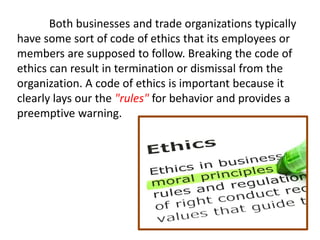
Both businesses and trade organizations typically
have some sort of code of ethics that its employees or
members are supposed to follow. Breaking the code of
ethics can result in termination or dismissal from the
organization. A code of ethics is important because it
clearly lays our the "rules" for behavior and provides a
preemptive warning.
In general :
Ethical codes are often adopted by management, not to
promote a particular moral theory, but rather because they are
seen as pragmatic necessities for running an organization in a
complex society in which moral concepts play an important
part.
They are distinct from moral codes that may apply to the
culture, education and religion of a whole society.
Often, acts that violate ethical codes may also violate a
law or regulation and can be punishable at law or by
government agency remedies.
Even organizations and
communities that may be
considered criminal in nature may
have ethical codes of conduct,
official or unofficial.
Examples could include
hacker communities,
bands of thieves, and
street gangs.
SERVICE
MOTIVES
Management as emerging profession
• Management is a new branch of knowledge.
• Need for acquiring skills to solve problems.
• Thus, it's not a full-fledged profession.
• Not a profession in the true sense of the word
since entry into professional management
does not require any formal qualification in
management.
• This is in contrast to medical or law profession
where basic qualification is a must.
Management as emerging profession
It consists :
• Special knowledge
• Formal training methods
• Fees
• Code of conduct
• Representative organization.
Professional Approach
o Commitment
o Application of modern Management tools
o Team approach
o Preparedness to accept change
o Preference to competence
o Optimization-Oriented (Decision Making)
o Responsive to the society
Profession of management in Malaysia
People wishing to manage others effectively in Malaysia need to be
aware of certain critical issues, which may vary enormously from their
own country of origin.
• Firstly, as an hierarchically oriented country, the manager should
never do anything to make a subordinate lose 'face'.
• It is also difficult to respect those who are overly direct - vagueness
and diplomacy are an art form, whereas directness can be
construed as uncivilised and uneducated behaviour.
• The manager is also expected to take an holistic interest in the well-
being of the subordinate - both in work and outside. The
relationship could be construed as being more like father and son
than the western view of boss and subordinate.
Profession of management in Malaysia
• Secondly, as basically group-oriented in
approach,
• people like to feel part of a team and expect
individual aspirations to be sublimated to the
group needs.
• Managers should foster this inter-group co-
operation rather than try to set up inter-group
competitiveness which will lead to lack of
harmony and therefore unhappiness.

Management as profession

  • 1.
    MANAGEMENT AS PROFESSION GROUP MEMBERS: •NUR ASHIKIN BINTI CHE ALIAS • NUR SHAHIRAH BINTI ZOLKIFLI • NUR MISBAH BINTI KHALIL • LIEYANA BINTI ARIPIN • NUR ELINA BINTI ADLI
  • 2.
    Meaning • A profession'sa well-defined body of knowledge which is learned intellectually, and with an organizational sense. To enter a profession, a person has to undergo the relevant course and write the exam. It's primarily concerned with serving others. Pros work either for charges or fees.
  • 3.
    Reasons why it'sconsidered a profession • It's considered a profession because it consists of special knowledge, has formal training methods, fees, has a code of conduct, and has a representative organization.
  • 4.
  • 5.
    BUSINESS USEFUL AND IMPORTANTKNOWLEDGE ALREADY EXISTS IN YOUR BUSINESS. IT CAN BE FOUND IN: • the experience of your employees • the designs and processes for your goods and services • your files of documents (whether held digitally, on paper or both) • your plans for future activities, such as ideas for new products or services
  • 6.
    EXISTENCE OF KNOWLEDGEIN BUSINESS PROFESSION • You've probably done market research into the need for your business to exist in the first place. If nobody wanted what you're selling, you wouldn't be trading. You can tailor this market knowledge to target particular customers with specific types of product or service. • Your files of documents from and about customers and suppliers hold a wealth of information which can be invaluable both in developing new products or services and improving existing ones. • Your employees are likely to have skills and experience that you can use as an asset. Having staff who are knowledgeable can be invaluable in setting you apart from competitors. You should make sure that your employees' knowledge and skills are passed on to their colleagues and successors wherever possible, e.g. through brainstorming sessions, training courses and documentation.
  • 7.
    BASIC SOURCES 0FKNOWLEDGE • Customer knowledge • Employee and supplier relationships • Market knowledge • Knowledge of the business environment
  • 8.
  • 9.
    WHAT IS THEKNOWLEDGE ACQUISITION?
  • 10.
    • Knowledge acquisitionrefers to the knowledge that a firm can try to obtain from external sources. • External knowledge sources are important and one should therefore take a holistic view of the value chain (Gamble & Blackwell 2001).
  • 11.
  • 12.
    Sources include : •Suppliers • Competitors • Partners/alliances • Customers • External experts
  • 13.
  • 14.
  • 15.
    • Customer knowledgecomes in different forms. • Gerbert et al (2002) identify three different types: • Knowledge for customer: The knowledge that the customers can gain in order to satisfy their knowledge needs.. It can include product, market, and supplier knowledge. It can be sourced from our company or from other external sources like other customers and competitors (Zanjani 2008). • Knowledge about customer: The kind of knowledge that enables us to know the customer better, to understand their motivations, and to address them better. Includes requirements, expectations, and purchasing activities. • Knowledge from customer: The kind of knowledge that deals with products, suppliers, and markets. It can be used to improve our products and services.
  • 16.
    • These threecategories apply to actual knowledge acquisition as well as to data and information, which can be processed and used to create knowledge (Zanjani 2008); e.g. data on purchasing habits could be analyzed to create knowledge that could improve marketing or design decisions. • Knowledge sharing is thus important, although it may take many different forms depending on the area of business. • Some possible Knowledge Acquisition initiatives thus include: • Collecting feedback • Collecting and processing marketing related information • Collecting suggestions • Involvement in development/design
  • 17.
    • Effective acquisitionof customer knowledge is dependent on customer relationship management. • It can be used in this context both as a means of collecting feedback and enhancing communication and cooperation between partners (the principles of knowledge sharing apply here within the confines of the specific relationship). • It is also useful as a way to gather data and information regarding sales, trends, feedback, and so on, which can then be used to create new knowledge within the organization.
  • 18.
  • 19.
    • Chan (2009)presents a classification for supplier knowledge based on the concepts outlined by Gerbert et al (2002) regarding customer knowledge. These are: • Knowledge for suppliers:This is the knowledge that suppliers require and includes "production needs and forecasts, inventory, products, customers, and markets" (Chan 2009). • Knowledge about suppliers:This is knowledge that is used to understand how the supplier can match the requirements of the organization; provide insight regarding quality, delivery, defects, financial risks etc. • Knowledge from suppliers:This refers to the knowledge that suppliers have gathered from their dealings with the organization. • Gamble and Blackwell (2001) refer to compatible goals, cultural alignment, and leadership commitment amongst the key factors for sustained, productive, long-term relationships.
  • 20.
  • 21.
    • This deservesmention but it is a fairly straightforward aspect of Knowledge Management. • It simply involves collecting, organizing and presenting the data, information, and knowledge that the firm has acquired in such a way that one can search, retrieve, and analyze it. • Some of this falls within the scope of information management, but it is particularly the process of using these components to create better decisions and new knowledge that is of interest here. • IT systems are very useful in this case, since the sources are largely explicit and presumably require frequent updating and manipulation. • Data mining and analysis, document management systems with suitable search functions, and expert systems are most relevant here.
  • 22.
  • 23.
    • Alliances intendedto increase knowledge are a valuable potential resource. However these must be properly managed. Key success factors include fostering trust, learning from your partner, and effectively managing the creation of knowledge relevant to both parties. • Knowledge transfer can be facilitated by personnel exchanges, common projects and other forms of regular interaction, technology sharing, etc. (Gamble & Blackwell 2001). • Focusing on informal communication, collaboration, and socialization is of paramount importance for valuable knowledge acquisition and for extending communities of practice beyond the firm's borders.
  • 24.
    • Chan (2009)once again formulates a set of knowledge types based around the work of Gerbert et al (2002): • Knowledge for partners:Knowledge which satisfies their needs, including "knowledge about products, markets, and suppliers" (Chan 2009). • Knowledge about partners:Knowledge acquisition focused on understanding the ability of partners to perform their role in the relationship. Includes distribution channels, products, services, etc. • Knowledge from partners:The knowledge that partners have accumulated from dealing with the organization.
  • 25.
  • 26.
    • Mergers andacquisitions (M&A) is an extremely complex task that has led to numerous failures. Within the scope of knowledge acquisition, the area related to KM is how to pass on the most amount of relevant knowledge from the previous two organizations to the new, combined firm. • Very broadly speaking there are a couple of roles where KM efforts should feature heavily once the target has been acquired: • To identify the valuable/redundant knowledge sources in the target organization: This is a very difficult process since it involves understanding of the target company's tacit and embedded knowledge locked within people, communities, processes, networks, procedures, etc. One of the major causes of failure in M&A is that during the restructuring process, key people are let go by mistake or key communities are disrupted. The old adage that the company should be seen more like a living organism than a machine holds very true here. .
  • 27.
    • To combinethis (relevant) knowledge with the organization's knowledge assets to achieve synergy: This is the essence of many M&A; the notion that the whole should be greater than the sum of its parts. Integrating acquired companies is a difficult task, heavy on people management and the creation of a common culture. It is hard to say how much of this falls within KM specifically, and there certainly are no universal rules on this topic. Fundamentally, the same principles on knowledge sharing, reuse, and creation apply here, with a particular focus on culture, networks, and incentives, within a different and potentially hostile environment
  • 28.
  • 29.
    • This refersto the other sources of external knowledge available to a firm, and includes hiring new personel or acquiring the services of consultants. • The role of KM in these cases is to make sure that the right knowledge is acquired. Essentially the process has two parts, on the one hand the strategic and tactical requirements of the firm must be taken into account, and on the other these must be compared to the knowledge assets of the organization. • If external services are acquired from consultants or other temporary service providers, KM must work together with strategic management to determine if this knowledge is worth integrating into the firm by assessing the need to reuse it in the future vs the cost of transferring it into the organization. • If it is deemed as something that should be integrated, then the right learning situations must be established to transfer the knowledge into the firm. These could be mentoring relationships, use of project teams that include organizational members, courses and education, etc.
  • 30.
    Management as profession •Profession Association
  • 31.
    • Function ofprofession association: - to regulate the behavior of its member - to create a code of conduct for guiding the activities of the profession. - to build up and promote the image of its members as a professional.
  • 32.
    • To prescribeminimum qualifications of its member. • To regulate entry to profession. • To take care of the social responsibility of the managers and the code of professional is also being prepared.
  • 33.
  • 34.
    Definition : A guideof principles designed to help professionals conduct business honestly and with integrity. A code of ethics document may outline the mission and values of the business or organization, how professionals are supposed to approach problems, the ethical principles based on the organization's core values and the standards to which the professional will be held.
  • 35.
    Both businesses andtrade organizations typically have some sort of code of ethics that its employees or members are supposed to follow. Breaking the code of ethics can result in termination or dismissal from the organization. A code of ethics is important because it clearly lays our the "rules" for behavior and provides a preemptive warning.
  • 36.
    In general : Ethicalcodes are often adopted by management, not to promote a particular moral theory, but rather because they are seen as pragmatic necessities for running an organization in a complex society in which moral concepts play an important part. They are distinct from moral codes that may apply to the culture, education and religion of a whole society. Often, acts that violate ethical codes may also violate a law or regulation and can be punishable at law or by government agency remedies.
  • 37.
    Even organizations and communitiesthat may be considered criminal in nature may have ethical codes of conduct, official or unofficial. Examples could include hacker communities, bands of thieves, and street gangs.
  • 38.
  • 39.
    Management as emergingprofession • Management is a new branch of knowledge. • Need for acquiring skills to solve problems. • Thus, it's not a full-fledged profession. • Not a profession in the true sense of the word since entry into professional management does not require any formal qualification in management. • This is in contrast to medical or law profession where basic qualification is a must.
  • 40.
    Management as emergingprofession It consists : • Special knowledge • Formal training methods • Fees • Code of conduct • Representative organization.
  • 41.
    Professional Approach o Commitment oApplication of modern Management tools o Team approach o Preparedness to accept change o Preference to competence o Optimization-Oriented (Decision Making) o Responsive to the society
  • 42.
    Profession of managementin Malaysia People wishing to manage others effectively in Malaysia need to be aware of certain critical issues, which may vary enormously from their own country of origin. • Firstly, as an hierarchically oriented country, the manager should never do anything to make a subordinate lose 'face'. • It is also difficult to respect those who are overly direct - vagueness and diplomacy are an art form, whereas directness can be construed as uncivilised and uneducated behaviour. • The manager is also expected to take an holistic interest in the well- being of the subordinate - both in work and outside. The relationship could be construed as being more like father and son than the western view of boss and subordinate.
  • 43.
    Profession of managementin Malaysia • Secondly, as basically group-oriented in approach, • people like to feel part of a team and expect individual aspirations to be sublimated to the group needs. • Managers should foster this inter-group co- operation rather than try to set up inter-group competitiveness which will lead to lack of harmony and therefore unhappiness.