
Principles and
Practice of
Management
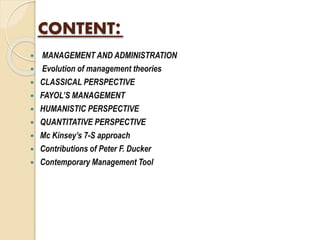
CONTENT:
 MANAGEMENT AND ADMINISTRATION
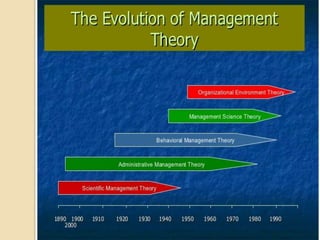
 Evolution of management theories
 CLASSICAL PERSPECTIVE
 FAYOL’S MANAGEMENT
 HUMANISTIC PERSPECTIVE
 QUANTITATIVE PERSPECTIVE
 Mc Kinsey’s 7-S approach
 Contributions of Peter F. Ducker
 Contemporary Management Tool
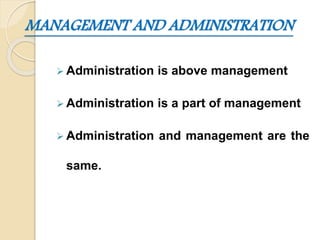
MANAGEMENT AND ADMINISTRATION
 Administration is above management
 Administration is a part of management
 Administration and management are the
same.
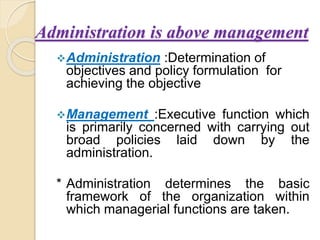
Administration is above management
Administration :Determination of
objectives and policy formulation for
achieving the objective
Management :Executive function which
is primarily concerned with carrying out
broad policies laid down by the
administration.
* Administration determines the basic
framework of the organization within
which managerial functions are taken.
Administration is a part of management
* Management-Social process involving
responsibility for the effective and
economical planning and the regulation of
the operation of an enterprise, in the
fulfillment of a given purpose or task
* Administration is that part of management
which is concerned with the installation and
carrying out of the procedures by which it is
laid down and communicating the process
of activities ,regulated and checked against
plans.
Administration and management are same
 Higher policy formulation level – higher
levels ,Lower at lower levels
 Board of Directors and Chief Executive-
administration
 Managers and supervisors – Execution
 Everyone performs all managerial
functions, only relative importance of
these function varies
CLASSICAL PERSPECTIVE
 SCIENTIFIC MANAGEMENT :
 Emphasized the scientific study of work methods to improve
the productivity of individual workers
 Features of scientific management
 Separation of planning and doing
 Functional Foremanship
 Job Analysis
 Standardization
 Scientific Selection and training of Workers
 Financial Incentives
 Economy
 Mental Revolution
Bureaucratic
Organizations
 Bureaucratic Organizations Approach- Max
Weber
 Management on an impersonal, rational
basis through elements such as clearly
defined authority and responsibility, formal
record-keeping, and separation of
management and ownership
 Focuses on the total organization rather
than the individual worker and delineates the
management functions of planning,
organizing, commanding, coordinating, and
controlling.
Characteristics of Bureaucracy:
• Division of Labor, with clear definitions of authority and
responsibility.
 Positions organized in a hierarchy of authority.
 Managers subject to rules and procedures that will
ensure reliable, predictable behavior.
 Management separate from the ownership of the
organization.
 Administrative acts and decisions recorded in writing
 Personnel selected and promoted based on technical
qualifications
FAYOLS PRINCIPLE OF MANAGEMENT
 Henry Fayol is a French Industrialist known as
the real father of modern management
 Administration’ instead of ‘management’
 Classified the activities of an industrial
organization into six groups:
 Technical (relating to production)
 Commercial (buying, selling and exchange)
 Financial (Search for capital and its optimum
use)
 Security (protection of property and person)
 Accounting (including statistics); and
 Managerial (planning, organization, command,
coordination and control)
FAYOL’S MANAGEMENT
 Fayol six types of qualities that a
manager requires physical, mental,
moral, educational,
technical experience
 The most important ability for a
worker is technical; the relative
importance of managerial ability
increases as one goes up the scalar
chain, with insight becoming the most
important ability for top level
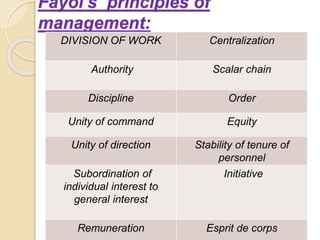
Fayol's principles of
management:
DIVISION OF WORK Centralization
Authority Scalar chain
Discipline Order
Unity of command Equity
Unity of direction Stability of tenure of
personnel
Subordination of
individual interest to
general interest
Initiative
Remuneration Esprit de corps
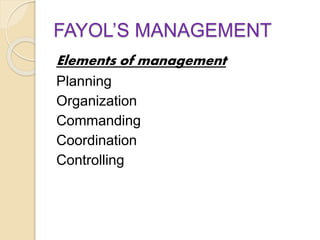
FAYOL’S MANAGEMENT
Elements of management
Planning
Organization
Commanding
Coordination
Controlling
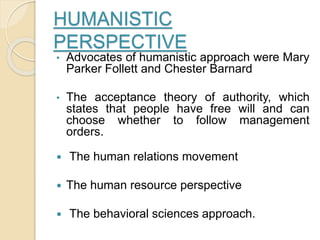
HUMANISTIC
PERSPECTIVE
• Advocates of humanistic approach were Mary
Parker Follett and Chester Barnard
• The acceptance theory of authority, which
states that people have free will and can
choose whether to follow management
orders.
 The human relations movement
 The human resource perspective
 The behavioral sciences approach.
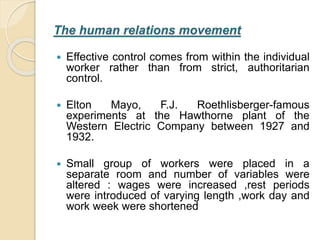
The human relations movement
 Effective control comes from within the individual
worker rather than from strict, authoritarian
control.
 Elton Mayo, F.J. Roethlisberger-famous
experiments at the Hawthorne plant of the
Western Electric Company between 1927 and
1932.
 Small group of workers were placed in a
separate room and number of variables were
altered : wages were increased ,rest periods
were introduced of varying length ,work day and
work week were shortened
Contributions of human relations movement
 A business organization is not merely a techno-economic system but is
also a social system
 No correlation between improved working conditions and productivity.
 Production norms for workers are set by their group and not by the time,
motion and fatigue studies
 Workers who deviate from the production norms set by the group are
isolated, harassed and penalized by their co-workers
 Non-financial factors such as affection and respect of his co-workers
play a significant role in influencing his behavior.
 Employee centered, democratic and participative style of supervisory
leadership is more effective than task-centered leadership.
 As informal groups play an important role in influencing workers’
behavior, the informal group and not the individual is the dominant unit of
analysis in the organization
The human resource perspective
 Two of the best-known contributors to the human
resources perspective were Abraham Maslow
and Douglas McGregor.
 The human resources perspective combines
prescriptions for design of job tasks with theories
of motivation.
 Jobs should be designed so that tasks are not
perceived as dehumanizing or demeaning but
instead allow workers to use their full potential.
 Douglas McGregor (1906-1964) formulated
Theory X and Theory Y
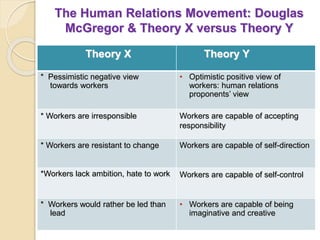
The Human Relations Movement: Douglas
McGregor & Theory X versus Theory Y
Theory X Theory Y
* Pessimistic negative view
towards workers
• Optimistic positive view of
workers: human relations
proponents’ view
* Workers are irresponsible Workers are capable of accepting
responsibility
* Workers are resistant to change Workers are capable of self-direction
*Workers lack ambition, hate to work Workers are capable of self-control
* Workers would rather be led than
lead
• Workers are capable of being
imaginative and creative
Behavioral Sciences Approach
* Scientific methods and draw from sociology,
psychology, anthropology, economics, and
other disciplines to develop theories about
human behavior and interaction in an
organizational setting.
* 1970s- Organization development -
behavioral sciences to improve the
organization’s health and effectiveness
through its ability to cope with change,
improve internal relationships, and increase
problem-solving capabilities
QUANTITATIVE
PERSPECTIVE
 Quantitative perspective involves mathematics
,statistical techniques and computer technology
 Helps in solving complex problems and facilitates
management decision making
* Operations research
* Operations management
* Information technology
Operations research :
Consists of mathematical model building and other
applications of quantitative techniques to managerial
problems
 Operations management :
 Specializes in the physical production of goods
 Quantitative techniques to solve manufacturing
problems such as forecasting , inventory modeling
,linear and nonlinear programming ,queuing theory,
scheduling ,simulation and break even analysis
 Information Technology
 Management information systems have adopted
technology to provide relevant information to
managers in timely and cost efficient manager
Mc Kinsey’s 7-S approach
 Strategy: Systematic action and allocation of resources
to achieve company objectives.
 Structure: Organization structure and
authority/responsibility relationships.
 Systems: Procedures and processes such as
information systems, manufacturing processes,
budgeting and control processes.
 Style: The way management behaves and collectively
spends its time to achieve organizational goals.
 Staff: The people in the enterprise and their
socialization into the organizational culture.
 Shared values (super –ordinate goals): The values
shared by the members of an organization that shape
its destiny.
 Skills: Distinctive capabilities of an enterprise.
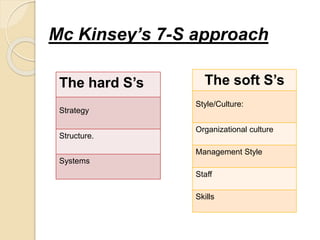
The hard S’s
Strategy
Structure.
Systems
The soft S’s
Style/Culture:
Organizational culture
Management Style
Staff
Skills
Mc Kinsey’s 7-S approach
Contributions of Peter F. Drucker
* Emphasized management with creative
and innovative characteristics.
* Managers should not only have skills and
techniques but should have right
perspective putting the things into
practice
* Need to be good practitioners so that
they can understand the social and
cultural requirements of various
organizations and countries.
Contributions of Peter F.
Drucker
 Manager has three basic functions
which he must perform to enable the
institution to make its contributions for:
(I)The specific purpose and mission of
the institution
(II)Making work productive and the
worker achieving
(III)Managing social impacts and social
responsibilities
Contributions of Peter F.
Drucker
 Replacement of bureaucratic structure
 Three basic characteristics of an
effective organization structure.
(i)Enterprise should be organized for
performance
(ii)It should contain the least possible
number of managerial levels
(iii) It must make possible the training and
testing of tomorrow’s top managers-
giving responsibility to a manager while
still he is young.
Contributions of Peter F.
Drucker
 Three basic aspects in organizing:
 Activity Analysis: Shows what work has to be performed,
what kind of work should be put together, and what emphasis
is to be given to each activity in the organization structure..
 Decision analysis: Takes into account the four aspects of
decision; the degree of futurity in the decision, the impact of a
decision over other functions, number of qualitative factors
that enter into it, and whether the decision is periodically
recurrent or rare. Such an analysis will determine the levels at
which the decision can be made
 Relation Analysis: Analysis helps in defining the structure
and also to give guidance in manning the structure
Systems Thinking
 A system is a set of interrelated parts that function as a
whole to achieve a common purpose
 Subsystems are parts of a system, such as an
organization, that depend on one another.
 Systems thinking is the ability to see both the distinct
elements of a system or situation and the complex and
changing interaction among those elements
Systems Approach
• A perspective for viewing problems than
a school of thought
• Organization is a system or an entity of
interrelated parts ,one part of system
effects the other automatically
* E.g. : Offering low compensation to job
candidates will affect product quality
(“Low quality “employees –accept low
wages- produce low quality goods)
Systems Approach
* Organization is an open system – one that
interacts with environment
* It transforms input into output supplies to
outside world
* Outputs are perceived as valuable
,organization prosper and survive
* Feedback loop indicates that acceptance of
the outputs by society gives the organization
new inputs for revitalization and expansion
* Managers can benefit from by recognizing
that whatever work they undertake should
contribute something of value to external
people (such as customers and clients).
Contingency approach
* Business organizations are open and
adaptive system
* Open and adaptable systems approach
which is called contingency or situational
approach can be adjusted to the
demands of changing environmental
situations
* Recognizing all subsystems of an
organization and supra – system of
environment, are interconnected and
interrelated, and by analyzing their
interrelationships, it helps the
management in finding solutions to
specific situations.
Total Quality Management
 Focuses on managing the total organization to deliver
better quality to customers
 High-quality values throughout every activity within a
company, with front-line workers intimately involved in
the process
 Four aspect are :
 Employee involvement, focus on the customer,
benchmarking, and continuous improvement,
often referred to as kaizen.
 TQM is not a quick fix, but companies such as General
Electric, Texas Instruments, Procter & Gamble, and
DuPont achieved astonishing results in efficiency,
quality, and customer satisfaction through total quality
management.
Contemporary Management Tool
 Customer Relationship Management
 Using the latest information technology to keep in close
touch with customers and to collect and manage large
amounts of customer data.
 Helping employees and managers act on customer
insights, make better decisions, and provide superior
customer service
 63 percent of surveyed managers reported their
companies used CRM in 2008 as against 35%
companies used CRM in 2000.
 Provides a tremendous boost to customer service and
satisfaction by knowing really what they want
Contemporary Management Tool
Outsourcing
* Contracting out selected functions or activities to other
organizations that can do the work more cost efficiently
Supply Chain management
* Managing the sequence of suppliers and purchasers,
covering all stages of processing from obtaining raw
materials to distributing finished goods to consumers.
* A network of multiple businesses and individuals that are
connected through the flow of products or services.
* E.g.Walmart managers have invested in an efficient
supply chain that electronically links farmers and small
manufacturers directly to the stores, maximizing value
for both ends
MANAGEMENT AND ADMINSTRATION

MANAGEMENT AND ADMINSTRATION

  • 1.
  • 2.
    CONTENT:  MANAGEMENT ANDADMINISTRATION  Evolution of management theories  CLASSICAL PERSPECTIVE  FAYOL’S MANAGEMENT  HUMANISTIC PERSPECTIVE  QUANTITATIVE PERSPECTIVE  Mc Kinsey’s 7-S approach  Contributions of Peter F. Ducker  Contemporary Management Tool
  • 3.
    MANAGEMENT AND ADMINISTRATION Administration is above management  Administration is a part of management  Administration and management are the same.
  • 4.
    Administration is abovemanagement Administration :Determination of objectives and policy formulation for achieving the objective Management :Executive function which is primarily concerned with carrying out broad policies laid down by the administration. * Administration determines the basic framework of the organization within which managerial functions are taken.
  • 5.
    Administration is apart of management * Management-Social process involving responsibility for the effective and economical planning and the regulation of the operation of an enterprise, in the fulfillment of a given purpose or task * Administration is that part of management which is concerned with the installation and carrying out of the procedures by which it is laid down and communicating the process of activities ,regulated and checked against plans.
  • 6.
    Administration and managementare same  Higher policy formulation level – higher levels ,Lower at lower levels  Board of Directors and Chief Executive- administration  Managers and supervisors – Execution  Everyone performs all managerial functions, only relative importance of these function varies
  • 8.
    CLASSICAL PERSPECTIVE  SCIENTIFICMANAGEMENT :  Emphasized the scientific study of work methods to improve the productivity of individual workers  Features of scientific management  Separation of planning and doing  Functional Foremanship  Job Analysis  Standardization  Scientific Selection and training of Workers  Financial Incentives  Economy  Mental Revolution
  • 9.
    Bureaucratic Organizations  Bureaucratic OrganizationsApproach- Max Weber  Management on an impersonal, rational basis through elements such as clearly defined authority and responsibility, formal record-keeping, and separation of management and ownership  Focuses on the total organization rather than the individual worker and delineates the management functions of planning, organizing, commanding, coordinating, and controlling.
  • 10.
    Characteristics of Bureaucracy: •Division of Labor, with clear definitions of authority and responsibility.  Positions organized in a hierarchy of authority.  Managers subject to rules and procedures that will ensure reliable, predictable behavior.  Management separate from the ownership of the organization.  Administrative acts and decisions recorded in writing  Personnel selected and promoted based on technical qualifications
  • 11.
    FAYOLS PRINCIPLE OFMANAGEMENT  Henry Fayol is a French Industrialist known as the real father of modern management  Administration’ instead of ‘management’  Classified the activities of an industrial organization into six groups:  Technical (relating to production)  Commercial (buying, selling and exchange)  Financial (Search for capital and its optimum use)  Security (protection of property and person)  Accounting (including statistics); and  Managerial (planning, organization, command, coordination and control)
  • 12.
    FAYOL’S MANAGEMENT  Fayolsix types of qualities that a manager requires physical, mental, moral, educational, technical experience  The most important ability for a worker is technical; the relative importance of managerial ability increases as one goes up the scalar chain, with insight becoming the most important ability for top level
  • 13.
    Fayol's principles of management: DIVISIONOF WORK Centralization Authority Scalar chain Discipline Order Unity of command Equity Unity of direction Stability of tenure of personnel Subordination of individual interest to general interest Initiative Remuneration Esprit de corps
  • 14.
    FAYOL’S MANAGEMENT Elements ofmanagement Planning Organization Commanding Coordination Controlling
  • 15.
    HUMANISTIC PERSPECTIVE • Advocates ofhumanistic approach were Mary Parker Follett and Chester Barnard • The acceptance theory of authority, which states that people have free will and can choose whether to follow management orders.  The human relations movement  The human resource perspective  The behavioral sciences approach.
  • 16.
    The human relationsmovement  Effective control comes from within the individual worker rather than from strict, authoritarian control.  Elton Mayo, F.J. Roethlisberger-famous experiments at the Hawthorne plant of the Western Electric Company between 1927 and 1932.  Small group of workers were placed in a separate room and number of variables were altered : wages were increased ,rest periods were introduced of varying length ,work day and work week were shortened
  • 17.
    Contributions of humanrelations movement  A business organization is not merely a techno-economic system but is also a social system  No correlation between improved working conditions and productivity.  Production norms for workers are set by their group and not by the time, motion and fatigue studies  Workers who deviate from the production norms set by the group are isolated, harassed and penalized by their co-workers  Non-financial factors such as affection and respect of his co-workers play a significant role in influencing his behavior.  Employee centered, democratic and participative style of supervisory leadership is more effective than task-centered leadership.  As informal groups play an important role in influencing workers’ behavior, the informal group and not the individual is the dominant unit of analysis in the organization
  • 18.
    The human resourceperspective  Two of the best-known contributors to the human resources perspective were Abraham Maslow and Douglas McGregor.  The human resources perspective combines prescriptions for design of job tasks with theories of motivation.  Jobs should be designed so that tasks are not perceived as dehumanizing or demeaning but instead allow workers to use their full potential.  Douglas McGregor (1906-1964) formulated Theory X and Theory Y
  • 19.
    The Human RelationsMovement: Douglas McGregor & Theory X versus Theory Y Theory X Theory Y * Pessimistic negative view towards workers • Optimistic positive view of workers: human relations proponents’ view * Workers are irresponsible Workers are capable of accepting responsibility * Workers are resistant to change Workers are capable of self-direction *Workers lack ambition, hate to work Workers are capable of self-control * Workers would rather be led than lead • Workers are capable of being imaginative and creative
  • 20.
    Behavioral Sciences Approach *Scientific methods and draw from sociology, psychology, anthropology, economics, and other disciplines to develop theories about human behavior and interaction in an organizational setting. * 1970s- Organization development - behavioral sciences to improve the organization’s health and effectiveness through its ability to cope with change, improve internal relationships, and increase problem-solving capabilities
  • 21.
    QUANTITATIVE PERSPECTIVE  Quantitative perspectiveinvolves mathematics ,statistical techniques and computer technology  Helps in solving complex problems and facilitates management decision making * Operations research * Operations management * Information technology
  • 22.
    Operations research : Consistsof mathematical model building and other applications of quantitative techniques to managerial problems  Operations management :  Specializes in the physical production of goods  Quantitative techniques to solve manufacturing problems such as forecasting , inventory modeling ,linear and nonlinear programming ,queuing theory, scheduling ,simulation and break even analysis  Information Technology  Management information systems have adopted technology to provide relevant information to managers in timely and cost efficient manager
  • 23.
    Mc Kinsey’s 7-Sapproach  Strategy: Systematic action and allocation of resources to achieve company objectives.  Structure: Organization structure and authority/responsibility relationships.  Systems: Procedures and processes such as information systems, manufacturing processes, budgeting and control processes.  Style: The way management behaves and collectively spends its time to achieve organizational goals.  Staff: The people in the enterprise and their socialization into the organizational culture.  Shared values (super –ordinate goals): The values shared by the members of an organization that shape its destiny.  Skills: Distinctive capabilities of an enterprise.
  • 24.
    The hard S’s Strategy Structure. Systems Thesoft S’s Style/Culture: Organizational culture Management Style Staff Skills Mc Kinsey’s 7-S approach
  • 25.
    Contributions of PeterF. Drucker * Emphasized management with creative and innovative characteristics. * Managers should not only have skills and techniques but should have right perspective putting the things into practice * Need to be good practitioners so that they can understand the social and cultural requirements of various organizations and countries.
  • 26.
    Contributions of PeterF. Drucker  Manager has three basic functions which he must perform to enable the institution to make its contributions for: (I)The specific purpose and mission of the institution (II)Making work productive and the worker achieving (III)Managing social impacts and social responsibilities
  • 27.
    Contributions of PeterF. Drucker  Replacement of bureaucratic structure  Three basic characteristics of an effective organization structure. (i)Enterprise should be organized for performance (ii)It should contain the least possible number of managerial levels (iii) It must make possible the training and testing of tomorrow’s top managers- giving responsibility to a manager while still he is young.
  • 28.
    Contributions of PeterF. Drucker  Three basic aspects in organizing:  Activity Analysis: Shows what work has to be performed, what kind of work should be put together, and what emphasis is to be given to each activity in the organization structure..  Decision analysis: Takes into account the four aspects of decision; the degree of futurity in the decision, the impact of a decision over other functions, number of qualitative factors that enter into it, and whether the decision is periodically recurrent or rare. Such an analysis will determine the levels at which the decision can be made  Relation Analysis: Analysis helps in defining the structure and also to give guidance in manning the structure
  • 29.
    Systems Thinking  Asystem is a set of interrelated parts that function as a whole to achieve a common purpose  Subsystems are parts of a system, such as an organization, that depend on one another.  Systems thinking is the ability to see both the distinct elements of a system or situation and the complex and changing interaction among those elements
  • 30.
    Systems Approach • Aperspective for viewing problems than a school of thought • Organization is a system or an entity of interrelated parts ,one part of system effects the other automatically * E.g. : Offering low compensation to job candidates will affect product quality (“Low quality “employees –accept low wages- produce low quality goods)
  • 31.
    Systems Approach * Organizationis an open system – one that interacts with environment * It transforms input into output supplies to outside world * Outputs are perceived as valuable ,organization prosper and survive * Feedback loop indicates that acceptance of the outputs by society gives the organization new inputs for revitalization and expansion * Managers can benefit from by recognizing that whatever work they undertake should contribute something of value to external people (such as customers and clients).
  • 32.
    Contingency approach * Businessorganizations are open and adaptive system * Open and adaptable systems approach which is called contingency or situational approach can be adjusted to the demands of changing environmental situations * Recognizing all subsystems of an organization and supra – system of environment, are interconnected and interrelated, and by analyzing their interrelationships, it helps the management in finding solutions to specific situations.
  • 33.
    Total Quality Management Focuses on managing the total organization to deliver better quality to customers  High-quality values throughout every activity within a company, with front-line workers intimately involved in the process  Four aspect are :  Employee involvement, focus on the customer, benchmarking, and continuous improvement, often referred to as kaizen.  TQM is not a quick fix, but companies such as General Electric, Texas Instruments, Procter & Gamble, and DuPont achieved astonishing results in efficiency, quality, and customer satisfaction through total quality management.
  • 34.
    Contemporary Management Tool Customer Relationship Management  Using the latest information technology to keep in close touch with customers and to collect and manage large amounts of customer data.  Helping employees and managers act on customer insights, make better decisions, and provide superior customer service  63 percent of surveyed managers reported their companies used CRM in 2008 as against 35% companies used CRM in 2000.  Provides a tremendous boost to customer service and satisfaction by knowing really what they want
  • 35.
    Contemporary Management Tool Outsourcing *Contracting out selected functions or activities to other organizations that can do the work more cost efficiently Supply Chain management * Managing the sequence of suppliers and purchasers, covering all stages of processing from obtaining raw materials to distributing finished goods to consumers. * A network of multiple businesses and individuals that are connected through the flow of products or services. * E.g.Walmart managers have invested in an efficient supply chain that electronically links farmers and small manufacturers directly to the stores, maximizing value for both ends