The Evolution of
Management Thinking
Chapter
2
Copyright © 2005 by South-Western, a division of Thomson Learning. All rights reserved.
2
New Approach to Management
Success accrues to those who learn how
 To be leaders
 To Initiate change
 To participate in and create organizations
– with fewer managers
– With less hierarchy that can change quickly
Copyright © 2005 by South-Western, a division of Thomson Learning. All rights reserved.
3
Management and Organization
 Management philosophies and organization
forms change over time to meet new needs
 Some ideas and practices from the past are
still relevant and applicable to management
today
Copyright © 2005 by South-Western, a division of Thomson Learning. All rights reserved.
4
Historical Perspective
 Provides a context or environment
 Develops an understanding of societal impact
 Achieves strategic thinking
 Improves conceptual skills
 Social, political, and economic forces have
influenced organizations and the practice of
management
Copyright © 2005 by South-Western, a division of Thomson Learning. All rights reserved.
5
Forces Influencing
Organizations and Management
 Social Forces - values, needs, and
standards of behavior
 Political Forces - influence of political and
legal institutions on people & organizations
 Economic Forces - forces that affect the
availability, production, & distribution of a
society’s resources among competing users
Copyright © 2005 by South-Western, a division of Thomson Learning. All rights reserved.
6
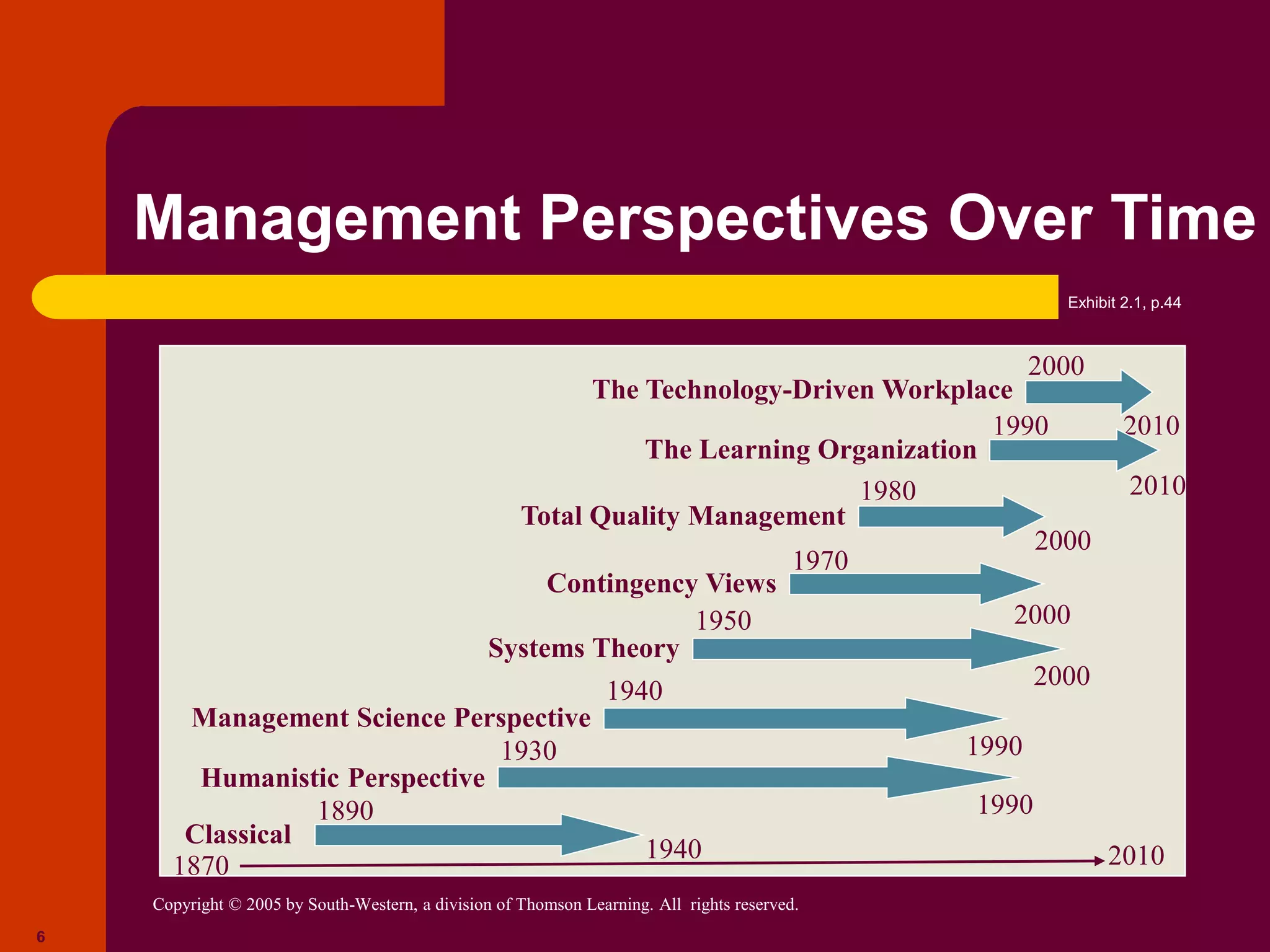
Management Perspectives Over Time
1930
Humanistic Perspective
1990
1890
Classical
1940
1950
2000
Systems Theory
2000
2010
The Technology-Driven Workplace
1990
2010
The Learning Organization
1970
Contingency Views
2000
1980
Total Quality Management
2000
1940
Management Science Perspective
1990
2010
1870
Exhibit 2.1, p.44
Copyright © 2005 by South-Western, a division of Thomson Learning. All rights reserved.
7
Classical Perspective: 3000 B.C.
● Rational, scientific approach to
management – make organizations
efficient operating machines
● Scientific Management
● Bureaucratic Organizations
● Administrative Principles
Copyright © 2005 by South-Western, a division of Thomson Learning. All rights reserved.
8
Scientific Management: Taylor 1856-1915
General Approach
 Developed standard method for performing each
job.
 Selected workers with appropriate abilities for
each job.
 Trained workers in standard method.
 Supported workers by planning work and
eliminating interruptions.
 Provided wage incentives to workers for
increased output.
Copyright © 2005 by South-Western, a division of Thomson Learning. All rights reserved.
9
Scientific Management
Contributions
 Demonstrated the importance of compensation for performance.
 Initiated the careful study of tasks and jobs.
 Demonstrated the importance of personnel and their training.
Criticisms
 Did not appreciate social context of work and higher needs of
workers.
 Did not acknowledge variance among individuals.
 Tended to regard workers as uninformed and ignored their ideas
Copyright © 2005 by South-Western, a division of Thomson Learning. All rights reserved.
10
Bureaucracy Organizations
 Max Weber 1864-1920
 Prior to Bureaucracy Organizations
– European employees were loyal to a single individual
rather than to the organization or its mission
– Resources used to realize individual desires rather
than organizational goals
 Systematic approach –looked at organization
as a whole
Ethical Dilemma: The Supervisor
Copyright © 2005 by South-Western, a division of Thomson Learning. All rights reserved.
11
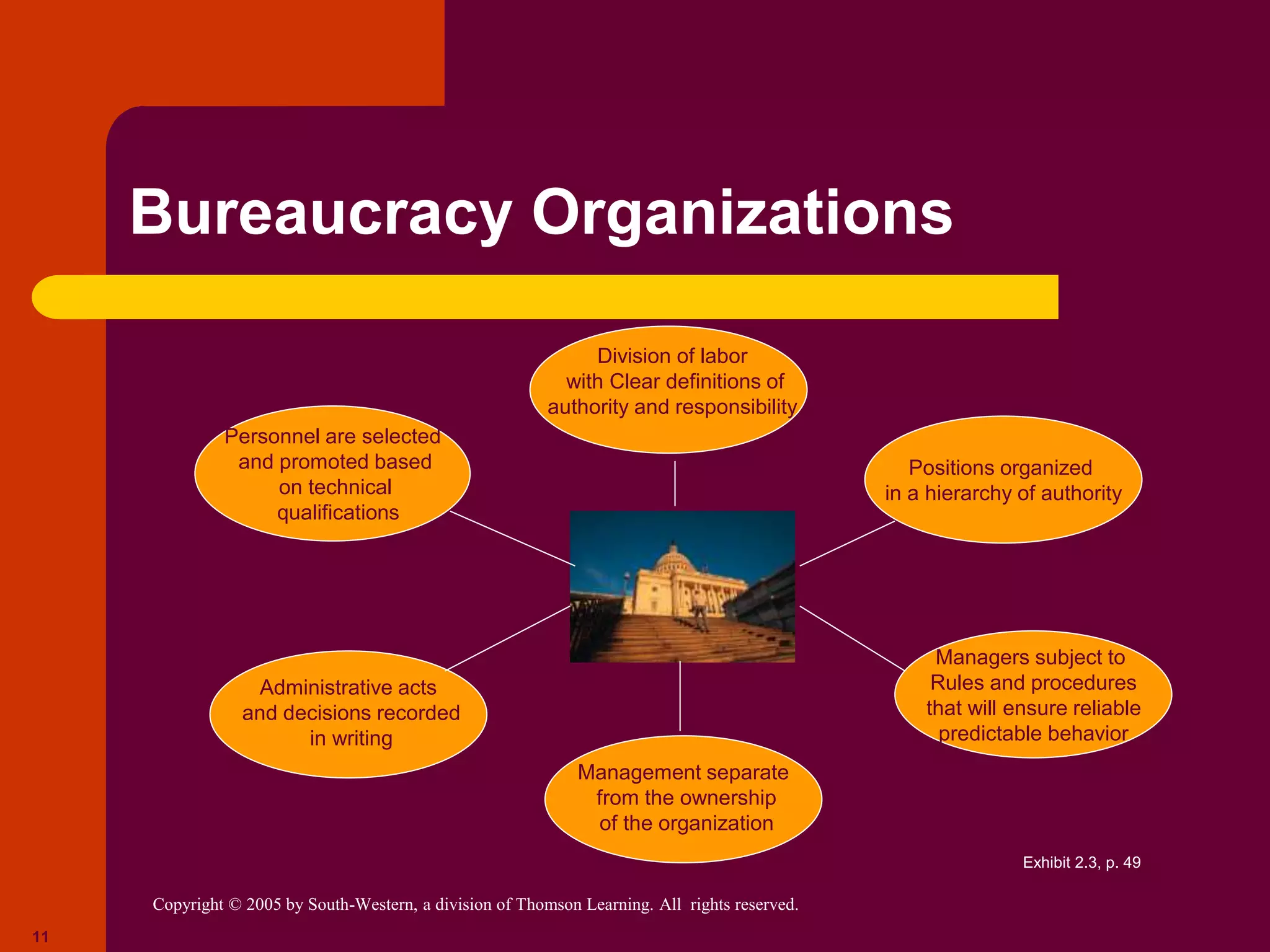
Bureaucracy Organizations
Positions organized
in a hierarchy of authority
Managers subject to
Rules and procedures
that will ensure reliable
predictable behavior
Personnel are selected
and promoted based
on technical
qualifications
Administrative acts
and decisions recorded
in writing
Management separate
from the ownership
of the organization
Division of labor
with Clear definitions of
authority and responsibility
Exhibit 2.3, p. 49
Copyright © 2005 by South-Western, a division of Thomson Learning. All rights reserved.
12
Administrative Principles
 Contributors: Henri Fayol, Mary Parker,
and Chester I. Barnard
 Focus:
– Organization rather than the individual
– Delineated the management functions of
planning, organizing, commanding,
coordinating, and controlling
Copyright © 2005 by South-Western, a division of Thomson Learning. All rights reserved.
13
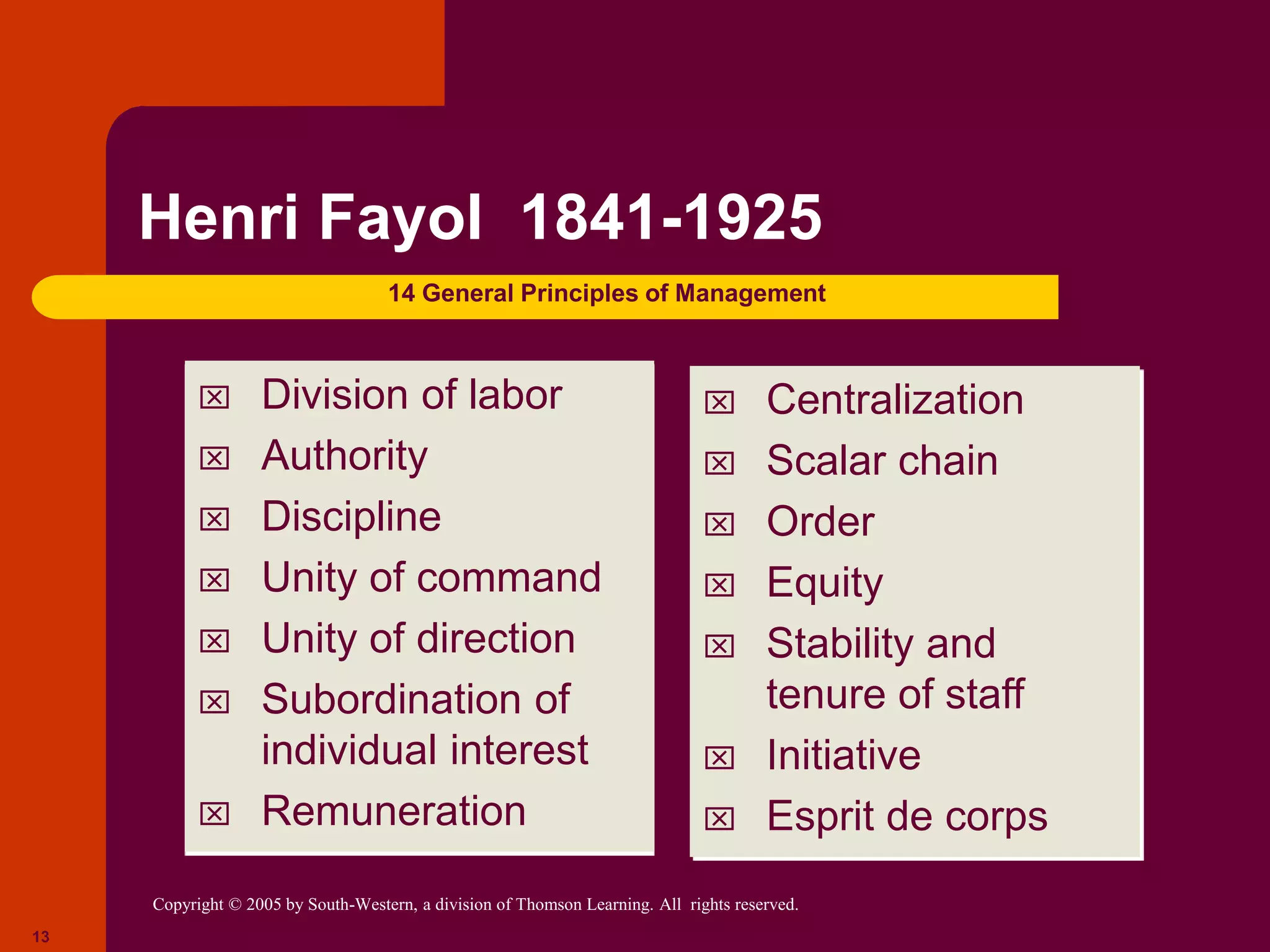
Henri Fayol 1841-1925
 Division of labor
 Authority
 Discipline
 Unity of command
 Unity of direction
 Subordination of
individual interest
 Remuneration
 Centralization
 Scalar chain
 Order
 Equity
 Stability and
tenure of staff
 Initiative
 Esprit de corps
14 General Principles of Management
Copyright © 2005 by South-Western, a division of Thomson Learning. All rights reserved.
14
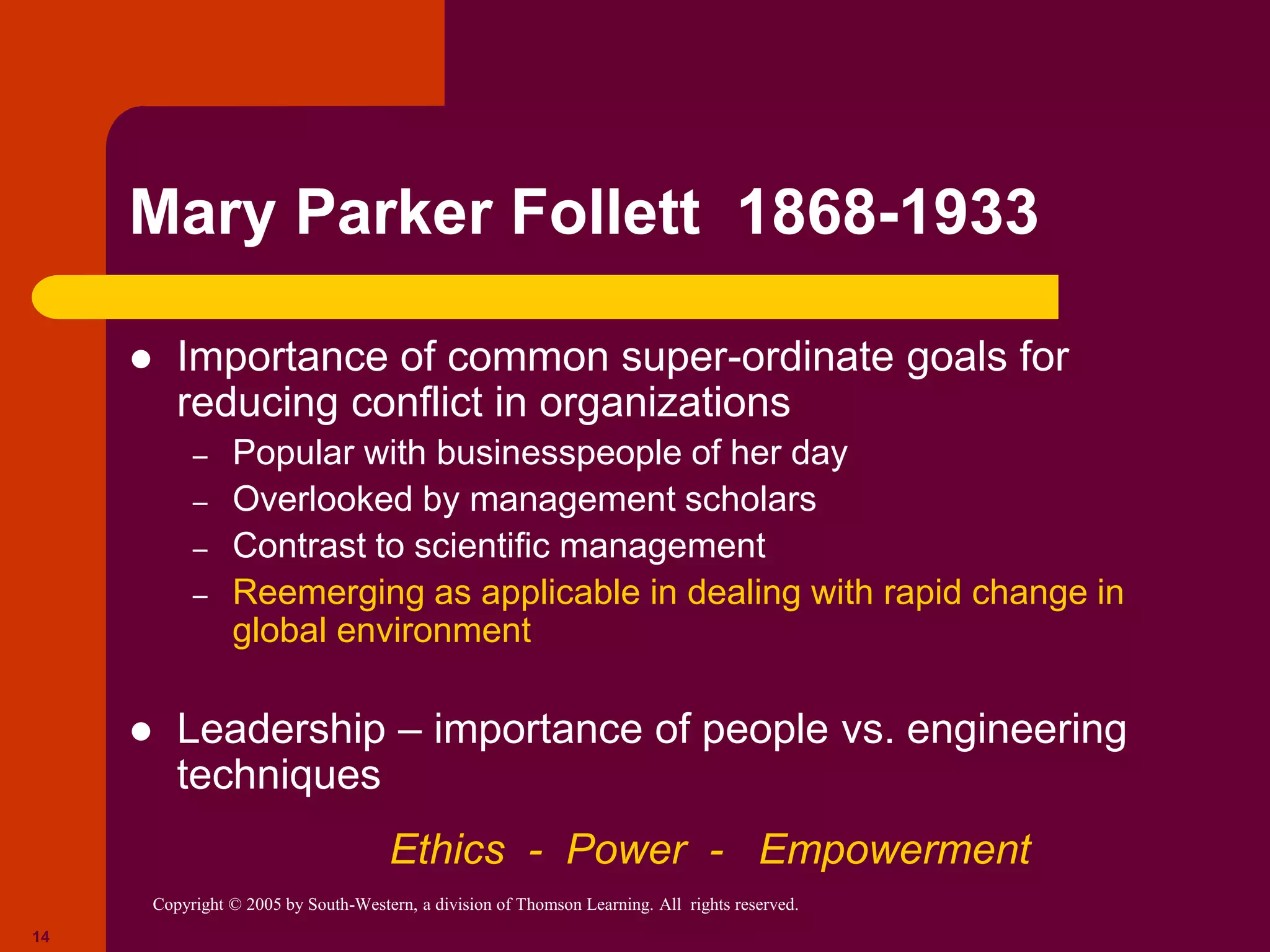
Mary Parker Follett 1868-1933
 Importance of common super-ordinate goals for
reducing conflict in organizations
– Popular with businesspeople of her day
– Overlooked by management scholars
– Contrast to scientific management
– Reemerging as applicable in dealing with rapid change in
global environment
 Leadership – importance of people vs. engineering
techniques
Ethics - Power - Empowerment
Copyright © 2005 by South-Western, a division of Thomson Learning. All rights reserved.
15
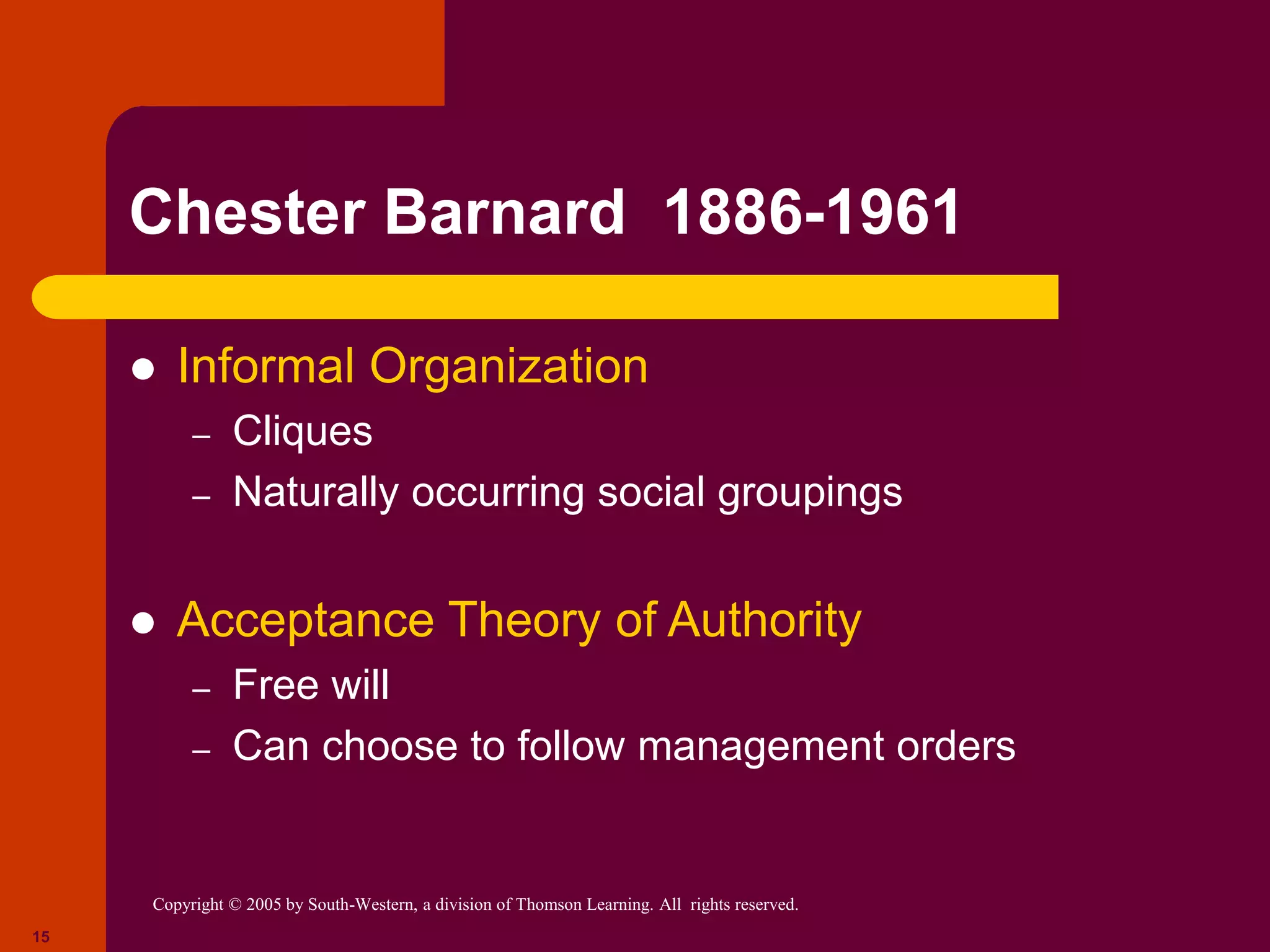
Chester Barnard 1886-1961
 Informal Organization
– Cliques
– Naturally occurring social groupings
 Acceptance Theory of Authority
– Free will
– Can choose to follow management orders
Copyright © 2005 by South-Western, a division of Thomson Learning. All rights reserved.
16
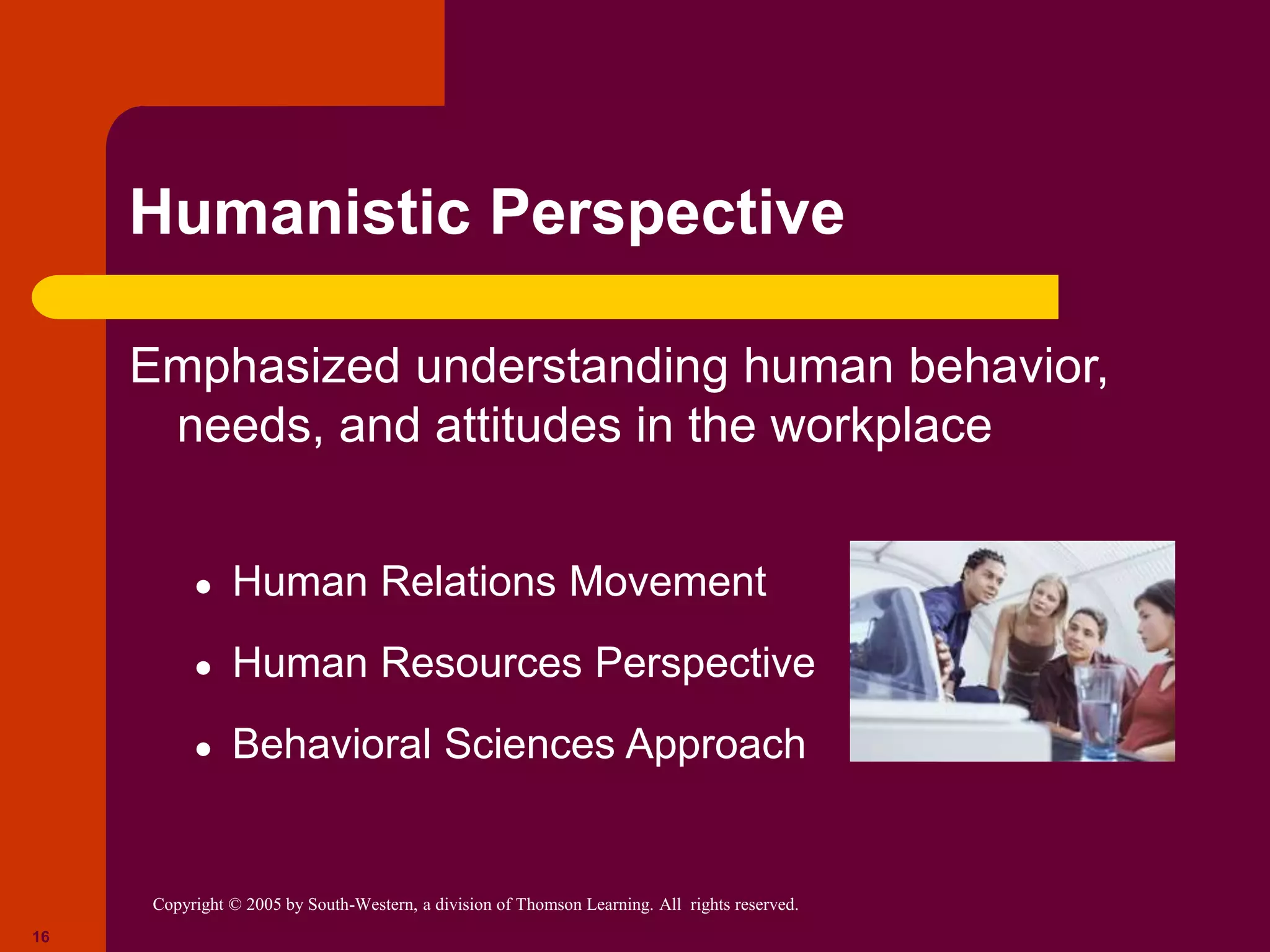
Humanistic Perspective
Emphasized understanding human behavior,
needs, and attitudes in the workplace
● Human Relations Movement
● Human Resources Perspective
● Behavioral Sciences Approach
Copyright © 2005 by South-Western, a division of Thomson Learning. All rights reserved.
17
Human Relations Movement
Emphasized satisfaction of employees’
basic needs as the key to increased
worker productivity
Copyright © 2005 by South-Western, a division of Thomson Learning. All rights reserved.
18
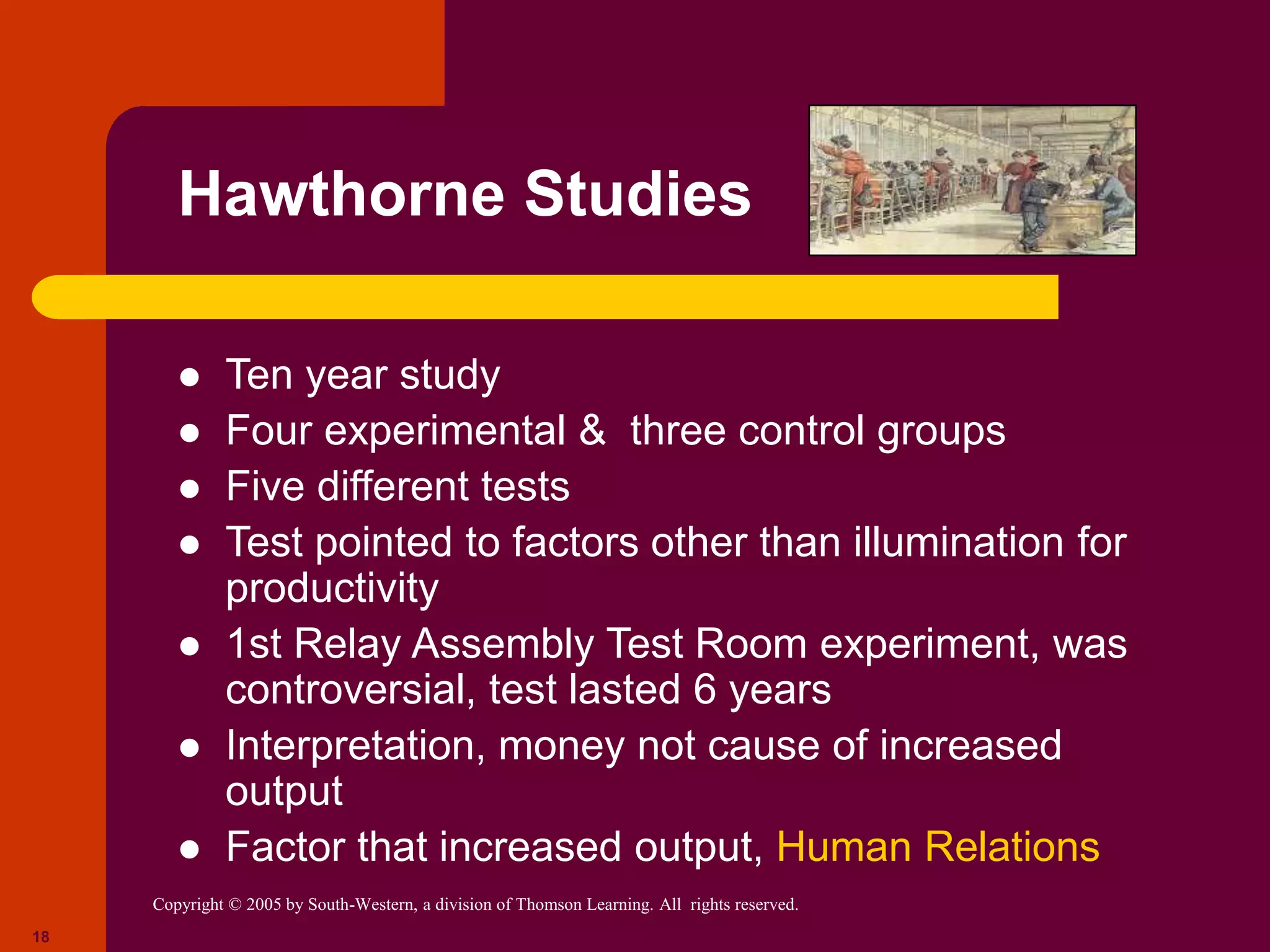
Hawthorne Studies
 Ten year study
 Four experimental & three control groups
 Five different tests
 Test pointed to factors other than illumination for
productivity
 1st Relay Assembly Test Room experiment, was
controversial, test lasted 6 years
 Interpretation, money not cause of increased
output
 Factor that increased output, Human Relations
Copyright © 2005 by South-Western, a division of Thomson Learning. All rights reserved.
19
Human Resource Perspective
Suggests jobs should be designed to meet
higher-level needs by allowing workers to
use their full potential
Copyright © 2005 by South-Western, a division of Thomson Learning. All rights reserved.
20
Physiological
Safety
Belongingness
Esteem
Self-
actualization
Abraham Maslow’s
Hierarchy of Needs
Based on needs satisfaction
1908-1970
Chapter 16 – Maslow in more detail
Copyright © 2005 by South-Western, a division of Thomson Learning. All rights reserved.
21
 Dislike work –will avoid it
 Must be coerced,
controlled, directed, or
threatened with
punishment
 Prefer direction, avoid
responsibility, little
ambition, want security
 Do not dislike work
 Self direction and self
control
 Seek responsibility
 Imagination, creativity
widely distributed
 Intellectual potential
only partially utilized
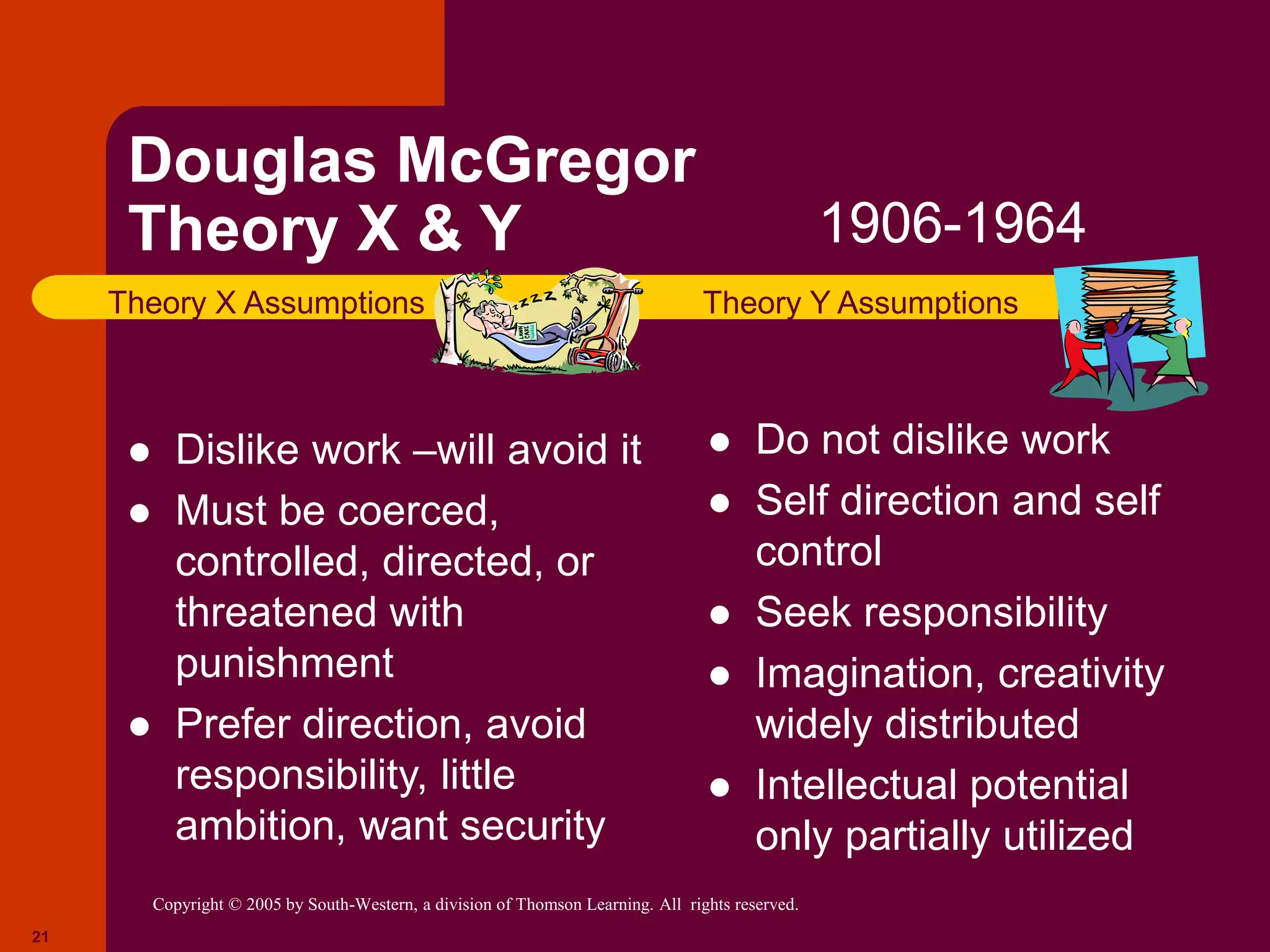
Douglas McGregor
Theory X & Y
Theory X Assumptions Theory Y Assumptions
1906-1964
Copyright © 2005 by South-Western, a division of Thomson Learning. All rights reserved.
22
Douglas McGregor Theory X & Y
 Few companies today still use Theory X
 Many are trying Theory Y techniques
Experiential Exercise: Theory X and Theory Y Scale
Copyright © 2005 by South-Western, a division of Thomson Learning. All rights reserved.
23
Behavioral Sciences Approach
 Applies social science in an organizational
context
 Draws from economics, psychology,
sociology, anthropology, and other
disciplines
– Understand employee behavior and interaction
in an organizational setting
– OD – Organization Development
Sub-field of the Humanistic Management Perspective
Copyright © 2005 by South-Western, a division of Thomson Learning. All rights reserved.
24
Management Science Perspective
 Emerged after WW II
 Applied mathematics, statistics, and other
quantitative techniques to managerial
problems
 Operations Research – mathematical modeling
 Operations Management – specializes in physical
production of goods or services
 Information Technology – reflected in management
information systems
Copyright © 2005 by South-Western, a division of Thomson Learning. All rights reserved.
25
Recent Historical Trends
● Systems Theory
● Contingency View
● Total Quality Management (TQM)
Copyright © 2005 by South-Western, a division of Thomson Learning. All rights reserved.
26
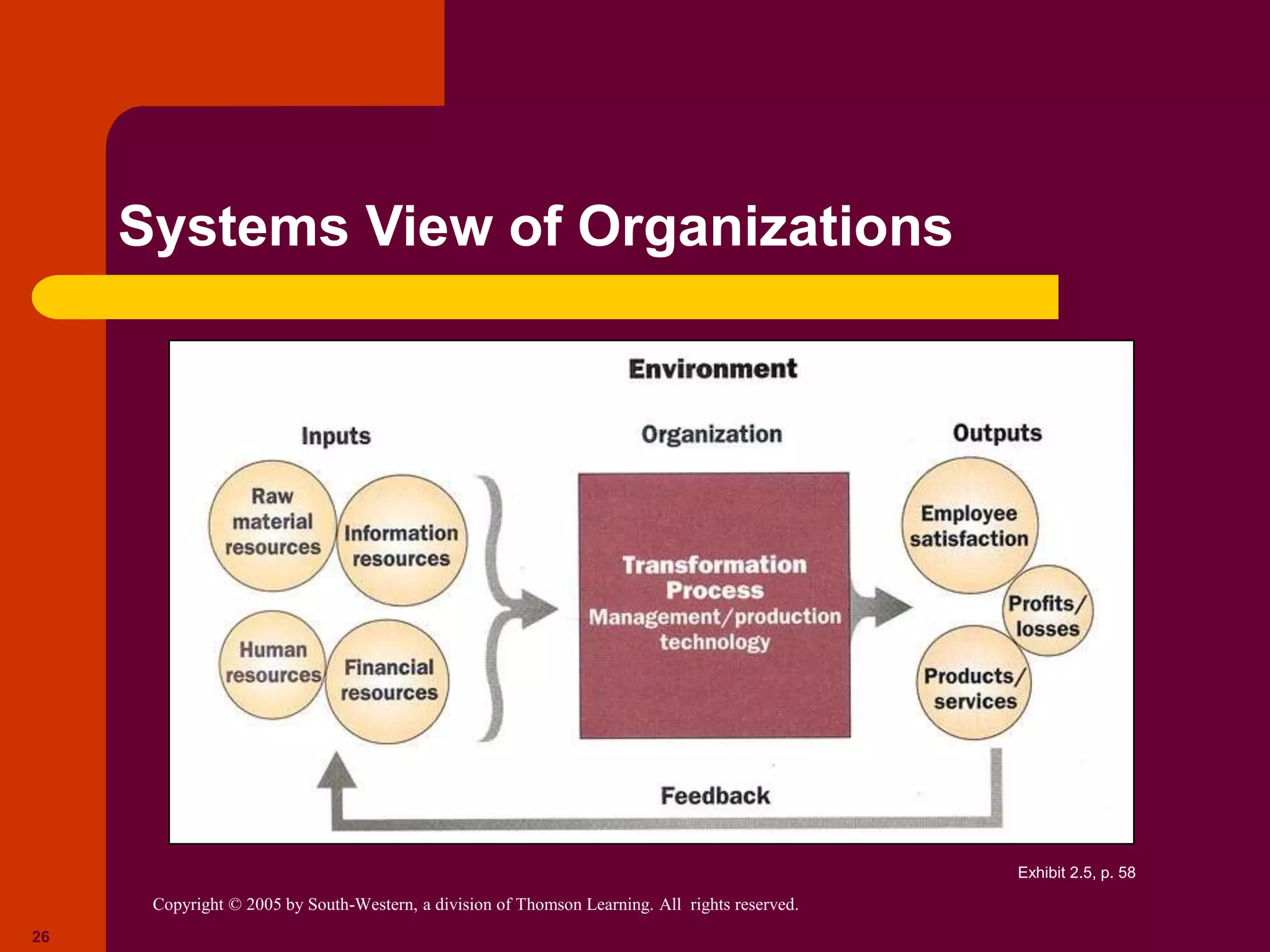
Systems View of Organizations
Exhibit 2.5, p. 58
Copyright © 2005 by South-Western, a division of Thomson Learning. All rights reserved.
27
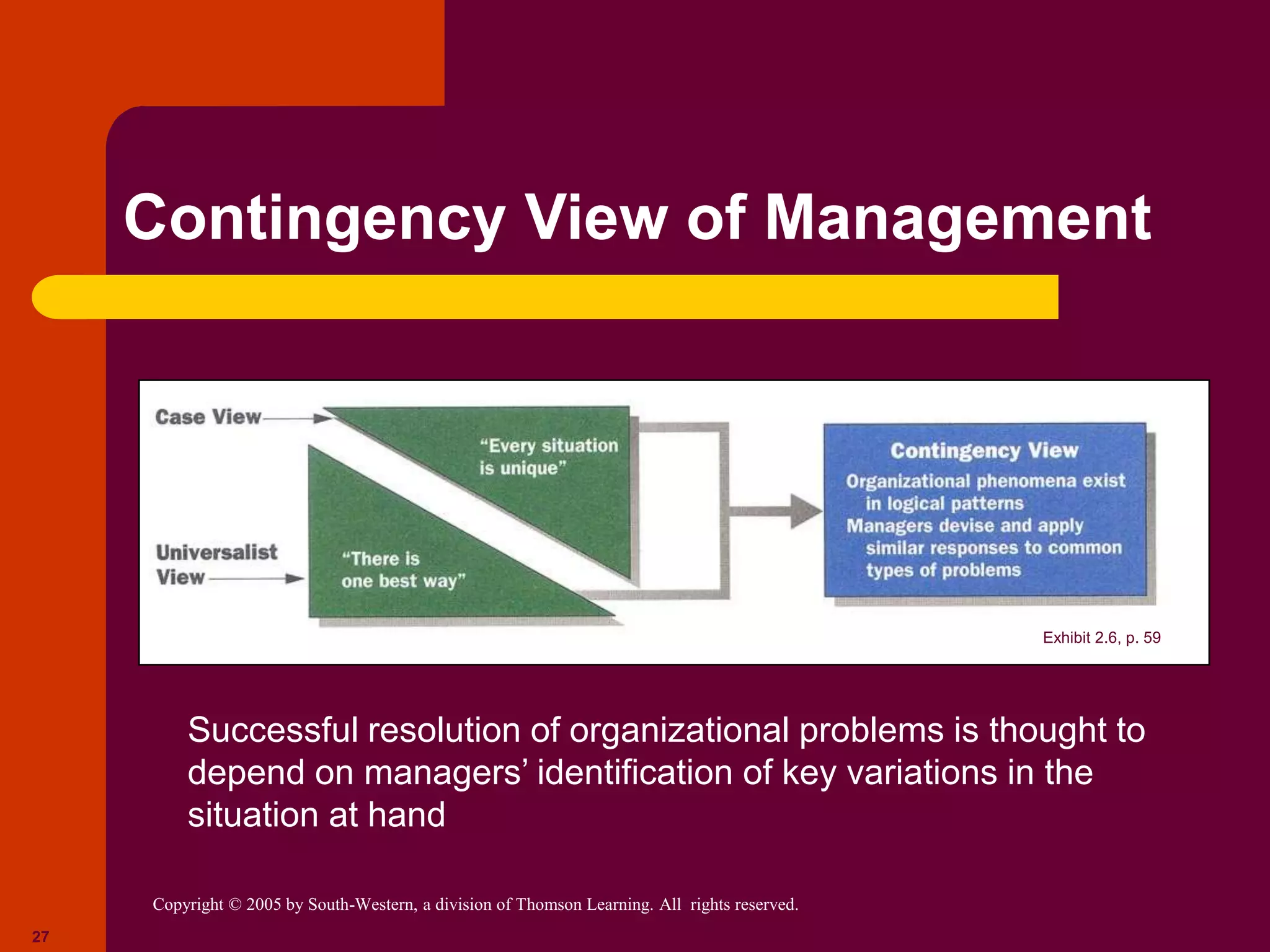
Contingency View of Management
Exhibit 2.6, p. 59
Successful resolution of organizational problems is thought to
depend on managers’ identification of key variations in the
situation at hand
Copyright © 2005 by South-Western, a division of Thomson Learning. All rights reserved.
28
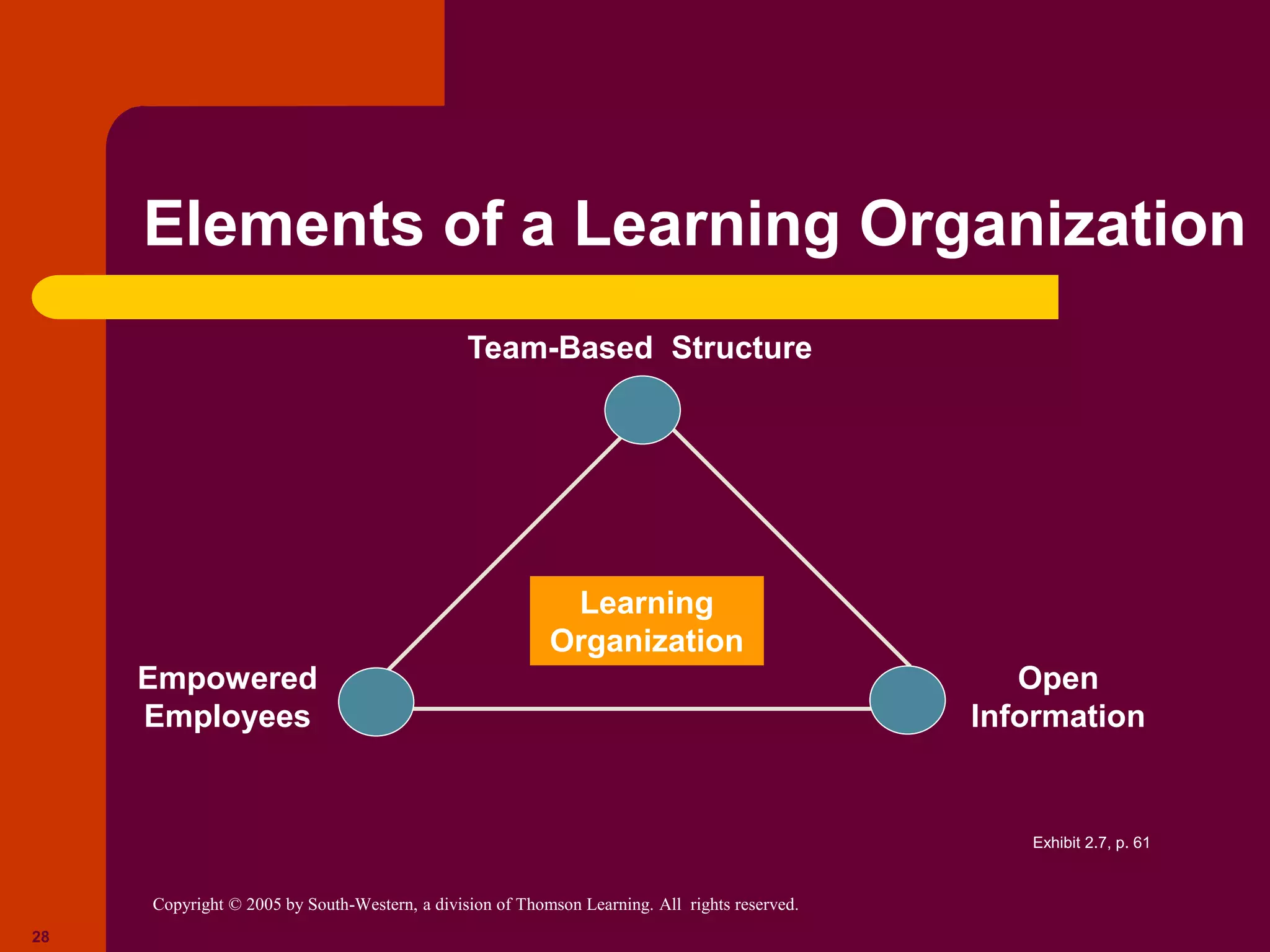
Elements of a Learning Organization
Learning
Organization
Open
Information
Empowered
Employees
Team-Based Structure
Exhibit 2.7, p. 61
Copyright © 2005 by South-Western, a division of Thomson Learning. All rights reserved.
29
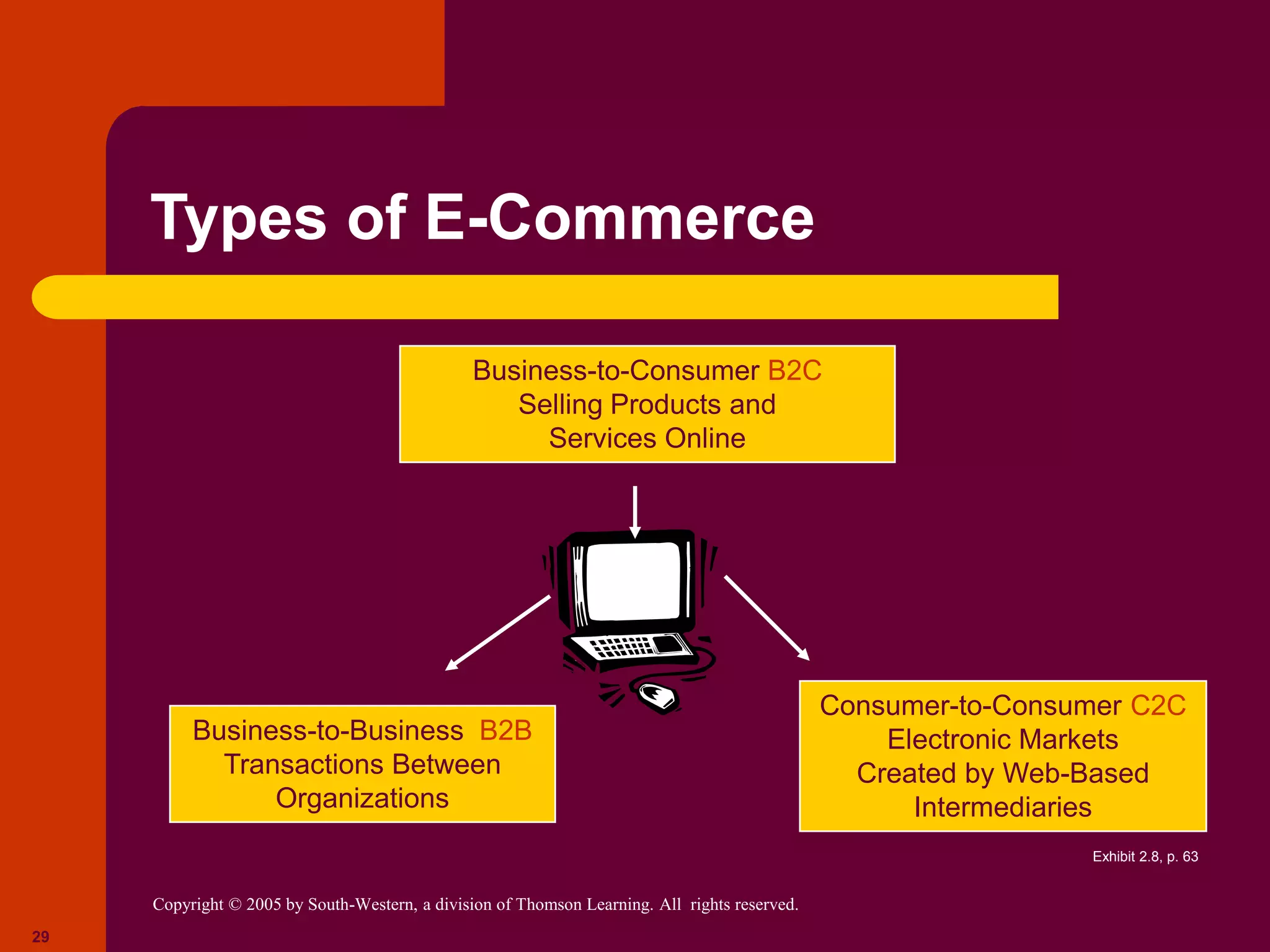
Types of E-Commerce
Business-to-Consumer B2C
Selling Products and
Services Online
Business-to-Business B2B
Transactions Between
Organizations
Consumer-to-Consumer C2C
Electronic Markets
Created by Web-Based
Intermediaries
Exhibit 2.8, p. 63

Ch02-The-Evolution-of-Management-Thinking.ppt

  • 1.
    The Evolution of ManagementThinking Chapter 2
  • 2.
    Copyright © 2005by South-Western, a division of Thomson Learning. All rights reserved. 2 New Approach to Management Success accrues to those who learn how  To be leaders  To Initiate change  To participate in and create organizations – with fewer managers – With less hierarchy that can change quickly
  • 3.
    Copyright © 2005by South-Western, a division of Thomson Learning. All rights reserved. 3 Management and Organization  Management philosophies and organization forms change over time to meet new needs  Some ideas and practices from the past are still relevant and applicable to management today
  • 4.
    Copyright © 2005by South-Western, a division of Thomson Learning. All rights reserved. 4 Historical Perspective  Provides a context or environment  Develops an understanding of societal impact  Achieves strategic thinking  Improves conceptual skills  Social, political, and economic forces have influenced organizations and the practice of management
  • 5.
    Copyright © 2005by South-Western, a division of Thomson Learning. All rights reserved. 5 Forces Influencing Organizations and Management  Social Forces - values, needs, and standards of behavior  Political Forces - influence of political and legal institutions on people & organizations  Economic Forces - forces that affect the availability, production, & distribution of a society’s resources among competing users
  • 6.
    Copyright © 2005by South-Western, a division of Thomson Learning. All rights reserved. 6 Management Perspectives Over Time 1930 Humanistic Perspective 1990 1890 Classical 1940 1950 2000 Systems Theory 2000 2010 The Technology-Driven Workplace 1990 2010 The Learning Organization 1970 Contingency Views 2000 1980 Total Quality Management 2000 1940 Management Science Perspective 1990 2010 1870 Exhibit 2.1, p.44
  • 7.
    Copyright © 2005by South-Western, a division of Thomson Learning. All rights reserved. 7 Classical Perspective: 3000 B.C. ● Rational, scientific approach to management – make organizations efficient operating machines ● Scientific Management ● Bureaucratic Organizations ● Administrative Principles
  • 8.
    Copyright © 2005by South-Western, a division of Thomson Learning. All rights reserved. 8 Scientific Management: Taylor 1856-1915 General Approach  Developed standard method for performing each job.  Selected workers with appropriate abilities for each job.  Trained workers in standard method.  Supported workers by planning work and eliminating interruptions.  Provided wage incentives to workers for increased output.
  • 9.
    Copyright © 2005by South-Western, a division of Thomson Learning. All rights reserved. 9 Scientific Management Contributions  Demonstrated the importance of compensation for performance.  Initiated the careful study of tasks and jobs.  Demonstrated the importance of personnel and their training. Criticisms  Did not appreciate social context of work and higher needs of workers.  Did not acknowledge variance among individuals.  Tended to regard workers as uninformed and ignored their ideas
  • 10.
    Copyright © 2005by South-Western, a division of Thomson Learning. All rights reserved. 10 Bureaucracy Organizations  Max Weber 1864-1920  Prior to Bureaucracy Organizations – European employees were loyal to a single individual rather than to the organization or its mission – Resources used to realize individual desires rather than organizational goals  Systematic approach –looked at organization as a whole Ethical Dilemma: The Supervisor
  • 11.
    Copyright © 2005by South-Western, a division of Thomson Learning. All rights reserved. 11 Bureaucracy Organizations Positions organized in a hierarchy of authority Managers subject to Rules and procedures that will ensure reliable predictable behavior Personnel are selected and promoted based on technical qualifications Administrative acts and decisions recorded in writing Management separate from the ownership of the organization Division of labor with Clear definitions of authority and responsibility Exhibit 2.3, p. 49
  • 12.
    Copyright © 2005by South-Western, a division of Thomson Learning. All rights reserved. 12 Administrative Principles  Contributors: Henri Fayol, Mary Parker, and Chester I. Barnard  Focus: – Organization rather than the individual – Delineated the management functions of planning, organizing, commanding, coordinating, and controlling
  • 13.
    Copyright © 2005by South-Western, a division of Thomson Learning. All rights reserved. 13 Henri Fayol 1841-1925  Division of labor  Authority  Discipline  Unity of command  Unity of direction  Subordination of individual interest  Remuneration  Centralization  Scalar chain  Order  Equity  Stability and tenure of staff  Initiative  Esprit de corps 14 General Principles of Management
  • 14.
    Copyright © 2005by South-Western, a division of Thomson Learning. All rights reserved. 14 Mary Parker Follett 1868-1933  Importance of common super-ordinate goals for reducing conflict in organizations – Popular with businesspeople of her day – Overlooked by management scholars – Contrast to scientific management – Reemerging as applicable in dealing with rapid change in global environment  Leadership – importance of people vs. engineering techniques Ethics - Power - Empowerment
  • 15.
    Copyright © 2005by South-Western, a division of Thomson Learning. All rights reserved. 15 Chester Barnard 1886-1961  Informal Organization – Cliques – Naturally occurring social groupings  Acceptance Theory of Authority – Free will – Can choose to follow management orders
  • 16.
    Copyright © 2005by South-Western, a division of Thomson Learning. All rights reserved. 16 Humanistic Perspective Emphasized understanding human behavior, needs, and attitudes in the workplace ● Human Relations Movement ● Human Resources Perspective ● Behavioral Sciences Approach
  • 17.
    Copyright © 2005by South-Western, a division of Thomson Learning. All rights reserved. 17 Human Relations Movement Emphasized satisfaction of employees’ basic needs as the key to increased worker productivity
  • 18.
    Copyright © 2005by South-Western, a division of Thomson Learning. All rights reserved. 18 Hawthorne Studies  Ten year study  Four experimental & three control groups  Five different tests  Test pointed to factors other than illumination for productivity  1st Relay Assembly Test Room experiment, was controversial, test lasted 6 years  Interpretation, money not cause of increased output  Factor that increased output, Human Relations
  • 19.
    Copyright © 2005by South-Western, a division of Thomson Learning. All rights reserved. 19 Human Resource Perspective Suggests jobs should be designed to meet higher-level needs by allowing workers to use their full potential
  • 20.
    Copyright © 2005by South-Western, a division of Thomson Learning. All rights reserved. 20 Physiological Safety Belongingness Esteem Self- actualization Abraham Maslow’s Hierarchy of Needs Based on needs satisfaction 1908-1970 Chapter 16 – Maslow in more detail
  • 21.
    Copyright © 2005by South-Western, a division of Thomson Learning. All rights reserved. 21  Dislike work –will avoid it  Must be coerced, controlled, directed, or threatened with punishment  Prefer direction, avoid responsibility, little ambition, want security  Do not dislike work  Self direction and self control  Seek responsibility  Imagination, creativity widely distributed  Intellectual potential only partially utilized Douglas McGregor Theory X & Y Theory X Assumptions Theory Y Assumptions 1906-1964
  • 22.
    Copyright © 2005by South-Western, a division of Thomson Learning. All rights reserved. 22 Douglas McGregor Theory X & Y  Few companies today still use Theory X  Many are trying Theory Y techniques Experiential Exercise: Theory X and Theory Y Scale
  • 23.
    Copyright © 2005by South-Western, a division of Thomson Learning. All rights reserved. 23 Behavioral Sciences Approach  Applies social science in an organizational context  Draws from economics, psychology, sociology, anthropology, and other disciplines – Understand employee behavior and interaction in an organizational setting – OD – Organization Development Sub-field of the Humanistic Management Perspective
  • 24.
    Copyright © 2005by South-Western, a division of Thomson Learning. All rights reserved. 24 Management Science Perspective  Emerged after WW II  Applied mathematics, statistics, and other quantitative techniques to managerial problems  Operations Research – mathematical modeling  Operations Management – specializes in physical production of goods or services  Information Technology – reflected in management information systems
  • 25.
    Copyright © 2005by South-Western, a division of Thomson Learning. All rights reserved. 25 Recent Historical Trends ● Systems Theory ● Contingency View ● Total Quality Management (TQM)
  • 26.
    Copyright © 2005by South-Western, a division of Thomson Learning. All rights reserved. 26 Systems View of Organizations Exhibit 2.5, p. 58
  • 27.
    Copyright © 2005by South-Western, a division of Thomson Learning. All rights reserved. 27 Contingency View of Management Exhibit 2.6, p. 59 Successful resolution of organizational problems is thought to depend on managers’ identification of key variations in the situation at hand
  • 28.
    Copyright © 2005by South-Western, a division of Thomson Learning. All rights reserved. 28 Elements of a Learning Organization Learning Organization Open Information Empowered Employees Team-Based Structure Exhibit 2.7, p. 61
  • 29.
    Copyright © 2005by South-Western, a division of Thomson Learning. All rights reserved. 29 Types of E-Commerce Business-to-Consumer B2C Selling Products and Services Online Business-to-Business B2B Transactions Between Organizations Consumer-to-Consumer C2C Electronic Markets Created by Web-Based Intermediaries Exhibit 2.8, p. 63