









ICBM-SCHOOLOF BUSINESSEXCELLENCE
Page 1
PROJECTREPORT ON
SUBMITTED TO-
(__________________) PREPARED BY-
Dr.KUNAL GAURAV T.KRUSHIKUMAR
DATE-17TH MAR’16 SECTION-C
ROLL NO-109
ICBM-SCHOOLOF BUSINESSEXCELLENCE
Page 2
INDEX
INTRODUCTION
PROFILE OF COMPANY
HISTORY
BRAND PORTFOLIO
HISTORICAL PERSPECTIVE
PRESENT ADVERTISEMENT
CONCULSION
ICBM-SCHOOLOF BUSINESSEXCELLENCE
Page 3
INTRODUCTION:
Indian automobile industry
The automobile industry in India is the ninth largest in the world with an annual
production of over 2.3 million units in 2008. In 2009, India emerged as Asia's fourth
largest exporter of automobiles, behind Japan, South Korea and Thailand.
India’s automobile sector consists of the passenger cars and utility vehicles, commercial
vehicle, two wheelers and tractors segment. The total market size of the auto sector in
India is approximately Rs 540 billion and has been growing at around 8percent per
annum for the last few years. Since the last four to five years, the two wheelers segment
has driven the overall volume growth on account of the spurt in the sales of
motorcycles. However, lately the passenger cars and commercial vehicles segment has
also seen a good growth due to high discounts, lower financing rates and a pickup in
industrial activity respectively.
Major automobile manufacturers in India include Maruti Udyog Ltd., General
MotorsIndia, Ford India Ltd., Eicher Motors, Bajaj Auto, Daewoo Motors India, Hero
HondaMotors, Hindustan Motors, Hyundai Motor India Ltd., Royal Enfield Motors,
TVSMotors and Swaraj Mazda Ltd.With the economy growing at 9% per annum and
increasing purchasing power there has been a continuous increase in demand for
automobiles. This, along with being the second largest populated country, makes the
automobile industry in India a very promising one
.
Indian two wheeler market
Ever since the old Lambretta scooter was replaced with the flurry of vibrant two-wheeler
models, Indian two wheeler industry has seen a phenomenal change in the way they
perceive the Indian market. Two wheeler manufacturers are now competing in an ever
growing consumer market by bringing out new products and features. The country has
now grown into the second largest producer of two wheelers in the world.
Currently there are around 10 two-wheeler manufacturers in the country, and they are
Bajaj, Hero, Hero Honda, Honda, Mahindra/Kinetic, Royal Enfield, Suzuki, TVS, and
Yamaha. There have been various reasons behind this growth. Because of poor public
transport system, the citizens found convenience in two wheelers. Added to this is the
fact that the average Indian still does not have the purchasing capacity for a more
expensive, four wheeler.
ICBM-SCHOOLOF BUSINESSEXCELLENCE
Page 4
The Indian two wheeler industries can be divided into motorcycles, scooters and
mopeds. The consumer has changed his preference from mopeds to scooters and then
to motorcycles. The trends seen in the past few years include female’s increasingly
using two-wheelers for their personal commutation and various two wheeler
manufacturers designing vehicles specially to cater to needs of this segment.
One of the earliest revolutions in this industry was Kinetic’s introduction of the concept
of electronic/self-start and automatic gears which made two wheelers comfortable and
useable by women, when compared to old Bajaj Chetak advertisements which showed
middle aged females riding a Bajaj Chetak scooter.
A recent trend in the industry has been electric vehicles, which mostly leverage on their
eco-friendliness and low operating costs, but is still not accepted well due to the lack of
reputation of the manufacturers and lack of trust on technology, which is still being
perceived in the nascent stages, especially battery and inverters which prove to be very
expensive components.
TVS recently leveraged this opportunity by launching a hybrid model of their non geared
scooter – TVS Scooty. The end of the last decade saw Bajaj taking a radical decision to
do away with the Scooter range and completely concentrate on motorcycles, especially
stating change in customer’s preference as the main reason.
The customers are left without a choice in most cases than to migrate from the
traditional scooters of the Indian family to the all youthful bikes that one’s son rides to
college.
ICBM-SCHOOLOF BUSINESSEXCELLENCE
Page 5
PROFILE OF ROYAL ENFIELD:
Royal Enfield was the brand name under which the Enfield Cycle Company (founded
1893) manufactured motorcycles, bicycles, lawnmowers and stationary engines. The
first Royal Enfield motorcycle was built in 1901; the original British concern was defunct
by 1970. The Enfield Cycle Company is responsible for the design and original
production of the Royal Enfield Bullet, the longest-lived motorcycle design in history.
In 1955, Enfield Cycle Company partnered with Madras Motors in India in
forming Enfield of India, based in Chennai, and started assembling the 350cc Royal
Enfield Bullet motorcycle in Madras. The first machines were assembled from
components imported from England. Starting in 1957, Enfield of India acquired the
machines necessary to build components in India, and by 1962 all components were
made in India.
Royal Enfield produced bicycles at its Red ditch factory until it closed in early 1967. The
company's last new bicycle was the 'Revelation' small wheeler, which was released in
1965.Production of motorcycles ceased in 1970 and the original Red ditch,
Worcestershire-based Company was dissolved in 1971. Enfield of India continued
ICBM-SCHOOLOF BUSINESSEXCELLENCE
Page 6
producing the 'Bullet', and began branding its motorcycles 'Royal Enfield' in 1999. A
lawsuit over the use of 'Royal', brought by trademark owner David Holder, was judged in
favor of Enfield of India, who now produces motorcycles under the Royal Enfield name
HISTORY:
In 1893, the Enfield Manufacturing Company Ltd was registered to manufacture
bicycles, adopting the branding Royal Enfield.
By 1899, Royal Enfield were producing a quadricycle – a bicycle modified by adding a
wrap-around four-wheeled frame, retaining a rear rider-saddle with handlebars – having
a front-mounted passenger seat, driven by a rear-mounted De Dion engine.
After experimenting with a heavy bicycle frame fitted with a Minerva engine clamped to
the front down tube, Enfield built their first motorcycle in 1901 with a 239 cc engine.
In 1907, Enfield merged with the Allays & Onions Pneumatic Engineering Co. of
Birmingham, and began manufacturing the Enfield-Allay automobile.
By 1910, Royal Enfield was using 344 cc Swiss Motosacoche V-Twin engines, or large-
displacement JAP and Vickers-Wellesley engines.
In 1912, the Royal Enfield Model 180 sidecar combination was introduced with a 770 cc
V-twin JAP engine which was raced successfully in the Isle of Man TT and
at Brooklands.
ICBM-SCHOOLOF BUSINESSEXCELLENCE
Page 7
First World War (1911–1921)
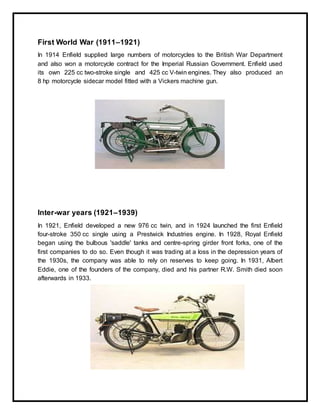
In 1914 Enfield supplied large numbers of motorcycles to the British War Department
and also won a motorcycle contract for the Imperial Russian Government. Enfield used
its own 225 cc two-stroke single and 425 cc V-twin engines. They also produced an
8 hp motorcycle sidecar model fitted with a Vickers machine gun.
Inter-war years (1921–1939)
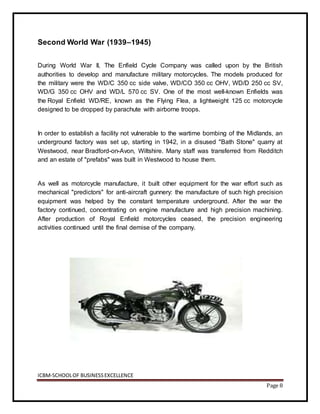
In 1921, Enfield developed a new 976 cc twin, and in 1924 launched the first Enfield
four-stroke 350 cc single using a Prestwick Industries engine. In 1928, Royal Enfield
began using the bulbous 'saddle' tanks and centre-spring girder front forks, one of the
first companies to do so. Even though it was trading at a loss in the depression years of
the 1930s, the company was able to rely on reserves to keep going. In 1931, Albert
Eddie, one of the founders of the company, died and his partner R.W. Smith died soon
afterwards in 1933.
ICBM-SCHOOLOF BUSINESSEXCELLENCE
Page 8
Second World War (1939–1945)
During World War II, The Enfield Cycle Company was called upon by the British
authorities to develop and manufacture military motorcycles. The models produced for
the military were the WD/C 350 cc side valve, WD/CO 350 cc OHV, WD/D 250 cc SV,
WD/G 350 cc OHV and WD/L 570 cc SV. One of the most well-known Enfields was
the Royal Enfield WD/RE, known as the Flying Flea, a lightweight 125 cc motorcycle
designed to be dropped by parachute with airborne troops.
In order to establish a facility not vulnerable to the wartime bombing of the Midlands, an
underground factory was set up, starting in 1942, in a disused "Bath Stone" quarry at
Westwood, near Bradford-on-Avon, Wiltshire. Many staff was transferred from Redditch
and an estate of "prefabs" was built in Westwood to house them.
As well as motorcycle manufacture, it built other equipment for the war effort such as
mechanical "predictors" for anti-aircraft gunnery: the manufacture of such high precision
equipment was helped by the constant temperature underground. After the war the
factory continued, concentrating on engine manufacture and high precision machining.
After production of Royal Enfield motorcycles ceased, the precision engineering
activities continued until the final demise of the company.
ICBM-SCHOOLOF BUSINESSEXCELLENCE
Page 9
BRAND PORFOLIO:
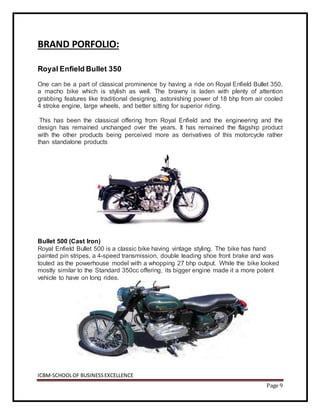
Royal Enfield Bullet 350
One can be a part of classical prominence by having a ride on Royal Enfield Bullet 350,
a macho bike which is stylish as well. The brawny is laden with plenty of attention
grabbing features like traditional designing, astonishing power of 18 bhp from air cooled
4 stroke engine, large wheels, and better sitting for superior riding.
This has been the classical offering from Royal Enfield and the engineering and the
design has remained unchanged over the years. It has remained the flagship product
with the other products being perceived more as derivatives of this motorcycle rather
than standalone products
Bullet 500 (Cast Iron)
Royal Enfield Bullet 500 is a classic bike having vintage styling. The bike has hand
painted pin stripes, a 4-speed transmission, double leading shoe front brake and was
touted as the powerhouse model with a whopping 27 bhp output. While the bike looked
mostly similar to the Standard 350cc offering, its bigger engine made it a more potent
vehicle to have on long rides.
ICBM-SCHOOLOF BUSINESSEXCELLENCE
Page 10
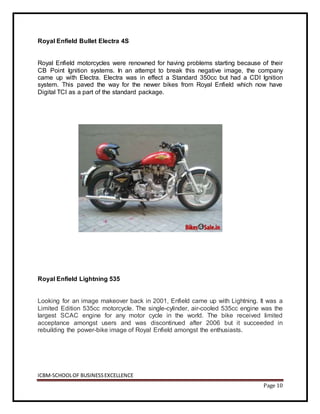
Royal Enfield Bullet Electra 4S
Royal Enfield motorcycles were renowned for having problems starting because of their
CB Point Ignition systems. In an attempt to break this negative image, the company
came up with Electra. Electra was in effect a Standard 350cc but had a CDI Ignition
system. This paved the way for the newer bikes from Royal Enfield which now have
Digital TCI as a part of the standard package.
Royal Enfield Lightning 535
Looking for an image makeover back in 2001, Enfield came up with Lightning. It was a
Limited Edition 535cc motorcycle. The single-cylinder, air-cooled 535cc engine was the
largest SCAC engine for any motor cycle in the world. The bike received limited
acceptance amongst users and was discontinued after 2006 but it succeeded in
rebuilding the power-bike image of Royal Enfield amongst the enthusiasts.
ICBM-SCHOOLOF BUSINESSEXCELLENCE
Page 11
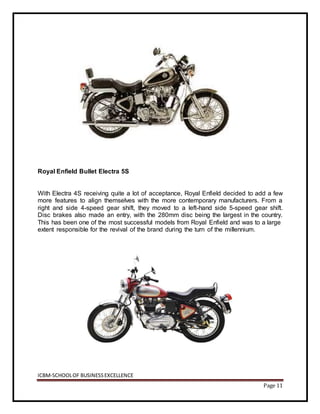
Royal Enfield Bullet Electra 5S
With Electra 4S receiving quite a lot of acceptance, Royal Enfield decided to add a few
more features to align themselves with the more contemporary manufacturers. From a
right and side 4-speed gear shift, they moved to a left-hand side 5-speed gear shift.
Disc brakes also made an entry, with the 280mm disc being the largest in the country.
This has been one of the most successful models from Royal Enfield and was to a large
extent responsible for the revival of the brand during the turn of the millennium.
ICBM-SCHOOLOF BUSINESSEXCELLENCE
Page 12
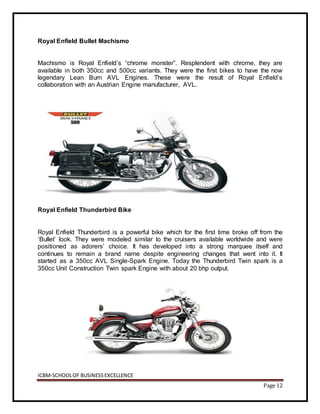
Royal Enfield Bullet Machismo
Machismo is Royal Enfield’s “chrome monster”. Resplendent with chrome, they are
available in both 350cc and 500cc variants. They were the first bikes to have the now
legendary Lean Burn AVL Engines. These were the result of Royal Enfield’s
collaboration with an Austrian Engine manufacturer, AVL.
Royal Enfield Thunderbird Bike
Royal Enfield Thunderbird is a powerful bike which for the first time broke off from the
‘Bullet’ look. They were modeled similar to the cruisers available worldwide and were
positioned as adorers’ choice. It has developed into a strong marquee itself and
continues to remain a brand name despite engineering changes that went into it. It
started as a 350cc AVL Single-Spark Engine. Today the Thunderbird Twin spark is a
350cc Unit Construction Twin spark Engine with about 20 bhp output.
ICBM-SCHOOLOF BUSINESSEXCELLENCE
Page 13
Royal Enfield Classic
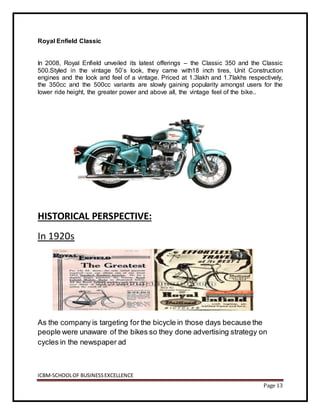
In 2008, Royal Enfield unveiled its latest offerings – the Classic 350 and the Classic
500.Styled in the vintage 50’s look, they came with18 inch tires, Unit Construction
engines and the look and feel of a vintage. Priced at 1.3lakh and 1.7lakhs respectively,
the 350cc and the 500cc variants are slowly gaining popularity amongst users for the
lower ride height, the greater power and above all, the vintage feel of the bike..
HISTORICAL PERSPECTIVE:
In 1920s
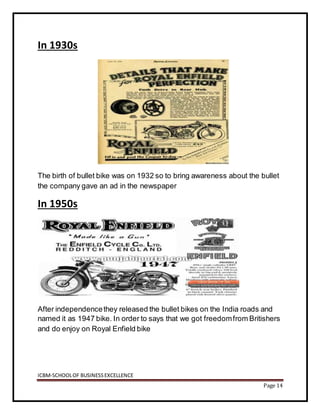
As the company is targeting for the bicycle in those days because the
people were unaware of the bikes so they done advertising strategy on
cycles in the newspaper ad
ICBM-SCHOOLOF BUSINESSEXCELLENCE
Page 14
In 1930s
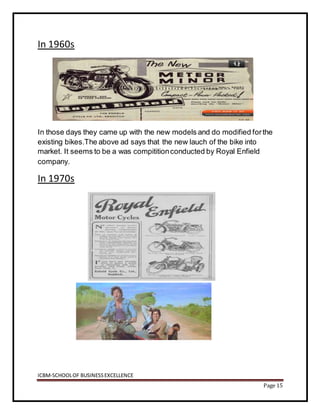
The birth of bullet bike was on 1932 so to bring awareness about the bullet
the company gave an ad in the newspaper
In 1950s
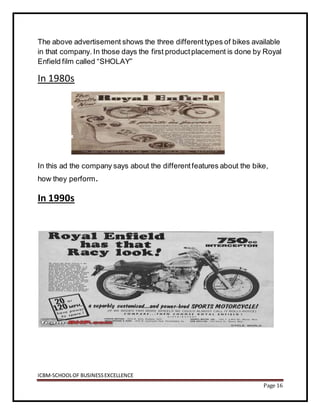
After independencethey released the bullet bikes on the India roads and
named it as 1947 bike. In order to says that we got freedomfrom Britishers
and do enjoy on Royal Enfield bike
ICBM-SCHOOLOF BUSINESSEXCELLENCE
Page 15
In 1960s
In those days they came up with the new models and do modified forthe
existing bikes.The above ad says that the new lauch of the bike into
market. It seems to be a was compititionconducted by Royal Enfield
company.
In 1970s
ICBM-SCHOOLOF BUSINESSEXCELLENCE
Page 16
The above advertisement shows the three differenttypes of bikes available
in that company. In those days the first productplacement is done by Royal
Enfield film called “SHOLAY”
In 1980s
In this ad the company says about the differentfeatures about the bike,
how they perform.
In 1990s
ICBM-SCHOOLOF BUSINESSEXCELLENCE
Page 17
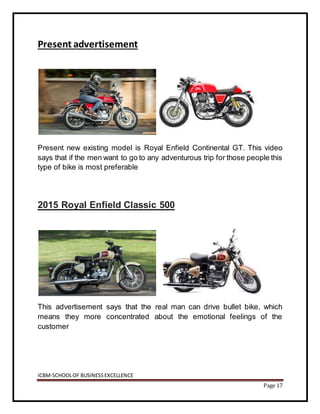
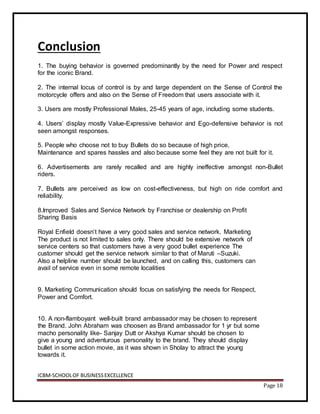
Present advertisement
Present new existing model is Royal Enfield Continental GT. This video
says that if the men want to go to any adventurous trip for those people this
type of bike is most preferable
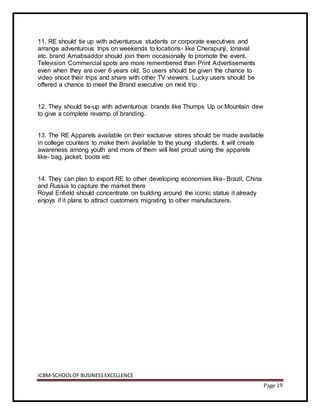
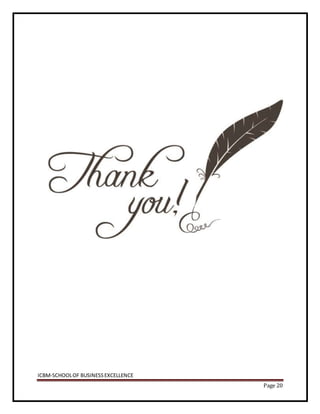
2015 Royal Enfield Classic 500
This advertisement says that the real man can drive bullet bike, which
means they more concentrated about the emotional feelings of the
customer
ICBM-SCHOOLOF BUSINESSEXCELLENCE
Page 18
Conclusion
1. The buying behavior is governed predominantly by the need for Power and respect
for the iconic Brand.
2. The internal locus of control is by and large dependent on the Sense of Control the
motorcycle offers and also on the Sense of Freedom that users associate with it.
3. Users are mostly Professional Males, 25-45 years of age, including some students.
4. Users’ display mostly Value-Expressive behavior and Ego-defensive behavior is not
seen amongst responses.
5. People who choose not to buy Bullets do so because of high price,
Maintenance and spares hassles and also because some feel they are not built for it.
6. Advertisements are rarely recalled and are highly ineffective amongst non-Bullet
riders.
7. Bullets are perceived as low on cost-effectiveness, but high on ride comfort and
reliability.
8.Improved Sales and Service Network by Franchise or dealership on Profit
Sharing Basis
Royal Enfield doesn’t have a very good sales and service network. Marketing
The product is not limited to sales only. There should be extensive network of
service centers so that customers have a very good bullet experience The
customer should get the service network similar to that of Maruti –Suzuki.
Also a helpline number should be launched, and on calling this, customers can
avail of service even in some remote localities
9. Marketing Communication should focus on satisfying the needs for Respect,
Power and Comfort.
10. A non-flamboyant well-built brand ambassador may be chosen to represent
the Brand. John Abraham was choosen as Brand ambassador for 1 yr but some
macho personality like- Sanjay Dutt or Akshya Kumar should be chosen to
give a young and adventurous personality to the brand. They should display
bullet in some action movie, as it was shown in Sholay to attract the young
towards it.
ICBM-SCHOOLOF BUSINESSEXCELLENCE
Page 19
11. RE should tie up with adventurous students or corporate executives and
arrange adventurous trips on weekends to locations- like Cherapunji, lonaval
etc. brand Amabsaddor should join them occasionally to promote the event.
Television Commercial spots are more remembered than Print Advertisements
even when they are over 6 years old. So users should be given the chance to
video shoot their trips and share with other TV viewers. Lucky users should be
offered a chance to meet the Brand executive on next trip
12. They should tie-up with adventurous brands like Thumps Up or Mountain dew
to give a complete revamp of branding.
13. The RE Apparels available on their exclusive stores should be made available
in college counters to make them available to the young students. It will create
awareness among youth and more of them will feel proud using the apparels
like- bag, jacket, boots etc
14. They can plan to export RE to other developing economies like- Brazil, China
and Russia to capture the market there
Royal Enfield should concentrate on building around the iconic status it already
enjoys if it plans to attract customers migrating to other manufacturers.
ICBM-SCHOOLOF BUSINESSEXCELLENCE
Page 20
ICBM-SCHOOLOF BUSINESSEXCELLENCE
Page 21
ICBM-SCHOOLOF BUSINESSEXCELLENCE
Page 22
ICBM-SCHOOLOF BUSINESSEXCELLENCE
Page 23
ICBM-SCHOOLOF BUSINESSEXCELLENCE
Page 24
ICBM-SCHOOLOF BUSINESSEXCELLENCE
Page 25
ICBM-SCHOOLOF BUSINESSEXCELLENCE
Page 26
ICBM-SCHOOLOF BUSINESSEXCELLENCE
Page 27
ICBM-SCHOOLOF BUSINESSEXCELLENCE
Page 28
ICBM-SCHOOLOF BUSINESSEXCELLENCE
Page 29
ICBM-SCHOOLOF BUSINESSEXCELLENCE
Page 30

Royal Enfield

  • 1.
    ICBM-SCHOOLOF BUSINESSEXCELLENCE Page 1 PROJECTREPORTON SUBMITTED TO- (__________________) PREPARED BY- Dr.KUNAL GAURAV T.KRUSHIKUMAR DATE-17TH MAR’16 SECTION-C ROLL NO-109
  • 2.
    ICBM-SCHOOLOF BUSINESSEXCELLENCE Page 2 INDEX INTRODUCTION PROFILEOF COMPANY HISTORY BRAND PORTFOLIO HISTORICAL PERSPECTIVE PRESENT ADVERTISEMENT CONCULSION
  • 3.
    ICBM-SCHOOLOF BUSINESSEXCELLENCE Page 3 INTRODUCTION: Indianautomobile industry The automobile industry in India is the ninth largest in the world with an annual production of over 2.3 million units in 2008. In 2009, India emerged as Asia's fourth largest exporter of automobiles, behind Japan, South Korea and Thailand. India’s automobile sector consists of the passenger cars and utility vehicles, commercial vehicle, two wheelers and tractors segment. The total market size of the auto sector in India is approximately Rs 540 billion and has been growing at around 8percent per annum for the last few years. Since the last four to five years, the two wheelers segment has driven the overall volume growth on account of the spurt in the sales of motorcycles. However, lately the passenger cars and commercial vehicles segment has also seen a good growth due to high discounts, lower financing rates and a pickup in industrial activity respectively. Major automobile manufacturers in India include Maruti Udyog Ltd., General MotorsIndia, Ford India Ltd., Eicher Motors, Bajaj Auto, Daewoo Motors India, Hero HondaMotors, Hindustan Motors, Hyundai Motor India Ltd., Royal Enfield Motors, TVSMotors and Swaraj Mazda Ltd.With the economy growing at 9% per annum and increasing purchasing power there has been a continuous increase in demand for automobiles. This, along with being the second largest populated country, makes the automobile industry in India a very promising one . Indian two wheeler market Ever since the old Lambretta scooter was replaced with the flurry of vibrant two-wheeler models, Indian two wheeler industry has seen a phenomenal change in the way they perceive the Indian market. Two wheeler manufacturers are now competing in an ever growing consumer market by bringing out new products and features. The country has now grown into the second largest producer of two wheelers in the world. Currently there are around 10 two-wheeler manufacturers in the country, and they are Bajaj, Hero, Hero Honda, Honda, Mahindra/Kinetic, Royal Enfield, Suzuki, TVS, and Yamaha. There have been various reasons behind this growth. Because of poor public transport system, the citizens found convenience in two wheelers. Added to this is the fact that the average Indian still does not have the purchasing capacity for a more expensive, four wheeler.
  • 4.
    ICBM-SCHOOLOF BUSINESSEXCELLENCE Page 4 TheIndian two wheeler industries can be divided into motorcycles, scooters and mopeds. The consumer has changed his preference from mopeds to scooters and then to motorcycles. The trends seen in the past few years include female’s increasingly using two-wheelers for their personal commutation and various two wheeler manufacturers designing vehicles specially to cater to needs of this segment. One of the earliest revolutions in this industry was Kinetic’s introduction of the concept of electronic/self-start and automatic gears which made two wheelers comfortable and useable by women, when compared to old Bajaj Chetak advertisements which showed middle aged females riding a Bajaj Chetak scooter. A recent trend in the industry has been electric vehicles, which mostly leverage on their eco-friendliness and low operating costs, but is still not accepted well due to the lack of reputation of the manufacturers and lack of trust on technology, which is still being perceived in the nascent stages, especially battery and inverters which prove to be very expensive components. TVS recently leveraged this opportunity by launching a hybrid model of their non geared scooter – TVS Scooty. The end of the last decade saw Bajaj taking a radical decision to do away with the Scooter range and completely concentrate on motorcycles, especially stating change in customer’s preference as the main reason. The customers are left without a choice in most cases than to migrate from the traditional scooters of the Indian family to the all youthful bikes that one’s son rides to college.
  • 5.
    ICBM-SCHOOLOF BUSINESSEXCELLENCE Page 5 PROFILEOF ROYAL ENFIELD: Royal Enfield was the brand name under which the Enfield Cycle Company (founded 1893) manufactured motorcycles, bicycles, lawnmowers and stationary engines. The first Royal Enfield motorcycle was built in 1901; the original British concern was defunct by 1970. The Enfield Cycle Company is responsible for the design and original production of the Royal Enfield Bullet, the longest-lived motorcycle design in history. In 1955, Enfield Cycle Company partnered with Madras Motors in India in forming Enfield of India, based in Chennai, and started assembling the 350cc Royal Enfield Bullet motorcycle in Madras. The first machines were assembled from components imported from England. Starting in 1957, Enfield of India acquired the machines necessary to build components in India, and by 1962 all components were made in India. Royal Enfield produced bicycles at its Red ditch factory until it closed in early 1967. The company's last new bicycle was the 'Revelation' small wheeler, which was released in 1965.Production of motorcycles ceased in 1970 and the original Red ditch, Worcestershire-based Company was dissolved in 1971. Enfield of India continued
  • 6.
    ICBM-SCHOOLOF BUSINESSEXCELLENCE Page 6 producingthe 'Bullet', and began branding its motorcycles 'Royal Enfield' in 1999. A lawsuit over the use of 'Royal', brought by trademark owner David Holder, was judged in favor of Enfield of India, who now produces motorcycles under the Royal Enfield name HISTORY: In 1893, the Enfield Manufacturing Company Ltd was registered to manufacture bicycles, adopting the branding Royal Enfield. By 1899, Royal Enfield were producing a quadricycle – a bicycle modified by adding a wrap-around four-wheeled frame, retaining a rear rider-saddle with handlebars – having a front-mounted passenger seat, driven by a rear-mounted De Dion engine. After experimenting with a heavy bicycle frame fitted with a Minerva engine clamped to the front down tube, Enfield built their first motorcycle in 1901 with a 239 cc engine. In 1907, Enfield merged with the Allays & Onions Pneumatic Engineering Co. of Birmingham, and began manufacturing the Enfield-Allay automobile. By 1910, Royal Enfield was using 344 cc Swiss Motosacoche V-Twin engines, or large- displacement JAP and Vickers-Wellesley engines. In 1912, the Royal Enfield Model 180 sidecar combination was introduced with a 770 cc V-twin JAP engine which was raced successfully in the Isle of Man TT and at Brooklands.
  • 7.
    ICBM-SCHOOLOF BUSINESSEXCELLENCE Page 7 FirstWorld War (1911–1921) In 1914 Enfield supplied large numbers of motorcycles to the British War Department and also won a motorcycle contract for the Imperial Russian Government. Enfield used its own 225 cc two-stroke single and 425 cc V-twin engines. They also produced an 8 hp motorcycle sidecar model fitted with a Vickers machine gun. Inter-war years (1921–1939) In 1921, Enfield developed a new 976 cc twin, and in 1924 launched the first Enfield four-stroke 350 cc single using a Prestwick Industries engine. In 1928, Royal Enfield began using the bulbous 'saddle' tanks and centre-spring girder front forks, one of the first companies to do so. Even though it was trading at a loss in the depression years of the 1930s, the company was able to rely on reserves to keep going. In 1931, Albert Eddie, one of the founders of the company, died and his partner R.W. Smith died soon afterwards in 1933.
  • 8.
    ICBM-SCHOOLOF BUSINESSEXCELLENCE Page 8 SecondWorld War (1939–1945) During World War II, The Enfield Cycle Company was called upon by the British authorities to develop and manufacture military motorcycles. The models produced for the military were the WD/C 350 cc side valve, WD/CO 350 cc OHV, WD/D 250 cc SV, WD/G 350 cc OHV and WD/L 570 cc SV. One of the most well-known Enfields was the Royal Enfield WD/RE, known as the Flying Flea, a lightweight 125 cc motorcycle designed to be dropped by parachute with airborne troops. In order to establish a facility not vulnerable to the wartime bombing of the Midlands, an underground factory was set up, starting in 1942, in a disused "Bath Stone" quarry at Westwood, near Bradford-on-Avon, Wiltshire. Many staff was transferred from Redditch and an estate of "prefabs" was built in Westwood to house them. As well as motorcycle manufacture, it built other equipment for the war effort such as mechanical "predictors" for anti-aircraft gunnery: the manufacture of such high precision equipment was helped by the constant temperature underground. After the war the factory continued, concentrating on engine manufacture and high precision machining. After production of Royal Enfield motorcycles ceased, the precision engineering activities continued until the final demise of the company.
  • 9.
    ICBM-SCHOOLOF BUSINESSEXCELLENCE Page 9 BRANDPORFOLIO: Royal Enfield Bullet 350 One can be a part of classical prominence by having a ride on Royal Enfield Bullet 350, a macho bike which is stylish as well. The brawny is laden with plenty of attention grabbing features like traditional designing, astonishing power of 18 bhp from air cooled 4 stroke engine, large wheels, and better sitting for superior riding. This has been the classical offering from Royal Enfield and the engineering and the design has remained unchanged over the years. It has remained the flagship product with the other products being perceived more as derivatives of this motorcycle rather than standalone products Bullet 500 (Cast Iron) Royal Enfield Bullet 500 is a classic bike having vintage styling. The bike has hand painted pin stripes, a 4-speed transmission, double leading shoe front brake and was touted as the powerhouse model with a whopping 27 bhp output. While the bike looked mostly similar to the Standard 350cc offering, its bigger engine made it a more potent vehicle to have on long rides.
  • 10.
    ICBM-SCHOOLOF BUSINESSEXCELLENCE Page 10 RoyalEnfield Bullet Electra 4S Royal Enfield motorcycles were renowned for having problems starting because of their CB Point Ignition systems. In an attempt to break this negative image, the company came up with Electra. Electra was in effect a Standard 350cc but had a CDI Ignition system. This paved the way for the newer bikes from Royal Enfield which now have Digital TCI as a part of the standard package. Royal Enfield Lightning 535 Looking for an image makeover back in 2001, Enfield came up with Lightning. It was a Limited Edition 535cc motorcycle. The single-cylinder, air-cooled 535cc engine was the largest SCAC engine for any motor cycle in the world. The bike received limited acceptance amongst users and was discontinued after 2006 but it succeeded in rebuilding the power-bike image of Royal Enfield amongst the enthusiasts.
  • 11.
    ICBM-SCHOOLOF BUSINESSEXCELLENCE Page 11 RoyalEnfield Bullet Electra 5S With Electra 4S receiving quite a lot of acceptance, Royal Enfield decided to add a few more features to align themselves with the more contemporary manufacturers. From a right and side 4-speed gear shift, they moved to a left-hand side 5-speed gear shift. Disc brakes also made an entry, with the 280mm disc being the largest in the country. This has been one of the most successful models from Royal Enfield and was to a large extent responsible for the revival of the brand during the turn of the millennium.
  • 12.
    ICBM-SCHOOLOF BUSINESSEXCELLENCE Page 12 RoyalEnfield Bullet Machismo Machismo is Royal Enfield’s “chrome monster”. Resplendent with chrome, they are available in both 350cc and 500cc variants. They were the first bikes to have the now legendary Lean Burn AVL Engines. These were the result of Royal Enfield’s collaboration with an Austrian Engine manufacturer, AVL. Royal Enfield Thunderbird Bike Royal Enfield Thunderbird is a powerful bike which for the first time broke off from the ‘Bullet’ look. They were modeled similar to the cruisers available worldwide and were positioned as adorers’ choice. It has developed into a strong marquee itself and continues to remain a brand name despite engineering changes that went into it. It started as a 350cc AVL Single-Spark Engine. Today the Thunderbird Twin spark is a 350cc Unit Construction Twin spark Engine with about 20 bhp output.
  • 13.
    ICBM-SCHOOLOF BUSINESSEXCELLENCE Page 13 RoyalEnfield Classic In 2008, Royal Enfield unveiled its latest offerings – the Classic 350 and the Classic 500.Styled in the vintage 50’s look, they came with18 inch tires, Unit Construction engines and the look and feel of a vintage. Priced at 1.3lakh and 1.7lakhs respectively, the 350cc and the 500cc variants are slowly gaining popularity amongst users for the lower ride height, the greater power and above all, the vintage feel of the bike.. HISTORICAL PERSPECTIVE: In 1920s As the company is targeting for the bicycle in those days because the people were unaware of the bikes so they done advertising strategy on cycles in the newspaper ad
  • 14.
    ICBM-SCHOOLOF BUSINESSEXCELLENCE Page 14 In1930s The birth of bullet bike was on 1932 so to bring awareness about the bullet the company gave an ad in the newspaper In 1950s After independencethey released the bullet bikes on the India roads and named it as 1947 bike. In order to says that we got freedomfrom Britishers and do enjoy on Royal Enfield bike
  • 15.
    ICBM-SCHOOLOF BUSINESSEXCELLENCE Page 15 In1960s In those days they came up with the new models and do modified forthe existing bikes.The above ad says that the new lauch of the bike into market. It seems to be a was compititionconducted by Royal Enfield company. In 1970s
  • 16.
    ICBM-SCHOOLOF BUSINESSEXCELLENCE Page 16 Theabove advertisement shows the three differenttypes of bikes available in that company. In those days the first productplacement is done by Royal Enfield film called “SHOLAY” In 1980s In this ad the company says about the differentfeatures about the bike, how they perform. In 1990s
  • 17.
    ICBM-SCHOOLOF BUSINESSEXCELLENCE Page 17 Presentadvertisement Present new existing model is Royal Enfield Continental GT. This video says that if the men want to go to any adventurous trip for those people this type of bike is most preferable 2015 Royal Enfield Classic 500 This advertisement says that the real man can drive bullet bike, which means they more concentrated about the emotional feelings of the customer
  • 18.
    ICBM-SCHOOLOF BUSINESSEXCELLENCE Page 18 Conclusion 1.The buying behavior is governed predominantly by the need for Power and respect for the iconic Brand. 2. The internal locus of control is by and large dependent on the Sense of Control the motorcycle offers and also on the Sense of Freedom that users associate with it. 3. Users are mostly Professional Males, 25-45 years of age, including some students. 4. Users’ display mostly Value-Expressive behavior and Ego-defensive behavior is not seen amongst responses. 5. People who choose not to buy Bullets do so because of high price, Maintenance and spares hassles and also because some feel they are not built for it. 6. Advertisements are rarely recalled and are highly ineffective amongst non-Bullet riders. 7. Bullets are perceived as low on cost-effectiveness, but high on ride comfort and reliability. 8.Improved Sales and Service Network by Franchise or dealership on Profit Sharing Basis Royal Enfield doesn’t have a very good sales and service network. Marketing The product is not limited to sales only. There should be extensive network of service centers so that customers have a very good bullet experience The customer should get the service network similar to that of Maruti –Suzuki. Also a helpline number should be launched, and on calling this, customers can avail of service even in some remote localities 9. Marketing Communication should focus on satisfying the needs for Respect, Power and Comfort. 10. A non-flamboyant well-built brand ambassador may be chosen to represent the Brand. John Abraham was choosen as Brand ambassador for 1 yr but some macho personality like- Sanjay Dutt or Akshya Kumar should be chosen to give a young and adventurous personality to the brand. They should display bullet in some action movie, as it was shown in Sholay to attract the young towards it.
  • 19.
    ICBM-SCHOOLOF BUSINESSEXCELLENCE Page 19 11.RE should tie up with adventurous students or corporate executives and arrange adventurous trips on weekends to locations- like Cherapunji, lonaval etc. brand Amabsaddor should join them occasionally to promote the event. Television Commercial spots are more remembered than Print Advertisements even when they are over 6 years old. So users should be given the chance to video shoot their trips and share with other TV viewers. Lucky users should be offered a chance to meet the Brand executive on next trip 12. They should tie-up with adventurous brands like Thumps Up or Mountain dew to give a complete revamp of branding. 13. The RE Apparels available on their exclusive stores should be made available in college counters to make them available to the young students. It will create awareness among youth and more of them will feel proud using the apparels like- bag, jacket, boots etc 14. They can plan to export RE to other developing economies like- Brazil, China and Russia to capture the market there Royal Enfield should concentrate on building around the iconic status it already enjoys if it plans to attract customers migrating to other manufacturers.
  • 20.
  • 21.
  • 22.
  • 23.
  • 24.
  • 25.
  • 26.
  • 27.
  • 28.
  • 29.
  • 30.