Management Accounting B.Com (Hons) Semester 4th
1 | Page Prepared by UMA KANT (Research Scholar “LU”, JRF(Commerce), UGC NET(Management), M.Com, MBA
Management Accounting
B.Com (Hons) Semester - 4th
Unit -1
University of Lucknow,
Lucknow
Meaning of Management Accounting:
The term Management Accounting consists of two words “Management” and
“Accounting”. It is the study of managerial aspects of accounting. It is a tool
in the hands of management to exercise decision making. The emphasis of
management accounting is to redesign accounting in a manner which is
helpful to the management in framing the policies and control of their
execution.
Management accounting is of recent origin. The term was first used in 1950
by a team of accountants visiting U.S.A. under the auspices of Anglo-
American Council on productivity. The terminology of cost accounting had
no reference to the word „management accountancy‟ before the visit by this
Management Accounting B.Com (Hons) Semester 4th
2 | Page Prepared by UMA KANT (Research Scholar “LU”, JRF(Commerce), UGC NET(Management), M.Com, MBA
study group. Intensive competitions, large scale production, dynamic
developments in technology, and complexities of modern business have led
to the development of management accounting-to solve many of the
problems.
“Management accounting is the presentation of accounting information in
such a way as to assist management in the creation of policy and in the day-
to-day operations of an undertaking”. I.C.M.A. – the definition recently
incorporated into the terminology.
Characteristics of Management Accounting:
The objective of Management accounting is to record, analyse and present
financial data to the Management in such a way that it becomes useful and
helpful in planning and running business operations systematically and
effectively.
The following are the main characteristics of management
accounting:
1) Providing Financial Information:
The main emphasis of management accounting is to provide financial
information to management. The information is provided in a manner
suitable to various levels of management for reviewing policies and decision
making.
2) Cause and Effect Analysis:
Management Accounting B.Com (Hons) Semester 4th
3 | Page Prepared by UMA KANT (Research Scholar “LU”, JRF(Commerce), UGC NET(Management), M.Com, MBA
Financial accounting confines itself to presentation of P&L account and
Balance Sheet. Management accounting analyses the cause and effect of the
facts and figures thereon. If there is loss causes for the losses are investigated.
If there is profit the variable affecting the profit are also analysed. The
amount of profit is compared with expenditure, sales, capital employed, etc.,
to draw appropriate conclusions relating to the effect of those items on profit.
3) Use of Special Techniques and Concepts:
Management accounting employs special techniques like standard costing,
budgetary control, marginal costing, fund flow, cash flow, ratio analysis,
responsibility accounting, etc. to make accounting data more useful and
helpful to the management. Each of these techniques or concepts is a useful
tool for specific purpose in analysis and interpretation of data, establishing
control over operations, etc.
4) Decision Making:
Main objective of management accounting is to provide relevant information-
to management to take various important decisions. Historical information
provides a base on which the future impact is predicted, alternatives are
developed and decisions are made to select to select the most beneficial
course of action.
5) No Fixed Conventions:
Financial accounting has various established principles and rules in preparing
the financial accounts. Management accounting has no such fixed rules. The
Management Accounting B.Com (Hons) Semester 4th
4 | Page Prepared by UMA KANT (Research Scholar “LU”, JRF(Commerce), UGC NET(Management), M.Com, MBA
tools or techniques applied by the management accounting are same but
application of these techniques various from concern to concern and situation
to situation.
6) Achievement of Objectives:
Management accounting is helpful in realising the enterprise objectives.
Based on the historicalinformation and with adjustments for predicate future
changes, objectives are laid down. Actual performance is recorded.
Comparison of actual with predetermined results is made. If there are
deviations of actual from the predetermined results, corrective action is taken
and predicted objectives are achieved. This becomes possible with the help
of management accounting techniques of standard costing and budgetary
control.
7) Improving Efficiency:
The purpose of accounting is to provide information to increase efficiency.
The efficiency of departments, and divisions can be improved by fixation of
targets or goals for a specific period. The actual performance is compared
with that of targets. Positive deviations are reviewed. Thenegative deviations
are probed to ascertain the causes. The ways and means to tackle the causes
are analysed and targets are achieved. The process of fixing and achieving
the targets leads to gradual improvement in overall efficiency.
8) Forecasting:
Management Accounting B.Com (Hons) Semester 4th
5 | Page Prepared by UMA KANT (Research Scholar “LU”, JRF(Commerce), UGC NET(Management), M.Com, MBA
Management accounting is concerned with taking decisions for future
implementation. This involves prediction and forecasting of future. It is
helpful in planning and laying down of objectives.
9) Providing of Information and not Decisions:
Management accounting provides financial information and not the
decisions. That is why it issaid that management accounting depends on the
efficiency of the management in using information and taking effective
decisions.
Objectives and Functions of Management Accounting:
Main objective of management accounting is to help the management in
performing its functions efficiently. The major functions of management are
planning, organising, directing and controlling. Management accounting
helps the management in performing these functions effectively.
1) Presentation of Data:
Traditional Profit and Loss Account and the Balance Sheet are not analytical
for decisionmaking. Management accounting modifies and rearranges data as
per the requirementsfor decision making through various techniques.
2) Aid of Planning and Forecasting:
Management accounting is helpful to the management in the process of
planning through the techniques of budgetary control and standard costing.
Forecasting is extensively used inpreparing budgets and setting standards.
3) Help in Organising:
Management Accounting B.Com (Hons) Semester 4th
6 | Page Prepared by UMA KANT (Research Scholar “LU”, JRF(Commerce), UGC NET(Management), M.Com, MBA
Organising is concerned with establishment of relationships among different
individuals in the firm. It includes delegation of authority and fixing
responsibility. Management Accounting aims at aiding the Management in
organising through establishment of cost centres, profit centres,
responsibility centres, Budget preparation etc. AH these activities are helpful
in setting up an effective organisational frame work.
4) Decision Making:
Management accounting provides comparative data for analysis and
interpretation foreffective decision making and policy formulation.
5) Reporting to Management of Different levels:
One of the Major objectives of Management accounting is to keep the
Management informed about the performance, adherence to plans and
progress of various sections of the organisation.
6) Communication of Management Policies:
Management accounting conveys the policies of the management downward
to the personal effectively for proper implementation.
7) Effective Control:
Standard costing and budgetary control are integral part of management
accounting. These techniques lay-down targets, compare actuals will
standards and budgets to evaluate the performance and control the
Management Accounting B.Com (Hons) Semester 4th
7 | Page Prepared by UMA KANT (Research Scholar “LU”, JRF(Commerce), UGC NET(Management), M.Com, MBA
deviations.
8) Incorporation of Non-Financial Information:
Management accounting considers both financial and non-financial
information for developing alternative courses of action which leads to
effective and accurate decisions.
9) Coordination:
The targets of different departments are communicated to them and their
performance is reported to the management from time to time. This continual
reporting helps the managementin coordinating various activities to improve
the overall performance.
10)Motivating Employees:
Budgets, standards and other programmers are to be implemented in practice
by the employees. A major objective of Management accounting is to
determine the targets in the form of budgets, standards and programmer in
such a way that the employees feel motivated to achieve them. Thisis usually
accomplished by making the targets practicable and offering suitable
monetary and Non-Monetary incentives to achieve them.
Management Accounting B.Com (Hons) Semester 4th
8 | Page Prepared by UMA KANT (Research Scholar “LU”, JRF(Commerce), UGC NET(Management), M.Com, MBA
Tools and Techniques of Management Accounting:
The tools and techniques used in management accounting are
explained below:
1) Financial Policy and Accounting:
Every business concern ha sot plan for its sources of funds. The fund can be
raised out of different sources. Utilising a particular source depends on cost of
servicing the source, terms of repayment in case of borrowings, etc. The
amount of share capital raised, the statutory obligations for repayment are to
be considered. The capital mix, i.e., the proportion of share capital and
borrowing has to be decided to have an optimum capital structure.
Management accounting provides capital budgeting techniques for financial
planning.
2) Analysis of Financial Statement:
Analysis of financial statements is means to classify and present the data in a
manner useful to the management. The significance of information provided is
explained in a nontechnical language in the form of ratio analysis, funds flow and
cash flow techniques.
3) Historical Cost Accounting:
Costs are recorded after being incurred for comparison with predetermined
targets to evaluate performance.
4) Budgetary Control:
Management Accounting B.Com (Hons) Semester 4th
9 | Page Prepared by UMA KANT (Research Scholar “LU”, JRF(Commerce), UGC NET(Management), M.Com, MBA
Budgets are used as a tool for planning and control. The expenditure and
revenue are predetermined. The actuals are compared with budgets to reveal
deviations and individuals responsible for the same. Corrective actions are
initiated to eliminate the negative deviations infuture.
5) Standard Costing:
Standard costing is an important technique of cost control. In Standard
costing the costs are determined in advance by systematic analysis. The
actual costs are compared with standards.The variances are analysed to find
the causes and action is taken for removal of the same to increase efficiency.
Generally, standard costing is used along with budgetary
control for effective control of operations.
6) Marginal Costing:
Under marginal costing, the cost of products is divided into fixed and
variable portions. While the variable costs are taken for decision making,
fixed costs are treated as period costs to be charged to costing Profit and Loss
account. Marginal costing is helpful to management in taking various
important decisions etc.
7) Other Tools of Management Accounting are:
a. Decision Accounting:
Here alternatives are evaluated for selection in decision situation.
b. Revaluation Accounting:
This is applied in replacement of fixed assets whose prices go
Management Accounting B.Com (Hons) Semester 4th
10 | Page Prepared by UMA KANT (Research Scholar “LU”, JRF(Commerce), UGC NET(Management), M.Com, MBA
up from period. The effect of inflation on the fixer assets is
tackled here.
c. Control Accounting:
In control accounting, internal check, internal audit and statutory audit
are used.
Advantages/ Merits/ Uses of Management Accounting:
Management Accounting is of immense value and utility for the management
of any firm and it has been considered as indispensable, particularly in large
organisations where the task of Management iscomplex.
The following can be listed as the benefits or uses of Management
Accounting:
1) Increase in Efficiency:
Management accounting contributes significantly towards increasing
efficiency in operations of a firm. Budgets, standards, reports etc., usually
elevate the level of performance.
2) Effective Planning:
Policy formulation and planning of operations become more effective through
the „decision data‟provided by Management Accounting.
3) Performance Evaluation:
Evaluating performance of employees, departments, etc., is facilitated by
Management accounting through Variance Analysis, control ratios etc.
4) Profit Maximisation:
Management Accounting B.Com (Hons) Semester 4th
11 | Page Prepared by UMA KANT (Research Scholar “LU”, JRF(Commerce), UGC NET(Management), M.Com, MBA
Management accounting is helpful in profit planning to pursue decisions
which can optimise profits.
5) Reliability:
The Tools used by Management accounting usually make the data supplied
to Management accurate and reliable.
6) Elimination of Wastages:
Standard costs, Budgets, cost control techniques, etc.,
contribute towards elimination of wastages, production of
defectives etc.
7) Effective Communication:
Regular and systematic reporting ensures constant flow of information about
operations to various levels of Management.
8) Employee Morale:
Morale of employees can be created and sustained through attainable
standards, practical budgets and incentive schemes.
9) Control and Co-ordination:
Control on costs and coordination in the efforts of different segments of an
organisation can be achieved through performance reporting, variance
analysis and follow up action etc.
Limitations of Management Accounting:
Like any other discipline Management Accounting has its own Limitations.
Though it is considered as an indispensable tool for Managerial decision
making, its recent origin and several external factors limitits effectiveness.
Management Accounting B.Com (Hons) Semester 4th
12 | Page Prepared by UMA KANT (Research Scholar “LU”, JRF(Commerce), UGC NET(Management), M.Com, MBA
These factors are explained below:
1) Dependence for Basic Records:
Management Accounting rarely maintains basic and primary records of
operations, expenses and revenues. It derives all of its Primary data from
Financial Accounting, cost Accounting and other relevant records. So, the
accuracy .and reliability of the conclusions derived by Management
Accounting is limited to the reliability of its sources of data, so, it suffers
from several of the limitations of Finance Accounts and cost Accounts.
2) Personal Bias:
Analysis and interpretation of financial information depends upon the
capability of the analyst and interpreter. Personal Judgement and usage of
discretion become necessary in several areas of Management accounting.
Personal „Prejudices‟ and „Bias‟ of individuals can affect theobjectivity and
effectiveness of the conclusions and recommendations.
3) Management Accounting is only a Tool:
Management accounting cannot be considered as an alternative or substitute
to Management.Management accountant acts as an adviser and facilitator for
decision making by management.The actual decisions, their implementation
and follow up action are the prerogative of the Management.
4) Management Accounting provides only Data:
The Main function of Management Accounting is to provide data in the form
of „Alternatives‟ to the Management. It is for Management to make suitable
choice among the alternatives or even discard all of them. So, Management
Accounting can „only Inform and not prescribe‟.
Management Accounting B.Com (Hons) Semester 4th
13 | Page Prepared by UMA KANT (Research Scholar “LU”, JRF(Commerce), UGC NET(Management), M.Com, MBA
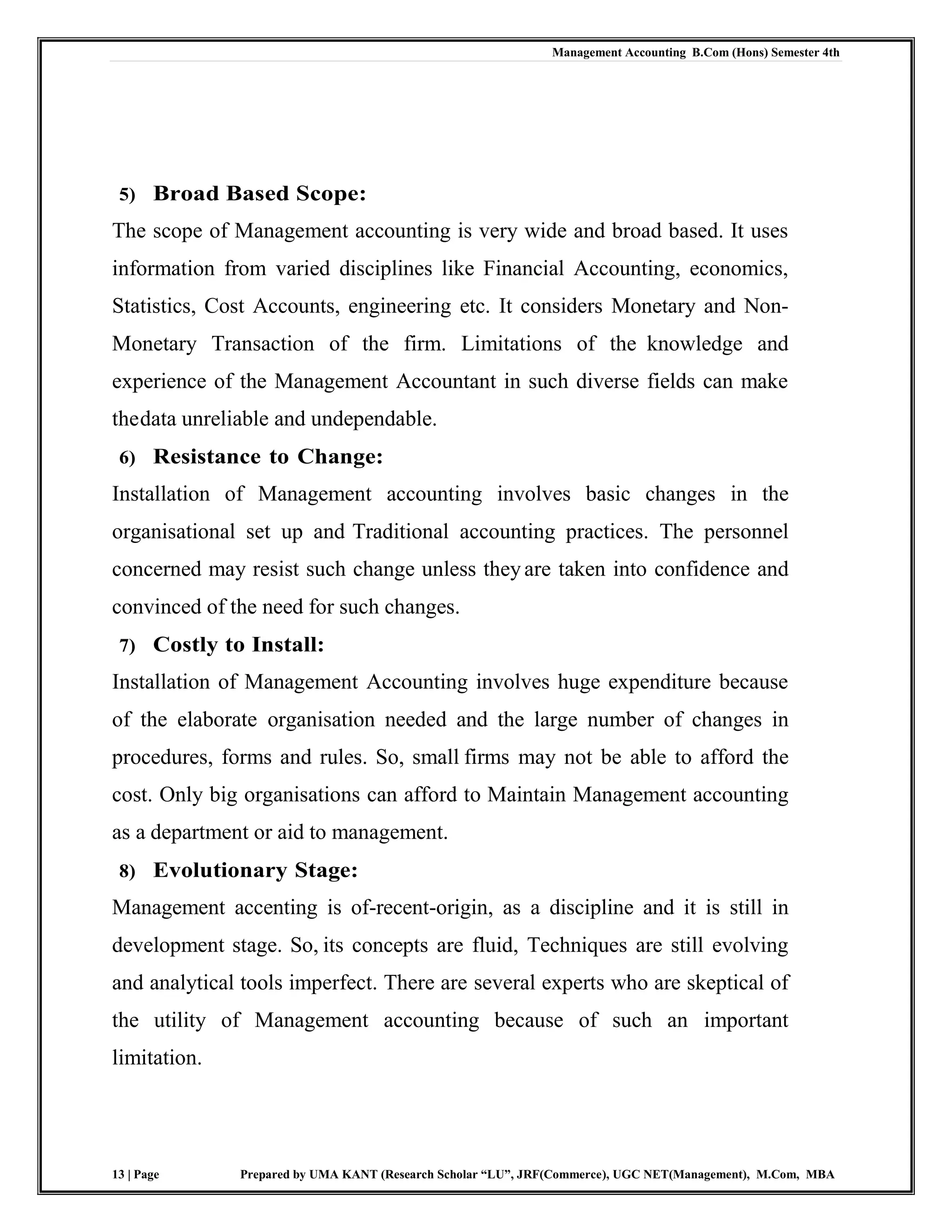
5) Broad Based Scope:
The scope of Management accounting is very wide and broad based. It uses
information from varied disciplines like Financial Accounting, economics,
Statistics, Cost Accounts, engineering etc. It considers Monetary and Non-
Monetary Transaction of the firm. Limitations of the knowledge and
experience of the Management Accountant in such diverse fields can make
thedata unreliable and undependable.
6) Resistance to Change:
Installation of Management accounting involves basic changes in the
organisational set up and Traditional accounting practices. The personnel
concerned may resist such change unless they are taken into confidence and
convinced of the need for such changes.
7) Costly to Install:
Installation of Management Accounting involves huge expenditure because
of the elaborate organisation needed and the large number of changes in
procedures, forms and rules. So, small firms may not be able to afford the
cost. Only big organisations can afford to Maintain Management accounting
as a department or aid to management.
8) Evolutionary Stage:
Management accenting is of-recent-origin, as a discipline and it is still in
development stage. So, its concepts are fluid, Techniques are still evolving
and analytical tools imperfect. There are several experts who are skeptical of
the utility of Management accounting because of such an important
limitation.
Management Accounting B.Com (Hons) Semester 4th
14 | Page Prepared by UMA KANT (Research Scholar “LU”, JRF(Commerce), UGC NET(Management), M.Com, MBA
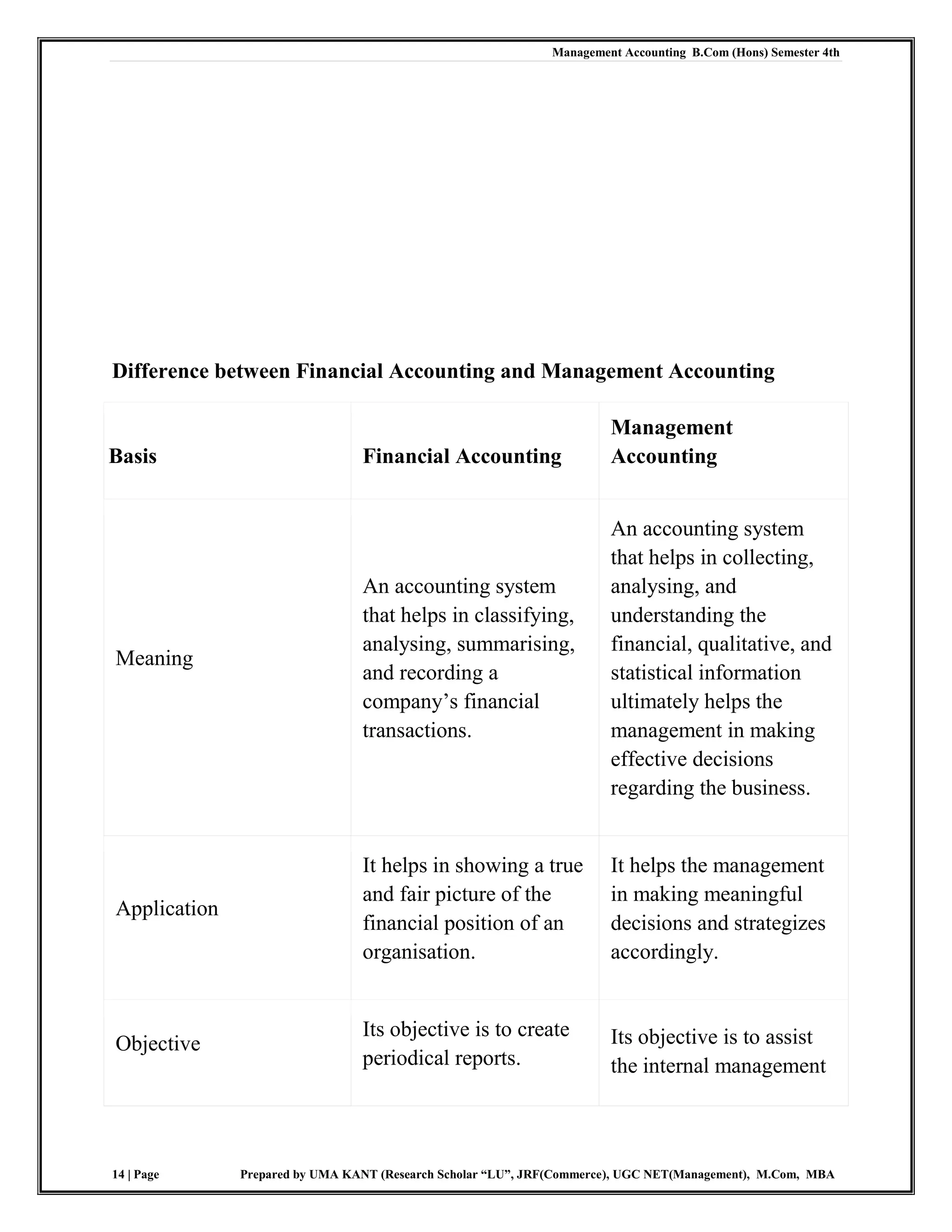
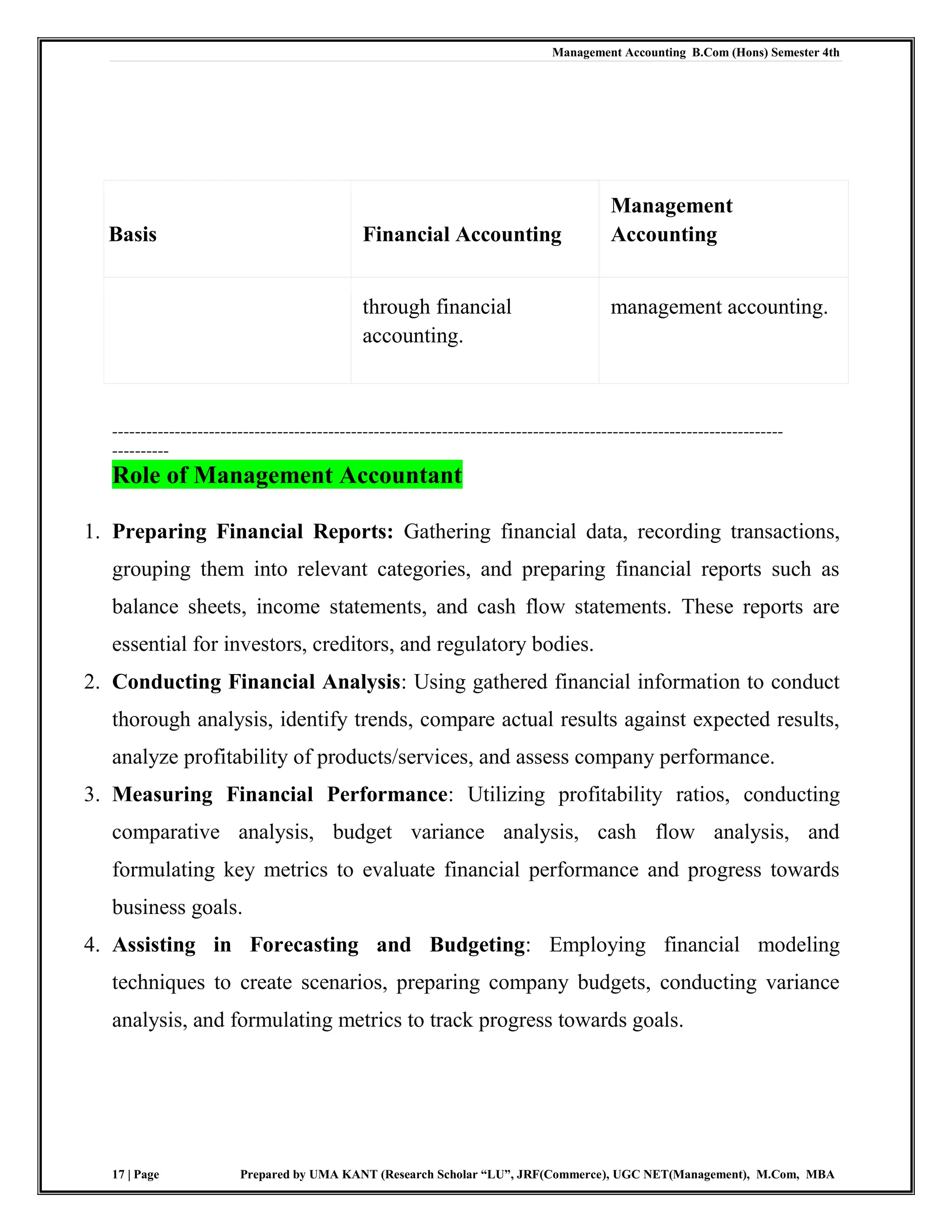
Difference between Financial Accounting and Management Accounting
Basis Financial Accounting
Management
Accounting
Meaning
An accounting system
that helps in classifying,
analysing, summarising,
and recording a
company‟s financial
transactions.
An accounting system
that helps in collecting,
analysing, and
understanding the
financial, qualitative, and
statistical information
ultimately helps the
management in making
effective decisions
regarding the business.
Application
It helps in showing a true
and fair picture of the
financial position of an
organisation.
It helps the management
in making meaningful
decisions and strategizes
accordingly.
Objective
Its objective is to create
periodical reports.
Its objective is to assist
the internal management
Management Accounting B.Com (Hons) Semester 4th
15 | Page Prepared by UMA KANT (Research Scholar “LU”, JRF(Commerce), UGC NET(Management), M.Com, MBA
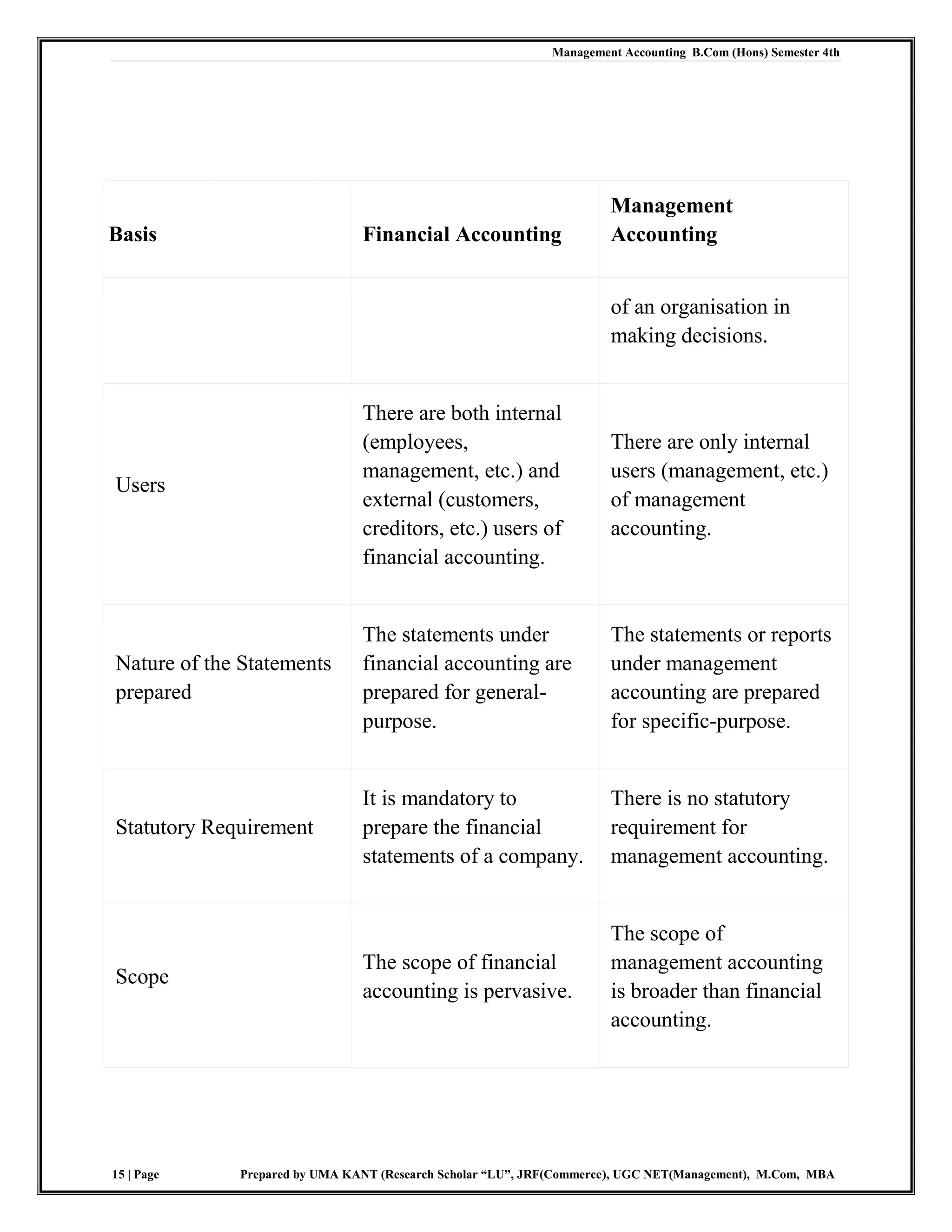
Basis Financial Accounting
Management
Accounting
of an organisation in
making decisions.
Users
There are both internal
(employees,
management, etc.) and
external (customers,
creditors, etc.) users of
financial accounting.
There are only internal
users (management, etc.)
of management
accounting.
Nature of the Statements
prepared
The statements under
financial accounting are
prepared for general-
purpose.
The statements or reports
under management
accounting are prepared
for specific-purpose.
Statutory Requirement
It is mandatory to
prepare the financial
statements of a company.
There is no statutory
requirement for
management accounting.
Scope
The scope of financial
accounting is pervasive.
The scope of
management accounting
is broader than financial
accounting.
Management Accounting B.Com (Hons) Semester 4th
16 | Page Prepared by UMA KANT (Research Scholar “LU”, JRF(Commerce), UGC NET(Management), M.Com, MBA
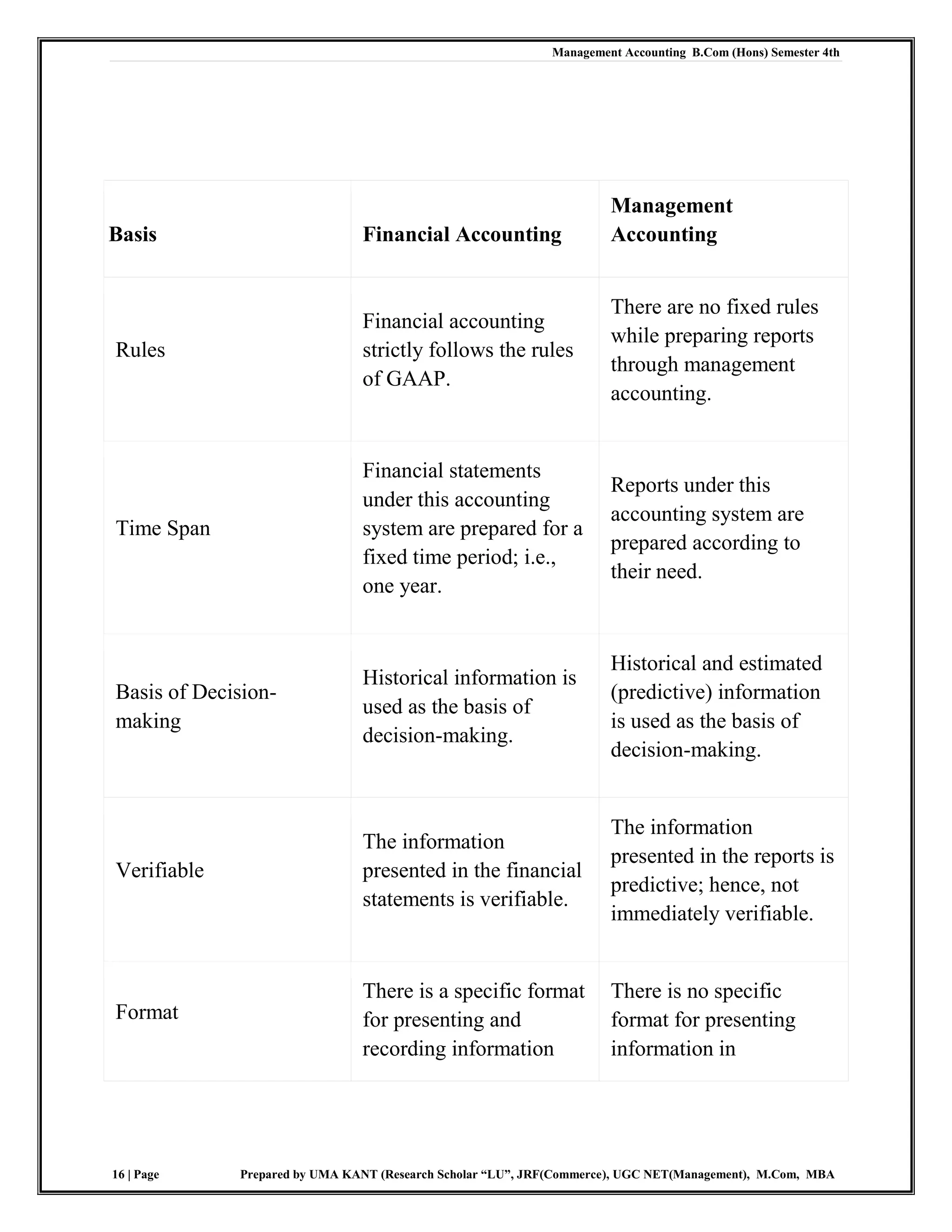
Basis Financial Accounting
Management
Accounting
Rules
Financial accounting
strictly follows the rules
of GAAP.
There are no fixed rules
while preparing reports
through management
accounting.
Time Span
Financial statements
under this accounting
system are prepared for a
fixed time period; i.e.,
one year.
Reports under this
accounting system are
prepared according to
their need.
Basis of Decision-
making
Historical information is
used as the basis of
decision-making.
Historical and estimated
(predictive) information
is used as the basis of
decision-making.
Verifiable
The information
presented in the financial
statements is verifiable.
The information
presented in the reports is
predictive; hence, not
immediately verifiable.
Format
There is a specific format
for presenting and
recording information
There is no specific
format for presenting
information in
Management Accounting B.Com (Hons) Semester 4th
17 | Page Prepared by UMA KANT (Research Scholar “LU”, JRF(Commerce), UGC NET(Management), M.Com, MBA
Basis Financial Accounting
Management
Accounting
through financial
accounting.
management accounting.
----------------------------------------------------------------------------------------------------------------------
----------
Role of Management Accountant
1. Preparing Financial Reports: Gathering financial data, recording transactions,
grouping them into relevant categories, and preparing financial reports such as
balance sheets, income statements, and cash flow statements. These reports are
essential for investors, creditors, and regulatory bodies.
2. Conducting Financial Analysis: Using gathered financial information to conduct
thorough analysis, identify trends, compare actual results against expected results,
analyze profitability of products/services, and assess company performance.
3. Measuring Financial Performance: Utilizing profitability ratios, conducting
comparative analysis, budget variance analysis, cash flow analysis, and
formulating key metrics to evaluate financial performance and progress towards
business goals.
4. Assisting in Forecasting and Budgeting: Employing financial modeling
techniques to create scenarios, preparing company budgets, conducting variance
analysis, and formulating metrics to track progress towards goals.
Management Accounting B.Com (Hons) Semester 4th
18 | Page Prepared by UMA KANT (Research Scholar “LU”, JRF(Commerce), UGC NET(Management), M.Com, MBA
5. Managing and Controlling Costs: Gathering detailed information about cost
drivers, establishing spending limits, identifying cost reduction opportunities,
estimating pricing for products/services, and developing key performance
indicators related to costs.
6. Assessing Risk: Conducting risk analysis, categorizing risks, assessing severity,
conducting root cause analysis, building risk analysis frameworks, and mitigating
financial risks.
7. Ensuring Compliance: Assisting in internal audits, preparing internal controls,
staying updated on regulations, accounting standards, and tax laws, and ensuring
adherence to legal obligations and regulatory guidelines.
Management Accountant Skills
1. Knowledge of Financial Software: Proficiency in using financial software for
tasks such as financial analysis, budgeting, cost tracking, compliance, and data
management. Understanding various financial tools and their features enables
adaptability to different software platforms.
2. Business Acumen: Ability to analyze financial data, recognize trends, identify
opportunities, and assess risks to generate business value. Understanding of
business processes and strategies aids in effective decision-making and
supporting senior management.
3. Attention to Detail: Strong focus on accuracy and precision in financial
reporting, data analysis, and documentation. Attention to detail helps in
identifying discrepancies, detecting fraud, and maintaining the integrity of
financial information, leading to improved decision-making.
Management Accounting B.Com (Hons) Semester 4th
19 | Page Prepared by UMA KANT (Research Scholar “LU”, JRF(Commerce), UGC NET(Management), M.Com, MBA
4. Communication Skills: Effective communication with financial professionals,
managers, auditors, vendors, and operations teams is essential. Clear and
concise communication facilitates collaboration, supports decision-making
processes, and fosters a positive work environment conducive to achieving
financial goals.
Responsibility Accounting
Responsibility Accounting is management accounting where all the company‟s
management, budgeting, and internal accounting are held responsible. The primary
objective of responsibility accounting is to hold responsible all the concerned
departments of any particular function.
In this type of accounting system, responsibility is assigned on the basis of the
knowledge and skills of the individuals. The basic motive of responsibility
accounting is to decrease the overall cost and increase the overall profit. If the
motives do not get fulfilled, the concerned people are held accountable and
answerable. Accountability is clearly defined under responsibility accounting, so
concerned people work more carefully as they are made answerable to their
seniors, management, and board of directors.
Responsibility accounting often entails the creation of monthly and annual budgets
for each responsibility centre. It also keeps track of a company‟s costs and
revenues, with reports compiled monthly or annually and sent to the appropriate
manager for review. The focus of responsibility accounting is mostly
on Responsibility Centers.
Management Accounting B.Com (Hons) Semester 4th
20 | Page Prepared by UMA KANT (Research Scholar “LU”, JRF(Commerce), UGC NET(Management), M.Com, MBA
Responsibility Centers
A responsibility center is a functional business entity that has definite objectives
and goals, dedicated personnel, procedures, and policies as well as the duty of
generating a financial report. Different types of responsibility centers are being
set up under responsibility accounting and every responsibility center has
different goals assigned to them that they have to fulfill in order to contribute to
the overall growth of the organization. Some basic responsibility centers that all
organisations generally need are Cost center, Profit center, Revenue Center and
Investment Center.
Types of Responsibility Centers
1. Cost Center
A cost center is responsible for cost control. The main objective of the cost center
is to minimize cost. The cost center‟s prime work is to check the cost of an
organisation and to limit the unwanted expenditure that the company may
acquire. Costs, in this respect, are basically classified as controllable costs and
non-controllable costs. Controllable costs are the costs that can be controlled by
the organization. Uncontrollable costs are the cost that the organization can not
control. The concerned center is made responsible and accountable for only
controllable expenses. So, it is important to distinguish between controllable costs
and non-controllable costs. The performance evaluation is done on the basis of
the actual cost that occurred and the targeted cost.
Some types of costs centers are:
 Production Cost Center
 Personal Cost Center
Management Accounting B.Com (Hons) Semester 4th
21 | Page Prepared by UMA KANT (Research Scholar “LU”, JRF(Commerce), UGC NET(Management), M.Com, MBA
 Service Cost Center
 Impersonal Cost Center
 Process Cost Center
 Operation Cost Center
2. Revenue Center
This center is basically inclined towards the generation of leads and subsequently
increasing the overall revenue of the firm. Company‟s sales team is mainly held
responsible for this. A revenue center is judged solely on its ability to generate
sales; it is not judged on the amount of costs incurred. Revenue centers are
employed in organisations that are heavily sales focused. Sales team are trained
to generate more leads and convert them. Trainings are set up for them and
evaluation of the personnel is made on the basis of the conversion rates.
3. Profit Center
A profit center refers to a center whose performance is measured in cost and
revenue both. It contributes to both revenue and expenses, resulting in profit and
loss. Profit occurs when revenues are more than costs and loss occurs when costs
are more than profits. The profit center is accountable for all the actions
associated with the sale of goods and production. The principle objective of a
profit center is to generate and maximize profit by minimising the cost incurred
and increasing sales. The accomplishment of a profit center is estimated in terms
of profit growth during a definite period.
4. Investment Center
This center is held responsible for using the company‟s assets in the most
efficient way and investing them in the best opportunities in order to increase
Management Accounting B.Com (Hons) Semester 4th
22 | Page Prepared by UMA KANT (Research Scholar “LU”, JRF(Commerce), UGC NET(Management), M.Com, MBA
returns. Companies evaluate the performance of an investment center according
to the revenues it brings in through investments in capital assets. An investment
center is sometimes called an investment division. Investment centers are
increasingly important for firms as financialization leads companies to seek
profits from investment and lending activities in addition to core production.
Features of Responsibility Accounting
1. Inputs and Outputs: Responsibility accounting majorly covers two most
important aspects of business i.e. costs and revenue. Costs can be identified as
inputs and revenue can be identified as outputs. Cost and revenue are the essence
of the business and need a close watch.
2. Use of Budgeting: Budgeting involves planning and controlling inputs and
outputs. Costs can be identified as inputs and revenue can be identified as
outputs. Under budgeting process, planned stats of cost and revenue are set up
and then compare with the actual cost and revenue and offset the deviations.
3. Performance Reporting: Performance reports of all the responsibility centers
are made properly and reported to seniors for evaluation. Corrective measures are
taken in case of deviations.
4. Identification of Responsibility Centers: Under responsibility accounting,
various types of responsibility centers are identified and operated to ensure the
smooth running of various functions of the organisation.
Objectives of Responsibility Accounting
1. Accountability: Responsibility Accounting makes concerned people
accountable for the results. Division needs to prepare the reports and send them to
Management Accounting B.Com (Hons) Semester 4th
23 | Page Prepared by UMA KANT (Research Scholar “LU”, JRF(Commerce), UGC NET(Management), M.Com, MBA
the manager. In this way, personnel takes care of all the necessary things, as they
know they have to give proper reports to the managing authorities.
2. More Responsible Personnel: Responsibility Accounting makes the
company‟s personnel more responsible for the organisation‟s performance.
Responsibility accounting ensures better results, growth, proper documentation,
effective and efficient personnel, and more accountable and responsible
employees.
3. Minimisation of Costs: Responsibility Accounting ensures the minimisation
of costs at various levels in order to avoid wastage of resources. A cost center
ensures a cut in costs and makes the overall cost system effective.
4. Maximisation of Profits: Under Responsibility Accounting, the main goal of
the profit center is to increase the profits of the organization over different
periods of time, which improves the overall financial position of the company.
5. Decentralisation: Responsibility Accounting decentralises power so that
personnel will have a sense of responsibility and belongingness to the
organisation.
Advantages of Responsibility Accounting
1. System of Control: Responsibility Accounting sets up a system of control in a
way that concerned people are held responsible for their work and they are
accountable to their seniors and management regarding their performances.
2. Awareness: Responsibility accounting creates awareness in the workplace as
the personnel has to explain the deviation of their assigned responsibility center.
Management Accounting B.Com (Hons) Semester 4th
24 | Page Prepared by UMA KANT (Research Scholar “LU”, JRF(Commerce), UGC NET(Management), M.Com, MBA
3. Better Results: As actual numbers are compared with the target numbers over
the years, management will know the reasons for the constant deviation and they
can take corrective measures carefully according to the needs of the organization.
4. Efficiency: Responsibility Accounting creates a sense of efficiency within
individual employees as their work and achievements will be reviewed.
5. Effective communication: Individual and company goals are established and
communicated in the best way.
Steps in Responsibility Accounting Process
Responsibility Accounting involves the following steps:
1. Identification of responsibility sectors correctly.
2. Setting goals and assigning responsibilities to the various responsibility
centers.
3. Keeping an eye on their actual performance.
4. Comparison of actual performance to the target.
5. Finding the reasons for deviations, if any.
6. Taking corrective measures.
Management Accounting B.Com (Hons) Semester 4th
25 | Page Prepared by UMA KANT (Research Scholar “LU”, JRF(Commerce), UGC NET(Management), M.Com, MBA
Unit - 2
Budgetary control
Budgetary control is the process by which budgets are prepared for the future
period and are compared with the actual performance for finding out variances, if
any. The comparison of budgeted figures with actual figures will help the
management to find out variances and take corrective actions without any delay.
The comparison of budgeted and actual figures will enable the management to find
out discrepancies and take remedial measures at a proper time. The budgetary
control is a continuous process which helps in planning and co-ordination. It
provides a method of control too. A budget is a means and budgetary control is the
end-result.
Objectives of Budgetary Control
The main objectives of budgetary control are given below:
1) Defining the objectives of the enterprise.
2) Providing plans for achieving the objectives so defined.
3) Coordinating the activities of various departments.
4) Operating various departments and cost centres economically and
efficiently.
5) :5. Increasing the profitability by eliminating waste.
6) Centralizing the control system.
7) Correcting variances from sit standards.
8) Fixing the responsibility of various individuals in the enterprise.
Management Accounting B.Com (Hons) Semester 4th
26 | Page Prepared by UMA KANT (Research Scholar “LU”, JRF(Commerce), UGC NET(Management), M.Com, MBA
Essentials of Successful Budgetary Control:
The following are the essential requisites for implementing budgetary control
successfully:
1) Clearly Defined Organisational Structure:- The authority and
responsibilities are to be properly defined to pin-point the responsibility of
specific individuals in key positions.
2) Efficient Accounting System: - The accounting system should provide
the required information in time.
3) Reporting of Deviations:- Efficient system has to be devised to reduce
the differences between the budgets and actual performance.
4) Motivation: - Staff are to be appraised of the budgets and benefits they
are going to derive directly and indirectly.
5) Realistic Targets: - The targets set should be realistic so that they are
achievable and budgets should not frustrate the workers by fixing
unrealistic targets.
6) Participation of All Departments Concerned: - Budgets are to be set for
all the departments so that their participation in implementation will be
effective.
7) Flexibility: - Budgets are prepared on the basis of certain conditions. If
there is change in conditions budgets also should be adjusted to
accommodate the changes.
Management Accounting B.Com (Hons) Semester 4th
27 | Page Prepared by UMA KANT (Research Scholar “LU”, JRF(Commerce), UGC NET(Management), M.Com, MBA
8) Top Management Support: - The budgetary control system should have
continuous support of top management which can ensure its all-round
acceptance.
Advantages of Budgetary Control
Some of the advantages of budgetary control are:
1) Budgetary control fixes targets. Each and every department is forced to work
efficiently to reach the target. Thus, it is an effective method of controlling
the activities of various departments of a business unit.
2) It secures better co-ordination among various departments.
3) In case the performance is below expectation, budgetary control helps the
management in finding up the responsibility.
4) It helps in reducing the cost of production by eliminating the wasteful
expenditure.
5) By promoting cost consciousness among the employees, budgetary control
brings in efficiency and economy.
6) Budgetary control facilitates centralized control with decentralized
activity.
7) As everything is planned and provided in advance, it helps in smooth
running of business enterprise.
8) It tells the management as to where action is required for solving problems
without delay.
Disadvantages or Limitations of Budgetary Control
Management Accounting B.Com (Hons) Semester 4th
28 | Page Prepared by UMA KANT (Research Scholar “LU”, JRF(Commerce), UGC NET(Management), M.Com, MBA
The following are the limitations of budgetary control:
1) Budget involves a heavy expenditure which small business concerns cannot
afford.
2) Budgets are prepared for the future period which is always uncertain. In
future, conditions may change which will upset the budgets. Thus, future
uncertainties minimize the utility of budgetary control system.
3) Budgetary control is only a management tool. It cannot replace management
in decision-making because it is not a substitute for management.
4) The success of budgetary control depends upon the support of the top
management. If there is lack of support from top management, then this will
fail.
5) It is really difficult to prepare the budgets accurately under inflationary
conditions.
Types of Budget in Management Accounting
Type # 1. Sales Budget:-
Many of the other budgets are based on the sales budget. It is taken to be the
critical starting point to which all other budgets are adjusted. Its preparation begins
with the prediction of units of each product that will be sold at specific prices. The
work starts with the examination of sales analysis for the current year.
Type # 2. Production Budget:-
The production budget shows the estimates of production planned for the
immediate future period. The production budget should indicate, apart from other
Management Accounting B.Com (Hons) Semester 4th
29 | Page Prepared by UMA KANT (Research Scholar “LU”, JRF(Commerce), UGC NET(Management), M.Com, MBA
things, targets of production for each product, each department and by each month.
Generally, the production budget is based on the sales budget.
 The production budget is prepared into two parts, namely:
 Production volume budget- It shows the physical units of the product to be
manufactured; and
 Cost of production or manufacturing cost budget- It gives details of the
budgeted cost under material, labour and factory overheads.
The following steps are involved in the preparation of production budget:
1) Production Planning – Production planning plays very important part in
the preparation of production budget. Production planning on sound lines
takes into consideration optimum utilisation of plant capacity by
elimination or reduction of limiting factors and both bottlenecks in
production like shortage of material, labour etc. Proper planning of
production levels out seasonal fluctuations of sales so that optimum
inventory of finished goods, components and work-in-progress is
maintained.
2) Consideration of Plant Capacity – The total quantities of each of the
products or group of products which the firm is capable of producing is
determined. This requires coordination of production budget with plant
utilization budget.
3) Co-ordination with the Sales Budget – Proper coordination between
production and sales budget is necessary to avoid imbalances of sales and
production.
Management Accounting B.Com (Hons) Semester 4th
30 | Page Prepared by UMA KANT (Research Scholar “LU”, JRF(Commerce), UGC NET(Management), M.Com, MBA
4) Inventory Policy Considerations – The extent to which inventory of
finished goods is to be carried depends upon several factors such as future
sales potential, availability of storage facilities, the risk and cost of stock-
out and cost of carrying inventory.
 The budgeted quantity of production is computed as follows:
 Units to be produced = Desired closing stock of finished goods +
Budgeted sales – Opening stock of finished goods.
5) Policy of the Management – Management policy as to whether certain
components or parts should be produced or procured from outside should
also be taken before finally setting the budget.
Type # 3. Production Cost Budget:
This is the quantity of products to be manufactured expressed in terms of cost.
Basically, there are three element of cost, namely, direct material, direct labour and
overheads. Separate budgets for each of these elements have to be prepared.
1) Direct Materials Budget:- Standard costing greatly facilitates the preparation
of a materials budget. When standard cost records are not available, the details
have to be adjusted to the period when manufacture takes place. Materials are
controlled on the basis of price and usage after allowing for normal wastage.
Technical experts decide on the best and most economical material to use for
each purpose.
2) Direct Labour Budget:- A similar procedure to the above applies to direct
labour. The hours shown in the production budget are used with the wage
Management Accounting B.Com (Hons) Semester 4th
31 | Page Prepared by UMA KANT (Research Scholar “LU”, JRF(Commerce), UGC NET(Management), M.Com, MBA
rates which are likely to apply during the period of production. Wages are
controlled according to the rates paid and the efficiency of the operator.
3) Overheads Budget:- Overheads budget has to be assembled from a large
amount of detailed information from past records. It has to be updated to
allow for changes in future costs and related activity. It is compiled on the
basis of department overhead expense budgets and cost centre budgets. The
overheads may relate to factory, general administration, selling and
distribution functions. Accordingly, separate budgets are prepared for factory
overheads, administrative overheads and selling and distribution overheads.
o Factory Overheads Budget:
o Administrative Overheads Budget:
o Selling and Distribution Overheads Budget:
Type # 4. Purchase Budget:-
The purchase budget states the purchases which must be made to achieve the
complete budget plan. These include the requirements of direct and indirect
material, and of purchased services as set out in the sales, production cost, capital
expenditure and research and development budgets adjusted in respect of-
o Inventory policy of the firm,
o Purchase orders already placed,
o Materials to be manufactured within the business as distinct from
those to be purchased from outside.
Type # 5. Cash Budget:
Management Accounting B.Com (Hons) Semester 4th
32 | Page Prepared by UMA KANT (Research Scholar “LU”, JRF(Commerce), UGC NET(Management), M.Com, MBA
The cash budget is a summary of the firm‟s expected cash inflows and outflows
over a particular period of time. In other words, cash budget involves a projection
of future cash receipts and cash disbursements over various time intervals. There
must be a balance between cash and the cash demanding activities/operations,
capital expenditure and so on. Very often, the need for additional cash is not
realised until the situation becomes critical.
The cash budget consists of two parts:
 The projected cash receipts (inflows) and;
 The planned cash disbursements (outflows).
 Cash receipts include collection from debtors, cash sales, dividends
received, sale of assets, loans received and issues of shares and
debentures. Payments include wages and salaries, payment to
creditors and suppliers, rent and rates, taxes, capital expenditure,
dividend payable, commission payable and repayment of loans and
debentures.
Type # 6. Master Budget:
A master budget is a master plan for the entire firm. It is the summary of final plan
for the forthcoming year. When all detailed functional budgets have been
completed, they are integrated into a master budget. According to the Chartered
Institute of Management Accounts, London, Terminology, a master budget is
defined as “The summary budget which is finally approved, adopted and
employed”.
Management Accounting B.Com (Hons) Semester 4th
33 | Page Prepared by UMA KANT (Research Scholar “LU”, JRF(Commerce), UGC NET(Management), M.Com, MBA
Type # 7. Fixed and Flexible Budgeting:
In the real world, one seldom finds stable operating conditions. Future can never be
predicted with certainty. A fixed or static budget is satisfactory only when a
company‟s activities can be estimated within close limits. According to The
Chartered Institute of Management Accountants, London, Terminology, a fixed
budget is defined as a “budget designed to remain unchanged irrespective of the
level of activity actually attained”.
Standard Costing
Meaning of Standard Costing:
It is a method of costing by which standard costs are employed. According to
ICMA, London, Standard Costing is “the preparation and use of standard costs,
their comparison with actual cost and the analysis of variances to their causes
and points of incidence”.
Standard Costing involves:
a) Ascertainment and use of Standard Costs;
b) Recording the actual costs;
c) Comparison of actual costs with standard costs in order to find out the
variance;
d) Analysis of variance; and
e) After analysing the variance, appropriate action may be taken where
necessary.
Management Accounting B.Com (Hons) Semester 4th
34 | Page Prepared by UMA KANT (Research Scholar “LU”, JRF(Commerce), UGC NET(Management), M.Com, MBA
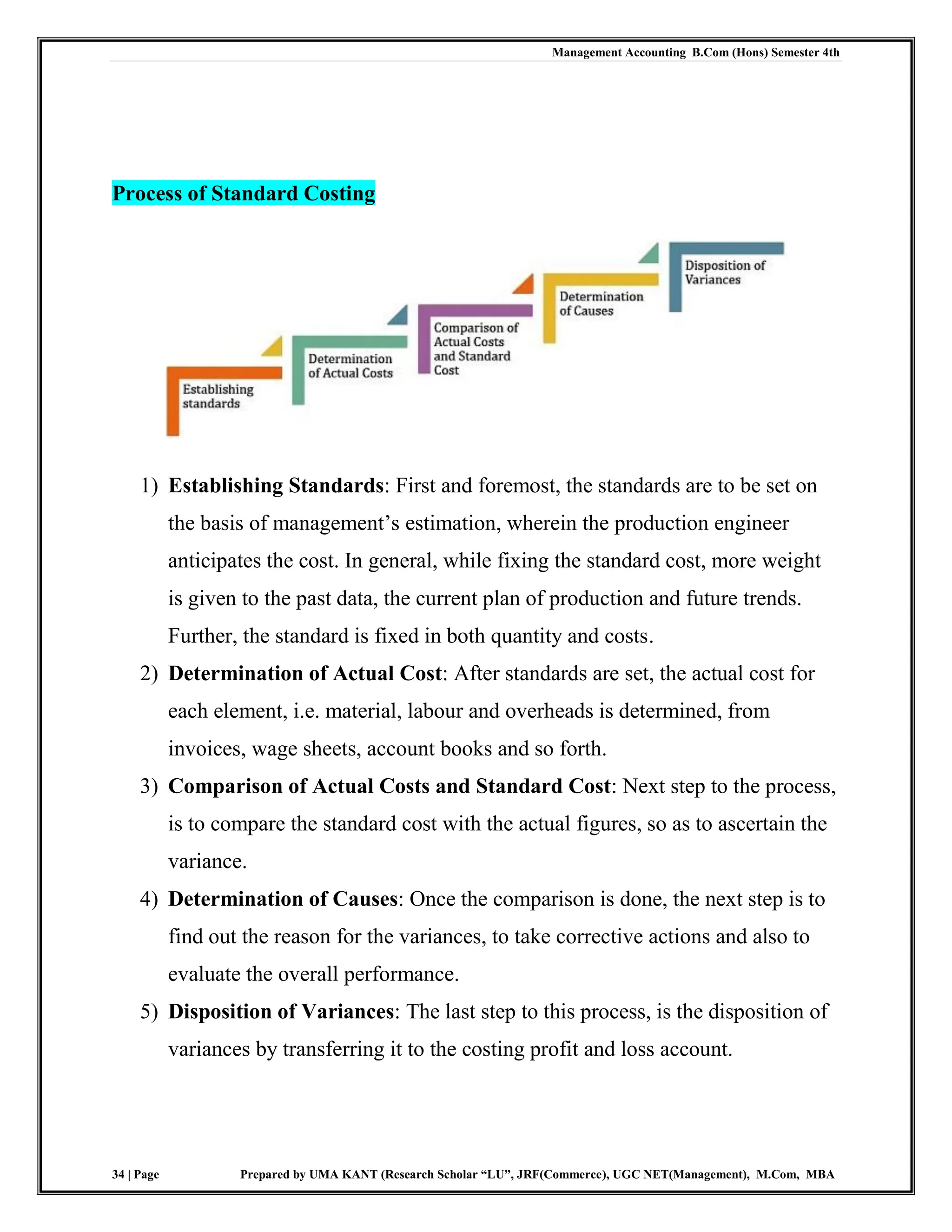
Process of Standard Costing
1) Establishing Standards: First and foremost, the standards are to be set on
the basis of management‟s estimation, wherein the production engineer
anticipates the cost. In general, while fixing the standard cost, more weight
is given to the past data, the current plan of production and future trends.
Further, the standard is fixed in both quantity and costs.
2) Determination of Actual Cost: After standards are set, the actual cost for
each element, i.e. material, labour and overheads is determined, from
invoices, wage sheets, account books and so forth.
3) Comparison of Actual Costs and Standard Cost: Next step to the process,
is to compare the standard cost with the actual figures, so as to ascertain the
variance.
4) Determination of Causes: Once the comparison is done, the next step is to
find out the reason for the variances, to take corrective actions and also to
evaluate the overall performance.
5) Disposition of Variances: The last step to this process, is the disposition of
variances by transferring it to the costing profit and loss account.
Management Accounting B.Com (Hons) Semester 4th
35 | Page Prepared by UMA KANT (Research Scholar “LU”, JRF(Commerce), UGC NET(Management), M.Com, MBA
Objectives of Standard Costing:
1) It helps to implement budgetary control system in operation;
2) It helps to ascertain performance evaluation.
3) It supplies the ways to utilise properly material, labour and also overhead
which will be economic in character.
4) It also helps to motivate the employees of a firm to improve their
performance by setting up a „standard‟.
5) It also helps the management to supply necessary data relating to cost
element to submit quotations or to fix up the selling price of a firm.
6) It also helps the management to make proper valuations of inventory (viz.,
Work-in- progress, and finished products).
7) It acts as a control device to the management.
8) It also helps the management to take various corrective decisions viz.,
fixation of price, make-or-buy decisions etc. which will be more
beneficial to the firm.
Advantages of Standard Costing:
The following advantages may be derived from Standard Costing:
1) Standard Costing serves as a guide to the management in several
management functions while formulating prices and production policies
etc.
2) More effective cost control is possible under standard costing if the same
is reviewed and analyzed at regular intervals.
Management Accounting B.Com (Hons) Semester 4th
36 | Page Prepared by UMA KANT (Research Scholar “LU”, JRF(Commerce), UGC NET(Management), M.Com, MBA
3) Analysis of variance and its measurement helps to detect inefficiencies
and mistakes which enable the management to investigate the reasons.
4) Since standard costs are predetermined costs they are very useful for
planning and budgeting.
5) Once the Standard Costing System is implemented it will lead to saving
cost since most of the costing work can be eliminated.
6) Delegation of authority and responsibility becomes effective by setting up
standards for each cost centre as the supervisors or executives of each cost
centre will know the standard which they have to maintain.
7) Standard costing is also used for inventory valuation purposes. Stock can
be valued at standard cost which can reduce the fluctuation of profit for
different methods of valuation for the same.
8) Efficiency of labour is promoted.
Disadvantages of Standard Costing:
1) Since Standard Costing involves high degree of technical skill, it is,
therefore, costly.
2) The executives are liable for those variances that are found from actions
which are actually controllable by them.
3) Standards are always changing since conditions of the business are equally
changing. So, standards are to be revised in order to make them comparable
with actual results.
4) Standards are either too liberal or rigid since the same are based on average
past results, attainable good performance or theoretical maximum efficiency.
Management Accounting B.Com (Hons) Semester 4th
37 | Page Prepared by UMA KANT (Research Scholar “LU”, JRF(Commerce), UGC NET(Management), M.Com, MBA
Material Variance:
The following variances constitute materials variances:
Material Cost Variance
The difference between the standard cost of direct materials specified for
production and the actual cost of direct materials used in production is known as
Direct Material Cost Variance. Material Cost Variance gives an idea of how much
more or less cost has been incurred when compared with the standard cost. Thus,
Variance Analysis is an important tool to keep a tab on the deviations from the
standard set by a company.
 Material Cost Variance = (Standard Cost – Actual Cost)
Material Price Variance
Management Accounting B.Com (Hons) Semester 4th
38 | Page Prepared by UMA KANT (Research Scholar “LU”, JRF(Commerce), UGC NET(Management), M.Com, MBA
Material Price Variance is the difference between the standard price and the actual
price for the actual quantity of materials used for production. The cause for
material price variance can be many including changes in prices, poor purchasing
procedures, deficiencies in price negotiation, etc.
 MPV = (Standard Price – Actual Price) x Actual Quantity
Let us understand this formula with the help of an example.
Standard Actual
Price $ 10 per kg. $ 8 per kg.
Quantity 200 kgs. 150 kgs.
Here, the Material Price Variance can be calculated as follows:
MPV = (10 – 8) x 150
= 300 (F)
Reasons of direct materials price variance:
A favorable or unfavorable material price variance may occur due to one or more
of the following reasons:
1) Order size: Some suppliers allow discount on large orders. The materials
purchased in large quantities may reduce the the unit price and a favorable
price variance may occur.
2) Rise in price: The rise in the general price level may increase the input costs
of the vendor and as a result vendor may increase the price of the materials.
3) Urgent needs: If production department does not indicate the need of
materials on time, the purchasing department may have to order on urgent
Management Accounting B.Com (Hons) Semester 4th
39 | Page Prepared by UMA KANT (Research Scholar “LU”, JRF(Commerce), UGC NET(Management), M.Com, MBA
basis that may increase the price of materials and other expenses associated
with the order.
4) Quality: A favorable price variance may be the result of purchasing low
quality materials and an unfavorable variance may be the result of
purchasing high quality materials.
5) Inefficient standard setting: Inefficiencies in terms of forecasting and
environmental scanning during standard setting process can be a reason of
huge variances.
6) Transportation: Transportation is a part of total direct materials cost. Any
change in the transportation expenses can change the total and per unit cost
of direct material.
7) Inefficient or unreliable suppliers: A deviation from standard material
costs may be the result of inefficient or unreliable vendors.
Material Usage Variance
Material Usage Variance is the difference between the standard quantity specified
for actual production and the actual quantity used at the standard purchase price.
There can be many reasons for material usage variance including the use of sub-
standard or defective products, pilferage, wastage, the differences in material
quality, etc.
 MUV = (Standard Quantity – Actual Quantity) x Standard Price
With the help of the above example, let us now calculate Material Usage Variance.
MUV = (200 – 150) x 10
= 500 (F)
Management Accounting B.Com (Hons) Semester 4th
40 | Page Prepared by UMA KANT (Research Scholar “LU”, JRF(Commerce), UGC NET(Management), M.Com, MBA
Causes for Direct Material Usage Variance.
1) Negligence in use of materials.
2) More wastage of materials by untrained workers.
3) Adopting defective or wring or improper production process.
4) Loss due to pilferage.
5) Use of material mix other than the standard mix.
6) Using of poor or bad quality of materials.
7) Carelessness and inefficiency of workers.
8) More or less yield from materials than the standard set.
9) Lack of skill of the employee‟s leads to more consumption of materials.
10) Defective production necessitating the use of additional materials.
11) Improper condition of Plant and Equipment.
12) Bad maintenance and upkeep of plant lead to more scraping materials.
13) Lack of proper inspection and supervision of materials lead to more
consumption of materials.
The materials usage or quantity variance can be separated into mix variance and
yield variance.
For certain products and processing operations, material mix is an important
operating variable, specific grades of materials and quantity are determined before
production begins. A mix variance will result when materials are not actually
placed into production in the same ratio as the standard formula.
Management Accounting B.Com (Hons) Semester 4th
41 | Page Prepared by UMA KANT (Research Scholar “LU”, JRF(Commerce), UGC NET(Management), M.Com, MBA
Material mix variance is usually found in industries, such as textiles, rubber and
chemicals, etc. A mix variance may arise because of attempts to achieve cost
savings, effective resources utilisation and when the needed raw materials
quantities may not be available at the required time.
a) Materials mix variance
Materials mix variance is that portion of the materials quantity variance which is
due to the difference between the actual composition of a mixture and the standard
mixture.
 MMV= Standard price * (Revised standard quantity-Actual quantity)
(b) Materials Yield Variance:
Materials yield variance explains the remaining portion of the total materials
quantity variance. It is that portion of materials usage variance which is due to the
difference between the actual yield obtained and standard yield specified (in terms
of actual inputs). In other words, yield variance occurs when the output of the final
product does not correspond with the output that could have been obtained by
using the actual inputs. In some industries like sugar, chemicals, steel, etc. actual
yield may differ from expected yield based on actual input resulting into yield
variance.
The formula for computing yield variance is as follows:
 MYV = Standard cost per unit x(Actual yield – Standard Yield specified)
Relationship between the Material variances:
Management Accounting B.Com (Hons) Semester 4th
42 | Page Prepared by UMA KANT (Research Scholar “LU”, JRF(Commerce), UGC NET(Management), M.Com, MBA
 MCV= MPV + MUV
 MCV= MPV + (MMV+ MYV) Or MPV + (MMV + MRUV/MSUV)
 MUV= (MMV+ MRUV/MSUV) Or MUV= (MMV+ MYV)
 MPV= MCV- MUV
 MUV= MCV- MPV
 MPV=MCV-(MMV+MYV)
Where,
MCV= material cost variance
MPV= Material Price variance
MUV= Material Usage variance
MMV= Material Mix variance
MRUV= Material Revised usage variance
MSUV= Material Sub- usage variance
MYV= Material Yield variance
Labour Variances:
Direct labour variances arise when actual labour costs are different from standard
labour costs. In analysis of labour costs, the emphasis is on labour rates and labour
hours.
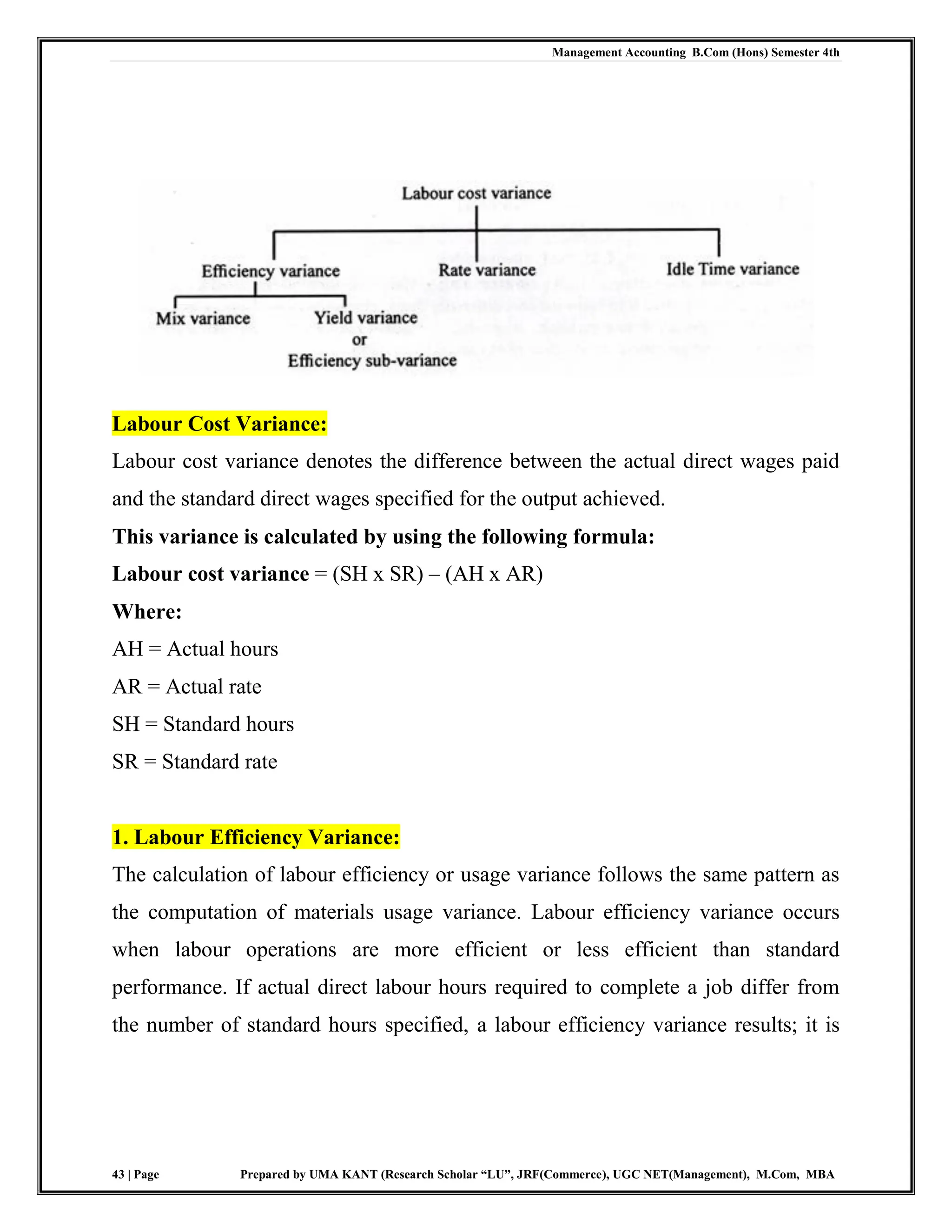
Labour variances constitute the following:
Management Accounting B.Com (Hons) Semester 4th
43 | Page Prepared by UMA KANT (Research Scholar “LU”, JRF(Commerce), UGC NET(Management), M.Com, MBA
Labour Cost Variance:
Labour cost variance denotes the difference between the actual direct wages paid
and the standard direct wages specified for the output achieved.
This variance is calculated by using the following formula:
Labour cost variance = (SH x SR) – (AH x AR)
Where:
AH = Actual hours
AR = Actual rate
SH = Standard hours
SR = Standard rate
1. Labour Efficiency Variance:
The calculation of labour efficiency or usage variance follows the same pattern as
the computation of materials usage variance. Labour efficiency variance occurs
when labour operations are more efficient or less efficient than standard
performance. If actual direct labour hours required to complete a job differ from
the number of standard hours specified, a labour efficiency variance results; it is
Management Accounting B.Com (Hons) Semester 4th
44 | Page Prepared by UMA KANT (Research Scholar “LU”, JRF(Commerce), UGC NET(Management), M.Com, MBA
the difference between actual hours expended and standard labour hours specified
multiplied by the standard labour rate per hour.
Labour efficiency variance = Std. rate per hour x(Standard hours for the actual
output- Actual hours)
(i) Labour Mix Variance:
Labour mix variance is computed in the same manner as materials mix variance.
Manufacturing or completing a job requires different types or grades of workers
and production will be complete if labour is mixed according to standard
proportion. Standard labour mix may not be adhered to under some circumstances
and substitution will have to be made. There may be changes in the wage rates of
some workers; there may be a need to use more skilled or expensive types of
labour, e.g., employment of men instead of women; sometimes workers and
operators may be absent.
These lead to the emergence of a labour mix variance which is calculated by using
the following formula:
Labour mix variance = (Actual labour mix – Revised standard labour mix in
terms of actual total hours) x Standard rate per hour
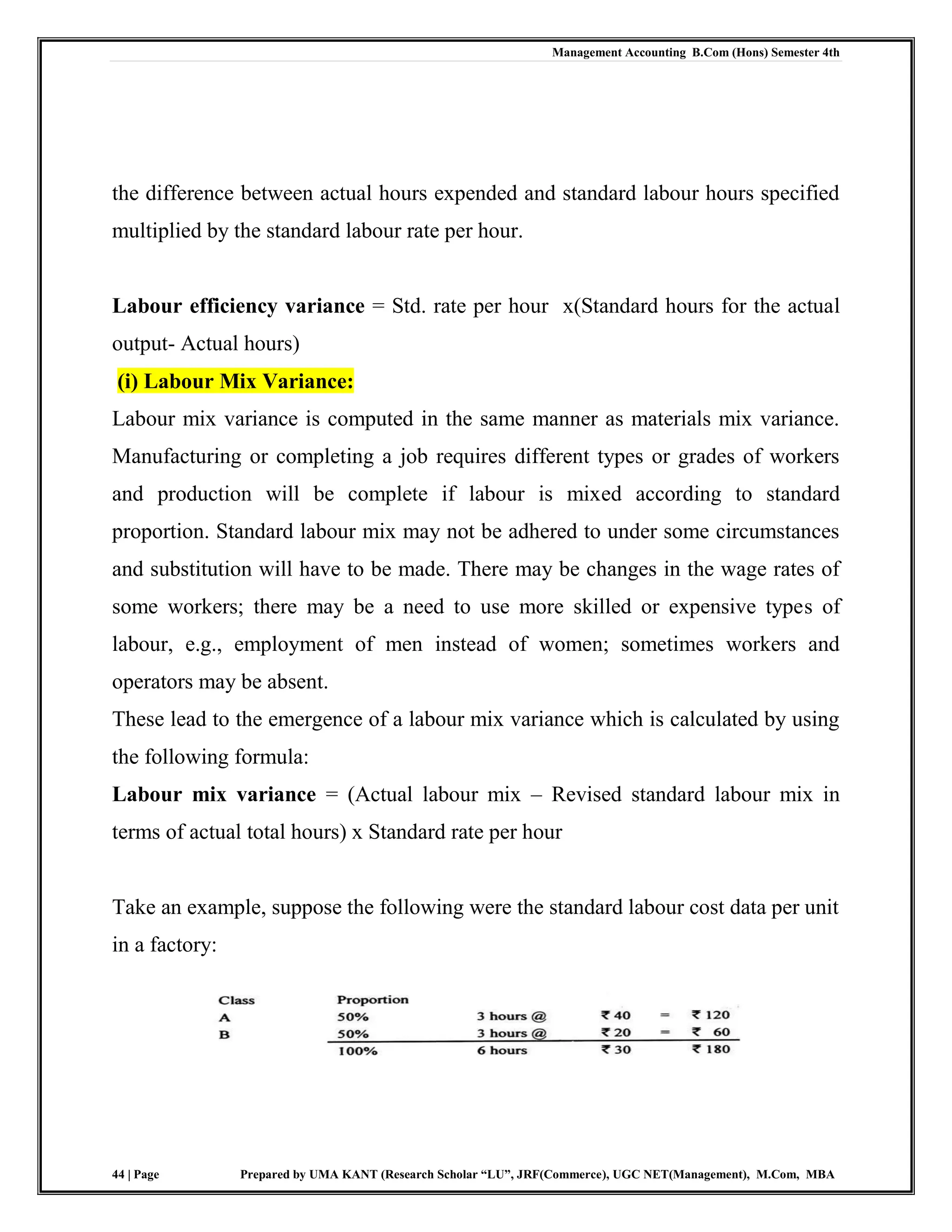
Take an example, suppose the following were the standard labour cost data per unit
in a factory:
Management Accounting B.Com (Hons) Semester 4th
45 | Page Prepared by UMA KANT (Research Scholar “LU”, JRF(Commerce), UGC NET(Management), M.Com, MBA
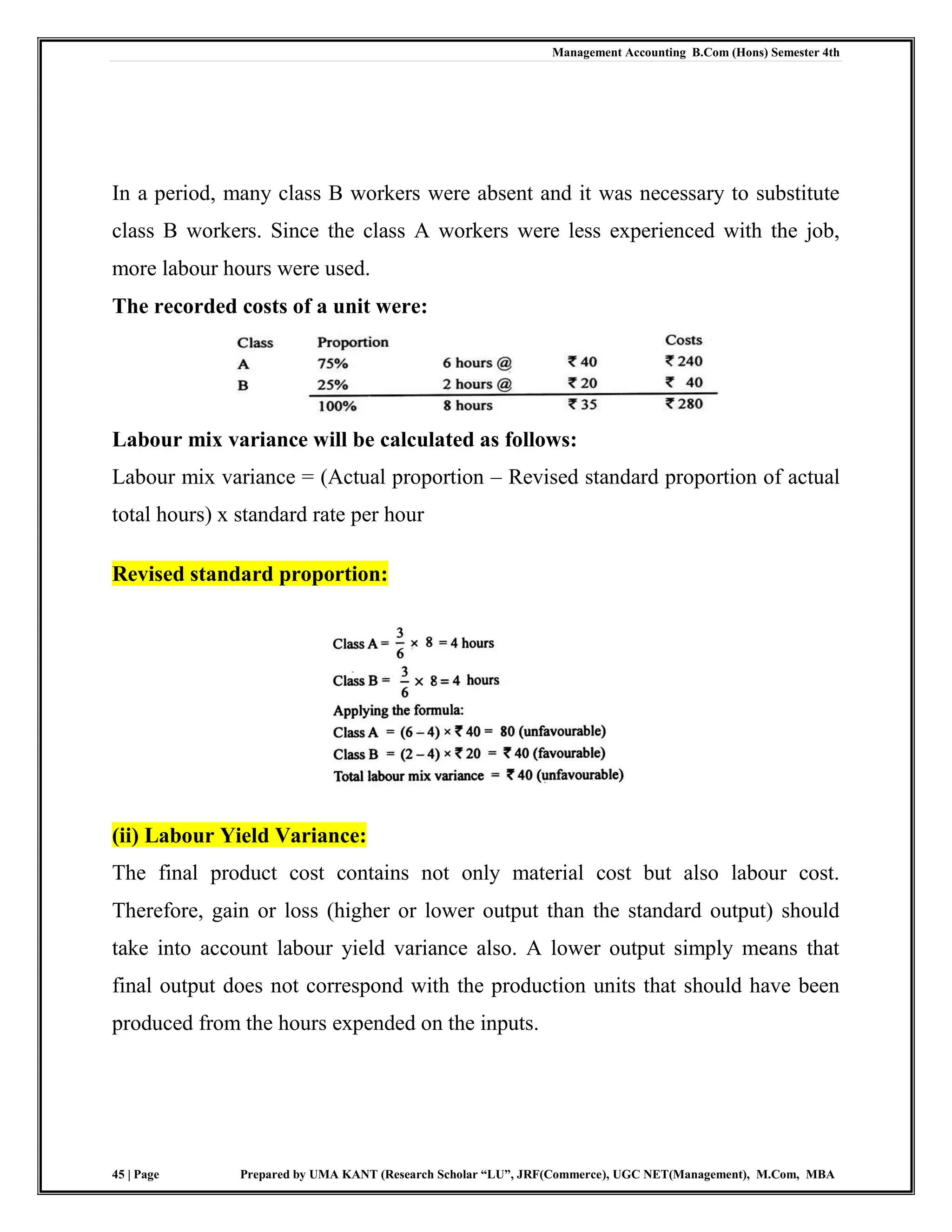
In a period, many class B workers were absent and it was necessary to substitute
class B workers. Since the class A workers were less experienced with the job,
more labour hours were used.
The recorded costs of a unit were:
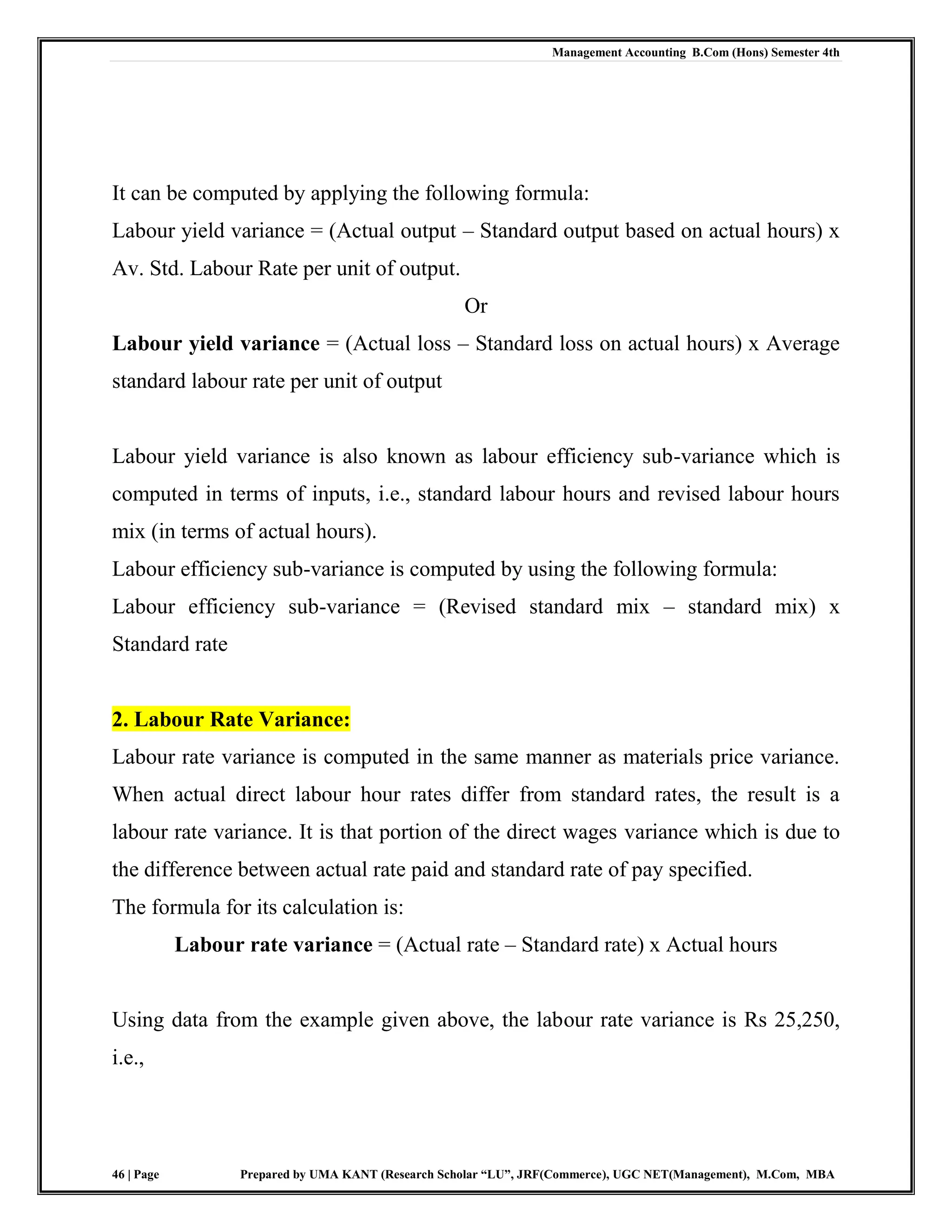
Labour mix variance will be calculated as follows:
Labour mix variance = (Actual proportion – Revised standard proportion of actual
total hours) x standard rate per hour
Revised standard proportion:
(ii) Labour Yield Variance:
The final product cost contains not only material cost but also labour cost.
Therefore, gain or loss (higher or lower output than the standard output) should
take into account labour yield variance also. A lower output simply means that
final output does not correspond with the production units that should have been
produced from the hours expended on the inputs.
Management Accounting B.Com (Hons) Semester 4th
46 | Page Prepared by UMA KANT (Research Scholar “LU”, JRF(Commerce), UGC NET(Management), M.Com, MBA
It can be computed by applying the following formula:
Labour yield variance = (Actual output – Standard output based on actual hours) x
Av. Std. Labour Rate per unit of output.
Or
Labour yield variance = (Actual loss – Standard loss on actual hours) x Average
standard labour rate per unit of output
Labour yield variance is also known as labour efficiency sub-variance which is
computed in terms of inputs, i.e., standard labour hours and revised labour hours
mix (in terms of actual hours).
Labour efficiency sub-variance is computed by using the following formula:
Labour efficiency sub-variance = (Revised standard mix – standard mix) x
Standard rate
2. Labour Rate Variance:
Labour rate variance is computed in the same manner as materials price variance.
When actual direct labour hour rates differ from standard rates, the result is a
labour rate variance. It is that portion of the direct wages variance which is due to
the difference between actual rate paid and standard rate of pay specified.
The formula for its calculation is:
Labour rate variance = (Actual rate – Standard rate) x Actual hours
Using data from the example given above, the labour rate variance is Rs 25,250,
i.e.,
Management Accounting B.Com (Hons) Semester 4th
47 | Page Prepared by UMA KANT (Research Scholar “LU”, JRF(Commerce), UGC NET(Management), M.Com, MBA
Labour rate variance = (35 – 30) x 5050 hours = 5 x 5050 = Rs 25,250
(unfavourable)
The number of actual hours worked is used in place of the number of the standard
hours specified because the objective is to know the cost difference due to change
in labour hour rates, and not hours worked. Favourable rate variances arise
whenever actual rates are less than standard rates; unfavourable variances occur
when actual rates exceed standard rates.
3. Idle Time Variance:
Idle time variance occurs when workers are not able to do the work due to some
reason during the hours for which they are paid. Idle time can be divided according
to causes responsible for creating idle time, e.g., idle time due to breakdown, lack
of materials or power failures. Idle time variance will be equivalent to the standard
labour cost of the hours during which no work has been done but for which
workers have been paid for unproductive time.
Suppose, in a factory 2,000 workers were idle because of a power failure. As a
result of this, a loss of production of 4,000 units of product A and 8,000 units of
product B occurred. Each employee was paid his normal wage (a rate of? 20 per
hour). A single standard hour is needed to manufacture four units of product A and
eight units of product B.
Idle time variance will be computed in the following manner:
Standard hours lost:
Product A = 4, 000/ 4 = 1,000 hr.
Product B = 8, 000 / 8 = 1,000 hr.
Management Accounting B.Com (Hons) Semester 4th
48 | Page Prepared by UMA KANT (Research Scholar “LU”, JRF(Commerce), UGC NET(Management), M.Com, MBA
Total hours lost = 2,000 hr.
Idle time variance (power failure)
2,000 hours @ Rs 20 per hour = Rs 40,000 (Adverse)
Unit -3
Marginal Costing
Definition: Marginal Costing is a costing technique wherein the marginal cost, i.e.
variable cost is charged to units of cost, while the fixed cost for the period is
completely written off against the contribution.
The term marginal cost implies the additional cost involved in producing an
extra unit of output, which can be reckoned by total variable cost assigned to one
unit. It can be calculated as:
Marginal Cost = Direct Material + Direct Labor + Direct Expenses + Variable
Overheads
Characteristics of Marginal Costing
1) Classification into Fixed and Variable Cost: Costs are bifurcated, on the basis
of variability into fixed cost and variable costs. In the same way, semi variable
cost is separated.
2) Valuation of Stock: While valuing the finished goods and work in progress,
only variable cost are taken into account. However, the variable selling and
distribution overheads are not included in the valuation of inventory.
Management Accounting B.Com (Hons) Semester 4th
49 | Page Prepared by UMA KANT (Research Scholar “LU”, JRF(Commerce), UGC NET(Management), M.Com, MBA
3) Determination of Price: The prices are determined on the basis of marginal
cost and marginal contribution.
4) Profitability: The ascertainment of departmental and product‟s profitability is
based on the contribution margin.
Features of Marginal Costing
1) Marginal Costing is a technique of decision making.
2) The total cost is classified into fixed and variable cost.
3) Fixed cost are ascertained separately and excluded from cost of production.
The fixed costs are charged to Profit and loss account.
4) The stock of work in Progress and finished goods are valued at variable cost.
Fixed cost will not be included in valuation of the stock.
5) Contribution is ascertained by reducing the variable cost from the selling
price.
6) The profitability of products or process is determined on the basis of
contribution.
7) Profit is ascertained by reducing the fixed cost from the contribution of all the
products or departments or process or division etc.
8) The profitability of various levels of activity is ascertained by calculating cost
volume profit relationship.
Facts Concerning Marginal Costing
Management Accounting B.Com (Hons) Semester 4th
50 | Page Prepared by UMA KANT (Research Scholar “LU”, JRF(Commerce), UGC NET(Management), M.Com, MBA
1) Cost Ascertainment: The basis for ascertaining cost in marginal costing is
the nature of cost, which gives an idea of the cost behavior, that has a great
impact on the profitability of the firm.
2) Special technique: It is not a unique method of costing, like contract
costing, process costing, batch costing. But, marginal costing is a different
type of technique, used by the managers for the purpose of decision making.
It provides a basis for understanding cost data so as to gauge the profitability
of various products, processes and cost centers.
3) Decision Making: It has a great role to play, in the field of decision making,
as the changes in the level of activity pose a serious problem to the
management of the undertaking.
Various Decisions under Marginal Costing
1) Fixation of Selling Price:- Price is one of the most significant factor that
determines themarket for the products as well as the volume of profit for the
organization. Under, normal circumstances, the price of a product mustcover
the total costs of the product plus a margin of profit.
2) Accepting Bulk Orders (or) Foreign Market Orders Some bulk orders may
be received from local dealers (or) foreign dealers asking for a price which is
below the market price. This calls for a decision to accept (or) reject the order
3) Make (or) Buy Decision In a make (or) buy decision, the price quoted by the
outside suppliers should be compared with the marginal cost of producing the
Management Accounting B.Com (Hons) Semester 4th
51 | Page Prepared by UMA KANT (Research Scholar “LU”, JRF(Commerce), UGC NET(Management), M.Com, MBA
component parts. If the outside price of the component is lower than the
marginal cost of producing it, it is worth buying. On the other hand, if the
outside price is higher than the marginal cost, making the component in the
factory may be preferred.
4) Selection of Suitable Product Mix When a factory manufacturers more than
one product, a problem is faced by the management as to which product will
give maximum profits. The solution is the products which give the maximum
contribution are to be retained and their production should be increased
5) Maintaining a Desired Level of Profit Management may be interested in
maintaining a desired level of profits. The sales required to earn a desired level
of profits can be ascertained by the marginal costing techniques.
6) Determination of Optimum Level of Activity The technique of marginal
costing helps the management indetermination the optimum level of activity. To
make such a decision, contribution at different levels of activity can be found.
The level of activity which gives the highest contribution will be the optimum
level. The level of production can be raised till the marginal cost does not
exceed the selling price.
7) Profit Planning Profit planning is a plan for future operation (or) or
planningbudget to attain the given objective or to attain the maximum profit.
Thevolume of sale required to maintain a desired profit can be ascertained.
Management Accounting B.Com (Hons) Semester 4th
52 | Page Prepared by UMA KANT (Research Scholar “LU”, JRF(Commerce), UGC NET(Management), M.Com, MBA
8) Introduction of a New Product A production firm may add additional
products with the available facility. The new product is sold in the market at a
reasonable price, inorder to sell it in large quantities. It may become popular. If
favourable, the sales can be increased. Thus, the total cost comes down and
contributes some amount towards fixed costs and profits.
9) Closure of a Department or Discontinuing a Product Marginal costing
technique shows the contribution of each product to fixed costs and profit. If a
department or a product contributes the least amount, then the department can
be closed (or) its production can be discountinued. It means the product which
gives a higher amount of contribution may be chosen and the rest should be
discontinued.
10) Introduction of New Product (or) Product Line The technique to assess
the profitability of a line extension products the incremental contribution
estimates. The same technique of contribution analysis would be followed in
assessing the profitability
Unit - 4
Financial Statement Analysis:
The term ‗financial analysis‘, also known as analysis and interpretation of financial
statements‘, refersto the process of determining financial strengths and weaknesses of the
firm by establishing strategicrelationship between the items of the balance sheet, profit
and loss account and other operative data. ―Analyzing financial statements,‖ according
to Metcalf and Titard, ―is a process of evaluating therelationship between component
parts of a financial statement to obtain a better understanding of afirm‘s position and
performance.‖
Management Accounting B.Com (Hons) Semester 4th
53 | Page Prepared by UMA KANT (Research Scholar “LU”, JRF(Commerce), UGC NET(Management), M.Com, MBA
In the words of Myers, ―Financial statement analysis is largely a study of relationship
among the various financial factors in a business as disclosed by a single set-of
statements and a study of the trend of these factors as shown in a series of statements.‖
Objectives and Importance of Financial Statement Analysis:
The primary objective of financial statement analysis is to understand and diagnose the
information contained in financial statement with a view to judge the profitability and
financial soundness of the firm, and to make forecast about future prospects of the firm.
The purpose of analysis depends upon the person interested in such analysis and his
object.
However, the following purposes or objectives of financial statements
analysis may be stated to bring out the significance of such analysis:
1) To assess the earning capacity or profitability of the firm.
2) To assess the operational efficiency and managerial effectiveness.
3) To assess the short term as well as long term solvency position of the firm.
4) To identify the reasons for change in profitability and financial position of the firm.
5) To make inter-firm comparison.
6) To make forecasts about future prospects of the firm.
7) To assess the progress of the firm over a period of time.
8) To help in decision making and control.
9) To guide or determine the dividend action.
10) To provide important information for granting credit.
Parties Interested in Financial Analysis:
The following parties are interested in the analysis of financial statements:
1) Investors or potential investors.
2) Management.
3) Creditors or suppliers.
4) Bankers and financial institutions.
5) Employees.
6) Government.
7) Trade associations.
8) Stock exchanges.
9) Economists and researchers.
10) Taxation authorities
Limitations of Financial Statement Analysis:
Some of the important limitations of financial analysis are, however, summed up
as below:
1) It is only a study of interim reports
2) Financial analysis is based upon only monetary information and non-
Management Accounting B.Com (Hons) Semester 4th
54 | Page Prepared by UMA KANT (Research Scholar “LU”, JRF(Commerce), UGC NET(Management), M.Com, MBA
monetary factors areignored.
3) It does not consider changes in price levels.
4) As the financial statements are prepared on the basis of a going concern, it
does not give exact position. Thus accounting concepts and conventions cause
a serious limitation to financial analysis.
5) Changes in accounting procedure by a firm may often make financial analysis
misleading.
6) Analysis is only a means and not an end in itself. The analyst has to make
interpretation and draw his own conclusions. Different people may interpret the
same analysis in different ways.
Tools or Techniques of Financial Statement Analysis
1) Comparative Statement or Comparative Financial and Operating Statements.
2) Common Size Statements.
3) Trend Ratios or Trend Analysis.
4) Average Analysis.
5) Statement of Changes in Working Capital.
6) Fund Flow Analysis.
7) Cash Flow Analysis.
8) Ratio Analysis.
9) Cost Volume Profit Analysis
A brief explanation of the tools or techniques of financial statement analysis presented below.
1) Comparative Statements
Comparative statements deal with the comparison of different items of the Profit
and Loss Account and Balance Sheets of two or more periods. Separate
comparative statements are prepared for Profit and Loss Account as
Comparative Income Statement and for Balance Sheets.
As a rule, any financial statement can be presented in the form of comparative
statement such as comparative balance sheet, comparative profit and loss
account, comparative cost of production statement, comparative statement of
working capital and the like.
2) Comparative Income Statement
Three important information are obtained from the Comparative Income
Statement. They are Gross Profit, Operating Profit and Net Profit. The changes
or the improvement in the profitabilityof the business concern is find out over a
period of time. If the changes or improvement is not satisfactory, the
management can find out the reasons for it and some corrective action can be
taken.
3) Comparative Balance Sheet
The financial condition of the business concern can be find out by preparing
comparative balance sheet. The various items of Balance sheet for two different
periods are used. The assets are classified as current assets and fixed assets for
comparison. Likewise, the liabilitiesare classified as current liabilities, long term
liabilities and shareholders‘ net worth. The term shareholders‘ net worth
includes Equity Share Capital, Preference Share Capital, Reserves and Surplus
Management Accounting B.Com (Hons) Semester 4th
55 | Page Prepared by UMA KANT (Research Scholar “LU”, JRF(Commerce), UGC NET(Management), M.Com, MBA
and the like.
4) Common Size Statements
A vertical presentation of financial information is followed for preparing
common-size statements. Besides, the rupee value of financial statement contents
are not taken into consideration. But, only percentage is considered for
preparing common size statement.
The total assets or total liabilities or sales is taken as 100 and the balance items
are comparedto the total assets, total liabilities or sales in terms of percentage.
Thus, a common size statement shows the relation of each component to the
whole. Separate common size statement is prepared for profit and loss account
as Common Size Income Statement and for balance sheet as Common Size
Balance Sheet.
5) Trend Analysis
The ratios of different items for various periods are find out and then compared
under this analysis. The analysis of the ratios over a period of years gives an idea
of whether the businessconcern is trending upward or downward. This analysis is
otherwise called as Pyramid Method.
6) Average Analysis
Whenever, the trend ratios are calculated for a business concern, such ratios are
compared with industry average. These both trends can be presented on the
graph paper also in the shape of curves. This presentation of facts in the shape of
pictures makes the analysis and comparison more comprehensive and
impressive.
7) Statement of Changes in Working Capital
The extent of increase or decrease of working capital is identified by preparing
the statement ofchanges in working capital. The amount of net working capital is
calculated by subtracting the sum of current liabilities from the sum of current
assets. It does not detail the reasons for changes in working capital.
8) Fund Flow Analysis
Fund flow analysis deals with detailed sources and application of funds of the
business concernfor a specific period. It indicates where funds come from and
how they are used during the period under review. It highlights the changes in the
financial structure of the company.
9) Cash Flow Analysis
Cash flow analysis is based on the movement of cash and bank balances. In other
words, the movement of cash instead of movement of working capital would be
considered in the cash flow analysis. There are two types of cash flows. They are
actual cash flows and notional cashflows.
10) Ratio Analysis
Ratio analysis is an attempt of developing meaningful relationship between
individual items (or group of items) in the balance sheet or profit and loss
account. Ratio analysis is not only useful to internal parties of business
concern but also useful to external parties. Ratio analysis
highlights the liquidity, solvency, profitability and capital gearing.
11) Cost Volume Profit Analysis
This analysis discloses the prevailing relationship among sales, cost and profit.
The cost is divided into two. They are fixed cost and variable cost. There is a
Management Accounting B.Com (Hons) Semester 4th
56 | Page Prepared by UMA KANT (Research Scholar “LU”, JRF(Commerce), UGC NET(Management), M.Com, MBA
constant relationship betweensales and variable cost. Cost analysis enables the
management for better profit planning.
Funds Flow Statement:
Funds flow statement is a statement which discloses the analytical information about the
different sources of a fund and the application of the same in an accounting cycle. It deals
with the transactions which change either the amount of current assets and current
liabilities (in the form of decrease or increase in working capital) or fixed assets, long-
term loans including ownership fund.
It gives a clear picture about the movement of funds between the opening and closing
dates of the Balance Sheet. It is also called the Statement of Sources and Applications of
Funds, Movement of Funds Statement; Where Got—Where Gone Statement: Inflow and
Outflow of Fund Statement, etc. No doubt, Funds Flow Statement is an important
indicator of financial analysis and control. It is valuable and also helps to determine how
the funds are financed. The financial analyst can evaluate the future flows of a firm on
the basis of past data.
This statement supplies an efficient method for the financial manager in order to assess the:
a. Growth of the firm,
b. Its resulting financial needs, and
c. To determine the best way to finance those needs.
Objective of Preparing a Fund Flow Statement:
The main purpose of preparing a Funds Flow Statement is that it reveals clearly the
important items relating to sources and applications of funds of fixed assets, long-term
loans including capital. It also informs how far the assets derived from normal activities
of business are being utilized properly with adequate consideration.
Secondly, it also reveals how much out of the total funds is being collected by disposing of
fixed assets,how much from issuing shares or debentures, how much from long-term or
short-term loans, and howmuch from normal operational activities of the business.
Thirdly, it also provides the information about the specific utilization of such funds, i.e.
how much has been applied for acquiring fixed assets, how much for repayment of long-
term or short-term loans as well as for payment of tax and dividend etc.
Lastly, it helps the management to prepare budgets and formulate the policies that will
be adopted forfuture operational activities.
The significance and importance of Funds Flow Statements may be summarized as:
(a) Analysis of Financial Statement:
The traditional financial statements, viz. Profit and Loss Account and Balance Sheet,
exhibit the result of the operation and financial position of a firm. Balance Sheet presents
a static view about the resources and how the said resources have been utilized at a
particular date with recording the changes in financial activities. But Funds Flow
Statement can do so, i.e., it explains the causes of changes so made and effect of such
change in the firm accordingly.
Management Accounting B.Com (Hons) Semester 4th
57 | Page Prepared by UMA KANT (Research Scholar “LU”, JRF(Commerce), UGC NET(Management), M.Com, MBA
(b)Highlighting Answers to Various Perplexing Questions:
Funds Flow Statement highlights answers of the following questions:
a. Causes of changes in Working Capital;
b. Whether the firm sells any Non-Current Asset; if sold, how were the proceeds
utilized?
c. Why smaller amount of dividend is paid in spite of sufficient profit?
d. Where did the net profit go?
e. Was it possible to pay more dividend than the present one?
f. Did the firm pay-off its scheduled debts? If so, how, and from what sources?
g. Sources of increased Working Capital, etc.
(c)Realistic Dividend Policy:
Sometimes it may so happen that a firm, instead of having sufficient profit, cannot pay
dividend due to lack of liquid sources, viz. cash. In such a circumstance, Funds Flow
Statement helps the firm to take decision about a sound dividend policy which is very
helpful to the management.
(d)Proper Allocation of Resources:
Resources are always limited. So, it is the duty of the management to make its proper use.
A projectedFunds Flow Statement helps the management to take proper decision about
the proper allocation of business resources in a best possible manner since it highlights
the future.
(e)As a Future Guide:
A projected Funds Flow Statement acts as a business guide. It helps the management to
make provision for the future for the necessary funds to be required on the basis of the
problem faced. In other words, the future needs of the fund for various purposes can be
known well in advance which is avery helpful guide to the management. In short, a firm
may arrange funds on the basis of thisstatement in order to avoid the financial problem
that may arise in future.
(f)Appraising of the Working Capital:
A projected Funds Flow Statement, no doubt, helps the management to know about how
the working capital has been efficiently used and, at the same time, also suggests how to
improve the working capital position for the future on the basis of the present problem
faced by it, if any.
Comparison Chart
BASIS
FO
R
COMPARISON
CASH FLOW FUND FLOW
Meaning A cash flow statement is a statementshowing
the inflows and outflows of cash and cash
equivalents over a period.
A fund flow statement is a statement
showing the changes in the financial
position of the entity in different
accounting years.
Management Accounting B.Com (Hons) Semester 4th
58 | Page Prepared by UMA KANT (Research Scholar “LU”, JRF(Commerce), UGC NET(Management), M.Com, MBA
Purpose of
Preparation
To show the reasons for movements in the
cash at the beginning and at the end of the
accounting period.
To show the reasons for the changes in
the financial position, with respect to
previous year and current accounting
year.
Basis Cash Basis of Accounting. Accrual Basis of Accounting.
Analysis Short Term Analysis of cash planning. Long Term Analysis of financial
planning
Discloses Inflows and Outflows of Cash Sources and applications of funds
Opening and
closing balance
Contains opening and closing balance ofcash
and cash equivalents.
Does not contains opening balanceof
cash and cash equivalents.
Part of Financial
Statement
Yes No
Cash Flow Statement
A cash flow statement provides information about the changes in cash and cash
equivalents of a business by classifying cash flows into operating, investing and financing
activities. It is a key report tobe prepared for each accounting period for which financial
statements are presented by an enterprise.
Monitoring the cash situation of any business is the key. The income statement would
reflect the profits but does not give any indication of the cash components. The important
information of what the business has been doing with the cash is provided by the cash
flow statement. Like the other financial statements, the cash flow statement is also
usually drawn up annually, but can be drawn up more often. It is noteworthy that cash
flow statement covers the flows of cash over a period of time (unlike the balance sheet
that provides a snapshot of the business at a particular date). Also, the cash flow
statement can be drawn up in a budget form and later compared to actual figures.
Objectives of preparing Cash Flow Statement
1) Cash flow statement shows inflow and outflow of cash and cash equivalents from
various activities of a company during a specific period under the main heads
i.e., operating activities, investing activities and financing activities.
2) Information through the Cash Flow statement is useful in assessing the ability of
any enterprise to generate cash and cash equivalents and the needs of the
enterprise to utilize those cash flows.
3) Taking economic decisions requires an evaluation of the ability of an enterprise
to generate cash and cash equivalents, which is provided by the cash flow
statement
Management Accounting B.Com (Hons) Semester 4th
59 | Page Prepared by UMA KANT (Research Scholar “LU”, JRF(Commerce), UGC NET(Management), M.Com, MBA
Cash and cash equivalents generally consist of the following:
o Cash in hand
o Cash at bank
o Short term investments that are highly liquid
o Bank overdrafts comprise an integral element of the organization‘s treasury management
CLASSIFICATION OF ACTIVITIES:
Cash flow activities are to be classified into three categories
:This is done to show separately the cash flows generated / used by
these activities, thereby helpingto assess the impact of these activities
on the financial position and cash and cashequivalents of an enterprise.
1) Operating activities
2) Investing activities
3) Financing activities
Cash from Operating Activities:
Operating activities are the activities that comprise of the primary / main activities of an
enterprise during an accounting period. For example, for a garment manufacturing
company, operating activities include procurement of raw material, sale of garments,
incurrence of manufacturing expenses, etc. These are the principal revenue generating
activities of the enterprise.
Profit before tax as presented in the income statement could be used as a starting point
to calculate the cash flows from operating activities.
Cash Inflows from operating activities:
o Cash receipts from sale of goods and rendering services.
o Cash receipts from fees, royalties, commissions and other revenues.
Cash Outflows from operating activities:
o Cash payments to suppliers for goods and services.
o Cash payments of income taxes unless they can be specifically identified with
financing and investing activities.
Following adjustments are required to be made to the profit
before tax to arriveat the cash flow from operations:
o Elimination of non cash expenses (e.g. depreciation, amortization,
impairment losses, bad debts written off, etc)
o Removal of expenses to be classified elsewhere in the cash flow
Management Accounting B.Com (Hons) Semester 4th
60 | Page Prepared by UMA KANT (Research Scholar “LU”, JRF(Commerce), UGC NET(Management), M.Com, MBA
statement (e.g. interest expense should be classified under financing
activities)
o Removal of income to be presented elsewhere in the cash flow
statement (e.g. dividend income and interest income should be classified
under investing activities unless in case of forexample an investment bank)
o Elimination of non cash income (e.g. gain on revaluation of investments)
o The amount of cash from operations indicates the internal solvency
level of the company. It is
a key indicator of the extent to which the operations of the enterprise have
generated sufficientcash flows to maintain its operating potential.
Cash from Investing Activities:
Cash flow from investing activities includes the movement in cash flows owing to the
purchase and sale of assets. It relates to purchase and sale of long-term assets or fixed
assets such as machinery, furniture, land and building, etc.
a) Cash Outflows from investing activities
b) Cash payments to acquire fixed assets including intangibles and capitalized R&D.
c) Cash advances and loans made to third party (other than advances and loans
made by a financial enterprise wherein it is operating activities).
d) Cash payments to acquire shares, warrants or debt instruments of other
enterprises other thanthe instruments those held for trading purposes.
Cash Inflows from investing activities
a) Cash receipt from disposal of fixed assets including intangibles.
b) Cash receipt from the repayment of advances or loans made to third parties
(except in case offinancial enterprise).
c) Dividend received from investments in other enterprises.
d) Cash receipt from disposal of shares, warrants or debt instruments of other
enterprises exceptthose held for trading purposes.
Cash from Financing Activities:
It includes financing activities related to long-term funds or capital of an enterprise.
Financing activitiesare activities that result in changes in the size and composition of the
owners‘ capital and borrowings of the enterprise.
e.g., cash proceeds from issue of equity shares, debentures, raising long-term loans,
repayment of bank loans, etc.
Cash Inflows from financing activities
o Cash proceeds from issuing shares (equity / preference).
o Cash proceeds from issuing debentures, loans, bonds and other short/ long-term
borrowings.
Management Accounting B.Com (Hons) Semester 4th
61 | Page Prepared by UMA KANT (Research Scholar “LU”, JRF(Commerce), UGC NET(Management), M.Com, MBA
Cash Outflows from financing activities:
o Cash repayments of amounts borrowed.
o Interest paid on debentures and long-term loans and advances.
o Dividends paid on equity and preference capital.
Main heads of Cash Flow statement:
Cash Flow Statement (Main heads only)
(A) Cash flows from operating activities xxx
(B) Cash flows from investing activities xxx
(C) Cash flows from financing activities xxx
Net increase (decrease) in cash and cash xxx equivalents (A + B + C) + Cash and cash
equivalents atthe beginning xxx = Cash and cash equivalents at the end xxxx
Methods of preparing the Cash Flow Statements
Operating activities are the main source of revenues and expenditures, thereby cash
flow from thesame needs to be ascertained. The cash flow can be reported through two
ways:
Direct method that discloses the major classes of gross cash receipts and cash
payments andIndirect method that has the net profit or loss adjusted for effects of
1) transactions of a non-cash nature,
2) any deferrals or accruals of past/future operating cash receipts and
3) items of income or expenses associated with investing or financing cash flows.
DIRECT METHOD:
In the direct method, the major heads of cash inflows and outflows (such as cash received from
tradereceivables, employee benefits, expenses paid, etc.) are to be considered.
As the different line items are recorded on accrual basis in statement of profit and loss,
certainadjustments are to be made to convert them into cash basis such as the following:
1) Cash receipts from customers = Revenue from operations + Trade receivables in the
beginning
– Trade receivables in the end.
2)
Cash payments to suppliers = Purchases + Trade Payables in the beginning –
Trade Payables inthe end.
3)
Purchases = Cost of Revenue from Operations – Opening Inventory + Closing Inventory.
4) Cash expenses = Expenses on accrual basis + Prepaid expenses in the beginning
and Outstanding expenses in the end – Prepaid expenses in the end and
Outstanding expenses in the beginning.
Management Accounting B.Com (Hons) Semester 4th
62 | Page Prepared by UMA KANT (Research Scholar “LU”, JRF(Commerce), UGC NET(Management), M.Com, MBA
Purpose & Importance of Cash Flow Statements
1) Statement of cash flows provides important insights about the liquidity and
solvency of a company which are vital for survival and growth of any
organization.
2) It enables analysts to use the information about historic cash flows for
projections of future cash flows of an entity on which to base their economic
decisions.
3) By summarizing key changes in financial position during a period, cash flow
statement serves to highlight priorities of management.
4) Comparison of cash flows of different entities helps reveal the relative quality of
their earnings since cash flow information is more objective as opposed to the
financial performance reflected in income statement.
Advantages of Cash Flow Statement
1) Cash Flow Statements help in knowing the liquidity / actual cash position of the
company whichfunds flow and P&L are unable to specify.
2) As the liquidity position is known, any shortfalls can be arranged for or excess
can be used forthe growth of the business
3) Any discrepancy in the financial reporting can be gauged through the cash flow
statement bycomparing the cash position of both.
4) Cash is the basis of all financial operations. Therefore, a projected cash flow
statement willenable the management to plan and control the financial
operations properly.
5) Cash Flow analysis together with the ratio analysis helps measure the
profitability and financialposition of business.
6) Cash flow statement helps in internal financial management as it is useful in
formulation offinancial plans.
Disadvantages of Cash Flow Statement
1) Through the cash flow statement alone, it is not possible to arrive at actual P&L
of the company as it shows only the cash position. It has limited usage and in
isolation it is of no use and requires BL, P&L for its projections. Cash flow
statement does not disclose net income from operations. Therefore, it cannot be a
substitute for income statement
2) The cash balance as shown by the cash flow statement may not represent the real
liquidity position of the business because it can be easily influenced by
postponing the purchases and other payments
3) Cash flow statement cannot replace the funds flow statement. Each of the two has
a separate function to perform.

Management Accounting Unit 1 for B.Com(Hons)/BCom/BBA.pdf

  • 1.
    Management Accounting B.Com(Hons) Semester 4th 1 | Page Prepared by UMA KANT (Research Scholar “LU”, JRF(Commerce), UGC NET(Management), M.Com, MBA Management Accounting B.Com (Hons) Semester - 4th Unit -1 University of Lucknow, Lucknow Meaning of Management Accounting: The term Management Accounting consists of two words “Management” and “Accounting”. It is the study of managerial aspects of accounting. It is a tool in the hands of management to exercise decision making. The emphasis of management accounting is to redesign accounting in a manner which is helpful to the management in framing the policies and control of their execution. Management accounting is of recent origin. The term was first used in 1950 by a team of accountants visiting U.S.A. under the auspices of Anglo- American Council on productivity. The terminology of cost accounting had no reference to the word „management accountancy‟ before the visit by this
  • 2.
    Management Accounting B.Com(Hons) Semester 4th 2 | Page Prepared by UMA KANT (Research Scholar “LU”, JRF(Commerce), UGC NET(Management), M.Com, MBA study group. Intensive competitions, large scale production, dynamic developments in technology, and complexities of modern business have led to the development of management accounting-to solve many of the problems. “Management accounting is the presentation of accounting information in such a way as to assist management in the creation of policy and in the day- to-day operations of an undertaking”. I.C.M.A. – the definition recently incorporated into the terminology. Characteristics of Management Accounting: The objective of Management accounting is to record, analyse and present financial data to the Management in such a way that it becomes useful and helpful in planning and running business operations systematically and effectively. The following are the main characteristics of management accounting: 1) Providing Financial Information: The main emphasis of management accounting is to provide financial information to management. The information is provided in a manner suitable to various levels of management for reviewing policies and decision making. 2) Cause and Effect Analysis:
  • 3.
    Management Accounting B.Com(Hons) Semester 4th 3 | Page Prepared by UMA KANT (Research Scholar “LU”, JRF(Commerce), UGC NET(Management), M.Com, MBA Financial accounting confines itself to presentation of P&L account and Balance Sheet. Management accounting analyses the cause and effect of the facts and figures thereon. If there is loss causes for the losses are investigated. If there is profit the variable affecting the profit are also analysed. The amount of profit is compared with expenditure, sales, capital employed, etc., to draw appropriate conclusions relating to the effect of those items on profit. 3) Use of Special Techniques and Concepts: Management accounting employs special techniques like standard costing, budgetary control, marginal costing, fund flow, cash flow, ratio analysis, responsibility accounting, etc. to make accounting data more useful and helpful to the management. Each of these techniques or concepts is a useful tool for specific purpose in analysis and interpretation of data, establishing control over operations, etc. 4) Decision Making: Main objective of management accounting is to provide relevant information- to management to take various important decisions. Historical information provides a base on which the future impact is predicted, alternatives are developed and decisions are made to select to select the most beneficial course of action. 5) No Fixed Conventions: Financial accounting has various established principles and rules in preparing the financial accounts. Management accounting has no such fixed rules. The
  • 4.
    Management Accounting B.Com(Hons) Semester 4th 4 | Page Prepared by UMA KANT (Research Scholar “LU”, JRF(Commerce), UGC NET(Management), M.Com, MBA tools or techniques applied by the management accounting are same but application of these techniques various from concern to concern and situation to situation. 6) Achievement of Objectives: Management accounting is helpful in realising the enterprise objectives. Based on the historicalinformation and with adjustments for predicate future changes, objectives are laid down. Actual performance is recorded. Comparison of actual with predetermined results is made. If there are deviations of actual from the predetermined results, corrective action is taken and predicted objectives are achieved. This becomes possible with the help of management accounting techniques of standard costing and budgetary control. 7) Improving Efficiency: The purpose of accounting is to provide information to increase efficiency. The efficiency of departments, and divisions can be improved by fixation of targets or goals for a specific period. The actual performance is compared with that of targets. Positive deviations are reviewed. Thenegative deviations are probed to ascertain the causes. The ways and means to tackle the causes are analysed and targets are achieved. The process of fixing and achieving the targets leads to gradual improvement in overall efficiency. 8) Forecasting:
  • 5.
    Management Accounting B.Com(Hons) Semester 4th 5 | Page Prepared by UMA KANT (Research Scholar “LU”, JRF(Commerce), UGC NET(Management), M.Com, MBA Management accounting is concerned with taking decisions for future implementation. This involves prediction and forecasting of future. It is helpful in planning and laying down of objectives. 9) Providing of Information and not Decisions: Management accounting provides financial information and not the decisions. That is why it issaid that management accounting depends on the efficiency of the management in using information and taking effective decisions. Objectives and Functions of Management Accounting: Main objective of management accounting is to help the management in performing its functions efficiently. The major functions of management are planning, organising, directing and controlling. Management accounting helps the management in performing these functions effectively. 1) Presentation of Data: Traditional Profit and Loss Account and the Balance Sheet are not analytical for decisionmaking. Management accounting modifies and rearranges data as per the requirementsfor decision making through various techniques. 2) Aid of Planning and Forecasting: Management accounting is helpful to the management in the process of planning through the techniques of budgetary control and standard costing. Forecasting is extensively used inpreparing budgets and setting standards. 3) Help in Organising:
  • 6.
    Management Accounting B.Com(Hons) Semester 4th 6 | Page Prepared by UMA KANT (Research Scholar “LU”, JRF(Commerce), UGC NET(Management), M.Com, MBA Organising is concerned with establishment of relationships among different individuals in the firm. It includes delegation of authority and fixing responsibility. Management Accounting aims at aiding the Management in organising through establishment of cost centres, profit centres, responsibility centres, Budget preparation etc. AH these activities are helpful in setting up an effective organisational frame work. 4) Decision Making: Management accounting provides comparative data for analysis and interpretation foreffective decision making and policy formulation. 5) Reporting to Management of Different levels: One of the Major objectives of Management accounting is to keep the Management informed about the performance, adherence to plans and progress of various sections of the organisation. 6) Communication of Management Policies: Management accounting conveys the policies of the management downward to the personal effectively for proper implementation. 7) Effective Control: Standard costing and budgetary control are integral part of management accounting. These techniques lay-down targets, compare actuals will standards and budgets to evaluate the performance and control the
  • 7.
    Management Accounting B.Com(Hons) Semester 4th 7 | Page Prepared by UMA KANT (Research Scholar “LU”, JRF(Commerce), UGC NET(Management), M.Com, MBA deviations. 8) Incorporation of Non-Financial Information: Management accounting considers both financial and non-financial information for developing alternative courses of action which leads to effective and accurate decisions. 9) Coordination: The targets of different departments are communicated to them and their performance is reported to the management from time to time. This continual reporting helps the managementin coordinating various activities to improve the overall performance. 10)Motivating Employees: Budgets, standards and other programmers are to be implemented in practice by the employees. A major objective of Management accounting is to determine the targets in the form of budgets, standards and programmer in such a way that the employees feel motivated to achieve them. Thisis usually accomplished by making the targets practicable and offering suitable monetary and Non-Monetary incentives to achieve them.
  • 8.
    Management Accounting B.Com(Hons) Semester 4th 8 | Page Prepared by UMA KANT (Research Scholar “LU”, JRF(Commerce), UGC NET(Management), M.Com, MBA Tools and Techniques of Management Accounting: The tools and techniques used in management accounting are explained below: 1) Financial Policy and Accounting: Every business concern ha sot plan for its sources of funds. The fund can be raised out of different sources. Utilising a particular source depends on cost of servicing the source, terms of repayment in case of borrowings, etc. The amount of share capital raised, the statutory obligations for repayment are to be considered. The capital mix, i.e., the proportion of share capital and borrowing has to be decided to have an optimum capital structure. Management accounting provides capital budgeting techniques for financial planning. 2) Analysis of Financial Statement: Analysis of financial statements is means to classify and present the data in a manner useful to the management. The significance of information provided is explained in a nontechnical language in the form of ratio analysis, funds flow and cash flow techniques. 3) Historical Cost Accounting: Costs are recorded after being incurred for comparison with predetermined targets to evaluate performance. 4) Budgetary Control:
  • 9.
    Management Accounting B.Com(Hons) Semester 4th 9 | Page Prepared by UMA KANT (Research Scholar “LU”, JRF(Commerce), UGC NET(Management), M.Com, MBA Budgets are used as a tool for planning and control. The expenditure and revenue are predetermined. The actuals are compared with budgets to reveal deviations and individuals responsible for the same. Corrective actions are initiated to eliminate the negative deviations infuture. 5) Standard Costing: Standard costing is an important technique of cost control. In Standard costing the costs are determined in advance by systematic analysis. The actual costs are compared with standards.The variances are analysed to find the causes and action is taken for removal of the same to increase efficiency. Generally, standard costing is used along with budgetary control for effective control of operations. 6) Marginal Costing: Under marginal costing, the cost of products is divided into fixed and variable portions. While the variable costs are taken for decision making, fixed costs are treated as period costs to be charged to costing Profit and Loss account. Marginal costing is helpful to management in taking various important decisions etc. 7) Other Tools of Management Accounting are: a. Decision Accounting: Here alternatives are evaluated for selection in decision situation. b. Revaluation Accounting: This is applied in replacement of fixed assets whose prices go
  • 10.
    Management Accounting B.Com(Hons) Semester 4th 10 | Page Prepared by UMA KANT (Research Scholar “LU”, JRF(Commerce), UGC NET(Management), M.Com, MBA up from period. The effect of inflation on the fixer assets is tackled here. c. Control Accounting: In control accounting, internal check, internal audit and statutory audit are used. Advantages/ Merits/ Uses of Management Accounting: Management Accounting is of immense value and utility for the management of any firm and it has been considered as indispensable, particularly in large organisations where the task of Management iscomplex. The following can be listed as the benefits or uses of Management Accounting: 1) Increase in Efficiency: Management accounting contributes significantly towards increasing efficiency in operations of a firm. Budgets, standards, reports etc., usually elevate the level of performance. 2) Effective Planning: Policy formulation and planning of operations become more effective through the „decision data‟provided by Management Accounting. 3) Performance Evaluation: Evaluating performance of employees, departments, etc., is facilitated by Management accounting through Variance Analysis, control ratios etc. 4) Profit Maximisation:
  • 11.
    Management Accounting B.Com(Hons) Semester 4th 11 | Page Prepared by UMA KANT (Research Scholar “LU”, JRF(Commerce), UGC NET(Management), M.Com, MBA Management accounting is helpful in profit planning to pursue decisions which can optimise profits. 5) Reliability: The Tools used by Management accounting usually make the data supplied to Management accurate and reliable. 6) Elimination of Wastages: Standard costs, Budgets, cost control techniques, etc., contribute towards elimination of wastages, production of defectives etc. 7) Effective Communication: Regular and systematic reporting ensures constant flow of information about operations to various levels of Management. 8) Employee Morale: Morale of employees can be created and sustained through attainable standards, practical budgets and incentive schemes. 9) Control and Co-ordination: Control on costs and coordination in the efforts of different segments of an organisation can be achieved through performance reporting, variance analysis and follow up action etc. Limitations of Management Accounting: Like any other discipline Management Accounting has its own Limitations. Though it is considered as an indispensable tool for Managerial decision making, its recent origin and several external factors limitits effectiveness.
  • 12.
    Management Accounting B.Com(Hons) Semester 4th 12 | Page Prepared by UMA KANT (Research Scholar “LU”, JRF(Commerce), UGC NET(Management), M.Com, MBA These factors are explained below: 1) Dependence for Basic Records: Management Accounting rarely maintains basic and primary records of operations, expenses and revenues. It derives all of its Primary data from Financial Accounting, cost Accounting and other relevant records. So, the accuracy .and reliability of the conclusions derived by Management Accounting is limited to the reliability of its sources of data, so, it suffers from several of the limitations of Finance Accounts and cost Accounts. 2) Personal Bias: Analysis and interpretation of financial information depends upon the capability of the analyst and interpreter. Personal Judgement and usage of discretion become necessary in several areas of Management accounting. Personal „Prejudices‟ and „Bias‟ of individuals can affect theobjectivity and effectiveness of the conclusions and recommendations. 3) Management Accounting is only a Tool: Management accounting cannot be considered as an alternative or substitute to Management.Management accountant acts as an adviser and facilitator for decision making by management.The actual decisions, their implementation and follow up action are the prerogative of the Management. 4) Management Accounting provides only Data: The Main function of Management Accounting is to provide data in the form of „Alternatives‟ to the Management. It is for Management to make suitable choice among the alternatives or even discard all of them. So, Management Accounting can „only Inform and not prescribe‟.
  • 13.
    Management Accounting B.Com(Hons) Semester 4th 13 | Page Prepared by UMA KANT (Research Scholar “LU”, JRF(Commerce), UGC NET(Management), M.Com, MBA 5) Broad Based Scope: The scope of Management accounting is very wide and broad based. It uses information from varied disciplines like Financial Accounting, economics, Statistics, Cost Accounts, engineering etc. It considers Monetary and Non- Monetary Transaction of the firm. Limitations of the knowledge and experience of the Management Accountant in such diverse fields can make thedata unreliable and undependable. 6) Resistance to Change: Installation of Management accounting involves basic changes in the organisational set up and Traditional accounting practices. The personnel concerned may resist such change unless they are taken into confidence and convinced of the need for such changes. 7) Costly to Install: Installation of Management Accounting involves huge expenditure because of the elaborate organisation needed and the large number of changes in procedures, forms and rules. So, small firms may not be able to afford the cost. Only big organisations can afford to Maintain Management accounting as a department or aid to management. 8) Evolutionary Stage: Management accenting is of-recent-origin, as a discipline and it is still in development stage. So, its concepts are fluid, Techniques are still evolving and analytical tools imperfect. There are several experts who are skeptical of the utility of Management accounting because of such an important limitation.
  • 14.
    Management Accounting B.Com(Hons) Semester 4th 14 | Page Prepared by UMA KANT (Research Scholar “LU”, JRF(Commerce), UGC NET(Management), M.Com, MBA Difference between Financial Accounting and Management Accounting Basis Financial Accounting Management Accounting Meaning An accounting system that helps in classifying, analysing, summarising, and recording a company‟s financial transactions. An accounting system that helps in collecting, analysing, and understanding the financial, qualitative, and statistical information ultimately helps the management in making effective decisions regarding the business. Application It helps in showing a true and fair picture of the financial position of an organisation. It helps the management in making meaningful decisions and strategizes accordingly. Objective Its objective is to create periodical reports. Its objective is to assist the internal management
  • 15.
    Management Accounting B.Com(Hons) Semester 4th 15 | Page Prepared by UMA KANT (Research Scholar “LU”, JRF(Commerce), UGC NET(Management), M.Com, MBA Basis Financial Accounting Management Accounting of an organisation in making decisions. Users There are both internal (employees, management, etc.) and external (customers, creditors, etc.) users of financial accounting. There are only internal users (management, etc.) of management accounting. Nature of the Statements prepared The statements under financial accounting are prepared for general- purpose. The statements or reports under management accounting are prepared for specific-purpose. Statutory Requirement It is mandatory to prepare the financial statements of a company. There is no statutory requirement for management accounting. Scope The scope of financial accounting is pervasive. The scope of management accounting is broader than financial accounting.
  • 16.
    Management Accounting B.Com(Hons) Semester 4th 16 | Page Prepared by UMA KANT (Research Scholar “LU”, JRF(Commerce), UGC NET(Management), M.Com, MBA Basis Financial Accounting Management Accounting Rules Financial accounting strictly follows the rules of GAAP. There are no fixed rules while preparing reports through management accounting. Time Span Financial statements under this accounting system are prepared for a fixed time period; i.e., one year. Reports under this accounting system are prepared according to their need. Basis of Decision- making Historical information is used as the basis of decision-making. Historical and estimated (predictive) information is used as the basis of decision-making. Verifiable The information presented in the financial statements is verifiable. The information presented in the reports is predictive; hence, not immediately verifiable. Format There is a specific format for presenting and recording information There is no specific format for presenting information in
  • 17.
    Management Accounting B.Com(Hons) Semester 4th 17 | Page Prepared by UMA KANT (Research Scholar “LU”, JRF(Commerce), UGC NET(Management), M.Com, MBA Basis Financial Accounting Management Accounting through financial accounting. management accounting. ---------------------------------------------------------------------------------------------------------------------- ---------- Role of Management Accountant 1. Preparing Financial Reports: Gathering financial data, recording transactions, grouping them into relevant categories, and preparing financial reports such as balance sheets, income statements, and cash flow statements. These reports are essential for investors, creditors, and regulatory bodies. 2. Conducting Financial Analysis: Using gathered financial information to conduct thorough analysis, identify trends, compare actual results against expected results, analyze profitability of products/services, and assess company performance. 3. Measuring Financial Performance: Utilizing profitability ratios, conducting comparative analysis, budget variance analysis, cash flow analysis, and formulating key metrics to evaluate financial performance and progress towards business goals. 4. Assisting in Forecasting and Budgeting: Employing financial modeling techniques to create scenarios, preparing company budgets, conducting variance analysis, and formulating metrics to track progress towards goals.
  • 18.
    Management Accounting B.Com(Hons) Semester 4th 18 | Page Prepared by UMA KANT (Research Scholar “LU”, JRF(Commerce), UGC NET(Management), M.Com, MBA 5. Managing and Controlling Costs: Gathering detailed information about cost drivers, establishing spending limits, identifying cost reduction opportunities, estimating pricing for products/services, and developing key performance indicators related to costs. 6. Assessing Risk: Conducting risk analysis, categorizing risks, assessing severity, conducting root cause analysis, building risk analysis frameworks, and mitigating financial risks. 7. Ensuring Compliance: Assisting in internal audits, preparing internal controls, staying updated on regulations, accounting standards, and tax laws, and ensuring adherence to legal obligations and regulatory guidelines. Management Accountant Skills 1. Knowledge of Financial Software: Proficiency in using financial software for tasks such as financial analysis, budgeting, cost tracking, compliance, and data management. Understanding various financial tools and their features enables adaptability to different software platforms. 2. Business Acumen: Ability to analyze financial data, recognize trends, identify opportunities, and assess risks to generate business value. Understanding of business processes and strategies aids in effective decision-making and supporting senior management. 3. Attention to Detail: Strong focus on accuracy and precision in financial reporting, data analysis, and documentation. Attention to detail helps in identifying discrepancies, detecting fraud, and maintaining the integrity of financial information, leading to improved decision-making.
  • 19.
    Management Accounting B.Com(Hons) Semester 4th 19 | Page Prepared by UMA KANT (Research Scholar “LU”, JRF(Commerce), UGC NET(Management), M.Com, MBA 4. Communication Skills: Effective communication with financial professionals, managers, auditors, vendors, and operations teams is essential. Clear and concise communication facilitates collaboration, supports decision-making processes, and fosters a positive work environment conducive to achieving financial goals. Responsibility Accounting Responsibility Accounting is management accounting where all the company‟s management, budgeting, and internal accounting are held responsible. The primary objective of responsibility accounting is to hold responsible all the concerned departments of any particular function. In this type of accounting system, responsibility is assigned on the basis of the knowledge and skills of the individuals. The basic motive of responsibility accounting is to decrease the overall cost and increase the overall profit. If the motives do not get fulfilled, the concerned people are held accountable and answerable. Accountability is clearly defined under responsibility accounting, so concerned people work more carefully as they are made answerable to their seniors, management, and board of directors. Responsibility accounting often entails the creation of monthly and annual budgets for each responsibility centre. It also keeps track of a company‟s costs and revenues, with reports compiled monthly or annually and sent to the appropriate manager for review. The focus of responsibility accounting is mostly on Responsibility Centers.
  • 20.
    Management Accounting B.Com(Hons) Semester 4th 20 | Page Prepared by UMA KANT (Research Scholar “LU”, JRF(Commerce), UGC NET(Management), M.Com, MBA Responsibility Centers A responsibility center is a functional business entity that has definite objectives and goals, dedicated personnel, procedures, and policies as well as the duty of generating a financial report. Different types of responsibility centers are being set up under responsibility accounting and every responsibility center has different goals assigned to them that they have to fulfill in order to contribute to the overall growth of the organization. Some basic responsibility centers that all organisations generally need are Cost center, Profit center, Revenue Center and Investment Center. Types of Responsibility Centers 1. Cost Center A cost center is responsible for cost control. The main objective of the cost center is to minimize cost. The cost center‟s prime work is to check the cost of an organisation and to limit the unwanted expenditure that the company may acquire. Costs, in this respect, are basically classified as controllable costs and non-controllable costs. Controllable costs are the costs that can be controlled by the organization. Uncontrollable costs are the cost that the organization can not control. The concerned center is made responsible and accountable for only controllable expenses. So, it is important to distinguish between controllable costs and non-controllable costs. The performance evaluation is done on the basis of the actual cost that occurred and the targeted cost. Some types of costs centers are:  Production Cost Center  Personal Cost Center
  • 21.
    Management Accounting B.Com(Hons) Semester 4th 21 | Page Prepared by UMA KANT (Research Scholar “LU”, JRF(Commerce), UGC NET(Management), M.Com, MBA  Service Cost Center  Impersonal Cost Center  Process Cost Center  Operation Cost Center 2. Revenue Center This center is basically inclined towards the generation of leads and subsequently increasing the overall revenue of the firm. Company‟s sales team is mainly held responsible for this. A revenue center is judged solely on its ability to generate sales; it is not judged on the amount of costs incurred. Revenue centers are employed in organisations that are heavily sales focused. Sales team are trained to generate more leads and convert them. Trainings are set up for them and evaluation of the personnel is made on the basis of the conversion rates. 3. Profit Center A profit center refers to a center whose performance is measured in cost and revenue both. It contributes to both revenue and expenses, resulting in profit and loss. Profit occurs when revenues are more than costs and loss occurs when costs are more than profits. The profit center is accountable for all the actions associated with the sale of goods and production. The principle objective of a profit center is to generate and maximize profit by minimising the cost incurred and increasing sales. The accomplishment of a profit center is estimated in terms of profit growth during a definite period. 4. Investment Center This center is held responsible for using the company‟s assets in the most efficient way and investing them in the best opportunities in order to increase
  • 22.
    Management Accounting B.Com(Hons) Semester 4th 22 | Page Prepared by UMA KANT (Research Scholar “LU”, JRF(Commerce), UGC NET(Management), M.Com, MBA returns. Companies evaluate the performance of an investment center according to the revenues it brings in through investments in capital assets. An investment center is sometimes called an investment division. Investment centers are increasingly important for firms as financialization leads companies to seek profits from investment and lending activities in addition to core production. Features of Responsibility Accounting 1. Inputs and Outputs: Responsibility accounting majorly covers two most important aspects of business i.e. costs and revenue. Costs can be identified as inputs and revenue can be identified as outputs. Cost and revenue are the essence of the business and need a close watch. 2. Use of Budgeting: Budgeting involves planning and controlling inputs and outputs. Costs can be identified as inputs and revenue can be identified as outputs. Under budgeting process, planned stats of cost and revenue are set up and then compare with the actual cost and revenue and offset the deviations. 3. Performance Reporting: Performance reports of all the responsibility centers are made properly and reported to seniors for evaluation. Corrective measures are taken in case of deviations. 4. Identification of Responsibility Centers: Under responsibility accounting, various types of responsibility centers are identified and operated to ensure the smooth running of various functions of the organisation. Objectives of Responsibility Accounting 1. Accountability: Responsibility Accounting makes concerned people accountable for the results. Division needs to prepare the reports and send them to
  • 23.
    Management Accounting B.Com(Hons) Semester 4th 23 | Page Prepared by UMA KANT (Research Scholar “LU”, JRF(Commerce), UGC NET(Management), M.Com, MBA the manager. In this way, personnel takes care of all the necessary things, as they know they have to give proper reports to the managing authorities. 2. More Responsible Personnel: Responsibility Accounting makes the company‟s personnel more responsible for the organisation‟s performance. Responsibility accounting ensures better results, growth, proper documentation, effective and efficient personnel, and more accountable and responsible employees. 3. Minimisation of Costs: Responsibility Accounting ensures the minimisation of costs at various levels in order to avoid wastage of resources. A cost center ensures a cut in costs and makes the overall cost system effective. 4. Maximisation of Profits: Under Responsibility Accounting, the main goal of the profit center is to increase the profits of the organization over different periods of time, which improves the overall financial position of the company. 5. Decentralisation: Responsibility Accounting decentralises power so that personnel will have a sense of responsibility and belongingness to the organisation. Advantages of Responsibility Accounting 1. System of Control: Responsibility Accounting sets up a system of control in a way that concerned people are held responsible for their work and they are accountable to their seniors and management regarding their performances. 2. Awareness: Responsibility accounting creates awareness in the workplace as the personnel has to explain the deviation of their assigned responsibility center.
  • 24.
    Management Accounting B.Com(Hons) Semester 4th 24 | Page Prepared by UMA KANT (Research Scholar “LU”, JRF(Commerce), UGC NET(Management), M.Com, MBA 3. Better Results: As actual numbers are compared with the target numbers over the years, management will know the reasons for the constant deviation and they can take corrective measures carefully according to the needs of the organization. 4. Efficiency: Responsibility Accounting creates a sense of efficiency within individual employees as their work and achievements will be reviewed. 5. Effective communication: Individual and company goals are established and communicated in the best way. Steps in Responsibility Accounting Process Responsibility Accounting involves the following steps: 1. Identification of responsibility sectors correctly. 2. Setting goals and assigning responsibilities to the various responsibility centers. 3. Keeping an eye on their actual performance. 4. Comparison of actual performance to the target. 5. Finding the reasons for deviations, if any. 6. Taking corrective measures.
  • 25.
    Management Accounting B.Com(Hons) Semester 4th 25 | Page Prepared by UMA KANT (Research Scholar “LU”, JRF(Commerce), UGC NET(Management), M.Com, MBA Unit - 2 Budgetary control Budgetary control is the process by which budgets are prepared for the future period and are compared with the actual performance for finding out variances, if any. The comparison of budgeted figures with actual figures will help the management to find out variances and take corrective actions without any delay. The comparison of budgeted and actual figures will enable the management to find out discrepancies and take remedial measures at a proper time. The budgetary control is a continuous process which helps in planning and co-ordination. It provides a method of control too. A budget is a means and budgetary control is the end-result. Objectives of Budgetary Control The main objectives of budgetary control are given below: 1) Defining the objectives of the enterprise. 2) Providing plans for achieving the objectives so defined. 3) Coordinating the activities of various departments. 4) Operating various departments and cost centres economically and efficiently. 5) :5. Increasing the profitability by eliminating waste. 6) Centralizing the control system. 7) Correcting variances from sit standards. 8) Fixing the responsibility of various individuals in the enterprise.
  • 26.
    Management Accounting B.Com(Hons) Semester 4th 26 | Page Prepared by UMA KANT (Research Scholar “LU”, JRF(Commerce), UGC NET(Management), M.Com, MBA Essentials of Successful Budgetary Control: The following are the essential requisites for implementing budgetary control successfully: 1) Clearly Defined Organisational Structure:- The authority and responsibilities are to be properly defined to pin-point the responsibility of specific individuals in key positions. 2) Efficient Accounting System: - The accounting system should provide the required information in time. 3) Reporting of Deviations:- Efficient system has to be devised to reduce the differences between the budgets and actual performance. 4) Motivation: - Staff are to be appraised of the budgets and benefits they are going to derive directly and indirectly. 5) Realistic Targets: - The targets set should be realistic so that they are achievable and budgets should not frustrate the workers by fixing unrealistic targets. 6) Participation of All Departments Concerned: - Budgets are to be set for all the departments so that their participation in implementation will be effective. 7) Flexibility: - Budgets are prepared on the basis of certain conditions. If there is change in conditions budgets also should be adjusted to accommodate the changes.
  • 27.
    Management Accounting B.Com(Hons) Semester 4th 27 | Page Prepared by UMA KANT (Research Scholar “LU”, JRF(Commerce), UGC NET(Management), M.Com, MBA 8) Top Management Support: - The budgetary control system should have continuous support of top management which can ensure its all-round acceptance. Advantages of Budgetary Control Some of the advantages of budgetary control are: 1) Budgetary control fixes targets. Each and every department is forced to work efficiently to reach the target. Thus, it is an effective method of controlling the activities of various departments of a business unit. 2) It secures better co-ordination among various departments. 3) In case the performance is below expectation, budgetary control helps the management in finding up the responsibility. 4) It helps in reducing the cost of production by eliminating the wasteful expenditure. 5) By promoting cost consciousness among the employees, budgetary control brings in efficiency and economy. 6) Budgetary control facilitates centralized control with decentralized activity. 7) As everything is planned and provided in advance, it helps in smooth running of business enterprise. 8) It tells the management as to where action is required for solving problems without delay. Disadvantages or Limitations of Budgetary Control
  • 28.
    Management Accounting B.Com(Hons) Semester 4th 28 | Page Prepared by UMA KANT (Research Scholar “LU”, JRF(Commerce), UGC NET(Management), M.Com, MBA The following are the limitations of budgetary control: 1) Budget involves a heavy expenditure which small business concerns cannot afford. 2) Budgets are prepared for the future period which is always uncertain. In future, conditions may change which will upset the budgets. Thus, future uncertainties minimize the utility of budgetary control system. 3) Budgetary control is only a management tool. It cannot replace management in decision-making because it is not a substitute for management. 4) The success of budgetary control depends upon the support of the top management. If there is lack of support from top management, then this will fail. 5) It is really difficult to prepare the budgets accurately under inflationary conditions. Types of Budget in Management Accounting Type # 1. Sales Budget:- Many of the other budgets are based on the sales budget. It is taken to be the critical starting point to which all other budgets are adjusted. Its preparation begins with the prediction of units of each product that will be sold at specific prices. The work starts with the examination of sales analysis for the current year. Type # 2. Production Budget:- The production budget shows the estimates of production planned for the immediate future period. The production budget should indicate, apart from other
  • 29.
    Management Accounting B.Com(Hons) Semester 4th 29 | Page Prepared by UMA KANT (Research Scholar “LU”, JRF(Commerce), UGC NET(Management), M.Com, MBA things, targets of production for each product, each department and by each month. Generally, the production budget is based on the sales budget.  The production budget is prepared into two parts, namely:  Production volume budget- It shows the physical units of the product to be manufactured; and  Cost of production or manufacturing cost budget- It gives details of the budgeted cost under material, labour and factory overheads. The following steps are involved in the preparation of production budget: 1) Production Planning – Production planning plays very important part in the preparation of production budget. Production planning on sound lines takes into consideration optimum utilisation of plant capacity by elimination or reduction of limiting factors and both bottlenecks in production like shortage of material, labour etc. Proper planning of production levels out seasonal fluctuations of sales so that optimum inventory of finished goods, components and work-in-progress is maintained. 2) Consideration of Plant Capacity – The total quantities of each of the products or group of products which the firm is capable of producing is determined. This requires coordination of production budget with plant utilization budget. 3) Co-ordination with the Sales Budget – Proper coordination between production and sales budget is necessary to avoid imbalances of sales and production.
  • 30.
    Management Accounting B.Com(Hons) Semester 4th 30 | Page Prepared by UMA KANT (Research Scholar “LU”, JRF(Commerce), UGC NET(Management), M.Com, MBA 4) Inventory Policy Considerations – The extent to which inventory of finished goods is to be carried depends upon several factors such as future sales potential, availability of storage facilities, the risk and cost of stock- out and cost of carrying inventory.  The budgeted quantity of production is computed as follows:  Units to be produced = Desired closing stock of finished goods + Budgeted sales – Opening stock of finished goods. 5) Policy of the Management – Management policy as to whether certain components or parts should be produced or procured from outside should also be taken before finally setting the budget. Type # 3. Production Cost Budget: This is the quantity of products to be manufactured expressed in terms of cost. Basically, there are three element of cost, namely, direct material, direct labour and overheads. Separate budgets for each of these elements have to be prepared. 1) Direct Materials Budget:- Standard costing greatly facilitates the preparation of a materials budget. When standard cost records are not available, the details have to be adjusted to the period when manufacture takes place. Materials are controlled on the basis of price and usage after allowing for normal wastage. Technical experts decide on the best and most economical material to use for each purpose. 2) Direct Labour Budget:- A similar procedure to the above applies to direct labour. The hours shown in the production budget are used with the wage
  • 31.
    Management Accounting B.Com(Hons) Semester 4th 31 | Page Prepared by UMA KANT (Research Scholar “LU”, JRF(Commerce), UGC NET(Management), M.Com, MBA rates which are likely to apply during the period of production. Wages are controlled according to the rates paid and the efficiency of the operator. 3) Overheads Budget:- Overheads budget has to be assembled from a large amount of detailed information from past records. It has to be updated to allow for changes in future costs and related activity. It is compiled on the basis of department overhead expense budgets and cost centre budgets. The overheads may relate to factory, general administration, selling and distribution functions. Accordingly, separate budgets are prepared for factory overheads, administrative overheads and selling and distribution overheads. o Factory Overheads Budget: o Administrative Overheads Budget: o Selling and Distribution Overheads Budget: Type # 4. Purchase Budget:- The purchase budget states the purchases which must be made to achieve the complete budget plan. These include the requirements of direct and indirect material, and of purchased services as set out in the sales, production cost, capital expenditure and research and development budgets adjusted in respect of- o Inventory policy of the firm, o Purchase orders already placed, o Materials to be manufactured within the business as distinct from those to be purchased from outside. Type # 5. Cash Budget:
  • 32.
    Management Accounting B.Com(Hons) Semester 4th 32 | Page Prepared by UMA KANT (Research Scholar “LU”, JRF(Commerce), UGC NET(Management), M.Com, MBA The cash budget is a summary of the firm‟s expected cash inflows and outflows over a particular period of time. In other words, cash budget involves a projection of future cash receipts and cash disbursements over various time intervals. There must be a balance between cash and the cash demanding activities/operations, capital expenditure and so on. Very often, the need for additional cash is not realised until the situation becomes critical. The cash budget consists of two parts:  The projected cash receipts (inflows) and;  The planned cash disbursements (outflows).  Cash receipts include collection from debtors, cash sales, dividends received, sale of assets, loans received and issues of shares and debentures. Payments include wages and salaries, payment to creditors and suppliers, rent and rates, taxes, capital expenditure, dividend payable, commission payable and repayment of loans and debentures. Type # 6. Master Budget: A master budget is a master plan for the entire firm. It is the summary of final plan for the forthcoming year. When all detailed functional budgets have been completed, they are integrated into a master budget. According to the Chartered Institute of Management Accounts, London, Terminology, a master budget is defined as “The summary budget which is finally approved, adopted and employed”.
  • 33.
    Management Accounting B.Com(Hons) Semester 4th 33 | Page Prepared by UMA KANT (Research Scholar “LU”, JRF(Commerce), UGC NET(Management), M.Com, MBA Type # 7. Fixed and Flexible Budgeting: In the real world, one seldom finds stable operating conditions. Future can never be predicted with certainty. A fixed or static budget is satisfactory only when a company‟s activities can be estimated within close limits. According to The Chartered Institute of Management Accountants, London, Terminology, a fixed budget is defined as a “budget designed to remain unchanged irrespective of the level of activity actually attained”. Standard Costing Meaning of Standard Costing: It is a method of costing by which standard costs are employed. According to ICMA, London, Standard Costing is “the preparation and use of standard costs, their comparison with actual cost and the analysis of variances to their causes and points of incidence”. Standard Costing involves: a) Ascertainment and use of Standard Costs; b) Recording the actual costs; c) Comparison of actual costs with standard costs in order to find out the variance; d) Analysis of variance; and e) After analysing the variance, appropriate action may be taken where necessary.
  • 34.
    Management Accounting B.Com(Hons) Semester 4th 34 | Page Prepared by UMA KANT (Research Scholar “LU”, JRF(Commerce), UGC NET(Management), M.Com, MBA Process of Standard Costing 1) Establishing Standards: First and foremost, the standards are to be set on the basis of management‟s estimation, wherein the production engineer anticipates the cost. In general, while fixing the standard cost, more weight is given to the past data, the current plan of production and future trends. Further, the standard is fixed in both quantity and costs. 2) Determination of Actual Cost: After standards are set, the actual cost for each element, i.e. material, labour and overheads is determined, from invoices, wage sheets, account books and so forth. 3) Comparison of Actual Costs and Standard Cost: Next step to the process, is to compare the standard cost with the actual figures, so as to ascertain the variance. 4) Determination of Causes: Once the comparison is done, the next step is to find out the reason for the variances, to take corrective actions and also to evaluate the overall performance. 5) Disposition of Variances: The last step to this process, is the disposition of variances by transferring it to the costing profit and loss account.
  • 35.
    Management Accounting B.Com(Hons) Semester 4th 35 | Page Prepared by UMA KANT (Research Scholar “LU”, JRF(Commerce), UGC NET(Management), M.Com, MBA Objectives of Standard Costing: 1) It helps to implement budgetary control system in operation; 2) It helps to ascertain performance evaluation. 3) It supplies the ways to utilise properly material, labour and also overhead which will be economic in character. 4) It also helps to motivate the employees of a firm to improve their performance by setting up a „standard‟. 5) It also helps the management to supply necessary data relating to cost element to submit quotations or to fix up the selling price of a firm. 6) It also helps the management to make proper valuations of inventory (viz., Work-in- progress, and finished products). 7) It acts as a control device to the management. 8) It also helps the management to take various corrective decisions viz., fixation of price, make-or-buy decisions etc. which will be more beneficial to the firm. Advantages of Standard Costing: The following advantages may be derived from Standard Costing: 1) Standard Costing serves as a guide to the management in several management functions while formulating prices and production policies etc. 2) More effective cost control is possible under standard costing if the same is reviewed and analyzed at regular intervals.
  • 36.
    Management Accounting B.Com(Hons) Semester 4th 36 | Page Prepared by UMA KANT (Research Scholar “LU”, JRF(Commerce), UGC NET(Management), M.Com, MBA 3) Analysis of variance and its measurement helps to detect inefficiencies and mistakes which enable the management to investigate the reasons. 4) Since standard costs are predetermined costs they are very useful for planning and budgeting. 5) Once the Standard Costing System is implemented it will lead to saving cost since most of the costing work can be eliminated. 6) Delegation of authority and responsibility becomes effective by setting up standards for each cost centre as the supervisors or executives of each cost centre will know the standard which they have to maintain. 7) Standard costing is also used for inventory valuation purposes. Stock can be valued at standard cost which can reduce the fluctuation of profit for different methods of valuation for the same. 8) Efficiency of labour is promoted. Disadvantages of Standard Costing: 1) Since Standard Costing involves high degree of technical skill, it is, therefore, costly. 2) The executives are liable for those variances that are found from actions which are actually controllable by them. 3) Standards are always changing since conditions of the business are equally changing. So, standards are to be revised in order to make them comparable with actual results. 4) Standards are either too liberal or rigid since the same are based on average past results, attainable good performance or theoretical maximum efficiency.
  • 37.
    Management Accounting B.Com(Hons) Semester 4th 37 | Page Prepared by UMA KANT (Research Scholar “LU”, JRF(Commerce), UGC NET(Management), M.Com, MBA Material Variance: The following variances constitute materials variances: Material Cost Variance The difference between the standard cost of direct materials specified for production and the actual cost of direct materials used in production is known as Direct Material Cost Variance. Material Cost Variance gives an idea of how much more or less cost has been incurred when compared with the standard cost. Thus, Variance Analysis is an important tool to keep a tab on the deviations from the standard set by a company.  Material Cost Variance = (Standard Cost – Actual Cost) Material Price Variance
  • 38.
    Management Accounting B.Com(Hons) Semester 4th 38 | Page Prepared by UMA KANT (Research Scholar “LU”, JRF(Commerce), UGC NET(Management), M.Com, MBA Material Price Variance is the difference between the standard price and the actual price for the actual quantity of materials used for production. The cause for material price variance can be many including changes in prices, poor purchasing procedures, deficiencies in price negotiation, etc.  MPV = (Standard Price – Actual Price) x Actual Quantity Let us understand this formula with the help of an example. Standard Actual Price $ 10 per kg. $ 8 per kg. Quantity 200 kgs. 150 kgs. Here, the Material Price Variance can be calculated as follows: MPV = (10 – 8) x 150 = 300 (F) Reasons of direct materials price variance: A favorable or unfavorable material price variance may occur due to one or more of the following reasons: 1) Order size: Some suppliers allow discount on large orders. The materials purchased in large quantities may reduce the the unit price and a favorable price variance may occur. 2) Rise in price: The rise in the general price level may increase the input costs of the vendor and as a result vendor may increase the price of the materials. 3) Urgent needs: If production department does not indicate the need of materials on time, the purchasing department may have to order on urgent
  • 39.
    Management Accounting B.Com(Hons) Semester 4th 39 | Page Prepared by UMA KANT (Research Scholar “LU”, JRF(Commerce), UGC NET(Management), M.Com, MBA basis that may increase the price of materials and other expenses associated with the order. 4) Quality: A favorable price variance may be the result of purchasing low quality materials and an unfavorable variance may be the result of purchasing high quality materials. 5) Inefficient standard setting: Inefficiencies in terms of forecasting and environmental scanning during standard setting process can be a reason of huge variances. 6) Transportation: Transportation is a part of total direct materials cost. Any change in the transportation expenses can change the total and per unit cost of direct material. 7) Inefficient or unreliable suppliers: A deviation from standard material costs may be the result of inefficient or unreliable vendors. Material Usage Variance Material Usage Variance is the difference between the standard quantity specified for actual production and the actual quantity used at the standard purchase price. There can be many reasons for material usage variance including the use of sub- standard or defective products, pilferage, wastage, the differences in material quality, etc.  MUV = (Standard Quantity – Actual Quantity) x Standard Price With the help of the above example, let us now calculate Material Usage Variance. MUV = (200 – 150) x 10 = 500 (F)
  • 40.
    Management Accounting B.Com(Hons) Semester 4th 40 | Page Prepared by UMA KANT (Research Scholar “LU”, JRF(Commerce), UGC NET(Management), M.Com, MBA Causes for Direct Material Usage Variance. 1) Negligence in use of materials. 2) More wastage of materials by untrained workers. 3) Adopting defective or wring or improper production process. 4) Loss due to pilferage. 5) Use of material mix other than the standard mix. 6) Using of poor or bad quality of materials. 7) Carelessness and inefficiency of workers. 8) More or less yield from materials than the standard set. 9) Lack of skill of the employee‟s leads to more consumption of materials. 10) Defective production necessitating the use of additional materials. 11) Improper condition of Plant and Equipment. 12) Bad maintenance and upkeep of plant lead to more scraping materials. 13) Lack of proper inspection and supervision of materials lead to more consumption of materials. The materials usage or quantity variance can be separated into mix variance and yield variance. For certain products and processing operations, material mix is an important operating variable, specific grades of materials and quantity are determined before production begins. A mix variance will result when materials are not actually placed into production in the same ratio as the standard formula.
  • 41.
    Management Accounting B.Com(Hons) Semester 4th 41 | Page Prepared by UMA KANT (Research Scholar “LU”, JRF(Commerce), UGC NET(Management), M.Com, MBA Material mix variance is usually found in industries, such as textiles, rubber and chemicals, etc. A mix variance may arise because of attempts to achieve cost savings, effective resources utilisation and when the needed raw materials quantities may not be available at the required time. a) Materials mix variance Materials mix variance is that portion of the materials quantity variance which is due to the difference between the actual composition of a mixture and the standard mixture.  MMV= Standard price * (Revised standard quantity-Actual quantity) (b) Materials Yield Variance: Materials yield variance explains the remaining portion of the total materials quantity variance. It is that portion of materials usage variance which is due to the difference between the actual yield obtained and standard yield specified (in terms of actual inputs). In other words, yield variance occurs when the output of the final product does not correspond with the output that could have been obtained by using the actual inputs. In some industries like sugar, chemicals, steel, etc. actual yield may differ from expected yield based on actual input resulting into yield variance. The formula for computing yield variance is as follows:  MYV = Standard cost per unit x(Actual yield – Standard Yield specified) Relationship between the Material variances:
  • 42.
    Management Accounting B.Com(Hons) Semester 4th 42 | Page Prepared by UMA KANT (Research Scholar “LU”, JRF(Commerce), UGC NET(Management), M.Com, MBA  MCV= MPV + MUV  MCV= MPV + (MMV+ MYV) Or MPV + (MMV + MRUV/MSUV)  MUV= (MMV+ MRUV/MSUV) Or MUV= (MMV+ MYV)  MPV= MCV- MUV  MUV= MCV- MPV  MPV=MCV-(MMV+MYV) Where, MCV= material cost variance MPV= Material Price variance MUV= Material Usage variance MMV= Material Mix variance MRUV= Material Revised usage variance MSUV= Material Sub- usage variance MYV= Material Yield variance Labour Variances: Direct labour variances arise when actual labour costs are different from standard labour costs. In analysis of labour costs, the emphasis is on labour rates and labour hours. Labour variances constitute the following:
  • 43.
    Management Accounting B.Com(Hons) Semester 4th 43 | Page Prepared by UMA KANT (Research Scholar “LU”, JRF(Commerce), UGC NET(Management), M.Com, MBA Labour Cost Variance: Labour cost variance denotes the difference between the actual direct wages paid and the standard direct wages specified for the output achieved. This variance is calculated by using the following formula: Labour cost variance = (SH x SR) – (AH x AR) Where: AH = Actual hours AR = Actual rate SH = Standard hours SR = Standard rate 1. Labour Efficiency Variance: The calculation of labour efficiency or usage variance follows the same pattern as the computation of materials usage variance. Labour efficiency variance occurs when labour operations are more efficient or less efficient than standard performance. If actual direct labour hours required to complete a job differ from the number of standard hours specified, a labour efficiency variance results; it is
  • 44.
    Management Accounting B.Com(Hons) Semester 4th 44 | Page Prepared by UMA KANT (Research Scholar “LU”, JRF(Commerce), UGC NET(Management), M.Com, MBA the difference between actual hours expended and standard labour hours specified multiplied by the standard labour rate per hour. Labour efficiency variance = Std. rate per hour x(Standard hours for the actual output- Actual hours) (i) Labour Mix Variance: Labour mix variance is computed in the same manner as materials mix variance. Manufacturing or completing a job requires different types or grades of workers and production will be complete if labour is mixed according to standard proportion. Standard labour mix may not be adhered to under some circumstances and substitution will have to be made. There may be changes in the wage rates of some workers; there may be a need to use more skilled or expensive types of labour, e.g., employment of men instead of women; sometimes workers and operators may be absent. These lead to the emergence of a labour mix variance which is calculated by using the following formula: Labour mix variance = (Actual labour mix – Revised standard labour mix in terms of actual total hours) x Standard rate per hour Take an example, suppose the following were the standard labour cost data per unit in a factory:
  • 45.
    Management Accounting B.Com(Hons) Semester 4th 45 | Page Prepared by UMA KANT (Research Scholar “LU”, JRF(Commerce), UGC NET(Management), M.Com, MBA In a period, many class B workers were absent and it was necessary to substitute class B workers. Since the class A workers were less experienced with the job, more labour hours were used. The recorded costs of a unit were: Labour mix variance will be calculated as follows: Labour mix variance = (Actual proportion – Revised standard proportion of actual total hours) x standard rate per hour Revised standard proportion: (ii) Labour Yield Variance: The final product cost contains not only material cost but also labour cost. Therefore, gain or loss (higher or lower output than the standard output) should take into account labour yield variance also. A lower output simply means that final output does not correspond with the production units that should have been produced from the hours expended on the inputs.
  • 46.
    Management Accounting B.Com(Hons) Semester 4th 46 | Page Prepared by UMA KANT (Research Scholar “LU”, JRF(Commerce), UGC NET(Management), M.Com, MBA It can be computed by applying the following formula: Labour yield variance = (Actual output – Standard output based on actual hours) x Av. Std. Labour Rate per unit of output. Or Labour yield variance = (Actual loss – Standard loss on actual hours) x Average standard labour rate per unit of output Labour yield variance is also known as labour efficiency sub-variance which is computed in terms of inputs, i.e., standard labour hours and revised labour hours mix (in terms of actual hours). Labour efficiency sub-variance is computed by using the following formula: Labour efficiency sub-variance = (Revised standard mix – standard mix) x Standard rate 2. Labour Rate Variance: Labour rate variance is computed in the same manner as materials price variance. When actual direct labour hour rates differ from standard rates, the result is a labour rate variance. It is that portion of the direct wages variance which is due to the difference between actual rate paid and standard rate of pay specified. The formula for its calculation is: Labour rate variance = (Actual rate – Standard rate) x Actual hours Using data from the example given above, the labour rate variance is Rs 25,250, i.e.,
  • 47.
    Management Accounting B.Com(Hons) Semester 4th 47 | Page Prepared by UMA KANT (Research Scholar “LU”, JRF(Commerce), UGC NET(Management), M.Com, MBA Labour rate variance = (35 – 30) x 5050 hours = 5 x 5050 = Rs 25,250 (unfavourable) The number of actual hours worked is used in place of the number of the standard hours specified because the objective is to know the cost difference due to change in labour hour rates, and not hours worked. Favourable rate variances arise whenever actual rates are less than standard rates; unfavourable variances occur when actual rates exceed standard rates. 3. Idle Time Variance: Idle time variance occurs when workers are not able to do the work due to some reason during the hours for which they are paid. Idle time can be divided according to causes responsible for creating idle time, e.g., idle time due to breakdown, lack of materials or power failures. Idle time variance will be equivalent to the standard labour cost of the hours during which no work has been done but for which workers have been paid for unproductive time. Suppose, in a factory 2,000 workers were idle because of a power failure. As a result of this, a loss of production of 4,000 units of product A and 8,000 units of product B occurred. Each employee was paid his normal wage (a rate of? 20 per hour). A single standard hour is needed to manufacture four units of product A and eight units of product B. Idle time variance will be computed in the following manner: Standard hours lost: Product A = 4, 000/ 4 = 1,000 hr. Product B = 8, 000 / 8 = 1,000 hr.
  • 48.
    Management Accounting B.Com(Hons) Semester 4th 48 | Page Prepared by UMA KANT (Research Scholar “LU”, JRF(Commerce), UGC NET(Management), M.Com, MBA Total hours lost = 2,000 hr. Idle time variance (power failure) 2,000 hours @ Rs 20 per hour = Rs 40,000 (Adverse) Unit -3 Marginal Costing Definition: Marginal Costing is a costing technique wherein the marginal cost, i.e. variable cost is charged to units of cost, while the fixed cost for the period is completely written off against the contribution. The term marginal cost implies the additional cost involved in producing an extra unit of output, which can be reckoned by total variable cost assigned to one unit. It can be calculated as: Marginal Cost = Direct Material + Direct Labor + Direct Expenses + Variable Overheads Characteristics of Marginal Costing 1) Classification into Fixed and Variable Cost: Costs are bifurcated, on the basis of variability into fixed cost and variable costs. In the same way, semi variable cost is separated. 2) Valuation of Stock: While valuing the finished goods and work in progress, only variable cost are taken into account. However, the variable selling and distribution overheads are not included in the valuation of inventory.
  • 49.
    Management Accounting B.Com(Hons) Semester 4th 49 | Page Prepared by UMA KANT (Research Scholar “LU”, JRF(Commerce), UGC NET(Management), M.Com, MBA 3) Determination of Price: The prices are determined on the basis of marginal cost and marginal contribution. 4) Profitability: The ascertainment of departmental and product‟s profitability is based on the contribution margin. Features of Marginal Costing 1) Marginal Costing is a technique of decision making. 2) The total cost is classified into fixed and variable cost. 3) Fixed cost are ascertained separately and excluded from cost of production. The fixed costs are charged to Profit and loss account. 4) The stock of work in Progress and finished goods are valued at variable cost. Fixed cost will not be included in valuation of the stock. 5) Contribution is ascertained by reducing the variable cost from the selling price. 6) The profitability of products or process is determined on the basis of contribution. 7) Profit is ascertained by reducing the fixed cost from the contribution of all the products or departments or process or division etc. 8) The profitability of various levels of activity is ascertained by calculating cost volume profit relationship. Facts Concerning Marginal Costing
  • 50.
    Management Accounting B.Com(Hons) Semester 4th 50 | Page Prepared by UMA KANT (Research Scholar “LU”, JRF(Commerce), UGC NET(Management), M.Com, MBA 1) Cost Ascertainment: The basis for ascertaining cost in marginal costing is the nature of cost, which gives an idea of the cost behavior, that has a great impact on the profitability of the firm. 2) Special technique: It is not a unique method of costing, like contract costing, process costing, batch costing. But, marginal costing is a different type of technique, used by the managers for the purpose of decision making. It provides a basis for understanding cost data so as to gauge the profitability of various products, processes and cost centers. 3) Decision Making: It has a great role to play, in the field of decision making, as the changes in the level of activity pose a serious problem to the management of the undertaking. Various Decisions under Marginal Costing 1) Fixation of Selling Price:- Price is one of the most significant factor that determines themarket for the products as well as the volume of profit for the organization. Under, normal circumstances, the price of a product mustcover the total costs of the product plus a margin of profit. 2) Accepting Bulk Orders (or) Foreign Market Orders Some bulk orders may be received from local dealers (or) foreign dealers asking for a price which is below the market price. This calls for a decision to accept (or) reject the order 3) Make (or) Buy Decision In a make (or) buy decision, the price quoted by the outside suppliers should be compared with the marginal cost of producing the
  • 51.
    Management Accounting B.Com(Hons) Semester 4th 51 | Page Prepared by UMA KANT (Research Scholar “LU”, JRF(Commerce), UGC NET(Management), M.Com, MBA component parts. If the outside price of the component is lower than the marginal cost of producing it, it is worth buying. On the other hand, if the outside price is higher than the marginal cost, making the component in the factory may be preferred. 4) Selection of Suitable Product Mix When a factory manufacturers more than one product, a problem is faced by the management as to which product will give maximum profits. The solution is the products which give the maximum contribution are to be retained and their production should be increased 5) Maintaining a Desired Level of Profit Management may be interested in maintaining a desired level of profits. The sales required to earn a desired level of profits can be ascertained by the marginal costing techniques. 6) Determination of Optimum Level of Activity The technique of marginal costing helps the management indetermination the optimum level of activity. To make such a decision, contribution at different levels of activity can be found. The level of activity which gives the highest contribution will be the optimum level. The level of production can be raised till the marginal cost does not exceed the selling price. 7) Profit Planning Profit planning is a plan for future operation (or) or planningbudget to attain the given objective or to attain the maximum profit. Thevolume of sale required to maintain a desired profit can be ascertained.
  • 52.
    Management Accounting B.Com(Hons) Semester 4th 52 | Page Prepared by UMA KANT (Research Scholar “LU”, JRF(Commerce), UGC NET(Management), M.Com, MBA 8) Introduction of a New Product A production firm may add additional products with the available facility. The new product is sold in the market at a reasonable price, inorder to sell it in large quantities. It may become popular. If favourable, the sales can be increased. Thus, the total cost comes down and contributes some amount towards fixed costs and profits. 9) Closure of a Department or Discontinuing a Product Marginal costing technique shows the contribution of each product to fixed costs and profit. If a department or a product contributes the least amount, then the department can be closed (or) its production can be discountinued. It means the product which gives a higher amount of contribution may be chosen and the rest should be discontinued. 10) Introduction of New Product (or) Product Line The technique to assess the profitability of a line extension products the incremental contribution estimates. The same technique of contribution analysis would be followed in assessing the profitability Unit - 4 Financial Statement Analysis: The term ‗financial analysis‘, also known as analysis and interpretation of financial statements‘, refersto the process of determining financial strengths and weaknesses of the firm by establishing strategicrelationship between the items of the balance sheet, profit and loss account and other operative data. ―Analyzing financial statements,‖ according to Metcalf and Titard, ―is a process of evaluating therelationship between component parts of a financial statement to obtain a better understanding of afirm‘s position and performance.‖
  • 53.
    Management Accounting B.Com(Hons) Semester 4th 53 | Page Prepared by UMA KANT (Research Scholar “LU”, JRF(Commerce), UGC NET(Management), M.Com, MBA In the words of Myers, ―Financial statement analysis is largely a study of relationship among the various financial factors in a business as disclosed by a single set-of statements and a study of the trend of these factors as shown in a series of statements.‖ Objectives and Importance of Financial Statement Analysis: The primary objective of financial statement analysis is to understand and diagnose the information contained in financial statement with a view to judge the profitability and financial soundness of the firm, and to make forecast about future prospects of the firm. The purpose of analysis depends upon the person interested in such analysis and his object. However, the following purposes or objectives of financial statements analysis may be stated to bring out the significance of such analysis: 1) To assess the earning capacity or profitability of the firm. 2) To assess the operational efficiency and managerial effectiveness. 3) To assess the short term as well as long term solvency position of the firm. 4) To identify the reasons for change in profitability and financial position of the firm. 5) To make inter-firm comparison. 6) To make forecasts about future prospects of the firm. 7) To assess the progress of the firm over a period of time. 8) To help in decision making and control. 9) To guide or determine the dividend action. 10) To provide important information for granting credit. Parties Interested in Financial Analysis: The following parties are interested in the analysis of financial statements: 1) Investors or potential investors. 2) Management. 3) Creditors or suppliers. 4) Bankers and financial institutions. 5) Employees. 6) Government. 7) Trade associations. 8) Stock exchanges. 9) Economists and researchers. 10) Taxation authorities Limitations of Financial Statement Analysis: Some of the important limitations of financial analysis are, however, summed up as below: 1) It is only a study of interim reports 2) Financial analysis is based upon only monetary information and non-
  • 54.
    Management Accounting B.Com(Hons) Semester 4th 54 | Page Prepared by UMA KANT (Research Scholar “LU”, JRF(Commerce), UGC NET(Management), M.Com, MBA monetary factors areignored. 3) It does not consider changes in price levels. 4) As the financial statements are prepared on the basis of a going concern, it does not give exact position. Thus accounting concepts and conventions cause a serious limitation to financial analysis. 5) Changes in accounting procedure by a firm may often make financial analysis misleading. 6) Analysis is only a means and not an end in itself. The analyst has to make interpretation and draw his own conclusions. Different people may interpret the same analysis in different ways. Tools or Techniques of Financial Statement Analysis 1) Comparative Statement or Comparative Financial and Operating Statements. 2) Common Size Statements. 3) Trend Ratios or Trend Analysis. 4) Average Analysis. 5) Statement of Changes in Working Capital. 6) Fund Flow Analysis. 7) Cash Flow Analysis. 8) Ratio Analysis. 9) Cost Volume Profit Analysis A brief explanation of the tools or techniques of financial statement analysis presented below. 1) Comparative Statements Comparative statements deal with the comparison of different items of the Profit and Loss Account and Balance Sheets of two or more periods. Separate comparative statements are prepared for Profit and Loss Account as Comparative Income Statement and for Balance Sheets. As a rule, any financial statement can be presented in the form of comparative statement such as comparative balance sheet, comparative profit and loss account, comparative cost of production statement, comparative statement of working capital and the like. 2) Comparative Income Statement Three important information are obtained from the Comparative Income Statement. They are Gross Profit, Operating Profit and Net Profit. The changes or the improvement in the profitabilityof the business concern is find out over a period of time. If the changes or improvement is not satisfactory, the management can find out the reasons for it and some corrective action can be taken. 3) Comparative Balance Sheet The financial condition of the business concern can be find out by preparing comparative balance sheet. The various items of Balance sheet for two different periods are used. The assets are classified as current assets and fixed assets for comparison. Likewise, the liabilitiesare classified as current liabilities, long term liabilities and shareholders‘ net worth. The term shareholders‘ net worth includes Equity Share Capital, Preference Share Capital, Reserves and Surplus
  • 55.
    Management Accounting B.Com(Hons) Semester 4th 55 | Page Prepared by UMA KANT (Research Scholar “LU”, JRF(Commerce), UGC NET(Management), M.Com, MBA and the like. 4) Common Size Statements A vertical presentation of financial information is followed for preparing common-size statements. Besides, the rupee value of financial statement contents are not taken into consideration. But, only percentage is considered for preparing common size statement. The total assets or total liabilities or sales is taken as 100 and the balance items are comparedto the total assets, total liabilities or sales in terms of percentage. Thus, a common size statement shows the relation of each component to the whole. Separate common size statement is prepared for profit and loss account as Common Size Income Statement and for balance sheet as Common Size Balance Sheet. 5) Trend Analysis The ratios of different items for various periods are find out and then compared under this analysis. The analysis of the ratios over a period of years gives an idea of whether the businessconcern is trending upward or downward. This analysis is otherwise called as Pyramid Method. 6) Average Analysis Whenever, the trend ratios are calculated for a business concern, such ratios are compared with industry average. These both trends can be presented on the graph paper also in the shape of curves. This presentation of facts in the shape of pictures makes the analysis and comparison more comprehensive and impressive. 7) Statement of Changes in Working Capital The extent of increase or decrease of working capital is identified by preparing the statement ofchanges in working capital. The amount of net working capital is calculated by subtracting the sum of current liabilities from the sum of current assets. It does not detail the reasons for changes in working capital. 8) Fund Flow Analysis Fund flow analysis deals with detailed sources and application of funds of the business concernfor a specific period. It indicates where funds come from and how they are used during the period under review. It highlights the changes in the financial structure of the company. 9) Cash Flow Analysis Cash flow analysis is based on the movement of cash and bank balances. In other words, the movement of cash instead of movement of working capital would be considered in the cash flow analysis. There are two types of cash flows. They are actual cash flows and notional cashflows. 10) Ratio Analysis Ratio analysis is an attempt of developing meaningful relationship between individual items (or group of items) in the balance sheet or profit and loss account. Ratio analysis is not only useful to internal parties of business concern but also useful to external parties. Ratio analysis highlights the liquidity, solvency, profitability and capital gearing. 11) Cost Volume Profit Analysis This analysis discloses the prevailing relationship among sales, cost and profit. The cost is divided into two. They are fixed cost and variable cost. There is a
  • 56.
    Management Accounting B.Com(Hons) Semester 4th 56 | Page Prepared by UMA KANT (Research Scholar “LU”, JRF(Commerce), UGC NET(Management), M.Com, MBA constant relationship betweensales and variable cost. Cost analysis enables the management for better profit planning. Funds Flow Statement: Funds flow statement is a statement which discloses the analytical information about the different sources of a fund and the application of the same in an accounting cycle. It deals with the transactions which change either the amount of current assets and current liabilities (in the form of decrease or increase in working capital) or fixed assets, long- term loans including ownership fund. It gives a clear picture about the movement of funds between the opening and closing dates of the Balance Sheet. It is also called the Statement of Sources and Applications of Funds, Movement of Funds Statement; Where Got—Where Gone Statement: Inflow and Outflow of Fund Statement, etc. No doubt, Funds Flow Statement is an important indicator of financial analysis and control. It is valuable and also helps to determine how the funds are financed. The financial analyst can evaluate the future flows of a firm on the basis of past data. This statement supplies an efficient method for the financial manager in order to assess the: a. Growth of the firm, b. Its resulting financial needs, and c. To determine the best way to finance those needs. Objective of Preparing a Fund Flow Statement: The main purpose of preparing a Funds Flow Statement is that it reveals clearly the important items relating to sources and applications of funds of fixed assets, long-term loans including capital. It also informs how far the assets derived from normal activities of business are being utilized properly with adequate consideration. Secondly, it also reveals how much out of the total funds is being collected by disposing of fixed assets,how much from issuing shares or debentures, how much from long-term or short-term loans, and howmuch from normal operational activities of the business. Thirdly, it also provides the information about the specific utilization of such funds, i.e. how much has been applied for acquiring fixed assets, how much for repayment of long- term or short-term loans as well as for payment of tax and dividend etc. Lastly, it helps the management to prepare budgets and formulate the policies that will be adopted forfuture operational activities. The significance and importance of Funds Flow Statements may be summarized as: (a) Analysis of Financial Statement: The traditional financial statements, viz. Profit and Loss Account and Balance Sheet, exhibit the result of the operation and financial position of a firm. Balance Sheet presents a static view about the resources and how the said resources have been utilized at a particular date with recording the changes in financial activities. But Funds Flow Statement can do so, i.e., it explains the causes of changes so made and effect of such change in the firm accordingly.
  • 57.
    Management Accounting B.Com(Hons) Semester 4th 57 | Page Prepared by UMA KANT (Research Scholar “LU”, JRF(Commerce), UGC NET(Management), M.Com, MBA (b)Highlighting Answers to Various Perplexing Questions: Funds Flow Statement highlights answers of the following questions: a. Causes of changes in Working Capital; b. Whether the firm sells any Non-Current Asset; if sold, how were the proceeds utilized? c. Why smaller amount of dividend is paid in spite of sufficient profit? d. Where did the net profit go? e. Was it possible to pay more dividend than the present one? f. Did the firm pay-off its scheduled debts? If so, how, and from what sources? g. Sources of increased Working Capital, etc. (c)Realistic Dividend Policy: Sometimes it may so happen that a firm, instead of having sufficient profit, cannot pay dividend due to lack of liquid sources, viz. cash. In such a circumstance, Funds Flow Statement helps the firm to take decision about a sound dividend policy which is very helpful to the management. (d)Proper Allocation of Resources: Resources are always limited. So, it is the duty of the management to make its proper use. A projectedFunds Flow Statement helps the management to take proper decision about the proper allocation of business resources in a best possible manner since it highlights the future. (e)As a Future Guide: A projected Funds Flow Statement acts as a business guide. It helps the management to make provision for the future for the necessary funds to be required on the basis of the problem faced. In other words, the future needs of the fund for various purposes can be known well in advance which is avery helpful guide to the management. In short, a firm may arrange funds on the basis of thisstatement in order to avoid the financial problem that may arise in future. (f)Appraising of the Working Capital: A projected Funds Flow Statement, no doubt, helps the management to know about how the working capital has been efficiently used and, at the same time, also suggests how to improve the working capital position for the future on the basis of the present problem faced by it, if any. Comparison Chart BASIS FO R COMPARISON CASH FLOW FUND FLOW Meaning A cash flow statement is a statementshowing the inflows and outflows of cash and cash equivalents over a period. A fund flow statement is a statement showing the changes in the financial position of the entity in different accounting years.
  • 58.
    Management Accounting B.Com(Hons) Semester 4th 58 | Page Prepared by UMA KANT (Research Scholar “LU”, JRF(Commerce), UGC NET(Management), M.Com, MBA Purpose of Preparation To show the reasons for movements in the cash at the beginning and at the end of the accounting period. To show the reasons for the changes in the financial position, with respect to previous year and current accounting year. Basis Cash Basis of Accounting. Accrual Basis of Accounting. Analysis Short Term Analysis of cash planning. Long Term Analysis of financial planning Discloses Inflows and Outflows of Cash Sources and applications of funds Opening and closing balance Contains opening and closing balance ofcash and cash equivalents. Does not contains opening balanceof cash and cash equivalents. Part of Financial Statement Yes No Cash Flow Statement A cash flow statement provides information about the changes in cash and cash equivalents of a business by classifying cash flows into operating, investing and financing activities. It is a key report tobe prepared for each accounting period for which financial statements are presented by an enterprise. Monitoring the cash situation of any business is the key. The income statement would reflect the profits but does not give any indication of the cash components. The important information of what the business has been doing with the cash is provided by the cash flow statement. Like the other financial statements, the cash flow statement is also usually drawn up annually, but can be drawn up more often. It is noteworthy that cash flow statement covers the flows of cash over a period of time (unlike the balance sheet that provides a snapshot of the business at a particular date). Also, the cash flow statement can be drawn up in a budget form and later compared to actual figures. Objectives of preparing Cash Flow Statement 1) Cash flow statement shows inflow and outflow of cash and cash equivalents from various activities of a company during a specific period under the main heads i.e., operating activities, investing activities and financing activities. 2) Information through the Cash Flow statement is useful in assessing the ability of any enterprise to generate cash and cash equivalents and the needs of the enterprise to utilize those cash flows. 3) Taking economic decisions requires an evaluation of the ability of an enterprise to generate cash and cash equivalents, which is provided by the cash flow statement
  • 59.
    Management Accounting B.Com(Hons) Semester 4th 59 | Page Prepared by UMA KANT (Research Scholar “LU”, JRF(Commerce), UGC NET(Management), M.Com, MBA Cash and cash equivalents generally consist of the following: o Cash in hand o Cash at bank o Short term investments that are highly liquid o Bank overdrafts comprise an integral element of the organization‘s treasury management CLASSIFICATION OF ACTIVITIES: Cash flow activities are to be classified into three categories :This is done to show separately the cash flows generated / used by these activities, thereby helpingto assess the impact of these activities on the financial position and cash and cashequivalents of an enterprise. 1) Operating activities 2) Investing activities 3) Financing activities Cash from Operating Activities: Operating activities are the activities that comprise of the primary / main activities of an enterprise during an accounting period. For example, for a garment manufacturing company, operating activities include procurement of raw material, sale of garments, incurrence of manufacturing expenses, etc. These are the principal revenue generating activities of the enterprise. Profit before tax as presented in the income statement could be used as a starting point to calculate the cash flows from operating activities. Cash Inflows from operating activities: o Cash receipts from sale of goods and rendering services. o Cash receipts from fees, royalties, commissions and other revenues. Cash Outflows from operating activities: o Cash payments to suppliers for goods and services. o Cash payments of income taxes unless they can be specifically identified with financing and investing activities. Following adjustments are required to be made to the profit before tax to arriveat the cash flow from operations: o Elimination of non cash expenses (e.g. depreciation, amortization, impairment losses, bad debts written off, etc) o Removal of expenses to be classified elsewhere in the cash flow
  • 60.
    Management Accounting B.Com(Hons) Semester 4th 60 | Page Prepared by UMA KANT (Research Scholar “LU”, JRF(Commerce), UGC NET(Management), M.Com, MBA statement (e.g. interest expense should be classified under financing activities) o Removal of income to be presented elsewhere in the cash flow statement (e.g. dividend income and interest income should be classified under investing activities unless in case of forexample an investment bank) o Elimination of non cash income (e.g. gain on revaluation of investments) o The amount of cash from operations indicates the internal solvency level of the company. It is a key indicator of the extent to which the operations of the enterprise have generated sufficientcash flows to maintain its operating potential. Cash from Investing Activities: Cash flow from investing activities includes the movement in cash flows owing to the purchase and sale of assets. It relates to purchase and sale of long-term assets or fixed assets such as machinery, furniture, land and building, etc. a) Cash Outflows from investing activities b) Cash payments to acquire fixed assets including intangibles and capitalized R&D. c) Cash advances and loans made to third party (other than advances and loans made by a financial enterprise wherein it is operating activities). d) Cash payments to acquire shares, warrants or debt instruments of other enterprises other thanthe instruments those held for trading purposes. Cash Inflows from investing activities a) Cash receipt from disposal of fixed assets including intangibles. b) Cash receipt from the repayment of advances or loans made to third parties (except in case offinancial enterprise). c) Dividend received from investments in other enterprises. d) Cash receipt from disposal of shares, warrants or debt instruments of other enterprises exceptthose held for trading purposes. Cash from Financing Activities: It includes financing activities related to long-term funds or capital of an enterprise. Financing activitiesare activities that result in changes in the size and composition of the owners‘ capital and borrowings of the enterprise. e.g., cash proceeds from issue of equity shares, debentures, raising long-term loans, repayment of bank loans, etc. Cash Inflows from financing activities o Cash proceeds from issuing shares (equity / preference). o Cash proceeds from issuing debentures, loans, bonds and other short/ long-term borrowings.
  • 61.
    Management Accounting B.Com(Hons) Semester 4th 61 | Page Prepared by UMA KANT (Research Scholar “LU”, JRF(Commerce), UGC NET(Management), M.Com, MBA Cash Outflows from financing activities: o Cash repayments of amounts borrowed. o Interest paid on debentures and long-term loans and advances. o Dividends paid on equity and preference capital. Main heads of Cash Flow statement: Cash Flow Statement (Main heads only) (A) Cash flows from operating activities xxx (B) Cash flows from investing activities xxx (C) Cash flows from financing activities xxx Net increase (decrease) in cash and cash xxx equivalents (A + B + C) + Cash and cash equivalents atthe beginning xxx = Cash and cash equivalents at the end xxxx Methods of preparing the Cash Flow Statements Operating activities are the main source of revenues and expenditures, thereby cash flow from thesame needs to be ascertained. The cash flow can be reported through two ways: Direct method that discloses the major classes of gross cash receipts and cash payments andIndirect method that has the net profit or loss adjusted for effects of 1) transactions of a non-cash nature, 2) any deferrals or accruals of past/future operating cash receipts and 3) items of income or expenses associated with investing or financing cash flows. DIRECT METHOD: In the direct method, the major heads of cash inflows and outflows (such as cash received from tradereceivables, employee benefits, expenses paid, etc.) are to be considered. As the different line items are recorded on accrual basis in statement of profit and loss, certainadjustments are to be made to convert them into cash basis such as the following: 1) Cash receipts from customers = Revenue from operations + Trade receivables in the beginning – Trade receivables in the end. 2) Cash payments to suppliers = Purchases + Trade Payables in the beginning – Trade Payables inthe end. 3) Purchases = Cost of Revenue from Operations – Opening Inventory + Closing Inventory. 4) Cash expenses = Expenses on accrual basis + Prepaid expenses in the beginning and Outstanding expenses in the end – Prepaid expenses in the end and Outstanding expenses in the beginning.
  • 62.
    Management Accounting B.Com(Hons) Semester 4th 62 | Page Prepared by UMA KANT (Research Scholar “LU”, JRF(Commerce), UGC NET(Management), M.Com, MBA Purpose & Importance of Cash Flow Statements 1) Statement of cash flows provides important insights about the liquidity and solvency of a company which are vital for survival and growth of any organization. 2) It enables analysts to use the information about historic cash flows for projections of future cash flows of an entity on which to base their economic decisions. 3) By summarizing key changes in financial position during a period, cash flow statement serves to highlight priorities of management. 4) Comparison of cash flows of different entities helps reveal the relative quality of their earnings since cash flow information is more objective as opposed to the financial performance reflected in income statement. Advantages of Cash Flow Statement 1) Cash Flow Statements help in knowing the liquidity / actual cash position of the company whichfunds flow and P&L are unable to specify. 2) As the liquidity position is known, any shortfalls can be arranged for or excess can be used forthe growth of the business 3) Any discrepancy in the financial reporting can be gauged through the cash flow statement bycomparing the cash position of both. 4) Cash is the basis of all financial operations. Therefore, a projected cash flow statement willenable the management to plan and control the financial operations properly. 5) Cash Flow analysis together with the ratio analysis helps measure the profitability and financialposition of business. 6) Cash flow statement helps in internal financial management as it is useful in formulation offinancial plans. Disadvantages of Cash Flow Statement 1) Through the cash flow statement alone, it is not possible to arrive at actual P&L of the company as it shows only the cash position. It has limited usage and in isolation it is of no use and requires BL, P&L for its projections. Cash flow statement does not disclose net income from operations. Therefore, it cannot be a substitute for income statement 2) The cash balance as shown by the cash flow statement may not represent the real liquidity position of the business because it can be easily influenced by postponing the purchases and other payments 3) Cash flow statement cannot replace the funds flow statement. Each of the two has a separate function to perform.