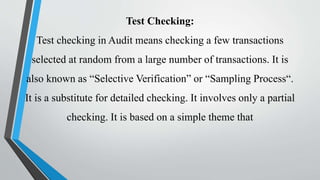
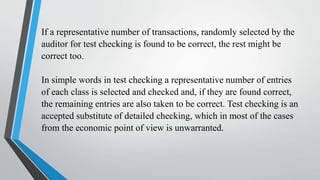
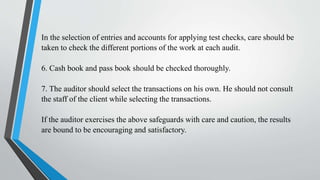
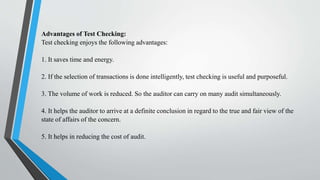
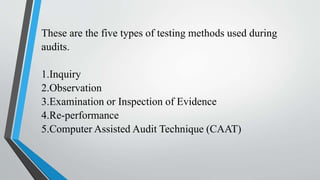
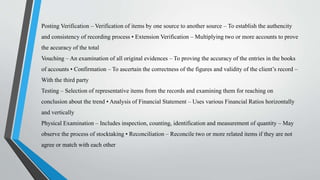
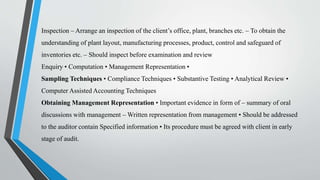
Test checking, also known as selective verification or sampling, involves auditors randomly selecting a representative number of transactions from an account or period to check, rather than checking all transactions. If the sample transactions are found to be accurate, it is assumed the non-checked transactions are also accurate. There are various techniques used for test checking, including inquiry, observation, examination of evidence, and re-performance of calculations. While it reduces the time and cost of a full audit, test checking carries risks such as not detecting all errors and fraud. Auditors must carefully select samples to draw valid conclusions from test checking.










![Audit evidence a framework (ppt ch7[1].pdf)](https://cdn.slidesharecdn.com/ss_thumbnails/auditevidence-aframeworkpptch71-pdf-121211154609-phpapp02-thumbnail.jpg?width=640&height=640&fit=bounds)


