By
Dr.E.Ramapraba,
Assistant professor of Commerce,
Bon Secours College for Women,
Thanjavur.
Meaning of Management Accounting:
Management Accounting is the
presentation of accounting information in
such a way as to assist management in the
creation of policy and the day-to-day
operation of an undertaking.
Thus, it relates to the use of accounting
data collected with the help of financial
accounting and cost accounting for the
purpose of policy formulation, planning,
control and decision-making by the
management.
Definition of Management Accounting:
“Management Accounting is concerned with
accounting information that is useful to
management.” —R.N. Anthony
“Management accounting is a system of
collection and presentation of relevant
economic information relating to an
enterprise for planning, controlling and
decision-making.” —ICWA of India
Objectives of Management Accounting:
➢Better planning for future policies.
➢To assist the management in promoting
efficiency.
➢To prepare budget .
➢To analyze monetary and non-monetary
transactions.
➢To compare actual performance with the plan
for identifying deviations.
➢To interpret financial statements.
➢To motivate the workforce.
➢To give up-to-date financial information
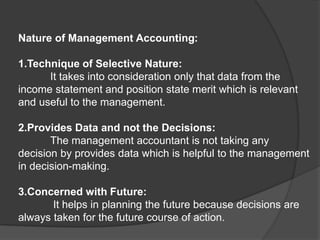
Nature of Management Accounting:
1.Technique of Selective Nature:
It takes into consideration only that data from the
income statement and position state merit which is relevant
and useful to the management.
2.Provides Data and not the Decisions:
The management accountant is not taking any
decision by provides data which is helpful to the management
in decision-making.
3.Concerned with Future:
It helps in planning the future because decisions are
always taken for the future course of action.
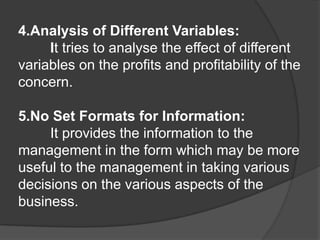
4.Analysis of Different Variables:
It tries to analyse the effect of different
variables on the profits and profitability of the
concern.
5.No Set Formats for Information:
It provides the information to the
management in the form which may be more
useful to the management in taking various
decisions on the various aspects of the
business.
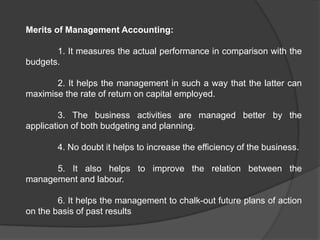
Merits of Management Accounting:
1. It measures the actual performance in comparison with the
budgets.
2. It helps the management in such a way that the latter can
maximise the rate of return on capital employed.
3. The business activities are managed better by the
application of both budgeting and planning.
4. No doubt it helps to increase the efficiency of the business.
5. It also helps to improve the relation between the
management and labour.
6. It helps the management to chalk-out future plans of action
on the basis of past results
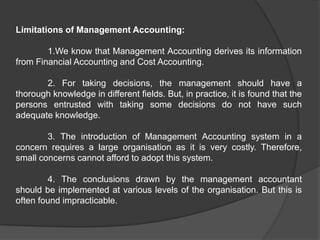
Limitations of Management Accounting:
1.We know that Management Accounting derives its information
from Financial Accounting and Cost Accounting.
2. For taking decisions, the management should have a
thorough knowledge in different fields. But, in practice, it is found that the
persons entrusted with taking some decisions do not have such
adequate knowledge.
3. The introduction of Management Accounting system in a
concern requires a large organisation as it is very costly. Therefore,
small concerns cannot afford to adopt this system.
4. The conclusions drawn by the management accountant
should be implemented at various levels of the organisation. But this is
often found impracticable.
Scope of Management Accounting:
The scope of management accounting is very wide and broad-based.
(i) Financial Accounting:
Financial accounting though provides historical information but is
very useful for future planning and financial forecasting.
(ii) Cost Accounting:
It provides various techniques of costing like marginal costing,
standard costing, operation costing etc. These techniques play an
important role in assisting the management in the formulation of policy ad
the operations of the undertaking.
(iii) Budgetary Control:
This includes framing of budgets, comparison of actual
performance with budgeted performance, computation of variances,
finding out their causes and suggesting remedial measures.
(iv) Inventory control:
It is concerned with control over inventory from the
time it is received till its disposal.
(v) Reporting:
Reporting includes the preparation of monthly,
quarterly, half-yearly income statements and other related
reports such as cash flow and fund flow statements. These
reports are submitted to the management for evaluation of
performance and decision-making.
(vi) Statistical Methods:
Statistical tools like graphs, charts, index numbers
etc. are used for presentation of information to various
departments.
(vii) Taxation:
It includes preparation of income statement, assessing the effect
of tax on capital expenditure proposals and pricing.
(viii) Methods and procedures:
They deal with organizational methods for cost reduction,
procedures for improving the efficiency of accounting and office
operations.
(ix) Internal Audit:
This refers to the establishment of a suitable internal audit system
for internal control.
(x) Office Services:
They cover a wide range of activities like data processing, filing,
coping, printing ,communication etc.
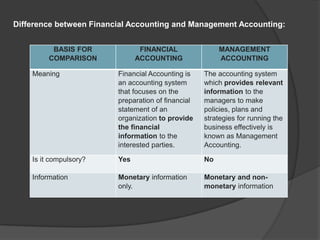
Difference between Financial Accounting and Management Accounting:
BASIS FOR
COMPARISON
FINANCIAL
ACCOUNTING
MANAGEMENT
ACCOUNTING
Meaning Financial Accounting is
an accounting system
that focuses on the
preparation of financial
statement of an
organization to provide
the financial
information to the
interested parties.
The accounting system
which provides relevant
information to the
managers to make
policies, plans and
strategies for running the
business effectively is
known as Management
Accounting.
Is it compulsory? Yes No
Information Monetary information
only.
Monetary and non-
monetary information
BASIS FOR
COMPARISON
FINANCIAL
ACCOUNTING
MANAGEMENT
ACCOUNTING
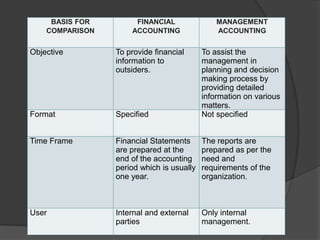
Objective To provide financial
information to
outsiders.
To assist the
management in
planning and decision
making process by
providing detailed
information on various
matters.
Format Specified Not specified
Time Frame Financial Statements
are prepared at the
end of the accounting
period which is usually
one year.
The reports are
prepared as per the
need and
requirements of the
organization.
User Internal and external
parties
Only internal
management.
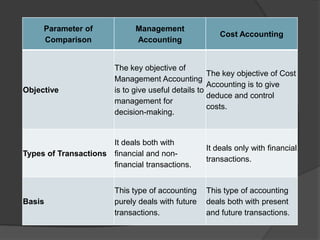
Parameter of
Comparison
Management
Accounting
Cost Accounting
Objective
The key objective of
Management Accounting
is to give useful details to
management for
decision-making.
The key objective of Cost
Accounting is to give
deduce and control
costs.
Types of Transactions
It deals both with
financial and non-
financial transactions.
It deals only with financial
transactions.
Basis
This type of accounting
purely deals with future
transactions.
This type of accounting
deals both with present
and future transactions.
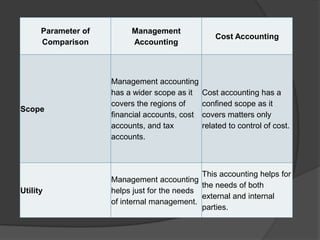
Parameter of
Comparison
Management
Accounting
Cost Accounting
Scope
Management accounting
has a wider scope as it
covers the regions of
financial accounts, cost
accounts, and tax
accounts.
Cost accounting has a
confined scope as it
covers matters only
related to control of cost.
Utility
Management accounting
helps just for the needs
of internal management.
This accounting helps for
the needs of both
external and internal
parties.
Thank You

Management accounting

  • 1.
    By Dr.E.Ramapraba, Assistant professor ofCommerce, Bon Secours College for Women, Thanjavur.
  • 2.
    Meaning of ManagementAccounting: Management Accounting is the presentation of accounting information in such a way as to assist management in the creation of policy and the day-to-day operation of an undertaking. Thus, it relates to the use of accounting data collected with the help of financial accounting and cost accounting for the purpose of policy formulation, planning, control and decision-making by the management.
  • 3.
    Definition of ManagementAccounting: “Management Accounting is concerned with accounting information that is useful to management.” —R.N. Anthony “Management accounting is a system of collection and presentation of relevant economic information relating to an enterprise for planning, controlling and decision-making.” —ICWA of India
  • 4.
    Objectives of ManagementAccounting: ➢Better planning for future policies. ➢To assist the management in promoting efficiency. ➢To prepare budget . ➢To analyze monetary and non-monetary transactions. ➢To compare actual performance with the plan for identifying deviations. ➢To interpret financial statements. ➢To motivate the workforce. ➢To give up-to-date financial information
  • 5.
    Nature of ManagementAccounting: 1.Technique of Selective Nature: It takes into consideration only that data from the income statement and position state merit which is relevant and useful to the management. 2.Provides Data and not the Decisions: The management accountant is not taking any decision by provides data which is helpful to the management in decision-making. 3.Concerned with Future: It helps in planning the future because decisions are always taken for the future course of action.
  • 6.
    4.Analysis of DifferentVariables: It tries to analyse the effect of different variables on the profits and profitability of the concern. 5.No Set Formats for Information: It provides the information to the management in the form which may be more useful to the management in taking various decisions on the various aspects of the business.
  • 7.
    Merits of ManagementAccounting: 1. It measures the actual performance in comparison with the budgets. 2. It helps the management in such a way that the latter can maximise the rate of return on capital employed. 3. The business activities are managed better by the application of both budgeting and planning. 4. No doubt it helps to increase the efficiency of the business. 5. It also helps to improve the relation between the management and labour. 6. It helps the management to chalk-out future plans of action on the basis of past results
  • 8.
    Limitations of ManagementAccounting: 1.We know that Management Accounting derives its information from Financial Accounting and Cost Accounting. 2. For taking decisions, the management should have a thorough knowledge in different fields. But, in practice, it is found that the persons entrusted with taking some decisions do not have such adequate knowledge. 3. The introduction of Management Accounting system in a concern requires a large organisation as it is very costly. Therefore, small concerns cannot afford to adopt this system. 4. The conclusions drawn by the management accountant should be implemented at various levels of the organisation. But this is often found impracticable.
  • 9.
    Scope of ManagementAccounting: The scope of management accounting is very wide and broad-based. (i) Financial Accounting: Financial accounting though provides historical information but is very useful for future planning and financial forecasting. (ii) Cost Accounting: It provides various techniques of costing like marginal costing, standard costing, operation costing etc. These techniques play an important role in assisting the management in the formulation of policy ad the operations of the undertaking. (iii) Budgetary Control: This includes framing of budgets, comparison of actual performance with budgeted performance, computation of variances, finding out their causes and suggesting remedial measures.
  • 10.
    (iv) Inventory control: Itis concerned with control over inventory from the time it is received till its disposal. (v) Reporting: Reporting includes the preparation of monthly, quarterly, half-yearly income statements and other related reports such as cash flow and fund flow statements. These reports are submitted to the management for evaluation of performance and decision-making. (vi) Statistical Methods: Statistical tools like graphs, charts, index numbers etc. are used for presentation of information to various departments.
  • 11.
    (vii) Taxation: It includespreparation of income statement, assessing the effect of tax on capital expenditure proposals and pricing. (viii) Methods and procedures: They deal with organizational methods for cost reduction, procedures for improving the efficiency of accounting and office operations. (ix) Internal Audit: This refers to the establishment of a suitable internal audit system for internal control. (x) Office Services: They cover a wide range of activities like data processing, filing, coping, printing ,communication etc.
  • 12.
    Difference between FinancialAccounting and Management Accounting: BASIS FOR COMPARISON FINANCIAL ACCOUNTING MANAGEMENT ACCOUNTING Meaning Financial Accounting is an accounting system that focuses on the preparation of financial statement of an organization to provide the financial information to the interested parties. The accounting system which provides relevant information to the managers to make policies, plans and strategies for running the business effectively is known as Management Accounting. Is it compulsory? Yes No Information Monetary information only. Monetary and non- monetary information
  • 13.
    BASIS FOR COMPARISON FINANCIAL ACCOUNTING MANAGEMENT ACCOUNTING Objective Toprovide financial information to outsiders. To assist the management in planning and decision making process by providing detailed information on various matters. Format Specified Not specified Time Frame Financial Statements are prepared at the end of the accounting period which is usually one year. The reports are prepared as per the need and requirements of the organization. User Internal and external parties Only internal management.
  • 15.
    Parameter of Comparison Management Accounting Cost Accounting Objective Thekey objective of Management Accounting is to give useful details to management for decision-making. The key objective of Cost Accounting is to give deduce and control costs. Types of Transactions It deals both with financial and non- financial transactions. It deals only with financial transactions. Basis This type of accounting purely deals with future transactions. This type of accounting deals both with present and future transactions.
  • 16.
    Parameter of Comparison Management Accounting Cost Accounting Scope Managementaccounting has a wider scope as it covers the regions of financial accounts, cost accounts, and tax accounts. Cost accounting has a confined scope as it covers matters only related to control of cost. Utility Management accounting helps just for the needs of internal management. This accounting helps for the needs of both external and internal parties.
  • 17.