Dr.E.RAMAPRABA,
ASSISTANT PROFESSOR OF COMMERCE
BON SECOURS COLLEGE FOR WOMEN,
THANJAVUR.
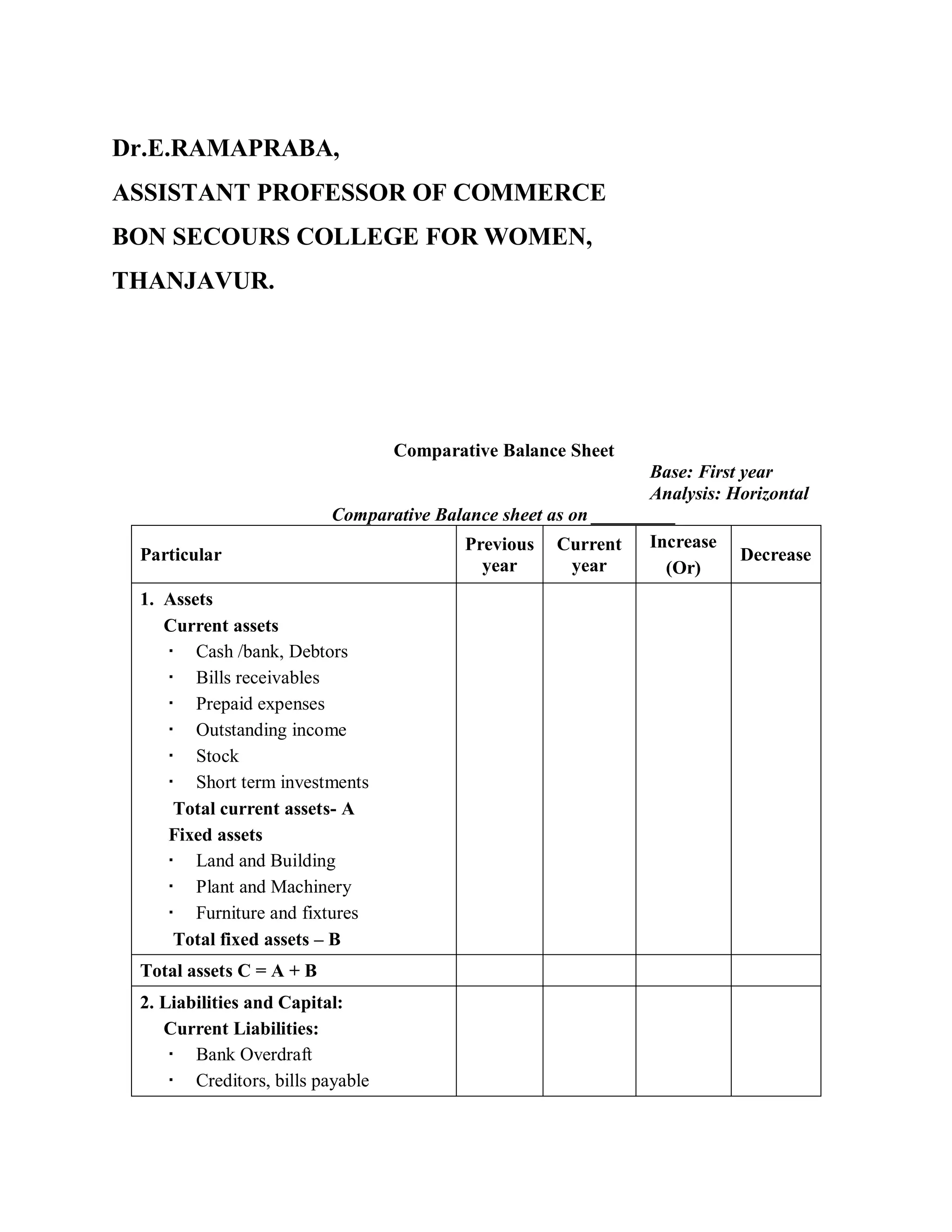
Comparative Balance Sheet
Base: First year
Analysis: Horizontal
Comparative Balance sheet as on _________
Particular
Previous
year
Current
year
Increase
(Or)
Decrease
1. Assets
Current assets
 Cash /bank, Debtors
 Bills receivables
 Prepaid expenses
 Outstanding income
 Stock
 Short term investments
Total current assets- A
Fixed assets
 Land and Building
 Plant and Machinery
 Furniture and fixtures
Total fixed assets – B
Total assets C = A + B
2. Liabilities and Capital:
Current Liabilities:
 Bank Overdraft
 Creditors, bills payable
 Prepaid income
 Outstanding expenses
 Provision for taxation
Total current liabilities – A
Long term liabilities
 Debentures
 Term loans
Total long term liabilities – B
Total liabilities A+B = C
3.Capital and Reserves
Share Capital
Retained earnings(P&L A/C)
Reserve &Surplus
Total Shareholders fund-- D
Total Liabilities & Capital E=C+D
Equations in Relation to Income Statement:
In Simple:
Operating Income (GP) – Operating Expenses = Operating Profit
Operating Profit + Non-Operating Income = Total Operating Profit
Total Operating Profit –Non Operating Expenses = Net Profit
In short
Operating profit = Operating Income (GP) – Operating Expenses
(Or)
= (Sales – CGS) –Operating Expenses
(Or)
= NP + Non-Operating Expenses – Non-Operating Income
Comparative Income Statement
Income statement, otherwise called profit and loss account, is the mirror which shows the
operative result of a firm. When income statement is prepared for two consecutive years, it is
called comparative income statement. Comparative income statement reveals the differences in
accounting figures with regard to sales, cost of sales, operating expenses and operating profit
between two dates of income statement. The difference might be either increase or decrease. The
change is also expressed in percentage.
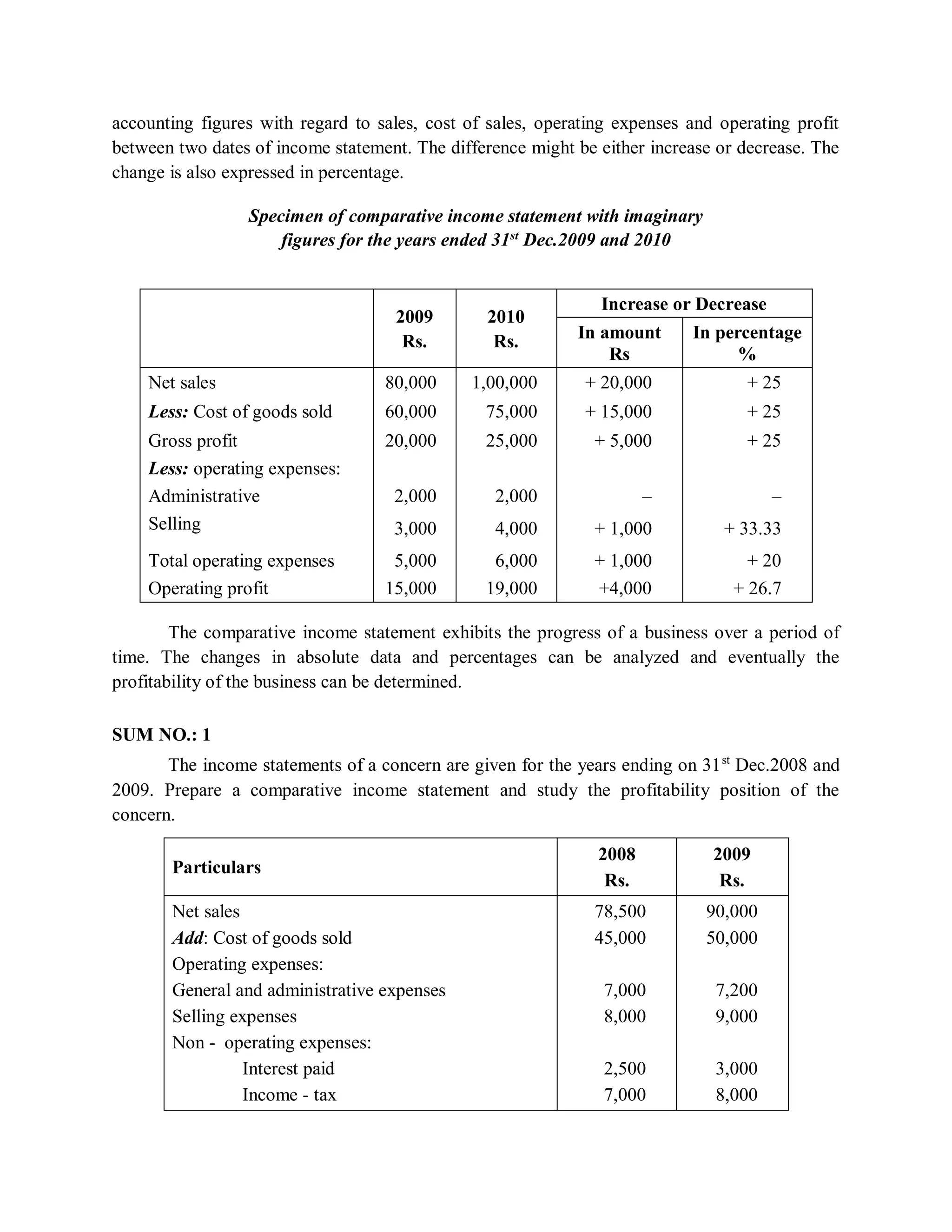
Specimen of comparative income statement with imaginary
figures for the years ended 31st
Dec.2009 and 2010
2009
Rs.
2010
Rs.
Increase or Decrease
In amount
Rs
In percentage
%
Net sales 80,000 1,00,000 + 20,000 + 25
Less: Cost of goods sold 60,000 75,000 + 15,000 + 25
Gross profit 20,000 25,000 + 5,000 + 25
Less: operating expenses:
Administrative 2,000 2,000 – –
Selling 3,000 4,000 + 1,000 + 33.33
Total operating expenses 5,000 6,000 + 1,000 + 20
Operating profit 15,000 19,000 +4,000 + 26.7
The comparative income statement exhibits the progress of a business over a period of
time. The changes in absolute data and percentages can be analyzed and eventually the
profitability of the business can be determined.
SUM NO.: 1
The income statements of a concern are given for the years ending on 31st
Dec.2008 and
2009. Prepare a comparative income statement and study the profitability position of the
concern.
Particulars
2008
Rs.
2009
Rs.
Net sales
Add: Cost of goods sold
Operating expenses:
General and administrative expenses
Selling expenses
Non - operating expenses:
Interest paid
Income - tax
78,500
45,000
7,000
8,000
2,500
7,000
90,000
50,000
7,200
9,000
3,000
8,000
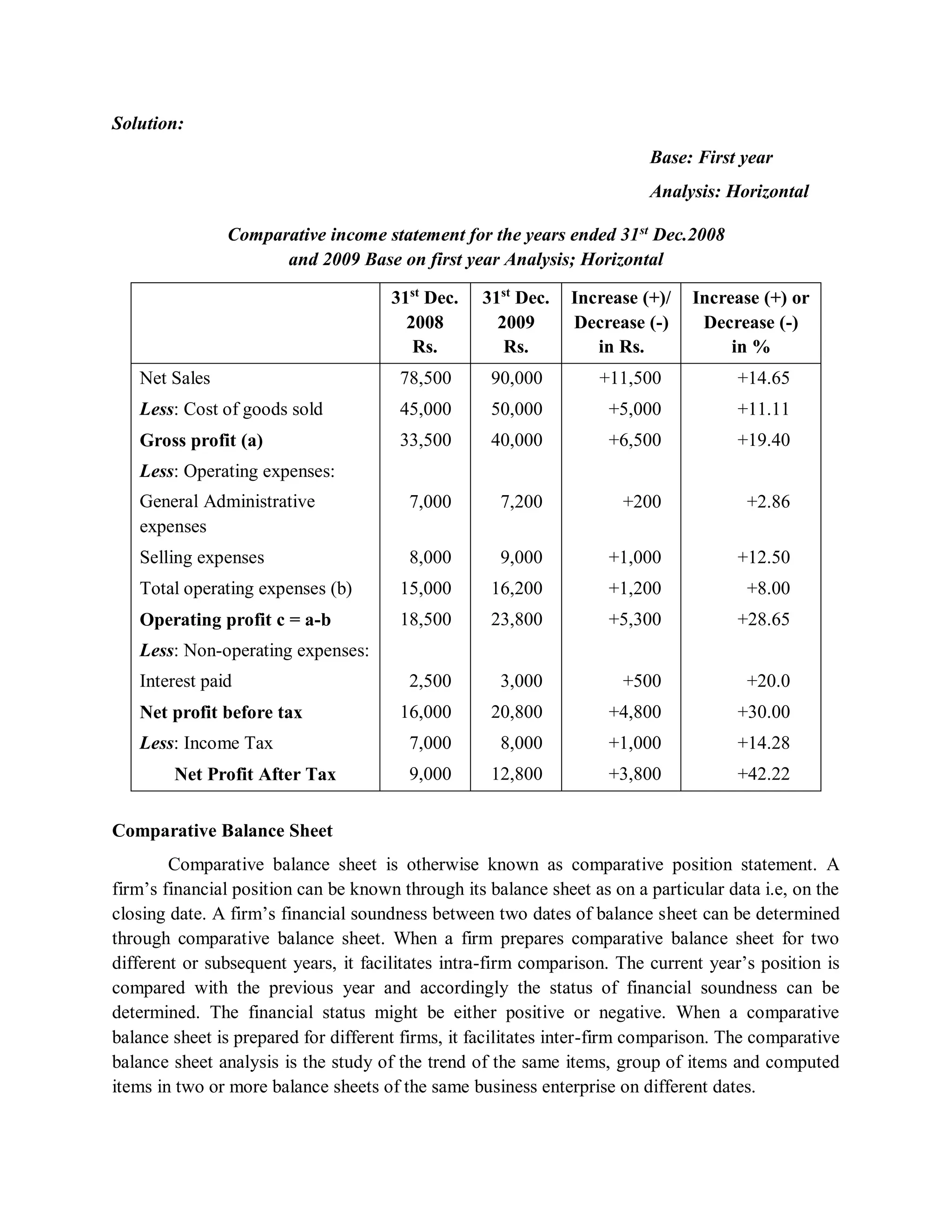
Solution:
Base: First year
Analysis: Horizontal
Comparative income statement for the years ended 31st
Dec.2008
and 2009 Base on first year Analysis; Horizontal
31st
Dec.
2008
Rs.
31st
Dec.
2009
Rs.
Increase (+)/
Decrease (-)
in Rs.
Increase (+) or
Decrease (-)
in %
Net Sales 78,500 90,000 +11,500 +14.65
Less: Cost of goods sold 45,000 50,000 +5,000 +11.11
Gross profit (a) 33,500 40,000 +6,500 +19.40
Less: Operating expenses:
General Administrative
expenses
7,000 7,200 +200 +2.86
Selling expenses 8,000 9,000 +1,000 +12.50
Total operating expenses (b) 15,000 16,200 +1,200 +8.00
Operating profit c = a-b 18,500 23,800 +5,300 +28.65
Less: Non-operating expenses:
Interest paid 2,500 3,000 +500 +20.0
Net profit before tax 16,000 20,800 +4,800 +30.00
Less: Income Tax 7,000 8,000 +1,000 +14.28
Net Profit After Tax 9,000 12,800 +3,800 +42.22
Comparative Balance Sheet
Comparative balance sheet is otherwise known as comparative position statement. A
firm’s financial position can be known through its balance sheet as on a particular data i.e, on the
closing date. A firm’s financial soundness between two dates of balance sheet can be determined
through comparative balance sheet. When a firm prepares comparative balance sheet for two
different or subsequent years, it facilitates intra-firm comparison. The current year’s position is
compared with the previous year and accordingly the status of financial soundness can be
determined. The financial status might be either positive or negative. When a comparative
balance sheet is prepared for different firms, it facilitates inter-firm comparison. The comparative
balance sheet analysis is the study of the trend of the same items, group of items and computed
items in two or more balance sheets of the same business enterprise on different dates.
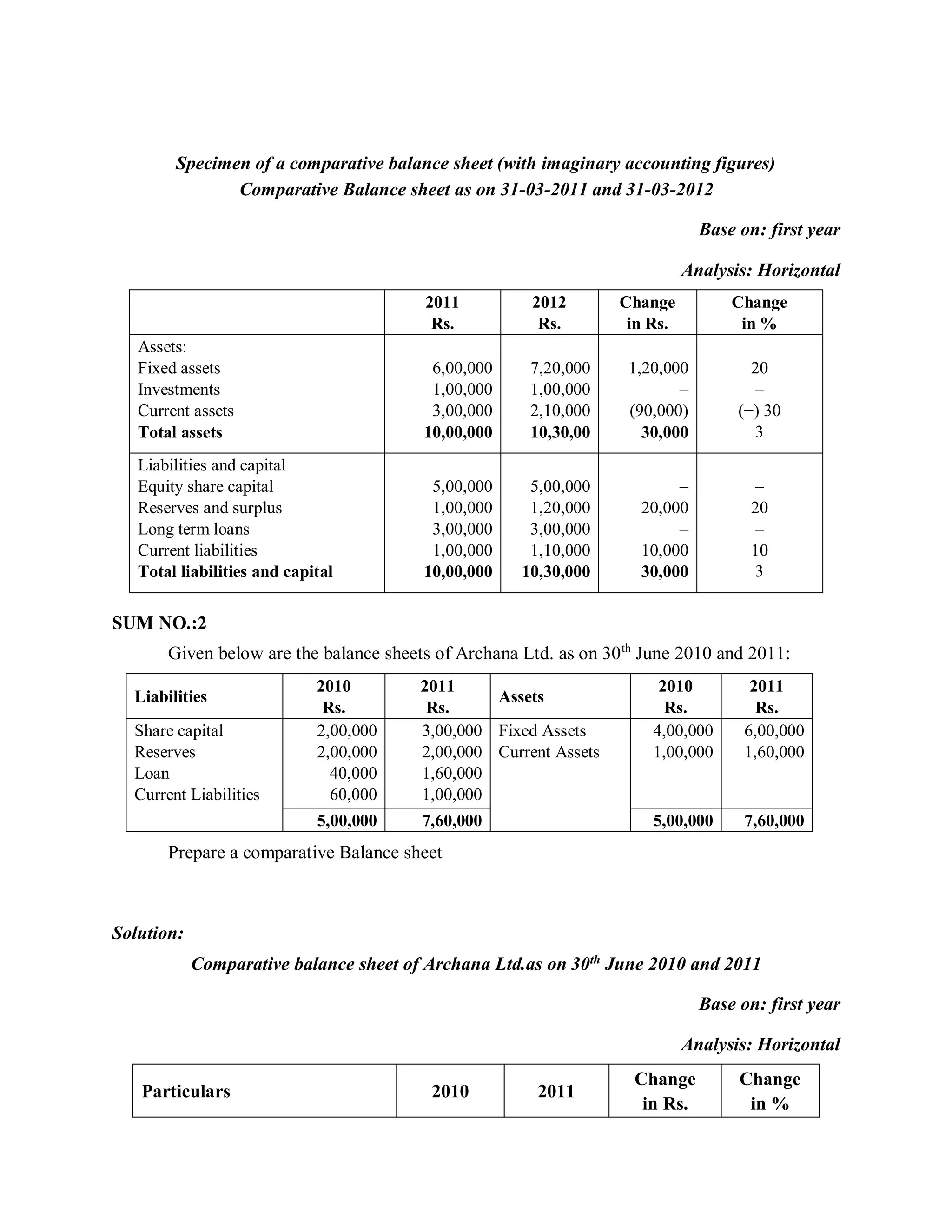
Specimen of a comparative balance sheet (with imaginary accounting figures)
Comparative Balance sheet as on 31-03-2011 and 31-03-2012
Base on: first year
Analysis: Horizontal
2011
Rs.
2012
Rs.
Change
in Rs.
Change
in %
Assets:
Fixed assets
Investments
Current assets
Total assets
6,00,000
1,00,000
3,00,000
10,00,000
7,20,000
1,00,000
2,10,000
10,30,00
1,20,000
–
(90,000)
30,000
20
–
(−) 30
3
Liabilities and capital
Equity share capital
Reserves and surplus
Long term loans
Current liabilities
Total liabilities and capital
5,00,000
1,00,000
3,00,000
1,00,000
10,00,000
5,00,000
1,20,000
3,00,000
1,10,000
10,30,000
–
20,000
–
10,000
30,000
–
20
–
10
3
SUM NO.:2
Given below are the balance sheets of Archana Ltd. as on 30th
June 2010 and 2011:
Liabilities
2010
Rs.
2011
Rs.
Assets
2010
Rs.
2011
Rs.
Share capital
Reserves
Loan
Current Liabilities
2,00,000
2,00,000
40,000
60,000
3,00,000
2,00,000
1,60,000
1,00,000
Fixed Assets
Current Assets
4,00,000
1,00,000
6,00,000
1,60,000
5,00,000 7,60,000 5,00,000 7,60,000
Prepare a comparative Balance sheet
Solution:
Comparative balance sheet of Archana Ltd.as on 30th
June 2010 and 2011
Base on: first year
Analysis: Horizontal
Particulars 2010 2011
Change
in Rs.
Change
in %
Fixed Assets 4,00,000 6,00,000 2,00,000 50
Current Assets 1,00,000 1,60,000 60,000 60
Total Assets 5,00,000 7,60,000 2,60,000 52
Liabilities and capital
Share capital 2,00,000 3,00,000 1,00,000 50
Reserves 2,00,000 2,00,000 – –
Loan 40,000 1,60,000 1,20,000 300
Current Liabilities 60,000 1,00,000 40,000 66.67
Total liabilities and capital 5,00,000 7,60,000 2,60,000 52
SUM NO.:3
Prepare comparative statements from the following data:
Income statements
Particulars
2008
Rs.
2009
Rs.
Net sales 6,00,000 7,50,000
Cost of goods sold 4,00,000 6,00,000
Administration expenses 20, 000 20,000
Selling expenses 10, 000 10,000
Net profit 1,70, 000 1,20,000
Position statements 2008 2009
Equity capital 4, 00,000 4, 00,000
8% preference share capital 3, 00,000 3, 00,000
Reserves 2, 00,000 2, 45,000
5% Debentures 1, 00,000 1, 50,000
Bills payable 50,000 75,000
Creditors 1, 50,000 2, 00,000
Tax payable 1, 00,000 1, 50,000
Total Liabilities and Capital 13, 00,000 15, 20,000
Land 1, 00,000 1, 00,000
Buildings 3, 00,000 2, 70,000
Plant 3, 00,000 2, 70,000
Furniture 1, 00,000 1, 40,000
Stock 2, 00,000 3, 00,000
Cash 3, 00,000 4, 40,000
Total Assets 13, 00,000 15, 20,000
Solution:
Comparative Income Statement for the years ended 2008 and 2009
Base on: first year
Analysis: Horizontal
Particulars
2008
Rs.
2009
Rs.
Increase
/Decrease
Rs.
Increase
/Decrease
%
Net sales 6,00,000 7,50,000 +1,50,000 +25
Less: Cost of goods sold 4,00,000 6,00,000 +2,00,000 +50
Gross Profit (A) 2,00,000 1,50,000 −50,000 −25
Operating expenses:
Administrative expenses 20,000 20,000 − −
Selling expenses 10,000 10,000 − −
Total operating expenses (B) 30,000 30,000 − −
Operating profit (C)
(A-B)
1,70,000 1,20,000 −50,000 −29.41
Less: Non-operating expenses
Net profit 1,70,000 1,20,000 −50,000 −29.41
Comparative Balance Sheet as on the closing dates of 2008 and 2009
Particulars
2008
Rs.
2009
Rs.
Increase/
Decrease
Rs.
Increase/
Decrease
%
ASSETS
Current Assets:
Cash 3,00,000 4,40,000 +1,40,000 +46.67
Stock 2,00,000 3,00,000 +1,00,000 +50.00
Total current assets 5,00,000 7,40,000 +2,40,000 +48.00
Fixed Assets:
Land 1,00,000 1,00,000  
Building 3,00,000 2,70,000 –30,000 10
Plant 3,00,000 2,70,000 –30,000 10
Furniture 1,00,000 1,40,000 +40,000 +40
Total fixed assets 8,00,000 7,80,000 –20,000 2.50
Total assets 13,00,000 15,20,000 +2,20,000 +16.92
LIABILITIES AND
CAPITAL
Current Liabilities:
Bills payable 50,000 75,000 +25,000 +50.00
Creditors 1,50,000 2,00,000 +50,000 +33.3
Tax payable 1,00,000 1,50,000 +50,000 +50.00
Total current liabilities 3,00,000 4,25,000 +1,25,000 +41.67
Long term Liabilities 5%
debentures
1,00,000 1,50,000 +50,000 +50.00
Total liabilities 4,00,000 5,75,000 +1,75,000 +43.75
CAPITAL
Equity share capital 4,00,000 4,00,000 – –
8% Preferential share capital 3,00,000 3,00,00 – –
Reserves 2,00,000 2,45,000 +45,000 +22.50
Total capital 9,00,000 9,45,000 +45,000 +5.00
Total liabilities and capital 13,00,000 15,20,000 +2,20,000 +16.92
Interpretation:
1. The comparative income statement clearly shows that though there has been an increase
in net sales to the extent of 25%, the cost of goods sold has been increased to 50%
causing a decrease in gross profit of 25%. Although the operating expenses have
remained constant, there has been decrease in net profit of 29.4%. Hence, the company
should look into this very seriously so as to reduce cost of goods sold and enhance net
profit.
2. The comparative balance sheet vividly exhibits that during 2009 there has been increase
in long-term liabilities to the tune of Rs.50, 000 yet fixed assets have been decreased by
2.5%. Thus, it is inferred that the company has used long-term funds to finance additional
working capital. In 2009, the current assets have increased by 48%. And, there has been
sufficient increase in cash and stock while the current liabilities have increased in 2009
by 41.67%. Thus, it is evident that the company’s liquidity position is sound.

Comparative statement

  • 1.
    Dr.E.RAMAPRABA, ASSISTANT PROFESSOR OFCOMMERCE BON SECOURS COLLEGE FOR WOMEN, THANJAVUR. Comparative Balance Sheet Base: First year Analysis: Horizontal Comparative Balance sheet as on _________ Particular Previous year Current year Increase (Or) Decrease 1. Assets Current assets  Cash /bank, Debtors  Bills receivables  Prepaid expenses  Outstanding income  Stock  Short term investments Total current assets- A Fixed assets  Land and Building  Plant and Machinery  Furniture and fixtures Total fixed assets – B Total assets C = A + B 2. Liabilities and Capital: Current Liabilities:  Bank Overdraft  Creditors, bills payable
  • 2.
     Prepaid income Outstanding expenses  Provision for taxation Total current liabilities – A Long term liabilities  Debentures  Term loans Total long term liabilities – B Total liabilities A+B = C 3.Capital and Reserves Share Capital Retained earnings(P&L A/C) Reserve &Surplus Total Shareholders fund-- D Total Liabilities & Capital E=C+D Equations in Relation to Income Statement: In Simple: Operating Income (GP) – Operating Expenses = Operating Profit Operating Profit + Non-Operating Income = Total Operating Profit Total Operating Profit –Non Operating Expenses = Net Profit In short Operating profit = Operating Income (GP) – Operating Expenses (Or) = (Sales – CGS) –Operating Expenses (Or) = NP + Non-Operating Expenses – Non-Operating Income Comparative Income Statement Income statement, otherwise called profit and loss account, is the mirror which shows the operative result of a firm. When income statement is prepared for two consecutive years, it is called comparative income statement. Comparative income statement reveals the differences in
  • 3.
    accounting figures withregard to sales, cost of sales, operating expenses and operating profit between two dates of income statement. The difference might be either increase or decrease. The change is also expressed in percentage. Specimen of comparative income statement with imaginary figures for the years ended 31st Dec.2009 and 2010 2009 Rs. 2010 Rs. Increase or Decrease In amount Rs In percentage % Net sales 80,000 1,00,000 + 20,000 + 25 Less: Cost of goods sold 60,000 75,000 + 15,000 + 25 Gross profit 20,000 25,000 + 5,000 + 25 Less: operating expenses: Administrative 2,000 2,000 – – Selling 3,000 4,000 + 1,000 + 33.33 Total operating expenses 5,000 6,000 + 1,000 + 20 Operating profit 15,000 19,000 +4,000 + 26.7 The comparative income statement exhibits the progress of a business over a period of time. The changes in absolute data and percentages can be analyzed and eventually the profitability of the business can be determined. SUM NO.: 1 The income statements of a concern are given for the years ending on 31st Dec.2008 and 2009. Prepare a comparative income statement and study the profitability position of the concern. Particulars 2008 Rs. 2009 Rs. Net sales Add: Cost of goods sold Operating expenses: General and administrative expenses Selling expenses Non - operating expenses: Interest paid Income - tax 78,500 45,000 7,000 8,000 2,500 7,000 90,000 50,000 7,200 9,000 3,000 8,000
  • 4.
    Solution: Base: First year Analysis:Horizontal Comparative income statement for the years ended 31st Dec.2008 and 2009 Base on first year Analysis; Horizontal 31st Dec. 2008 Rs. 31st Dec. 2009 Rs. Increase (+)/ Decrease (-) in Rs. Increase (+) or Decrease (-) in % Net Sales 78,500 90,000 +11,500 +14.65 Less: Cost of goods sold 45,000 50,000 +5,000 +11.11 Gross profit (a) 33,500 40,000 +6,500 +19.40 Less: Operating expenses: General Administrative expenses 7,000 7,200 +200 +2.86 Selling expenses 8,000 9,000 +1,000 +12.50 Total operating expenses (b) 15,000 16,200 +1,200 +8.00 Operating profit c = a-b 18,500 23,800 +5,300 +28.65 Less: Non-operating expenses: Interest paid 2,500 3,000 +500 +20.0 Net profit before tax 16,000 20,800 +4,800 +30.00 Less: Income Tax 7,000 8,000 +1,000 +14.28 Net Profit After Tax 9,000 12,800 +3,800 +42.22 Comparative Balance Sheet Comparative balance sheet is otherwise known as comparative position statement. A firm’s financial position can be known through its balance sheet as on a particular data i.e, on the closing date. A firm’s financial soundness between two dates of balance sheet can be determined through comparative balance sheet. When a firm prepares comparative balance sheet for two different or subsequent years, it facilitates intra-firm comparison. The current year’s position is compared with the previous year and accordingly the status of financial soundness can be determined. The financial status might be either positive or negative. When a comparative balance sheet is prepared for different firms, it facilitates inter-firm comparison. The comparative balance sheet analysis is the study of the trend of the same items, group of items and computed items in two or more balance sheets of the same business enterprise on different dates.
  • 5.
    Specimen of acomparative balance sheet (with imaginary accounting figures) Comparative Balance sheet as on 31-03-2011 and 31-03-2012 Base on: first year Analysis: Horizontal 2011 Rs. 2012 Rs. Change in Rs. Change in % Assets: Fixed assets Investments Current assets Total assets 6,00,000 1,00,000 3,00,000 10,00,000 7,20,000 1,00,000 2,10,000 10,30,00 1,20,000 – (90,000) 30,000 20 – (−) 30 3 Liabilities and capital Equity share capital Reserves and surplus Long term loans Current liabilities Total liabilities and capital 5,00,000 1,00,000 3,00,000 1,00,000 10,00,000 5,00,000 1,20,000 3,00,000 1,10,000 10,30,000 – 20,000 – 10,000 30,000 – 20 – 10 3 SUM NO.:2 Given below are the balance sheets of Archana Ltd. as on 30th June 2010 and 2011: Liabilities 2010 Rs. 2011 Rs. Assets 2010 Rs. 2011 Rs. Share capital Reserves Loan Current Liabilities 2,00,000 2,00,000 40,000 60,000 3,00,000 2,00,000 1,60,000 1,00,000 Fixed Assets Current Assets 4,00,000 1,00,000 6,00,000 1,60,000 5,00,000 7,60,000 5,00,000 7,60,000 Prepare a comparative Balance sheet Solution: Comparative balance sheet of Archana Ltd.as on 30th June 2010 and 2011 Base on: first year Analysis: Horizontal Particulars 2010 2011 Change in Rs. Change in %
  • 6.
    Fixed Assets 4,00,0006,00,000 2,00,000 50 Current Assets 1,00,000 1,60,000 60,000 60 Total Assets 5,00,000 7,60,000 2,60,000 52 Liabilities and capital Share capital 2,00,000 3,00,000 1,00,000 50 Reserves 2,00,000 2,00,000 – – Loan 40,000 1,60,000 1,20,000 300 Current Liabilities 60,000 1,00,000 40,000 66.67 Total liabilities and capital 5,00,000 7,60,000 2,60,000 52 SUM NO.:3 Prepare comparative statements from the following data: Income statements Particulars 2008 Rs. 2009 Rs. Net sales 6,00,000 7,50,000 Cost of goods sold 4,00,000 6,00,000 Administration expenses 20, 000 20,000 Selling expenses 10, 000 10,000 Net profit 1,70, 000 1,20,000 Position statements 2008 2009 Equity capital 4, 00,000 4, 00,000 8% preference share capital 3, 00,000 3, 00,000 Reserves 2, 00,000 2, 45,000 5% Debentures 1, 00,000 1, 50,000 Bills payable 50,000 75,000 Creditors 1, 50,000 2, 00,000 Tax payable 1, 00,000 1, 50,000 Total Liabilities and Capital 13, 00,000 15, 20,000 Land 1, 00,000 1, 00,000 Buildings 3, 00,000 2, 70,000 Plant 3, 00,000 2, 70,000 Furniture 1, 00,000 1, 40,000 Stock 2, 00,000 3, 00,000
  • 7.
    Cash 3, 00,0004, 40,000 Total Assets 13, 00,000 15, 20,000 Solution: Comparative Income Statement for the years ended 2008 and 2009 Base on: first year Analysis: Horizontal Particulars 2008 Rs. 2009 Rs. Increase /Decrease Rs. Increase /Decrease % Net sales 6,00,000 7,50,000 +1,50,000 +25 Less: Cost of goods sold 4,00,000 6,00,000 +2,00,000 +50 Gross Profit (A) 2,00,000 1,50,000 −50,000 −25 Operating expenses: Administrative expenses 20,000 20,000 − − Selling expenses 10,000 10,000 − − Total operating expenses (B) 30,000 30,000 − − Operating profit (C) (A-B) 1,70,000 1,20,000 −50,000 −29.41 Less: Non-operating expenses Net profit 1,70,000 1,20,000 −50,000 −29.41 Comparative Balance Sheet as on the closing dates of 2008 and 2009 Particulars 2008 Rs. 2009 Rs. Increase/ Decrease Rs. Increase/ Decrease % ASSETS Current Assets: Cash 3,00,000 4,40,000 +1,40,000 +46.67 Stock 2,00,000 3,00,000 +1,00,000 +50.00 Total current assets 5,00,000 7,40,000 +2,40,000 +48.00 Fixed Assets: Land 1,00,000 1,00,000   Building 3,00,000 2,70,000 –30,000 10 Plant 3,00,000 2,70,000 –30,000 10
  • 8.
    Furniture 1,00,000 1,40,000+40,000 +40 Total fixed assets 8,00,000 7,80,000 –20,000 2.50 Total assets 13,00,000 15,20,000 +2,20,000 +16.92 LIABILITIES AND CAPITAL Current Liabilities: Bills payable 50,000 75,000 +25,000 +50.00 Creditors 1,50,000 2,00,000 +50,000 +33.3 Tax payable 1,00,000 1,50,000 +50,000 +50.00 Total current liabilities 3,00,000 4,25,000 +1,25,000 +41.67 Long term Liabilities 5% debentures 1,00,000 1,50,000 +50,000 +50.00 Total liabilities 4,00,000 5,75,000 +1,75,000 +43.75 CAPITAL Equity share capital 4,00,000 4,00,000 – – 8% Preferential share capital 3,00,000 3,00,00 – – Reserves 2,00,000 2,45,000 +45,000 +22.50 Total capital 9,00,000 9,45,000 +45,000 +5.00 Total liabilities and capital 13,00,000 15,20,000 +2,20,000 +16.92 Interpretation: 1. The comparative income statement clearly shows that though there has been an increase in net sales to the extent of 25%, the cost of goods sold has been increased to 50% causing a decrease in gross profit of 25%. Although the operating expenses have remained constant, there has been decrease in net profit of 29.4%. Hence, the company should look into this very seriously so as to reduce cost of goods sold and enhance net profit. 2. The comparative balance sheet vividly exhibits that during 2009 there has been increase in long-term liabilities to the tune of Rs.50, 000 yet fixed assets have been decreased by 2.5%. Thus, it is inferred that the company has used long-term funds to finance additional working capital. In 2009, the current assets have increased by 48%. And, there has been sufficient increase in cash and stock while the current liabilities have increased in 2009 by 41.67%. Thus, it is evident that the company’s liquidity position is sound.