RECRUITMENT
MEANING:
Recruitment is the process of finding suitable
candidates for the various posts in an organization.
DEFINITION:
According to Edwin B. Flippo,
“Recruitment is the process of searching for
prospective employees and stimulating them to apply for jobs
in the organization.”
Vacancies may arise in an organization
due to any of the following:
• Retirement of an employees.
• Death of an employees.
• Resignation of job by the employee.
• Disablement of employee.
• Dismissal of an employee.
RECRUITMENT PROCESS
The Recruitment process consists of the following steps:
1. Recruitment process generally begins when the
personnel department receives requisitions for
recruitment from any department of the company.
2. Identifying the prospective employees with required
characteristics.
3. 3.Locating and developing the sources of required
number and type of employee.
4. Communicating the information about the
organization , the job and the terms and
conditions of service.
5. Encouraging the identified candidates to
apply for jobs in the organization.
6.Evaluating the effectiveness of recruitment
process.
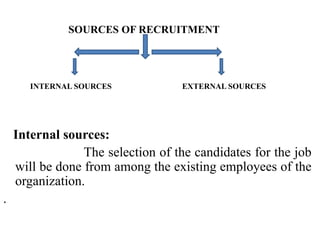
SOURCES OF RECRUITMENT
INTERNAL SOURCES EXTERNAL SOURCES
Internal sources:
The selection of the candidates for the job
will be done from among the existing employees of the
organization.
.
i)Transfer:
If a particulars department has a couple of surplus
staff and another department is short staffed, the surplus
staff may be transferred to that other department.
ii)Promotion:
When a vacancy arises at a higher level in an
organization, it is filled up elevating a person who comes next in
the hierarchy. The process of elevating a person to a higher level
job is what is known as promotion.
iii)Recommendation by existing employees.
Vacancies may also be filled up internally based
on the recommendations made .by the existing employees of the
concern. A family member, relative or friend of an employee
may be considered for appointment.
MERITS OF INTERNAL SOURCES OF
RECRUITMENT:
1) It motivates the employees to work harder as they
are aware that by providing their efficiency, they
can move better job on the organization.
2) As the management already knows the employee,
there is no risk involved in appointing him to some
other post in the organization.
3) As the employee is already familiar with the
organizational policies, rules and regulations, these
need not be explained to him.
4) It also saves lot of time and money for the
management.
DEMERITS:
1) It restricts choice.
2) It denies opportunities for capable
outsiders.
3) As an existing employee is
accustomed to the organizational
routine , he lacks the capacity to think
originally.
EXTERNAL SOURCES OF RECRUITMENT
It consists of the various outside sources
from which an employer can find candidates eligible for
the various posts in his organization.
1) Advertisement:
The employer can
advertise vacancies
in his organization
in popular
newspapers.
2) Employment exchange:
Employment exchange function under the control
of the government. They register the names of the job
seekers and also maintain their bio data. They provide
these details to any employer who approaches them.
3) Private employment consultants:
Employer having vacancies in their organizations
may also approach employment consultants who may help
them by finding suitable candidates. They do this work
for a consultancy fee.
4) Campus interview:
Many employer visit colleges and universities
every year and interview students who are in their final
year of study.
5) Rival firms:
To find an employer drawing efficient
employees from rival firms by offering them higher
remuneration. Efficient salesmen, Chartered
accountant etc.,
6) Unsolicited applicants:
An organization may often receive applicants for jobs
from many educated unemployed persons although it has not
notified vacancies. Such applications are called unsolicited
applications. These applicants apply voluntarily.
MERITS OF EXTERNAL SOURCES OF
RECRUITMENT:
1) It provides wider choice for the employer. He
can examine many applicants and select the
candidates.
2) Candidates recruited from the external source are
sure to do their work without any fear or favour.
3) External sources is more reliable than the internal
sources of recruitment.
4) External sources of recruitment is socially
desirable in the sense that it enables the educated
unemployed to get employment.
DEMERITS:
• 1)Recruitment from the external source is an
elaborate process.
• 2)The cost of recruitment from the external
source is also very high. Advertisement
charges have to be paid.
• 3) The newly recruited candidate will not be
familiar with the organizational environment.
• 4) Sometimes the existing employees of the
organization may not co-operate with the
candidate who has come from a different
environment.
• FACTORS DETERMINING RECRUITMENT
Certain organizations may have difficulty in finding
efficient persons for various jobs.
1) Reputation of the concern:
The reputation of the concern determines whether it
will have a good response whenever it notifies
vacancies. Eg. Ashok leyland, TVS, Reliance etc.,
2) Salary and other monetary benefits offered:
Salary and other monetary benefits offered are
attractive, the job can certainly attract a good
number of applications.
3)Terms and conditions of services:
The hours of work, leave benefits, transfer
conditions, guidelines for promotion etc., also influence
the job preference of applicants.
4) Nature of the vacancy:
The nature of the vacancy whether it is permanent or
temporary is another important factor. If the vacancy is
temporary one it may not attract a good number of
applications.
5) Government reservation norms:
As per reservation policy of the Government, certain
number of posts have to be reserved for certain sections of
the society. Government organizations and those
receiving grant from government are required to fill up
vacancies in accordance with the reservation policy.
Recruitment in hrm

Recruitment in hrm

  • 2.
    RECRUITMENT MEANING: Recruitment is theprocess of finding suitable candidates for the various posts in an organization. DEFINITION: According to Edwin B. Flippo, “Recruitment is the process of searching for prospective employees and stimulating them to apply for jobs in the organization.”
  • 3.
    Vacancies may arisein an organization due to any of the following: • Retirement of an employees. • Death of an employees. • Resignation of job by the employee. • Disablement of employee. • Dismissal of an employee.
  • 4.
    RECRUITMENT PROCESS The Recruitmentprocess consists of the following steps: 1. Recruitment process generally begins when the personnel department receives requisitions for recruitment from any department of the company. 2. Identifying the prospective employees with required characteristics. 3. 3.Locating and developing the sources of required number and type of employee.
  • 5.
    4. Communicating theinformation about the organization , the job and the terms and conditions of service. 5. Encouraging the identified candidates to apply for jobs in the organization. 6.Evaluating the effectiveness of recruitment process.
  • 6.
    SOURCES OF RECRUITMENT INTERNALSOURCES EXTERNAL SOURCES Internal sources: The selection of the candidates for the job will be done from among the existing employees of the organization. .
  • 7.
    i)Transfer: If a particularsdepartment has a couple of surplus staff and another department is short staffed, the surplus staff may be transferred to that other department.
  • 8.
    ii)Promotion: When a vacancyarises at a higher level in an organization, it is filled up elevating a person who comes next in the hierarchy. The process of elevating a person to a higher level job is what is known as promotion.
  • 9.
    iii)Recommendation by existingemployees. Vacancies may also be filled up internally based on the recommendations made .by the existing employees of the concern. A family member, relative or friend of an employee may be considered for appointment.
  • 10.
    MERITS OF INTERNALSOURCES OF RECRUITMENT: 1) It motivates the employees to work harder as they are aware that by providing their efficiency, they can move better job on the organization. 2) As the management already knows the employee, there is no risk involved in appointing him to some other post in the organization. 3) As the employee is already familiar with the organizational policies, rules and regulations, these need not be explained to him. 4) It also saves lot of time and money for the management.
  • 11.
    DEMERITS: 1) It restrictschoice. 2) It denies opportunities for capable outsiders. 3) As an existing employee is accustomed to the organizational routine , he lacks the capacity to think originally.
  • 12.
    EXTERNAL SOURCES OFRECRUITMENT It consists of the various outside sources from which an employer can find candidates eligible for the various posts in his organization. 1) Advertisement: The employer can advertise vacancies in his organization in popular newspapers.
  • 13.
    2) Employment exchange: Employmentexchange function under the control of the government. They register the names of the job seekers and also maintain their bio data. They provide these details to any employer who approaches them.
  • 14.
    3) Private employmentconsultants: Employer having vacancies in their organizations may also approach employment consultants who may help them by finding suitable candidates. They do this work for a consultancy fee.
  • 15.
    4) Campus interview: Manyemployer visit colleges and universities every year and interview students who are in their final year of study.
  • 16.
    5) Rival firms: Tofind an employer drawing efficient employees from rival firms by offering them higher remuneration. Efficient salesmen, Chartered accountant etc.,
  • 17.
    6) Unsolicited applicants: Anorganization may often receive applicants for jobs from many educated unemployed persons although it has not notified vacancies. Such applications are called unsolicited applications. These applicants apply voluntarily.
  • 18.
    MERITS OF EXTERNALSOURCES OF RECRUITMENT: 1) It provides wider choice for the employer. He can examine many applicants and select the candidates. 2) Candidates recruited from the external source are sure to do their work without any fear or favour. 3) External sources is more reliable than the internal sources of recruitment. 4) External sources of recruitment is socially desirable in the sense that it enables the educated unemployed to get employment.
  • 19.
    DEMERITS: • 1)Recruitment fromthe external source is an elaborate process. • 2)The cost of recruitment from the external source is also very high. Advertisement charges have to be paid. • 3) The newly recruited candidate will not be familiar with the organizational environment. • 4) Sometimes the existing employees of the organization may not co-operate with the candidate who has come from a different environment.
  • 20.
    • FACTORS DETERMININGRECRUITMENT Certain organizations may have difficulty in finding efficient persons for various jobs. 1) Reputation of the concern: The reputation of the concern determines whether it will have a good response whenever it notifies vacancies. Eg. Ashok leyland, TVS, Reliance etc., 2) Salary and other monetary benefits offered: Salary and other monetary benefits offered are attractive, the job can certainly attract a good number of applications.
  • 21.
    3)Terms and conditionsof services: The hours of work, leave benefits, transfer conditions, guidelines for promotion etc., also influence the job preference of applicants. 4) Nature of the vacancy: The nature of the vacancy whether it is permanent or temporary is another important factor. If the vacancy is temporary one it may not attract a good number of applications. 5) Government reservation norms: As per reservation policy of the Government, certain number of posts have to be reserved for certain sections of the society. Government organizations and those receiving grant from government are required to fill up vacancies in accordance with the reservation policy.