Dr.E.RAMAPRABA,
ASSISTANT PROFESSOR OF COMMERCE
BON SECOURS COLLEGE FOR WOMEN,
THANJAVUR.
MARGINAL COSTING
Contribution
1. Contribution is the difference between sales and variable costs and it
contributes towards fixed costs and profit.
2. It helps in sales and pricing policies and measuring the profitability of
different proposals.
Formula for calculating contribution:
(i) Contribution = Sales – variable cost.
(ii) Contribution = Profit + fixed cost.
(iii) Contribution = Loss – fixed cost.
(iv) Contribution = Sales × PV ratio.
PV ratio (Or) Profit volume ratio
1. The profit volume ratio is usually called P.V ratio.
2. It is one of the most useful ratios for studying the profitability of
business.
3. The ratio of contribution of sales is the P/V ratio.
4. It may be expressed in the variable cost per unit or by increasing the
selling price per unit.
Formula for calculating P.V ratio:
(i) PV ratio = Contribution ×100
Sales
(ii) PV ratio = Sales – variable cost ×100
Sales
(iii) PV ratio = Profit + fixed cost ×100
Sales
(iv) PV ratio = Loss – fixed cost ×100
Sales
(v) PV ratio = Profit ×100 (MOS = Margin of safety).
MOS
When two years (Or) two periods given:
(i) PV ratio = Changes in contribution ×100
Changes in sales
(ii) PV ratio = Changes in profit ×100
Changes in sales
Break-even point:
1. Break-even point refers to the point where total cost is equal to total
revenue. It is a point of no profit, no loss.
2. This is also a minimum point of production where total costs are
recovered.
3. If sales go up beyond the break-even point, the organisation makes a
profit.
4. If they come down, loss is incurred.
Formula for calculating BEP:
(i) BEP (in units) = Fixed cost
Contribution
Per
Unit
(ii) BEP (in rupees) = Fixed cost
Contribution
(Or)
(iii) BEP (in rupees) = Fixed cost
P/V ratio
Margin of safety (MOS):
1. Margin of safety is the excess of sales over the break-even sales.
2. It can be expressed in absolute sales amount or in percentage.
3. It indicates the extent to which the sales can be reduced without
resulting in loss.
4. A large margin of safety indicates the soundness of the business.
Formula for calculating margin of safety:
(i) MOS = Actual – break-even sales.
(ii) MOS (in units) = Profit
Contribution per unit
(iii) MOS (in Rs) = Profit
Contribution
(iv) MOS (in Rs) = Profit
P/V ratio
MOS ratio:
MOS ratio = MOS ×100
Total sales
STANDARD COSTING
(1) Standard costing:
Standard costing is the preparation and use of standard costs, their
comparison with actual costs and the analysis of variance to their causes
and point of incidence.
(2) Types of standard:
(i) Ideal standards.
(ii) Expected standards.
(iii) Basic standards.
(iv) Normal standards.
(3) Variance analysis:
Variance means difference. In standard costing, variance means the
difference between the standard cost and actual cost.
I.C.M.A. London defines variance as “difference between a standard
cost and the comparable actual cost incurred during a period”.
(4) Types of variance:
(i) Direct material cost variances.
(ii) Direct labour cost variance.
(iii) Overheads cost variances.
(iv) Sales variances.
(5) Direct material cost variances:
(i) Material cost variances = (SQ × SP) – (AQ × AP)
(ii) Material price variances = (SP – AP) AQ
(iii) Material usage variances = (SQ – AQ) SP
(iv) Material mix variance = (RSQ – AQ) SP
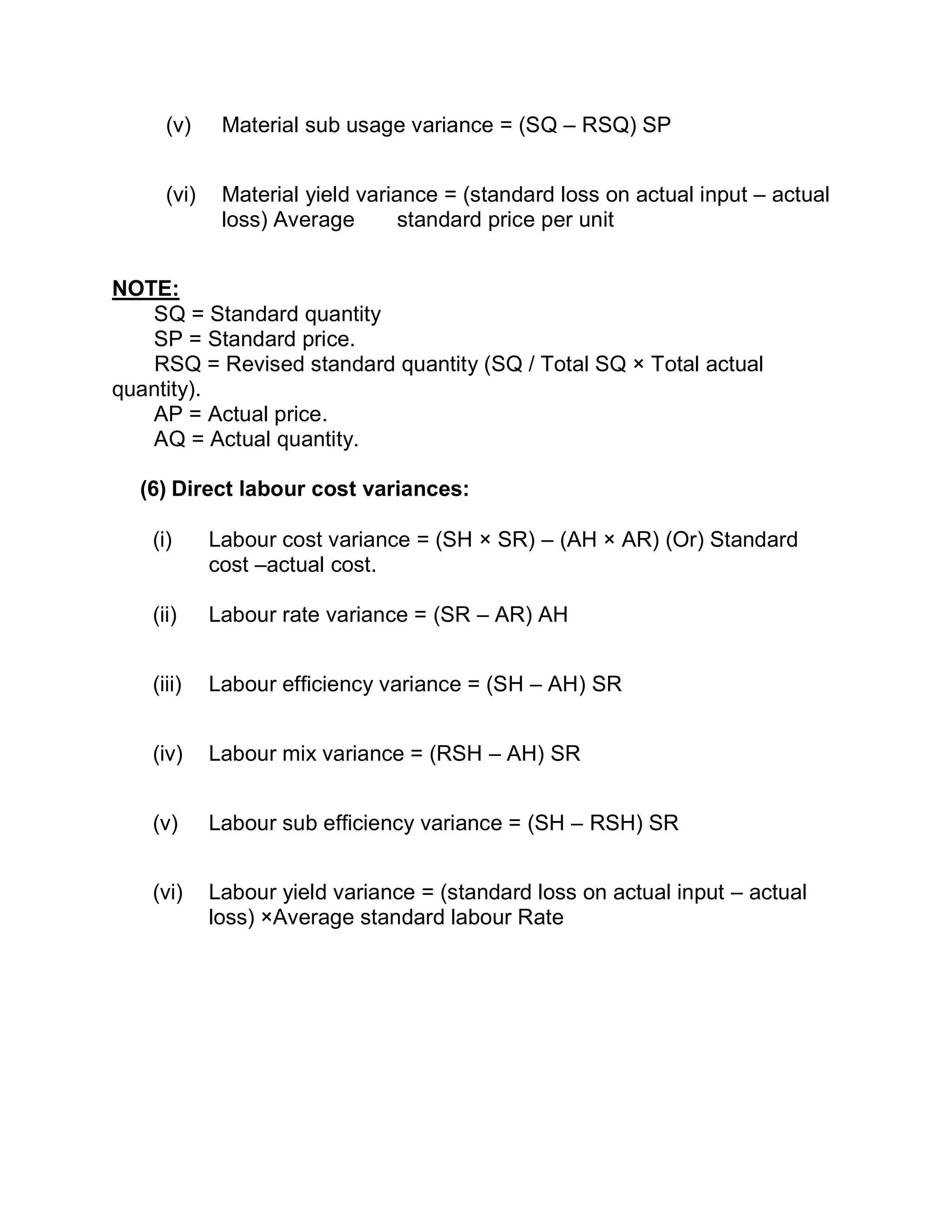
(v) Material sub usage variance = (SQ – RSQ) SP
(vi) Material yield variance = (standard loss on actual input – actual
loss) Average standard price per unit
NOTE:
SQ = Standard quantity
SP = Standard price.
RSQ = Revised standard quantity (SQ / Total SQ × Total actual
quantity).
AP = Actual price.
AQ = Actual quantity.
(6) Direct labour cost variances:
(i) Labour cost variance = (SH × SR) – (AH × AR) (Or) Standard
cost –actual cost.
(ii) Labour rate variance = (SR – AR) AH
(iii) Labour efficiency variance = (SH – AH) SR
(iv) Labour mix variance = (RSH – AH) SR
(v) Labour sub efficiency variance = (SH – RSH) SR
(vi) Labour yield variance = (standard loss on actual input – actual
loss) ×Average standard labour Rate
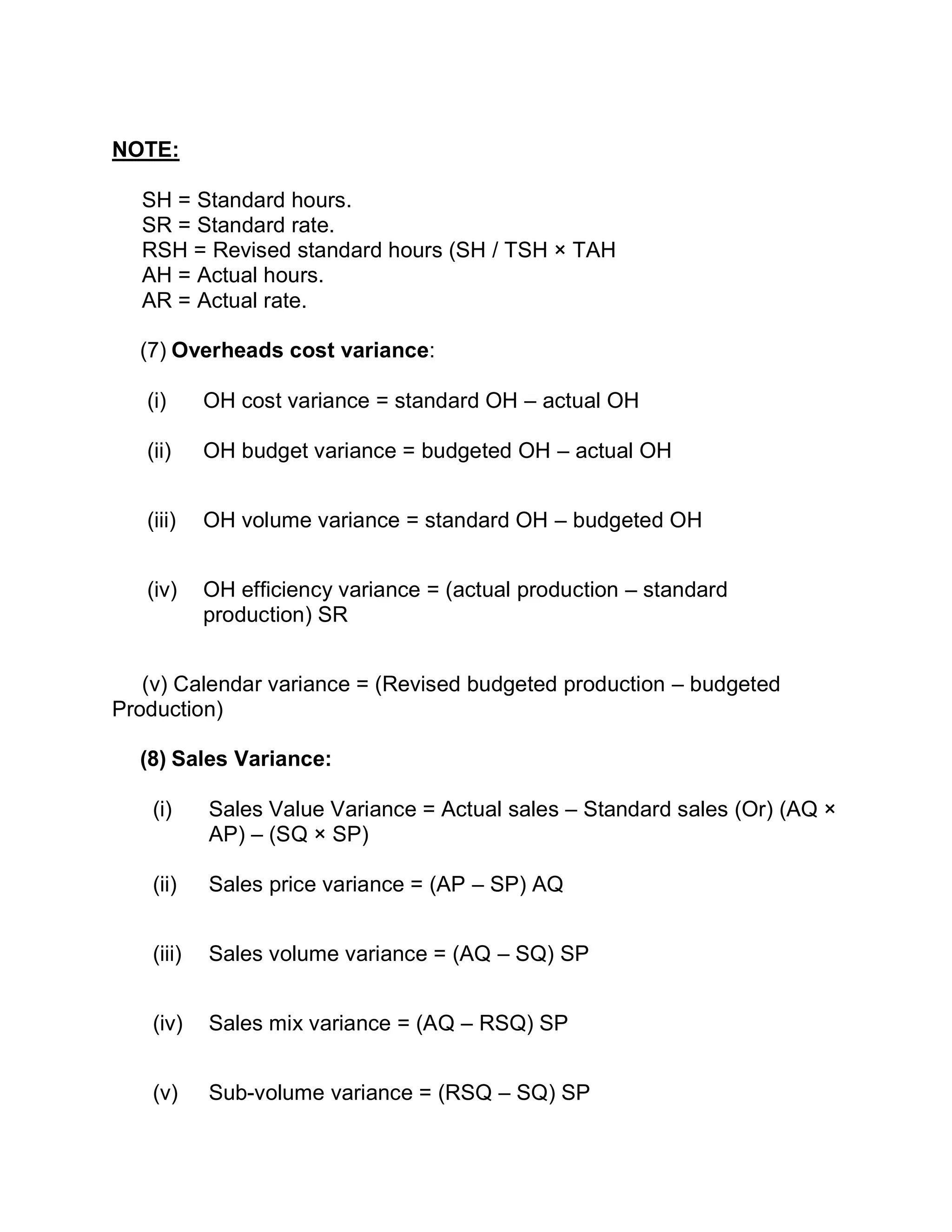
NOTE:
SH = Standard hours.
SR = Standard rate.
RSH = Revised standard hours (SH / TSH × TAH
AH = Actual hours.
AR = Actual rate.
(7) Overheads cost variance:
(i) OH cost variance = standard OH – actual OH
(ii) OH budget variance = budgeted OH – actual OH
(iii) OH volume variance = standard OH – budgeted OH
(iv) OH efficiency variance = (actual production – standard
production) SR
(v) Calendar variance = (Revised budgeted production – budgeted
Production)
(8) Sales Variance:
(i) Sales Value Variance = Actual sales – Standard sales (Or) (AQ ×
AP) – (SQ × SP)
(ii) Sales price variance = (AP – SP) AQ
(iii) Sales volume variance = (AQ – SQ) SP
(iv) Sales mix variance = (AQ – RSQ) SP
(v) Sub-volume variance = (RSQ – SQ) SP
RSQ = (SQ / Total SQ × Total actual quantity).

Marginal costing

  • 1.
    Dr.E.RAMAPRABA, ASSISTANT PROFESSOR OFCOMMERCE BON SECOURS COLLEGE FOR WOMEN, THANJAVUR. MARGINAL COSTING Contribution 1. Contribution is the difference between sales and variable costs and it contributes towards fixed costs and profit. 2. It helps in sales and pricing policies and measuring the profitability of different proposals. Formula for calculating contribution: (i) Contribution = Sales – variable cost. (ii) Contribution = Profit + fixed cost. (iii) Contribution = Loss – fixed cost. (iv) Contribution = Sales × PV ratio. PV ratio (Or) Profit volume ratio 1. The profit volume ratio is usually called P.V ratio. 2. It is one of the most useful ratios for studying the profitability of business. 3. The ratio of contribution of sales is the P/V ratio. 4. It may be expressed in the variable cost per unit or by increasing the selling price per unit. Formula for calculating P.V ratio: (i) PV ratio = Contribution ×100 Sales (ii) PV ratio = Sales – variable cost ×100 Sales (iii) PV ratio = Profit + fixed cost ×100
  • 2.
    Sales (iv) PV ratio= Loss – fixed cost ×100 Sales (v) PV ratio = Profit ×100 (MOS = Margin of safety). MOS When two years (Or) two periods given: (i) PV ratio = Changes in contribution ×100 Changes in sales (ii) PV ratio = Changes in profit ×100 Changes in sales Break-even point: 1. Break-even point refers to the point where total cost is equal to total revenue. It is a point of no profit, no loss. 2. This is also a minimum point of production where total costs are recovered. 3. If sales go up beyond the break-even point, the organisation makes a profit. 4. If they come down, loss is incurred. Formula for calculating BEP: (i) BEP (in units) = Fixed cost Contribution Per Unit (ii) BEP (in rupees) = Fixed cost Contribution (Or) (iii) BEP (in rupees) = Fixed cost
  • 3.
    P/V ratio Margin ofsafety (MOS): 1. Margin of safety is the excess of sales over the break-even sales. 2. It can be expressed in absolute sales amount or in percentage. 3. It indicates the extent to which the sales can be reduced without resulting in loss. 4. A large margin of safety indicates the soundness of the business. Formula for calculating margin of safety: (i) MOS = Actual – break-even sales. (ii) MOS (in units) = Profit Contribution per unit (iii) MOS (in Rs) = Profit Contribution (iv) MOS (in Rs) = Profit P/V ratio MOS ratio: MOS ratio = MOS ×100 Total sales STANDARD COSTING (1) Standard costing:
  • 4.
    Standard costing isthe preparation and use of standard costs, their comparison with actual costs and the analysis of variance to their causes and point of incidence. (2) Types of standard: (i) Ideal standards. (ii) Expected standards. (iii) Basic standards. (iv) Normal standards. (3) Variance analysis: Variance means difference. In standard costing, variance means the difference between the standard cost and actual cost. I.C.M.A. London defines variance as “difference between a standard cost and the comparable actual cost incurred during a period”. (4) Types of variance: (i) Direct material cost variances. (ii) Direct labour cost variance. (iii) Overheads cost variances. (iv) Sales variances. (5) Direct material cost variances: (i) Material cost variances = (SQ × SP) – (AQ × AP) (ii) Material price variances = (SP – AP) AQ (iii) Material usage variances = (SQ – AQ) SP (iv) Material mix variance = (RSQ – AQ) SP
  • 5.
    (v) Material subusage variance = (SQ – RSQ) SP (vi) Material yield variance = (standard loss on actual input – actual loss) Average standard price per unit NOTE: SQ = Standard quantity SP = Standard price. RSQ = Revised standard quantity (SQ / Total SQ × Total actual quantity). AP = Actual price. AQ = Actual quantity. (6) Direct labour cost variances: (i) Labour cost variance = (SH × SR) – (AH × AR) (Or) Standard cost –actual cost. (ii) Labour rate variance = (SR – AR) AH (iii) Labour efficiency variance = (SH – AH) SR (iv) Labour mix variance = (RSH – AH) SR (v) Labour sub efficiency variance = (SH – RSH) SR (vi) Labour yield variance = (standard loss on actual input – actual loss) ×Average standard labour Rate
  • 6.
    NOTE: SH = Standardhours. SR = Standard rate. RSH = Revised standard hours (SH / TSH × TAH AH = Actual hours. AR = Actual rate. (7) Overheads cost variance: (i) OH cost variance = standard OH – actual OH (ii) OH budget variance = budgeted OH – actual OH (iii) OH volume variance = standard OH – budgeted OH (iv) OH efficiency variance = (actual production – standard production) SR (v) Calendar variance = (Revised budgeted production – budgeted Production) (8) Sales Variance: (i) Sales Value Variance = Actual sales – Standard sales (Or) (AQ × AP) – (SQ × SP) (ii) Sales price variance = (AP – SP) AQ (iii) Sales volume variance = (AQ – SQ) SP (iv) Sales mix variance = (AQ – RSQ) SP (v) Sub-volume variance = (RSQ – SQ) SP
  • 7.
    RSQ = (SQ/ Total SQ × Total actual quantity).