Management Accounting
Topic : Break even point
Dr. K.A. Wangal
Introduction
In the present age of Globalization, free economy and
developments taking place in different fields of trade,
business and Commerce. A new concept was
introduction that accounting can be based to control
the business and guide its operations and therefore
this new accounting technique emerged as a new
system of accounting is known as ‘ Management
accounting ‘.
Definition
According to the institute of charted
accountants of England,” Any form of
accounting, which enables a business to be
conducted more efficiently can be regarded
as management Accounting”.
Functions of Management Accounting
The overall functions of Management Accounting
are classified in following categories:
A. Management operating function
B. Management theoretical functions
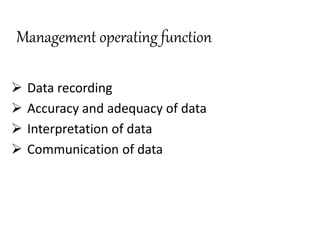
Management operating function
 Data recording
 Accuracy and adequacy of data
 Interpretation of data
 Communication of data
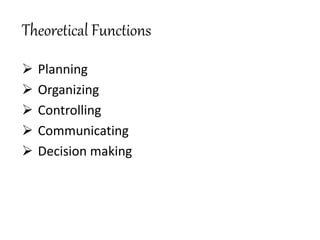
Theoretical Functions
 Planning
 Organizing
 Controlling
 Communicating
 Decision making
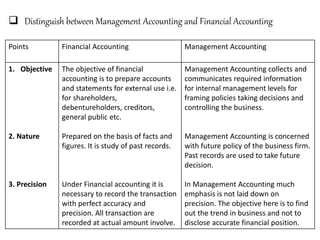
 Distinguish between Management Accounting and Financial Accounting
Points Financial Accounting Management Accounting
1. Objective
2. Nature
3. Precision
The objective of financial
accounting is to prepare accounts
and statements for external use i.e.
for shareholders,
debentureholders, creditors,
general public etc.
Prepared on the basis of facts and
figures. It is study of past records.
Under Financial accounting it is
necessary to record the transaction
with perfect accuracy and
precision. All transaction are
recorded at actual amount involve.
Management Accounting collects and
communicates required information
for internal management levels for
framing policies taking decisions and
controlling the business.
Management Accounting is concerned
with future policy of the business firm.
Past records are used to take future
decision.
In Management Accounting much
emphasis is not laid down on
precision. The objective here is to find
out the trend in business and not to
disclose accurate financial position.
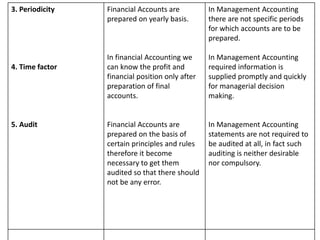
3. Periodicity
4. Time factor
5. Audit
Financial Accounts are
prepared on yearly basis.
In financial Accounting we
can know the profit and
financial position only after
preparation of final
accounts.
Financial Accounts are
prepared on the basis of
certain principles and rules
therefore it become
necessary to get them
audited so that there should
not be any error.
In Management Accounting
there are not specific periods
for which accounts are to be
prepared.
In Management Accounting
required information is
supplied promptly and quickly
for managerial decision
making.
In Management Accounting
statements are not required to
be audited at all, in fact such
auditing is neither desirable
nor compulsory.
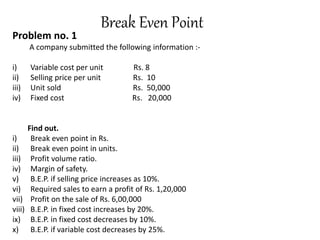
Break Even Point
Problem no. 1
A company submitted the following information :-
i) Variable cost per unit Rs. 8
ii) Selling price per unit Rs. 10
iii) Unit sold Rs. 50,000
iv) Fixed cost Rs. 20,000
Find out.
i) Break even point in Rs.
ii) Break even point in units.
iii) Profit volume ratio.
iv) Margin of safety.
v) B.E.P. if selling price increases as 10%.
vi) Required sales to earn a profit of Rs. 1,20,000
vii) Profit on the sale of Rs. 6,00,000
viii) B.E.P. in fixed cost increases by 20%.
ix) B.E.P. in fixed cost decreases by 10%.
x) B.E.P. if variable cost decreases by 25%.
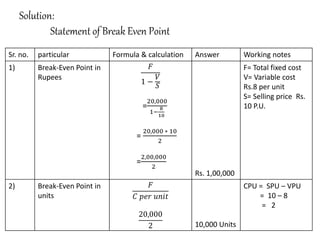
Solution:
Statement of Break Even Point
Sr. no. particular Formula & calculation Answer Working notes
1) Break-Even Point in
Rupees
𝐹
1 −
𝑉
𝑆
=
20,000
1−
8
10
=
20,000 ∗ 10
2
=
2,00,000
2
Rs. 1,00,000
F= Total fixed cost
V= Variable cost
Rs.8 per unit
S= Selling price Rs.
10 P.U.
2) Break-Even Point in
units
𝐹
𝐶 𝑝𝑒𝑟 𝑢𝑛𝑖𝑡
20,000
2 10,000 Units
CPU = SPU – VPU
= 10 – 8
= 2
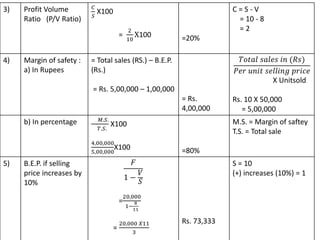
3) Profit Volume
Ratio (P/V Ratio)
𝐶
𝑆
X100
=
2
10
X100 =20%
C = S - V
= 10 - 8
= 2
4) Margin of safety :
a) In Rupees
= Total sales (RS.) – B.E.P.
(Rs.)
= Rs. 5,00,000 – 1,00,000
= Rs.
4,00,000
𝑇𝑜𝑡𝑎𝑙 𝑠𝑎𝑙𝑒𝑠 𝑖𝑛 (𝑅𝑠)
𝑃𝑒𝑟 𝑢𝑛𝑖𝑡 𝑠𝑒𝑙𝑙𝑖𝑛𝑔 𝑝𝑟𝑖𝑐𝑒
X Unitsold
Rs. 10 X 50,000
= 5,00,000
b) In percentage 𝑀.𝑆.
𝑇.𝑆.
X100
4,00,000
5,00,000
X100 =80%
M.S. = Margin of saftey
T.S. = Total sale
5) B.E.P. if selling
price increases by
10%
𝐹
1 −
𝑉
𝑆
=
20,000
1−
8
11
=
20,000 𝑋11
3
Rs. 73,333
S = 10
(+) increases (10%) = 1
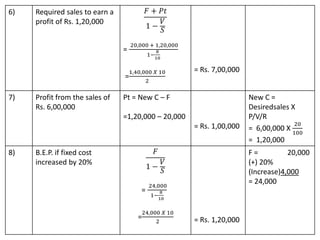
6) Required sales to earn a
profit of Rs. 1,20,000
𝐹 + 𝑃𝑡
1 −
𝑉
𝑆
=
20,000 + 1,20,000
1−
8
10
=
1,40,000 𝑋 10
2
= Rs. 7,00,000
7) Profit from the sales of
Rs. 6,00,000
Pt = New C – F
=1,20,000 – 20,000
= Rs. 1,00,000
New C =
Desiredsales X
P/V/R
= 6,00,000 X
20
100
= 1,20,000
8) B.E.P. if fixed cost
increased by 20%
𝐹
1 −
𝑉
𝑆
=
24,000
1−
8
10
=
24,000 𝑋 10
2 = Rs. 1,20,000
F = 20,000
(+) 20%
(Increase)4,000
= 24,000
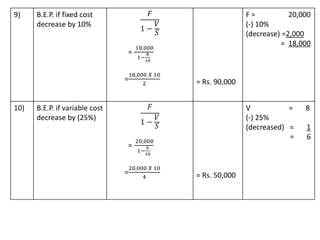
9) B.E.P. if fixed cost
decrease by 10%
𝐹
1 −
𝑉
𝑆
=
18,000
1−
8
10
=
18,000 𝑋 10
2 = Rs. 90,000
F = 20,000
(-) 10%
(decrease) =2,000
= 18,000
10) B.E.P. if variable cost
decrease by (25%)
𝐹
1 −
𝑉
𝑆
=
20,000
1−
6
10
=
20,000 𝑋 10
4 = Rs. 50,000
V = 8
(-) 25%
(decreased) = 1
= 6
Thank you
Presented by : Dr. K. A. Wangal

Management accounting

  • 1.
    Management Accounting Topic :Break even point Dr. K.A. Wangal
  • 2.
    Introduction In the presentage of Globalization, free economy and developments taking place in different fields of trade, business and Commerce. A new concept was introduction that accounting can be based to control the business and guide its operations and therefore this new accounting technique emerged as a new system of accounting is known as ‘ Management accounting ‘.
  • 3.
    Definition According to theinstitute of charted accountants of England,” Any form of accounting, which enables a business to be conducted more efficiently can be regarded as management Accounting”.
  • 4.
    Functions of ManagementAccounting The overall functions of Management Accounting are classified in following categories: A. Management operating function B. Management theoretical functions
  • 5.
    Management operating function Data recording  Accuracy and adequacy of data  Interpretation of data  Communication of data
  • 6.
    Theoretical Functions  Planning Organizing  Controlling  Communicating  Decision making
  • 7.
     Distinguish betweenManagement Accounting and Financial Accounting Points Financial Accounting Management Accounting 1. Objective 2. Nature 3. Precision The objective of financial accounting is to prepare accounts and statements for external use i.e. for shareholders, debentureholders, creditors, general public etc. Prepared on the basis of facts and figures. It is study of past records. Under Financial accounting it is necessary to record the transaction with perfect accuracy and precision. All transaction are recorded at actual amount involve. Management Accounting collects and communicates required information for internal management levels for framing policies taking decisions and controlling the business. Management Accounting is concerned with future policy of the business firm. Past records are used to take future decision. In Management Accounting much emphasis is not laid down on precision. The objective here is to find out the trend in business and not to disclose accurate financial position.
  • 8.
    3. Periodicity 4. Timefactor 5. Audit Financial Accounts are prepared on yearly basis. In financial Accounting we can know the profit and financial position only after preparation of final accounts. Financial Accounts are prepared on the basis of certain principles and rules therefore it become necessary to get them audited so that there should not be any error. In Management Accounting there are not specific periods for which accounts are to be prepared. In Management Accounting required information is supplied promptly and quickly for managerial decision making. In Management Accounting statements are not required to be audited at all, in fact such auditing is neither desirable nor compulsory.
  • 9.
    Break Even Point Problemno. 1 A company submitted the following information :- i) Variable cost per unit Rs. 8 ii) Selling price per unit Rs. 10 iii) Unit sold Rs. 50,000 iv) Fixed cost Rs. 20,000 Find out. i) Break even point in Rs. ii) Break even point in units. iii) Profit volume ratio. iv) Margin of safety. v) B.E.P. if selling price increases as 10%. vi) Required sales to earn a profit of Rs. 1,20,000 vii) Profit on the sale of Rs. 6,00,000 viii) B.E.P. in fixed cost increases by 20%. ix) B.E.P. in fixed cost decreases by 10%. x) B.E.P. if variable cost decreases by 25%.
  • 10.
    Solution: Statement of BreakEven Point Sr. no. particular Formula & calculation Answer Working notes 1) Break-Even Point in Rupees 𝐹 1 − 𝑉 𝑆 = 20,000 1− 8 10 = 20,000 ∗ 10 2 = 2,00,000 2 Rs. 1,00,000 F= Total fixed cost V= Variable cost Rs.8 per unit S= Selling price Rs. 10 P.U. 2) Break-Even Point in units 𝐹 𝐶 𝑝𝑒𝑟 𝑢𝑛𝑖𝑡 20,000 2 10,000 Units CPU = SPU – VPU = 10 – 8 = 2
  • 11.
    3) Profit Volume Ratio(P/V Ratio) 𝐶 𝑆 X100 = 2 10 X100 =20% C = S - V = 10 - 8 = 2 4) Margin of safety : a) In Rupees = Total sales (RS.) – B.E.P. (Rs.) = Rs. 5,00,000 – 1,00,000 = Rs. 4,00,000 𝑇𝑜𝑡𝑎𝑙 𝑠𝑎𝑙𝑒𝑠 𝑖𝑛 (𝑅𝑠) 𝑃𝑒𝑟 𝑢𝑛𝑖𝑡 𝑠𝑒𝑙𝑙𝑖𝑛𝑔 𝑝𝑟𝑖𝑐𝑒 X Unitsold Rs. 10 X 50,000 = 5,00,000 b) In percentage 𝑀.𝑆. 𝑇.𝑆. X100 4,00,000 5,00,000 X100 =80% M.S. = Margin of saftey T.S. = Total sale 5) B.E.P. if selling price increases by 10% 𝐹 1 − 𝑉 𝑆 = 20,000 1− 8 11 = 20,000 𝑋11 3 Rs. 73,333 S = 10 (+) increases (10%) = 1
  • 12.
    6) Required salesto earn a profit of Rs. 1,20,000 𝐹 + 𝑃𝑡 1 − 𝑉 𝑆 = 20,000 + 1,20,000 1− 8 10 = 1,40,000 𝑋 10 2 = Rs. 7,00,000 7) Profit from the sales of Rs. 6,00,000 Pt = New C – F =1,20,000 – 20,000 = Rs. 1,00,000 New C = Desiredsales X P/V/R = 6,00,000 X 20 100 = 1,20,000 8) B.E.P. if fixed cost increased by 20% 𝐹 1 − 𝑉 𝑆 = 24,000 1− 8 10 = 24,000 𝑋 10 2 = Rs. 1,20,000 F = 20,000 (+) 20% (Increase)4,000 = 24,000
  • 13.
    9) B.E.P. iffixed cost decrease by 10% 𝐹 1 − 𝑉 𝑆 = 18,000 1− 8 10 = 18,000 𝑋 10 2 = Rs. 90,000 F = 20,000 (-) 10% (decrease) =2,000 = 18,000 10) B.E.P. if variable cost decrease by (25%) 𝐹 1 − 𝑉 𝑆 = 20,000 1− 6 10 = 20,000 𝑋 10 4 = Rs. 50,000 V = 8 (-) 25% (decreased) = 1 = 6
  • 14.
    Thank you Presented by: Dr. K. A. Wangal