Financial Accounting
1
Lecture – 45
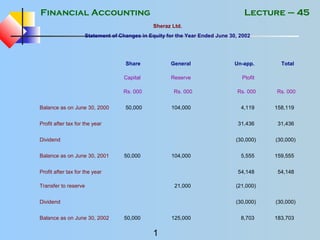
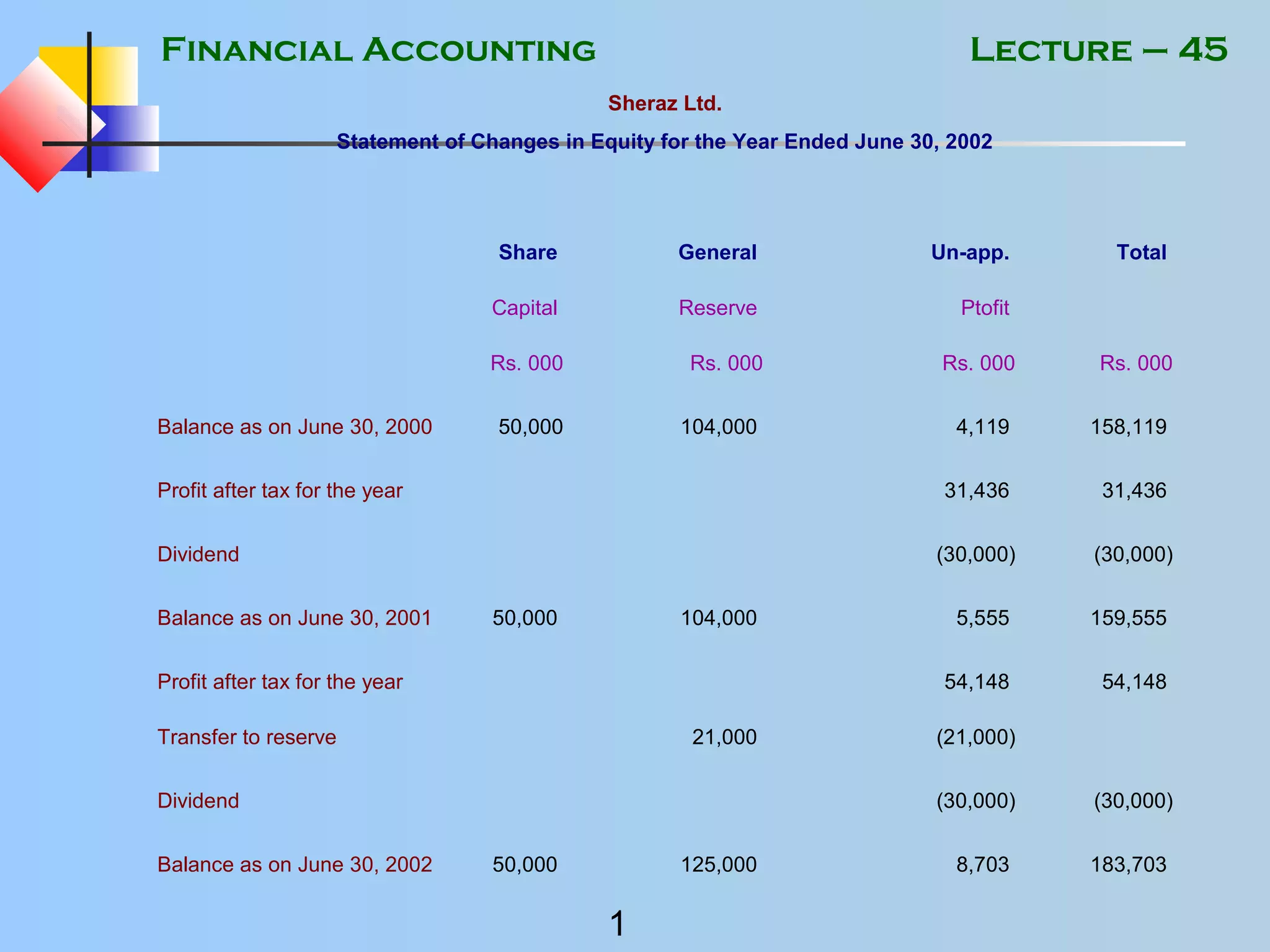
Sheraz Ltd.
Statement of Changes in Equity for the Year Ended June 30, 2002
Share General Un-app. Total
Capital Reserve Ptofit
Rs. 000 Rs. 000 Rs. 000 Rs. 000
Balance as on June 30, 2000 50,000 104,000 4,119 158,119
Profit after tax for the year 31,436 31,436
Dividend (30,000) (30,000)
Balance as on June 30, 2001 50,000 104,000 5,555 159,555
Profit after tax for the year 54,148 54,148
Transfer to reserve 21,000 (21,000)
Dividend (30,000) (30,000)
Balance as on June 30, 2002 50,000 125,000 8,703 183,703
Financial Accounting
2
Lecture – 45
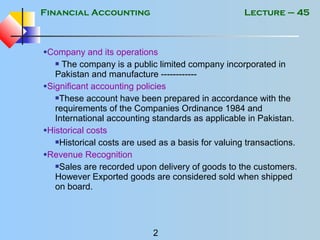
•Company and its operations
 The company is a public limited company incorporated in
Pakistan and manufacture ------------
•Significant accounting policies
These account have been prepared in accordance with the
requirements of the Companies Ordinance 1984 and
International accounting standards as applicable in Pakistan.
•Historical costs
Historical costs are used as a basis for valuing transactions.
•Revenue Recognition
Sales are recorded upon delivery of goods to the customers.
However Exported goods are considered sold when shipped
on board.
Financial Accounting
3
Lecture – 45
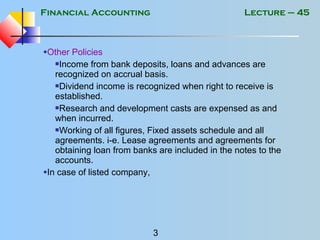
•Other Policies
Income from bank deposits, loans and advances are
recognized on accrual basis.
Dividend income is recognized when right to receive is
established.
Research and development casts are expensed as and
when incurred.
Working of all figures, Fixed assets schedule and all
agreements. i-e. Lease agreements and agreements for
obtaining loan from banks are included in the notes to the
accounts.
•In case of listed company,
Financial Accounting
4
Lecture – 45
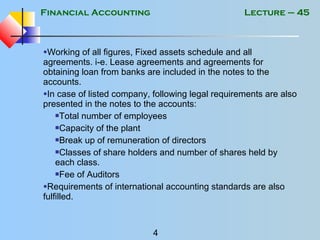
•Working of all figures, Fixed assets schedule and all
agreements. i-e. Lease agreements and agreements for
obtaining loan from banks are included in the notes to the
accounts.
•In case of listed company, following legal requirements are also
presented in the notes to the accounts:
Total number of employees
Capacity of the plant
Break up of remuneration of directors
Classes of share holders and number of shares held by
each class.
Fee of Auditors
•Requirements of international accounting standards are also
fulfilled.
Financial Accounting
5
Lecture – 45
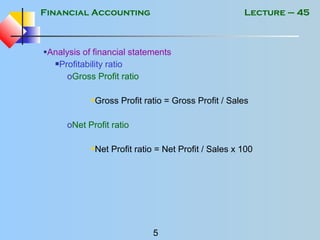
•Analysis of financial statements
Profitability ratio
oGross Profit ratio
Gross Profit ratio = Gross Profit / Sales
oNet Profit ratio
Net Profit ratio = Net Profit / Sales x 100
Financial Accounting
6
Lecture – 45
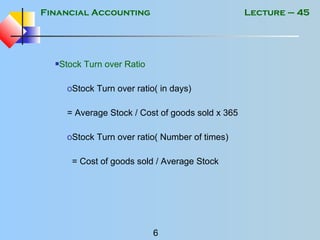
Stock Turn over Ratio
oStock Turn over ratio( in days)
= Average Stock / Cost of goods sold x 365
oStock Turn over ratio( Number of times)
= Cost of goods sold / Average Stock
Financial Accounting
7
Lecture – 45
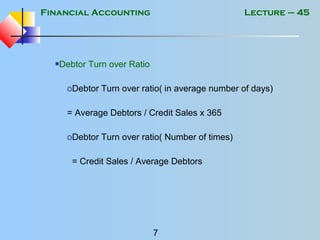
Debtor Turn over Ratio
oDebtor Turn over ratio( in average number of days)
= Average Debtors / Credit Sales x 365
oDebtor Turn over ratio( Number of times)
= Credit Sales / Average Debtors
Financial Accounting
8
Lecture – 45
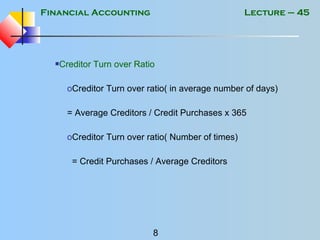
Creditor Turn over Ratio
oCreditor Turn over ratio( in average number of days)
= Average Creditors / Credit Purchases x 365
oCreditor Turn over ratio( Number of times)
= Credit Purchases / Average Creditors
Financial Accounting
9
Lecture – 45
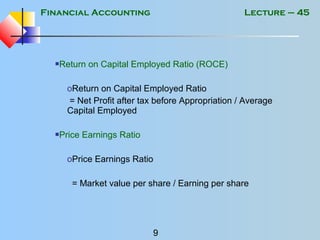
Return on Capital Employed Ratio (ROCE)
oReturn on Capital Employed Ratio
= Net Profit after tax before Appropriation / Average
Capital Employed
Price Earnings Ratio
oPrice Earnings Ratio
= Market value per share / Earning per share
Financial Accounting
10
Lecture – 45
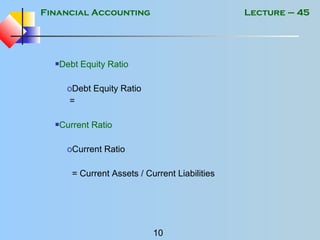
Debt Equity Ratio
oDebt Equity Ratio
=
Current Ratio
oCurrent Ratio
= Current Assets / Current Liabilities
Financial Accounting
11
Lecture – 45
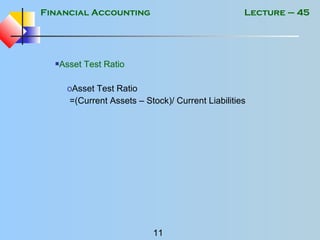
Asset Test Ratio
oAsset Test Ratio
=(Current Assets – Stock)/ Current Liabilities

MGT101 - Financial Accounting- Lecture 45

  • 1.
    Financial Accounting 1 Lecture –45 Sheraz Ltd. Statement of Changes in Equity for the Year Ended June 30, 2002 Share General Un-app. Total Capital Reserve Ptofit Rs. 000 Rs. 000 Rs. 000 Rs. 000 Balance as on June 30, 2000 50,000 104,000 4,119 158,119 Profit after tax for the year 31,436 31,436 Dividend (30,000) (30,000) Balance as on June 30, 2001 50,000 104,000 5,555 159,555 Profit after tax for the year 54,148 54,148 Transfer to reserve 21,000 (21,000) Dividend (30,000) (30,000) Balance as on June 30, 2002 50,000 125,000 8,703 183,703
  • 2.
    Financial Accounting 2 Lecture –45 •Company and its operations  The company is a public limited company incorporated in Pakistan and manufacture ------------ •Significant accounting policies These account have been prepared in accordance with the requirements of the Companies Ordinance 1984 and International accounting standards as applicable in Pakistan. •Historical costs Historical costs are used as a basis for valuing transactions. •Revenue Recognition Sales are recorded upon delivery of goods to the customers. However Exported goods are considered sold when shipped on board.
  • 3.
    Financial Accounting 3 Lecture –45 •Other Policies Income from bank deposits, loans and advances are recognized on accrual basis. Dividend income is recognized when right to receive is established. Research and development casts are expensed as and when incurred. Working of all figures, Fixed assets schedule and all agreements. i-e. Lease agreements and agreements for obtaining loan from banks are included in the notes to the accounts. •In case of listed company,
  • 4.
    Financial Accounting 4 Lecture –45 •Working of all figures, Fixed assets schedule and all agreements. i-e. Lease agreements and agreements for obtaining loan from banks are included in the notes to the accounts. •In case of listed company, following legal requirements are also presented in the notes to the accounts: Total number of employees Capacity of the plant Break up of remuneration of directors Classes of share holders and number of shares held by each class. Fee of Auditors •Requirements of international accounting standards are also fulfilled.
  • 5.
    Financial Accounting 5 Lecture –45 •Analysis of financial statements Profitability ratio oGross Profit ratio Gross Profit ratio = Gross Profit / Sales oNet Profit ratio Net Profit ratio = Net Profit / Sales x 100
  • 6.
    Financial Accounting 6 Lecture –45 Stock Turn over Ratio oStock Turn over ratio( in days) = Average Stock / Cost of goods sold x 365 oStock Turn over ratio( Number of times) = Cost of goods sold / Average Stock
  • 7.
    Financial Accounting 7 Lecture –45 Debtor Turn over Ratio oDebtor Turn over ratio( in average number of days) = Average Debtors / Credit Sales x 365 oDebtor Turn over ratio( Number of times) = Credit Sales / Average Debtors
  • 8.
    Financial Accounting 8 Lecture –45 Creditor Turn over Ratio oCreditor Turn over ratio( in average number of days) = Average Creditors / Credit Purchases x 365 oCreditor Turn over ratio( Number of times) = Credit Purchases / Average Creditors
  • 9.
    Financial Accounting 9 Lecture –45 Return on Capital Employed Ratio (ROCE) oReturn on Capital Employed Ratio = Net Profit after tax before Appropriation / Average Capital Employed Price Earnings Ratio oPrice Earnings Ratio = Market value per share / Earning per share
  • 10.
    Financial Accounting 10 Lecture –45 Debt Equity Ratio oDebt Equity Ratio = Current Ratio oCurrent Ratio = Current Assets / Current Liabilities
  • 11.
    Financial Accounting 11 Lecture –45 Asset Test Ratio oAsset Test Ratio =(Current Assets – Stock)/ Current Liabilities