Introduction to Management 1 
Seminar 2 Objectives and 
performance 
Stage 2 Session 2
Overview 
• To experientially examine objective setting and explore how difficult it can be to be 
effective 
• To set their own individual objectives for the coming academic year and coach 
each other on how to improve them – ensure they stretch 
2
Learning Outcomes of this lecture 
• To have greater understanding of objectives, how to devise 
them and the pitfalls therein 
• To create their own and experience each others and coach 
each other to better objectives
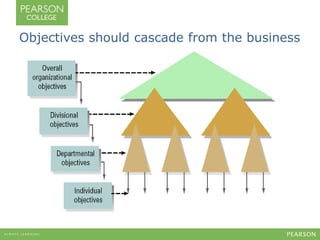
Objectives should cascade from the business
What are Effective Objectives? 
• Let’s explore this question by considering whether it really is… 
• Please take a trash can 
• And prepare some ‘ball’s made out of waste 
• paper
Round 1 
 Take the crumpled pieces of paper 
 You have 30 seconds - go!
Round 2 
 Here’s another crumpled piece of paper 
 Throw it in the trash can 
 Your performance will be evaluated on how 
many pieces you can throw in the can 
 Success = how many pieces you get in the 
can 
 30 seconds
Round 3 
 Now stand 10 feet away from the trash can 
 Toss the papers into the can 
 Keep your eyes closed 
 Keep throwing, keep eyes shut 
 Be aware the trash can may move 
 Your performance will be evaluated against 
how many pieces of paper are in the can 
 30 seconds
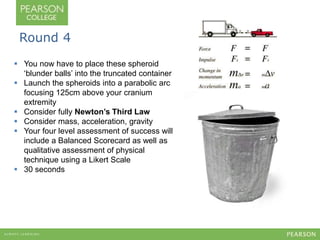
Round 4 
 You now have to place these spheroid 
‘blunder balls’ into the truncated container 
 Launch the spheroids into a parabolic arc 
focusing 125cm above your cranium 
extremity 
 Consider fully Newton’s Third Law 
 Consider mass, acceleration, gravity 
 Your four level assessment of success will 
include a Balanced Scorecard as well as 
qualitative assessment of physical 
technique using a Likert Scale 
 30 seconds
Round 5 
 Now take stock – take a few 
deep breaths and relax, let your 
mind go with the flow 
 Centre yourself on self 
actualising – find the ‘real you’ 
in this moment… 
 Use this feeling – this mind 
power to bring the paper into the 
trash can 
 Go, when you are ready and feel 
the chilling out manifest itself into 
motion 
 No time, it might just take forever 
but who really cares, just float 
downstream…
Round 6 
The Company is launching a new Performance Management Strategy – not just another appraisal form, but a process requires all Associates to fully 
leverage their individual and collective core competencies, to ensure all are fully engaged and singing from the same song sheet, with all their proverbial 
ducks in a row within the Group – to be totally cognisant and regarding the roles and numbers of Indians and Chiefs - not having too many Indians, but 
also ensuring our Indians that we do have an understanding of their place and the work based interventions they will need to fully optimise their human 
capital. The results will be fed back via a monthly Dashboard to the Human Capital Management Steering Group. 
In so doing we need to be very mindful of all of the Willis environment business and context, (with environmental scans underway) - migrating towards 
best in class Lean based Continuous Improvement Methodology to drive the anti-SMART performance management culture change process over the next 
three years. Needless to say all the OPCO are totally driven in their outlook to create real and sustainable change in the short, medium, and long term, not 
playing lip service to desired client outcomes but by focusing upon dynamic, real, and underlying cultural shift. This change program and process, both 
longitudinal and organic, titled Re-Shaping Our Future Cause (see attached Excel spread sheets and organograms for full detailed implementation plans 
and specific step change effect on Key Client Outcomes) now requires full underpinning aims, strategy, goals, objectives and tasks defined for each 
activity individualised for each Associate. 
Hence your particular application of this TRASH process. 
You will be given a wide array of Office based TRASH materials, including, but not limited to, unused A4 sheets of paper probably white in colour but not 
necessarily so – some additional colour provision may ensue in certain identified scenarios, but should be ignored if not there. You will also have full 
access, unlimited for the duration of this specific activity, to the Trash Can or similar item of standard issue, often used in government offices or those 
other such professional environments – City base in the UK, Wall Street issue, as well as International models translating into all languages: TRASH and 
other references. Translation costs are currently being argued over – which budget they should be allocated to – though we fully expect them in English 
and one other, American. 
Whilst considering this activity you will need to be aware of the legal regulations concerned with undertaking such potentially dangerous acts. Prior to 
embarking it is then recommended that the full reading of these regulations, and where necessary attendance of the specific blended learning 
interventions is mandated. Particular reference should be made to afflictions such as repetitive strain injury (RSI). Further you should also take full 
account of regulations and risk in the wider legal sense and fully familiarise yourself with the Risk Register and Spread sheet Reporting Procedures 
therein: there is nothing, and we mean nothing, more important than Risk. 
Using said approved procedures as enshrined in ISO9000001 lifting of trash items, alternating hands, to avoid repetitive strain injury, you should dispose 
of the trash at a rate that exceeds five pieces every thirty seconds. During your performance you must not refer to any notes, job aids, or consultative 
assistance from colleagues and supervisors. Peers should also not get involved, nor Group HR and or Group Organisation Development. 
Please begin. You have a total of thirty seconds (half a minute).
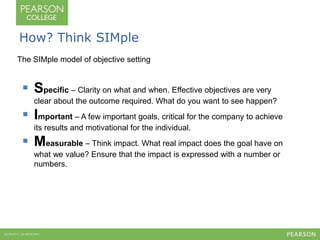
How? Think SIMple 
The SIMple model of objective setting 
 Specific – Clarity on what and when. Effective objectives are very 
clear about the outcome required. What do you want to see happen? 
 Important – A few important goals, critical for the company to achieve 
its results and motivational for the individual. 
 Measurable – Think impact. What real impact does the goal have on 
what we value? Ensure that the impact is expressed with a number or 
numbers.
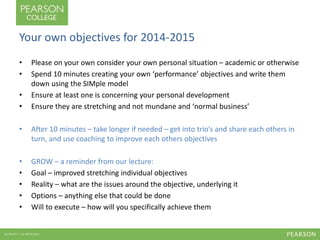
Your own objectives for 2014-2015 
• Please on your own consider your own personal situation – academic or otherwise 
• Spend 10 minutes creating your own ‘performance’ objectives and write them 
down using the SIMple model 
• Ensure at least one is concerning your personal development 
• Ensure they are stretching and not mundane and ‘normal business’ 
• After 10 minutes – take longer if needed – get into trio’s and share each others in 
turn, and use coaching to improve each others objectives 
• GROW – a reminder from our lecture: 
• Goal – improved stretching individual objectives 
• Reality – what are the issues around the objective, underlying it 
• Options – anything else that could be done 
• Will to execute – how will you specifically achieve them
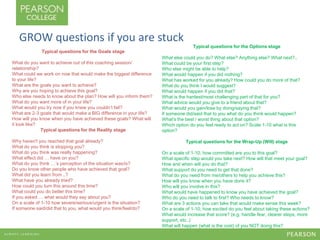
GROW questions if you are stuck 
Typical questions for the Options stage 
What else could you do? What else? Anything else? What next?.. 
What could be your first step? 
Who else might be able to help? 
What would happen if you did nothing? 
What has worked for you already? How could you do more of that? 
What do you think I would suggest? 
What would happen if you did that? 
What is the hardest/most challenging part of that for you? 
What advice would you give to a friend about that? 
What would you gain/lose by doing/saying that? 
If someone did/said that to you what do you think would happen? 
What's the best / worst thing about that option? 
Which option do you feel ready to act on? Scale 1-10 what is this 
option? 
Typical questions for the Wrap-Up (Will) stage 
On a scale of 1-10, how committed are you to this goal? 
What specific step would you take next? How will that meet your goal? 
How and when will you do that? 
What support do you need to get that done? 
What do you need from me/others to help you achieve this? 
How will you know when you have done it? 
Who will you involve in this? 
What would have happened to know you have achieved the goal? 
Who do you need to talk to first? Who needs to know? 
What are 3 actions you can take that would make sense this week? 
On a scale of 1-10, how excited do you feel about taking these actions? 
What would increase that score? (e.g. handle fear, clearer steps, more 
support, etc..) 
What will happen (what is the cost) of you NOT doing this? 
Typical questions for the Goals stage 
What do you want to achieve out of this coaching session/ 
relationship? 
What could we work on now that would make the biggest difference 
to your life? 
What are the goals you want to achieve? 
Why are you hoping to achieve this goal? 
Who else needs to know about the plan? How will you inform them? 
What do you want more of in your life? 
What would you try now if you knew you couldn’t fail? 
What are 2-3 goals that would make a BIG difference in your life? 
How will you know when you have achieved these goals? What will 
it look like? 
Typical questions for the Reality stage 
Why haven't you reached that goal already? 
What do you think is stopping you? 
What do you think was really happening? 
What effect did … have on you? 
What do you think …’s perception of the situation was/is? 
Do you know other people who have achieved that goal? 
What did you learn from ..? 
What have you already tried? 
How could you turn this around this time? 
What could you do better this time? 
If you asked … what would they say about you? 
On a scale of 1-10 how severe/serious/urgent is the situation? 
If someone said/did that to you, what would you think/feel/do?
End of Seminar 
Note: This recording is for your 
personal use only and not for further 
distribution or wider review. 
© Pearson College 2013

Management 1 seminar 2 (1)

  • 1.
    Introduction to Management1 Seminar 2 Objectives and performance Stage 2 Session 2
  • 2.
    Overview • Toexperientially examine objective setting and explore how difficult it can be to be effective • To set their own individual objectives for the coming academic year and coach each other on how to improve them – ensure they stretch 2
  • 3.
    Learning Outcomes ofthis lecture • To have greater understanding of objectives, how to devise them and the pitfalls therein • To create their own and experience each others and coach each other to better objectives
  • 4.
    Objectives should cascadefrom the business
  • 5.
    What are EffectiveObjectives? • Let’s explore this question by considering whether it really is… • Please take a trash can • And prepare some ‘ball’s made out of waste • paper
  • 6.
    Round 1 Take the crumpled pieces of paper  You have 30 seconds - go!
  • 7.
    Round 2 Here’s another crumpled piece of paper  Throw it in the trash can  Your performance will be evaluated on how many pieces you can throw in the can  Success = how many pieces you get in the can  30 seconds
  • 8.
    Round 3 Now stand 10 feet away from the trash can  Toss the papers into the can  Keep your eyes closed  Keep throwing, keep eyes shut  Be aware the trash can may move  Your performance will be evaluated against how many pieces of paper are in the can  30 seconds
  • 9.
    Round 4 You now have to place these spheroid ‘blunder balls’ into the truncated container  Launch the spheroids into a parabolic arc focusing 125cm above your cranium extremity  Consider fully Newton’s Third Law  Consider mass, acceleration, gravity  Your four level assessment of success will include a Balanced Scorecard as well as qualitative assessment of physical technique using a Likert Scale  30 seconds
  • 10.
    Round 5 Now take stock – take a few deep breaths and relax, let your mind go with the flow  Centre yourself on self actualising – find the ‘real you’ in this moment…  Use this feeling – this mind power to bring the paper into the trash can  Go, when you are ready and feel the chilling out manifest itself into motion  No time, it might just take forever but who really cares, just float downstream…
  • 11.
    Round 6 TheCompany is launching a new Performance Management Strategy – not just another appraisal form, but a process requires all Associates to fully leverage their individual and collective core competencies, to ensure all are fully engaged and singing from the same song sheet, with all their proverbial ducks in a row within the Group – to be totally cognisant and regarding the roles and numbers of Indians and Chiefs - not having too many Indians, but also ensuring our Indians that we do have an understanding of their place and the work based interventions they will need to fully optimise their human capital. The results will be fed back via a monthly Dashboard to the Human Capital Management Steering Group. In so doing we need to be very mindful of all of the Willis environment business and context, (with environmental scans underway) - migrating towards best in class Lean based Continuous Improvement Methodology to drive the anti-SMART performance management culture change process over the next three years. Needless to say all the OPCO are totally driven in their outlook to create real and sustainable change in the short, medium, and long term, not playing lip service to desired client outcomes but by focusing upon dynamic, real, and underlying cultural shift. This change program and process, both longitudinal and organic, titled Re-Shaping Our Future Cause (see attached Excel spread sheets and organograms for full detailed implementation plans and specific step change effect on Key Client Outcomes) now requires full underpinning aims, strategy, goals, objectives and tasks defined for each activity individualised for each Associate. Hence your particular application of this TRASH process. You will be given a wide array of Office based TRASH materials, including, but not limited to, unused A4 sheets of paper probably white in colour but not necessarily so – some additional colour provision may ensue in certain identified scenarios, but should be ignored if not there. You will also have full access, unlimited for the duration of this specific activity, to the Trash Can or similar item of standard issue, often used in government offices or those other such professional environments – City base in the UK, Wall Street issue, as well as International models translating into all languages: TRASH and other references. Translation costs are currently being argued over – which budget they should be allocated to – though we fully expect them in English and one other, American. Whilst considering this activity you will need to be aware of the legal regulations concerned with undertaking such potentially dangerous acts. Prior to embarking it is then recommended that the full reading of these regulations, and where necessary attendance of the specific blended learning interventions is mandated. Particular reference should be made to afflictions such as repetitive strain injury (RSI). Further you should also take full account of regulations and risk in the wider legal sense and fully familiarise yourself with the Risk Register and Spread sheet Reporting Procedures therein: there is nothing, and we mean nothing, more important than Risk. Using said approved procedures as enshrined in ISO9000001 lifting of trash items, alternating hands, to avoid repetitive strain injury, you should dispose of the trash at a rate that exceeds five pieces every thirty seconds. During your performance you must not refer to any notes, job aids, or consultative assistance from colleagues and supervisors. Peers should also not get involved, nor Group HR and or Group Organisation Development. Please begin. You have a total of thirty seconds (half a minute).
  • 12.
    How? Think SIMple The SIMple model of objective setting  Specific – Clarity on what and when. Effective objectives are very clear about the outcome required. What do you want to see happen?  Important – A few important goals, critical for the company to achieve its results and motivational for the individual.  Measurable – Think impact. What real impact does the goal have on what we value? Ensure that the impact is expressed with a number or numbers.
  • 13.
    Your own objectivesfor 2014-2015 • Please on your own consider your own personal situation – academic or otherwise • Spend 10 minutes creating your own ‘performance’ objectives and write them down using the SIMple model • Ensure at least one is concerning your personal development • Ensure they are stretching and not mundane and ‘normal business’ • After 10 minutes – take longer if needed – get into trio’s and share each others in turn, and use coaching to improve each others objectives • GROW – a reminder from our lecture: • Goal – improved stretching individual objectives • Reality – what are the issues around the objective, underlying it • Options – anything else that could be done • Will to execute – how will you specifically achieve them
  • 14.
    GROW questions ifyou are stuck Typical questions for the Options stage What else could you do? What else? Anything else? What next?.. What could be your first step? Who else might be able to help? What would happen if you did nothing? What has worked for you already? How could you do more of that? What do you think I would suggest? What would happen if you did that? What is the hardest/most challenging part of that for you? What advice would you give to a friend about that? What would you gain/lose by doing/saying that? If someone did/said that to you what do you think would happen? What's the best / worst thing about that option? Which option do you feel ready to act on? Scale 1-10 what is this option? Typical questions for the Wrap-Up (Will) stage On a scale of 1-10, how committed are you to this goal? What specific step would you take next? How will that meet your goal? How and when will you do that? What support do you need to get that done? What do you need from me/others to help you achieve this? How will you know when you have done it? Who will you involve in this? What would have happened to know you have achieved the goal? Who do you need to talk to first? Who needs to know? What are 3 actions you can take that would make sense this week? On a scale of 1-10, how excited do you feel about taking these actions? What would increase that score? (e.g. handle fear, clearer steps, more support, etc..) What will happen (what is the cost) of you NOT doing this? Typical questions for the Goals stage What do you want to achieve out of this coaching session/ relationship? What could we work on now that would make the biggest difference to your life? What are the goals you want to achieve? Why are you hoping to achieve this goal? Who else needs to know about the plan? How will you inform them? What do you want more of in your life? What would you try now if you knew you couldn’t fail? What are 2-3 goals that would make a BIG difference in your life? How will you know when you have achieved these goals? What will it look like? Typical questions for the Reality stage Why haven't you reached that goal already? What do you think is stopping you? What do you think was really happening? What effect did … have on you? What do you think …’s perception of the situation was/is? Do you know other people who have achieved that goal? What did you learn from ..? What have you already tried? How could you turn this around this time? What could you do better this time? If you asked … what would they say about you? On a scale of 1-10 how severe/serious/urgent is the situation? If someone said/did that to you, what would you think/feel/do?
  • 15.
    End of Seminar Note: This recording is for your personal use only and not for further distribution or wider review. © Pearson College 2013

Editor's Notes

  • #2 Tutor notes to go in here
  • #7 Tutor gives no more instruction, just asks for a volunteer and says go! Sees what happens – usually confusion, looking for guidance, ambiguity Stop after some short time and ask the group what is wrong with this objective Lessons – objectives should be – its unspecific and hopeless
  • #8 Try again – with some theatre, ask for another volunteer Thirty seconds – then ask for a debrief on how effective is this objective Key lesson: it’s pointless – why bother
  • #9 Again using more ‘theatre’ brief ask for another volunteer When their eyes are closed and have thrown a few, move the trashcan Stop, debrief – key lesson – this ain’t fair!
  • #10 Again another volunteer Before showing the slide tell them it is more difficult – then reveal the slide Read it out and say go! See what happens – debrief – key lesson – way too complex!
  • #11 Penultimate round, ask for another volunteer Put a chair in the middle and then ask them to sit on it and reveal the slide, read it out with a ‘hippy’ voice (man) See what happens… Debrief – key lesson – has to be achievable
  • #12 Last round – ask for a volunteer before revealing the slide Then ask them to read it, soon they will get bored with it all Key lesson – way too much detail in this objective Then sum up and move on to some ideas about being more effective in what sounds simple – objective setting – but what in reality organisations struggle endlessly with
  • #13 A model to help
  • #15 Keep this slide up during the exercise to illustrate the questions they can use in coaching