
TIME MANAGEMENT
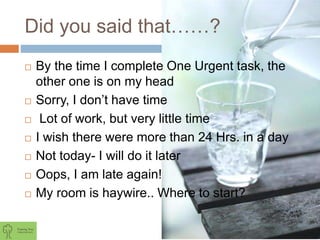
Did you said that……?
 By the time I complete One Urgent task, the
other one is on my head
 Sorry, I don’t have time
 Lot of work, but very little time
 I wish there were more than 24 Hrs. in a day
 Not today- I will do it later
 Oops, I am late again!
 My room is haywire.. Where to start?
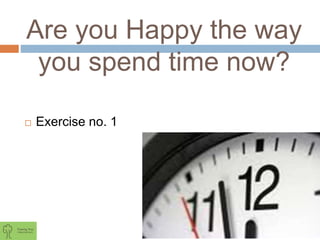
Are you Happy the way
you spend time now?
 Exercise no. 1
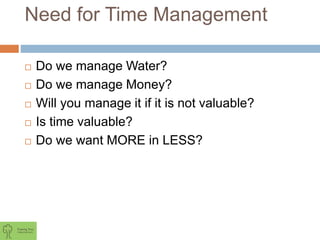
Need for Time Management
 Do we manage Water?
 Do we manage Money?
 Will you manage it if it is not valuable?
 Is time valuable?
 Do we want MORE in LESS?
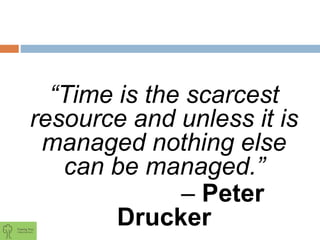
“Time is the scarcest
resource and unless it is
managed nothing else
can be managed.”
– Peter
Drucker
Objective of Time Management
 Accomplish more in less time
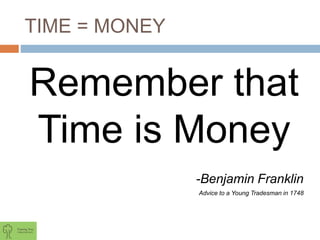
TIME = MONEY
Remember that
Time is Money
-Benjamin Franklin
Advice to a Young Tradesman in 1748
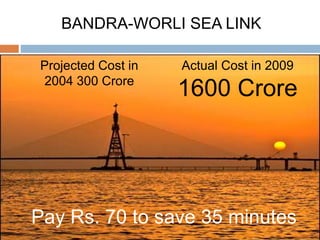
Pay Rs. 70 to save 35 minutes
Projected Cost in
2004 300 Crore
Actual Cost in 2009
1600 Crore
BANDRA-WORLI SEA LINK
Other Examples
 Air Tickets
 Penalty on Delayed Projects
 Cost Escalation
 Interest on Money
To Realize the Value of:

ONE YEAR, ask a student who failed a grade.
ONE MONTH, ask a mother who gave birth to a premature baby.
ONE WEEK, ask the editor of a weekly newspaper.
ONE HOUR, ask the lovers who are waiting to meet.
ONE MINUTE, ask a person who missed the train.
ONE SECOND, ask a person who just avoided an accident.
ONE MILLISECOND, ask the person who won a silver medal in the
Olympics.
Treasure every moment that you have! And treasure it more
because you shared it with someone special, special enough to
spend your time.
And remember, time waits for no one.
Yesterday is history.
Tomorrow is a mystery.
Today is a gift. That's why it's called the present.
Need for Time Management
 Value of Time
Demand and Supply
Cannot Buy or Store
 Desire to Achieve More in Life
 Impression Building
Questions
 Why Some People Have More Time Than
Others?
 Why Successful People are far Less
Stressed?
 Why some Executives have clean Tables?
 Why some people always reach in Time?
 When will my work get over?
 When will I feel relaxed again?
Answer…….
 They Manage Their Time Well
 When I will Manage My Time Well
“If you want something done,
ask a busy person to do it.”
-Lucille Bal
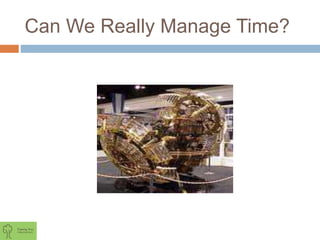
Can We Really Manage Time?
Is TIME real?
 Can we create it?
 Can we store it?
 Can we hold it?
TIME is Relative
 Sachin had all the time in the world to play the
ball
 So TIME is a CONVERSATION
 TIME is INETERNAL TALK / SELF TALK
 For the subconscious there is no Past, Present
or Future. Every thing is NOW
So Time Management is …
Applying management
principles which help in
maximising the value of
time by including those
activities which produce
positive results and
rejecting those activities
which either waste time or
produce negative results.
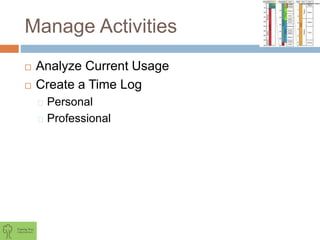
Manage Activities
 Analyze Current Usage
 Create a Time Log
Personal
Professional
Time Log
 Unexplained Usage
Wastage
Scattered Activities - Block of Activities
 Lion Share of Time
Time Wasters
 List Your Time Wasters
 Role Play the Time Wasters
 TV
 Avoidable Disputes
 Gossips
 Doing it Yourself
 Perfectionism
 Interruptions
Casual Visitors
Lengthy Tel Calls
Email, Messenger &
SMS
 Meetings
 Clutters
 Day Dreaming
How to say NO
 Assertiveness
 Firm
 Give Alternative
 Accept conditionally
 Think of
consequences
 Genuinely Polite
 Permission mode
 Documentation
 Refer Priorities
 Talk of Company’s
objectives
To people To Boss
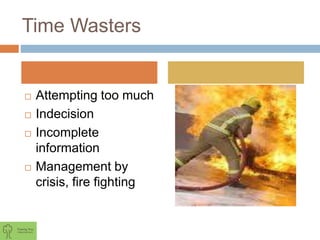
Time Wasters
 Attempting too much
 Indecision
 Incomplete
information
 Management by
crisis, fire fighting
Solution
 Avoid All Zero &
Negative Result
Activities
 Improve Productivity
in Already Positive
Result Activities
Do you feel …
 The more I do, the more I get
 Shifting priorities with every new task
 I have no control
 Frustration
Can I treat TIME as
INVESTMENT?
Do I Have a Strategy to invest my
time?
What is a STRATEGY
 a plan of action designed to achieve a
particular goal
 Future result of current actions
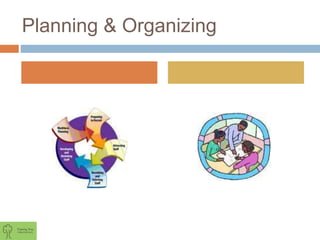
Planning & Organizing
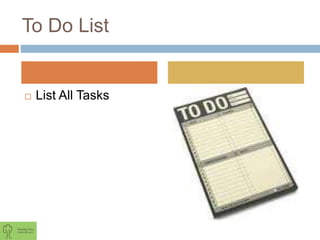
To Do List
 List All Tasks
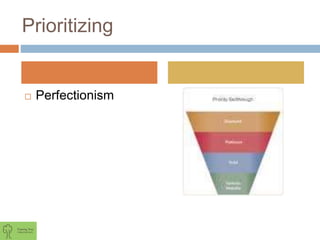
Prioritizing
 Perfectionism
I MUST do it MYSELF
 List the Tasks You Think Should be done by
you only
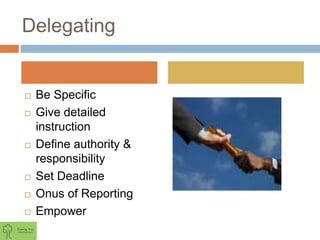
Delegating
 Be Specific
 Give detailed
instruction
 Define authority &
responsibility
 Set Deadline
 Onus of Reporting
 Empower
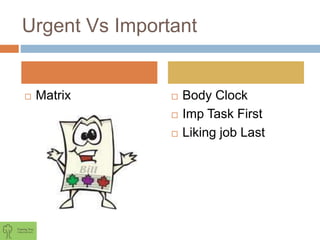
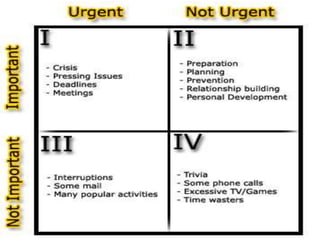
Urgent Vs Important
 Matrix  Body Clock
 Imp Task First
 Liking job Last
Deadlines must be DEAD much
before they arrive
 Reliance Patalganga Project – 6 months
before schedule
Efficiency
 Pass The Ring
How to increase efficiency
 Exercise
 Eat Light
 Positive Attitude
 Do more and more
 Keep Record
 Quiet Time - Meditation
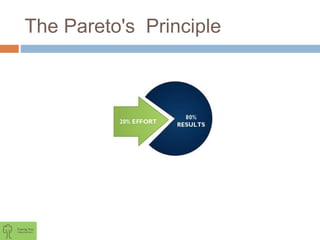
The Pareto's Principle
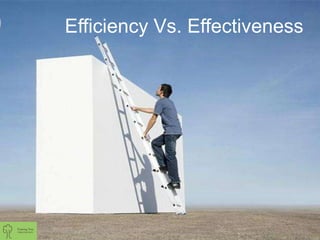
Efficiency Vs. Effectiveness
The Perfectionist
Work seems to
expand in
proportion to time
available
Day Diary
 Provide for
Relaxation
Thinking
Buffer
 Plan Ahead
 Plan for Hobbies
 Short, Medium and
Long Term Planning
Scheduling
Nothing Ever Happens
Until You Create A Space For It To
Happen
Set Goals
 Gossips
 Efficiency
 Why we
procrastinate?
.
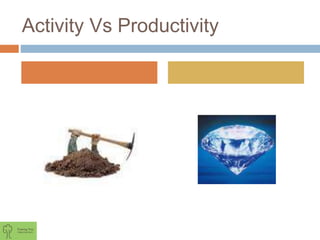
Activity Vs Productivity
Meetings
 Inform meeting
schedule
 Do I need to attend?
 Agenda
 Ending time
 One person at a time
 To the point
 Avoid Arguments
 Use notes and
presentations
 Discourage late
comers
 We Keep Minutes and
waste Hours
 Remain focused on
topic
 Record the meeting
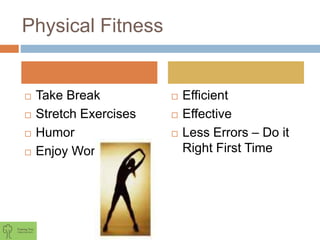
Physical Fitness
 Take Break
 Stretch Exercises
 Humor
 Enjoy Work
 Efficient
 Effective
 Less Errors – Do it
Right First Time
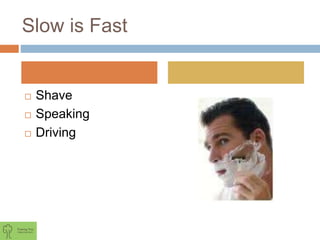
Slow is Fast
 Shave
 Speaking
 Driving
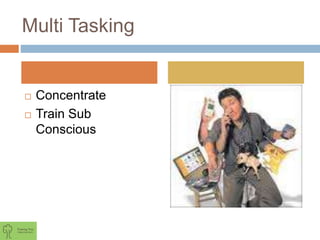
Multi Tasking
 Concentrate
 Train Sub
Conscious
Assertiveness
 Aware
 Express
 Without Hurting
 Aware
 Exercise
 Without Hurting
Feelings Rights
Clean Up
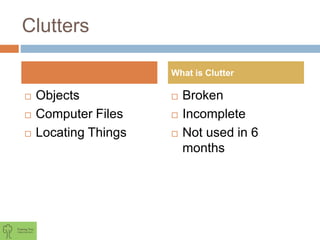
Clutters
 Objects
 Computer Files
 Locating Things
 Broken
 Incomplete
 Not used in 6
months
What is Clutter
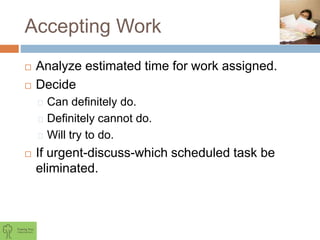
Accepting Work
 Analyze estimated time for work assigned.
 Decide
Can definitely do.
Definitely cannot do.
Will try to do.
 If urgent-discuss-which scheduled task be
eliminated.
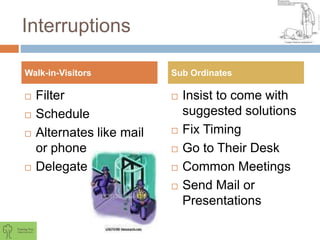
Interruptions
 Filter
 Schedule
 Alternates like mail
or phone
 Delegate
 Insist to come with
suggested solutions
 Fix Timing
 Go to Their Desk
 Common Meetings
 Send Mail or
Presentations
Walk-in-Visitors Sub Ordinates
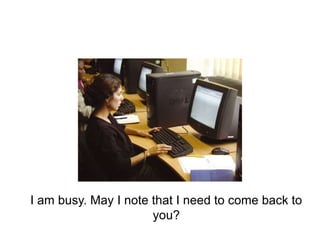
I am busy. May I note that I need to come back to
you?
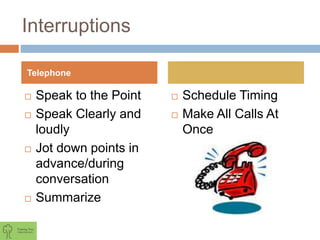
Interruptions
 Speak to the Point
 Speak Clearly and
loudly
 Jot down points in
advance/during
conversation
 Summarize
 Schedule Timing
 Make All Calls At
Once
Telephone
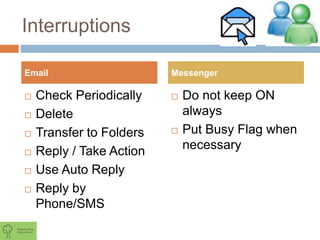
Interruptions
 Check Periodically
 Delete
 Transfer to Folders
 Reply / Take Action
 Use Auto Reply
 Reply by
Phone/SMS
 Do not keep ON
always
 Put Busy Flag when
necessary
Email Messenger
Handling Interruptions
 Close the Door
 Rearrange the Furniture – have lesser or no
chair
 Set Regular meeting time
 Delegate – ask them to meet your subordinate
 Meet outside office
 Be firm and have control – Have a minute?
No/ Yes, but only one minute
 Stand to signal end of conversation
 Have planted signals
Reaching in time
 Reach before time.
Gain respect.
Risk of reaching late.
 Target 30-60 minutes before Schedule
 Carry work on Laptop, Mobile, Reading, Audio
Books
Punctuality
 Gain Respect – Professional Image
 Peace of Mind
 Keep Buffer Time for delivery
Post Lunch Activity
 Collect Highest denomination notes available
with the late coming participants
Debriefing Questions
 Why did you agreed on the time limit?
 Can you refuse to pay?
 Why were you late?
 Was that task more important?
 Was it your choice to come back in time?
 Who was controlling your time?
 Had you focused on your priority of attending
session, would you come back in time?
Ten Myths about Time
1. Myth: Time can be managed.
2. Myth: The longer or harder you work the
more you accomplish.
3. Myth: If you want something done right, do it
yourself.
4. Myth: You aren’t supposed to enjoy work.
5. Myth: We should take pride in working hard.
Ten Myths about Time
6. Myth: You should try to do the most in the
least amount of time.
7. Myth: Technology will help you do it better,
faster.
8. Myth: Do one thing at a time.
9. Myth: Handle paper only once.
10. Myth: Get more done and you’ll be happier.
How to finish our Assignments in
time?
 Loads of work is assigned to me. The more I
do, the more is given. Where will it end?
Learn to say NO objectively.
 Resources (Computer, Money, Time) are
limited, yet a lot is expected
Make optimum use of the resources. Think out of
box.
Delegate
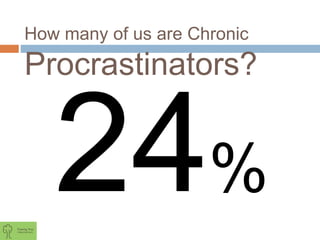
How many of us are Chronic
Procrastinators?
%
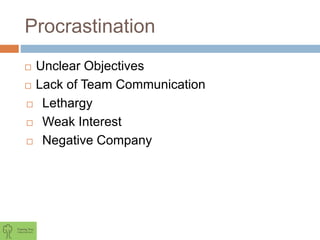
Procrastination
 Unclear Objectives
 Lack of Team Communication
 Lethargy
 Weak Interest
 Negative Company
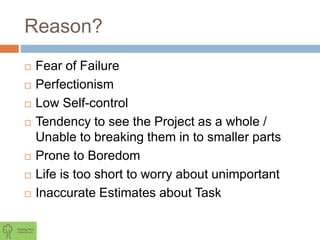
Reason?
 Fear of Failure
 Perfectionism
 Low Self-control
 Tendency to see the Project as a whole /
Unable to breaking them in to smaller parts
 Prone to Boredom
 Life is too short to worry about unimportant
 Inaccurate Estimates about Task
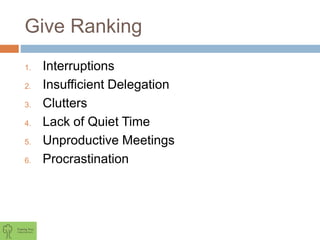
Give Ranking
1. Interruptions
2. Insufficient Delegation
3. Clutters
4. Lack of Quiet Time
5. Unproductive Meetings
6. Procrastination
Group Activity
 There are 6 tables/areas marked
 Go to the table/area of your Ranking no.1
 After the bell, move to Ranking no.2
 After the bell, move to Ranking no. 3
 Share how you will deal with the issues
How Much Time Can You Save
Now?
What will you do with
this Additional Time?
Personal Action Plan
Implementation Sheet

Time management 2014

  • 1.
  • 3.
    Did you saidthat……?  By the time I complete One Urgent task, the other one is on my head  Sorry, I don’t have time  Lot of work, but very little time  I wish there were more than 24 Hrs. in a day  Not today- I will do it later  Oops, I am late again!  My room is haywire.. Where to start?
  • 4.
    Are you Happythe way you spend time now?  Exercise no. 1
  • 5.
    Need for TimeManagement  Do we manage Water?  Do we manage Money?  Will you manage it if it is not valuable?  Is time valuable?  Do we want MORE in LESS?
  • 6.
    “Time is thescarcest resource and unless it is managed nothing else can be managed.” – Peter Drucker
  • 7.
    Objective of TimeManagement  Accomplish more in less time
  • 8.
    TIME = MONEY Rememberthat Time is Money -Benjamin Franklin Advice to a Young Tradesman in 1748
  • 9.
    Pay Rs. 70to save 35 minutes Projected Cost in 2004 300 Crore Actual Cost in 2009 1600 Crore BANDRA-WORLI SEA LINK
  • 10.
    Other Examples  AirTickets  Penalty on Delayed Projects  Cost Escalation  Interest on Money
  • 11.
    To Realize theValue of:  ONE YEAR, ask a student who failed a grade. ONE MONTH, ask a mother who gave birth to a premature baby. ONE WEEK, ask the editor of a weekly newspaper. ONE HOUR, ask the lovers who are waiting to meet. ONE MINUTE, ask a person who missed the train. ONE SECOND, ask a person who just avoided an accident. ONE MILLISECOND, ask the person who won a silver medal in the Olympics. Treasure every moment that you have! And treasure it more because you shared it with someone special, special enough to spend your time. And remember, time waits for no one. Yesterday is history. Tomorrow is a mystery. Today is a gift. That's why it's called the present.
  • 12.
    Need for TimeManagement  Value of Time Demand and Supply Cannot Buy or Store  Desire to Achieve More in Life  Impression Building
  • 13.
    Questions  Why SomePeople Have More Time Than Others?  Why Successful People are far Less Stressed?  Why some Executives have clean Tables?  Why some people always reach in Time?  When will my work get over?  When will I feel relaxed again?
  • 14.
    Answer…….  They ManageTheir Time Well  When I will Manage My Time Well
  • 15.
    “If you wantsomething done, ask a busy person to do it.” -Lucille Bal
  • 16.
    Can We ReallyManage Time?
  • 17.
    Is TIME real? Can we create it?  Can we store it?  Can we hold it?
  • 18.
    TIME is Relative Sachin had all the time in the world to play the ball  So TIME is a CONVERSATION  TIME is INETERNAL TALK / SELF TALK  For the subconscious there is no Past, Present or Future. Every thing is NOW
  • 19.
    So Time Managementis … Applying management principles which help in maximising the value of time by including those activities which produce positive results and rejecting those activities which either waste time or produce negative results.
  • 20.
    Manage Activities  AnalyzeCurrent Usage  Create a Time Log Personal Professional
  • 21.
    Time Log  UnexplainedUsage Wastage Scattered Activities - Block of Activities  Lion Share of Time
  • 22.
    Time Wasters  ListYour Time Wasters  Role Play the Time Wasters
  • 23.
     TV  AvoidableDisputes  Gossips  Doing it Yourself  Perfectionism  Interruptions Casual Visitors Lengthy Tel Calls Email, Messenger & SMS  Meetings  Clutters  Day Dreaming
  • 24.
    How to sayNO  Assertiveness  Firm  Give Alternative  Accept conditionally  Think of consequences  Genuinely Polite  Permission mode  Documentation  Refer Priorities  Talk of Company’s objectives To people To Boss
  • 25.
    Time Wasters  Attemptingtoo much  Indecision  Incomplete information  Management by crisis, fire fighting
  • 26.
    Solution  Avoid AllZero & Negative Result Activities  Improve Productivity in Already Positive Result Activities
  • 27.
    Do you feel…  The more I do, the more I get  Shifting priorities with every new task  I have no control  Frustration
  • 28.
    Can I treatTIME as INVESTMENT?
  • 29.
    Do I Havea Strategy to invest my time?
  • 30.
    What is aSTRATEGY  a plan of action designed to achieve a particular goal  Future result of current actions
  • 31.
  • 32.
    To Do List List All Tasks
  • 33.
  • 34.
    I MUST doit MYSELF  List the Tasks You Think Should be done by you only
  • 35.
    Delegating  Be Specific Give detailed instruction  Define authority & responsibility  Set Deadline  Onus of Reporting  Empower
  • 36.
    Urgent Vs Important Matrix  Body Clock  Imp Task First  Liking job Last
  • 38.
    Deadlines must beDEAD much before they arrive  Reliance Patalganga Project – 6 months before schedule
  • 39.
  • 40.
    How to increaseefficiency  Exercise  Eat Light  Positive Attitude  Do more and more  Keep Record  Quiet Time - Meditation
  • 41.
  • 42.
  • 43.
    The Perfectionist Work seemsto expand in proportion to time available
  • 44.
    Day Diary  Providefor Relaxation Thinking Buffer  Plan Ahead  Plan for Hobbies  Short, Medium and Long Term Planning
  • 45.
    Scheduling Nothing Ever Happens UntilYou Create A Space For It To Happen
  • 46.
    Set Goals  Gossips Efficiency  Why we procrastinate? .
  • 47.
  • 48.
    Meetings  Inform meeting schedule Do I need to attend?  Agenda  Ending time  One person at a time  To the point  Avoid Arguments  Use notes and presentations  Discourage late comers  We Keep Minutes and waste Hours  Remain focused on topic  Record the meeting
  • 49.
    Physical Fitness  TakeBreak  Stretch Exercises  Humor  Enjoy Work  Efficient  Effective  Less Errors – Do it Right First Time
  • 50.
    Slow is Fast Shave  Speaking  Driving
  • 51.
  • 52.
    Assertiveness  Aware  Express Without Hurting  Aware  Exercise  Without Hurting Feelings Rights
  • 53.
  • 54.
    Clutters  Objects  ComputerFiles  Locating Things  Broken  Incomplete  Not used in 6 months What is Clutter
  • 55.
    Accepting Work  Analyzeestimated time for work assigned.  Decide Can definitely do. Definitely cannot do. Will try to do.  If urgent-discuss-which scheduled task be eliminated.
  • 56.
    Interruptions  Filter  Schedule Alternates like mail or phone  Delegate  Insist to come with suggested solutions  Fix Timing  Go to Their Desk  Common Meetings  Send Mail or Presentations Walk-in-Visitors Sub Ordinates
  • 58.
    I am busy.May I note that I need to come back to you?
  • 59.
    Interruptions  Speak tothe Point  Speak Clearly and loudly  Jot down points in advance/during conversation  Summarize  Schedule Timing  Make All Calls At Once Telephone
  • 60.
    Interruptions  Check Periodically Delete  Transfer to Folders  Reply / Take Action  Use Auto Reply  Reply by Phone/SMS  Do not keep ON always  Put Busy Flag when necessary Email Messenger
  • 61.
    Handling Interruptions  Closethe Door  Rearrange the Furniture – have lesser or no chair  Set Regular meeting time  Delegate – ask them to meet your subordinate  Meet outside office  Be firm and have control – Have a minute? No/ Yes, but only one minute  Stand to signal end of conversation  Have planted signals
  • 62.
    Reaching in time Reach before time. Gain respect. Risk of reaching late.  Target 30-60 minutes before Schedule  Carry work on Laptop, Mobile, Reading, Audio Books
  • 63.
    Punctuality  Gain Respect– Professional Image  Peace of Mind  Keep Buffer Time for delivery
  • 64.
    Post Lunch Activity Collect Highest denomination notes available with the late coming participants
  • 65.
    Debriefing Questions  Whydid you agreed on the time limit?  Can you refuse to pay?  Why were you late?  Was that task more important?  Was it your choice to come back in time?  Who was controlling your time?  Had you focused on your priority of attending session, would you come back in time?
  • 66.
    Ten Myths aboutTime 1. Myth: Time can be managed. 2. Myth: The longer or harder you work the more you accomplish. 3. Myth: If you want something done right, do it yourself. 4. Myth: You aren’t supposed to enjoy work. 5. Myth: We should take pride in working hard.
  • 67.
    Ten Myths aboutTime 6. Myth: You should try to do the most in the least amount of time. 7. Myth: Technology will help you do it better, faster. 8. Myth: Do one thing at a time. 9. Myth: Handle paper only once. 10. Myth: Get more done and you’ll be happier.
  • 68.
    How to finishour Assignments in time?  Loads of work is assigned to me. The more I do, the more is given. Where will it end? Learn to say NO objectively.  Resources (Computer, Money, Time) are limited, yet a lot is expected Make optimum use of the resources. Think out of box. Delegate
  • 69.
    How many ofus are Chronic Procrastinators? %
  • 70.
    Procrastination  Unclear Objectives Lack of Team Communication  Lethargy  Weak Interest  Negative Company
  • 71.
    Reason?  Fear ofFailure  Perfectionism  Low Self-control  Tendency to see the Project as a whole / Unable to breaking them in to smaller parts  Prone to Boredom  Life is too short to worry about unimportant  Inaccurate Estimates about Task
  • 72.
    Give Ranking 1. Interruptions 2.Insufficient Delegation 3. Clutters 4. Lack of Quiet Time 5. Unproductive Meetings 6. Procrastination
  • 73.
    Group Activity  Thereare 6 tables/areas marked  Go to the table/area of your Ranking no.1  After the bell, move to Ranking no.2  After the bell, move to Ranking no. 3  Share how you will deal with the issues
  • 74.
    How Much TimeCan You Save Now?
  • 75.
    What will youdo with this Additional Time?
  • 76.
  • 77.