Corporate Social Responsibility in China


                                    10/09/11   Seite
New Paradigm for Doing Business in a Globalized World

• Higher expectations from stakeholders and the general public

• Corporate transparency, accountability and stakeholder relationships are the new
  frontier for competitive innovation

• Stakeholders more aware of critical topics such as corporate ethics and climate
  change

• More processes outsourced than ever before

• Production located in different centers at a global scale

• Hyper-connected world / Speed of communications

• Need for horizontal and decentralised structures = fast response time and better
  service


                                                                 10/09/11   Seite
Defining CSR

Social Responsibility

Responsibility of an organization for the impacts of its
decisions and activities on society and the
environment , through transparent and ethical behaviour that

⎯ contributes to sustainable development, including health
  and the welfare of society;
⎯ takes into account the expectations of stakeholders;
⎯ is in compliance with applicable law and consistent with
  international norms of behaviour; and
⎯ is integrated throughout the organization and practised in
  its relationships
Source: ISO 26000 Guidance on Social Responsibility


                                                         10/09/11   Seite
Rationale for CSR in Emerging Economies

1. Emerging economies represent the most rapidly expanding
   economies, and hence the most lucrative growth markets for
   business


2. Emerging economies are where globalization, economic growth,
   investment, and business activity are likely to have the most
   dramatic social and environmental impacts (both positive and
   negative)


3. Emerging economies present a distinctive set of CSR agenda
   challenges which are different to those faced in the developed
   world.


                                                         10/09/11   Seite
Chinese Central Government Position on CSR


    Premier Wen Jiabao:*

    “Enterprises should carry out the policy of the
    country, take care of society and assume their
    respective social responsibilities. The entrepreneurs
    should not only focus on business and management,
    they should have the blood of ethics flowing in their
    body.”

    * 2009, Cambridge University, U.K.


                                                 10/09/11   Seite
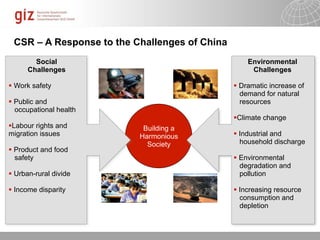
CSR – A Response to the Challenges of China
        Social                                     Environmental
      Challenges                                    Challenges

 Work safety                                   Dramatic increase of
                                                 demand for natural
 Public and                                     resources
  occupational health
                                               Climate change
Labour rights and         Building a
migration issues          Harmonious            Industrial and
                            Society              household discharge
 Product and food
  safety                                        Environmental
                                                 degradation and
 Urban-rural divide                             pollution

 Income disparity                              Increasing resource
                                                 consumption and
                                                 depletion


                                                  10/09/11   Seite
GIZ’s Sino-German Corporate Social Responsibility Project
   Objective:
     Support key political institutions, intermediary organisations, and
      enterprises to incorporate CSR into their strategies, policies, and
      practices

   Duration:
     2007 - 2012
   Key Government Partner:
     Department of WTO Affairs, Ministry of Commerce of the PRC
   Focus on:
      Central and local governments (Macro)
      Intermediaries (Meso)
      Individual enterprises (Micro)
      International exchange

                                                                 10/09/11   Seite
German International Cooperation (GIZ)

 International cooperation enterprise for sustainable development

 Operations in more than 130 countries in Europe, Asia, Africa, and
  Latin America

 17.000 people are employed worldwide, more than 60% are local
  personnel

 A federally-owned not-for-profit organisation

 Estimated turnover of EUR 1.9 billion


                                                     10/09/11   Seite
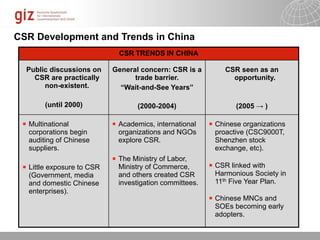
CSR Development and Trends in China
                              CSR TRENDS IN CHINA

  Public discussions on     General concern: CSR is a         CSR seen as an
    CSR are practically           trade barrier.                opportunity.
       non-existent.          “Wait-and-See Years”

        (until 2000)                (2000-2004)                   (2005 → )

  Multinational             Academics, international     Chinese organizations
   corporations begin         organizations and NGOs       proactive (CSC9000T,
   auditing of Chinese        explore CSR.                 Shenzhen stock
   suppliers.                                              exchange, etc).
                             The Ministry of Labor,
  Little exposure to CSR     Ministry of Commerce,        CSR linked with
   (Government, media         and others created CSR       Harmonious Society in
   and domestic Chinese       investigation committees.    11th Five Year Plan.
   enterprises).
                                                           Chinese MNCs and
                                                           SOEs becoming early
                                                           adopters.

                                                                     10/09/11   Seite
Recent CSR Trends in China
 Government - promotion and support of CSR (SASAC and Shanghai)
 Shanghai and Shenzhen Stock Markets - CSR guidelines
 Industry associations - encourage members to implement CSR measures
 Increasing media attention
 Rising NGO awareness and supervision
 Developing consumer awareness
 Changing employee demands
 Increasing influence of MNCs on CSR aspects
 Rising interest in sustainable investment
 Growing number of CSR reports


                                                           10/09/11   Seite   1
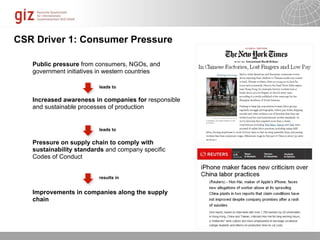
CSR Driver 1: Consumer Pressure

   Public pressure from consumers, NGOs, and
   government initiatives in western countries

                         leads to


   Increased awareness in companies for responsible
   and sustainable processes of production


                         leads to


   Pressure on supply chain to comply with
   sustainability standards and company specific
   Codes of Conduct


                         results in


   Improvements in companies along the supply
   chain


                                                      10/09/11   Seite   1
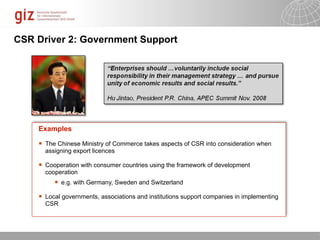
CSR Driver 2: Government Support


    Examples

       The Chinese Ministry of Commerce takes aspects of CSR into consideration when
        assigning export licences

       Cooperation with consumer countries using the framework of development
        cooperation
              e.g. with Germany, Sweden and Switzerland

       Local governments, associations and institutions support companies in implementing
        CSR


                                                                              10/09/11   Seite   1
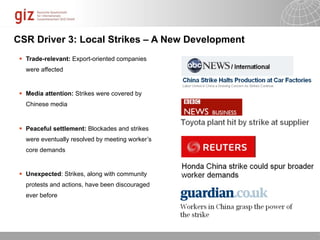
CSR Driver 3: Local Strikes – A New Development
  Trade-relevant: Export-oriented companies
   were affected


  Media attention: Strikes were covered by
   Chinese media


  Peaceful settlement: Blockades and strikes
   were eventually resolved by meeting worker’s
   core demands


  Unexpected: Strikes, along with community
   protests and actions, have been discouraged
   ever before


                                                  10/09/11   Seite   1
CSR Policy Advise

 Policy recommendations to the State-owned Assets Supervision and
  Administration Commission (SASAC), Ministry of Human Resources and
  Social Security, Ministry of Commerce, e.g. creation of an Inter-Ministerial
  CSR Coordination Mechanism, promotion of ISO 26000


 Policy recommendations on CSR promotion and incentive policies to local
  governments, e.g. Zhejiang Province, Wenzhou, Taizhou


 Research and Trainings on “Local Governments’ CSR Policies in China”


                                                                   10/09/11   Seite   1
Introducing CSR to Intermediaries


Development of CSR action plans for Chinese industry associations and
chambers of commerce, e.g. China Chamber of Commerce for Import and
Export of Machinery and Electronic Products


Translation and dissemination of ISEAL Codes of Good Practice, e.g.
Standard-Setting Code


Support of internet-based platforms operated by service providers, e.g.
China WTO Tribune, focusing on CSR


                                                                 10/09/11   Seite   1
Global Initiatives with the Chinese Market
 Taking Chinese central government delegations to Europe, e.g. with focus on
  carbon reduction policies

 Organising Sino-European roundtables and conferences on CSR in China
  and Europe (with BSCI)

 Presenting CSR Best Practices at the 2010 World Expo in Shanghai

 Training on CSR Reporting (with GRI)

 Initiating international conferences on CSR issues and events on
  sustainability

 Contributing to CSR Asian forums and conferences


                                                               10/09/11   Seite   1
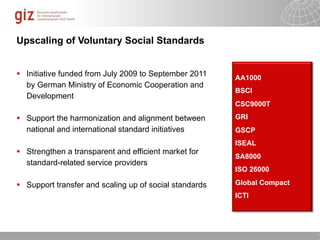
Upscaling of Voluntary Social Standards


 Initiative funded from July 2009 to September 2011    AA1000
  by German Ministry of Economic Cooperation and
                                                        BSCI
  Development
                                                        CSC9000T

 Support the harmonization and alignment between       GRI
  national and international standard initiatives       GSCP
                                                        ISEAL
 Strengthen a transparent and efficient market for
                                                        SA8000
  standard-related service providers
                                                        ISO 26000

 Support transfer and scaling up of social standards   Global Compact
                                                        ICTI


                                                           10/09/11   Seite   1
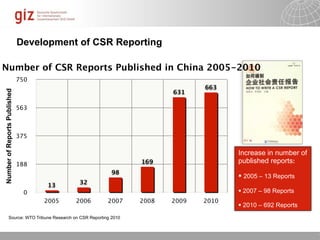
Development of CSR Reporting

Number of CSR Reports Published in China 2005-2010
                              750
                                                                               663
Number of Reports Published


                                                                        631

                              563


                              375

                                                                                      Increase in number of
                              188                                169                  published reports:
                                                          98
                                                                                       2005 – 13 Reports
                                    13     32
                                0                                                      2007 – 98 Reports
                                    2005   2006         2007     2008   2009   2010
                                                                                       2010 – 692 Reports
            Source: WTO Tribune Research on CSR Reporting 2010


                                                                                        10/09/11   Seite      1
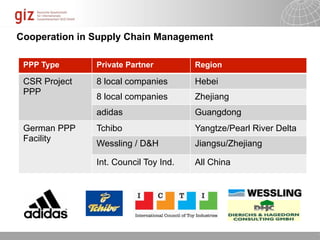
Cooperation in Supply Chain Management

 PPP Type      Private Partner         Region

 CSR Project   8 local companies       Hebei
 PPP
               8 local companies       Zhejiang
               adidas                  Guangdong
 German PPP    Tchibo                  Yangtze/Pearl River Delta
 Facility
               Wessling / D&H          Jiangsu/Zhejiang

               Int. Council Toy Ind.   All China


                                                   10/09/11   Seite   1
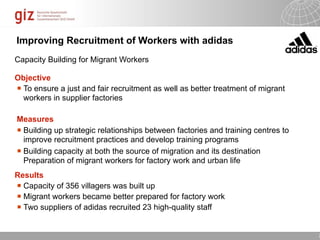
Improving Recruitment of Workers with adidas
Capacity Building for Migrant Workers

Objective
 To ensure a just and fair recruitment as well as better treatment of migrant
  workers in supplier factories

Measures
 Building up strategic relationships between factories and training centres to
  improve recruitment practices and develop training programs
 Building capacity at both the source of migration and its destination
  Preparation of migrant workers for factory work and urban life
Results
 Capacity of 356 villagers was built up
 Migrant workers became better prepared for factory work
 Two suppliers of adidas recruited 23 high-quality staff

                                                                  10/09/11   Seite   2
Improving Labour Conditions in Toy Production

Objective
 Improving access to information, training and support related to compliance
  with health, safety and labour standards for toy factory workers in China

Measures
   Development of training materials
   Trainings for toy factory workers
   On-site visits and consultancy services


Results
 Eight toy factories and five NGO partners participated in the project
 Two-day training conducted for 16 managers and 17 workers
 In-factory training to be conducted by end of March 2011 for additional workers
 131 sets of DVD training materials were developed and distributed to stakeholders
 Worker helpline service launched, 1,437 calls and instant messages received
 595,000 “What You Should Know” pocket cards distributed in 1,186 factories
                                                                        10/09/11   Seite   2
Summary of CSR Experience with Companies

Capacity building and advisory services to individual Chinese and international
companies on specific areas such as:

    Environmental Management, e.g. Environment-oriented Cost Management

    Hazardous Waste and Toxic Substances Management
    Energy Efficiency
    Improvement of Working Conditions and Social Standards in Enterprises
    Introduction of Dialogue Systems between Migrant Workers and
     Management
    CSR-related Communications, e.g. CSR Reporting
    Implementation of Effective Monitoring and Evaluation Systems


                                                                 10/09/11   Seite   2
Thank you for your attention!

                     Contact:

                 Rolf Dietmar
                Project Director
Sino-German Corporate Social Responsibility Project


                +86 10 8419 5686
               rolf.dietmar@giz.de
              www.chinacsrproject.org


                                                 10/09/11   Seite   2

CSR in China examples from GIZ

  • 1.
    Corporate Social Responsibilityin China 10/09/11 Seite
  • 2.
    New Paradigm forDoing Business in a Globalized World • Higher expectations from stakeholders and the general public • Corporate transparency, accountability and stakeholder relationships are the new frontier for competitive innovation • Stakeholders more aware of critical topics such as corporate ethics and climate change • More processes outsourced than ever before • Production located in different centers at a global scale • Hyper-connected world / Speed of communications • Need for horizontal and decentralised structures = fast response time and better service 10/09/11 Seite
  • 3.
    Defining CSR Social Responsibility Responsibilityof an organization for the impacts of its decisions and activities on society and the environment , through transparent and ethical behaviour that ⎯ contributes to sustainable development, including health and the welfare of society; ⎯ takes into account the expectations of stakeholders; ⎯ is in compliance with applicable law and consistent with international norms of behaviour; and ⎯ is integrated throughout the organization and practised in its relationships Source: ISO 26000 Guidance on Social Responsibility 10/09/11 Seite
  • 4.
    Rationale for CSRin Emerging Economies 1. Emerging economies represent the most rapidly expanding economies, and hence the most lucrative growth markets for business 2. Emerging economies are where globalization, economic growth, investment, and business activity are likely to have the most dramatic social and environmental impacts (both positive and negative) 3. Emerging economies present a distinctive set of CSR agenda challenges which are different to those faced in the developed world. 10/09/11 Seite
  • 5.
    Chinese Central GovernmentPosition on CSR Premier Wen Jiabao:* “Enterprises should carry out the policy of the country, take care of society and assume their respective social responsibilities. The entrepreneurs should not only focus on business and management, they should have the blood of ethics flowing in their body.” * 2009, Cambridge University, U.K. 10/09/11 Seite
  • 6.
    CSR – AResponse to the Challenges of China Social Environmental Challenges Challenges  Work safety  Dramatic increase of demand for natural  Public and resources occupational health Climate change Labour rights and Building a migration issues Harmonious  Industrial and Society household discharge  Product and food safety  Environmental degradation and  Urban-rural divide pollution  Income disparity  Increasing resource consumption and depletion 10/09/11 Seite
  • 7.
    GIZ’s Sino-German CorporateSocial Responsibility Project  Objective:  Support key political institutions, intermediary organisations, and enterprises to incorporate CSR into their strategies, policies, and practices  Duration:  2007 - 2012  Key Government Partner:  Department of WTO Affairs, Ministry of Commerce of the PRC  Focus on:  Central and local governments (Macro)  Intermediaries (Meso)  Individual enterprises (Micro)  International exchange 10/09/11 Seite
  • 8.
    German International Cooperation(GIZ)  International cooperation enterprise for sustainable development  Operations in more than 130 countries in Europe, Asia, Africa, and Latin America  17.000 people are employed worldwide, more than 60% are local personnel  A federally-owned not-for-profit organisation  Estimated turnover of EUR 1.9 billion 10/09/11 Seite
  • 9.
    CSR Development andTrends in China CSR TRENDS IN CHINA Public discussions on General concern: CSR is a CSR seen as an CSR are practically trade barrier. opportunity. non-existent. “Wait-and-See Years” (until 2000) (2000-2004) (2005 → )  Multinational  Academics, international  Chinese organizations corporations begin organizations and NGOs proactive (CSC9000T, auditing of Chinese explore CSR. Shenzhen stock suppliers. exchange, etc).  The Ministry of Labor,  Little exposure to CSR Ministry of Commerce,  CSR linked with (Government, media and others created CSR Harmonious Society in and domestic Chinese investigation committees. 11th Five Year Plan. enterprises).  Chinese MNCs and SOEs becoming early adopters. 10/09/11 Seite
  • 10.
    Recent CSR Trendsin China  Government - promotion and support of CSR (SASAC and Shanghai)  Shanghai and Shenzhen Stock Markets - CSR guidelines  Industry associations - encourage members to implement CSR measures  Increasing media attention  Rising NGO awareness and supervision  Developing consumer awareness  Changing employee demands  Increasing influence of MNCs on CSR aspects  Rising interest in sustainable investment  Growing number of CSR reports 10/09/11 Seite 1
  • 11.
    CSR Driver 1:Consumer Pressure Public pressure from consumers, NGOs, and government initiatives in western countries leads to Increased awareness in companies for responsible and sustainable processes of production leads to Pressure on supply chain to comply with sustainability standards and company specific Codes of Conduct results in Improvements in companies along the supply chain 10/09/11 Seite 1
  • 12.
    CSR Driver 2:Government Support Examples  The Chinese Ministry of Commerce takes aspects of CSR into consideration when assigning export licences  Cooperation with consumer countries using the framework of development cooperation  e.g. with Germany, Sweden and Switzerland  Local governments, associations and institutions support companies in implementing CSR 10/09/11 Seite 1
  • 13.
    CSR Driver 3:Local Strikes – A New Development  Trade-relevant: Export-oriented companies were affected  Media attention: Strikes were covered by Chinese media  Peaceful settlement: Blockades and strikes were eventually resolved by meeting worker’s core demands  Unexpected: Strikes, along with community protests and actions, have been discouraged ever before 10/09/11 Seite 1
  • 14.
    CSR Policy Advise Policy recommendations to the State-owned Assets Supervision and Administration Commission (SASAC), Ministry of Human Resources and Social Security, Ministry of Commerce, e.g. creation of an Inter-Ministerial CSR Coordination Mechanism, promotion of ISO 26000  Policy recommendations on CSR promotion and incentive policies to local governments, e.g. Zhejiang Province, Wenzhou, Taizhou  Research and Trainings on “Local Governments’ CSR Policies in China” 10/09/11 Seite 1
  • 15.
    Introducing CSR toIntermediaries Development of CSR action plans for Chinese industry associations and chambers of commerce, e.g. China Chamber of Commerce for Import and Export of Machinery and Electronic Products Translation and dissemination of ISEAL Codes of Good Practice, e.g. Standard-Setting Code Support of internet-based platforms operated by service providers, e.g. China WTO Tribune, focusing on CSR 10/09/11 Seite 1
  • 16.
    Global Initiatives withthe Chinese Market  Taking Chinese central government delegations to Europe, e.g. with focus on carbon reduction policies  Organising Sino-European roundtables and conferences on CSR in China and Europe (with BSCI)  Presenting CSR Best Practices at the 2010 World Expo in Shanghai  Training on CSR Reporting (with GRI)  Initiating international conferences on CSR issues and events on sustainability  Contributing to CSR Asian forums and conferences 10/09/11 Seite 1
  • 17.
    Upscaling of VoluntarySocial Standards  Initiative funded from July 2009 to September 2011 AA1000 by German Ministry of Economic Cooperation and BSCI Development CSC9000T  Support the harmonization and alignment between GRI national and international standard initiatives GSCP ISEAL  Strengthen a transparent and efficient market for SA8000 standard-related service providers ISO 26000  Support transfer and scaling up of social standards Global Compact ICTI 10/09/11 Seite 1
  • 18.
    Development of CSRReporting Number of CSR Reports Published in China 2005-2010 750 663 Number of Reports Published 631 563 375 Increase in number of 188 169 published reports: 98  2005 – 13 Reports 13 32 0  2007 – 98 Reports 2005 2006 2007 2008 2009 2010  2010 – 692 Reports Source: WTO Tribune Research on CSR Reporting 2010 10/09/11 Seite 1
  • 19.
    Cooperation in SupplyChain Management PPP Type Private Partner Region CSR Project 8 local companies Hebei PPP 8 local companies Zhejiang adidas Guangdong German PPP Tchibo Yangtze/Pearl River Delta Facility Wessling / D&H Jiangsu/Zhejiang Int. Council Toy Ind. All China 10/09/11 Seite 1
  • 20.
    Improving Recruitment ofWorkers with adidas Capacity Building for Migrant Workers Objective  To ensure a just and fair recruitment as well as better treatment of migrant workers in supplier factories Measures  Building up strategic relationships between factories and training centres to improve recruitment practices and develop training programs  Building capacity at both the source of migration and its destination Preparation of migrant workers for factory work and urban life Results  Capacity of 356 villagers was built up  Migrant workers became better prepared for factory work  Two suppliers of adidas recruited 23 high-quality staff 10/09/11 Seite 2
  • 21.
    Improving Labour Conditionsin Toy Production Objective  Improving access to information, training and support related to compliance with health, safety and labour standards for toy factory workers in China Measures  Development of training materials  Trainings for toy factory workers  On-site visits and consultancy services Results  Eight toy factories and five NGO partners participated in the project  Two-day training conducted for 16 managers and 17 workers  In-factory training to be conducted by end of March 2011 for additional workers  131 sets of DVD training materials were developed and distributed to stakeholders  Worker helpline service launched, 1,437 calls and instant messages received  595,000 “What You Should Know” pocket cards distributed in 1,186 factories 10/09/11 Seite 2
  • 22.
    Summary of CSRExperience with Companies Capacity building and advisory services to individual Chinese and international companies on specific areas such as:  Environmental Management, e.g. Environment-oriented Cost Management  Hazardous Waste and Toxic Substances Management  Energy Efficiency  Improvement of Working Conditions and Social Standards in Enterprises  Introduction of Dialogue Systems between Migrant Workers and Management  CSR-related Communications, e.g. CSR Reporting  Implementation of Effective Monitoring and Evaluation Systems 10/09/11 Seite 2
  • 23.
    Thank you foryour attention! Contact: Rolf Dietmar Project Director Sino-German Corporate Social Responsibility Project +86 10 8419 5686 rolf.dietmar@giz.de www.chinacsrproject.org 10/09/11 Seite 2