Principles of Business 
Seminar: Applying economic concepts 
to your business 
Topic Number:5
Overview 
The economic environment is an important determinant of 
business success. This seminar looks to determine the 
implications and impacts of the global economy on your 
business. 
You are tasked with initially explaining the concept of supply & 
demand and the factors that influence it in relation to your 
business activity. 
As part of this analysis you will determine a number of the key 
economic indicators in relation to your business. As you have 
recently learnt about the various strategies you can adopt when 
‘going global’, determine how the theory of comparative 
advantage can help your business. 
Finally, if you were going to make an investment abroad explain 
if you would opt for direct or indirect FDI.
Learning outcomes of this seminar 
• Be able to explain the concept of supply & demand 
and the factors that influence it in relation to your 
business activity 
• Identify and describe the key economic indicators 
that could impact your business? 
• Illustrate and apply the comparative advantage 
theory in your business 
• Critically evaluate and describe the various global 
investment options
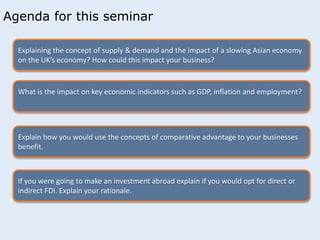
Agenda for this seminar 
Explaining the concept of supply & demand and the impact of a slowing Asian economy 
on the UK’s economy? How could this impact your business? 
What is the impact on key economic indicators such as GDP, inflation and employment? 
Explain how you would use the concepts of comparative advantage to your businesses 
benefit. 
If you were going to make an investment abroad explain if you would opt for direct or 
indirect FDI. Explain your rationale.
Structure for the session 
You will have 
15 minutes to 
discuss each 
question 
We will have a 
de-brief at the 
end of each 15 
minutes to hear 
your thoughts 
on each area 
Feel free to ask 
questions but 
please do not 
have separate 
conversations 
‘we are all in 
this together’!
Explaining the concept 
of supply & demand and 
the impact of a slowing 
Asian economy on the 
UK’s economy? How 
could this impact your 
business?
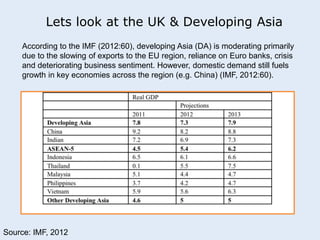
Lets look at the UK & Developing Asia 
According to the IMF (2012:60), developing Asia (DA) is moderating primarily 
due to the slowing of exports to the EU region, reliance on Euro banks, crisis 
and deteriorating business sentiment. However, domestic demand still fuels 
growth in key economies across the region (e.g. China) (IMF, 2012:60). 
Source: IMF, 2012
Implications for supply and demand 
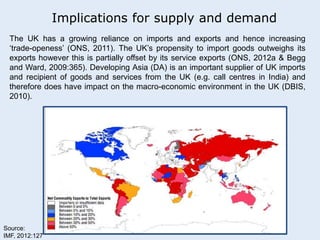
The UK has a growing reliance on imports and exports and hence increasing 
‘trade-openess’ (ONS, 2011). The UK’s propensity to import goods outweighs its 
exports however this is partially offset by its service exports (ONS, 2012a & Begg 
and Ward, 2009:365). Developing Asia (DA) is an important supplier of UK imports 
and recipient of goods and services from the UK (e.g. call centres in India) and 
therefore does have impact on the macro-economic environment in the UK (DBIS, 
2010). 
	 
Source: 
IMF, 2012:127
Implications for supply and demand 
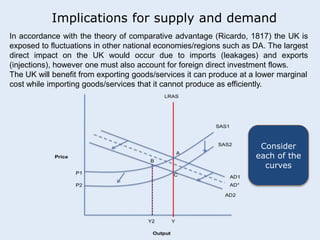
In accordance with the theory of comparative advantage (Ricardo, 1817) the UK is 
exposed to fluctuations in other national economies/regions such as DA. The largest 
direct impact on the UK would occur due to imports (leakages) and exports 
(injections), however one must also account for foreign direct investment flows. 
The UK will benefit from exporting goods/services it can produce at a lower marginal 
cost while importing goods/services that it cannot produce as efficiently. 
	 
Consider 
each of the 
curves
What is the impact on 
key economic indicators 
such as GDP, inflation 
and employment?
Impact on GDP 
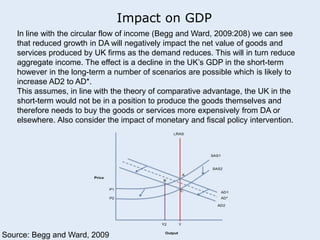
In line with the circular flow of income (Begg and Ward, 2009:208) we can see 
that reduced growth in DA will negatively impact the net value of goods and 
services produced by UK firms as the demand reduces. This will in turn reduce 
aggregate income. The effect is a decline in the UK’s GDP in the short-term 
however in the long-term a number of scenarios are possible which is likely to 
increase AD2 to AD*. 
This assumes, in line with the theory of comparative advantage, the UK in the 
short-term would not be in a position to produce the goods themselves and 
therefore needs to buy the goods or services more expensively from DA or 
elsewhere. Also consider the impact of monetary and fiscal policy intervention. 
Source: Begg and Ward, 2009
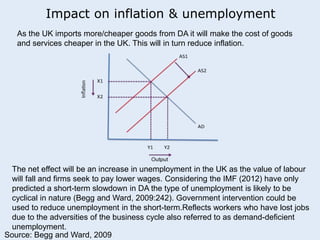
Impact on inflation & unemployment 
As the UK imports more/cheaper goods from DA it will make the cost of goods 
and services cheaper in the UK. This will in turn reduce inflation. 
	 
The net effect will be an increase in unemployment in the UK as the value of labour 
will fall and firms seek to pay lower wages. Considering the IMF (2012) have only 
predicted a short-term slowdown in DA the type of unemployment is likely to be 
cyclical in nature (Begg and Ward, 2009:242). Government intervention could be 
used to reduce unemployment in the short-term.Reflects workers who have lost jobs 
due to the adversities of the business cycle also referred to as demand-deficient 
unemployment. 
Source: Begg and Ward, 2009
Explain how you would 
use the concepts of 
comparative advantage 
to your businesses 
benefit
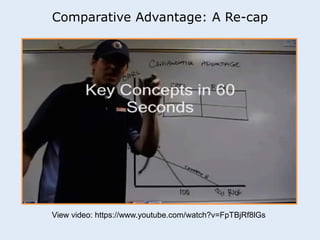
Comparative Advantage: A Re-cap 
View video: https://www.youtube.com/watch?v=FpTBjRf8lGs
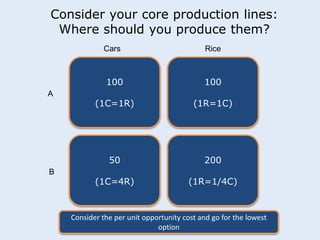
Consider your core production lines: 
Where should you produce them? 
Cars Rice 
100 
(1C=1R) 
100 
(1R=1C) 
50 
(1C=4R) 
200 
(1R=1/4C) 
A 
B 
Consider the per unit opportunity cost and go for the lowest 
option
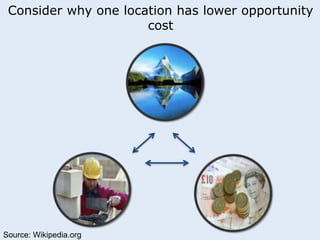
Consider why one location has lower opportunity 
cost 
Source: Wikipedia.org
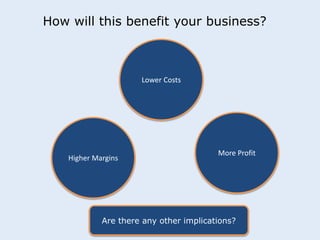
How will this benefit your business? 
Higher Margins 
Lower Costs 
More Profit 
Are there any other implications?
An example from Starbucks 
View video: https://www.youtube.com/watch?v=ElYNhGbOTOQ
If you were going to 
make an investment 
abroad explain if you 
would opt for direct or 
indirect FDI. Explain 
your rationale.
Firstly consider the options 
View video: https://www.youtube.com/watch?v=I8w7Kv2aZPg
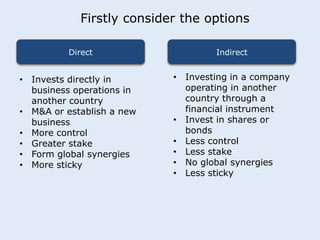
Firstly consider the options 
Direct Indirect 
• Invests directly in 
business operations in 
another country 
• M&A or establish a new 
business 
• More control 
• Greater stake 
• Form global synergies 
• More sticky 
• Investing in a company 
operating in another 
country through a 
financial instrument 
• Invest in shares or 
bonds 
• Less control 
• Less stake 
• No global synergies 
• Less sticky
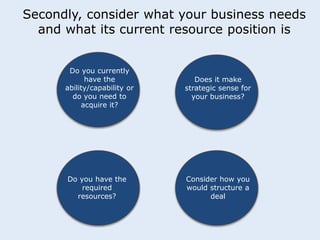
Secondly, consider what your business needs 
and what its current resource position is 
Do you currently 
have the 
ability/capability or 
do you need to 
acquire it? 
Does it make 
strategic sense for 
your business? 
Do you have the 
required 
resources? 
Consider how you 
would structure a 
deal
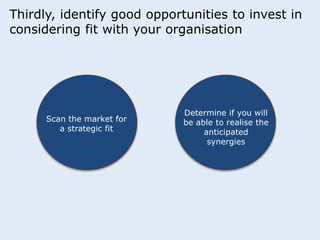
Thirdly, identify good opportunities to invest in 
considering fit with your organisation 
Determine if you will 
be able to realise the 
anticipated 
synergies 
Scan the market for 
a strategic fit
End of Seminar 
Note: This recording is for your 
personal use only and not for further 
distribution or wider review. 
© Pearson College 2013
Pob stage 1   seminar 5 sbd

Pob stage 1 seminar 5 sbd

  • 1.
    Principles of Business Seminar: Applying economic concepts to your business Topic Number:5
  • 2.
    Overview The economicenvironment is an important determinant of business success. This seminar looks to determine the implications and impacts of the global economy on your business. You are tasked with initially explaining the concept of supply & demand and the factors that influence it in relation to your business activity. As part of this analysis you will determine a number of the key economic indicators in relation to your business. As you have recently learnt about the various strategies you can adopt when ‘going global’, determine how the theory of comparative advantage can help your business. Finally, if you were going to make an investment abroad explain if you would opt for direct or indirect FDI.
  • 3.
    Learning outcomes ofthis seminar • Be able to explain the concept of supply & demand and the factors that influence it in relation to your business activity • Identify and describe the key economic indicators that could impact your business? • Illustrate and apply the comparative advantage theory in your business • Critically evaluate and describe the various global investment options
  • 4.
    Agenda for thisseminar Explaining the concept of supply & demand and the impact of a slowing Asian economy on the UK’s economy? How could this impact your business? What is the impact on key economic indicators such as GDP, inflation and employment? Explain how you would use the concepts of comparative advantage to your businesses benefit. If you were going to make an investment abroad explain if you would opt for direct or indirect FDI. Explain your rationale.
  • 5.
    Structure for thesession You will have 15 minutes to discuss each question We will have a de-brief at the end of each 15 minutes to hear your thoughts on each area Feel free to ask questions but please do not have separate conversations ‘we are all in this together’!
  • 6.
    Explaining the concept of supply & demand and the impact of a slowing Asian economy on the UK’s economy? How could this impact your business?
  • 7.
    Lets look atthe UK & Developing Asia According to the IMF (2012:60), developing Asia (DA) is moderating primarily due to the slowing of exports to the EU region, reliance on Euro banks, crisis and deteriorating business sentiment. However, domestic demand still fuels growth in key economies across the region (e.g. China) (IMF, 2012:60). Source: IMF, 2012
  • 8.
    Implications for supplyand demand The UK has a growing reliance on imports and exports and hence increasing ‘trade-openess’ (ONS, 2011). The UK’s propensity to import goods outweighs its exports however this is partially offset by its service exports (ONS, 2012a & Begg and Ward, 2009:365). Developing Asia (DA) is an important supplier of UK imports and recipient of goods and services from the UK (e.g. call centres in India) and therefore does have impact on the macro-economic environment in the UK (DBIS, 2010). Source: IMF, 2012:127
  • 9.
    Implications for supplyand demand In accordance with the theory of comparative advantage (Ricardo, 1817) the UK is exposed to fluctuations in other national economies/regions such as DA. The largest direct impact on the UK would occur due to imports (leakages) and exports (injections), however one must also account for foreign direct investment flows. The UK will benefit from exporting goods/services it can produce at a lower marginal cost while importing goods/services that it cannot produce as efficiently. Consider each of the curves
  • 10.
    What is theimpact on key economic indicators such as GDP, inflation and employment?
  • 11.
    Impact on GDP In line with the circular flow of income (Begg and Ward, 2009:208) we can see that reduced growth in DA will negatively impact the net value of goods and services produced by UK firms as the demand reduces. This will in turn reduce aggregate income. The effect is a decline in the UK’s GDP in the short-term however in the long-term a number of scenarios are possible which is likely to increase AD2 to AD*. This assumes, in line with the theory of comparative advantage, the UK in the short-term would not be in a position to produce the goods themselves and therefore needs to buy the goods or services more expensively from DA or elsewhere. Also consider the impact of monetary and fiscal policy intervention. Source: Begg and Ward, 2009
  • 12.
    Impact on inflation& unemployment As the UK imports more/cheaper goods from DA it will make the cost of goods and services cheaper in the UK. This will in turn reduce inflation. The net effect will be an increase in unemployment in the UK as the value of labour will fall and firms seek to pay lower wages. Considering the IMF (2012) have only predicted a short-term slowdown in DA the type of unemployment is likely to be cyclical in nature (Begg and Ward, 2009:242). Government intervention could be used to reduce unemployment in the short-term.Reflects workers who have lost jobs due to the adversities of the business cycle also referred to as demand-deficient unemployment. Source: Begg and Ward, 2009
  • 13.
    Explain how youwould use the concepts of comparative advantage to your businesses benefit
  • 14.
    Comparative Advantage: ARe-cap View video: https://www.youtube.com/watch?v=FpTBjRf8lGs
  • 15.
    Consider your coreproduction lines: Where should you produce them? Cars Rice 100 (1C=1R) 100 (1R=1C) 50 (1C=4R) 200 (1R=1/4C) A B Consider the per unit opportunity cost and go for the lowest option
  • 16.
    Consider why onelocation has lower opportunity cost Source: Wikipedia.org
  • 17.
    How will thisbenefit your business? Higher Margins Lower Costs More Profit Are there any other implications?
  • 18.
    An example fromStarbucks View video: https://www.youtube.com/watch?v=ElYNhGbOTOQ
  • 19.
    If you weregoing to make an investment abroad explain if you would opt for direct or indirect FDI. Explain your rationale.
  • 20.
    Firstly consider theoptions View video: https://www.youtube.com/watch?v=I8w7Kv2aZPg
  • 21.
    Firstly consider theoptions Direct Indirect • Invests directly in business operations in another country • M&A or establish a new business • More control • Greater stake • Form global synergies • More sticky • Investing in a company operating in another country through a financial instrument • Invest in shares or bonds • Less control • Less stake • No global synergies • Less sticky
  • 22.
    Secondly, consider whatyour business needs and what its current resource position is Do you currently have the ability/capability or do you need to acquire it? Does it make strategic sense for your business? Do you have the required resources? Consider how you would structure a deal
  • 23.
    Thirdly, identify goodopportunities to invest in considering fit with your organisation Determine if you will be able to realise the anticipated synergies Scan the market for a strategic fit
  • 24.
    End of Seminar Note: This recording is for your personal use only and not for further distribution or wider review. © Pearson College 2013