TIME  MANAGEMENT VIPIN.B
TASK 1 What are the reasons for poor time management? What are the advantages of good time management?
REASONS FOR POOR TIME MANAGEMENT Lack of clarity about task Feeling overwhelmed Fallacious beliefs ( ‘I’m too smart “) Thinking, “ its too hard”
ADVANTAGES OF GOOD TIME MANAGEMENT It saves time Increased effectiveness and efficiency Prevents stress and anxiety Reduces avoidance Leads to more balance
TASK 2 LIST ALL THE ACTIVITIES THAT YOU DO IN A DAY. IN A WEEK  ( DO NOT REPEAT THE ACTIVITIES THAT ARE  MENIONED IN THE DAY
OBJECTIVES ` I will learn techniques that will help me to direct my work life instead of merely managing my time. I will learn a framework for developing a mission and vision that gives purpose and direction to my work. I will learn how to prioritize my highest-leveraged activities, leading to significant increases in productivity.
 
STORY Every morning in Africa a deer wakes up.  It knows that it must run faster than the fastest lion.  Otherwise it will be killed. Every morning in Africa the lion wakes up.  It knows that it must run faster than the slowest deer.  Otherwise it will starve. It does not matter if you are deer or lion but when the sun rises  it is time to run.
THE COMPLETE SIX-STEP PROCESS Connect to mission Review roles Identify goals Organize weekly Exercise integrity Evaluate
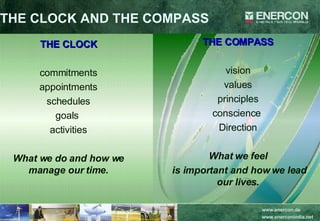
THE CLOCK AND THE COMPASS THE CLOCK commitments appointments schedules goals  activities What we do and how we manage our time. THE COMPASS vision values principles conscience  Direction What we feel is important and how we lead our lives.
TRADITIONAL TIME MANAGEMENT First generation—notes and checklists Second generation—planning and preparation Third generation—planning, prioritizing and controlling
FIRST GENERATION GO WITH THE FLOW based on reminders attempt to keep track of things you do with your time simple notes and checklists carry lists with you and refer to them in order to remember incomplete tasks put on tomorrow’s list
FIRST GENERATION Strengths flexible responsive to people not over-structured less stress  tracks to-do’s Weaknesses no real structure things fall through cracks commitments suffer little accomplished  crisis to crisis first things— things right in front of you
SECOND GENERATION Planning and Preparation Calendars and appointment books Efficiency in goal setting and planning ahead Make appointments, write down commitments, identify deadlines May keep information on computer or network
SECOND GENERATION Strengths tracks commitments and appointments more accomplished through planning and goal setting more effective meetings and presentations due to preparation Weaknesses puts schedule over people accomplish more of what you want—not necessarily what is needed or fulfilling independent thinking —see people as means or barriers first things– those that are on the schedule
THIRD GENERATION Planning, Prioritizing and Controlling have spent time clarifying values and priorities set long, medium, and short-term goals to attain values, prioritizes on a daily basis uses wide variety of planners and organizers, with detailed forms for daily planning gets more done in less time--  but still feels frustrated
THIRD GENERATION Strengths assumes responsibility for results connects with values taps into the power of long, medium, and short-term goals translates values into goals and actions gives structure and order to life Weaknesses can lead to false sense of control, pride power of vision untapped can lead to guilt, imbalance of roles less flexibility/spontaneity first things set by urgency and values
FOURTH   GENERATION LIFE LEADERSHIP Puts people ahead of schedules, compasses ahead of clocks Uses the best of generations 1, 2, and 3 You want to lead a life of meaning and contribution, with balance
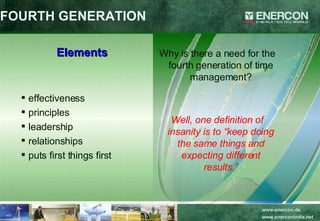
FOURTH GENERATION Elements effectiveness principles leadership relationships puts first things first Why is there a need for the fourth generation of time management? Well, one definition of insanity is to “keep doing the same things and expecting different results.”
UNDERSTANDING TIME “ A  no  uttered from the deepest conviction is better than a  yes  merely uttered to please, or what is worse, to avoid trouble.” Mahatma Gandhi
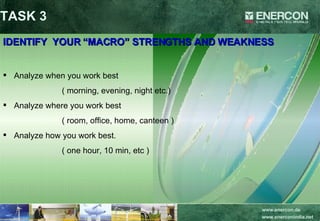
IDENTIFY  YOUR “MACRO” STRENGTHS AND WEAKNESS Analyze when you work best  ( morning, evening, night etc.) Analyze where you work best ( room, office, home, canteen ) Analyze how you work best. ( one hour, 10 min, etc ) TASK 3
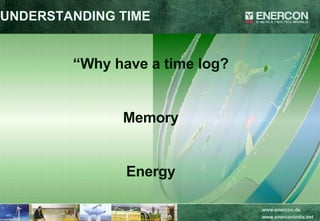
UNDERSTANDING TIME “ Why have a time log? Memory Energy
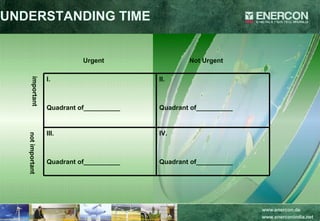
UNDERSTANDING TIME Urgent Not Urgent important not important IV.  Quadrant of__________ III.  Quadrant of__________ II.  Quadrant of__________ I. Quadrant of__________
UNDERSTANDING TIME Move into quadrant II quadrant I—manage:  the quadrant of necessity; things are both urgent and important quadrant II—leadership and quality:  the quadrant of focus; things are important but not urgent
UNDERSTANDING TIME Move into quadrant II quadrant III—(AVOID):  the quadrant of deception; things are urgent but not important quadrant IV—(AVOID):  the quadrant of waste; things are neither important nor urgent
TASK 5. Each group makes a list of items that are “important and  urgent” Each group’ team leader selects  an item that will represent that team ( to be written on the flip chart ). Each team selects a member who forms a committee. The committee will recommend whether the Q1 items will stay in Q1 or can be pushed to Q2. The rest of the groups will now be converted into two groups.  One to ensure that the issues stay in Q1.  The other  group to make sure that it leaves Q1. The committee leader argues on each point in the flip chart and the two groups depending on the outcome oppose or support him. 10 min is given for each argument and the presenter decides the outcome. The game will prove that we consider all activities as important and urgent and in reality it is not.
UNDERSTANDING TIME THERE  WILL  BE NEVER ENOGH TIME TO  GET  EVERYTHING  DONE BUT THERE WILL  ALWAYS  BE  ENOUGH   TIME  TO GET THE MOST IMPORTANT THINGS DONE
MOVE INTO QUADRANT II How do I get there? The six step process connect to mission review roles identify goals organize weekly exercise integrity evaluate
STEP 1: CONNECT WITH VISION & MISSION Consider the big picture.  The key to this connection lies in the clarity of your vision around such questions as: What is most important? What gives your life meaning? What do you want to be and do in your life?
STEP 2: IDENTIFY YOUR ROLES We have important roles at work, in the family, in the community, or other areas of our lives Roles represent responsibilities, relationships, and areas of contribution
STEP 3: SELECT QUAD II GOALS FOR EACH ROLE What is the most important thing I could do for each role this week that would have the greatest positive impact? Consider the relationships for each role Review a “perhaps” list for ideas Identify the steps that need to be taken to achieve long-term goals
STEP 3 (cont ): TO-DO LISTS List your activities for the day Prioritize those activities Check for activities that you can accomplish at the same time Break larger activities into smaller ones. Include your to – do lists into smaller ones Include your to-do list in your daily schedule The to-do list will help you clarify what you need to accomplish each day. They also help you to accomplish it
STEP 4:  ORGANIZE WEEKLY translating high leverage quad II goals requires a framework most people are always trying to find time in their overflowing quad I/III schedules They move, delegate, cancel, and postpone—all in hopes of “putting first things first” The key is in scheduling your priorities, not prioritizing your schedule
TIPS TO START YOUR DAY Tip  # 1 Preview your schedule—get your bearings: Review your compass Look at the day in the context of the week Renew your power to respond to changes in a meaningful way
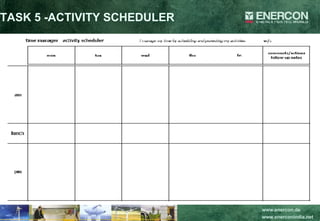
TASK 5 -ACTIVITY SCHEDULER
TASK 6 - ACTIVITY SCHEDULER
TIPS TO START YOUR DAY Tip  # 2 Prioritize: identify activities as QI or QII—keeps QIII and IV out of your schedule emphasizes the importance paradigm keeps you aware of choices you make Must understand that prioritization includes only items that you’ve put in the framework
TIPS TO START YOUR DAY Tip  # 3 Planning:  time sensitive activities on the right, any time activities on the left makes for effective schedule decisions Helps you remain sensitive to commitments Best use of your time: remember importance rather than urgency!
STEP 5: EXERCISE INTEGRITY IN THE MOMENT Should I carry out my plan or make conscience directed changes?
STEP 6: EVALUATE To be successful, you must make successes of one week the foundation for the next.  At the end of the week, ask yourself some questions: What goals did I achieve? What challenges did I encounter? What decisions did I make? Did I keep “first things first?”
STEP 6: EVALUATE Different ways to evaluate   Mark accomplished goals on weekly compass Keep a journal or daily log and review Review past weekly compasses Ask specific questions about your performance and actions
STEP 6: EVALUATE Weekly Evaluation What did I learn from the week as a whole? Am I setting goals that are realistic but challenging? Have I been effective in work related communications? Have I been successful in maintaining a Quad II perspective?
CLOSING THOUGHT A journey of a thousand miles must begin with a single step. Lao-Tzu
CREDITS MEGAN POORE – ACADEMIC SKILLS AND LEARNING CENTRE DAMONE – SLIDESHARE.NET

Time Management

  • 1.
  • 2.
    TASK 1 Whatare the reasons for poor time management? What are the advantages of good time management?
  • 3.
    REASONS FOR POORTIME MANAGEMENT Lack of clarity about task Feeling overwhelmed Fallacious beliefs ( ‘I’m too smart “) Thinking, “ its too hard”
  • 4.
    ADVANTAGES OF GOODTIME MANAGEMENT It saves time Increased effectiveness and efficiency Prevents stress and anxiety Reduces avoidance Leads to more balance
  • 5.
    TASK 2 LISTALL THE ACTIVITIES THAT YOU DO IN A DAY. IN A WEEK ( DO NOT REPEAT THE ACTIVITIES THAT ARE MENIONED IN THE DAY
  • 6.
    OBJECTIVES ` Iwill learn techniques that will help me to direct my work life instead of merely managing my time. I will learn a framework for developing a mission and vision that gives purpose and direction to my work. I will learn how to prioritize my highest-leveraged activities, leading to significant increases in productivity.
  • 7.
  • 8.
    STORY Every morningin Africa a deer wakes up. It knows that it must run faster than the fastest lion. Otherwise it will be killed. Every morning in Africa the lion wakes up. It knows that it must run faster than the slowest deer. Otherwise it will starve. It does not matter if you are deer or lion but when the sun rises it is time to run.
  • 9.
    THE COMPLETE SIX-STEPPROCESS Connect to mission Review roles Identify goals Organize weekly Exercise integrity Evaluate
  • 10.
    THE CLOCK ANDTHE COMPASS THE CLOCK commitments appointments schedules goals activities What we do and how we manage our time. THE COMPASS vision values principles conscience Direction What we feel is important and how we lead our lives.
  • 11.
    TRADITIONAL TIME MANAGEMENTFirst generation—notes and checklists Second generation—planning and preparation Third generation—planning, prioritizing and controlling
  • 12.
    FIRST GENERATION GOWITH THE FLOW based on reminders attempt to keep track of things you do with your time simple notes and checklists carry lists with you and refer to them in order to remember incomplete tasks put on tomorrow’s list
  • 13.
    FIRST GENERATION Strengthsflexible responsive to people not over-structured less stress tracks to-do’s Weaknesses no real structure things fall through cracks commitments suffer little accomplished crisis to crisis first things— things right in front of you
  • 14.
    SECOND GENERATION Planningand Preparation Calendars and appointment books Efficiency in goal setting and planning ahead Make appointments, write down commitments, identify deadlines May keep information on computer or network
  • 15.
    SECOND GENERATION Strengthstracks commitments and appointments more accomplished through planning and goal setting more effective meetings and presentations due to preparation Weaknesses puts schedule over people accomplish more of what you want—not necessarily what is needed or fulfilling independent thinking —see people as means or barriers first things– those that are on the schedule
  • 16.
    THIRD GENERATION Planning,Prioritizing and Controlling have spent time clarifying values and priorities set long, medium, and short-term goals to attain values, prioritizes on a daily basis uses wide variety of planners and organizers, with detailed forms for daily planning gets more done in less time-- but still feels frustrated
  • 17.
    THIRD GENERATION Strengthsassumes responsibility for results connects with values taps into the power of long, medium, and short-term goals translates values into goals and actions gives structure and order to life Weaknesses can lead to false sense of control, pride power of vision untapped can lead to guilt, imbalance of roles less flexibility/spontaneity first things set by urgency and values
  • 18.
    FOURTH GENERATION LIFE LEADERSHIP Puts people ahead of schedules, compasses ahead of clocks Uses the best of generations 1, 2, and 3 You want to lead a life of meaning and contribution, with balance
  • 19.
    FOURTH GENERATION Elementseffectiveness principles leadership relationships puts first things first Why is there a need for the fourth generation of time management? Well, one definition of insanity is to “keep doing the same things and expecting different results.”
  • 20.
    UNDERSTANDING TIME “A no uttered from the deepest conviction is better than a yes merely uttered to please, or what is worse, to avoid trouble.” Mahatma Gandhi
  • 21.
    IDENTIFY YOUR“MACRO” STRENGTHS AND WEAKNESS Analyze when you work best ( morning, evening, night etc.) Analyze where you work best ( room, office, home, canteen ) Analyze how you work best. ( one hour, 10 min, etc ) TASK 3
  • 22.
    UNDERSTANDING TIME “Why have a time log? Memory Energy
  • 23.
    UNDERSTANDING TIME UrgentNot Urgent important not important IV. Quadrant of__________ III. Quadrant of__________ II. Quadrant of__________ I. Quadrant of__________
  • 24.
    UNDERSTANDING TIME Moveinto quadrant II quadrant I—manage: the quadrant of necessity; things are both urgent and important quadrant II—leadership and quality: the quadrant of focus; things are important but not urgent
  • 25.
    UNDERSTANDING TIME Moveinto quadrant II quadrant III—(AVOID): the quadrant of deception; things are urgent but not important quadrant IV—(AVOID): the quadrant of waste; things are neither important nor urgent
  • 26.
    TASK 5. Eachgroup makes a list of items that are “important and urgent” Each group’ team leader selects an item that will represent that team ( to be written on the flip chart ). Each team selects a member who forms a committee. The committee will recommend whether the Q1 items will stay in Q1 or can be pushed to Q2. The rest of the groups will now be converted into two groups. One to ensure that the issues stay in Q1. The other group to make sure that it leaves Q1. The committee leader argues on each point in the flip chart and the two groups depending on the outcome oppose or support him. 10 min is given for each argument and the presenter decides the outcome. The game will prove that we consider all activities as important and urgent and in reality it is not.
  • 27.
    UNDERSTANDING TIME THERE WILL BE NEVER ENOGH TIME TO GET EVERYTHING DONE BUT THERE WILL ALWAYS BE ENOUGH TIME TO GET THE MOST IMPORTANT THINGS DONE
  • 28.
    MOVE INTO QUADRANTII How do I get there? The six step process connect to mission review roles identify goals organize weekly exercise integrity evaluate
  • 29.
    STEP 1: CONNECTWITH VISION & MISSION Consider the big picture. The key to this connection lies in the clarity of your vision around such questions as: What is most important? What gives your life meaning? What do you want to be and do in your life?
  • 30.
    STEP 2: IDENTIFYYOUR ROLES We have important roles at work, in the family, in the community, or other areas of our lives Roles represent responsibilities, relationships, and areas of contribution
  • 31.
    STEP 3: SELECTQUAD II GOALS FOR EACH ROLE What is the most important thing I could do for each role this week that would have the greatest positive impact? Consider the relationships for each role Review a “perhaps” list for ideas Identify the steps that need to be taken to achieve long-term goals
  • 32.
    STEP 3 (cont): TO-DO LISTS List your activities for the day Prioritize those activities Check for activities that you can accomplish at the same time Break larger activities into smaller ones. Include your to – do lists into smaller ones Include your to-do list in your daily schedule The to-do list will help you clarify what you need to accomplish each day. They also help you to accomplish it
  • 33.
    STEP 4: ORGANIZE WEEKLY translating high leverage quad II goals requires a framework most people are always trying to find time in their overflowing quad I/III schedules They move, delegate, cancel, and postpone—all in hopes of “putting first things first” The key is in scheduling your priorities, not prioritizing your schedule
  • 34.
    TIPS TO STARTYOUR DAY Tip # 1 Preview your schedule—get your bearings: Review your compass Look at the day in the context of the week Renew your power to respond to changes in a meaningful way
  • 35.
  • 36.
    TASK 6 -ACTIVITY SCHEDULER
  • 37.
    TIPS TO STARTYOUR DAY Tip # 2 Prioritize: identify activities as QI or QII—keeps QIII and IV out of your schedule emphasizes the importance paradigm keeps you aware of choices you make Must understand that prioritization includes only items that you’ve put in the framework
  • 38.
    TIPS TO STARTYOUR DAY Tip # 3 Planning: time sensitive activities on the right, any time activities on the left makes for effective schedule decisions Helps you remain sensitive to commitments Best use of your time: remember importance rather than urgency!
  • 39.
    STEP 5: EXERCISEINTEGRITY IN THE MOMENT Should I carry out my plan or make conscience directed changes?
  • 40.
    STEP 6: EVALUATETo be successful, you must make successes of one week the foundation for the next. At the end of the week, ask yourself some questions: What goals did I achieve? What challenges did I encounter? What decisions did I make? Did I keep “first things first?”
  • 41.
    STEP 6: EVALUATEDifferent ways to evaluate Mark accomplished goals on weekly compass Keep a journal or daily log and review Review past weekly compasses Ask specific questions about your performance and actions
  • 42.
    STEP 6: EVALUATEWeekly Evaluation What did I learn from the week as a whole? Am I setting goals that are realistic but challenging? Have I been effective in work related communications? Have I been successful in maintaining a Quad II perspective?
  • 43.
    CLOSING THOUGHT Ajourney of a thousand miles must begin with a single step. Lao-Tzu
  • 44.
    CREDITS MEGAN POORE– ACADEMIC SKILLS AND LEARNING CENTRE DAMONE – SLIDESHARE.NET