
AN EMPIRICAL STUDY ON SOCIO- ECONOMIC
PERFORMANCE OF THE CSR: TRIPLE BOTTOM LINE
APPROACH OF THE DIFFERENT INDUSTRIAL CATEGORIES
- WITH SPECIAL REFERENCE TO DAKSHINA KANNADA
DISTRICT
Ms. Ramyashree M G,
Research Scholar (JRF),
Department of Studies and Research in
Commerce,
Mangalore University
Mangalagangothri-574199
“THINK GLOBALLY, ACT LOCALLY”
INTRODUCTION
 Corporate Social Responsibility (CSR) is a
commitment to improve community well-
being through discretionary business
practices and contributions of corporate
resources.
 many Indian companies talked about
responsible business or triple P
(People, Planet and Profit)
 Business ethics has also been brought into
the arena of corporate social responsibility
SIGNIFICANCE OF THE STUDY
The purpose of this study was to investigate
the relationship between organization
corporate social responsibility and its
performance in economic, social and
environmental responsibility under triple
bottom line approaches in organizations.
OBJECTIVES OF THE STUDY
 To know the conceptual framework of corporate
social responsibility.
 To understand the concept of Triple Bottom Line
Approach.
 Systematically understand the practices of Socio
Economic Performance of the companies
regarding sustainable development.
 To examine and analyze the trends and
developments of TBL policies and practices of
different industrial categories
 To reveal the findings from the analytical study and
suggest some measures on the basis of the study.
SCOPE OF THE STUDY
 This study may be considered as „micro
study‟. The area of the study limited to some
different industries categories such as
Chemical, Oil and
Refiner, Textiles, Banking, bakery
goods, sweets, milk processing, breweries
etc., in Dakshina Kannada district of
Karnataka.
RESEARCH METHODOLOGY
 The present study is in partly descriptive partly
diagnostic in nature.
 Conceptual framework was developed from the
secondary data comprising of the published
literature.
 A structured questionnaire, mail survey and
telephonic interview were used to generate
primary data. Simple Random sampling method is
used to generate primary data.
 In the questionnaire, three-point Likert-scales were
mostly employed that allowed respondents to
agree or disagree with pre-formulated statements.
 Sample
 In total 20 enterprises of all firm
sizes, agribusiness sectors respondents
participated in the survey.
LIMITATIONS
 No research methodology is perfect with any
drawback. The limitations of the study
include:
 Due to the shortage of time it may not be
possible to include large sample.
 Sample is restricted only to some companies
and Dakshina Kannada District in Karnataka
State.
 The results of the study vary depending on the
policy changes.
CONCEPTUALFRAMEWORK OF CSR
For the Organisation for Economic
Cooperation and Development (OECD
2000, 2001):
 "Corporate Social Responsibility is the
commitment of business to contribute to
economic development while preserving the
environment, working with employees, their
families, the local community and society at
large to improve their quality of life".
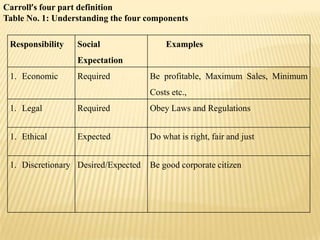
Responsibility Social
Expectation
Examples
1. Economic Required Be profitable, Maximum Sales, Minimum
Costs etc.,
1. Legal Required Obey Laws and Regulations
1. Ethical Expected Do what is right, fair and just
1. Discretionary Desired/Expected Be good corporate citizen
Carroll’s four part definition
Table No. 1: Understanding the four components
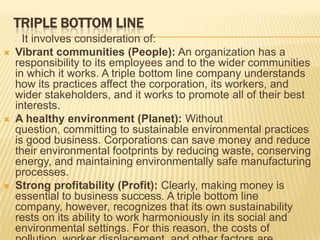
TRIPLE BOTTOM LINE
It involves consideration of:
 Vibrant communities (People): An organization has a
responsibility to its employees and to the wider communities
in which it works. A triple bottom line company understands
how its practices affect the corporation, its workers, and
wider stakeholders, and it works to promote all of their best
interests.
 A healthy environment (Planet): Without
question, committing to sustainable environmental practices
is good business. Corporations can save money and reduce
their environmental footprints by reducing waste, conserving
energy, and maintaining environmentally safe manufacturing
processes.
 Strong profitability (Profit): Clearly, making money is
essential to business success. A triple bottom line
company, however, recognizes that its own sustainability
rests on its ability to work harmoniously in its social and
environmental settings. For this reason, the costs of
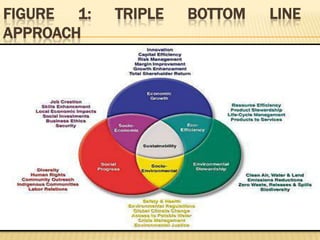
FIGURE 1: TRIPLE BOTTOM LINE
APPROACH
ANALYSIS AND DISCUSSION
Weights of low, moderate or high are
assigned to the specified criteria upon
examining the code of conduct as
follows:
 1. social initiatives
 2. environmental initiatives
 3. economic initiatives
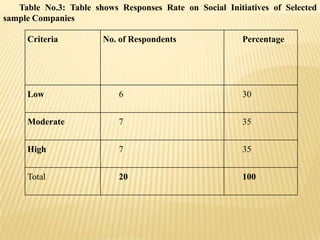
Criteria No. of Respondents Percentage
Low 6 30
Moderate 7 35
High 7 35
Total 20 100
Table No.3: Table shows Responses Rate on Social Initiatives of Selected
sample Companies
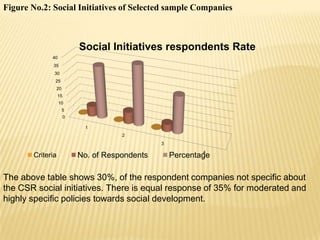
Figure No.2: Social Initiatives of Selected sample Companies
0
5
10
15
20
25
30
35
40
1
2
3
4
Social Initiatives respondents Rate
Criteria No. of Respondents Percentage
The above table shows 30%, of the respondent companies not specific about
the CSR social initiatives. There is equal response of 35% for moderated and
highly specific policies towards social development.
Criteria No. of Respondents Percentage
Low 7 35
Moderate 8 40
High 5 25
Total 20 100
• Economic Initiatives
Table No 4: Table shows Response Rates on Economic Initiatives of Selected
sample Companies
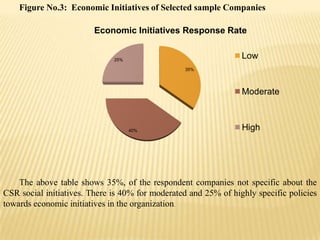
Figure No.3: Economic Initiatives of Selected sample Companies
35%
40%
25%
Economic Initiatives Response Rate
Low
Moderate
High
The above table shows 35%, of the respondent companies not specific about the
CSR social initiatives. There is 40% for moderated and 25% of highly specific policies
towards economic initiatives in the organization.
Criteria No. of
Respondents
Percentage
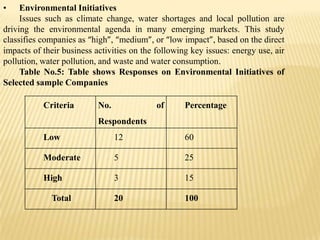
Low 12 60
Moderate 5 25
High 3 15
Total 20 100
• Environmental Initiatives
Issues such as climate change, water shortages and local pollution are
driving the environmental agenda in many emerging markets. This study
classifies companies as “high”, “medium”, or “low impact”, based on the direct
impacts of their business activities on the following key issues: energy use, air
pollution, water pollution, and waste and water consumption.
Table No.5: Table shows Responses on Environmental Initiatives of
Selected sample Companies
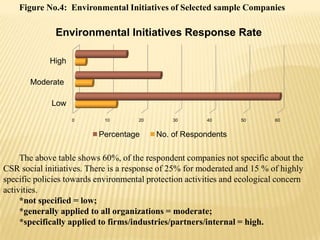
Figure No.4: Environmental Initiatives of Selected sample Companies
0 10 20 30 40 50 60
Low
Moderate
High
Environmental Initiatives Response Rate
Percentage No. of Respondents
The above table shows 60%, of the respondent companies not specific about the
CSR social initiatives. There is a response of 25% for moderated and 15 % of highly
specific policies towards environmental protection activities and ecological concern
activities.
*not specified = low;
*generally applied to all organizations = moderate;
*specifically applied to firms/industries/partners/internal = high.
KEY FINDINGS
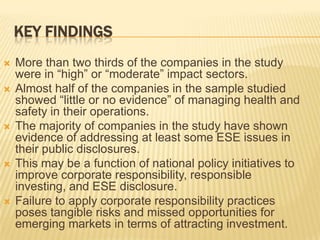
 More than two thirds of the companies in the study
were in “high” or “moderate” impact sectors.
 Almost half of the companies in the sample studied
showed “little or no evidence” of managing health and
safety in their operations.
 The majority of companies in the study have shown
evidence of addressing at least some ESE issues in
their public disclosures.
 This may be a function of national policy initiatives to
improve corporate responsibility, responsible
investing, and ESE disclosure.
 Failure to apply corporate responsibility practices
poses tangible risks and missed opportunities for
emerging markets in terms of attracting investment.
SUGGESTIONS
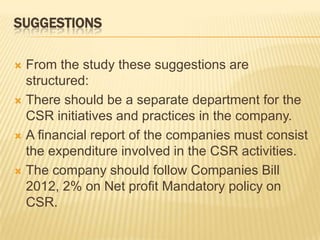
 From the study these suggestions are
structured:
 There should be a separate department for the
CSR initiatives and practices in the company.
 A financial report of the companies must consist
the expenditure involved in the CSR activities.
 The company should follow Companies Bill
2012, 2% on Net profit Mandatory policy on
CSR.
CONCLUSIONS
 “There is need of well versed in the language of sustainability in the
field of multinational companies in social, environmental, and
financial responsibility; clearly, their version of Corporate Social
Responsibility is not lip service.
 Based on the knowledge and insight gained while visiting different
industrial categories, it is concluded that the integration of
socially, environmentally, and financially responsible practices into
the culture and value system of a company is important to ensure
that CSR initiatives are effective and sustainable.
 In sum, companies should keep sustainability initiatives and one to
look to for a sustainable corporate approach to CSR in a way that
helps, not hurts, the bottom line.
"Everything is connected to everything else" is often called the
First Law of Ecology. Helping human society to prosper in the
21st century requires that we recognize the importance of
living in balance with our physical environment and treating
each other with dignity and equity.”
THANK YOU

Tbl corporate social responsibility ramya

  • 1.
    AN EMPIRICAL STUDYON SOCIO- ECONOMIC PERFORMANCE OF THE CSR: TRIPLE BOTTOM LINE APPROACH OF THE DIFFERENT INDUSTRIAL CATEGORIES - WITH SPECIAL REFERENCE TO DAKSHINA KANNADA DISTRICT Ms. Ramyashree M G, Research Scholar (JRF), Department of Studies and Research in Commerce, Mangalore University Mangalagangothri-574199
  • 2.
    “THINK GLOBALLY, ACTLOCALLY” INTRODUCTION  Corporate Social Responsibility (CSR) is a commitment to improve community well- being through discretionary business practices and contributions of corporate resources.  many Indian companies talked about responsible business or triple P (People, Planet and Profit)  Business ethics has also been brought into the arena of corporate social responsibility
  • 3.
    SIGNIFICANCE OF THESTUDY The purpose of this study was to investigate the relationship between organization corporate social responsibility and its performance in economic, social and environmental responsibility under triple bottom line approaches in organizations.
  • 4.
    OBJECTIVES OF THESTUDY  To know the conceptual framework of corporate social responsibility.  To understand the concept of Triple Bottom Line Approach.  Systematically understand the practices of Socio Economic Performance of the companies regarding sustainable development.  To examine and analyze the trends and developments of TBL policies and practices of different industrial categories  To reveal the findings from the analytical study and suggest some measures on the basis of the study.
  • 5.
    SCOPE OF THESTUDY  This study may be considered as „micro study‟. The area of the study limited to some different industries categories such as Chemical, Oil and Refiner, Textiles, Banking, bakery goods, sweets, milk processing, breweries etc., in Dakshina Kannada district of Karnataka.
  • 6.
    RESEARCH METHODOLOGY  Thepresent study is in partly descriptive partly diagnostic in nature.  Conceptual framework was developed from the secondary data comprising of the published literature.  A structured questionnaire, mail survey and telephonic interview were used to generate primary data. Simple Random sampling method is used to generate primary data.  In the questionnaire, three-point Likert-scales were mostly employed that allowed respondents to agree or disagree with pre-formulated statements.  Sample  In total 20 enterprises of all firm sizes, agribusiness sectors respondents participated in the survey.
  • 7.
    LIMITATIONS  No researchmethodology is perfect with any drawback. The limitations of the study include:  Due to the shortage of time it may not be possible to include large sample.  Sample is restricted only to some companies and Dakshina Kannada District in Karnataka State.  The results of the study vary depending on the policy changes.
  • 8.
    CONCEPTUALFRAMEWORK OF CSR Forthe Organisation for Economic Cooperation and Development (OECD 2000, 2001):  "Corporate Social Responsibility is the commitment of business to contribute to economic development while preserving the environment, working with employees, their families, the local community and society at large to improve their quality of life".
  • 9.
    Responsibility Social Expectation Examples 1. EconomicRequired Be profitable, Maximum Sales, Minimum Costs etc., 1. Legal Required Obey Laws and Regulations 1. Ethical Expected Do what is right, fair and just 1. Discretionary Desired/Expected Be good corporate citizen Carroll’s four part definition Table No. 1: Understanding the four components
  • 10.
    TRIPLE BOTTOM LINE Itinvolves consideration of:  Vibrant communities (People): An organization has a responsibility to its employees and to the wider communities in which it works. A triple bottom line company understands how its practices affect the corporation, its workers, and wider stakeholders, and it works to promote all of their best interests.  A healthy environment (Planet): Without question, committing to sustainable environmental practices is good business. Corporations can save money and reduce their environmental footprints by reducing waste, conserving energy, and maintaining environmentally safe manufacturing processes.  Strong profitability (Profit): Clearly, making money is essential to business success. A triple bottom line company, however, recognizes that its own sustainability rests on its ability to work harmoniously in its social and environmental settings. For this reason, the costs of
  • 11.
    FIGURE 1: TRIPLEBOTTOM LINE APPROACH
  • 12.
    ANALYSIS AND DISCUSSION Weightsof low, moderate or high are assigned to the specified criteria upon examining the code of conduct as follows:  1. social initiatives  2. environmental initiatives  3. economic initiatives
  • 13.
    Criteria No. ofRespondents Percentage Low 6 30 Moderate 7 35 High 7 35 Total 20 100 Table No.3: Table shows Responses Rate on Social Initiatives of Selected sample Companies
  • 14.
    Figure No.2: SocialInitiatives of Selected sample Companies 0 5 10 15 20 25 30 35 40 1 2 3 4 Social Initiatives respondents Rate Criteria No. of Respondents Percentage The above table shows 30%, of the respondent companies not specific about the CSR social initiatives. There is equal response of 35% for moderated and highly specific policies towards social development.
  • 15.
    Criteria No. ofRespondents Percentage Low 7 35 Moderate 8 40 High 5 25 Total 20 100 • Economic Initiatives Table No 4: Table shows Response Rates on Economic Initiatives of Selected sample Companies
  • 16.
    Figure No.3: EconomicInitiatives of Selected sample Companies 35% 40% 25% Economic Initiatives Response Rate Low Moderate High The above table shows 35%, of the respondent companies not specific about the CSR social initiatives. There is 40% for moderated and 25% of highly specific policies towards economic initiatives in the organization.
  • 17.
    Criteria No. of Respondents Percentage Low12 60 Moderate 5 25 High 3 15 Total 20 100 • Environmental Initiatives Issues such as climate change, water shortages and local pollution are driving the environmental agenda in many emerging markets. This study classifies companies as “high”, “medium”, or “low impact”, based on the direct impacts of their business activities on the following key issues: energy use, air pollution, water pollution, and waste and water consumption. Table No.5: Table shows Responses on Environmental Initiatives of Selected sample Companies
  • 18.
    Figure No.4: EnvironmentalInitiatives of Selected sample Companies 0 10 20 30 40 50 60 Low Moderate High Environmental Initiatives Response Rate Percentage No. of Respondents The above table shows 60%, of the respondent companies not specific about the CSR social initiatives. There is a response of 25% for moderated and 15 % of highly specific policies towards environmental protection activities and ecological concern activities. *not specified = low; *generally applied to all organizations = moderate; *specifically applied to firms/industries/partners/internal = high.
  • 19.
    KEY FINDINGS  Morethan two thirds of the companies in the study were in “high” or “moderate” impact sectors.  Almost half of the companies in the sample studied showed “little or no evidence” of managing health and safety in their operations.  The majority of companies in the study have shown evidence of addressing at least some ESE issues in their public disclosures.  This may be a function of national policy initiatives to improve corporate responsibility, responsible investing, and ESE disclosure.  Failure to apply corporate responsibility practices poses tangible risks and missed opportunities for emerging markets in terms of attracting investment.
  • 20.
    SUGGESTIONS  From thestudy these suggestions are structured:  There should be a separate department for the CSR initiatives and practices in the company.  A financial report of the companies must consist the expenditure involved in the CSR activities.  The company should follow Companies Bill 2012, 2% on Net profit Mandatory policy on CSR.
  • 21.
    CONCLUSIONS  “There isneed of well versed in the language of sustainability in the field of multinational companies in social, environmental, and financial responsibility; clearly, their version of Corporate Social Responsibility is not lip service.  Based on the knowledge and insight gained while visiting different industrial categories, it is concluded that the integration of socially, environmentally, and financially responsible practices into the culture and value system of a company is important to ensure that CSR initiatives are effective and sustainable.  In sum, companies should keep sustainability initiatives and one to look to for a sustainable corporate approach to CSR in a way that helps, not hurts, the bottom line. "Everything is connected to everything else" is often called the First Law of Ecology. Helping human society to prosper in the 21st century requires that we recognize the importance of living in balance with our physical environment and treating each other with dignity and equity.”
  • 22.