Introduction to Management 1 
Lecture 2: The coaching style of 
management 
Stage 2 Session 2
Overview 
• Styles of management – linked to Situational Leadership 
(Blanchard) 
• Management situations – what the manager does 
• Update to focus on coaching – study from SEB that indicates 
the sales impact of coaching 
• What it is, what it is not and how it works 
• Critique of GROW model, offer alternatives 
2
Learning Outcomes of this lecture 
• To understand how to effectively manage through others – 
how to tailor management behaviour to situations and 
contexts 
• To appreciate more the ‘state’ of the recipient of the 
‘management’ and how to best influence their behaviour 
• To provide a deeper understanding of what coaching is, how 
to apply it, and and why it is crucial for success in business
Situational Theories 
• Hersey–Blanchard Situational Leadership Model 
(1960’s) 
– A model aims to provide a practical way to decide how to 
adapt his or her style to the task. 
– Model focuses on four styles: 
• The delegating style lets the members of the group decide what to 
do. 
• The participating style asks the members of the group what to do, 
but makes the final decisions. 
• The selling style makes the decision but explains the reasons. 
• The telling style makes the decision and tells the group what to do. 
May 2, 2006 LIS580- Spring 2006 4
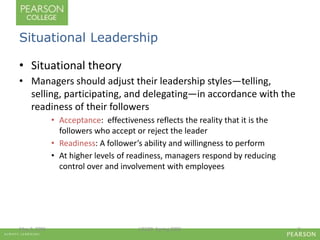
Situational Leadership 
• Situational theory 
• Managers should adjust their leadership styles—telling, 
selling, participating, and delegating—in accordance with the 
readiness of their followers 
• Acceptance: effectiveness reflects the reality that it is the 
followers who accept or reject the leader 
• Readiness: A follower’s ability and willingness to perform 
• At higher levels of readiness, managers respond by reducing 
control over and involvement with employees 
May 2, 2006 LIS580- Spring 2006 5
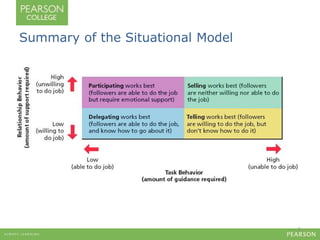
Summary of the Situational Model 
6
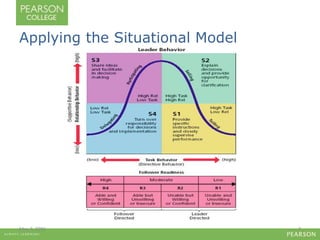
Applying the Situational Model 
May 2, 2006 7
Coaching Style Video – is this coaching? 
http://www.youtube.com/watch?v=WO4tIrjBDkk 
Consider what is effective and less effective about the behaviours you observe 
8
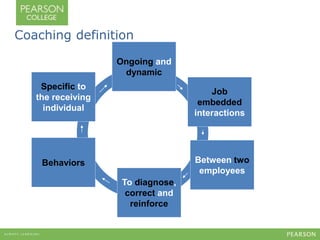
Coaching definition 
Ongoing and 
dynamic 
Job 
embedded 
interactions 
Behaviors Between two 
employees 
Specific to 
the receiving 
individual 
To diagnose, 
correct and 
reinforce
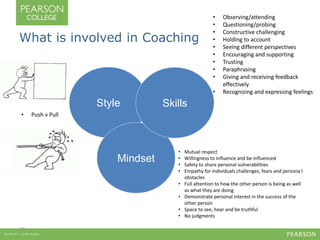
What is involved in Coaching 
10 
Style 
Mindset 
Skills 
• Observing/attending 
• Questioning/probing 
• Constructive challenging 
• Holding to account 
• Seeing different perspectives 
• Encouraging and supporting 
• Trusting 
• Paraphrasing 
• Giving and receiving feedback 
effectively 
• Recognizing and expressing feelings 
• Mutual respect 
• Willingness to influence and be influenced 
• Safety to share personal vulnerabilities 
• Empathy for individuals challenges, fears and persona l 
obstacles 
• Full attention to how the other person is being as well 
as what they are doing 
• Demonstrate personal interest in the success of the 
other person 
• Space to see, hear and be truthful 
• No judgments 
• Push v Pull
11 
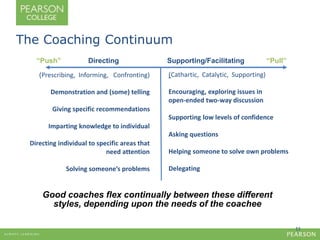
The Coaching Continuum 
Directing Supporting/Facilitating 
(Prescribing, Informing, Confronting) 
Demonstration and (some) telling 
Giving specific recommendations 
Imparting knowledge to individual 
Directing individual to specific areas that 
need attention 
Solving someone’s problems 
(Cathartic, Catalytic, Supporting) 
Encouraging, exploring issues in 
open-ended two-way discussion 
Supporting low levels of confidence 
Asking questions 
Helping someone to solve own problems 
Delegating 
“Push” 
Good coaches flex continually between these different 
styles, depending upon the needs of the coachee 
“Pull”
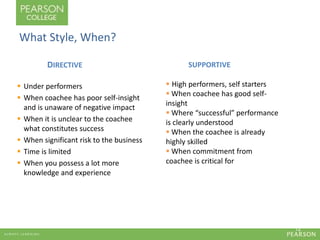
What Style, When? 
12 
DIRECTIVE SUPPORTIVE 
 Under performers 
 When coachee has poor self-insight 
and is unaware of negative impact 
 When it is unclear to the coachee 
what constitutes success 
 When significant risk to the business 
 Time is limited 
 When you possess a lot more 
knowledge and experience 
 High performers, self starters 
 When coachee has good self-insight 
 Where “successful” performance 
is clearly understood 
 When the coachee is already 
highly skilled 
 When commitment from 
coachee is critical for success
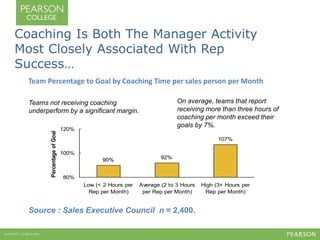
Coaching Is Both The Manager Activity 
Most Closely Associated With Rep 
Success… 
Team Percentage to Goal by Coaching Time per sales person per Month 
Teams not receiving coaching 
underperform by a significant margin. 
90% 92% 
107% 
120% 
100% 
80% 
Low (< 2 Hours per 
Rep per Month) 
Average (2 to 3 Hours 
per Rep per Month) 
High (3+ Hours per 
Rep per Month) 
Percentage of Goal 
Source : Sales Executive Council n = 2,400. 
13 
On average, teams that report 
receiving more than three hours of 
coaching per month exceed their 
goals by 7%.
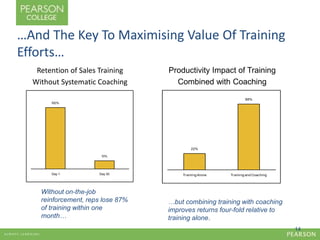
…And The Key To Maximising Value Of Training 
Efforts… 
100% 
13% 
Day 1 Day 30 
14 
22% 
88% 
Training Alone Training and Coaching 
Retention of Sales Training 
Without Systematic Coaching 
Without on-the-job 
reinforcement, reps lose 87% 
of training within one 
month… 
Productivity Impact of Training 
Combined with Coaching 
…but combining training with coaching 
improves returns four-fold relative to 
training alone.
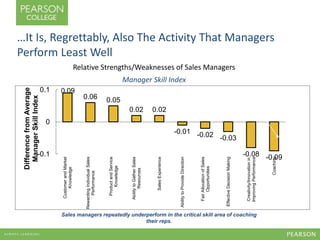
…It Is, Regrettably, Also The Activity That Managers 
Perform Least Well 
0.09 
0.06 0.05 
0.02 0.02 
-0.01 -0.02 -0.03 
0.1 
0 
-0.1 -0.08 -0.09 
Customer and Market 
Knowledge 
Rewarding Individual Sales 
Performance 
Product and Service 
Knowledge 
Ability to Gather Sales 
Resources 
Sales Experience 
Ability to Provide Direction 
Fair Allocation of Sales 
Opportunities 
Effective Decision Making 
Creativity/Innovation in 
Improving Performance 
Coaching 
Difference from Average 
Manager Skill Index 
Relative Strengths/Weaknesses of Sales Managers 
Manager Skill Index 
Sales managers repeatedly underperform in the critical skill area of coaching 
their reps.
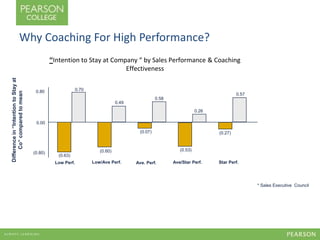
Why Coaching For High Performance? 
* Sales Executive Council 
“Intention to Stay at Company “ by Sales Performance & Coaching 
Effectiveness 
0.80 
0.00 
(0.80) 
Difference in “Intention to Stay at 
Co” compared to mean 
(0.53) 
(0.07) 
(0.60) 
(0.63) 
0.49 
0.70 
(0.27) 
0.57 
0.26 
0.58 
Low Perf. Low/Ave Perf. Ave. Perf. Ave/Star Perf. Star Perf.
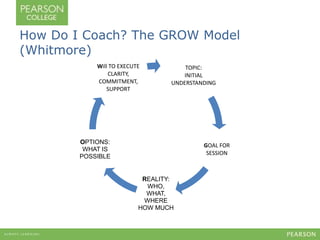
How Do I Coach? The GROW Model 
(Whitmore) 
TOPIC: 
INITIAL 
UNDERSTANDING 
GOAL FOR 
SESSION 
Will TO EXECUTE 
REALITY: 
WHO, 
WHAT, 
WHERE 
HOW MUCH 
CLARITY, 
COMMITMENT, 
SUPPORT 
OPTIONS: 
WHAT IS 
POSSIBLE
Topic 
This is setting the boundaries for the discussion: 
• Scale 
• Importance 
• Emotional significance 
• Understand specifically what the person wants to 
talk about
Goals 
• Establish the desired outcome of the conversation 
• Identify and agree to a number of achievable 
outcomes within the session, and maybe longer
Reality 
• Get an accurate picture of the problem 
• Discuss and become more aware of all aspects of the 
topic 
• The goal for the coach is simply to UNDERSTAND (not 
to fix it, offer guidance, advice or conclusions!)
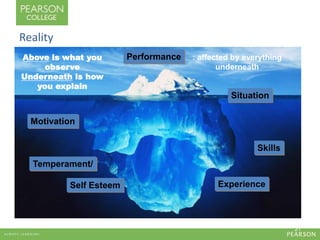
Reality 
21 
: affected by everything 
underneath 
Above is what you 
observe 
Underneath is how 
you explain 
Performance 
Situation 
Skills 
Experience 
Motivation 
Temperament/ 
Self Esteem
Options 
• Draw out a list of possibilities that address the goals 
• Encourage the person to think. Do not think for 
them 
• Do not judge or evaluate the options 
• Like a brainstorming session
Will to execute 
• Have the person being coached select the 
most appropriate option 
• Agree to the next steps 
• Check commitment
Some Coaching Questions? 
• Can anyone coach? 
• Can a good coach coach anything? 
• Do you need subject matter expertise? 
• What does it feel like coaching? 
• What does it feel like being coached? 
• How much should a coach ask questions and how much 
tell? 
• What questions does it raise about the receiver of 
coaching? 
• How much coaching do you observe in Willis?
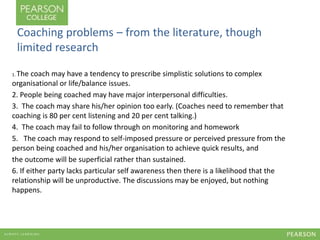
Coaching problems – from the literature, though 
limited research 
1. The coach may have a tendency to prescribe simplistic solutions to complex 
organisational or life/balance issues. 
2. People being coached may have major interpersonal difficulties. 
3. The coach may share his/her opinion too early. (Coaches need to remember that 
coaching is 80 per cent listening and 20 per cent talking.) 
4. The coach may fail to follow through on monitoring and homework 
5. The coach may respond to self-imposed pressure or perceived pressure from the 
person being coached and his/her organisation to achieve quick results, and 
the outcome will be superficial rather than sustained. 
6. If either party lacks particular self awareness then there is a likelihood that the 
relationship will be unproductive. The discussions may be enjoyed, but nothing 
happens.
Movie
End of Lecture 
Note: This recording is for your 
personal use only and not for further 
distribution or wider review. 
© Pearson College 2013

Management 1 lecture 2v2without movie

  • 1.
    Introduction to Management1 Lecture 2: The coaching style of management Stage 2 Session 2
  • 2.
    Overview • Stylesof management – linked to Situational Leadership (Blanchard) • Management situations – what the manager does • Update to focus on coaching – study from SEB that indicates the sales impact of coaching • What it is, what it is not and how it works • Critique of GROW model, offer alternatives 2
  • 3.
    Learning Outcomes ofthis lecture • To understand how to effectively manage through others – how to tailor management behaviour to situations and contexts • To appreciate more the ‘state’ of the recipient of the ‘management’ and how to best influence their behaviour • To provide a deeper understanding of what coaching is, how to apply it, and and why it is crucial for success in business
  • 4.
    Situational Theories •Hersey–Blanchard Situational Leadership Model (1960’s) – A model aims to provide a practical way to decide how to adapt his or her style to the task. – Model focuses on four styles: • The delegating style lets the members of the group decide what to do. • The participating style asks the members of the group what to do, but makes the final decisions. • The selling style makes the decision but explains the reasons. • The telling style makes the decision and tells the group what to do. May 2, 2006 LIS580- Spring 2006 4
  • 5.
    Situational Leadership •Situational theory • Managers should adjust their leadership styles—telling, selling, participating, and delegating—in accordance with the readiness of their followers • Acceptance: effectiveness reflects the reality that it is the followers who accept or reject the leader • Readiness: A follower’s ability and willingness to perform • At higher levels of readiness, managers respond by reducing control over and involvement with employees May 2, 2006 LIS580- Spring 2006 5
  • 6.
    Summary of theSituational Model 6
  • 7.
    Applying the SituationalModel May 2, 2006 7
  • 8.
    Coaching Style Video– is this coaching? http://www.youtube.com/watch?v=WO4tIrjBDkk http://www.youtube.com/watch?v=WO4tIrjBDkk Consider what is effective and less effective about the behaviours you observe 8
  • 9.
    Coaching definition Ongoingand dynamic Job embedded interactions Behaviors Between two employees Specific to the receiving individual To diagnose, correct and reinforce
  • 10.
    What is involvedin Coaching 10 Style Mindset Skills • Observing/attending • Questioning/probing • Constructive challenging • Holding to account • Seeing different perspectives • Encouraging and supporting • Trusting • Paraphrasing • Giving and receiving feedback effectively • Recognizing and expressing feelings • Mutual respect • Willingness to influence and be influenced • Safety to share personal vulnerabilities • Empathy for individuals challenges, fears and persona l obstacles • Full attention to how the other person is being as well as what they are doing • Demonstrate personal interest in the success of the other person • Space to see, hear and be truthful • No judgments • Push v Pull
  • 11.
    11 The CoachingContinuum Directing Supporting/Facilitating (Prescribing, Informing, Confronting) Demonstration and (some) telling Giving specific recommendations Imparting knowledge to individual Directing individual to specific areas that need attention Solving someone’s problems (Cathartic, Catalytic, Supporting) Encouraging, exploring issues in open-ended two-way discussion Supporting low levels of confidence Asking questions Helping someone to solve own problems Delegating “Push” Good coaches flex continually between these different styles, depending upon the needs of the coachee “Pull”
  • 12.
    What Style, When? 12 DIRECTIVE SUPPORTIVE  Under performers  When coachee has poor self-insight and is unaware of negative impact  When it is unclear to the coachee what constitutes success  When significant risk to the business  Time is limited  When you possess a lot more knowledge and experience  High performers, self starters  When coachee has good self-insight  Where “successful” performance is clearly understood  When the coachee is already highly skilled  When commitment from coachee is critical for success
  • 13.
    Coaching Is BothThe Manager Activity Most Closely Associated With Rep Success… Team Percentage to Goal by Coaching Time per sales person per Month Teams not receiving coaching underperform by a significant margin. 90% 92% 107% 120% 100% 80% Low (< 2 Hours per Rep per Month) Average (2 to 3 Hours per Rep per Month) High (3+ Hours per Rep per Month) Percentage of Goal Source : Sales Executive Council n = 2,400. 13 On average, teams that report receiving more than three hours of coaching per month exceed their goals by 7%.
  • 14.
    …And The KeyTo Maximising Value Of Training Efforts… 100% 13% Day 1 Day 30 14 22% 88% Training Alone Training and Coaching Retention of Sales Training Without Systematic Coaching Without on-the-job reinforcement, reps lose 87% of training within one month… Productivity Impact of Training Combined with Coaching …but combining training with coaching improves returns four-fold relative to training alone.
  • 15.
    …It Is, Regrettably,Also The Activity That Managers Perform Least Well 0.09 0.06 0.05 0.02 0.02 -0.01 -0.02 -0.03 0.1 0 -0.1 -0.08 -0.09 Customer and Market Knowledge Rewarding Individual Sales Performance Product and Service Knowledge Ability to Gather Sales Resources Sales Experience Ability to Provide Direction Fair Allocation of Sales Opportunities Effective Decision Making Creativity/Innovation in Improving Performance Coaching Difference from Average Manager Skill Index Relative Strengths/Weaknesses of Sales Managers Manager Skill Index Sales managers repeatedly underperform in the critical skill area of coaching their reps.
  • 16.
    Why Coaching ForHigh Performance? * Sales Executive Council “Intention to Stay at Company “ by Sales Performance & Coaching Effectiveness 0.80 0.00 (0.80) Difference in “Intention to Stay at Co” compared to mean (0.53) (0.07) (0.60) (0.63) 0.49 0.70 (0.27) 0.57 0.26 0.58 Low Perf. Low/Ave Perf. Ave. Perf. Ave/Star Perf. Star Perf.
  • 17.
    How Do ICoach? The GROW Model (Whitmore) TOPIC: INITIAL UNDERSTANDING GOAL FOR SESSION Will TO EXECUTE REALITY: WHO, WHAT, WHERE HOW MUCH CLARITY, COMMITMENT, SUPPORT OPTIONS: WHAT IS POSSIBLE
  • 18.
    Topic This issetting the boundaries for the discussion: • Scale • Importance • Emotional significance • Understand specifically what the person wants to talk about
  • 19.
    Goals • Establishthe desired outcome of the conversation • Identify and agree to a number of achievable outcomes within the session, and maybe longer
  • 20.
    Reality • Getan accurate picture of the problem • Discuss and become more aware of all aspects of the topic • The goal for the coach is simply to UNDERSTAND (not to fix it, offer guidance, advice or conclusions!)
  • 21.
    Reality 21 :affected by everything underneath Above is what you observe Underneath is how you explain Performance Situation Skills Experience Motivation Temperament/ Self Esteem
  • 22.
    Options • Drawout a list of possibilities that address the goals • Encourage the person to think. Do not think for them • Do not judge or evaluate the options • Like a brainstorming session
  • 23.
    Will to execute • Have the person being coached select the most appropriate option • Agree to the next steps • Check commitment
  • 24.
    Some Coaching Questions? • Can anyone coach? • Can a good coach coach anything? • Do you need subject matter expertise? • What does it feel like coaching? • What does it feel like being coached? • How much should a coach ask questions and how much tell? • What questions does it raise about the receiver of coaching? • How much coaching do you observe in Willis?
  • 25.
    Coaching problems –from the literature, though limited research 1. The coach may have a tendency to prescribe simplistic solutions to complex organisational or life/balance issues. 2. People being coached may have major interpersonal difficulties. 3. The coach may share his/her opinion too early. (Coaches need to remember that coaching is 80 per cent listening and 20 per cent talking.) 4. The coach may fail to follow through on monitoring and homework 5. The coach may respond to self-imposed pressure or perceived pressure from the person being coached and his/her organisation to achieve quick results, and the outcome will be superficial rather than sustained. 6. If either party lacks particular self awareness then there is a likelihood that the relationship will be unproductive. The discussions may be enjoyed, but nothing happens.
  • 26.
  • 27.
    End of Lecture Note: This recording is for your personal use only and not for further distribution or wider review. © Pearson College 2013