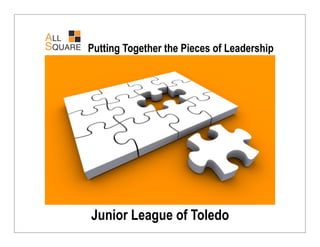
Putting Together the Pieces of Leadership


Junior League of Toledo
WHY           360
WHAT DO WE HOPE TO ACCOMPLISH?

 Reward my friends and punish my enemies
 Learn how effective I am as a leader
 Determine how I compare to my colleagues
 Discover my weaknesses
 Find out who’s been saying bad things about me
know the perils
why bother?
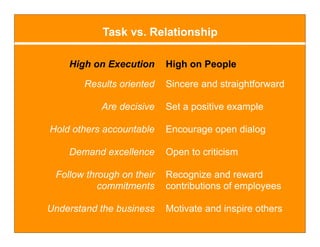
task vs. relationship
Task-focused
      leaders concentrate
T A   on end results and
S K   appraise their personal
      worth by the list of
      their achievements.
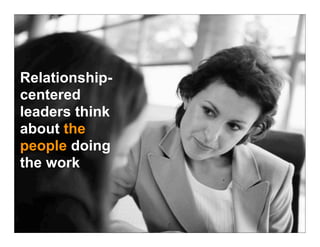
Relationship-
centered
leaders think
about the
people doing
the work
Task vs. Relationship

    High on Execution      High on People

       Results oriented    Sincere and straightforward

           Are decisive    Set a positive example

Hold others accountable    Encourage open dialog

    Demand excellence      Open to criticism

 Follow through on their   Recognize and reward
           commitments     contributions of employees

Understand the business    Motivate and inspire others
FACT:
While tasks and results are
important, it’s the ability to form
and nourish relationships that
sets highly effective leaders
apart from the rest
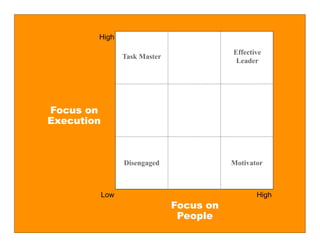
High

                                           Effective
                  Task Master
                                            Leader


Focus on
Execution


                  Disengaged               Motivator


            Low                                   High
                                Focus on
                                 People
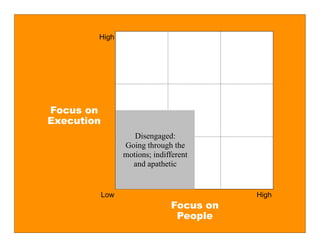
High


Focus on
Execution
                     Disengaged:
                  Going through the
                  motions; indifferent
                    and apathetic


            Low                            High
                                Focus on
                                 People
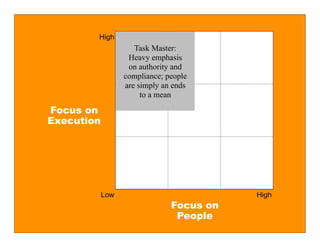
High
                     Task Master:
                   Heavy emphasis
                   on authority and
                  compliance; people
                  are simply an ends
                       to a mean
Focus on
Execution


            Low                           High
                               Focus on
                                People
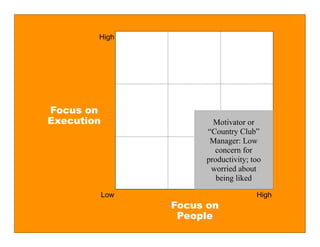
High


Focus on
Execution                Motivator or
                       “Country Club”
                        Manager: Low
                         concern for
                       productivity; too
                        worried about
                          being liked

            Low                       High
                  Focus on
                   People
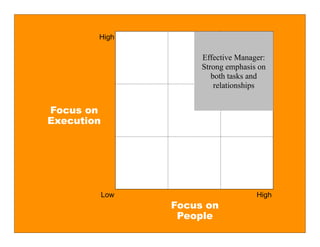
High

                       Effective Manager:
                       Strong emphasis on
                          both tasks and
                           relationships


Focus on
Execution


            Low                       High
                  Focus on
                   People
eitheror
HIGH SCORES IN ONE
COMPETENCY NORMALLY
CORRELATE TO LOW GRADES IN
THE OTHER, SUBSTANTIATING THE
THEORY THAT LEADERS ARE EITHER
TASK OR RELATIONSHIP ORIENTED
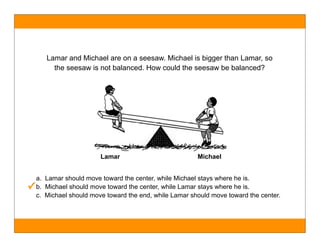
Lamar and Michael are on a seesaw. Michael is bigger than Lamar, so
        the seesaw is not balanced. How could the seesaw be balanced?


                        Lamar                          Michael
                                                                   !
  a. Lamar should move toward the center, while Michael stays where he is.
✓ b. Michael should move toward the center, while Lamar stays where he is.
  c. Michael should move toward the end, while Lamar should move toward the center.
Raw Scores

An average of your feedback
results on a five-point scale,
 with 1 being the lowest and
     5 being the highest.
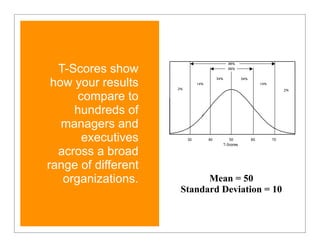
T-Scores show
 how your results
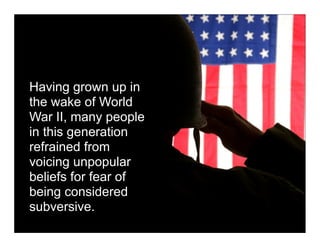
      compare to
     hundreds of
   managers and
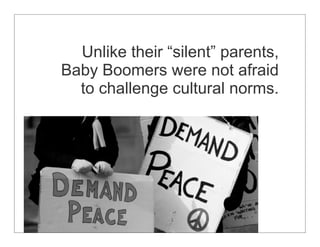
       executives
                                               !
  across a broad
range of different
   organizations.          Mean = 50
                     Standard Deviation = 10
Forget reality.
Perception drives
behavior.
10 sure-fire ways
  of improving your
360 o evaluation results
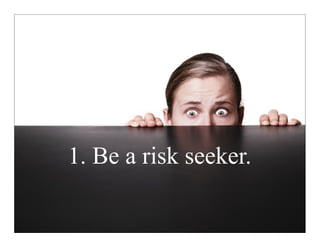
1. Be a risk seeker.
risk
 Verb: To do something despite
 danger; to incur the chance of
harm or loss by taking an action.
Risk Takers
Some people respond to
challenges that are presented…


                      Risk Seekers
                    …while others seek out
                     opportunities to lead.
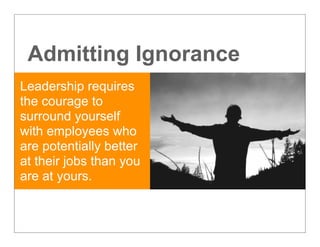
Admitting Ignorance
Leadership requires
the courage to
surround yourself
with employees who
are potentially better
at their jobs than you
are at yours.
Pushing for
PRO        Change
ACT           “In a time of constant
         change, one thing hasn’t

IVE   changed: Organizations are
         still resistant to change.”
                      Robert Reich
challenging bad decisions
        “If you are in middle management,
        don’t be a wimp. Don’t sit on the
        sidelines waiting for the senior people
        to make a decision so that later on you
        can criticize them over a beer—‘My
        God, how could they be so dumb?’
        Your time for participating is now.”
                           Andrew Grove, CEO Intel
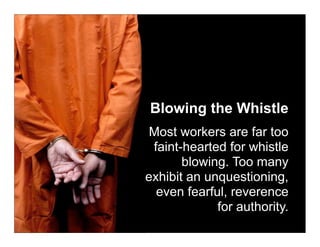
Blowing the Whistle
 Most workers are far too
 faint-hearted for whistle
       blowing. Too many
exhibit an unquestioning,
  even fearful, reverence
             for authority.
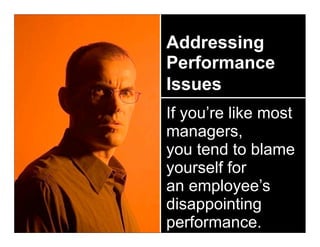
Addressing
Performance
Issues
If you’re like most
managers,
you tend to blame
yourself for
an employee’s
disappointing
performance.
first
GO

     “Leadership is going first
         in a new direction—
         and being followed.”
              Andrew Grove
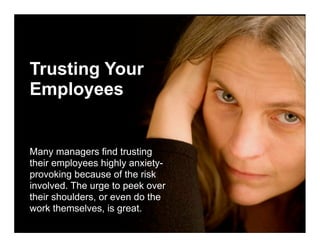
Trusting Your
Employees


Many managers find trusting
their employees highly anxiety-
provoking because of the risk
involved. The urge to peek over
their shoulders, or even do the
work themselves, is great.
Risk
Seeker
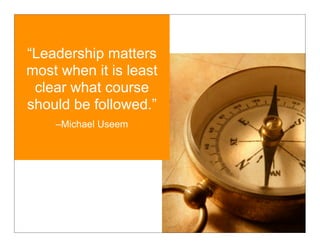
“Leadership matters
most when it is least
 clear what course
should be followed.”
    –Michael Useem
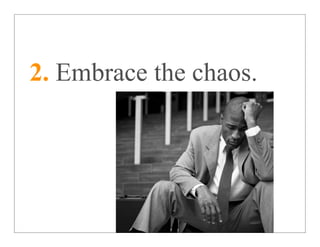
2. Embrace the chaos.
Challenge is not an activity,
   it’s a state of mind.
psychological
hardiness
“Hardy” individuals are more likely
 to approach stressful events as
opportunities from which to learn,
     rather than as threats to
          fear or avoid.
2:1
Non-Hardy to Hardy
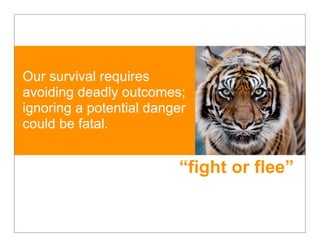
Our survival requires
avoiding deadly outcomes;
ignoring a potential danger
could be fatal.


                         “fight or flee”
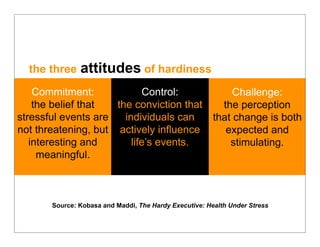
the three    attitudes of hardiness
    Commitment:             Control:                         Challenge:
    the belief that  the conviction that                  the perception
stressful events are   individuals can                  that change is both
not threatening, but actively influence                    expected and
   interesting and       life’s events.                     stimulating.
     meaningful.


       Source: Kobasa and Maddi, The Hardy Executive: Health Under Stress
Commitment
  People who are committed to and
involved in their work are more apt to
   perceive chaos as interesting.
Control
People adapt to change best when
 they understand the control they
   have over their environments.
Challenge
When chaos is welcomed, we can
perceive it as stimulating, if not a
 hidden opportunity for personal
          development.
“Crises are part of
what makes work fun.”


     Robert Hayes
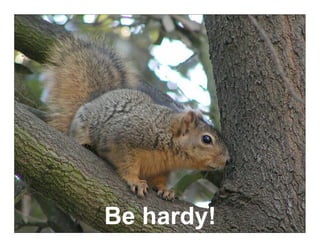
Be hardy!
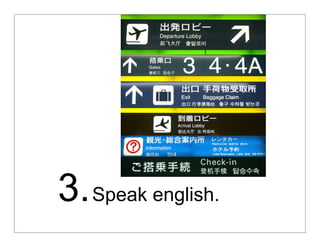
3. Speak english.
“ The biggest problem
with leadership communication is
  the                  that it has occurred.

                                                   ”
        —Boyd Clarke and Ron Crossland, The Leader’s Voice
“Yeah-uhhh! Yo, yo dude.
  What’s up dawg? How you
  feelin’? You feelin’ alright?
Listen, man. I’ve got to give you
 props. You’re doin’ your thing
 and it was dope. I ain’t mad.”
“Let’s talk offline after the
lateral-thinking quality circle.”
“With all this synergy, we should
 shift our paradigm and identify
       some best practices.”
“At the end of the day, we must
 tee up a seamless solution to
    our disconnect, per se.”
“What the…?”
J A R G O N
JARGON
 often includes euphemisms
used to substitute inoffensive
    expressions for those
    considered offensive.
why     jargon?
Speakers sometimes invoke workplace
jargon to impress others, or to establish
their membership in an elite faction.
Some use jargon to exclude or
confuse others, or to mask their
own inexperience or lack of
knowledge.
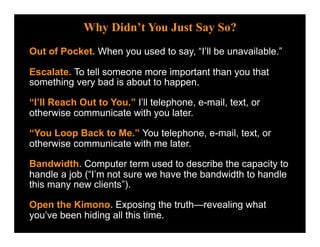
Why Didn’t You Just Say So?
Out of Pocket. When you used to say, “I’ll be unavailable.”

Escalate. To tell someone more important than you that
something very bad is about to happen.

“I’ll Reach Out to You.” I’ll telephone, e-mail, text, or
otherwise communicate with you later.

“You Loop Back to Me.” You telephone, e-mail, text, or
otherwise communicate with me later.

Bandwidth. Computer term used to describe the capacity to
handle a job (“I’m not sure we have the bandwidth to handle
this many new clients”).

Open the Kimono. Exposing the truth—revealing what
you’ve been hiding all this time.
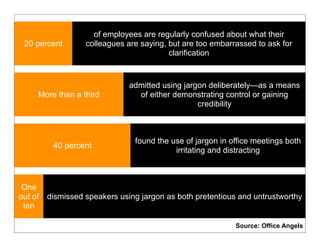
of employees are regularly confused about what their
 20 percent        colleagues are saying, but are too embarrassed to ask for
                                          clarification


                               admitted using jargon deliberately—as a means
     More than a third           of either demonstrating control or gaining
                                                  credibility


                                found the use of jargon in office meetings both
          40 percent
                                           irritating and distracting


 One
out of   dismissed speakers using jargon as both pretentious and untrustworthy
 ten

                                                            Source: Office Angels
A single voice.
    A candid voice.
   A genuine voice.


Your voice.
4. Tell stories.
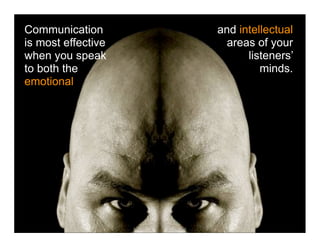
Communication       and intellectual
is most effective     areas of your
when you speak            listeners’
to both the                  minds.
emotional
Stories
   create the emotional
perspective listeners need
   to connect with your
        message.
“It is impossible even
   to think without a
    mental picture.”

             Aristotle
     On Memory and Recollection
              358 B.C.
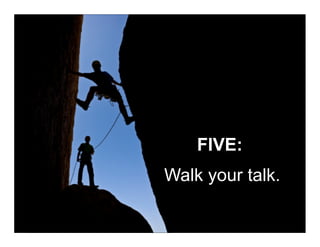
FIVE:
Walk your talk.
“We aspire to be known as a
company with the highest standards
  of moral and ethical conduct—
 working to earn client trust, day in
and day out. Our word is our bond.”
From Citigroup’s statement of values
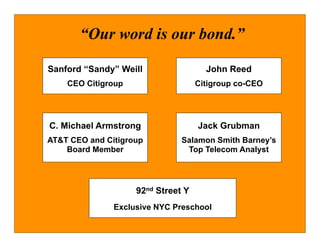
“Our word is our bond.”

Sanford “Sandy” Weill                 John Reed
    CEO Citigroup                   Citigroup co-CEO


C. Michael Armstrong                Jack Grubman
AT&T CEO and Citigroup         Salamon Smith Barney’s
    Board Member                Top Telecom Analyst


                    92nd Street Y
               Exclusive NYC Preschool
“I used Sandy to get my kids into 92nd
  St. Y pre-school (which is harder than
Harvard) and Sandy needed Armstrong’s
    vote on our board to nuke Reed in
  showdown. Once coast was clear for
both of us (ie Sandy clear victor and my
    kids confirmed) I went back to my
      normal negative self on [AT&]T.
   Armstrong never knew that we both
 (Sandy and I) played him like a fiddle.”
         E-mail from Jack Grubman
               January 13, 2001
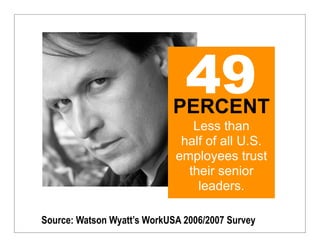
49
                            PERCENT
                                Less than
                              half of all U.S.
                             employees trust
                               their senior
                                 leaders.

Source: Watson Wyatt’s WorkUSA 2006/2007 Survey
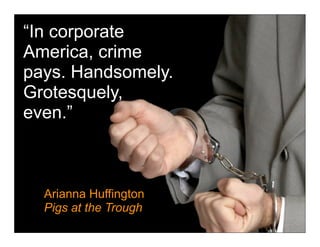
“In corporate
America, crime
pays. Handsomely.
Grotesquely,
even.”


  Arianna Huffington
  Pigs at the Trough
“
                           WHAT WE FOUND IN
                           OUR INVESTIGATION OF
                           ADMIRED LEADERSHIP
KOUZES & POSNER
                           QUALITIES IS THAT MORE
The Leadership Challenge   THAN ANYTHING, PEOPLE
                           WANT TO FOLLOW
                           LEADERS WHO ARE
                                   ”
                           CREDIBLE.
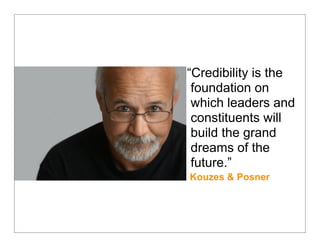
“Credibility is the
 foundation on
 which leaders and
 constituents will
 build the grand
 dreams of the
 future.”
Kouzes & Posner
DWYSYWD
The mission statement is “not a
trophy that decorates office walls,
   but an organic body of beliefs
    and a foundation of guiding
  principles we hold in common.”
    Howard Schultz, founder of Starbucks
“Clearly, there is a link
between core values and
emotional commitment.”

                     Gary Cohen
               President, CO2 Partners
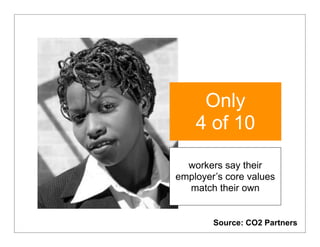
Only
    4 of 10

  workers say their
employer’s core values
  match their own


        Source: CO2 Partners
Employees need to know
   how aligning with the
 organization’s values will
meet their personal interests
and needs. Otherwise, their
 initiative diminishes and
   money becomes their
     primary motivator.
Employees are
      searching for leaders
with integrity who prove
    their credibility
continuously.
prove yours!
Give away
your authority.
“Hierarchy is an
  organization with its face
toward the CEO and its ass
   toward the customer.”

 -Kjell A. Nordström and Jonas Ridderstråle
               Funky Business
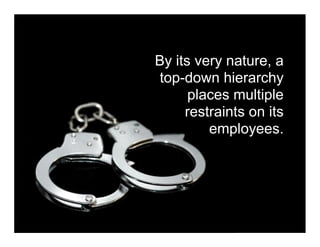
By its very nature, a
top-down hierarchy
      places multiple
     restraints on its
         employees.
ONE-SIDED
    accountability
Employees must produce results—
though they have little influence on,
  or authority over, the process for
      producing those results.
EMPOWERMENT
Unleashing your organization’s potential
requires placing authority in the hands of
 those people who actually do the work.
Wally who?
Giving authority to workers on
the front lines is a cornerstone to
job enrichment.
“But my employees
 don’t want to be
 empowered!”
         Common Rebuttal
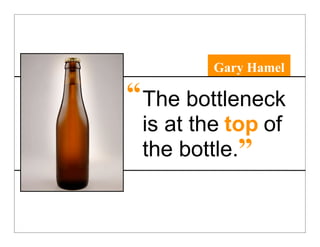
Gary Hamel

“ The bottleneck
 is at the top of
 the bottle.”
Leaders who consider

themselves effective
are less apt to micromanage
                 high
and more likely to set

expectations for
their employees.
“  A basic function of
leadership is to produce
 more leaders, not more
                ”
       followers.

            Ralph Nader
7   Figure out what people do
    best–and then let them do it.
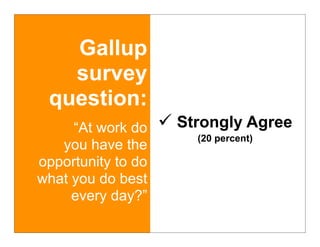
Gallup
   survey
 question:
     “At work do  Strongly Agree
                    (20 percent)
   you have the
opportunity to do
what you do best
     every day?”
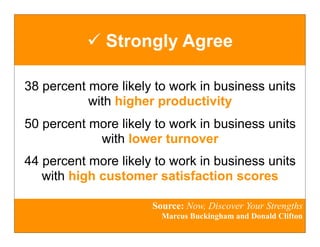
 Strongly Agree

38 percent more likely to work in business units
           with higher productivity
50 percent more likely to work in business units
            with lower turnover
44 percent more likely to work in business units
   with high customer satisfaction scores

                      Source: Now, Discover Your Strengths
                        Marcus Buckingham and Donald Clifton
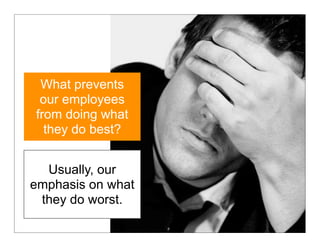
What prevents
 our employees
from doing what
  they do best?


  Usually, our
emphasis on what
 they do worst.
strivingforimprovement,
most of us do the same thing:
we take our strengths for granted,
and concentrate all our efforts on
conquering our weaknesses
Not surprisingly,

the vast majority of organizations
  appear to believe that the best
 way for individuals to grow is to
   eliminate their weaknesses.
Identifying each person’s strongest
talents permits everyone the opportunity
        to contribute what they do


        BEST.
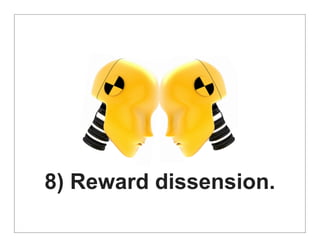
8) Reward dissension.
COHESION
A demonstrated tendency for a group
 to stay together and remain united in
the pursuit of its goals and objectives.
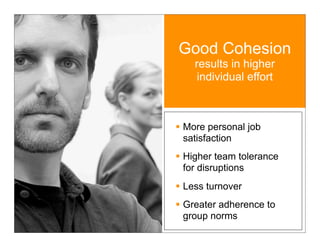
Good Cohesion
    results in higher
     individual effort


 More personal job
  satisfaction
 Higher team tolerance
  for disruptions
 Less turnover
 Greater adherence to
  group norms
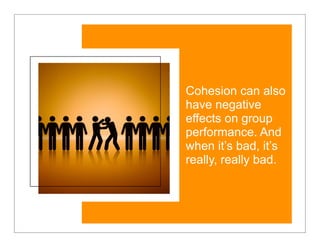
Cohesion can also
have negative
effects on group
performance. And
when it’s bad, it’s
really, really bad.
“Because people value their membership
  in cohesive groups, they are willing to
adjust their behavior to group standards.”

                      SUSAN CAROL LOSH, Ph.D.
                     FLORIDA STATE UNIVERSITY
GROUPTHINK
occurs when the pressure to
   conform within a group
 interferes with the group’s
   decision making ability.
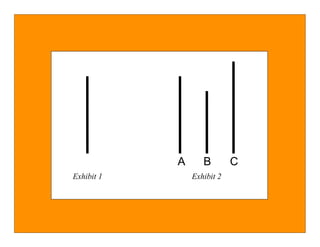
A      B        C
Exhibit 1       Exhibit 2
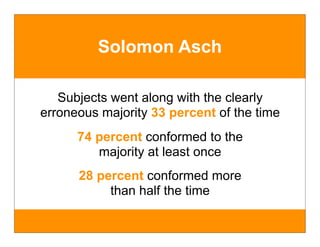
Solomon Asch

   Subjects went along with the clearly
erroneous majority 33 percent of the time
      74 percent conformed to the
         majority at least once
      28 percent conformed more
           than half the time
“The tendency to conformity
 in our society is so strong
 that reasonably intelligent
  and well-meaning young
  people are willing to call
        white black.”
      Solomon Asch
            1951
Groupthink stops members
      from suggesting ideas that
      might deviate from the
      collective opinion, causing
      a deceptive appearance of
group consensus
      when, in fact, only one
      approach is considered.
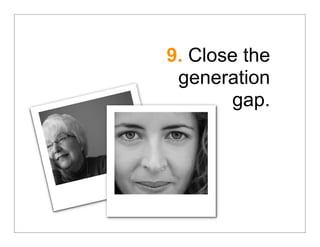
9. Close the
 generation
       gap.
MILESTONE                             THE 21ST
                                       CENTURY
marks the first time in history that members of four
separate generations make up the U.S. workforce
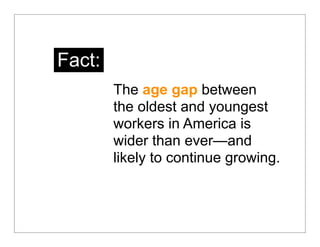
Fact:
        The age gap between
        the oldest and youngest
        workers in America is
        wider than ever—and
        likely to continue growing.
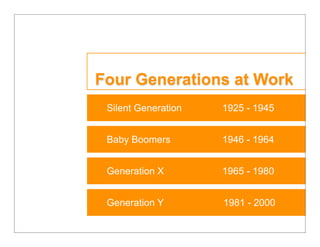
Four Generations at Work
 Silent Generation   1925 - 1945


 Baby Boomers        1946 - 1964


 Generation X        1965 - 1980

 Generation Y        1981 - 2000
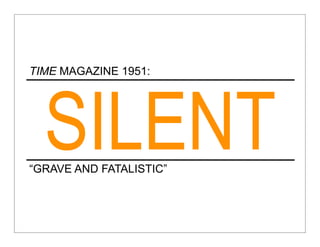
TIME MAGAZINE 1951:


  SILENT
“GRAVE AND FATALISTIC”
Lacking Conviction*
*or so it seemed
Having grown up in
the wake of World
War II, many people
in this generation
refrained from
voicing unpopular
beliefs for fear of
being considered
subversive.
Whether because they
are leading longer, healthier
 lives or lacking the financial
resources necessary to stop
working, many older workers
   are putting off retirement.
The largest generation,

BABY BOOMERS
make up 50 percent of the U.S. workforce.
Unlike their “silent” parents,
Baby Boomers were not afraid
  to challenge cultural norms.
“Change Agents”
 Civil Rights bills passed
 U.S. involvement in Vietnam War ended
 Legislation enacted barring discrimination on the basis
  of race, gender, religion, national origin, sexual
  preference, physical ability, and age
 Movements to stop polluting the earth and to start
  conserving it instead
 Employee-focused policies, procedures, and regulations
  prevalent in most business organizations today
In the twenty years following the

Boomers’ entrance in the workforce,

the annualamount of time
Americans spent at work increased

an average of one full month.
Boomers may have traded marching
  on Washington for walking for a
  cure, but they’re still looking for
    ways to make a difference.
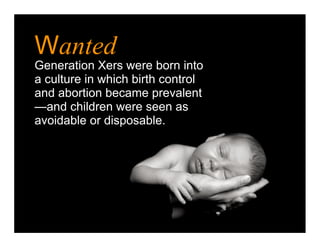
Wanted
Generation Xers were born into
a culture in which birth control
and abortion became prevalent
—and children were seen as
avoidable or disposable.
it’s all about


ME
56 percent of Gen Xers are married,
and 49 percent have children at home.
In other words, the “me generation” is
 entrenched in the American Dream.

   Source: Randstad, 2008 World of Work Survey
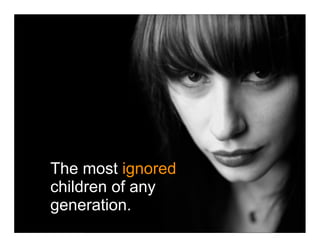
The most ignored
children of any
generation.
WORK-LIFE BALANCE
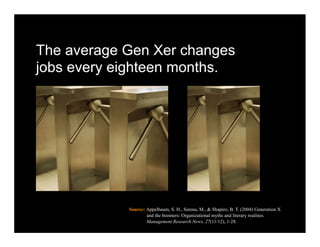
The average Gen Xer changes
jobs every eighteen months.


            Source: Appelbaum, S. H., Serena, M., & Shapiro, B. T. (2004) Generation X
                    and the boomers: Organizational myths and literary realities.
                    Management Research News, 27(11/12), 1-28.
MILLENNIAL
 =Gen Y
the   e   word
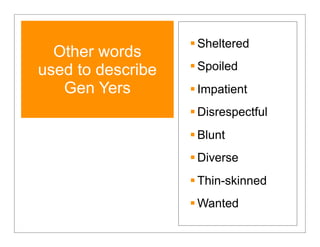
 Sheltered
  Other words
used to describe    Spoiled
   Gen Yers         Impatient
                    Disrespectful
                    Blunt
                    Diverse
                    Thin-skinned
                    Wanted
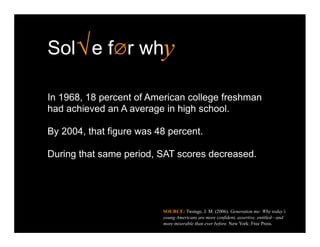
Sol√ e f∅r why

In 1968, 18 percent of American college freshman
had achieved an A average in high school.

By 2004, that figure was 48 percent.

During that same period, SAT scores decreased.


                          SOURCE: Twenge, J. M. (2006). Generation me: Why today’s
                          young Americans are more confident, assertive, entitled—and
                          more miserable than ever before. New York: Free Press.
Grade
>> INFLATION
Self-Esteem First.

             Learning Second.
thx for the iview!
i wud to work 4 u!! :)
reality:
“The transfer of knowledge
between retiring generations
of veteran workers and newer
entrants to the workforce is
unlikely.” Randstad
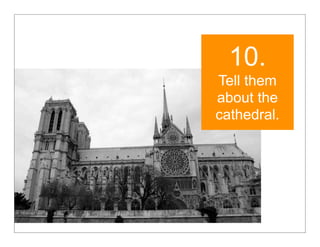
10.
Tell them
about the
cathedral.
Old story:
Two stonemasons are
working on the same
project. An observer
asks, “What are you
doing?”


   The first stonemason
                 replies: “I’m cutting stone.”

The second stonemason
               replies: “I’m building a great
                        cathedral.”
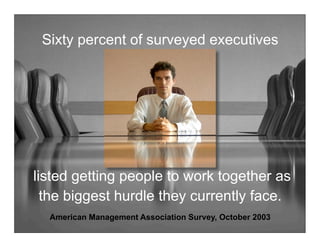
Sixty percent of surveyed executives


listed getting people to work together as
  the biggest hurdle they currently face.
  American Management Association Survey, October 2003
fortyninepercent

Less than half of all
employees understand the
steps their organizations
are taking to reach new
business goals.

 Source: Watson Wyatt’s WorkUSA 2002 Survey
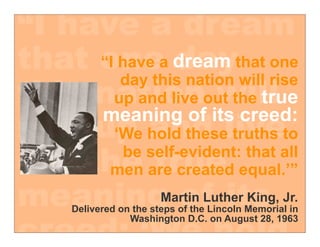
“I have a dream
that onea dream that rise
     “I have day             one

this nationout the true
       up and live will
        day this nation will


rise up hold theseliveto
       ‘We and truths
     meaning of its creed:

out the are created equal.’”
      men true
         be self-evident: that all


meaning of its           Martin Luther King, Jr.
      Delivered on the steps of the Lincoln Memorial in

creed: ‘We hold
                  Washington D.C. on August 28, 1963
If you think that conveying ideas
effectively is an innate ability—a talent
reserved for naturally gifted orators—
then you are probably neglecting your
        role as a communicator.
I N S P I R E
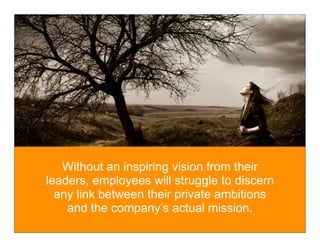
Without an inspiring vision from their
leaders, employees will struggle to discern
  any link between their private ambitions
    and the company’s actual mission.
“The age-old secret to
        generating buy-in is to
     strategically design, target,
       and deliver a story that
     projects a positive future.”

               Mark S. Walton
Generating Buy-In: Mastering the Language of Leadership
10 sure-fire ways
  of improving your
360 o evaluation results
Endeavor for
humility, not
 perfection.
Putting Together the Pieces of Leadership


Junior League of Toledo

Junior League

  • 1.
    Putting Together thePieces of Leadership Junior League of Toledo
  • 2.
    WHY 360 WHAT DO WE HOPE TO ACCOMPLISH?  Reward my friends and punish my enemies  Learn how effective I am as a leader  Determine how I compare to my colleagues  Discover my weaknesses  Find out who’s been saying bad things about me
  • 3.
  • 4.
  • 5.
  • 6.
    Task-focused leaders concentrate T A on end results and S K appraise their personal worth by the list of their achievements.
  • 7.
  • 8.
    Task vs. Relationship High on Execution High on People Results oriented Sincere and straightforward Are decisive Set a positive example Hold others accountable Encourage open dialog Demand excellence Open to criticism Follow through on their Recognize and reward commitments contributions of employees Understand the business Motivate and inspire others
  • 9.
    FACT: While tasks andresults are important, it’s the ability to form and nourish relationships that sets highly effective leaders apart from the rest
  • 10.
    High Effective Task Master Leader Focus on Execution Disengaged Motivator Low High Focus on People
  • 11.
    High Focus on Execution Disengaged: Going through the motions; indifferent and apathetic Low High Focus on People
  • 12.
    High Task Master: Heavy emphasis on authority and compliance; people are simply an ends to a mean Focus on Execution Low High Focus on People
  • 13.
    High Focus on Execution Motivator or “Country Club” Manager: Low concern for productivity; too worried about being liked Low High Focus on People
  • 14.
    High Effective Manager: Strong emphasis on both tasks and relationships Focus on Execution Low High Focus on People
  • 15.
    eitheror HIGH SCORES INONE COMPETENCY NORMALLY CORRELATE TO LOW GRADES IN THE OTHER, SUBSTANTIATING THE THEORY THAT LEADERS ARE EITHER TASK OR RELATIONSHIP ORIENTED
  • 16.
    Lamar and Michaelare on a seesaw. Michael is bigger than Lamar, so the seesaw is not balanced. How could the seesaw be balanced? Lamar Michael ! a. Lamar should move toward the center, while Michael stays where he is. ✓ b. Michael should move toward the center, while Lamar stays where he is. c. Michael should move toward the end, while Lamar should move toward the center.
  • 17.
    Raw Scores An averageof your feedback results on a five-point scale, with 1 being the lowest and 5 being the highest.
  • 18.
    T-Scores show howyour results compare to hundreds of managers and executives ! across a broad range of different organizations. Mean = 50 Standard Deviation = 10
  • 19.
  • 20.
    10 sure-fire ways of improving your 360 o evaluation results
  • 21.
    1. Be arisk seeker.
  • 22.
    risk Verb: Todo something despite danger; to incur the chance of harm or loss by taking an action.
  • 23.
    Risk Takers Some peoplerespond to challenges that are presented… Risk Seekers …while others seek out opportunities to lead.
  • 24.
    Admitting Ignorance Leadership requires thecourage to surround yourself with employees who are potentially better at their jobs than you are at yours.
  • 25.
    Pushing for PRO Change ACT “In a time of constant change, one thing hasn’t IVE changed: Organizations are still resistant to change.” Robert Reich
  • 26.
    challenging bad decisions “If you are in middle management, don’t be a wimp. Don’t sit on the sidelines waiting for the senior people to make a decision so that later on you can criticize them over a beer—‘My God, how could they be so dumb?’ Your time for participating is now.” Andrew Grove, CEO Intel
  • 27.
    Blowing the Whistle Most workers are far too faint-hearted for whistle blowing. Too many exhibit an unquestioning, even fearful, reverence for authority.
  • 28.
    Addressing Performance Issues If you’re likemost managers, you tend to blame yourself for an employee’s disappointing performance.
  • 29.
    first GO “Leadership is going first in a new direction— and being followed.” Andrew Grove
  • 30.
    Trusting Your Employees Many managersfind trusting their employees highly anxiety- provoking because of the risk involved. The urge to peek over their shoulders, or even do the work themselves, is great.
  • 31.
  • 32.
    “Leadership matters most whenit is least clear what course should be followed.” –Michael Useem
  • 33.
  • 34.
    Challenge is notan activity, it’s a state of mind.
  • 35.
    psychological hardiness “Hardy” individuals aremore likely to approach stressful events as opportunities from which to learn, rather than as threats to fear or avoid.
  • 36.
  • 37.
    Our survival requires avoidingdeadly outcomes; ignoring a potential danger could be fatal. “fight or flee”
  • 38.
    the three attitudes of hardiness Commitment: Control: Challenge: the belief that the conviction that the perception stressful events are individuals can that change is both not threatening, but actively influence expected and interesting and life’s events. stimulating. meaningful. Source: Kobasa and Maddi, The Hardy Executive: Health Under Stress
  • 39.
    Commitment Peoplewho are committed to and involved in their work are more apt to perceive chaos as interesting.
  • 40.
    Control People adapt tochange best when they understand the control they have over their environments.
  • 41.
    Challenge When chaos iswelcomed, we can perceive it as stimulating, if not a hidden opportunity for personal development.
  • 42.
    “Crises are partof what makes work fun.” Robert Hayes
  • 43.
  • 45.
  • 46.
    “ The biggestproblem with leadership communication is the that it has occurred. ” —Boyd Clarke and Ron Crossland, The Leader’s Voice
  • 47.
    “Yeah-uhhh! Yo, yodude. What’s up dawg? How you feelin’? You feelin’ alright? Listen, man. I’ve got to give you props. You’re doin’ your thing and it was dope. I ain’t mad.”
  • 48.
    “Let’s talk offlineafter the lateral-thinking quality circle.”
  • 49.
    “With all thissynergy, we should shift our paradigm and identify some best practices.”
  • 50.
    “At the endof the day, we must tee up a seamless solution to our disconnect, per se.”
  • 51.
  • 52.
    J A RG O N
  • 53.
    JARGON often includeseuphemisms used to substitute inoffensive expressions for those considered offensive.
  • 54.
    why jargon? Speakers sometimes invoke workplace jargon to impress others, or to establish their membership in an elite faction. Some use jargon to exclude or confuse others, or to mask their own inexperience or lack of knowledge.
  • 55.
    Why Didn’t YouJust Say So? Out of Pocket. When you used to say, “I’ll be unavailable.” Escalate. To tell someone more important than you that something very bad is about to happen. “I’ll Reach Out to You.” I’ll telephone, e-mail, text, or otherwise communicate with you later. “You Loop Back to Me.” You telephone, e-mail, text, or otherwise communicate with me later. Bandwidth. Computer term used to describe the capacity to handle a job (“I’m not sure we have the bandwidth to handle this many new clients”). Open the Kimono. Exposing the truth—revealing what you’ve been hiding all this time.
  • 56.
    of employees areregularly confused about what their 20 percent colleagues are saying, but are too embarrassed to ask for clarification admitted using jargon deliberately—as a means More than a third of either demonstrating control or gaining credibility found the use of jargon in office meetings both 40 percent irritating and distracting One out of dismissed speakers using jargon as both pretentious and untrustworthy ten Source: Office Angels
  • 57.
    A single voice. A candid voice. A genuine voice. Your voice.
  • 58.
  • 59.
    Communication and intellectual is most effective areas of your when you speak listeners’ to both the minds. emotional
  • 60.
    Stories create the emotional perspective listeners need to connect with your message.
  • 62.
    “It is impossibleeven to think without a mental picture.” Aristotle On Memory and Recollection 358 B.C.
  • 63.
  • 64.
    “We aspire tobe known as a company with the highest standards of moral and ethical conduct— working to earn client trust, day in and day out. Our word is our bond.” From Citigroup’s statement of values
  • 65.
    “Our word isour bond.” Sanford “Sandy” Weill John Reed CEO Citigroup Citigroup co-CEO C. Michael Armstrong Jack Grubman AT&T CEO and Citigroup Salamon Smith Barney’s Board Member Top Telecom Analyst 92nd Street Y Exclusive NYC Preschool
  • 66.
    “I used Sandyto get my kids into 92nd St. Y pre-school (which is harder than Harvard) and Sandy needed Armstrong’s vote on our board to nuke Reed in showdown. Once coast was clear for both of us (ie Sandy clear victor and my kids confirmed) I went back to my normal negative self on [AT&]T. Armstrong never knew that we both (Sandy and I) played him like a fiddle.” E-mail from Jack Grubman January 13, 2001
  • 67.
    49 PERCENT Less than half of all U.S. employees trust their senior leaders. Source: Watson Wyatt’s WorkUSA 2006/2007 Survey
  • 68.
    “In corporate America, crime pays.Handsomely. Grotesquely, even.” Arianna Huffington Pigs at the Trough
  • 69.
    WHAT WE FOUND IN OUR INVESTIGATION OF ADMIRED LEADERSHIP KOUZES & POSNER QUALITIES IS THAT MORE The Leadership Challenge THAN ANYTHING, PEOPLE WANT TO FOLLOW LEADERS WHO ARE ” CREDIBLE.
  • 70.
    “Credibility is the foundation on which leaders and constituents will build the grand dreams of the future.” Kouzes & Posner
  • 71.
  • 72.
    The mission statementis “not a trophy that decorates office walls, but an organic body of beliefs and a foundation of guiding principles we hold in common.” Howard Schultz, founder of Starbucks
  • 74.
    “Clearly, there isa link between core values and emotional commitment.” Gary Cohen President, CO2 Partners
  • 75.
    Only 4 of 10 workers say their employer’s core values match their own Source: CO2 Partners
  • 76.
    Employees need toknow how aligning with the organization’s values will meet their personal interests and needs. Otherwise, their initiative diminishes and money becomes their primary motivator.
  • 77.
    Employees are searching for leaders with integrity who prove their credibility continuously.
  • 78.
  • 79.
  • 80.
    “Hierarchy is an organization with its face toward the CEO and its ass toward the customer.” -Kjell A. Nordström and Jonas Ridderstråle Funky Business
  • 81.
    By its verynature, a top-down hierarchy places multiple restraints on its employees.
  • 82.
    ONE-SIDED accountability Employees must produce results— though they have little influence on, or authority over, the process for producing those results.
  • 83.
    EMPOWERMENT Unleashing your organization’spotential requires placing authority in the hands of those people who actually do the work.
  • 84.
  • 85.
    Giving authority toworkers on the front lines is a cornerstone to job enrichment.
  • 86.
    “But my employees don’t want to be empowered!” Common Rebuttal
  • 87.
    Gary Hamel “ Thebottleneck is at the top of the bottle.”
  • 88.
    Leaders who consider themselveseffective are less apt to micromanage high and more likely to set expectations for their employees.
  • 90.
    “ Abasic function of leadership is to produce more leaders, not more ” followers. Ralph Nader
  • 91.
    7 Figure out what people do best–and then let them do it.
  • 92.
    Gallup survey question: “At work do  Strongly Agree (20 percent) you have the opportunity to do what you do best every day?”
  • 93.
     Strongly Agree 38percent more likely to work in business units with higher productivity 50 percent more likely to work in business units with lower turnover 44 percent more likely to work in business units with high customer satisfaction scores Source: Now, Discover Your Strengths Marcus Buckingham and Donald Clifton
  • 94.
    What prevents ouremployees from doing what they do best? Usually, our emphasis on what they do worst.
  • 95.
    strivingforimprovement, most of usdo the same thing: we take our strengths for granted, and concentrate all our efforts on conquering our weaknesses
  • 96.
    Not surprisingly, the vastmajority of organizations appear to believe that the best way for individuals to grow is to eliminate their weaknesses.
  • 97.
    Identifying each person’sstrongest talents permits everyone the opportunity to contribute what they do BEST.
  • 98.
  • 99.
    COHESION A demonstrated tendencyfor a group to stay together and remain united in the pursuit of its goals and objectives.
  • 100.
    Good Cohesion results in higher individual effort  More personal job satisfaction  Higher team tolerance for disruptions  Less turnover  Greater adherence to group norms
  • 101.
    Cohesion can also havenegative effects on group performance. And when it’s bad, it’s really, really bad.
  • 102.
    “Because people valuetheir membership in cohesive groups, they are willing to adjust their behavior to group standards.” SUSAN CAROL LOSH, Ph.D. FLORIDA STATE UNIVERSITY
  • 103.
    GROUPTHINK occurs when thepressure to conform within a group interferes with the group’s decision making ability.
  • 104.
    A B C Exhibit 1 Exhibit 2
  • 105.
    Solomon Asch Subjects went along with the clearly erroneous majority 33 percent of the time 74 percent conformed to the majority at least once 28 percent conformed more than half the time
  • 106.
    “The tendency toconformity in our society is so strong that reasonably intelligent and well-meaning young people are willing to call white black.” Solomon Asch 1951
  • 107.
    Groupthink stops members from suggesting ideas that might deviate from the collective opinion, causing a deceptive appearance of group consensus when, in fact, only one approach is considered.
  • 108.
    9. Close the generation gap.
  • 109.
    MILESTONE THE 21ST CENTURY marks the first time in history that members of four separate generations make up the U.S. workforce
  • 110.
    Fact: The age gap between the oldest and youngest workers in America is wider than ever—and likely to continue growing.
  • 111.
    Four Generations atWork Silent Generation 1925 - 1945 Baby Boomers 1946 - 1964 Generation X 1965 - 1980 Generation Y 1981 - 2000
  • 112.
    TIME MAGAZINE 1951: SILENT “GRAVE AND FATALISTIC”
  • 113.
  • 114.
    Having grown upin the wake of World War II, many people in this generation refrained from voicing unpopular beliefs for fear of being considered subversive.
  • 115.
    Whether because they areleading longer, healthier lives or lacking the financial resources necessary to stop working, many older workers are putting off retirement.
  • 116.
    The largest generation, BABYBOOMERS make up 50 percent of the U.S. workforce.
  • 117.
    Unlike their “silent”parents, Baby Boomers were not afraid to challenge cultural norms.
  • 118.
    “Change Agents”  CivilRights bills passed  U.S. involvement in Vietnam War ended  Legislation enacted barring discrimination on the basis of race, gender, religion, national origin, sexual preference, physical ability, and age  Movements to stop polluting the earth and to start conserving it instead  Employee-focused policies, procedures, and regulations prevalent in most business organizations today
  • 119.
    In the twentyyears following the Boomers’ entrance in the workforce, the annualamount of time Americans spent at work increased an average of one full month.
  • 120.
    Boomers may havetraded marching on Washington for walking for a cure, but they’re still looking for ways to make a difference.
  • 121.
    Wanted Generation Xers wereborn into a culture in which birth control and abortion became prevalent —and children were seen as avoidable or disposable.
  • 122.
  • 123.
    56 percent ofGen Xers are married, and 49 percent have children at home. In other words, the “me generation” is entrenched in the American Dream. Source: Randstad, 2008 World of Work Survey
  • 124.
    The most ignored childrenof any generation.
  • 125.
  • 126.
    The average GenXer changes jobs every eighteen months. Source: Appelbaum, S. H., Serena, M., & Shapiro, B. T. (2004) Generation X and the boomers: Organizational myths and literary realities. Management Research News, 27(11/12), 1-28.
  • 127.
  • 128.
    the e word
  • 129.
     Sheltered Other words used to describe  Spoiled Gen Yers  Impatient  Disrespectful  Blunt  Diverse  Thin-skinned  Wanted
  • 130.
    Sol√ e f∅rwhy In 1968, 18 percent of American college freshman had achieved an A average in high school. By 2004, that figure was 48 percent. During that same period, SAT scores decreased. SOURCE: Twenge, J. M. (2006). Generation me: Why today’s young Americans are more confident, assertive, entitled—and more miserable than ever before. New York: Free Press.
  • 131.
  • 132.
    Self-Esteem First. Learning Second.
  • 133.
    thx for theiview! i wud to work 4 u!! :)
  • 134.
    reality: “The transfer ofknowledge between retiring generations of veteran workers and newer entrants to the workforce is unlikely.” Randstad
  • 135.
  • 136.
    Old story: Two stonemasonsare working on the same project. An observer asks, “What are you doing?” The first stonemason replies: “I’m cutting stone.” The second stonemason replies: “I’m building a great cathedral.”
  • 137.
    Sixty percent ofsurveyed executives listed getting people to work together as the biggest hurdle they currently face. American Management Association Survey, October 2003
  • 138.
    fortyninepercent Less than halfof all employees understand the steps their organizations are taking to reach new business goals. Source: Watson Wyatt’s WorkUSA 2002 Survey
  • 139.
    “I have adream that onea dream that rise “I have day one this nationout the true up and live will day this nation will rise up hold theseliveto ‘We and truths meaning of its creed: out the are created equal.’” men true be self-evident: that all meaning of its Martin Luther King, Jr. Delivered on the steps of the Lincoln Memorial in creed: ‘We hold Washington D.C. on August 28, 1963
  • 140.
    If you thinkthat conveying ideas effectively is an innate ability—a talent reserved for naturally gifted orators— then you are probably neglecting your role as a communicator.
  • 141.
    I N SP I R E
  • 142.
    Without an inspiringvision from their leaders, employees will struggle to discern any link between their private ambitions and the company’s actual mission.
  • 143.
    “The age-old secretto generating buy-in is to strategically design, target, and deliver a story that projects a positive future.” Mark S. Walton Generating Buy-In: Mastering the Language of Leadership
  • 144.
    10 sure-fire ways of improving your 360 o evaluation results
  • 145.
  • 146.
    Putting Together thePieces of Leadership Junior League of Toledo