Introduction to Management 1 
Lecture 1: What is Management 
Stage 2 Session 2
Overview 
• Introduction to the ‘management’ of others, what is different 
from being an individual contributor 
• The key employee: manager interfaces and their implications 
for effectiveness 
• What is ‘Performance Management’ (PM) - definition, origins 
– the key task of the manager above all else 
• Stretch goals and expectancy theory 
• The process that is true performance management – beyond 
the theory 
• Goal setting practice – theory and reality 
2
Learning Outcomes of this lecture 
• To be able to understand what does it mean to be a manager, 
how this differs from being an individual, and how the role 
changes with the scope of the responsibility 
• To understand in depth what is meant by managing the 
performance of others – what ‘performance management’ is 
and how to apply it in organisations
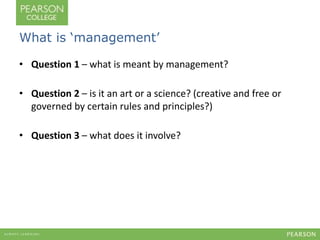
What is ‘management’ 
• Question 1 – what is meant by management? 
• Question 2 – is it an art or a science? (creative and free or 
governed by certain rules and principles?) 
• Question 3 – what does it involve?
Summary 
Management is the process of achieving 
organizational objectives through people and other 
resources.
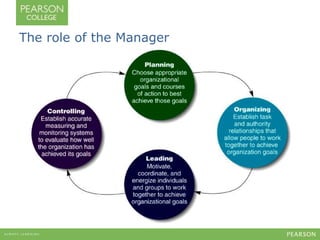
The role of the Manager
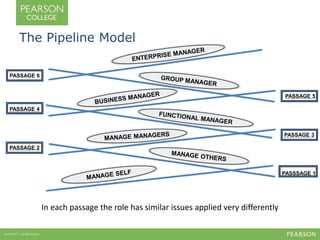
PASSSAGE 1 
The Pipeline Model 
PASSAGE 4 
PASSAGE 5 
PASSAGE 3 
PASSAGE 2 
In each passage the role has similar issues applied very differently 
PASSAGE 6
| 8 
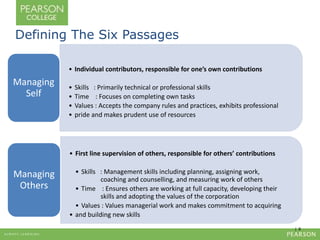
Defining The Six Passages 
• Individual contributors, responsible for one’s own contributions 
• Skills : Primarily technical or professional skills 
• Time : Focuses on completing own tasks 
• Values : Accepts the company rules and practices, exhibits professional 
• pride and makes prudent use of resources 
Managing 
Self 
• First line supervision of others, responsible for others’ contributions 
• Skills : Management skills including planning, assigning work, 
coaching and counselling, and measuring work of others 
• Time : Ensures others are working at full capacity, developing their 
skills and adopting the values of the corporation 
• Values : Values managerial work and makes commitment to acquiring 
• and building new skills 
Managing 
Others
| 9 
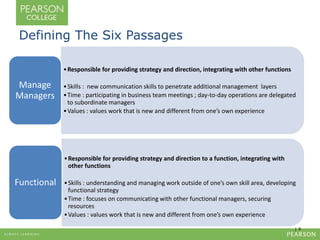
Defining The Six Passages 
•Responsible for providing strategy and direction, integrating with other functions 
• Skills : new communication skills to penetrate additional management layers 
•Time : participating in business team meetings ; day-to-day operations are delegated 
to subordinate managers 
• Values : values work that is new and different from one’s own experience 
Manage 
Managers 
•Responsible for providing strategy and direction to a function, integrating with 
other functions 
• Skills : understanding and managing work outside of one’s own skill area, developing 
functional strategy 
• Time : focuses on communicating with other functional managers, securing 
resources 
• Values : values work that is new and different from one’s own experience 
Functional
| 10 
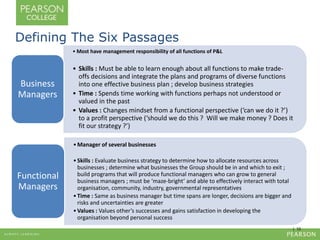
Defining The Six Passages 
•Most have management responsibility of all functions of P&L 
• Skills : Must be able to learn enough about all functions to make trade-offs 
decisions and integrate the plans and programs of diverse functions 
into one effective business plan ; develop business strategies 
• Time : Spends time working with functions perhaps not understood or 
valued in the past 
• Values : Changes mindset from a functional perspective (‘can we do it ?’) 
to a profit perspective (‘should we do this ? Will we make money ? Does it 
fit our strategy ?’) 
Business 
Managers 
•Manager of several businesses 
• Skills : Evaluate business strategy to determine how to allocate resources across 
businesses ; determine what businesses the Group should be in and which to exit ; 
build programs that will produce functional managers who can grow to general 
business managers ; must be ‘maze-bright’ and able to effectively interact with total 
organisation, community, industry, governmental representatives 
• Time : Same as business manager but time spans are longer, decisions are bigger and 
risks and uncertainties are greater 
•Values : Values other’s successes and gains satisfaction in developing the 
organisation beyond personal success 
Functional 
Managers
| 11 
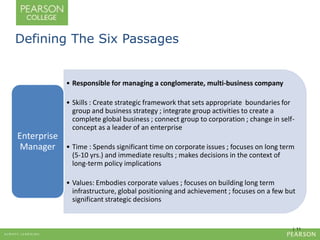
Defining The Six Passages 
• Responsible for managing a conglomerate, multi-business company 
• Skills : Create strategic framework that sets appropriate boundaries for 
group and business strategy ; integrate group activities to create a 
complete global business ; connect group to corporation ; change in self-concept 
as a leader of an enterprise 
• Time : Spends significant time on corporate issues ; focuses on long term 
(5-10 yrs.) and immediate results ; makes decisions in the context of 
long-term policy implications 
• Values: Embodies corporate values ; focuses on building long term 
infrastructure, global positioning and achievement ; focuses on a few but 
significant strategic decisions 
Enterprise 
Manager
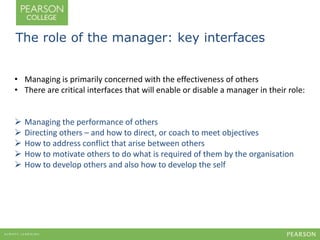
The role of the manager: key interfaces 
• Managing is primarily concerned with the effectiveness of others 
• There are critical interfaces that will enable or disable a manager in their role: 
 Managing the performance of others 
 Directing others – and how to direct, or coach to meet objectives 
 How to address conflict that arise between others 
 How to motivate others to do what is required of them by the organisation 
 How to develop others and also how to develop the self
Managing the performance of others 
Daniels: 
"In simplest terms, it's a way of getting people to do what you 
want them to do and to like doing it."
Managing the performance of others 
A formal definition: 
• Performance Management is a scientifically based, data-oriented 
management system. 
• It consists of three primary elements: 
1. Measurement 
2. Feedback 
3. Positive reinforcement. 
Although each of these three elements can exist alone, all three must be 
present before you have true Performance Management. And they must be 
implemented systematically and in sequence
The Performance Management Life Cycle: a 
case study 
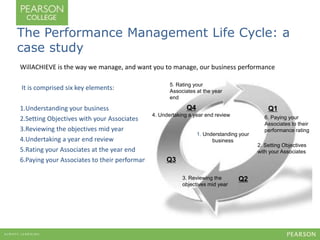
WillACHIEVE is the way we manage, and want you to manage, our business performance 
It is comprised six key elements: 
5. Rating your 
Associates at the year 
end 
1.Understanding your business 
2.Setting Objectives with your Associates 
3.Reviewing the objectives mid year 
4.Undertaking a year end review 
5.Rating your Associates at the year end 
6.Paying your Associates to their performance rating 
4. Undertaking a year end review 
1. Understanding your 
business 
Q1 
Q2 
Q3 
Q4 
2. Setting Objectives 
with your Associates 
3. Reviewing the 
objectives mid year 
6. Paying your 
Associates to their 
performance rating
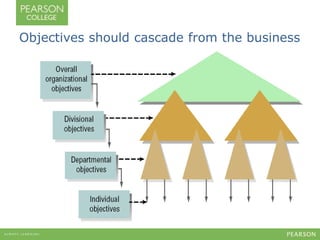
Objectives should cascade from the business
“Expectancy theory” 
• Expectancy theory has been researched by many, but 
is attributed to Victor Vroom. 
• It appears to hold up well to experiment – many 
theories of motivation don’t. 
• It also seems pertinent to sales situations, business 
situations, particularly how well the motivation of 
the seller matches the motivation of the buyer, and 
performance managment more generally
What the theory says 
• We create for ourselves expectations about future outcomes, e.g. “Having 
a villa in France would probably make me happy”. 
• We weigh up considerations about those expectations before taking 
action: 
– How much do I value the outcome? What’s in it for me? Is it worth 
the effort? How does it stack up against other outcomes I want? 
– Is there any way of achieving those outcomes? Can I see a clear path 
of actions that would lead to that outcome? How do other people do 
it? 
– Am I, personally, capable of taking those actions? Do I have the 
knowledge and skills? Resources? 
• If the answers to all three questions are positive, I am likely to be 
motivated into action. 
• If the answer to any one of the three questions is negative, I am unlikely 
to take any action at all.
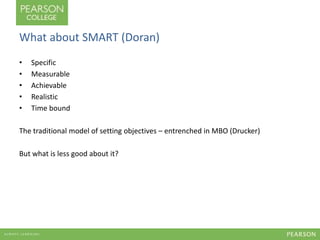
What about SMART (Doran) 
• Specific 
• Measurable 
• Achievable 
• Realistic 
• Time bound 
The traditional model of setting objectives – entrenched in MBO (Drucker) 
But what is less good about it?
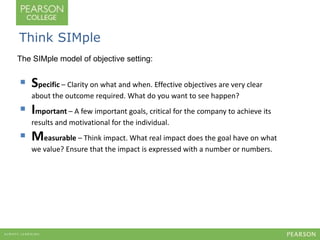
Think SIMple 
The SIMple model of objective setting: 
 Specific – Clarity on what and when. Effective objectives are very clear 
about the outcome required. What do you want to see happen? 
 Important – A few important goals, critical for the company to achieve its 
results and motivational for the individual. 
 Measurable – Think impact. What real impact does the goal have on what 
we value? Ensure that the impact is expressed with a number or numbers.
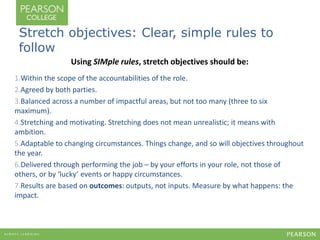
Stretch objectives: Clear, simple rules to 
follow 
Using SIMple rules, stretch objectives should be: 
1.Within the scope of the accountabilities of the role. 
2.Agreed by both parties. 
3.Balanced across a number of impactful areas, but not too many (three to six 
maximum). 
4.Stretching and motivating. Stretching does not mean unrealistic; it means with 
ambition. 
5.Adaptable to changing circumstances. Things change, and so will objectives throughout 
the year. 
6.Delivered through performing the job – by your efforts in your role, not those of 
others, or by ‘lucky’ events or happy circumstances. 
7.Results are based on outcomes: outputs, not inputs. Measure by what happens: the 
impact.
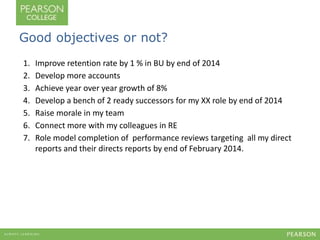
Good objectives or not? 
1. Improve retention rate by 1 % in BU by end of 2014 
2. Develop more accounts 
3. Achieve year over year growth of 8% 
4. Develop a bench of 2 ready successors for my XX role by end of 2014 
5. Raise morale in my team 
6. Connect more with my colleagues in RE 
7. Role model completion of performance reviews targeting all my direct 
reports and their directs reports by end of February 2014.
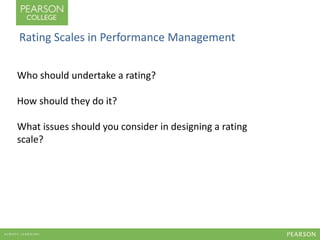
Rating Scales in Performance Management 
Who should undertake a rating? 
How should they do it? 
What issues should you consider in designing a rating 
scale? 
Question 2
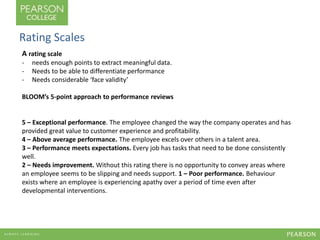
Rating Scales 
A rating scale 
- needs enough points to extract meaningful data. 
- Needs to be able to differentiate performance 
- Needs considerable ‘face validity’ 
BLOOM’s 5-point approach to performance reviews 
5 – Exceptional performance. The employee changed the way the company operates and has 
provided great value to customer experience and profitability. 
4 – Above average performance. The employee excels over others in a talent area. 
3 – Performance meets expectations. Every job has tasks that need to be done consistently 
well. 
2 – Needs improvement. Without this rating there is no opportunity to convey areas where 
an employee seems to be slipping and needs support. 1 – Poor performance. Behaviour 
exists where an employee is experiencing apathy over a period of time even after 
developmental interventions.
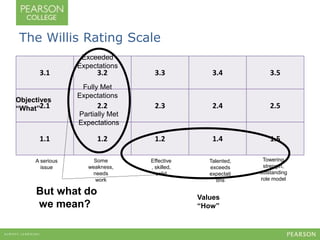
The Willis Rating Scale 
Exceeded 
Expectations 
3.1 3.2 3.3 3.4 3.5 
Fully Met 
Expectations 
2.1 2.2 2.3 2.4 2.5 
Partially Met 
Expectations 
1.1 1.2 1.2 1.4 1.5 
A serious 
issue 
Some 
weakness, 
needs 
work 
Objectives 
“What” 
Values 
“How” 
But what do 
we mean? 
Effective 
, skilled, 
solid 
Towering 
strength, 
outstanding 
role model 
Talented, 
exceeds 
expectati 
ons
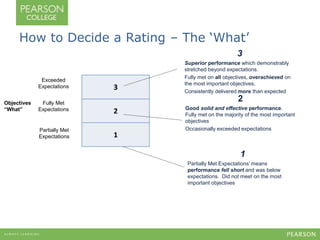
How to Decide a Rating – The ‘What’ 
3 
2 
1 
Exceeded 
Expectations 
Fully Met 
Expectations 
Partially Met 
Expectations 
Objectives 
“What” 
3 
Superior performance which demonstrably 
stretched beyond expectations. 
Fully met on all objectives, overachieved on 
the most important objectives, 
Consistently delivered more than expected 
2 
Good solid and effective performance. 
Fully met on the majority of the most important 
objectives 
Occasionally exceeded expectations 
1 
Partially Met Expectations’ means 
performance fell short and was below 
expectations. Did not meet on the most 
important objectives
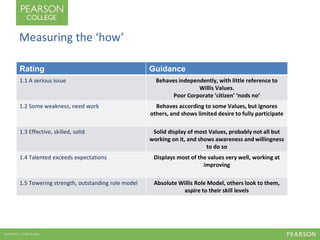
Measuring the ‘how’ 
Rating Guidance 
1.1 A serious issue Behaves independently, with little reference to 
Willis Values. 
Poor Corporate ‘citizen’ ‘nods no’ 
1.2 Some weakness, need work Behaves according to some Values, but ignores 
others, and shows limited desire to fully participate 
1.3 Effective, skilled, solid Solid display of most Values, probably not all but 
working on it, and shows awareness and willingness 
to do so 
1.4 Talented exceeds expectations Displays most of the values very well, working at 
improving 
1.5 Towering strength, outstanding role model Absolute Willis Role Model, others look to them, 
aspire to their skill levels
Rating Values: Practice 
Watch this short video’s and assess the team working: 
– Team working – what do we mean before we view the video? 
– http://www.youtube.co/watch?v=qfVRzc3yA1U
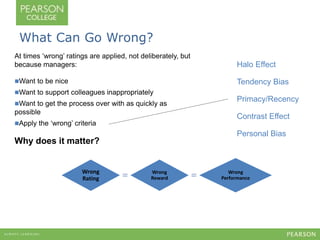
What Can Go Wrong? 
At times ‘wrong’ ratings are applied, not deliberately, but 
because managers: 
Want to be nice 
Want to support colleagues inappropriately 
Want to get the process over with as quickly as 
possible 
Apply the ‘wrong’ criteria 
Why does it matter? 
Wrong 
Rating 
Wrong 
Reward 
Halo Effect 
Tendency Bias 
Primacy/Recency 
Contrast Effect 
Personal Bias 
Wrong 
Performance
‘Best Practice’ Performance Management: McKinsey 
• The performance review is split into two parts: 
1. Peer review: 
– you ask for feedback from the colleagues you have worked with on a 
particular project. 
– It is in the form of a questionnaire and even a phone call. These reviews are 
on a scale of 1-3 
• An independent review of how well you have progressed with the professional 
development plan you decided on earlier in the year. Someone senior in the firm 
who can guide the career. He/she bases his opinion on the feedback received from 
peers and seniors. Not the line manager. 
• Promotion: 
Once these two reviews are done, the DGL presents your case in front of the 
evaluation committee. The evaluation committee consists of other leaders, 
seniors, partners etc. Everyone gives their opinion once the case is presented. On 
the basis of this discussion, your promotion is decided.
End of Lecture 
Note: This recording is for your 
personal use only and not for further 
distribution or wider review. 
© Pearson College 2013

Management 1 lecture 1v4

  • 1.
    Introduction to Management1 Lecture 1: What is Management Stage 2 Session 2
  • 2.
    Overview • Introductionto the ‘management’ of others, what is different from being an individual contributor • The key employee: manager interfaces and their implications for effectiveness • What is ‘Performance Management’ (PM) - definition, origins – the key task of the manager above all else • Stretch goals and expectancy theory • The process that is true performance management – beyond the theory • Goal setting practice – theory and reality 2
  • 3.
    Learning Outcomes ofthis lecture • To be able to understand what does it mean to be a manager, how this differs from being an individual, and how the role changes with the scope of the responsibility • To understand in depth what is meant by managing the performance of others – what ‘performance management’ is and how to apply it in organisations
  • 4.
    What is ‘management’ • Question 1 – what is meant by management? • Question 2 – is it an art or a science? (creative and free or governed by certain rules and principles?) • Question 3 – what does it involve?
  • 5.
    Summary Management isthe process of achieving organizational objectives through people and other resources.
  • 6.
    The role ofthe Manager
  • 7.
    PASSSAGE 1 ThePipeline Model PASSAGE 4 PASSAGE 5 PASSAGE 3 PASSAGE 2 In each passage the role has similar issues applied very differently PASSAGE 6
  • 8.
    | 8 DefiningThe Six Passages • Individual contributors, responsible for one’s own contributions • Skills : Primarily technical or professional skills • Time : Focuses on completing own tasks • Values : Accepts the company rules and practices, exhibits professional • pride and makes prudent use of resources Managing Self • First line supervision of others, responsible for others’ contributions • Skills : Management skills including planning, assigning work, coaching and counselling, and measuring work of others • Time : Ensures others are working at full capacity, developing their skills and adopting the values of the corporation • Values : Values managerial work and makes commitment to acquiring • and building new skills Managing Others
  • 9.
    | 9 DefiningThe Six Passages •Responsible for providing strategy and direction, integrating with other functions • Skills : new communication skills to penetrate additional management layers •Time : participating in business team meetings ; day-to-day operations are delegated to subordinate managers • Values : values work that is new and different from one’s own experience Manage Managers •Responsible for providing strategy and direction to a function, integrating with other functions • Skills : understanding and managing work outside of one’s own skill area, developing functional strategy • Time : focuses on communicating with other functional managers, securing resources • Values : values work that is new and different from one’s own experience Functional
  • 10.
    | 10 DefiningThe Six Passages •Most have management responsibility of all functions of P&L • Skills : Must be able to learn enough about all functions to make trade-offs decisions and integrate the plans and programs of diverse functions into one effective business plan ; develop business strategies • Time : Spends time working with functions perhaps not understood or valued in the past • Values : Changes mindset from a functional perspective (‘can we do it ?’) to a profit perspective (‘should we do this ? Will we make money ? Does it fit our strategy ?’) Business Managers •Manager of several businesses • Skills : Evaluate business strategy to determine how to allocate resources across businesses ; determine what businesses the Group should be in and which to exit ; build programs that will produce functional managers who can grow to general business managers ; must be ‘maze-bright’ and able to effectively interact with total organisation, community, industry, governmental representatives • Time : Same as business manager but time spans are longer, decisions are bigger and risks and uncertainties are greater •Values : Values other’s successes and gains satisfaction in developing the organisation beyond personal success Functional Managers
  • 11.
    | 11 DefiningThe Six Passages • Responsible for managing a conglomerate, multi-business company • Skills : Create strategic framework that sets appropriate boundaries for group and business strategy ; integrate group activities to create a complete global business ; connect group to corporation ; change in self-concept as a leader of an enterprise • Time : Spends significant time on corporate issues ; focuses on long term (5-10 yrs.) and immediate results ; makes decisions in the context of long-term policy implications • Values: Embodies corporate values ; focuses on building long term infrastructure, global positioning and achievement ; focuses on a few but significant strategic decisions Enterprise Manager
  • 12.
    The role ofthe manager: key interfaces • Managing is primarily concerned with the effectiveness of others • There are critical interfaces that will enable or disable a manager in their role:  Managing the performance of others  Directing others – and how to direct, or coach to meet objectives  How to address conflict that arise between others  How to motivate others to do what is required of them by the organisation  How to develop others and also how to develop the self
  • 13.
    Managing the performanceof others Daniels: "In simplest terms, it's a way of getting people to do what you want them to do and to like doing it."
  • 14.
    Managing the performanceof others A formal definition: • Performance Management is a scientifically based, data-oriented management system. • It consists of three primary elements: 1. Measurement 2. Feedback 3. Positive reinforcement. Although each of these three elements can exist alone, all three must be present before you have true Performance Management. And they must be implemented systematically and in sequence
  • 15.
    The Performance ManagementLife Cycle: a case study WillACHIEVE is the way we manage, and want you to manage, our business performance It is comprised six key elements: 5. Rating your Associates at the year end 1.Understanding your business 2.Setting Objectives with your Associates 3.Reviewing the objectives mid year 4.Undertaking a year end review 5.Rating your Associates at the year end 6.Paying your Associates to their performance rating 4. Undertaking a year end review 1. Understanding your business Q1 Q2 Q3 Q4 2. Setting Objectives with your Associates 3. Reviewing the objectives mid year 6. Paying your Associates to their performance rating
  • 16.
    Objectives should cascadefrom the business
  • 17.
    “Expectancy theory” •Expectancy theory has been researched by many, but is attributed to Victor Vroom. • It appears to hold up well to experiment – many theories of motivation don’t. • It also seems pertinent to sales situations, business situations, particularly how well the motivation of the seller matches the motivation of the buyer, and performance managment more generally
  • 18.
    What the theorysays • We create for ourselves expectations about future outcomes, e.g. “Having a villa in France would probably make me happy”. • We weigh up considerations about those expectations before taking action: – How much do I value the outcome? What’s in it for me? Is it worth the effort? How does it stack up against other outcomes I want? – Is there any way of achieving those outcomes? Can I see a clear path of actions that would lead to that outcome? How do other people do it? – Am I, personally, capable of taking those actions? Do I have the knowledge and skills? Resources? • If the answers to all three questions are positive, I am likely to be motivated into action. • If the answer to any one of the three questions is negative, I am unlikely to take any action at all.
  • 19.
    What about SMART(Doran) • Specific • Measurable • Achievable • Realistic • Time bound The traditional model of setting objectives – entrenched in MBO (Drucker) But what is less good about it?
  • 20.
    Think SIMple TheSIMple model of objective setting:  Specific – Clarity on what and when. Effective objectives are very clear about the outcome required. What do you want to see happen?  Important – A few important goals, critical for the company to achieve its results and motivational for the individual.  Measurable – Think impact. What real impact does the goal have on what we value? Ensure that the impact is expressed with a number or numbers.
  • 21.
    Stretch objectives: Clear,simple rules to follow Using SIMple rules, stretch objectives should be: 1.Within the scope of the accountabilities of the role. 2.Agreed by both parties. 3.Balanced across a number of impactful areas, but not too many (three to six maximum). 4.Stretching and motivating. Stretching does not mean unrealistic; it means with ambition. 5.Adaptable to changing circumstances. Things change, and so will objectives throughout the year. 6.Delivered through performing the job – by your efforts in your role, not those of others, or by ‘lucky’ events or happy circumstances. 7.Results are based on outcomes: outputs, not inputs. Measure by what happens: the impact.
  • 22.
    Good objectives ornot? 1. Improve retention rate by 1 % in BU by end of 2014 2. Develop more accounts 3. Achieve year over year growth of 8% 4. Develop a bench of 2 ready successors for my XX role by end of 2014 5. Raise morale in my team 6. Connect more with my colleagues in RE 7. Role model completion of performance reviews targeting all my direct reports and their directs reports by end of February 2014.
  • 23.
    Rating Scales inPerformance Management Who should undertake a rating? How should they do it? What issues should you consider in designing a rating scale? Question 2
  • 24.
    Rating Scales Arating scale - needs enough points to extract meaningful data. - Needs to be able to differentiate performance - Needs considerable ‘face validity’ BLOOM’s 5-point approach to performance reviews 5 – Exceptional performance. The employee changed the way the company operates and has provided great value to customer experience and profitability. 4 – Above average performance. The employee excels over others in a talent area. 3 – Performance meets expectations. Every job has tasks that need to be done consistently well. 2 – Needs improvement. Without this rating there is no opportunity to convey areas where an employee seems to be slipping and needs support. 1 – Poor performance. Behaviour exists where an employee is experiencing apathy over a period of time even after developmental interventions.
  • 25.
    The Willis RatingScale Exceeded Expectations 3.1 3.2 3.3 3.4 3.5 Fully Met Expectations 2.1 2.2 2.3 2.4 2.5 Partially Met Expectations 1.1 1.2 1.2 1.4 1.5 A serious issue Some weakness, needs work Objectives “What” Values “How” But what do we mean? Effective , skilled, solid Towering strength, outstanding role model Talented, exceeds expectati ons
  • 26.
    How to Decidea Rating – The ‘What’ 3 2 1 Exceeded Expectations Fully Met Expectations Partially Met Expectations Objectives “What” 3 Superior performance which demonstrably stretched beyond expectations. Fully met on all objectives, overachieved on the most important objectives, Consistently delivered more than expected 2 Good solid and effective performance. Fully met on the majority of the most important objectives Occasionally exceeded expectations 1 Partially Met Expectations’ means performance fell short and was below expectations. Did not meet on the most important objectives
  • 27.
    Measuring the ‘how’ Rating Guidance 1.1 A serious issue Behaves independently, with little reference to Willis Values. Poor Corporate ‘citizen’ ‘nods no’ 1.2 Some weakness, need work Behaves according to some Values, but ignores others, and shows limited desire to fully participate 1.3 Effective, skilled, solid Solid display of most Values, probably not all but working on it, and shows awareness and willingness to do so 1.4 Talented exceeds expectations Displays most of the values very well, working at improving 1.5 Towering strength, outstanding role model Absolute Willis Role Model, others look to them, aspire to their skill levels
  • 28.
    Rating Values: Practice Watch this short video’s and assess the team working: – Team working – what do we mean before we view the video? – http://www.youtube.co/watch?v=qfVRzc3yA1U
  • 29.
    What Can GoWrong? At times ‘wrong’ ratings are applied, not deliberately, but because managers: Want to be nice Want to support colleagues inappropriately Want to get the process over with as quickly as possible Apply the ‘wrong’ criteria Why does it matter? Wrong Rating Wrong Reward Halo Effect Tendency Bias Primacy/Recency Contrast Effect Personal Bias Wrong Performance
  • 30.
    ‘Best Practice’ PerformanceManagement: McKinsey • The performance review is split into two parts: 1. Peer review: – you ask for feedback from the colleagues you have worked with on a particular project. – It is in the form of a questionnaire and even a phone call. These reviews are on a scale of 1-3 • An independent review of how well you have progressed with the professional development plan you decided on earlier in the year. Someone senior in the firm who can guide the career. He/she bases his opinion on the feedback received from peers and seniors. Not the line manager. • Promotion: Once these two reviews are done, the DGL presents your case in front of the evaluation committee. The evaluation committee consists of other leaders, seniors, partners etc. Everyone gives their opinion once the case is presented. On the basis of this discussion, your promotion is decided.
  • 31.
    End of Lecture Note: This recording is for your personal use only and not for further distribution or wider review. © Pearson College 2013

Editor's Notes

  • #2 Tutor notes to go in here
  • #20 What is wrong with SMART ? Why do we still not have SMART objectives in many companies after over 20 years of using this acronym ? It is a great acronym but it is to go one, or two better. You can have perfectly SMART objectives that are totally irrelevant to the business results. Most managers are not likely to be setting unachievable and unrealistic goals, so we can delete these two aspects of SMART with little risk that the quality of the objective will suffer. (it is also assuming positive intent in managers, which is an adult attitude) If an objective is specific, it should incorporate the concept of time (eg get x done by y), so we can drop time-bound as separate consideration SMART leaves out two important factors : the relevance of the objective to the organisation and the relevance of the goal to the individual. The first is important to the company to achieve its results and the second is critical to motivate the employee to higher performance (see research findings) If you add the concept of ‘importance’ to what makes a great goal, you end up with specific, important, measurable – SIMple objectives setting. Objectives structured that way also meet the key criteria for motivational goals : they are specific and challenging
  • #27 You must have evidence to support your ratings, particularly when allocating a ‘3’. It will be very rare to see individuals overachieving on ALL their key objectives, which is what’s required to give a rating of ‘exceeded expectations’. If an Associate has exceeded all objectives, ensure that appropriate measures are set for future goals… no one should be exceeding expectations on a frequent basis. Add guidance note and tools as hand-outs for this
  • #28 Again, it’s important to ensure that there is evidence to support ratings and that proper consideration is given to them. .2 means that ALL values have been consistently demonstrated throughout the year. If this is not the case, a rating of .1 MUST be given on the ‘values’ scale Ask delegates – how would you apply a rating based on this scale? What will you need to consider?