Mammography
BY HEENA PARVEEN
RADIOLOGY FACULTY
CONTENTS
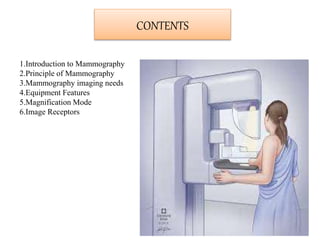
1.Introduction to Mammography
2.Principle of Mammography
3.Mammography imaging needs
4.Equipment Features
5.Magnification Mode
6.Image Receptors
What is Mammography?
Mammography is the process to examine the human breast for
diagnosis and screening by using low-energy X-rays .
PRINCIPLE OF MAMMOGRAPHY-
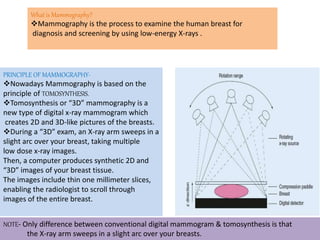
Nowadays Mammography is based on the
principle of TOMOSYNTHESIS.
Tomosynthesis or “3D” mammography is a
new type of digital x-ray mammogram which
creates 2D and 3D-like pictures of the breasts.
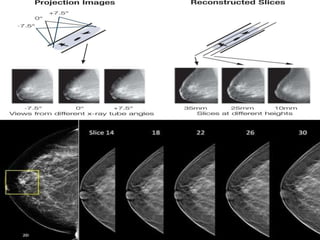
During a “3D” exam, an X-ray arm sweeps in a
slight arc over your breast, taking multiple
low dose x-ray images.
Then, a computer produces synthetic 2D and
“3D” images of your breast tissue.
The images include thin one millimeter slices,
enabling the radiologist to scroll through
images of the entire breast.
NOTE- Only difference between conventional digital mammogram & tomosynthesis is that
the X-ray arm sweeps in a slight arc over your breasts.
Excellent Spatial Resolution-
•Shape and spatial configuration of calcification (0.15mm)
•Achieved with-
-Dedicated Digital detector
-X-ray tube with small focal spot
Excellent Contrast Resolution
•Required to see minimal attenuation difference
between normal glandular tissue & breast tissue
•Achieved with-Low Kvp technique
•Compression
•Grid
Mammography imaging needs
Noise should be low
•Required for accurate detector of subtle contrast difference & tiny structure
•Achieved with- Appropriate mAs (balance between noise & dose)
-Compression (Reduces breast thickness)
Dose should be low
•As breast is radiosensitive organ
•Must balance with resolution,contrast & noise
•Achieved with- Appropriate exposure factors
-Appropriate target & filter material
-AEC
-Collimation
-Shielding
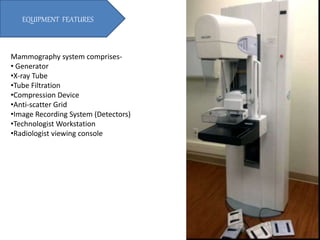
Mammography system comprises-
• Generator
•X-ray Tube
•Tube Filtration
•Compression Device
•Anti-scatter Grid
•Image Recording System (Detectors)
•Technologist Workstation
•Radiologist viewing console
EQUIPMENT FEATURES
•Stationery
•Anode Angle-6 degree
•Tube angle- 23 degree
•Focal Spot size- small (0.1mm – 0.3mm)
•Target Material- Tungsten(W)
-Molybdenum (Mo)
-Rhodium (Rh)
When tungsten target is used- Only Bremstrahlung xrays
predominate.
L-shell xrays are of no value (too low to penetrate)
Contribute only to patient radiation dose.
•Exposure factors- Low Kvp & High mAs
•X-ray most useful for enhancing differential absorption in
breast tissue & maximising
radio-contrast are in the range of 25-28 Kvp.
Source to Image Receptor Distance (SID)- 60-70 cm
X-ray Tube
The conic shape of the breast requires that the radiation intensity near the chest wall
must be higher than that to the nipple side to ensure near uniform exposure of the image
Receptor.
Accomplished by positioning the cathode to the chest wall.
However its not absolutely necessary because compression ensures imaging of a uniform
thickness of tissue
HEEL EFFECT APPLICATION
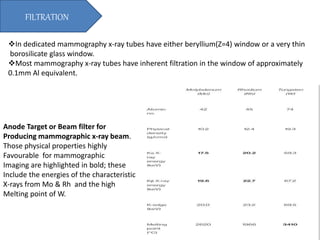
In dedicated mammography x-ray tubes have either beryllium(Z=4) window or a very thin
borosilicate glass window.
Most mammography x-ray tubes have inherent filtration in the window of approximately
0.1mm Al equivalent.
FILTRATION
Anode Target or Beam filter for
Producing mammographic x-ray beam.
Those physical properties highly
Favourable for mammographic
Imaging are highlighted in bold; these
Include the energies of the characteristic
X-rays from Mo & Rh and the high
Melting point of W.
COMPRESSION DEVICE
Routinely used in Mammography.
Most system now have a moving grid with a ratio of 4:1 to 5:1.
Grid frequency- 40lines /cm
Use of such grid increases patient dose compared with nongrid contact mammography.
Dose is still acceptably low, & improvement in contrast is signifant.
Unique grid that has been developed especially for mammography is HTC
(High Transmission Cellular Grid)
•Cross-Hatched grid
•Cleanup characteristics of crossed grid
•Grid strip material- Copper
•Air- Interspace material
Anti-Scatter Grid
Air gap between breast and detector
not only increases magnification but also
reduces amount of scatter radiation.
NO grid used.
MAGNIFICATION MODE
Phototimers- measure not only image intensity but also x-ray quality.
Position of AEC- after Image Receptor to minimize OID & improve spatial resolution.
AUTOMATIC EXPOSURE CONTROL
Indirect Conversion
•Xrays are converted in two step process,
•Xray energy is collected by CsI & converted into light.
•Light photons are then converted into electric signals by photodiode array.
•Some earlier models, such as GE 2000D or Fisher SenoScan use this type of detector s with CsI.
•This process is less efficient & results in some light scatter during conversion.
Direct Conversion
•Xrays are converted in a one step process.
•The layer of a-Se in the detector absorbs the xray energy & converts it into electronic
signal directly.
•Based on efficiency of direct conversion & its elimination of light scatter, a-Se offer
high resolution.
•Later system like Hologic Dimensions uses direct flat panel detectors with a-Selenium.
Image Receptors/Detectors
Mammography.pptx

Mammography.pptx

  • 1.
  • 2.
    CONTENTS 1.Introduction to Mammography 2.Principleof Mammography 3.Mammography imaging needs 4.Equipment Features 5.Magnification Mode 6.Image Receptors
  • 3.
    What is Mammography? Mammographyis the process to examine the human breast for diagnosis and screening by using low-energy X-rays . PRINCIPLE OF MAMMOGRAPHY- Nowadays Mammography is based on the principle of TOMOSYNTHESIS. Tomosynthesis or “3D” mammography is a new type of digital x-ray mammogram which creates 2D and 3D-like pictures of the breasts. During a “3D” exam, an X-ray arm sweeps in a slight arc over your breast, taking multiple low dose x-ray images. Then, a computer produces synthetic 2D and “3D” images of your breast tissue. The images include thin one millimeter slices, enabling the radiologist to scroll through images of the entire breast. NOTE- Only difference between conventional digital mammogram & tomosynthesis is that the X-ray arm sweeps in a slight arc over your breasts.
  • 6.
    Excellent Spatial Resolution- •Shapeand spatial configuration of calcification (0.15mm) •Achieved with- -Dedicated Digital detector -X-ray tube with small focal spot Excellent Contrast Resolution •Required to see minimal attenuation difference between normal glandular tissue & breast tissue •Achieved with-Low Kvp technique •Compression •Grid Mammography imaging needs
  • 7.
    Noise should below •Required for accurate detector of subtle contrast difference & tiny structure •Achieved with- Appropriate mAs (balance between noise & dose) -Compression (Reduces breast thickness) Dose should be low •As breast is radiosensitive organ •Must balance with resolution,contrast & noise •Achieved with- Appropriate exposure factors -Appropriate target & filter material -AEC -Collimation -Shielding
  • 8.
    Mammography system comprises- •Generator •X-ray Tube •Tube Filtration •Compression Device •Anti-scatter Grid •Image Recording System (Detectors) •Technologist Workstation •Radiologist viewing console EQUIPMENT FEATURES
  • 10.
    •Stationery •Anode Angle-6 degree •Tubeangle- 23 degree •Focal Spot size- small (0.1mm – 0.3mm) •Target Material- Tungsten(W) -Molybdenum (Mo) -Rhodium (Rh) When tungsten target is used- Only Bremstrahlung xrays predominate. L-shell xrays are of no value (too low to penetrate) Contribute only to patient radiation dose. •Exposure factors- Low Kvp & High mAs •X-ray most useful for enhancing differential absorption in breast tissue & maximising radio-contrast are in the range of 25-28 Kvp. Source to Image Receptor Distance (SID)- 60-70 cm X-ray Tube
  • 11.
    The conic shapeof the breast requires that the radiation intensity near the chest wall must be higher than that to the nipple side to ensure near uniform exposure of the image Receptor. Accomplished by positioning the cathode to the chest wall. However its not absolutely necessary because compression ensures imaging of a uniform thickness of tissue HEEL EFFECT APPLICATION
  • 12.
    In dedicated mammographyx-ray tubes have either beryllium(Z=4) window or a very thin borosilicate glass window. Most mammography x-ray tubes have inherent filtration in the window of approximately 0.1mm Al equivalent. FILTRATION Anode Target or Beam filter for Producing mammographic x-ray beam. Those physical properties highly Favourable for mammographic Imaging are highlighted in bold; these Include the energies of the characteristic X-rays from Mo & Rh and the high Melting point of W.
  • 14.
  • 16.
    Routinely used inMammography. Most system now have a moving grid with a ratio of 4:1 to 5:1. Grid frequency- 40lines /cm Use of such grid increases patient dose compared with nongrid contact mammography. Dose is still acceptably low, & improvement in contrast is signifant. Unique grid that has been developed especially for mammography is HTC (High Transmission Cellular Grid) •Cross-Hatched grid •Cleanup characteristics of crossed grid •Grid strip material- Copper •Air- Interspace material Anti-Scatter Grid
  • 17.
    Air gap betweenbreast and detector not only increases magnification but also reduces amount of scatter radiation. NO grid used. MAGNIFICATION MODE
  • 18.
    Phototimers- measure notonly image intensity but also x-ray quality. Position of AEC- after Image Receptor to minimize OID & improve spatial resolution. AUTOMATIC EXPOSURE CONTROL
  • 19.
    Indirect Conversion •Xrays areconverted in two step process, •Xray energy is collected by CsI & converted into light. •Light photons are then converted into electric signals by photodiode array. •Some earlier models, such as GE 2000D or Fisher SenoScan use this type of detector s with CsI. •This process is less efficient & results in some light scatter during conversion. Direct Conversion •Xrays are converted in a one step process. •The layer of a-Se in the detector absorbs the xray energy & converts it into electronic signal directly. •Based on efficiency of direct conversion & its elimination of light scatter, a-Se offer high resolution. •Later system like Hologic Dimensions uses direct flat panel detectors with a-Selenium. Image Receptors/Detectors