
Mass spectrometry in
proteomics
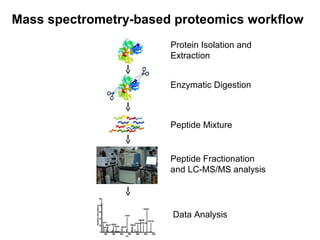
Mass spectrometry-based proteomics workflow
Enzymatic Digestion
Peptide Fractionation
and LC-MS/MS analysis
Protein Isolation and
Extraction
Data Analysis
Peptide Mixture
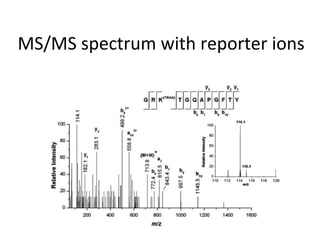
MS/MS spectrum with reporter ions
SILAC
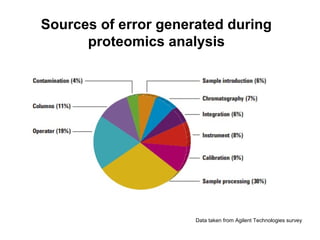
Sources of error generated during
proteomics analysis
Data taken from Agilent Technologies survey
Mass spectrometry in Proteomics
1.Basics of mass spectrometry
2.Ionization methods- MALDI and ESI
3.Mass analyzers – Quadrupole, TOF and Ion trap
4.Tandem mass spectrometry
5.Tandem MS modes
6.Fragmentation methods
What is a mass spectrometer?
• A highly powerful tool for protein identification and
quantification
What does a mass spectrometer do?
• Measures mass to charge ratio (m/z) of molecules
and this information is used to calculate the molecular
weight of the molecule
• Complementary to other technologies and analysis
methods
What are mass measurements good for?
• To identify, verify, and quantitate: metabolites,
recombinant proteins, proteins isolated from natural
sources, oligonucleotides, drug candidates, peptides,
synthetic organic chemicals, polymers
• Mass is given as m/z which is the mass of the ion divided
by its charge
• Monoisotopic mass is the mass of an ion for a given
empirical formula calculated using the exact mass of the
most abundant isotope of each element (C=12.00000,
H=1.007825 etc)
What is Mass?
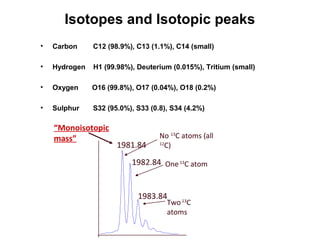
Isotopes and Isotopic peaks
1981.84
1982.84
1983.84
No 13
C atoms (all
12
C)
One13
C atom
Two13
C
atoms
“Monoisotopic
mass”
• Carbon C12 (98.9%), C13 (1.1%), C14 (small)
• Hydrogen H1 (99.98%), Deuterium (0.015%), Tritium (small)
• Oxygen O16 (99.8%), O17 (0.04%), O18 (0.2%)
• Sulphur S32 (95.0%), S33 (0.8), S34 (4.2%)
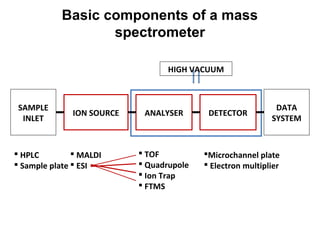
ION SOURCE ANALYSER DETECTOR
SAMPLE
INLET
DATA
SYSTEM
HIGH VACUUM
 MALDI
 ESI
 TOF
 Quadrupole
 Ion Trap
 FTMS
Microchannel plate
 Electron multiplier
 HPLC
 Sample plate
Basic components of a mass
spectrometer
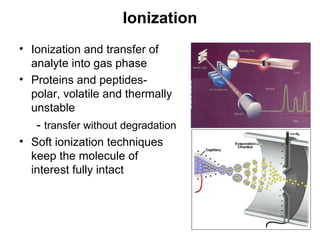
Ionization
• Ionization and transfer of
analyte into gas phase
• Proteins and peptides-
polar, volatile and thermally
unstable
- transfer without degradation
• Soft ionization techniques
keep the molecule of
interest fully intact
Ionization methods
• Electron impact ionisation (1919 A.J. Dempster)
• Chemical Ionisation CI
• Fast atomic bombardment FAB (1981 M. Barber)
• Matrix Assisted Laser Desorption/Ionization MALDI
(1988 Tanaka, Karas, Hillenkamp)
• Electrospray ionization ESI (1985 Fenn)
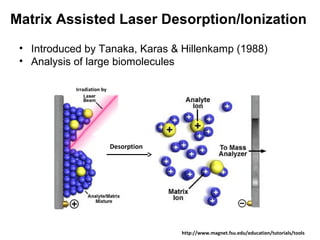
Matrix Assisted Laser Desorption/Ionization
• Introduced by Tanaka, Karas & Hillenkamp (1988)
• Analysis of large biomolecules
Desorption
http://www.magnet.fsu.edu/education/tutorials/tools
Irradiation by
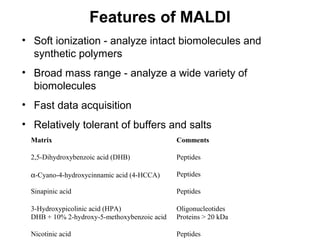
Features of MALDI
• Soft ionization - analyze intact biomolecules and
synthetic polymers
• Broad mass range - analyze a wide variety of
biomolecules
• Fast data acquisition
• Relatively tolerant of buffers and salts
Matrix Comments
2,5-Dihydroxybenzoic acid (DHB) Peptides
α-Cyano-4-hydroxycinnamic acid (4-HCCA) Peptides
Sinapinic acid Peptides
3-Hydroxypicolinic acid (HPA) Oligonucleotides
DHB + 10% 2-hydroxy-5-methoxybenzoic acid Proteins > 20 kDa
Nicotinic acid Peptides
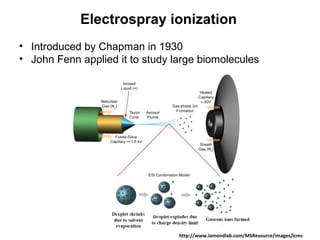
Electrospray ionization
• Introduced by Chapman in 1930
• John Fenn applied it to study large biomolecules
http://www.lamondlab.com/MSResource/images/lcms
Advantages
• Production of molecular ions from solution
• The ease of coupling with separation techniques (micro
LC-MS/MSMS, nano LCMS/MSMS)
• Production of multiply charged ions
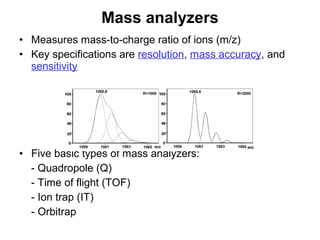
• Measures mass-to-charge ratio of ions (m/z)
• Key specifications are resolution, mass accuracy, and
sensitivity
• Five basic types of mass analyzers:
- Quadropole (Q)
- Time of flight (TOF)
- Ion trap (IT)
- Orbitrap
Mass analyzers
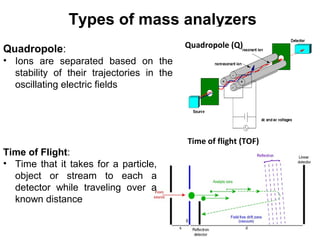
Types of mass analyzers
Quadropole (Q)
Time of flight (TOF)
Quadropole:
• Ions are separated based on the
stability of their trajectories in the
oscillating electric fields
Time of Flight:
• Time that it takes for a particle,
object or stream to each a
detector while traveling over a
known distance
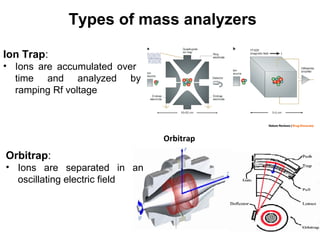
Orbitrap
Types of mass analyzers
Ion Trap:
• Ions are accumulated over
time and analyzed by
ramping Rf voltage
Orbitrap:
• Ions are separated in an
oscillating electric field
How do hybrid mass spectrometers get their
names?
Types of ion sources:
• Electrospray (ESI)
• Matrix Assisted Laser Desorption Ionization (MALDI)
Types of mass analyzers:
•Quadrupole (Quad, Q)
• Ion Trap
• Time-of-Flight (TOF)
• Orbitrap
-Analyzers can be combined to create “hybrid” instruments
such as ESI-QQQ, MALDI QQ TOF, Q Trap
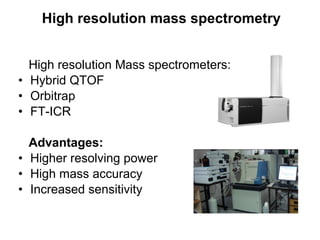
High resolution Mass spectrometers:
• Hybrid QTOF
• Orbitrap
• FT-ICR
Advantages:
• Higher resolving power
• High mass accuracy
• Increased sensitivity
High resolution mass spectrometry
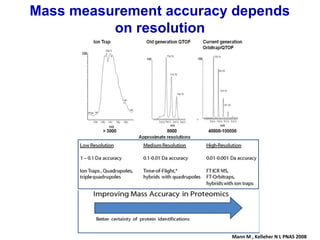
Mann M , Kelleher N L PNAS 2008
Mass measurement accuracy depends
on resolution
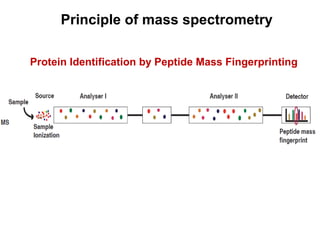
Principle of mass spectrometry
Protein Identification by Peptide Mass Fingerprinting
Principle of mass spectrometry
Tandem Mass Spectrometry Based Identification
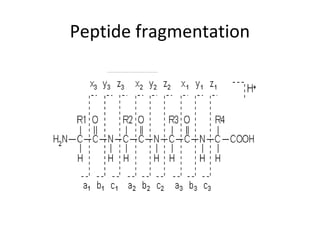
Peptide fragmentation
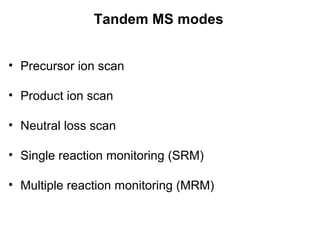
Tandem MS modes
• Precursor ion scan
• Product ion scan
• Neutral loss scan
• Single reaction monitoring (SRM)
• Multiple reaction monitoring (MRM)
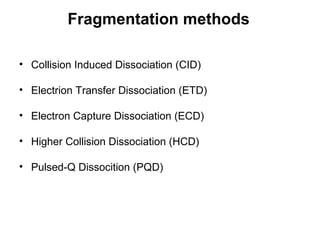
Fragmentation methods
• Collision Induced Dissociation (CID)
• Electrion Transfer Dissociation (ETD)
• Electron Capture Dissociation (ECD)
• Higher Collision Dissociation (HCD)
• Pulsed-Q Dissocition (PQD)
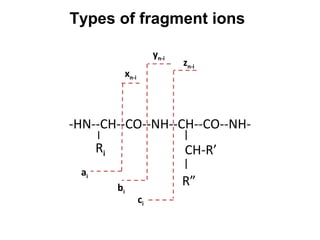
Types of fragment ions
-HN--CH--CO--NH--CH--CO--NH-
Ri CH-R’
ci
zn-i
R”
ai
xn-i
bi
yn-i
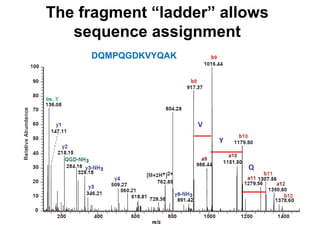
The fragment “ladder” allows
sequence assignment
DQMPQGDKVYQAK
Q
Y
V
•Automated and high throughput technology
•offer highly sensitive analytical capabilities
• totally unbiased method and relatively large dynamic
range of detection
•increasingly become the method of choice for in depth
profiling of complex protein mixtures
•In addition, the relatively high throughput of LC-MS
technologies is amenable to clinical applications that
involve human biofluids and disease tissues
LC-MS or Tandem MS-based
proteomics : Advantages
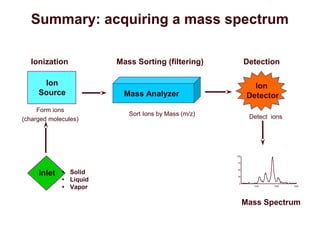
Inlet
Ionization
Mass Analyzer
Mass Sorting (filtering)
Ion
Detector
Detection
Ion
Source
• Solid
• Liquid
• Vapor
Detect ions
Form ions
(charged molecules)
Sort Ions by Mass (m/z)
1330 1340 1350
100
75
50
25
0
Mass Spectrum
Summary: acquiring a mass spectrum
Thank you

Anil bl gather mass spectrometry

  • 1.
  • 2.
    Mass spectrometry-based proteomicsworkflow Enzymatic Digestion Peptide Fractionation and LC-MS/MS analysis Protein Isolation and Extraction Data Analysis Peptide Mixture
  • 3.
    MS/MS spectrum withreporter ions
  • 4.
  • 5.
    Sources of errorgenerated during proteomics analysis Data taken from Agilent Technologies survey
  • 6.
    Mass spectrometry inProteomics 1.Basics of mass spectrometry 2.Ionization methods- MALDI and ESI 3.Mass analyzers – Quadrupole, TOF and Ion trap 4.Tandem mass spectrometry 5.Tandem MS modes 6.Fragmentation methods
  • 7.
    What is amass spectrometer? • A highly powerful tool for protein identification and quantification What does a mass spectrometer do? • Measures mass to charge ratio (m/z) of molecules and this information is used to calculate the molecular weight of the molecule • Complementary to other technologies and analysis methods What are mass measurements good for? • To identify, verify, and quantitate: metabolites, recombinant proteins, proteins isolated from natural sources, oligonucleotides, drug candidates, peptides, synthetic organic chemicals, polymers
  • 8.
    • Mass isgiven as m/z which is the mass of the ion divided by its charge • Monoisotopic mass is the mass of an ion for a given empirical formula calculated using the exact mass of the most abundant isotope of each element (C=12.00000, H=1.007825 etc) What is Mass?
  • 9.
    Isotopes and Isotopicpeaks 1981.84 1982.84 1983.84 No 13 C atoms (all 12 C) One13 C atom Two13 C atoms “Monoisotopic mass” • Carbon C12 (98.9%), C13 (1.1%), C14 (small) • Hydrogen H1 (99.98%), Deuterium (0.015%), Tritium (small) • Oxygen O16 (99.8%), O17 (0.04%), O18 (0.2%) • Sulphur S32 (95.0%), S33 (0.8), S34 (4.2%)
  • 10.
    ION SOURCE ANALYSERDETECTOR SAMPLE INLET DATA SYSTEM HIGH VACUUM  MALDI  ESI  TOF  Quadrupole  Ion Trap  FTMS Microchannel plate  Electron multiplier  HPLC  Sample plate Basic components of a mass spectrometer
  • 11.
    Ionization • Ionization andtransfer of analyte into gas phase • Proteins and peptides- polar, volatile and thermally unstable - transfer without degradation • Soft ionization techniques keep the molecule of interest fully intact
  • 12.
    Ionization methods • Electronimpact ionisation (1919 A.J. Dempster) • Chemical Ionisation CI • Fast atomic bombardment FAB (1981 M. Barber) • Matrix Assisted Laser Desorption/Ionization MALDI (1988 Tanaka, Karas, Hillenkamp) • Electrospray ionization ESI (1985 Fenn)
  • 13.
    Matrix Assisted LaserDesorption/Ionization • Introduced by Tanaka, Karas & Hillenkamp (1988) • Analysis of large biomolecules Desorption http://www.magnet.fsu.edu/education/tutorials/tools Irradiation by
  • 14.
    Features of MALDI •Soft ionization - analyze intact biomolecules and synthetic polymers • Broad mass range - analyze a wide variety of biomolecules • Fast data acquisition • Relatively tolerant of buffers and salts Matrix Comments 2,5-Dihydroxybenzoic acid (DHB) Peptides α-Cyano-4-hydroxycinnamic acid (4-HCCA) Peptides Sinapinic acid Peptides 3-Hydroxypicolinic acid (HPA) Oligonucleotides DHB + 10% 2-hydroxy-5-methoxybenzoic acid Proteins > 20 kDa Nicotinic acid Peptides
  • 15.
    Electrospray ionization • Introducedby Chapman in 1930 • John Fenn applied it to study large biomolecules http://www.lamondlab.com/MSResource/images/lcms
  • 16.
    Advantages • Production ofmolecular ions from solution • The ease of coupling with separation techniques (micro LC-MS/MSMS, nano LCMS/MSMS) • Production of multiply charged ions
  • 17.
    • Measures mass-to-chargeratio of ions (m/z) • Key specifications are resolution, mass accuracy, and sensitivity • Five basic types of mass analyzers: - Quadropole (Q) - Time of flight (TOF) - Ion trap (IT) - Orbitrap Mass analyzers
  • 18.
    Types of massanalyzers Quadropole (Q) Time of flight (TOF) Quadropole: • Ions are separated based on the stability of their trajectories in the oscillating electric fields Time of Flight: • Time that it takes for a particle, object or stream to each a detector while traveling over a known distance
  • 19.
    Orbitrap Types of massanalyzers Ion Trap: • Ions are accumulated over time and analyzed by ramping Rf voltage Orbitrap: • Ions are separated in an oscillating electric field
  • 20.
    How do hybridmass spectrometers get their names? Types of ion sources: • Electrospray (ESI) • Matrix Assisted Laser Desorption Ionization (MALDI) Types of mass analyzers: •Quadrupole (Quad, Q) • Ion Trap • Time-of-Flight (TOF) • Orbitrap -Analyzers can be combined to create “hybrid” instruments such as ESI-QQQ, MALDI QQ TOF, Q Trap
  • 21.
    High resolution Massspectrometers: • Hybrid QTOF • Orbitrap • FT-ICR Advantages: • Higher resolving power • High mass accuracy • Increased sensitivity High resolution mass spectrometry
  • 22.
    Mann M ,Kelleher N L PNAS 2008 Mass measurement accuracy depends on resolution
  • 23.
    Principle of massspectrometry Protein Identification by Peptide Mass Fingerprinting
  • 24.
    Principle of massspectrometry Tandem Mass Spectrometry Based Identification
  • 25.
  • 26.
    Tandem MS modes •Precursor ion scan • Product ion scan • Neutral loss scan • Single reaction monitoring (SRM) • Multiple reaction monitoring (MRM)
  • 27.
    Fragmentation methods • CollisionInduced Dissociation (CID) • Electrion Transfer Dissociation (ETD) • Electron Capture Dissociation (ECD) • Higher Collision Dissociation (HCD) • Pulsed-Q Dissocition (PQD)
  • 28.
    Types of fragmentions -HN--CH--CO--NH--CH--CO--NH- Ri CH-R’ ci zn-i R” ai xn-i bi yn-i
  • 29.
    The fragment “ladder”allows sequence assignment DQMPQGDKVYQAK Q Y V
  • 30.
    •Automated and highthroughput technology •offer highly sensitive analytical capabilities • totally unbiased method and relatively large dynamic range of detection •increasingly become the method of choice for in depth profiling of complex protein mixtures •In addition, the relatively high throughput of LC-MS technologies is amenable to clinical applications that involve human biofluids and disease tissues LC-MS or Tandem MS-based proteomics : Advantages
  • 31.
    Inlet Ionization Mass Analyzer Mass Sorting(filtering) Ion Detector Detection Ion Source • Solid • Liquid • Vapor Detect ions Form ions (charged molecules) Sort Ions by Mass (m/z) 1330 1340 1350 100 75 50 25 0 Mass Spectrum Summary: acquiring a mass spectrum
  • 32.

Editor's Notes

  • #22 Allows robust analysis of prtns, peptides and PTMs