MALARIA
BY-DrAnubhavAgrawal
Juniorresident
UpgradedDepofCommunityMedicine
andpublichealth
KGMU,Lucknow
SYNOPSIS
● INTRODUCTIONTOCOMMUNICABLEDISEASES
● VECTORBORNEDISEASES
● MALARIA-INTRODUCTION
● MAGNITUTEOFTHEPROBLEM
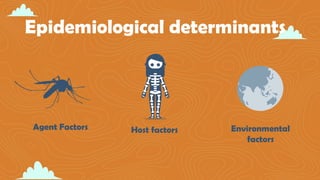
● EPIDEMIOLOGICAL DETERMINANTS
● TRANSMISSIONDYNAMICS
● EPIDEMIOLOGICALSUBTYPES
● MEASUREMENTANDSURVEYOFMALARIA
● NFME(2016-2030)
● Bibliography
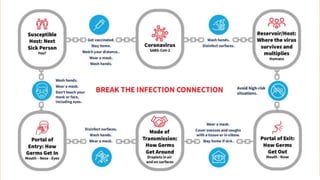
Communicable Diseases
• communicablediseasesaredefinedasdiseases,whoseetiology
lies ina“microbial(orinfectious)agent”andcanbetransmitted
fromaninfectedpersonoranimalorcontaminatedenvironment
toanotherpersonoranimal.
• therearesomeinterrelatedfactors,whichareessentialfor
theoccurrenceofacommunicabledisease,theyaretogether
referredas“epidemiologicalchainofinfection”.
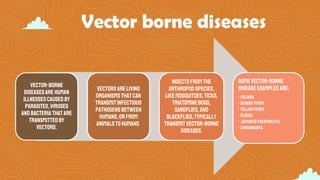
Vector borne diseases
Vector-borne
diseasesare human
illnessescausedby
parasites,viruses
andbacteriathatare
transmittedby
vectors.
Vectorsareliving
organismsthatcan
transmitinfectious
pathogensbetween
humans,orfrom
animalsto humans.
Insectsfrom the
arthropod species,
likemosquitoes,ticks,
triatominebugs,
sandflies,and
blackflies,typically
transmitvector-borne
diseases.
Somevector-borne
diseaseexamples are:
• Malaria
• Denguefever
• Yellowfever
• Plague
• Japaneseencephalitis
• Chikungunya
Malaria
● Malariais anacuteandchronicdiseasecausedbyobligate
intracellularprotozoaofthegenus plasmodium.
● FourspeciesofplasmodiumspreadsfromthebiteoffemaleAnopheles
mosquito.Blood transfusionandcontaminatedneedlesmayalso
transmitmalaria.
● Thefirstsymptomsmaybemild,similartomanyfebrileillnesses, and
difficulty torecognizeasmalaria.
Magnitude of
the problem
01
Global disease burden
And
Indianperspective
Global Disease Burden
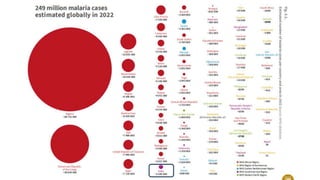
• Accordingtothelatest Worldmalariareport,therewere249millioncasesof
malariain 2022comparedto244millioncasesin 2021.Theestimatednumberof
malariadeathsstoodat608,000in2022comparedto 610,000in2021.
• TheWHOAfricanRegioncontinuestocarryadisproportionatelyhigh shareofthe
global malariaburden.
• In2022 theRegionwashometoabout94%ofall malariacasesand95%ofdeaths.
ild, similar to many febrile illnesses, and difficulty to
recognize as malaria.
KEY NUMBERS
2021
244millions 249millions
2022
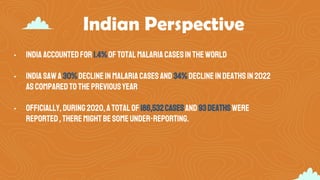
Indian Perspective
• India accountedfor1.4%oftotalmalariacasesin theworld
• India sawa30%declinein malariacasesand 34%declineindeathsin2022
ascomparedtothepreviousyear
• Officially,during2020,atotalof 186,532casesand93deathswere
reported,theremightbesomeunder-reporting.
Epidemiological determinants
Agent Factors Host factors Environmental
factors
Agent Factors
• Protozoaofgenusplasmodiumareresponsibleformalariaanddiseaseis
causedbyfourparasites:
1.p.vivax
2.p.malariae
3.p.Falciparum
4.p.ovale
• Inrecentyears,humancasesofmalariaduetop.knowlesi areseen,which
causesmalariaamongmonkeysinSoutheastasia.
Life History
• Its adigeneticparasite,i.e.itrequirestwohoststocompleteits cycle
• Plasmodium arerecognizedtaxonomically bythepresenceoftwotypesofdivision:
Schizogony,in vertebratehost;andsporogony,in theinsectvector.
• Thelaterphaseincludes thedevelopmentcyclein theredcells (erythrocytic
schizogony)andthephasetakingplacein theparenchymacells intheliver(pre-
erythrocyticschizogony).
• Thevertebrateactastheintermediate(secondary)host fortheparasite,while the
mosquitoisconsideredtobethedefinitive(primary)oneasthesexual reproduction
takesplaceinmosquito.
Agent Factors
Agent Factors
Mercury is the closest
planet to the Sun
Reservoirand source
Venus is the second
planet from the Sun
C
Despite being red, Mars
is actually a cold place
JUPITER
It’s the biggest planet
in the Solar System
SATURN
Saturn is composed of
hydrogen and helium
NEPTUNE
Neptune is the farthest
planet from the Sun
Communicability
• Malariais communicableaslongas
mature,viable gametocytesexist in
thecirculatingblood in sufficient
densitytoinfectvectormosquitoes.
• Malariamayalso betransmitted
fromamothertoherunborninfant
beforeorduringdelivery
("congenital"malaria).
Host Factors
• All agesandbothgendersareequallyaffectedbutmaleshavehigherincident
becauseofhigher exposure.
• Peoplewith sicklecelltraitarerelativelyimmunetop.falciparumandindividuals
lackingdaffy“a”and “b”areresistanttop.vivax.
• Economicstatusisinverselyrelatedtomalaria,mainly becauseofpoorhousing.
Acquired Immunity
• Immunitytomalariaisacquiredafterrepeatedexposureover
severalyears.Thusinendemicmalarious areasastateof
collectiveimmunitybecomesestablishedslowly.
• Infantsbornofimmunemothersaregenerallyprotected
duringthefirst3-5monthsbymaternalImmunoglobulins.
Environmental factors
• Inanendemicregion,malariaoccursthroughouttheyear;howeverit
dependson rainfall patterns,breeding,temperatureandhumidity.
• Temp.of20 –30 degreeCelsiusandhumidityof>60%isoptimumformalaria
transmission.
• Maalriais morecommonduringrainyseasonastherearemorebreedingsites
andanophilines survivelonger.
• Theproximityofhumanhabitationtobreedingsites increasestransmission.
Vector- Related factors
• Thereareapproximately3,500speciesofmosquitoesgroupedinto41genera.
Humanmalariais transmittedonly byfemalesofthegenusAnopheles.Ofthe
approximately430Anopheles species,only 30-40transmitmalaria(i.e.,are
“vectors”)innature.
• Out ofthese,thereare56speciesofanophelines inindia,out ofwhich6are
regardedasprimaryvectorsand another3or4secondary.
• Like all mosquitoes,anophelines gothroughfourstages intheirlife cycles:
egg,larva,pupa,and adult.
Eggs
• Adultfemales lay50–200
eggsperoviposition.The
eggsarequite small
(about 0.5millimetres
(0.02in) ×0.2millimetres
(0.008in)). Eggsarelaid
singly anddirectlyon
water.Theyareunique in
thattheyhavefloats on
eitherside.
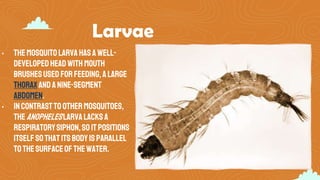
Larvae
• Themosquitolarvahasawell-
developedheadwith mouth
brushesused forfeeding,alarge
thoraxandanine-segment
abdomen.
• Incontrasttoothermosquitoes,
theAnopheleslarvalacksa
respiratorysiphon,soitpositions
itselfsothatits bodyis parallel
tothesurfaceofthewater.
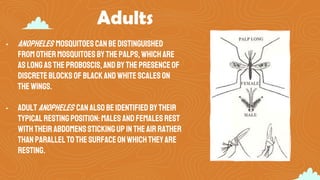
Adults
• Anopheles mosquitoescanbedistinguished
fromothermosquitoes bythepalps,whichare
aslong astheproboscis,andbythepresenceof
discreteblocks ofblackandwhite scaleson
the wings.
• AdultAnopheles canalsobeidentified bytheir
typicalrestingposition:malesandfemalesrest
with their abdomensstickingupin theair rather
thanparalleltothe surfaceon whichtheyare
resting.
Transmission dynamics
• Modeoftransmission:mostprevalentmodeoftransmissionisthrough
thebiteofinfectedfemaleanophelesmosquito.Malariacanalso be
transmittedbytransfusion/injectionofinfectedblood/plasma,and,
rarely,frominfectedmothertonewborn(directandcongenital).
• Stableandunstablemalaria:stableendemicmalariaissaid tobe
presentwhennaturaltransmissionoccursovermanyyearsandthere
ispredictableincidenceandprevalence.Unstablemalariais
characterizedbyvaryingratesoftransmissionandhigherchancesof
epidemics.
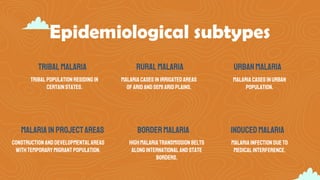
Epidemiological subtypes
Tribalpopulationresiding in
certainstates.
Ruralmalaria
Malariacases inirrigatedareas
of arid andsemi arid plains.
Urbanmalaria
Malariacases inurban
population.
Malariain projectareas
Construction anddevelopmentalareas
withtemporarymigrantpopulation.
Bordermalaria
Highmalariatransmissionbelts
alonginternationalandstate
borders.
Inducedmalaria
Malariainfectiondue to
medicalinterference.
Tribalmalaria
Malaria epidemiological
surveys
Bydefinition,surveillancealso impliesthecontinuingscrutinyofall aspectsof
occurrenceandspreadofadisease,thatarepertinenttoeffectivecontrol.Included in
thesearethesystematiccollectionandevaluationoffield investigations,etc.The
following parametersarewidely used intheepidemiologicalsurveillanceofmalaria:
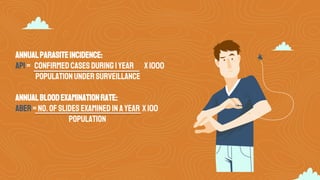
(a)Annual parasiteincidence(API);
(b)Annual blood examinationrate(ABER);
(c)Annual falciparumincidence(AFI);
(d)Slide positivityrate(SPR);and
(e)Slide falciparumrate(SFR).
AnnualParasiteIncidence:
API= Confirmedcasesduring1year x1000
Populationundersurveillance
AnnualBloodExaminationRate:
ABER=No.ofslides examinedin ayear x 100
Population
National Framework for Malaria Elimination in
India (2016-30)
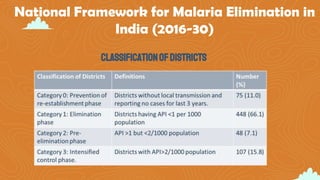
ClassificationofDistricts
National Framework for Malaria Elimination in
India (2016-30)
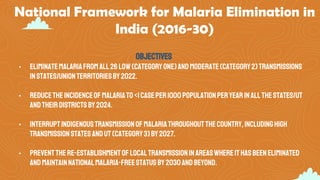
Objectives
• Eliminatemalariafromall26 low(categoryone)andmoderate(category2)transmissions
instates/unionterritoriesby2022.
• Reducetheincidenceofmalariato<1caseper1000populationperyearinallthestates/UT
andtheirdistrictsby2024.
• Interruptindigenoustransmissionofmalariathroughoutthecountry,includinghigh
transmissionstatesandUT(category3)by2027.
• Preventthere-establishmentoflocaltransmissioninareaswhereithasbeeneliminated
andmaintainnationalmalaria-freestatusby2030andbeyond.
Bibliography
• Bhalwar5th edition,chapter82,sectionIX
• Park27th edition,chapter5,sectioniii,malaria
• https://ourworldindata.org/malaria
• https://www.cdc.gov/malaria/about/biology/index.html
• https://www.who.int/news-room/fact-sheets/detail/malaria
Malaria epidemiology                     .

Malaria epidemiology .