RESPECTFUL
MIDWIFERY CARE
INTRODUCTION
Pregnancy is a special and often blissful period in
a women’s life. Women may undergo various
physiological changes during antepartum, intra-partum
and post-partum period. The birthing room environment
and health care providers’ attitude are important to
minimize the pain and offer a positive childbirth
experience.
Con…..
Respectful maternity care (RMC) is a universal
human right due to every childbearing woman in every
health system around the world while many
interventions aim to improve access to skilled birth care.
Less attention has been focused on the quality of
relationship with care givers during maternity care.
Con……
Dearth of RMC from medical professionals like
the doctors and midwives may cause women to feel
unsatisfied with the health care system and lessen their
obligation to seek antenatal, delivery, and postnatal care
services. Hence the knowledge on RMC is essential for
all health care professionals.
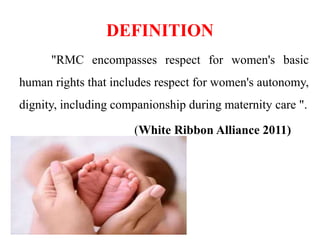
DEFINITION
"RMC encompasses respect for women's basic
human rights that includes respect for women's autonomy,
dignity, including companionship during maternity care ".
(White Ribbon Alliance 2011)
Con……
Respectful midwifery care which refers to care
organized for and provided to all women in a manner
that maintains their dignity, privacy and confidentiality,
ensures freedom from harm and mistreatment, and
enables informed choice and continuous support during
labour and childbirth.
-WHO
CONCEPT OF RESPECTFUL
MATERNITY CARE
 “Respectful Maternity Care” (RMC) is an approach that
 Focuses on the interpersonal aspect of maternal care.
 Emphasizes the fundamental rights of the mother, newborn
and families including protecting the mother and baby.
 Recognizes that all childbearing women needed deserve to
respectful care and protection of the women’s rights to
choose and preferences
COMPONENTS OF RESPECTFUL
MIDWIFERY CARE
 Freedom from harm and ill treatment.
 Right to information.
 Prospective provision of information
and seeking of informed consent.
 Respect for choices and preferences.
 Right to companionship.
Con…..
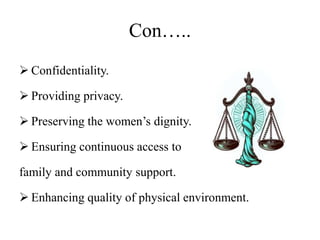
 Confidentiality.
 Providing privacy.
 Preserving the women’s dignity.
 Ensuring continuous access to
family and community support.
 Enhancing quality of physical environment.
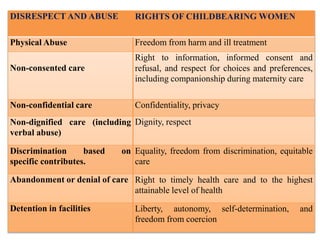
DISRESPECT AND ABUSE RIGHTS OF CHILDBEARING WOMEN
Physical Abuse Freedom from harm and ill treatment
Non-consented care
Right to information, informed consent and
refusal, and respect for choices and preferences,
including companionship during maternity care
Non-confidential care Confidentiality, privacy
Non-dignified care (including
verbal abuse)
Dignity, respect
Discrimination based on
specific contributes.
Equality, freedom from discrimination, equitable
care
Abandonment or denial of care Right to timely health care and to the highest
attainable level of health
Detention in facilities Liberty, autonomy, self-determination, and
freedom from coercion
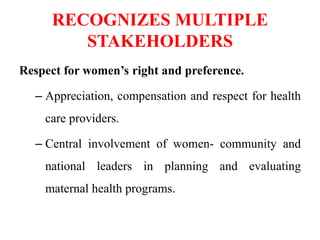
RECOGNIZES MULTIPLE
STAKEHOLDERS
Respect for women’s right and preference.
– Appreciation, compensation and respect for health
care providers.
– Central involvement of women- community and
national leaders in planning and evaluating
maternal health programs.
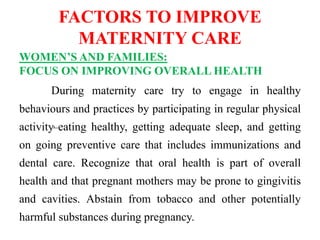
FACTORS TO IMPROVE
MATERNITY CARE
WOMEN’S AND FAMILIES:
FOCUS ON IMPROVING OVERALL HEALTH
During maternity care try to engage in healthy
behaviours and practices by participating in regular physical
activity, eating healthy, getting adequate sleep, and getting
on going preventive care that includes immunizations and
dental care. Recognize that oral health is part of overall
health and that pregnant mothers may be prone to gingivitis
and cavities. Abstain from tobacco and other potentially
harmful substances during pregnancy.
PROMOTE POSITIVE INVOLVEMENT OF MEN
AS FATHERS/PARTNERS DURING
PREGNANCY, CHILDBIRTH, AND AFTER
DELIVERY
Promote men’s positive involvement as partners
and fathers. Include men in decision-making to support
the woman’s health, to the extent that it promotes and
facilitates women’s choices and their autonomy in
decision-making.
ATTEND HEALTH CARE
APPOINTMENTS
Women should attend primary care, prenatal,
postpartum, and any recommended specialty care visits
and provide health information, including pregnancy
history and complications, to their health care providers
during all medical care visits, even in the years
following delivery
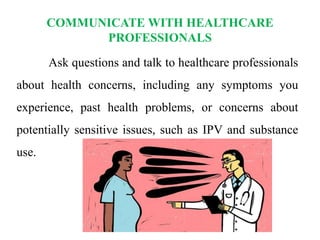
COMMUNICATE WITH HEALTHCARE
PROFESSIONALS
Ask questions and talk to healthcare professionals
about health concerns, including any symptoms you
experience, past health problems, or concerns about
potentially sensitive issues, such as IPV and substance
use.
LEARN HOW TO IDENTIFY PHYSICALAND
MENTAL WARNING SIGNS DURING AND
AFTER PREGNANCY
Utilize resources that provide information about
the changes that occur with a healthy pregnancy and
how to recognize the warning signs for complications
that may need prompt medical attention. The CDC’s
Hear Her campaign seeks to raise awareness of warning
signs, empower women to speak up and raise concerns,
and encourage their support systems and providers to
engage with them in life-saving conversations
CREATE SOCIALAND PHYSICAL
ENVIRONMENTS THAT PROMOTE GOOD
HEALTH
Improve factors that are associated with health and
wellness, including safe communities, clean water and air,
stable housing, access to affordable healthy food, public
transportation, parks and sidewalks, and other social
determinants of health. Support prevention of domestic
violence and abuse. Consider addressing areas recognized as
“food deserts” (areas with little access to affordable,
nutritious food) or “food swamps” (areas with an abundance
of fast food and junk food outlets).
STATES, TRIBES AND LOCAL
COMMUNITIES
PROVIDE BREASTFEEDING SUPPORT AT THE
INDIVIDUAL AND COMMUNITY LEVELS
Establish policies to support women’s abilities to
breastfeed, to reach their breastfeeding goals once they
return to their communities and worksites, and thus
achieve full health benefits of breastfeeding for their
babies and themselves.
HEALTH CARE PROFESSIONAL
ENSURE QUALITY PREVENTIVE HEALTHCARE
FOR ALL WOMEN, CHILDREN, AND FAMILIES
Increase knowledge, awareness, and utilization of
clinical practice tools. Use preventive health care and
wellness visits to conduct screenings, assess risk factors,
provide support for family planning, offer immunizations,
and provide education and counselling to promote optimal
health
HEALTH SYSTEM, HOSPITALS
AND BIRTHING FACILITIES
ENSURE AVAILABILITY OF RISK-APPROPRIATE
CARE ACROSS THE HEALTHCARE SYSTEM
Ensure staff, equipment, and services are available to
address the health needs of women with both low- and high-
risk pregnancies. Implement guidelines for levels of
maternal care at all birthing hospitals and facilities and work
with states to adopt standardized criteria and uniform
definitions for levels of maternal care.
Con…..
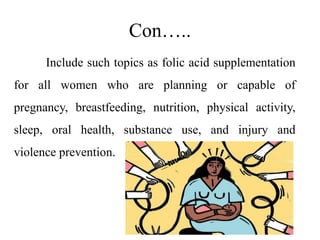
Include such topics as folic acid supplementation
for all women who are planning or capable of
pregnancy, breastfeeding, nutrition, physical activity,
sleep, oral health, substance use, and injury and
violence prevention.
ADDRESS DISPARITIES SUCH AS RACIAL,
SOCIOECONOMIC, GEOGRAPHIC, AND AGE,
AND PROVIDE CULTURALLY APPROPRIATE
CARE IN CLINICAL PRACTICES
Increase self and situational awareness of and
attention to disparities. Participate in research to
determine if provider training may improve patient-
provider interactions. Learn how to identify and work to
address inequities within health systems, processes, and
clinical practices using standardized protocols. Provide
culturally and linguistically appropriate services that
respect and respond to individual needs and preferences.
COMMUNICATE WITH WOMEN AND THEIR
FAMILIES ABOUT PREGNANCY
Listen to women and their family members’ concerns
before, during, and after delivery. Engage the family in
creating a supportive environment. Discuss and make
available options for traditional practices that may vary by
culture and personal preferences. Educate about warning
signs during pregnancy and the postpartum period. Use
culturally acceptable and easily understandable methods of
communication. Link women with a substance use disorder
to family-centred treatment approaches.
FACILITATE TIMELY RECOGNITION AND
INTERVENTION OF EARLY WARNING SIGNS
DURING AND UP TO ONE YEAR AFTER
PREGNANCY
Track patient vital signs (e.g., blood pressure)
across healthcare visits, including prenatal, initial
hospital admission, and postpartum visits. Learn to
recognize and react to signs and symptoms associated
with haemorrhage, pre-eclampsia, hypertension,
cardiomyopathy, infection, embolism, substance use,
and mental health issues.
Con…..
Use screenings and tools to identify warning
signs early so women can receive timely treatment.
Coordinate care across obstetrician-gynaecologists and
primary care providers and consult with specialists, as
needed.
IMPROVE HEALTHCARE SERVICES DURING
THE POSTPARTUM PERIOD AND BEYOND
Communicate the importance of postpartum
visits, including the ACOG recommendation for an
initial assessment within the first 3 weeks postpartum
followed by on going care as needed and a
comprehensive visit within 12 weeks after
delivery. Non-obstetric providers can have an important
role to play.
PARTICIPATE IN QUALITY IMPROVEMENT
AND SAFETY INITIATIVES TO IMPROVE CARE
Engage with state and/or national quality
collaborative and patient safety initiatives to improve
maternal health.
HEALTH SYSTEM, HOSPITALS AND
BIRTHING FACILITIES
ENSURE AVAILABILITY OF RISK-
APPROPRIATE CARE ACROSS THE HEALTH
CARE SYSTEM
Ensure staff, equipment, and services are available
to address the health needs of women with both low- and
high-risk pregnancies. Implement guidelines for levels of
maternal care at all birthing hospitals and facilities and
work with states to adopt standardized criteria and
uniform definitions for levels of maternal care.
IMPROVE ACCESS TO CARE AND
COMMUNICATION WITH PATIENTS
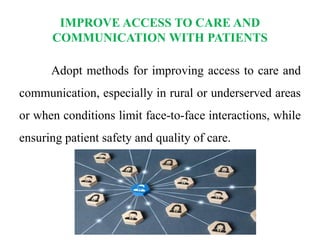
Adopt methods for improving access to care and
communication, especially in rural or underserved areas
or when conditions limit face-to-face interactions, while
ensuring patient safety and quality of care.
IMPROVE THE QUALITY AND SAFETY OF
PERINATAL CARE
Provide evidence-based clinical practice,
including utilization of standardized protocols related to
pregnancy, delivery, and the postpartum period.
Consider other resources, such as the Agency for
Healthcare Research and Quality’s Toolkit for
Improving Perinatal Safety.
PROVIDE COMPREHENSIVE DISCHARGE
INSTRUCTIONS
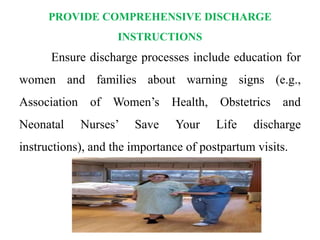
Ensure discharge processes include education for
women and families about warning signs (e.g.,
Association of Women’s Health, Obstetrics and
Neonatal Nurses’ Save Your Life discharge
instructions), and the importance of postpartum visits.
ENCOURAGE OBSTETRIC CARE-TRAINED
PROVIDERS TO SERVE IN RURAL, REMOTE
AND UNDERSERVED AREAS
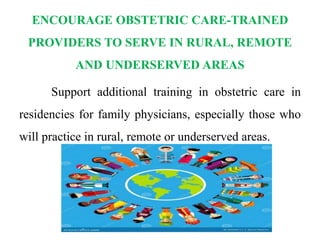
Support additional training in obstetric care in
residencies for family physicians, especially those who
will practice in rural, remote or underserved areas.
ADDRESS DISPARITIES AND PROVIDE
CULTURALLY APPROPRIATE CARE IN
HEALTHCARE SETTINGS
Provide education and training on disabilities.
Identify and work to address inequities within health
systems, processes, and clinical practices. Ensure the
availability of culturally and linguistically appropriate
services that respect and respond to individual needs
and preferences.
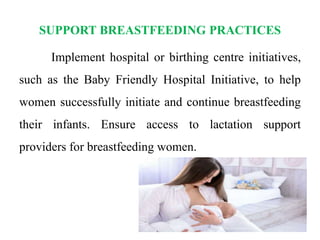
SUPPORT BREASTFEEDING PRACTICES
Implement hospital or birthing centre initiatives,
such as the Baby Friendly Hospital Initiative, to help
women successfully initiate and continue breastfeeding
their infants. Ensure access to lactation support
providers for breastfeeding women.
ENHANCE COMMUNICATION WITHIN AND ACROSS
HEALTHCARE SETTINGS
Adopt methods to ensure the seamless transition
of information between providers along the care
continuum, including strengthening communication and
care coordination among obstetrician-gynaecologists
and other health care professionals.
ADOPT AND SUPPORT FAMILY-FRIENDLY
POLICIES
Consider paid family leave and other family-
friendly policies, such as flexible work schedules and
on-site or easy-to-access high quality childcare. These
policies may also help with recruitment and retention of
valuable employees.
GENERAL RECOMMENDATIONS
Strengthening training
Implementing quality improvement approaches
Developing classical guidelines and protocols
Implementing community activities including campaign
Strengthening local law and regulations
Advocacy including initiative and client’s right charter.
Con……
Others information on rights of family / parents
training in newborn care / comprehensive preparation
for parenthood rights
Respect for belief, traditions and culture
Continuous support during labour
Choice of companion during labour and birth
The right of information and privacy freedom of
movement during labour
Con…..
Choice of position during birth
Good communication between clint and provider
Support of the mother and baby pair
Improvement of working condition and respectful and
collaborative relationships among all cadres of health
workers
Preventive of disrespect and abuse and institutional
violence against women
RESPECTFUL MIDWIFERY CARE.pptx

RESPECTFUL MIDWIFERY CARE.pptx

  • 1.
  • 2.
    INTRODUCTION Pregnancy is aspecial and often blissful period in a women’s life. Women may undergo various physiological changes during antepartum, intra-partum and post-partum period. The birthing room environment and health care providers’ attitude are important to minimize the pain and offer a positive childbirth experience.
  • 3.
    Con….. Respectful maternity care(RMC) is a universal human right due to every childbearing woman in every health system around the world while many interventions aim to improve access to skilled birth care. Less attention has been focused on the quality of relationship with care givers during maternity care.
  • 4.
    Con…… Dearth of RMCfrom medical professionals like the doctors and midwives may cause women to feel unsatisfied with the health care system and lessen their obligation to seek antenatal, delivery, and postnatal care services. Hence the knowledge on RMC is essential for all health care professionals.
  • 5.
    DEFINITION "RMC encompasses respectfor women's basic human rights that includes respect for women's autonomy, dignity, including companionship during maternity care ". (White Ribbon Alliance 2011)
  • 6.
    Con…… Respectful midwifery carewhich refers to care organized for and provided to all women in a manner that maintains their dignity, privacy and confidentiality, ensures freedom from harm and mistreatment, and enables informed choice and continuous support during labour and childbirth. -WHO
  • 7.
    CONCEPT OF RESPECTFUL MATERNITYCARE  “Respectful Maternity Care” (RMC) is an approach that  Focuses on the interpersonal aspect of maternal care.  Emphasizes the fundamental rights of the mother, newborn and families including protecting the mother and baby.  Recognizes that all childbearing women needed deserve to respectful care and protection of the women’s rights to choose and preferences
  • 8.
    COMPONENTS OF RESPECTFUL MIDWIFERYCARE  Freedom from harm and ill treatment.  Right to information.  Prospective provision of information and seeking of informed consent.  Respect for choices and preferences.  Right to companionship.
  • 9.
    Con…..  Confidentiality.  Providingprivacy.  Preserving the women’s dignity.  Ensuring continuous access to family and community support.  Enhancing quality of physical environment.
  • 10.
    DISRESPECT AND ABUSERIGHTS OF CHILDBEARING WOMEN Physical Abuse Freedom from harm and ill treatment Non-consented care Right to information, informed consent and refusal, and respect for choices and preferences, including companionship during maternity care Non-confidential care Confidentiality, privacy Non-dignified care (including verbal abuse) Dignity, respect Discrimination based on specific contributes. Equality, freedom from discrimination, equitable care Abandonment or denial of care Right to timely health care and to the highest attainable level of health Detention in facilities Liberty, autonomy, self-determination, and freedom from coercion
  • 11.
    RECOGNIZES MULTIPLE STAKEHOLDERS Respect forwomen’s right and preference. – Appreciation, compensation and respect for health care providers. – Central involvement of women- community and national leaders in planning and evaluating maternal health programs.
  • 12.
    FACTORS TO IMPROVE MATERNITYCARE WOMEN’S AND FAMILIES: FOCUS ON IMPROVING OVERALL HEALTH During maternity care try to engage in healthy behaviours and practices by participating in regular physical activity, eating healthy, getting adequate sleep, and getting on going preventive care that includes immunizations and dental care. Recognize that oral health is part of overall health and that pregnant mothers may be prone to gingivitis and cavities. Abstain from tobacco and other potentially harmful substances during pregnancy.
  • 13.
    PROMOTE POSITIVE INVOLVEMENTOF MEN AS FATHERS/PARTNERS DURING PREGNANCY, CHILDBIRTH, AND AFTER DELIVERY Promote men’s positive involvement as partners and fathers. Include men in decision-making to support the woman’s health, to the extent that it promotes and facilitates women’s choices and their autonomy in decision-making.
  • 14.
    ATTEND HEALTH CARE APPOINTMENTS Womenshould attend primary care, prenatal, postpartum, and any recommended specialty care visits and provide health information, including pregnancy history and complications, to their health care providers during all medical care visits, even in the years following delivery
  • 15.
    COMMUNICATE WITH HEALTHCARE PROFESSIONALS Askquestions and talk to healthcare professionals about health concerns, including any symptoms you experience, past health problems, or concerns about potentially sensitive issues, such as IPV and substance use.
  • 16.
    LEARN HOW TOIDENTIFY PHYSICALAND MENTAL WARNING SIGNS DURING AND AFTER PREGNANCY Utilize resources that provide information about the changes that occur with a healthy pregnancy and how to recognize the warning signs for complications that may need prompt medical attention. The CDC’s Hear Her campaign seeks to raise awareness of warning signs, empower women to speak up and raise concerns, and encourage their support systems and providers to engage with them in life-saving conversations
  • 17.
    CREATE SOCIALAND PHYSICAL ENVIRONMENTSTHAT PROMOTE GOOD HEALTH Improve factors that are associated with health and wellness, including safe communities, clean water and air, stable housing, access to affordable healthy food, public transportation, parks and sidewalks, and other social determinants of health. Support prevention of domestic violence and abuse. Consider addressing areas recognized as “food deserts” (areas with little access to affordable, nutritious food) or “food swamps” (areas with an abundance of fast food and junk food outlets).
  • 18.
    STATES, TRIBES ANDLOCAL COMMUNITIES PROVIDE BREASTFEEDING SUPPORT AT THE INDIVIDUAL AND COMMUNITY LEVELS Establish policies to support women’s abilities to breastfeed, to reach their breastfeeding goals once they return to their communities and worksites, and thus achieve full health benefits of breastfeeding for their babies and themselves.
  • 19.
    HEALTH CARE PROFESSIONAL ENSUREQUALITY PREVENTIVE HEALTHCARE FOR ALL WOMEN, CHILDREN, AND FAMILIES Increase knowledge, awareness, and utilization of clinical practice tools. Use preventive health care and wellness visits to conduct screenings, assess risk factors, provide support for family planning, offer immunizations, and provide education and counselling to promote optimal health
  • 20.
    HEALTH SYSTEM, HOSPITALS ANDBIRTHING FACILITIES ENSURE AVAILABILITY OF RISK-APPROPRIATE CARE ACROSS THE HEALTHCARE SYSTEM Ensure staff, equipment, and services are available to address the health needs of women with both low- and high- risk pregnancies. Implement guidelines for levels of maternal care at all birthing hospitals and facilities and work with states to adopt standardized criteria and uniform definitions for levels of maternal care.
  • 21.
    Con….. Include such topicsas folic acid supplementation for all women who are planning or capable of pregnancy, breastfeeding, nutrition, physical activity, sleep, oral health, substance use, and injury and violence prevention.
  • 22.
    ADDRESS DISPARITIES SUCHAS RACIAL, SOCIOECONOMIC, GEOGRAPHIC, AND AGE, AND PROVIDE CULTURALLY APPROPRIATE CARE IN CLINICAL PRACTICES Increase self and situational awareness of and attention to disparities. Participate in research to determine if provider training may improve patient- provider interactions. Learn how to identify and work to address inequities within health systems, processes, and clinical practices using standardized protocols. Provide culturally and linguistically appropriate services that respect and respond to individual needs and preferences.
  • 23.
    COMMUNICATE WITH WOMENAND THEIR FAMILIES ABOUT PREGNANCY Listen to women and their family members’ concerns before, during, and after delivery. Engage the family in creating a supportive environment. Discuss and make available options for traditional practices that may vary by culture and personal preferences. Educate about warning signs during pregnancy and the postpartum period. Use culturally acceptable and easily understandable methods of communication. Link women with a substance use disorder to family-centred treatment approaches.
  • 24.
    FACILITATE TIMELY RECOGNITIONAND INTERVENTION OF EARLY WARNING SIGNS DURING AND UP TO ONE YEAR AFTER PREGNANCY Track patient vital signs (e.g., blood pressure) across healthcare visits, including prenatal, initial hospital admission, and postpartum visits. Learn to recognize and react to signs and symptoms associated with haemorrhage, pre-eclampsia, hypertension, cardiomyopathy, infection, embolism, substance use, and mental health issues.
  • 25.
    Con….. Use screenings andtools to identify warning signs early so women can receive timely treatment. Coordinate care across obstetrician-gynaecologists and primary care providers and consult with specialists, as needed.
  • 26.
    IMPROVE HEALTHCARE SERVICESDURING THE POSTPARTUM PERIOD AND BEYOND Communicate the importance of postpartum visits, including the ACOG recommendation for an initial assessment within the first 3 weeks postpartum followed by on going care as needed and a comprehensive visit within 12 weeks after delivery. Non-obstetric providers can have an important role to play.
  • 27.
    PARTICIPATE IN QUALITYIMPROVEMENT AND SAFETY INITIATIVES TO IMPROVE CARE Engage with state and/or national quality collaborative and patient safety initiatives to improve maternal health.
  • 28.
    HEALTH SYSTEM, HOSPITALSAND BIRTHING FACILITIES ENSURE AVAILABILITY OF RISK- APPROPRIATE CARE ACROSS THE HEALTH CARE SYSTEM Ensure staff, equipment, and services are available to address the health needs of women with both low- and high-risk pregnancies. Implement guidelines for levels of maternal care at all birthing hospitals and facilities and work with states to adopt standardized criteria and uniform definitions for levels of maternal care.
  • 29.
    IMPROVE ACCESS TOCARE AND COMMUNICATION WITH PATIENTS Adopt methods for improving access to care and communication, especially in rural or underserved areas or when conditions limit face-to-face interactions, while ensuring patient safety and quality of care.
  • 30.
    IMPROVE THE QUALITYAND SAFETY OF PERINATAL CARE Provide evidence-based clinical practice, including utilization of standardized protocols related to pregnancy, delivery, and the postpartum period. Consider other resources, such as the Agency for Healthcare Research and Quality’s Toolkit for Improving Perinatal Safety.
  • 31.
    PROVIDE COMPREHENSIVE DISCHARGE INSTRUCTIONS Ensuredischarge processes include education for women and families about warning signs (e.g., Association of Women’s Health, Obstetrics and Neonatal Nurses’ Save Your Life discharge instructions), and the importance of postpartum visits.
  • 32.
    ENCOURAGE OBSTETRIC CARE-TRAINED PROVIDERSTO SERVE IN RURAL, REMOTE AND UNDERSERVED AREAS Support additional training in obstetric care in residencies for family physicians, especially those who will practice in rural, remote or underserved areas.
  • 33.
    ADDRESS DISPARITIES ANDPROVIDE CULTURALLY APPROPRIATE CARE IN HEALTHCARE SETTINGS Provide education and training on disabilities. Identify and work to address inequities within health systems, processes, and clinical practices. Ensure the availability of culturally and linguistically appropriate services that respect and respond to individual needs and preferences.
  • 34.
    SUPPORT BREASTFEEDING PRACTICES Implementhospital or birthing centre initiatives, such as the Baby Friendly Hospital Initiative, to help women successfully initiate and continue breastfeeding their infants. Ensure access to lactation support providers for breastfeeding women.
  • 35.
    ENHANCE COMMUNICATION WITHINAND ACROSS HEALTHCARE SETTINGS Adopt methods to ensure the seamless transition of information between providers along the care continuum, including strengthening communication and care coordination among obstetrician-gynaecologists and other health care professionals.
  • 36.
    ADOPT AND SUPPORTFAMILY-FRIENDLY POLICIES Consider paid family leave and other family- friendly policies, such as flexible work schedules and on-site or easy-to-access high quality childcare. These policies may also help with recruitment and retention of valuable employees.
  • 37.
    GENERAL RECOMMENDATIONS Strengthening training Implementingquality improvement approaches Developing classical guidelines and protocols Implementing community activities including campaign Strengthening local law and regulations Advocacy including initiative and client’s right charter.
  • 38.
    Con…… Others information onrights of family / parents training in newborn care / comprehensive preparation for parenthood rights Respect for belief, traditions and culture Continuous support during labour Choice of companion during labour and birth The right of information and privacy freedom of movement during labour
  • 39.
    Con….. Choice of positionduring birth Good communication between clint and provider Support of the mother and baby pair Improvement of working condition and respectful and collaborative relationships among all cadres of health workers Preventive of disrespect and abuse and institutional violence against women