Making Web2.0 for science


  James Stewart,
  JRC-IPTS, European Commission, Sevilla
  ISSTI, University of Edinburgh

James Stewart1,3, Rob Procter2, Meik Poschen2, Robin Williams (Forthcoming)
 The role of academic publishers in shaping the development of
 Web 2.0 services for scholarly communications, New Media and Society
What is Web 2.0?
1. “Web 2.0 encompasses a variety of different
   meanings that include
   a) an increased emphasis on user-generated content,
   b) data and content sharing and collaborative effort,
      together with the use of various kinds of social software,
   c) new ways of interacting with web-based applications,
      and
   d) the use of the web as a platform for generating, re-
      purposing and consuming content.”
  (Franklin and van Harmelen, 2007)


2. Web 2.0 is a set of concrete examples and categories
3. Ways of developing: experimental, perpetual-beta
4. New media, information and knowledge forms
Web 2.0 is not a given: it is a work in progress
‘Web2.0’ in scholarship is emerging though socio-
  technical change processes in which the value, form
  and use of scholarly knowledge is being negotiated and
  changed, and the roles of key intermediaries tested
   – Explored with multi-method study of producers, users and
     intermediaries

‘Web2.0’ created by people investing, experimenting and
  creating ideas: a finite number of small teams lead this
  work, influenced by access to resources and a host of
  other constraints, and driven by visions of the
  potential of the technology.
   – Explored by examining the work of 2 teams, based in two
     conventional intermediaries of scholarly communication:
     academic publishing houses, PLOS and NPG (Macmillan)
Empirical insights
• Publishers are playing a role as user, developer, and
  intermediary in creating Web2.0 for scholars - but the story
  has only begun.
The Story
• Publishers driven by vision – better science though Web2.0
• User rejection of closed thin experimental reproductions of
  exemplar ‘social’ consumer Web2.0. led to
• Deeper exploration of potential to integrate data-mining
  with human interpretative activities (writing searching,
  reading, annotation)
• Knitting the ‘article’ closer into a broader network of new
  objects of scholarly communication
• Revaluing the publisher role in a re-framed but
  conservative scholarly communication processes- the
  business of discovery
Approach
• A social shaping approach
     – Social technical change through interactions of multiple
       stakeholder
     (MacKenzie and Wajcman; Williams and Edge; Bijker;)

• Social learning approach
     – Long process of experimentation, learning, failure and
       reinvention of common socio-technical frames, where tentative
       technical configurations and user and stakeholder
       representations are tested and ‘solidified’ through cycles of
       development and domestication of technology
(Sørensen; Williams, Stewart, Slack.; Hyysalo )

• Innovation Intermediary approach
     – Beyond users and producers: Hybrids that stimulate, facilitate, configure
       and broker the social shaping and social learning processes
(Howells, Stewart and Hyysalo )
Questions
• How are scholarly publishers contributing to
  the development of Web2.0?
  – How are they doing this, within the context of
    broader dynamics in scholarly communication?
  – What are the results of this work?
• What can we learn more generally about how
  we are inventing “Web2.0”
Study context
• “Adoption and Use of Web 2.0 in Scholarly
  Communications” funded by RIN 2009
     • Representative survey of UK scholarly community to
       discover basic use and awareness.
     • 50+ in-depth interviews on scholarly communications
       and Web 2.0.
     • Case studies of promoters, developers and users of
       specific Web 2.0 services
• Exploring adoption and non-adoption,
  domestication, adoption features (barriers,
  drivers etc) and impact on behaviour of broad
  range of ‘ Web2.0’ services
Survey results
• Web2.0 just beginning; 10% active users
• Enthusiasm for change and tools to support
  interdisciplinary work
• Conservatism related to use of articles, status of
  articles and understanding of new tools
• Discovery though search most popular
• Only use new tools when it is put in front of their
  noses
• Failure of adhoc new systems dependent on other
  people’s use, and with any sort of learning curve.

• Deep disciplinary differences
Publisher cases
•   Documentary and technological evidence (papers, blogs, websites
    webtools, journals etc)
•   1 hr semi structured interviews with members of teams exploring
     –   Motivations
     –    the organisational interests and constraints,
     –   'practice-bound' visions (Hyysalo, 2006)
     –   Activities in technological, business, publishing and political arenas
     –   representations of potential users and themselves
     –   interactions with stakeholders and end-users.

•   Follow up interviews with directors, and review of literature and
    documentary evidence; discussion of research findings
•   Draw on broader results of Web2.0 survey

•   NPG (Publishing director, 4 members of development team, editor of
    Nature Chemistry)
•   PLOS (publishing, technology and marketing managers)
What is Scholarly Communications?
A range of formal and informal communications:
• In developing ideas, preparing, shaping and disseminating formal
   results
    – Usually conceived of as roughly linear process
• Pursuing personal careers, managing research teams and research
  programmes;
• In teaching and communicating scholarly ideas to broader
  communities.

Special techniques and tools for the advancement of scholarship- e.g.
   scientific method, peer-review
“journal publication dominates our definition of a unit of
   communication” Sompel 2004
Privileged role given to the academic article, which becomes a tool in
   scholarly careers advancement and research business
Dynamic Structural Context
• ‘Crisis’ in Publishing – publishers, peer review etc
• ‘Hot’ Open Science Movement
• Fight over the governance and business of scholarship
  (Elsevier Boycott, Green v. Gold)

• Scholarly communication moves online:
   •   Globalisation of Research
   •   Emphasis on interdisciplinary and inter-institutional research
   •   Increasing metrification of publication
   •   Opening of Industry research (Pharma, IT)
• Mass market adoption of ‘Web2.0’ including by scholars
• “New units of scholarly communication” Sompel et al 2004
• Massive diversity in scholarly practice across disciplines,
  countries, institutions etc. diversity in embracing new
  forms of communication e.g.
   • physics – arXiv; bio-informaticians - friendfeed
Web2.0: The ‘Radical’ Open Research
               position
• Web 2.0 provides the technical platform essential
  to the ‘re-evolution’ of Science
   – it allows the scholarly community to return to it roots
     of open scholarship and trustworthy peer-review.
• The ossified institutions of scholarly research:
  universities, libraries, academic publishers,
  venerable scholarly societies etc have lost their
  purpose and benefits in the world of global
  electronically mediated, cross-disciplinary
  research.
• Challenge gatekeeper role of journals
   • “What are academic publishers for” (JSC 2012) – they
     neither prepare manuscripts or manage review.
Examples(provocation!)
• Visiting Google replaces visiting Libraries
• Open-reviewed blogs replacing peer-reviewed paper
  journal
• Data and methods shared on open websites
• Journal articles judged on own value, rather than on
  ranking of journal
• Articles published online with free access
• Research teams distributed and electronically mediated.
• Global online communities replacing old ‘disciplinary
  scholarly societies
• Hyperlinked discovery replaces journal and library
  organised discovery.
The Cases
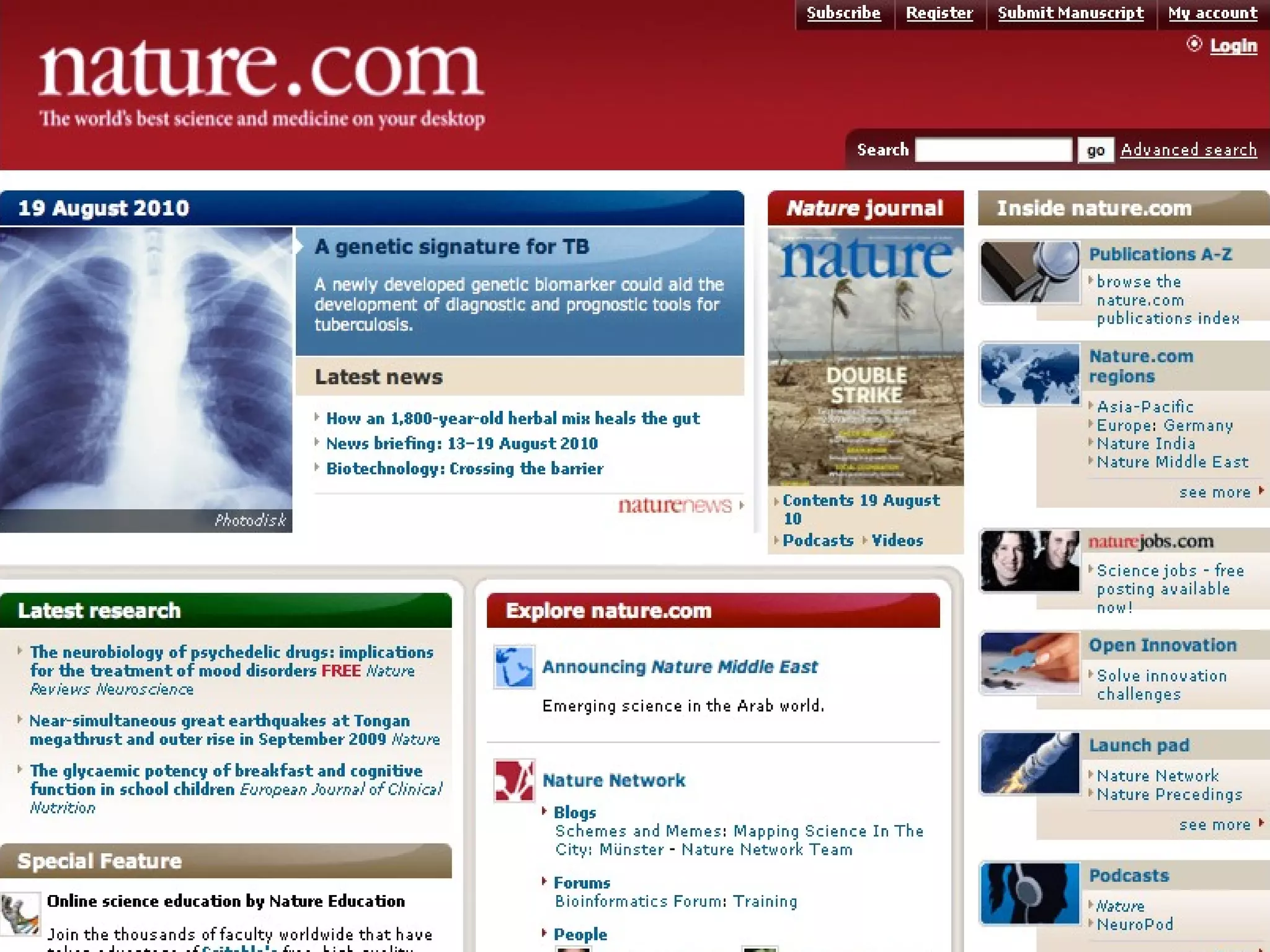
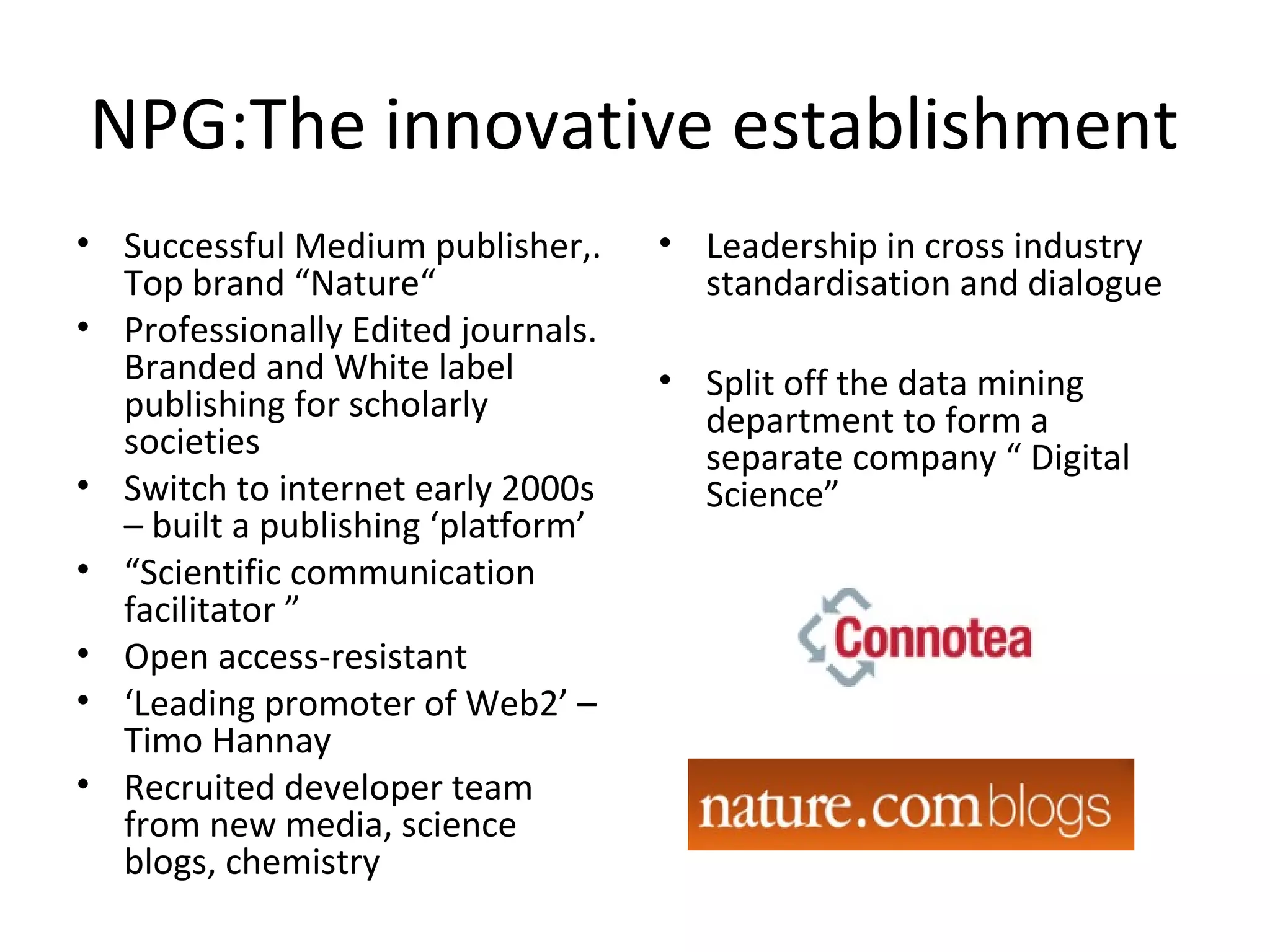
NPG:The innovative establishment
• Successful Medium publisher,.     • Leadership in cross industry
  Top brand “Nature“                  standardisation and dialogue
• Professionally Edited journals.
  Branded and White label           • Split off the data mining
  publishing for scholarly            department to form a
  societies                           separate company “ Digital
• Switch to internet early 2000s      Science”
  – built a publishing ‘platform’
• “Scientific communication
  facilitator ”
• Open access-resistant
• ‘Leading promoter of Web2’ –
  Timo Hannay
• Recruited developer team
  from new media, science
  blogs, chemistry
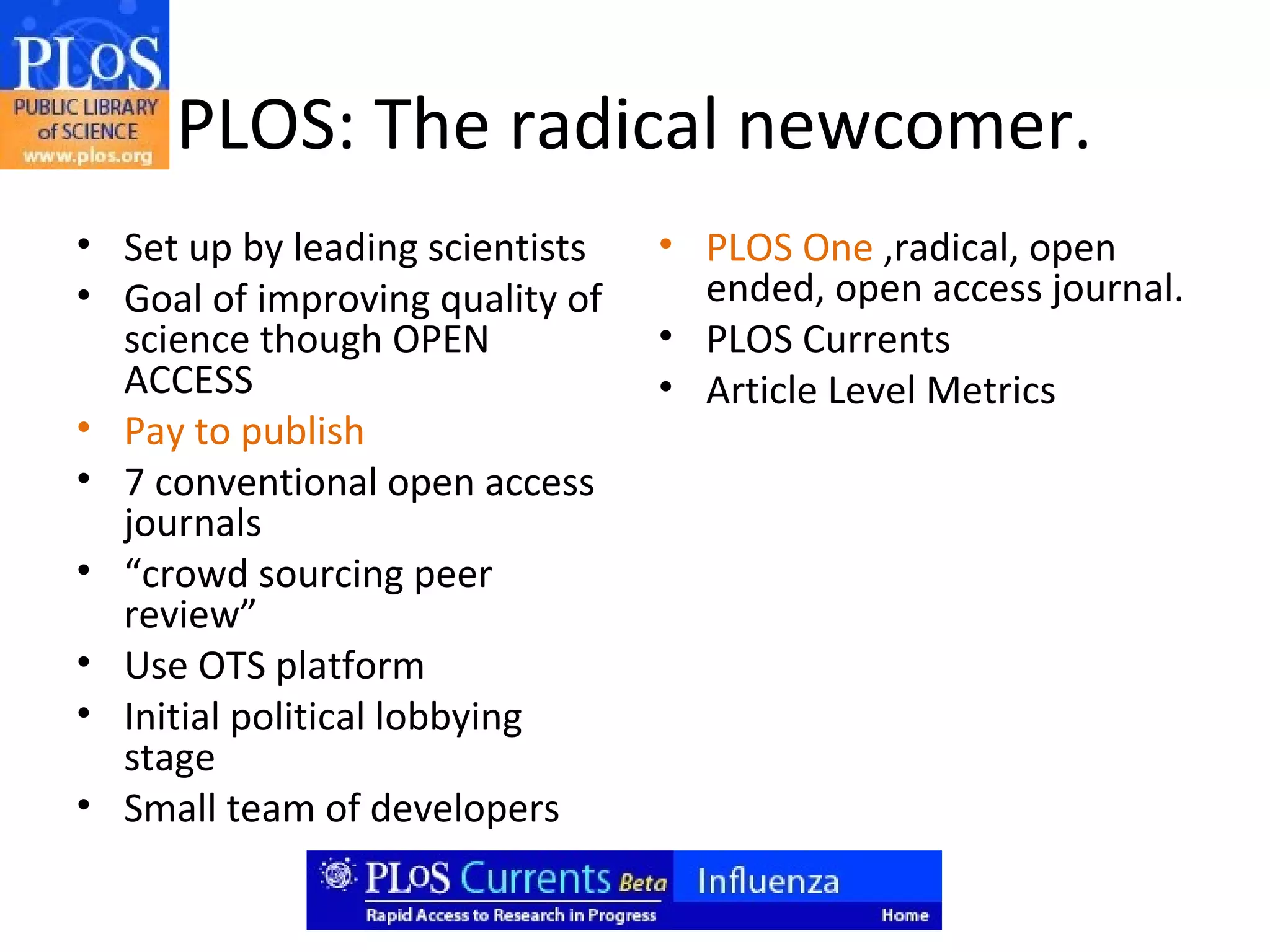
PLOS: The radical newcomer.
• Set up by leading scientists   • PLOS One ,radical, open
• Goal of improving quality of     ended, open access journal.
  science though OPEN            • PLOS Currents
  ACCESS                         • Article Level Metrics
• Pay to publish
• 7 conventional open access
  journals
• “crowd sourcing peer
  review”
• Use OTS platform
• Initial political lobbying
  stage
• Small team of developers
Academic publishers
• Suppliers are the customers
• Users are both readers and authors and
  effectively members of staff (reviewing,
  editing)
• Deeply dependent on the the ‘academic
  community’.
• Diversity of publishers –
  – University presses; multinationals
  – Small innovative; obstructive giants
Stage 1: “Mode of massive
               experimentation”
• 2007-2009 NPG and PLOS copied consumer Web2.0
  “social tools”
   –   Article Comments and rating
   –   Wiki editing
   –   Social network
   –   Social bookmarking
   –   Blogs (‘whitelist’)
   –   Multimedia
– Little ‘new’ technology or ideas
"If we’re going to fail hopefully we can fail quickly and
   cheaply but try different things and see what works
   and see what will be useful and also see what we can
   make money out of and what we can't." (NPG)
“Failure”
• Most Users rejected most things
   – Structural value of peer-review, publications in career progress,
     etc
   – Tensions within organisations
   – Antisocial academics!
• Publishers and the web journals behaving as Innovation
   intermediaries:
• facilitating social learning by interactions between
   developers, active users, the scientific community, journal
   editors etc
"Innovation comes from having 2 way communication
   channels to allow them [the users] to shape what we do.”
   (PLOS)
• publishers gain privileged information and data unavailable
   to others
Stage 2: A New Media strategy
• Web2.0 activity taking place outside their platforms
   – Blogs, Twitter, Friendfeed, Blogs
• Media strategy: Promote to external media, link back
  to article using human and automatic linking
   – Techniques to drive scholars and public to the articles
     (promotion, multimedia)
   – Raises value of journal to scholars to publish (impact
     factor)
   – Enhances discovery
   – Requires data-mining of unstructured data + emotion
     driven hype.
• New metrics : Article level Metrics. …
Stage 3: Raising value for scholar:
    discoverability and “linked data”
• Discovering knowledge
   – Old discovery: the Journal, the society, the discipline,
     citations, reviewing, discipline conference
   – New discovery: Search, interdisciplinary, new published
     objects, new metrics of use, New Social Media mentions
     and reviews, adhoc conferences

• New Discoverability pathways and networks
   – New ways to link into and out of contents of articles
      • Requires Annotations in the article, link-backs,
   – New published elements: data and methods
   – New indexes: libraries e.g. classifications of chemicals
   – Open and extended Metadata
Messy linking
• Journal articles are not well suited to machine
  annotation
• Linking citations to authors and other papers
  hard (for legacy)
• Some disciplines have object that can be
  automatically linked (chemicals), most do not.
• Need Human annotation.
New publisher role: insertion into the
            network:
• Who can do the new media promotion?
• Who can do the annotations?
  – Difficult, time consuming, specialist knowledge
     •   Authors? Limited skill and time
     •   The ‘crowd’ of readers? They don’t, and there isn’t a crowd
     •   Librarians…?
     •   Datamining machine? Yes, but only some.

• Lazy/Pragmatic answer: Let the publishers
  (editors) run the prepublication and post
  publication !
Limits of the publishers
• Limited resources
• Publishing businesses first,
   – technology users, developers, lobbyists secondary roles
• The journal ‘overflowing’: data, methods, Web etc
• Metadata generated inside and outside publisher
  control
• Technical systems better developed outside?
   – NPG -> web2.0 team split off to form ‘Digital Science’,
     division of Macmillan
   – PLOS limit their development
"What are academic publishers for?”
• Publishing articles – but new roles added to old ones –
  preparing manuscript, managing review
• Focused role and responsibilities allows them to focus
  on deep, and multilevel innovation.
• A key innovation intermediary: their place in network,
  control over ‘the article’ and publishing platform give
  them privileged position
   – Put the inventions related to articles in front of users at
     the point of use
• BUT others could do this too if the data were released?
• Pre-publication; Peer review – for another study
Reflections on methods
• Tools of STS allow us to describe more the
  emergence of ‘Web2.0”
• Need to explore in detail how decisions are
  made on forms, user interactions, affordances
  of information/data and systems, and usage
  by producers and users.
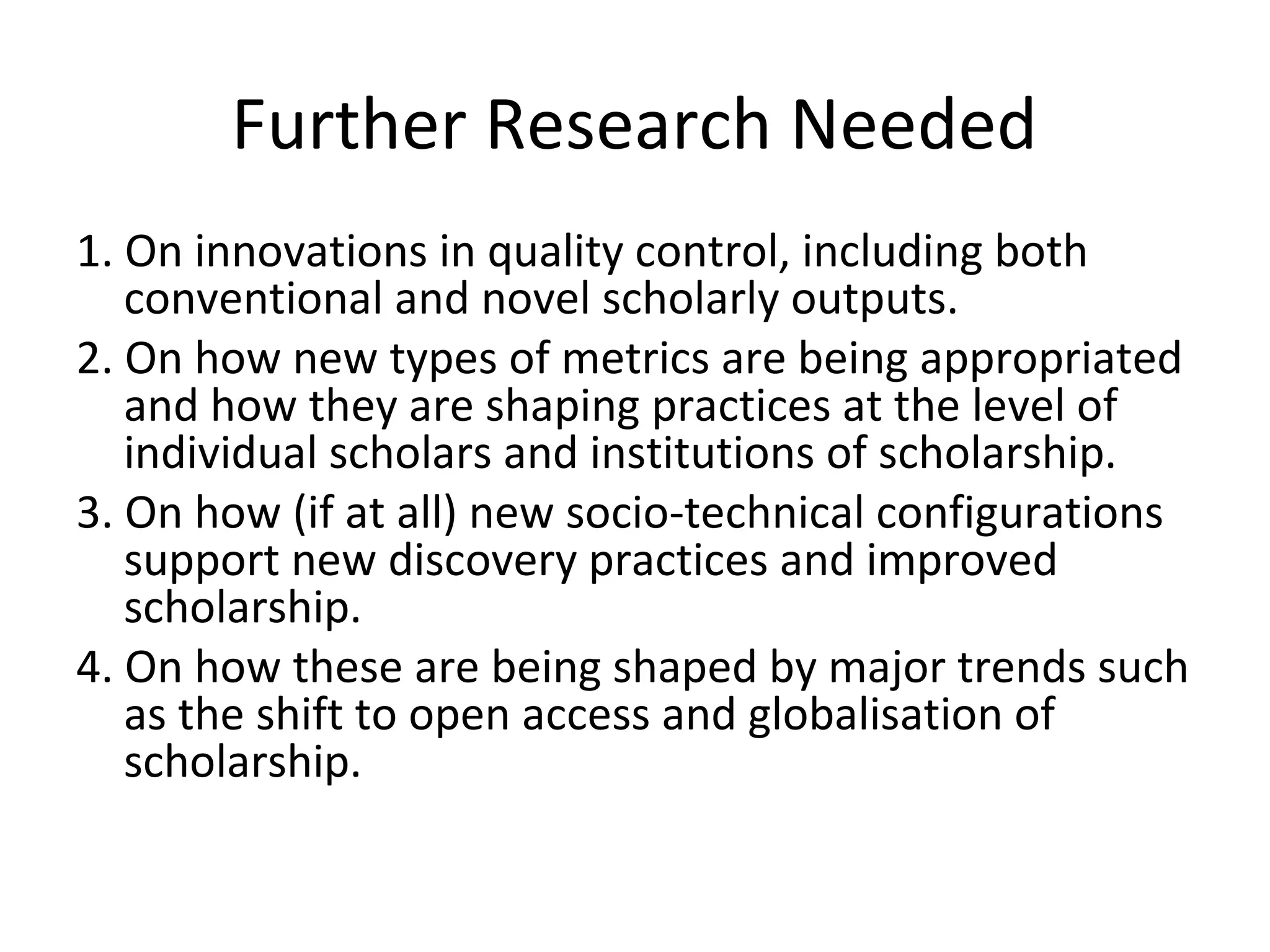
Further Research Needed
1. On innovations in quality control, including both
   conventional and novel scholarly outputs.
2. On how new types of metrics are being appropriated
   and how they are shaping practices at the level of
   individual scholars and institutions of scholarship.
3. On how (if at all) new socio-technical configurations
   support new discovery practices and improved
   scholarship.
4. On how these are being shaped by major trends such
   as the shift to open access and globalisation of
   scholarship.
Extra Slides
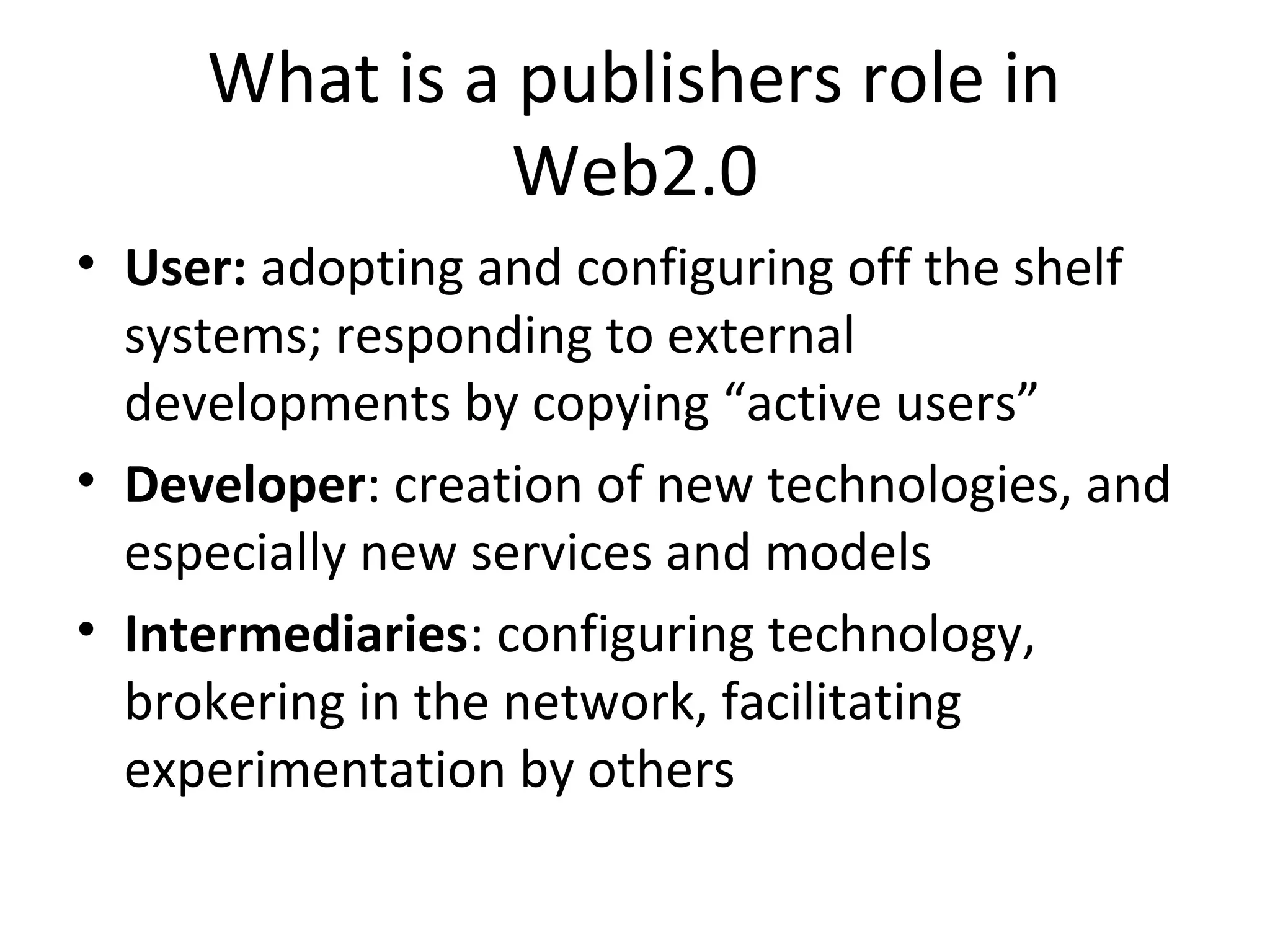
What is a publishers role in
               Web2.0
• User: adopting and configuring off the shelf
  systems; responding to external
  developments by copying “active users”
• Developer: creation of new technologies, and
  especially new services and models
• Intermediaries: configuring technology,
  brokering in the network, facilitating
  experimentation by others
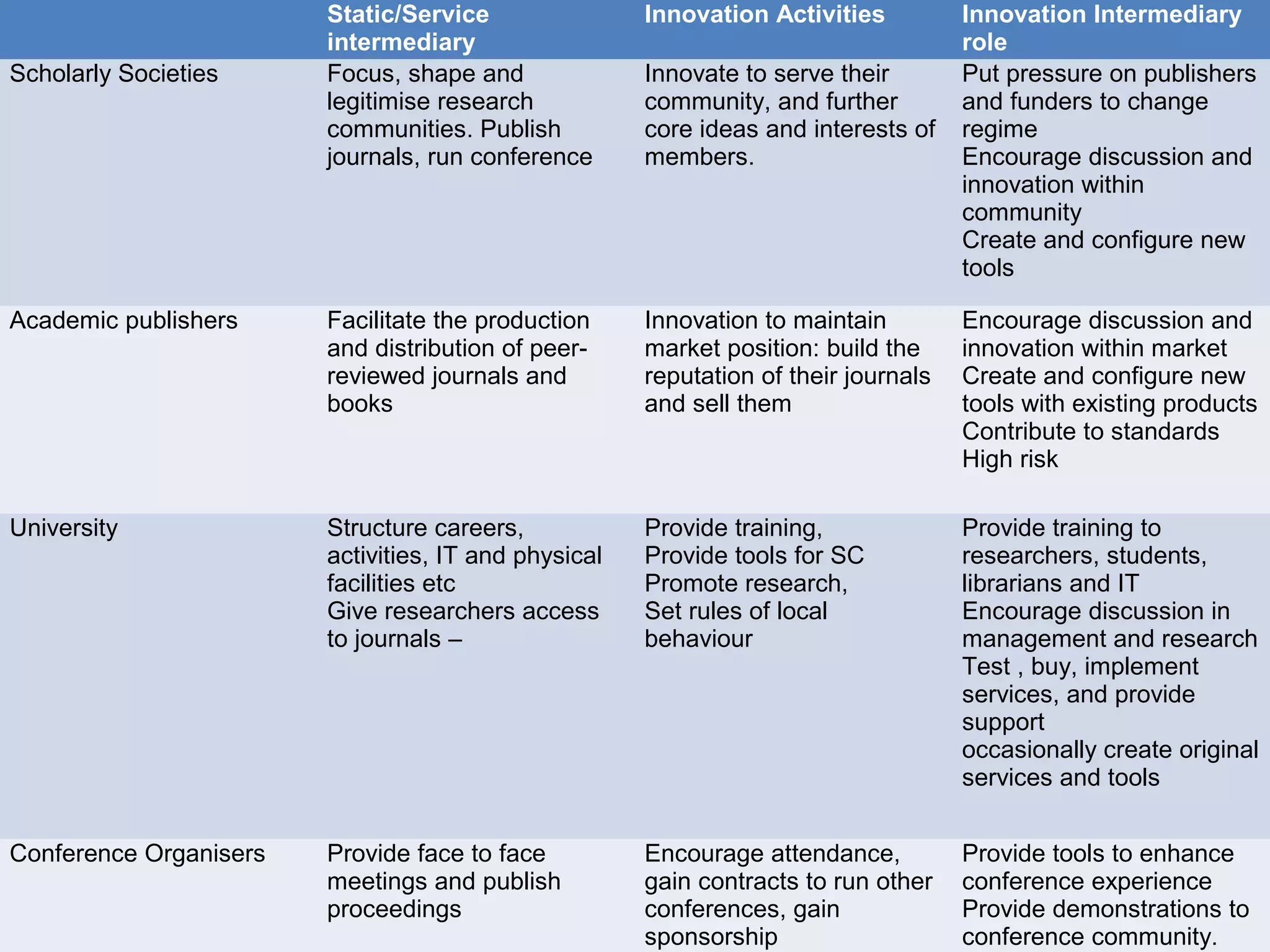
Static/Service                Innovation Activities          Innovation Intermediary
                        intermediary                                                 role
Scholarly Societies     Focus, shape and              Innovate to serve their        Put pressure on publishers
                        legitimise research           community, and further         and funders to change
                        communities. Publish          core ideas and interests of    regime
                        journals, run conference      members.                       Encourage discussion and
                                                                                     innovation within
                                                                                     community
                                                                                     Create and configure new
                                                                                     tools

Academic publishers     Facilitate the production     Innovation to maintain         Encourage discussion and
                        and distribution of peer-     market position: build the     innovation within market
                        reviewed journals and         reputation of their journals   Create and configure new
                        books                         and sell them                  tools with existing products
                                                                                     Contribute to standards
                                                                                     High risk

University              Structure careers,            Provide training,              Provide training to
                        activities, IT and physical   Provide tools for SC           researchers, students,
                        facilities etc                Promote research,              librarians and IT
                        Give researchers access       Set rules of local             Encourage discussion in
                        to journals –                 behaviour                      management and research
                                                                                     Test , buy, implement
                                                                                     services, and provide
                                                                                     support
                                                                                     occasionally create original
                                                                                     services and tools


Conference Organisers   Provide face to face          Encourage attendance,          Provide tools to enhance
                        meetings and publish          gain contracts to run other    conference experience
                        proceedings                   conferences, gain              Provide demonstrations to
                                                      sponsorship                    conference community.
Intermediary role

Making Web2.0 for science: Co-production of Web2.0 platforms and knowledge

  • 2.
    Making Web2.0 forscience James Stewart, JRC-IPTS, European Commission, Sevilla ISSTI, University of Edinburgh James Stewart1,3, Rob Procter2, Meik Poschen2, Robin Williams (Forthcoming) The role of academic publishers in shaping the development of Web 2.0 services for scholarly communications, New Media and Society
  • 3.
    What is Web2.0? 1. “Web 2.0 encompasses a variety of different meanings that include a) an increased emphasis on user-generated content, b) data and content sharing and collaborative effort, together with the use of various kinds of social software, c) new ways of interacting with web-based applications, and d) the use of the web as a platform for generating, re- purposing and consuming content.” (Franklin and van Harmelen, 2007) 2. Web 2.0 is a set of concrete examples and categories 3. Ways of developing: experimental, perpetual-beta 4. New media, information and knowledge forms
  • 4.
    Web 2.0 isnot a given: it is a work in progress ‘Web2.0’ in scholarship is emerging though socio- technical change processes in which the value, form and use of scholarly knowledge is being negotiated and changed, and the roles of key intermediaries tested – Explored with multi-method study of producers, users and intermediaries ‘Web2.0’ created by people investing, experimenting and creating ideas: a finite number of small teams lead this work, influenced by access to resources and a host of other constraints, and driven by visions of the potential of the technology. – Explored by examining the work of 2 teams, based in two conventional intermediaries of scholarly communication: academic publishing houses, PLOS and NPG (Macmillan)
  • 5.
    Empirical insights • Publishersare playing a role as user, developer, and intermediary in creating Web2.0 for scholars - but the story has only begun. The Story • Publishers driven by vision – better science though Web2.0 • User rejection of closed thin experimental reproductions of exemplar ‘social’ consumer Web2.0. led to • Deeper exploration of potential to integrate data-mining with human interpretative activities (writing searching, reading, annotation) • Knitting the ‘article’ closer into a broader network of new objects of scholarly communication • Revaluing the publisher role in a re-framed but conservative scholarly communication processes- the business of discovery
  • 6.
    Approach • A socialshaping approach – Social technical change through interactions of multiple stakeholder (MacKenzie and Wajcman; Williams and Edge; Bijker;) • Social learning approach – Long process of experimentation, learning, failure and reinvention of common socio-technical frames, where tentative technical configurations and user and stakeholder representations are tested and ‘solidified’ through cycles of development and domestication of technology (Sørensen; Williams, Stewart, Slack.; Hyysalo ) • Innovation Intermediary approach – Beyond users and producers: Hybrids that stimulate, facilitate, configure and broker the social shaping and social learning processes (Howells, Stewart and Hyysalo )
  • 7.
    Questions • How arescholarly publishers contributing to the development of Web2.0? – How are they doing this, within the context of broader dynamics in scholarly communication? – What are the results of this work? • What can we learn more generally about how we are inventing “Web2.0”
  • 8.
    Study context • “Adoptionand Use of Web 2.0 in Scholarly Communications” funded by RIN 2009 • Representative survey of UK scholarly community to discover basic use and awareness. • 50+ in-depth interviews on scholarly communications and Web 2.0. • Case studies of promoters, developers and users of specific Web 2.0 services • Exploring adoption and non-adoption, domestication, adoption features (barriers, drivers etc) and impact on behaviour of broad range of ‘ Web2.0’ services
  • 9.
    Survey results • Web2.0just beginning; 10% active users • Enthusiasm for change and tools to support interdisciplinary work • Conservatism related to use of articles, status of articles and understanding of new tools • Discovery though search most popular • Only use new tools when it is put in front of their noses • Failure of adhoc new systems dependent on other people’s use, and with any sort of learning curve. • Deep disciplinary differences
  • 10.
    Publisher cases • Documentary and technological evidence (papers, blogs, websites webtools, journals etc) • 1 hr semi structured interviews with members of teams exploring – Motivations – the organisational interests and constraints, – 'practice-bound' visions (Hyysalo, 2006) – Activities in technological, business, publishing and political arenas – representations of potential users and themselves – interactions with stakeholders and end-users. • Follow up interviews with directors, and review of literature and documentary evidence; discussion of research findings • Draw on broader results of Web2.0 survey • NPG (Publishing director, 4 members of development team, editor of Nature Chemistry) • PLOS (publishing, technology and marketing managers)
  • 11.
    What is ScholarlyCommunications? A range of formal and informal communications: • In developing ideas, preparing, shaping and disseminating formal results – Usually conceived of as roughly linear process • Pursuing personal careers, managing research teams and research programmes; • In teaching and communicating scholarly ideas to broader communities. Special techniques and tools for the advancement of scholarship- e.g. scientific method, peer-review “journal publication dominates our definition of a unit of communication” Sompel 2004 Privileged role given to the academic article, which becomes a tool in scholarly careers advancement and research business
  • 12.
    Dynamic Structural Context •‘Crisis’ in Publishing – publishers, peer review etc • ‘Hot’ Open Science Movement • Fight over the governance and business of scholarship (Elsevier Boycott, Green v. Gold) • Scholarly communication moves online: • Globalisation of Research • Emphasis on interdisciplinary and inter-institutional research • Increasing metrification of publication • Opening of Industry research (Pharma, IT) • Mass market adoption of ‘Web2.0’ including by scholars • “New units of scholarly communication” Sompel et al 2004 • Massive diversity in scholarly practice across disciplines, countries, institutions etc. diversity in embracing new forms of communication e.g. • physics – arXiv; bio-informaticians - friendfeed
  • 13.
    Web2.0: The ‘Radical’Open Research position • Web 2.0 provides the technical platform essential to the ‘re-evolution’ of Science – it allows the scholarly community to return to it roots of open scholarship and trustworthy peer-review. • The ossified institutions of scholarly research: universities, libraries, academic publishers, venerable scholarly societies etc have lost their purpose and benefits in the world of global electronically mediated, cross-disciplinary research. • Challenge gatekeeper role of journals • “What are academic publishers for” (JSC 2012) – they neither prepare manuscripts or manage review.
  • 15.
    Examples(provocation!) • Visiting Googlereplaces visiting Libraries • Open-reviewed blogs replacing peer-reviewed paper journal • Data and methods shared on open websites • Journal articles judged on own value, rather than on ranking of journal • Articles published online with free access • Research teams distributed and electronically mediated. • Global online communities replacing old ‘disciplinary scholarly societies • Hyperlinked discovery replaces journal and library organised discovery.
  • 16.
  • 18.
    NPG:The innovative establishment •Successful Medium publisher,. • Leadership in cross industry Top brand “Nature“ standardisation and dialogue • Professionally Edited journals. Branded and White label • Split off the data mining publishing for scholarly department to form a societies separate company “ Digital • Switch to internet early 2000s Science” – built a publishing ‘platform’ • “Scientific communication facilitator ” • Open access-resistant • ‘Leading promoter of Web2’ – Timo Hannay • Recruited developer team from new media, science blogs, chemistry
  • 19.
    PLOS: The radicalnewcomer. • Set up by leading scientists • PLOS One ,radical, open • Goal of improving quality of ended, open access journal. science though OPEN • PLOS Currents ACCESS • Article Level Metrics • Pay to publish • 7 conventional open access journals • “crowd sourcing peer review” • Use OTS platform • Initial political lobbying stage • Small team of developers
  • 20.
    Academic publishers • Suppliersare the customers • Users are both readers and authors and effectively members of staff (reviewing, editing) • Deeply dependent on the the ‘academic community’. • Diversity of publishers – – University presses; multinationals – Small innovative; obstructive giants
  • 21.
    Stage 1: “Modeof massive experimentation” • 2007-2009 NPG and PLOS copied consumer Web2.0 “social tools” – Article Comments and rating – Wiki editing – Social network – Social bookmarking – Blogs (‘whitelist’) – Multimedia – Little ‘new’ technology or ideas "If we’re going to fail hopefully we can fail quickly and cheaply but try different things and see what works and see what will be useful and also see what we can make money out of and what we can't." (NPG)
  • 22.
    “Failure” • Most Usersrejected most things – Structural value of peer-review, publications in career progress, etc – Tensions within organisations – Antisocial academics! • Publishers and the web journals behaving as Innovation intermediaries: • facilitating social learning by interactions between developers, active users, the scientific community, journal editors etc "Innovation comes from having 2 way communication channels to allow them [the users] to shape what we do.” (PLOS) • publishers gain privileged information and data unavailable to others
  • 23.
    Stage 2: ANew Media strategy • Web2.0 activity taking place outside their platforms – Blogs, Twitter, Friendfeed, Blogs • Media strategy: Promote to external media, link back to article using human and automatic linking – Techniques to drive scholars and public to the articles (promotion, multimedia) – Raises value of journal to scholars to publish (impact factor) – Enhances discovery – Requires data-mining of unstructured data + emotion driven hype. • New metrics : Article level Metrics. …
  • 24.
    Stage 3: Raisingvalue for scholar: discoverability and “linked data” • Discovering knowledge – Old discovery: the Journal, the society, the discipline, citations, reviewing, discipline conference – New discovery: Search, interdisciplinary, new published objects, new metrics of use, New Social Media mentions and reviews, adhoc conferences • New Discoverability pathways and networks – New ways to link into and out of contents of articles • Requires Annotations in the article, link-backs, – New published elements: data and methods – New indexes: libraries e.g. classifications of chemicals – Open and extended Metadata
  • 25.
    Messy linking • Journalarticles are not well suited to machine annotation • Linking citations to authors and other papers hard (for legacy) • Some disciplines have object that can be automatically linked (chemicals), most do not. • Need Human annotation.
  • 26.
    New publisher role:insertion into the network: • Who can do the new media promotion? • Who can do the annotations? – Difficult, time consuming, specialist knowledge • Authors? Limited skill and time • The ‘crowd’ of readers? They don’t, and there isn’t a crowd • Librarians…? • Datamining machine? Yes, but only some. • Lazy/Pragmatic answer: Let the publishers (editors) run the prepublication and post publication !
  • 27.
    Limits of thepublishers • Limited resources • Publishing businesses first, – technology users, developers, lobbyists secondary roles • The journal ‘overflowing’: data, methods, Web etc • Metadata generated inside and outside publisher control • Technical systems better developed outside? – NPG -> web2.0 team split off to form ‘Digital Science’, division of Macmillan – PLOS limit their development
  • 28.
    "What are academicpublishers for?” • Publishing articles – but new roles added to old ones – preparing manuscript, managing review • Focused role and responsibilities allows them to focus on deep, and multilevel innovation. • A key innovation intermediary: their place in network, control over ‘the article’ and publishing platform give them privileged position – Put the inventions related to articles in front of users at the point of use • BUT others could do this too if the data were released? • Pre-publication; Peer review – for another study
  • 29.
    Reflections on methods •Tools of STS allow us to describe more the emergence of ‘Web2.0” • Need to explore in detail how decisions are made on forms, user interactions, affordances of information/data and systems, and usage by producers and users.
  • 30.
    Further Research Needed 1.On innovations in quality control, including both conventional and novel scholarly outputs. 2. On how new types of metrics are being appropriated and how they are shaping practices at the level of individual scholars and institutions of scholarship. 3. On how (if at all) new socio-technical configurations support new discovery practices and improved scholarship. 4. On how these are being shaped by major trends such as the shift to open access and globalisation of scholarship.
  • 31.
  • 32.
    What is apublishers role in Web2.0 • User: adopting and configuring off the shelf systems; responding to external developments by copying “active users” • Developer: creation of new technologies, and especially new services and models • Intermediaries: configuring technology, brokering in the network, facilitating experimentation by others
  • 33.
    Static/Service Innovation Activities Innovation Intermediary intermediary role Scholarly Societies Focus, shape and Innovate to serve their Put pressure on publishers legitimise research community, and further and funders to change communities. Publish core ideas and interests of regime journals, run conference members. Encourage discussion and innovation within community Create and configure new tools Academic publishers Facilitate the production Innovation to maintain Encourage discussion and and distribution of peer- market position: build the innovation within market reviewed journals and reputation of their journals Create and configure new books and sell them tools with existing products Contribute to standards High risk University Structure careers, Provide training, Provide training to activities, IT and physical Provide tools for SC researchers, students, facilities etc Promote research, librarians and IT Give researchers access Set rules of local Encourage discussion in to journals – behaviour management and research Test , buy, implement services, and provide support occasionally create original services and tools Conference Organisers Provide face to face Encourage attendance, Provide tools to enhance meetings and publish gain contracts to run other conference experience proceedings conferences, gain Provide demonstrations to sponsorship conference community.
  • 34.

Editor's Notes

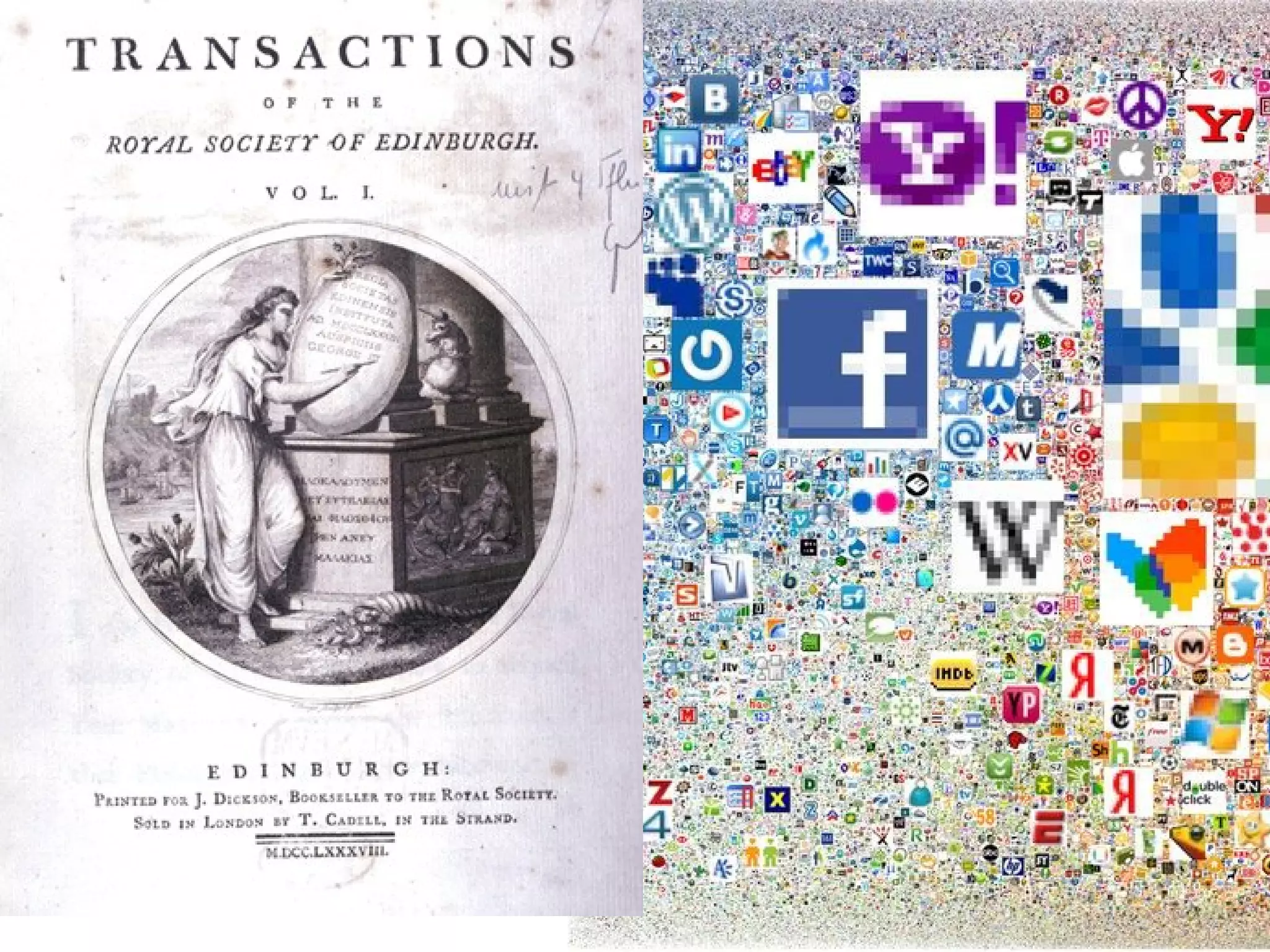
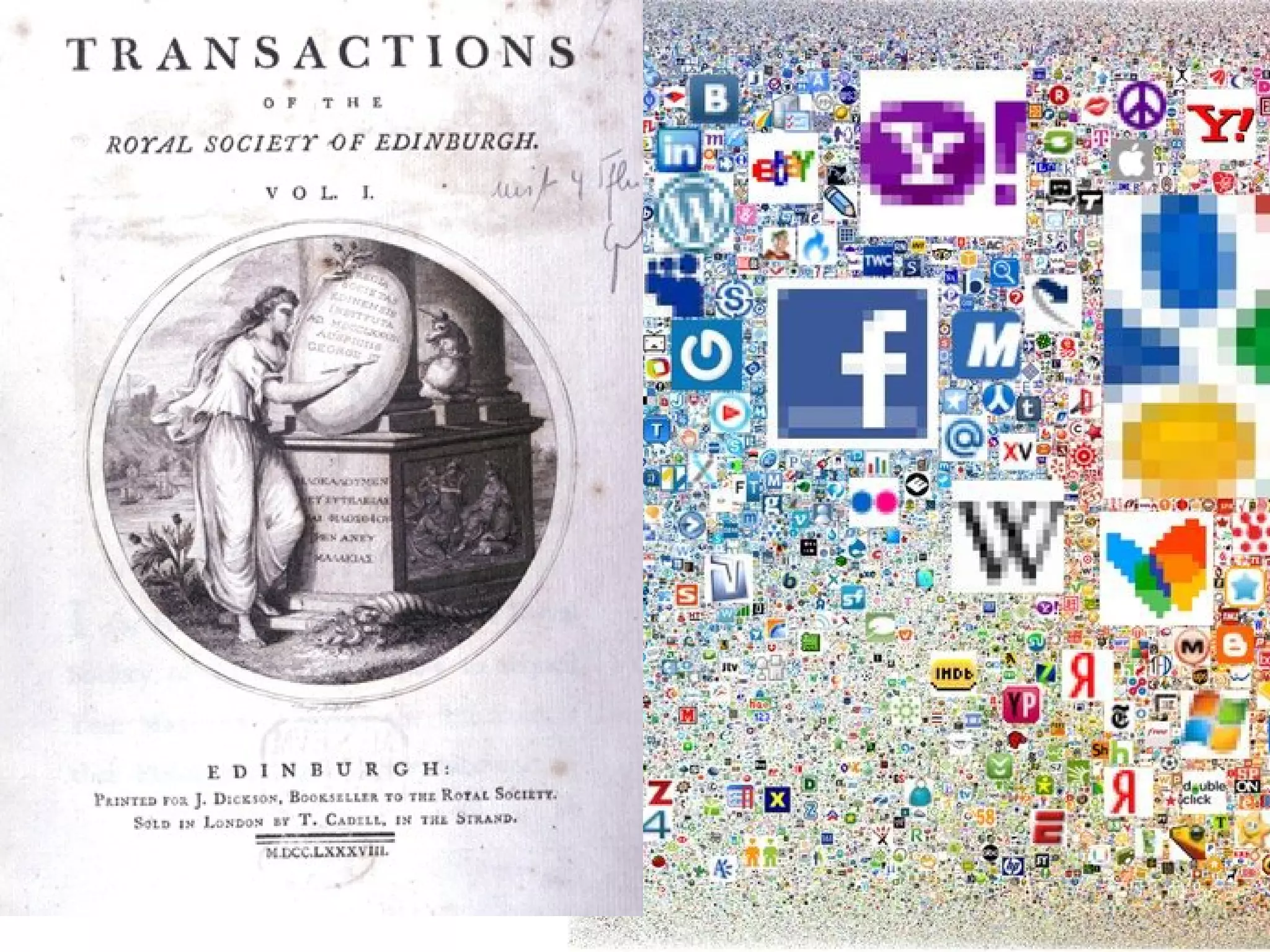
  • #2 The case is situated in the field of Scholarly Communication. This is the term used to describe what we are doing now, and all the other forms of communications that researchers have in the course doing research. These communications include: lectures, research meetings, academic papers, conference papers, letters and conversations between researchers, public communications etc. The bedrock of formal scholarly communications is the academic paper, published in a peer reviewed scholarly journal. The 18 th century ‘ideal form’ is scientific and philosophical scholars presenting papers in person, or writing letters to the learned society, and having them subject to peer scrutiny, and possibly published in the in Review or Letters of the society. The members of the Society make up the Society. However, as the Society takes on rules, and formal officers, it becomes institutionalised, and we can start to talk of the Society being the intermediary in the development of scientific knowledge. The Society has a library, lecturer theatres, rules, a president etc. Members may vote and propose changes to operations, but we start to see change and innovation in scholarly communication mediated by the Society. Fast forward 200 years.
  • #12 The case is situated in the field of Scholarly Communication. This is the term used to describe what we are doing now, and all the other forms of communications that researchers have in the course doing research. These communications include: lectures, research meetings, academic papers, conference papers, letters and conversations between researchers, public communications etc. The bedrock of formal scholarly communications is the academic paper, published in a peer reviewed scholarly journal. The 18 th century ‘ideal form’ is scientific and philosophical scholars presenting papers in person, or writing letters to the learned society, and having them subject to peer scrutiny, and possibly published in the in Review or Letters of the society. The members of the Society make up the Society. However, as the Society takes on rules, and formal officers, it becomes institutionalised, and we can start to talk of the Society being the intermediary in the development of scientific knowledge. The Society has a library, lecturer theatres, rules, a president etc. Members may vote and propose changes to operations, but we start to see change and innovation in scholarly communication mediated by the Society. Fast forward 200 years. Many societies still run journals, largely outsourcing them to professional publishers. Many publishers run their own scholarly journals. These have boards of scholars giving them direction, scholars do the peer reviewing. The journals are bought largely by University and laboratory libraries, who give access to scholars, but are finding themselves bypassed, since the majority of published material is obtained on the Internet. With a proliferation of journals, and high fees paid by libraries for access to ‘bundles’ of journals, the Open access movement is leading to many scholarly papers appearing, legitimately or illegimately, online to download for free. Activiists for open science are criticising the journal publishers for throttling science, and scientific funders and universities for promoting systems of reward based on papers being judged by the ‘ranking’ of journals they appear in, rather then their intrinsic scientific worth. The open access/ open science ‘movement’ is heavily reliant on an idea of the internet as a key driver for change and innovation in scholarly communication. While old style communication actually provided a model for free and flexible communication using the Web and the internet , it seems that the rest of the world is moving ahead of the world of research in its innovation and use of ‘Web2.0’. While high energy physics has been the source of the WWW and Open access repository, most research communication is heavily dependent on a slow, commericalised and bureaucratised publishing system. Meanwhile individual scholars search using Google, use email, mailing lists, post papers on their websites, email each other pdfs, and many are turning to tools from outside the domain of Universities, using del.ici.ous, google, youtube, facebook, twitter, blogging services, slide sharing etc etc. s
  • #13 Many societies still run journals, largely outsourcing them to professional publishers. Many publishers run their own scholarly journals. These have boards of scholars giving them direction, scholars do the peer reviewing. The journals are bought largely by University and laboratory libraries, who give access to scholars, but are finding themselves bypassed, since the majority of published material is obtained on the Internet. With a proliferation of journals, and high fees paid by libraries for access to ‘bundles’ of journals, the Open access movement is leading to many scholarly papers appearing, legitimately or illegimately, online to download for free. Activiists for open science are criticising the journal publishers for throttling science, and scientific funders and universities for promoting systems of reward based on papers being judged by the ‘ranking’ of journals they appear in, rather then their intrinsic scientific worth. The open access/ open science ‘movement’ is heavily reliant on an idea of the internet as a key driver for change and innovation in scholarly communication. While old style communication actually provided a model for free and flexible communication using the Web and the internet , it seems that the rest of the world is moving ahead of the world of research in its innovation and use of ‘Web2.0’. While high energy physics has been the source of the WWW and Open access repository, most research communication is heavily dependent on a slow, commericalised and bureaucratised publishing system. Meanwhile individual scholars search using Google, use email, mailing lists, post papers on their websites, email each other pdfs, and many are turning to tools from outside the domain of Universities, using del.ici.ous, google, youtube, facebook, twitter, blogging services, slide sharing etc etc. s
  • #15 The case is situated in the field of Scholarly Communication. This is the term used to describe what we are doing now, and all the other forms of communications that researchers have in the course doing research. These communications include: lectures, research meetings, academic papers, conference papers, letters and conversations between researchers, public communications etc. The bedrock of formal scholarly communications is the academic paper, published in a peer reviewed scholarly journal. The 18 th century ‘ideal form’ is scientific and philosophical scholars presenting papers in person, or writing letters to the learned society, and having them subject to peer scrutiny, and possibly published in the in Review or Letters of the society. The members of the Society make up the Society. However, as the Society takes on rules, and formal officers, it becomes institutionalised, and we can start to talk of the Society being the intermediary in the development of scientific knowledge. The Society has a library, lecturer theatres, rules, a president etc. Members may vote and propose changes to operations, but we start to see change and innovation in scholarly communication mediated by the Society. Fast forward 200 years.