Framing the landscape
Brian Lavoie
Research Scientist
OCLC Research
December 10, 2014
Workshop on the Evolving Scholarly Record
Washington, DC
The Evolving Scholarly Record
What is scholarly?
2
“Avoid activities that will distract you from research.
Whatever you do, do not start a blog. That will only
establish your lack of seriousness as a scholar.”
Greg Mankiw’s Blog [February 24, 2007]
“ … I wanted to officially announce some good news –
Savage Minds is now being archived at the University
of Texas at Austin … SM really has become the blog
of record for the sociocultural anthropological
internetosphere.”
Savage Minds Blog [October 24, 2014]
Content of scholarly record evolving …
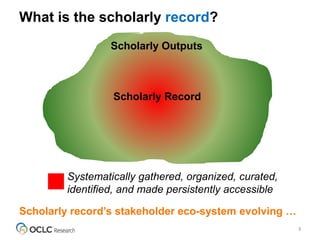
What is the scholarly record?
3
Systematically gathered, organized, curated,
identified, and made persistently accessible
Scholarly Outputs
Scholarly Record
Scholarly record’s stakeholder eco-system evolving …
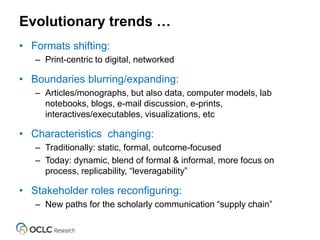
Evolutionary trends …
• Formats shifting:
– Print-centric to digital, networked
• Boundaries blurring/expanding:
– Articles/monographs, but also data, computer models, lab
notebooks, blogs, e-mail discussion, e-prints,
interactives/executables, visualizations, etc
• Characteristics changing:
– Traditionally: static, formal, outcome-focused
– Today: dynamic, blend of formal & informal, more focus on
process, replicability, “leveragability”
• Stakeholder roles reconfiguring:
– New paths for the scholarly communication “supply chain”
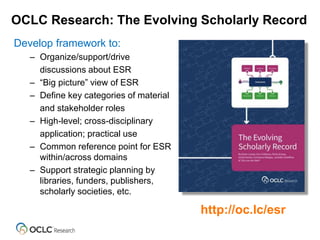
OCLC Research: The Evolving Scholarly Record
Develop framework to:
– Organize/support/drive
discussions about ESR
– “Big picture” view of ESR
– Define key categories of material
and stakeholder roles
– High-level; cross-disciplinary
application; practical use
– Common reference point for ESR
within/across domains
– Support strategic planning by
libraries, funders, publishers,
scholarly societies, etc.
http://oc.lc/esr
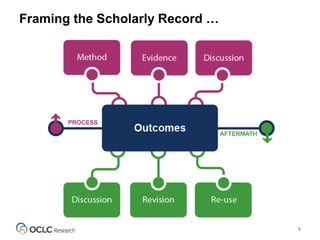
Framing the Scholarly Record …
6
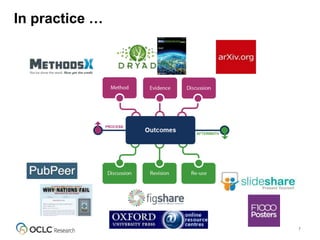
In practice …
7
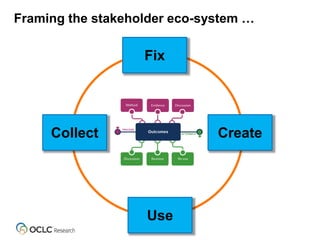
Framing the stakeholder eco-system …
Create
Use
Collect
Fix
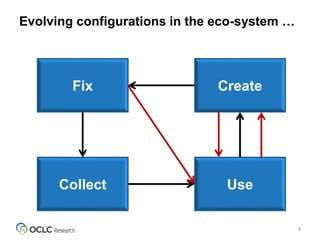
Evolving configurations in the eco-system …
9
Create
UseCollect
Fix
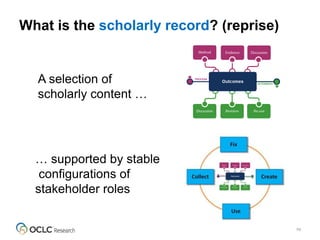
What is the scholarly record? (reprise)
10
A selection of
scholarly content …
… supported by stable
configurations of
stakeholder roles
Thank You!
©2014 OCLC. This work is licensed under a Creative Commons Attribution 3.0 Unported License. Suggested attribution: “This
work uses content from [presentation title] © OCLC, used under a Creative Commons Attribution license:
http://creativecommons.org/licenses/by/3.0/”
Brian Lavoie
OCLC Research
lavoie@oclc.org
11

The Evolving Scholarly Record: Framing the Landscape

  • 1.
    Framing the landscape BrianLavoie Research Scientist OCLC Research December 10, 2014 Workshop on the Evolving Scholarly Record Washington, DC The Evolving Scholarly Record
  • 2.
    What is scholarly? 2 “Avoidactivities that will distract you from research. Whatever you do, do not start a blog. That will only establish your lack of seriousness as a scholar.” Greg Mankiw’s Blog [February 24, 2007] “ … I wanted to officially announce some good news – Savage Minds is now being archived at the University of Texas at Austin … SM really has become the blog of record for the sociocultural anthropological internetosphere.” Savage Minds Blog [October 24, 2014] Content of scholarly record evolving …
  • 3.
    What is thescholarly record? 3 Systematically gathered, organized, curated, identified, and made persistently accessible Scholarly Outputs Scholarly Record Scholarly record’s stakeholder eco-system evolving …
  • 4.
    Evolutionary trends … •Formats shifting: – Print-centric to digital, networked • Boundaries blurring/expanding: – Articles/monographs, but also data, computer models, lab notebooks, blogs, e-mail discussion, e-prints, interactives/executables, visualizations, etc • Characteristics changing: – Traditionally: static, formal, outcome-focused – Today: dynamic, blend of formal & informal, more focus on process, replicability, “leveragability” • Stakeholder roles reconfiguring: – New paths for the scholarly communication “supply chain”
  • 5.
    OCLC Research: TheEvolving Scholarly Record Develop framework to: – Organize/support/drive discussions about ESR – “Big picture” view of ESR – Define key categories of material and stakeholder roles – High-level; cross-disciplinary application; practical use – Common reference point for ESR within/across domains – Support strategic planning by libraries, funders, publishers, scholarly societies, etc. http://oc.lc/esr
  • 6.
  • 7.
  • 8.
    Framing the stakeholdereco-system … Create Use Collect Fix
  • 9.
    Evolving configurations inthe eco-system … 9 Create UseCollect Fix
  • 10.
    What is thescholarly record? (reprise) 10 A selection of scholarly content … … supported by stable configurations of stakeholder roles
  • 11.
    Thank You! ©2014 OCLC.This work is licensed under a Creative Commons Attribution 3.0 Unported License. Suggested attribution: “This work uses content from [presentation title] © OCLC, used under a Creative Commons Attribution license: http://creativecommons.org/licenses/by/3.0/” Brian Lavoie OCLC Research lavoie@oclc.org 11

Editor's Notes

  • #4 Scholarly outputs … amorphous collection of materials , the boundaries of which are somewhat indistinct New configurations of stakeholder roles are being enacted around the scholarly record
  • #8 http://global.oup.com/uk/orc/busecon/economics/carlin/
  • #10 Traditional print configuration Collection dis-intermediated