Data and Innovation in
the Public Sector
Ritchie Somerville, James Stewart and
Ewan Klein
Edinburgh Living Lab
University of Edinburgh
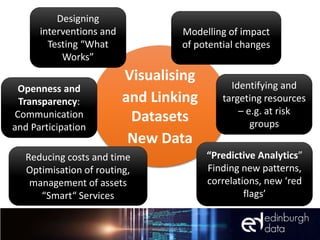
Visualising
and Linking
Datasets
New Data
“Predictive Analytics”
Finding new patterns,
correlations, new ‘red
flags’
Reducing costs and time
Optimisation of routing,
management of assets
“Smart“ Services
Openness and
Transparency:
Communication
and Participation
Designing
interventions and
Testing “What
Works”
Identifying and
targeting resources
– e.g. at risk
groups
Modelling of impact
of potential changes
Example
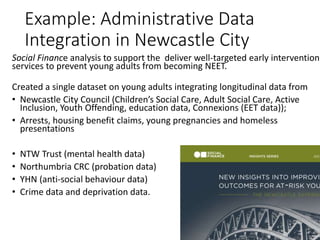
Example: Administrative Data
Integration in Newcastle City
Social Finance analysis to support the deliver well-targeted early intervention
services to prevent young adults from becoming NEET.
Created a single dataset on young adults integrating longitudinal data from
• Newcastle City Council (Children’s Social Care, Adult Social Care, Active
Inclusion, Youth Offending, education data, Connexions (EET data));
• Arrests, housing benefit claims, young pregnancies and homeless
presentations
• NTW Trust (mental health data)
• Northumbria CRC (probation data)
• YHN (anti-social behaviour data)
• Crime data and deprivation data.
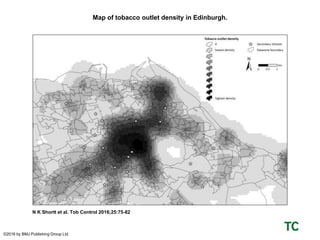
Map of tobacco outlet density in Edinburgh.
N K Shortt et al. Tob Control 2016;25:75-82
©2016 by BMJ Publishing Group Ltd
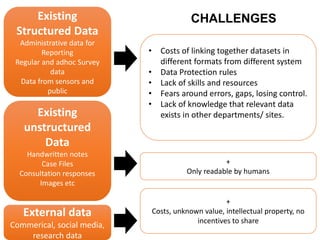
Existing
Structured Data
Administrative data for
Reporting
Regular and adhoc Survey
data
Data from sensors and
public
Existing
unstructured
Data
Handwritten notes
Case Files
Consultation responses
Images etc
• Costs of linking together datasets in
different formats from different system
• Data Protection rules
• Lack of skills and resources
• Fears around errors, gaps, losing control.
• Lack of knowledge that relevant data
exists in other departments/ sites.
+
Only readable by humans
External data
Commerical, social media,
research data
+
Costs, unknown value, intellectual property, no
incentives to share
CHALLENGES
Existing
Structured
Data
Existing
unstructured
Data
External
datasets
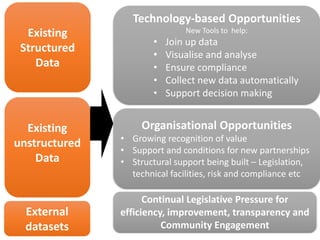
Technology-based Opportunities
New Tools to help:
• Join up data
• Visualise and analyse
• Ensure compliance
• Collect new data automatically
• Support decision making
Organisational Opportunities
• Growing recognition of value
• Support and conditions for new partnerships
• Structural support being built – Legislation,
technical facilities, risk and compliance etc
Continual Legislative Pressure for
efficiency, improvement, transparency and
Community Engagement
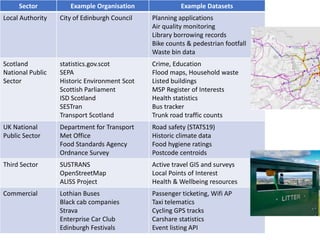
Sector Example Organisation Example Datasets
Local Authority City of Edinburgh Council Planning applications
Air quality monitoring
Library borrowing records
Bike counts & pedestrian footfall
Waste bin data
Scotland
National Public
Sector
statistics.gov.scot
SEPA
Historic Environment Scot
Scottish Parliament
ISD Scotland
SESTran
Transport Scotland
Crime, Education
Flood maps, Household waste
Listed buildings
MSP Register of Interests
Health statistics
Bus tracker
Trunk road traffic counts
UK National
Public Sector
Department for Transport
Met Office
Food Standards Agency
Ordnance Survey
Road safety (STATS19)
Historic climate data
Food hygiene ratings
Postcode centroids
Third Sector SUSTRANS
OpenStreetMap
ALISS Project
Active travel GIS and surveys
Local Points of Interest
Health & Wellbeing resources
Commercial Lothian Buses
Black cab companies
Strava
Enterprise Car Club
Edinburgh Festivals
Passenger ticketing, Wifi AP
Taxi telematics
Cycling GPS tracks
Carshare statistics
Event listing API
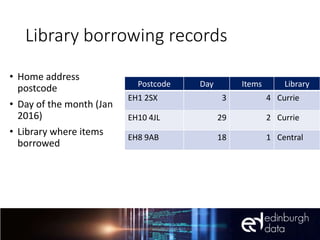
Library borrowing records
• Home address
postcode
• Day of the month (Jan
2016)
• Library where items
borrowed
Postcode Day Items Library
EH1 2SX 3 4 Currie
EH10 4JL 29 2 Currie
EH8 9AB 18 1 Central
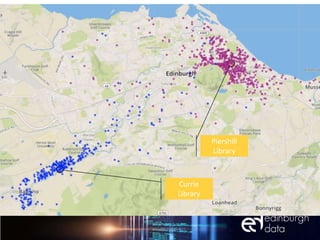
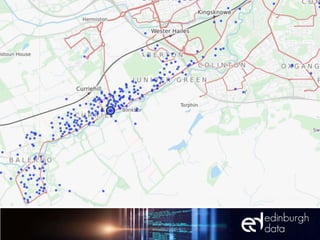
Currie
Library
Piershill
Library
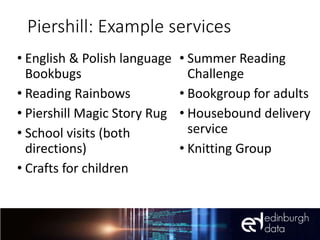
Piershill: Example services
• English & Polish language
Bookbugs
• Reading Rainbows
• Piershill Magic Story Rug
• School visits (both
directions)
• Crafts for children
• Summer Reading
Challenge
• Bookgroup for adults
• Housebound delivery
service
• Knitting Group
Libraries & Community Centres
• How do catchment areas relate to ‘natural
neighbourhoods’?
• How important are transport links?
• Can we build a better picture of how services
offered by libraries and community centres meet
local needs?
• What other data sets could we combine with
library catchment areas?
Exploring partnerships and use
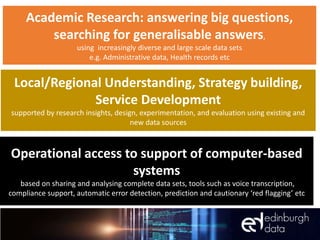
Academic Research: answering big questions,
searching for generalisable answers,
using increasingly diverse and large scale data sets
e.g. Administrative data, Health records etc
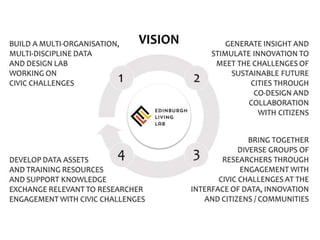
Local/Regional Understanding, Strategy building,
Service Development
supported by research insights, design, experimentation, and evaluation using existing and
new data sources
Operational access to support of computer-based
systems
based on sharing and analysing complete data sets, tools such as voice transcription,
compliance support, automatic error detection, prediction and cautionary ‘red flagging’ etc
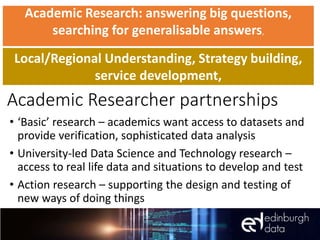
Academic Researcher partnerships
• ‘Basic’ research – academics want access to datasets and
provide verification, sophisticated data analysis
• University-led Data Science and Technology research –
access to real life data and situations to develop and test
• Action research – supporting the design and testing of
new ways of doing things
Academic Research: answering big questions,
searching for generalisable answers,
Local/Regional Understanding, Strategy building,
service development,
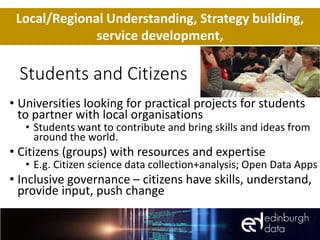
Students and Citizens
• Universities looking for practical projects for students
to partner with local organisations
• Students want to contribute and bring skills and ideas from
around the world.
• Citizens (groups) with resources and expertise
• E.g. Citizen science data collection+analysis; Open Data Apps
• Inclusive governance – citizens have skills, understand,
provide input, push change
Local/Regional Understanding, Strategy building,
service development,
Partnerships with service providers
• Existing service providers need to develop new services that
can offer operationally
• New firms want ways want to develop, licence and
commercialise new technology and services
• University spinoffs
Local/Regional Understanding, Strategy building,
service development
Operational access to support of computer-based
systems
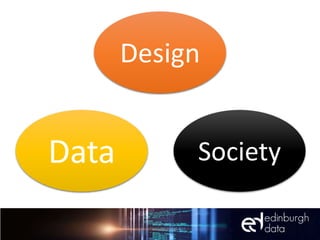
Data Society
Design

Data and Innovation in the public sector

  • 1.
    Data and Innovationin the Public Sector Ritchie Somerville, James Stewart and Ewan Klein Edinburgh Living Lab University of Edinburgh
  • 4.
    Visualising and Linking Datasets New Data “PredictiveAnalytics” Finding new patterns, correlations, new ‘red flags’ Reducing costs and time Optimisation of routing, management of assets “Smart“ Services Openness and Transparency: Communication and Participation Designing interventions and Testing “What Works” Identifying and targeting resources – e.g. at risk groups Modelling of impact of potential changes
  • 5.
  • 6.
    Example: Administrative Data Integrationin Newcastle City Social Finance analysis to support the deliver well-targeted early intervention services to prevent young adults from becoming NEET. Created a single dataset on young adults integrating longitudinal data from • Newcastle City Council (Children’s Social Care, Adult Social Care, Active Inclusion, Youth Offending, education data, Connexions (EET data)); • Arrests, housing benefit claims, young pregnancies and homeless presentations • NTW Trust (mental health data) • Northumbria CRC (probation data) • YHN (anti-social behaviour data) • Crime data and deprivation data.
  • 7.
    Map of tobaccooutlet density in Edinburgh. N K Shortt et al. Tob Control 2016;25:75-82 ©2016 by BMJ Publishing Group Ltd
  • 8.
    Existing Structured Data Administrative datafor Reporting Regular and adhoc Survey data Data from sensors and public Existing unstructured Data Handwritten notes Case Files Consultation responses Images etc • Costs of linking together datasets in different formats from different system • Data Protection rules • Lack of skills and resources • Fears around errors, gaps, losing control. • Lack of knowledge that relevant data exists in other departments/ sites. + Only readable by humans External data Commerical, social media, research data + Costs, unknown value, intellectual property, no incentives to share CHALLENGES
  • 9.
    Existing Structured Data Existing unstructured Data External datasets Technology-based Opportunities New Toolsto help: • Join up data • Visualise and analyse • Ensure compliance • Collect new data automatically • Support decision making Organisational Opportunities • Growing recognition of value • Support and conditions for new partnerships • Structural support being built – Legislation, technical facilities, risk and compliance etc Continual Legislative Pressure for efficiency, improvement, transparency and Community Engagement
  • 10.
    Sector Example OrganisationExample Datasets Local Authority City of Edinburgh Council Planning applications Air quality monitoring Library borrowing records Bike counts & pedestrian footfall Waste bin data Scotland National Public Sector statistics.gov.scot SEPA Historic Environment Scot Scottish Parliament ISD Scotland SESTran Transport Scotland Crime, Education Flood maps, Household waste Listed buildings MSP Register of Interests Health statistics Bus tracker Trunk road traffic counts UK National Public Sector Department for Transport Met Office Food Standards Agency Ordnance Survey Road safety (STATS19) Historic climate data Food hygiene ratings Postcode centroids Third Sector SUSTRANS OpenStreetMap ALISS Project Active travel GIS and surveys Local Points of Interest Health & Wellbeing resources Commercial Lothian Buses Black cab companies Strava Enterprise Car Club Edinburgh Festivals Passenger ticketing, Wifi AP Taxi telematics Cycling GPS tracks Carshare statistics Event listing API
  • 11.
    Library borrowing records •Home address postcode • Day of the month (Jan 2016) • Library where items borrowed Postcode Day Items Library EH1 2SX 3 4 Currie EH10 4JL 29 2 Currie EH8 9AB 18 1 Central
  • 12.
  • 14.
    Piershill: Example services •English & Polish language Bookbugs • Reading Rainbows • Piershill Magic Story Rug • School visits (both directions) • Crafts for children • Summer Reading Challenge • Bookgroup for adults • Housebound delivery service • Knitting Group
  • 15.
    Libraries & CommunityCentres • How do catchment areas relate to ‘natural neighbourhoods’? • How important are transport links? • Can we build a better picture of how services offered by libraries and community centres meet local needs? • What other data sets could we combine with library catchment areas?
  • 16.
  • 17.
    Academic Research: answeringbig questions, searching for generalisable answers, using increasingly diverse and large scale data sets e.g. Administrative data, Health records etc Local/Regional Understanding, Strategy building, Service Development supported by research insights, design, experimentation, and evaluation using existing and new data sources Operational access to support of computer-based systems based on sharing and analysing complete data sets, tools such as voice transcription, compliance support, automatic error detection, prediction and cautionary ‘red flagging’ etc
  • 18.
    Academic Researcher partnerships •‘Basic’ research – academics want access to datasets and provide verification, sophisticated data analysis • University-led Data Science and Technology research – access to real life data and situations to develop and test • Action research – supporting the design and testing of new ways of doing things Academic Research: answering big questions, searching for generalisable answers, Local/Regional Understanding, Strategy building, service development,
  • 19.
    Students and Citizens •Universities looking for practical projects for students to partner with local organisations • Students want to contribute and bring skills and ideas from around the world. • Citizens (groups) with resources and expertise • E.g. Citizen science data collection+analysis; Open Data Apps • Inclusive governance – citizens have skills, understand, provide input, push change Local/Regional Understanding, Strategy building, service development,
  • 20.
    Partnerships with serviceproviders • Existing service providers need to develop new services that can offer operationally • New firms want ways want to develop, licence and commercialise new technology and services • University spinoffs Local/Regional Understanding, Strategy building, service development Operational access to support of computer-based systems
  • 21.

Editor's Notes

  • #8 Map of tobacco outlet density in Edinburgh.
  • #13 Data from one complete month (Jan 2016?) of all 28 libraries in Edinburgh)
  • #14 Bottom loop is 44 bus route