Do
     Libraries
         meet
Research 2.0?
or
      Collaborative Tools and their
 Relevance for Research Libraries

                                            Guus Van den Brekel,
     Central Medical Library, University Medical Center Groningen
                                        (UMCG), The Netherlands.
                                                        Member of
European Association for Health Information and Libraries (EAHIL)
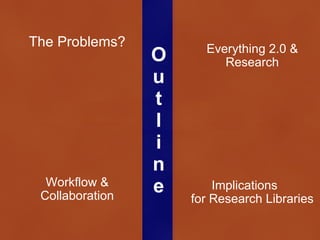
The Problems?          Everything 2.0 &
                 O        Research
                 u
                 t
                 l
                 i
                 n
  Workflow &
 Collaboration
                 e       Implications
                     for Research Libraries
Problems?


 Library Disconnects

         &

Bypassing the Library
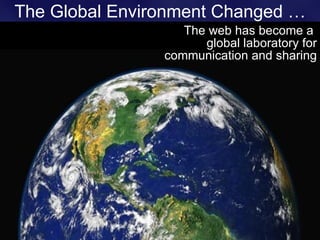
The Global Environment Changed …
                   The web has become a
                      global laboratory for
                communication and sharing
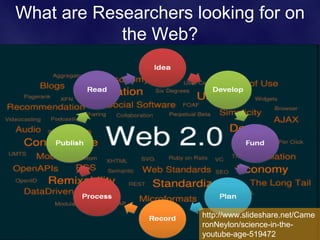
What are Researchers looking for on
            the Web?


                      http://www.slideshare.net/Came
                      ronNeylon/science-in-the-
                      youtube-age-519472
What are Researchers looking for
          on the Web?


• Tools for improving their workflow,
  to gain efficiency
• Communication, sharing, collaboration,
  dissemination research ideas and output
• to possibly get bigger recognition and
  reward of their research output
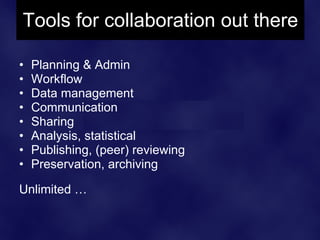
Tools for collaboration out there

•   Planning & Admin
•   Workflow
•   Data management
•   Communication
•   Sharing
•   Analysis, statistical
•   Publishing, (peer) reviewing
•   Preservation, archiving

Unlimited …
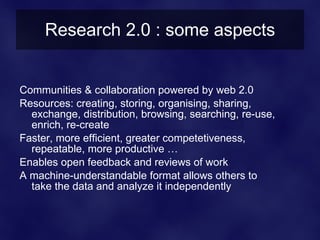
Research 2.0 : some aspects


Communities & collaboration powered by web 2.0
Resources: creating, storing, organising, sharing,
  exchange, distribution, browsing, searching, re-use,
  enrich, re-create
Faster, more efficient, greater competetiveness,
  repeatable, more productive …
Enables open feedback and reviews of work
A machine-understandable format allows others to
  take the data and analyze it independently
Scientists are certainly
    looking for it…
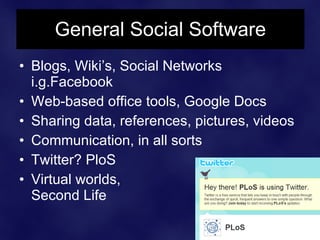
General Social Software
• Blogs, Wiki’s, Social Networks
  i.g.Facebook
• Web-based office tools, Google Docs
• Sharing data, references, pictures, videos
• Communication, in all sorts
• Twitter? PloS
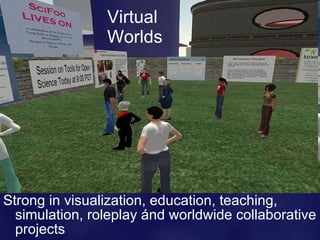
• Virtual worlds,
  Second Life
Virtual
                Worlds


Strong in visualization, education, teaching,
  simulation, roleplay ánd worldwide collaborative
  projects
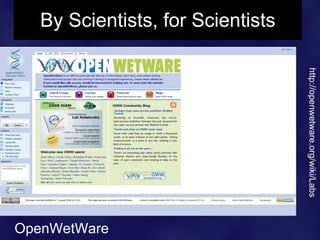
By Scientists, for Scientists


                                   http://openwetware.org/wiki/Labs
OpenWetWare
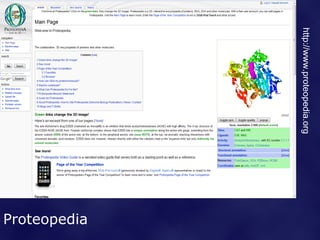
http://www.proteopedia.org
                             Proteopedia
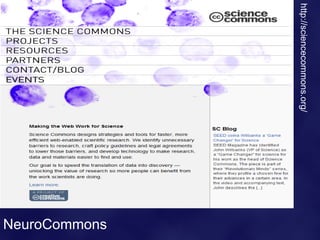
http://sciencecommons.org/
                             NeuroCommons
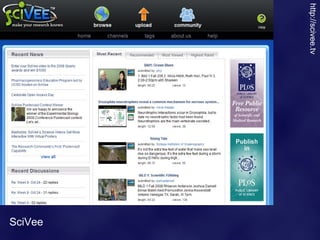
http://scivee.tv
                   SciVee
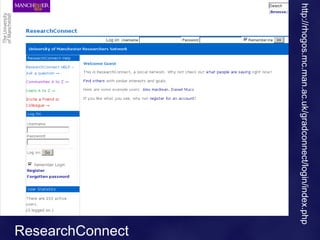
http://rhogos.mc.man.ac.uk/gradconnect/login/index.php
                                                     ResearchConnect
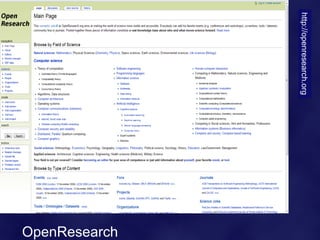
http://openresearch.org
                          OpenResearch
But we also see others
         offering services…

All kinds of parties research using
  web 2.0 to connect and integrate into the
  workflow of scientist and researchers.
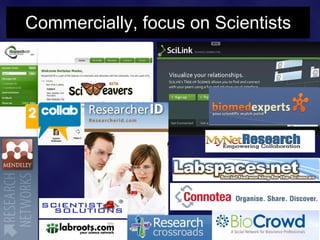
Commercially, focus on Scientists
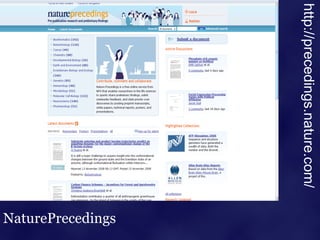
http://precedings.nature.com/
                                NaturePrecedings
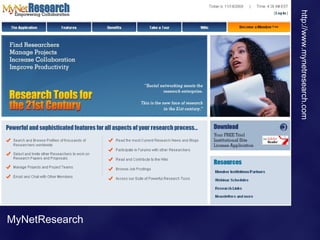
http://www.mynetresearch.com
                               MyNetResearch
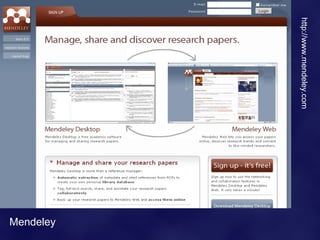
http://www.mendeley.com
                          Mendeley
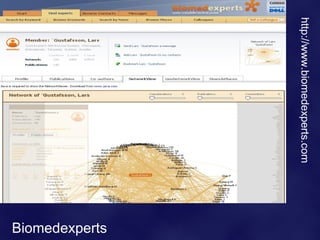
http://www.biomedexperts.com
                               Biomedexperts
'What is happening in the world is
   bypassing university libraries’

         Professor Peter Murray-Rust
Reasons NOT to ignore
Social Networks and the tools offered
                 • Efficiency possibilities
                 • Build professional communities
                    – Research
                    – Management
                 • Build learning communities
                 • Build sharing communities
                 • Build community support through
                   outreach


       Online Social Networks in Healthcare & Libraries
       PF Anderson, Emerging Technologies Librarian, Health Sciences Libraries,
       pfa@umich.edu
More Reasons ….

  • Connection, communication, collaboration,
    consultation
  • Discuss & share information (articles, photos,
    videos, cases, data, methodologies)
  • Q&A, rapid response (sometimes), serendipitous
    discovery
  • Global, international connections & opportunities
  • Find employment & research opportunities
  • Emerging trends, topics, medications, treatments,
    insights in your field


     Online Social Networks in Healthcare & Libraries
     PF Anderson, Emerging Technologies Librarian, Health Sciences Libraries,
     pfa@umich.edu
Do we see the libraries look for it
            as well?


 • The question is not whether the shift is
   going to happen, but how fast?

 • It will change the behaviour of researcher,
   new ways of thinking and operating;
   we should adapt
“(Get) Into The Workflow”

           Lorcan Dempsey, OCLC

And get to the people!
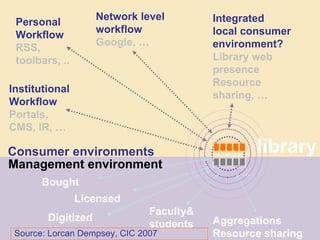
Network level         Integrated
 Personal
                    workflow              local consumer
 Workflow
                    Google, …             environment?
 RSS,
 toolbars, ..                             Library web
                                          presence
                                          Resource
Institutional
                                          sharing, …
Workflow
Portals,
CMS, IR, …

Consumer environments                              library
Management environment
                                               …
       Bought
                Licensed
                               Faculty&
        Digitized                         Aggregations
                               students
 Source: Lorcan Dempsey, CIC 2007         Resource sharing
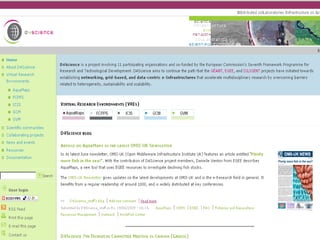
There are the Virtual Research
           Networks (VREs)

•   JISC VRE
•   MS Sharepoint
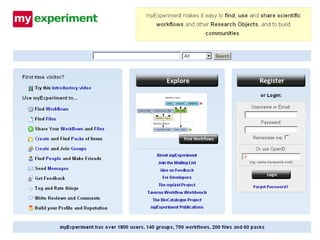
•   MyExperiment
•   D4Science
•   DARIAH
Key Points
• Communication
  between researchers and librarians

• Play a role in the exchange and sharing of research-based
  information in social network technologies

• Re-define the library, services, it’s systems, to reach:
  Visibility, Findability, Searchability and Accessibility

• Branding and marketing the library:
  embed & integrate

• Libraries should collaborate, communicate, cooperate,
  facilitate, support learning & research
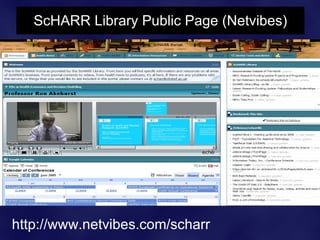
ScHARR Library Public Page (Netvibes)


http://www.netvibes.com/scharr
Strategical Implications
• Developing the supporting infrastructure for
   – Creation
   – Data management
   – Communication

• Re-focus policy
   Staff development & expertise
   Soft-, hardware choice

• By collaboration and partnership with other
  organizational parties, but also externally

• Embedded libraries
• Collaborative libraries
-There is a “battle” going on
      for the Scientists -


  “They got their work and data,
now they want the people as well ..


     We should be there first …
     and get them back quickly”
Thank you for your
      attention!

Guus van den Brekel
   Email:       a.j.p.van.den.brekel@med.umcg.nl / brekelajp@gmail.com
   Twitter:     digicmb
   Blog:        digicmb.blogspot.com
   Netvibes:    www.netvibes.com/digicmb
   Slideshare: www.slideshare.net/digicmb
   Facebook: http://profile.to/guusvandenbrekel/
   Linkedin:    www.linkedin.com/profile?viewProfile=&key=18148582
   Second Life: Namro Orman
(see for bookmarks: http://delicious.com/digicmb

Do Libraries Meet Research 2.0 : collaborative tools and relevance for Research Libraries

  • 1.
    Do Libraries meet Research 2.0?
  • 2.
    or Collaborative Tools and their Relevance for Research Libraries Guus Van den Brekel, Central Medical Library, University Medical Center Groningen (UMCG), The Netherlands. Member of European Association for Health Information and Libraries (EAHIL)
  • 3.
    The Problems? Everything 2.0 & O Research u t l i n Workflow & Collaboration e Implications for Research Libraries
  • 4.
    Problems? Library Disconnects & Bypassing the Library
  • 5.
    The Global EnvironmentChanged … The web has become a global laboratory for communication and sharing
  • 7.
    What are Researcherslooking for on the Web? http://www.slideshare.net/Came ronNeylon/science-in-the- youtube-age-519472
  • 8.
    What are Researcherslooking for on the Web? • Tools for improving their workflow, to gain efficiency • Communication, sharing, collaboration, dissemination research ideas and output • to possibly get bigger recognition and reward of their research output
  • 9.
    Tools for collaborationout there • Planning & Admin • Workflow • Data management • Communication • Sharing • Analysis, statistical • Publishing, (peer) reviewing • Preservation, archiving Unlimited …
  • 10.
    Research 2.0 :some aspects Communities & collaboration powered by web 2.0 Resources: creating, storing, organising, sharing, exchange, distribution, browsing, searching, re-use, enrich, re-create Faster, more efficient, greater competetiveness, repeatable, more productive … Enables open feedback and reviews of work A machine-understandable format allows others to take the data and analyze it independently
  • 11.
    Scientists are certainly looking for it…
  • 12.
    General Social Software •Blogs, Wiki’s, Social Networks i.g.Facebook • Web-based office tools, Google Docs • Sharing data, references, pictures, videos • Communication, in all sorts • Twitter? PloS • Virtual worlds, Second Life
  • 13.
    Virtual Worlds Strong in visualization, education, teaching, simulation, roleplay ánd worldwide collaborative projects
  • 14.
    By Scientists, forScientists http://openwetware.org/wiki/Labs OpenWetWare
  • 15.
  • 16.
  • 17.
  • 18.
  • 19.
  • 20.
    But we alsosee others offering services… All kinds of parties research using web 2.0 to connect and integrate into the workflow of scientist and researchers.
  • 21.
  • 22.
  • 23.
  • 24.
  • 25.
  • 26.
    'What is happeningin the world is bypassing university libraries’ Professor Peter Murray-Rust
  • 27.
    Reasons NOT toignore Social Networks and the tools offered • Efficiency possibilities • Build professional communities – Research – Management • Build learning communities • Build sharing communities • Build community support through outreach Online Social Networks in Healthcare & Libraries PF Anderson, Emerging Technologies Librarian, Health Sciences Libraries, pfa@umich.edu
  • 28.
    More Reasons …. • Connection, communication, collaboration, consultation • Discuss & share information (articles, photos, videos, cases, data, methodologies) • Q&A, rapid response (sometimes), serendipitous discovery • Global, international connections & opportunities • Find employment & research opportunities • Emerging trends, topics, medications, treatments, insights in your field Online Social Networks in Healthcare & Libraries PF Anderson, Emerging Technologies Librarian, Health Sciences Libraries, pfa@umich.edu
  • 29.
    Do we seethe libraries look for it as well? • The question is not whether the shift is going to happen, but how fast? • It will change the behaviour of researcher, new ways of thinking and operating; we should adapt
  • 30.
    “(Get) Into TheWorkflow” Lorcan Dempsey, OCLC And get to the people!
  • 31.
    Network level Integrated Personal workflow local consumer Workflow Google, … environment? RSS, toolbars, .. Library web presence Resource Institutional sharing, … Workflow Portals, CMS, IR, … Consumer environments library Management environment … Bought Licensed Faculty& Digitized Aggregations students Source: Lorcan Dempsey, CIC 2007 Resource sharing
  • 32.
    There are theVirtual Research Networks (VREs) • JISC VRE • MS Sharepoint • MyExperiment • D4Science • DARIAH
  • 35.
    Key Points • Communication between researchers and librarians • Play a role in the exchange and sharing of research-based information in social network technologies • Re-define the library, services, it’s systems, to reach: Visibility, Findability, Searchability and Accessibility • Branding and marketing the library: embed & integrate • Libraries should collaborate, communicate, cooperate, facilitate, support learning & research
  • 36.
    ScHARR Library PublicPage (Netvibes) http://www.netvibes.com/scharr
  • 37.
    Strategical Implications • Developingthe supporting infrastructure for – Creation – Data management – Communication • Re-focus policy Staff development & expertise Soft-, hardware choice • By collaboration and partnership with other organizational parties, but also externally • Embedded libraries • Collaborative libraries
  • 38.
    -There is a“battle” going on for the Scientists - “They got their work and data, now they want the people as well .. We should be there first … and get them back quickly”
  • 39.
    Thank you foryour attention! Guus van den Brekel Email: a.j.p.van.den.brekel@med.umcg.nl / brekelajp@gmail.com Twitter: digicmb Blog: digicmb.blogspot.com Netvibes: www.netvibes.com/digicmb Slideshare: www.slideshare.net/digicmb Facebook: http://profile.to/guusvandenbrekel/ Linkedin: www.linkedin.com/profile?viewProfile=&key=18148582 Second Life: Namro Orman (see for bookmarks: http://delicious.com/digicmb