SCIENCE, WEB 2.0 AND NEW
MODES OF SCHOLARLY
COMMUNICATION
Bonnie J. M. Swoger
SUNY Geneseo
May 28-30, 2008
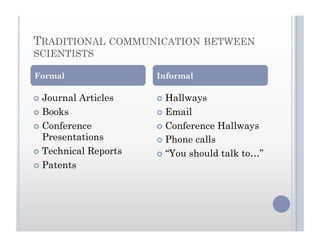
TRADITIONAL COMMUNICATION BETWEEN
SCIENTISTS
  Journal Articles
  Books
  Conference
Presentations
  Technical Reports
  Patents
  Hallways
  Email
  Conference Hallways
  Phone calls
  “You should talk to…”
Formal Informal
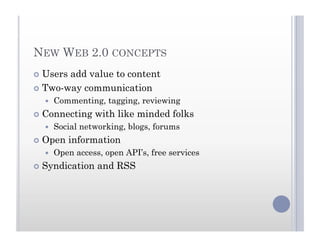
NEW WEB 2.0 CONCEPTS
  Users add value to content
  Two-way communication
  Commenting, tagging, reviewing
  Connecting with like minded folks
  Social networking, blogs, forums
  Open information
  Open access, open API’s, free services
  Syndication and RSS
NATURE NETWORK
  http://network.nature.com
  Sign up, create a profile, add friends and
contacts, interests, publications
  Read blogs, join groups, participate in discussions
  Network with colleagues before and after
conferences, learn about upcoming events
  From Nature Publishing Group
Civilian counterparts: Facebook, My Space
SCIENCE BLOGGING
  Communication with other scientists and with
the general public
  Discussion about policy, humor, academe and
commentary on peer review research
  See:
  Postgenomic.com - Summaries
  ScienceBlogs.com
  ResearchBlogging.org
Especially: Blogging about peer reviewed research
SOCIAL BOOKMARKING FOR SCHOLARS
  Connotea – developed by Nature Publishing
Group
  2collab – developed by Elsevier. Integrated into
database products ScienceDirect and Scopus
  CiteULike – independently developed
  Bookmark web links and journal articles
  Assign useful tags, enter citation information
  Explore papers and sites other researchers have
bookmarked
Civilian counterpart: del.icio.us
OPEN NOTEBOOK SCIENCE
  Online lab notebooks with multiple contributors
  Blogs, Wikis
  Multiple labs working on the same problem
  Sharing ideas, protocols
  Being open about failed experiments and ideas.
See “Useful Chemistry”, “OpenWetWare”
PLOS ONE
  Review of the “importance” of a paper occurs
post-publication by other researchers
  Annotations and commenting features
  From PLoS – Public Library of Science
  Downloads/Views help determine which papers
are featured on the home page.
Open access online journal with a different model of
publication
THE FUTURE OF SCIENTIFIC SCHOLARSHIP
  Greater transparency at every step of the
research and publication process
  Transformation of information seeking methods
  Increased open access to published products
  Emphasis on authority will be retained, but how
authority is gauged may shift

Cit Presentation 2008

  • 1.
    SCIENCE, WEB 2.0AND NEW MODES OF SCHOLARLY COMMUNICATION Bonnie J. M. Swoger SUNY Geneseo May 28-30, 2008
  • 2.
    TRADITIONAL COMMUNICATION BETWEEN SCIENTISTS  Journal Articles   Books   Conference Presentations   Technical Reports   Patents   Hallways   Email   Conference Hallways   Phone calls   “You should talk to…” Formal Informal
  • 3.
    NEW WEB 2.0CONCEPTS   Users add value to content   Two-way communication   Commenting, tagging, reviewing   Connecting with like minded folks   Social networking, blogs, forums   Open information   Open access, open API’s, free services   Syndication and RSS
  • 4.
    NATURE NETWORK   http://network.nature.com  Sign up, create a profile, add friends and contacts, interests, publications   Read blogs, join groups, participate in discussions   Network with colleagues before and after conferences, learn about upcoming events   From Nature Publishing Group Civilian counterparts: Facebook, My Space
  • 5.
    SCIENCE BLOGGING   Communicationwith other scientists and with the general public   Discussion about policy, humor, academe and commentary on peer review research   See:   Postgenomic.com - Summaries   ScienceBlogs.com   ResearchBlogging.org Especially: Blogging about peer reviewed research
  • 6.
    SOCIAL BOOKMARKING FORSCHOLARS   Connotea – developed by Nature Publishing Group   2collab – developed by Elsevier. Integrated into database products ScienceDirect and Scopus   CiteULike – independently developed   Bookmark web links and journal articles   Assign useful tags, enter citation information   Explore papers and sites other researchers have bookmarked Civilian counterpart: del.icio.us
  • 7.
    OPEN NOTEBOOK SCIENCE  Online lab notebooks with multiple contributors   Blogs, Wikis   Multiple labs working on the same problem   Sharing ideas, protocols   Being open about failed experiments and ideas. See “Useful Chemistry”, “OpenWetWare”
  • 8.
    PLOS ONE   Reviewof the “importance” of a paper occurs post-publication by other researchers   Annotations and commenting features   From PLoS – Public Library of Science   Downloads/Views help determine which papers are featured on the home page. Open access online journal with a different model of publication
  • 9.
    THE FUTURE OFSCIENTIFIC SCHOLARSHIP   Greater transparency at every step of the research and publication process   Transformation of information seeking methods   Increased open access to published products   Emphasis on authority will be retained, but how authority is gauged may shift