From Crowd to Cloud: The Present and
Future of Work in the Network
Economy – the role of Online Work
Exchanges
James Stewart
University of Edinburgh
j.k.stewart@ed.ac.uk
Virtual Work, Bucharest March 2014
This work was funded by and conducted at
the JRC-IPTS, European Commission
ICT4EMPL "The Future of Work"
This presentation
does not represent
the views of the
European
Commission
My concern from policy?
207/09/14
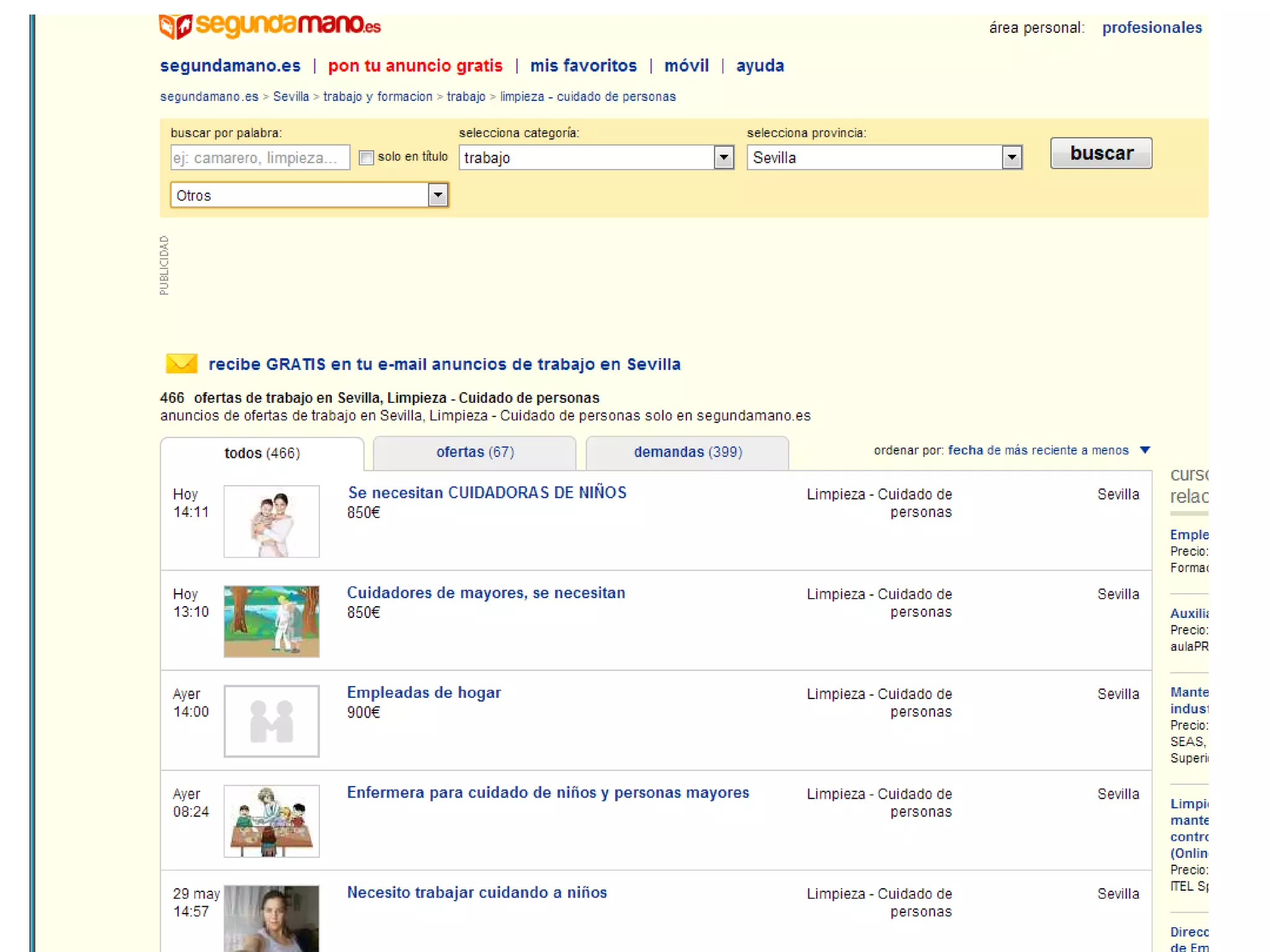
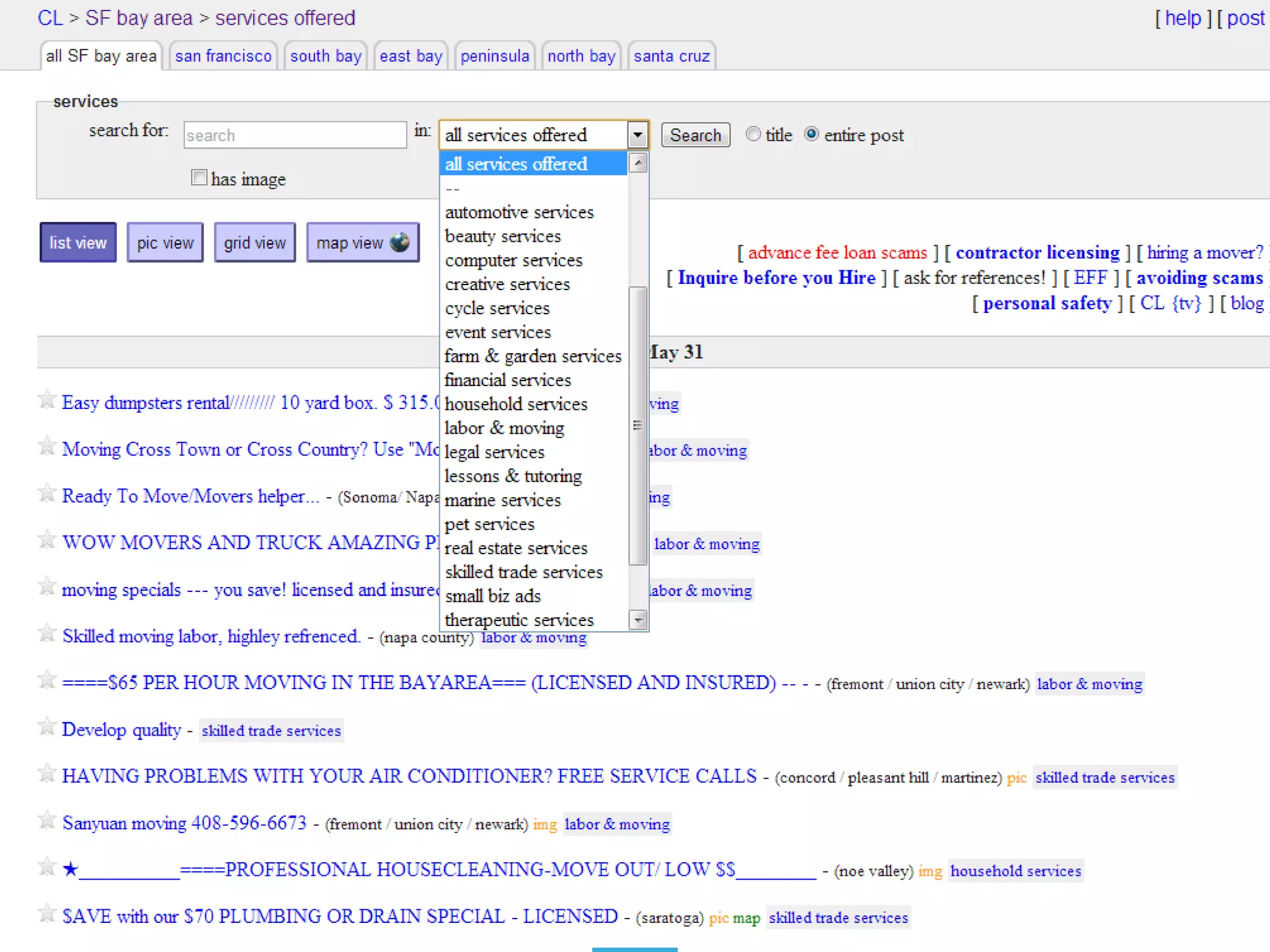
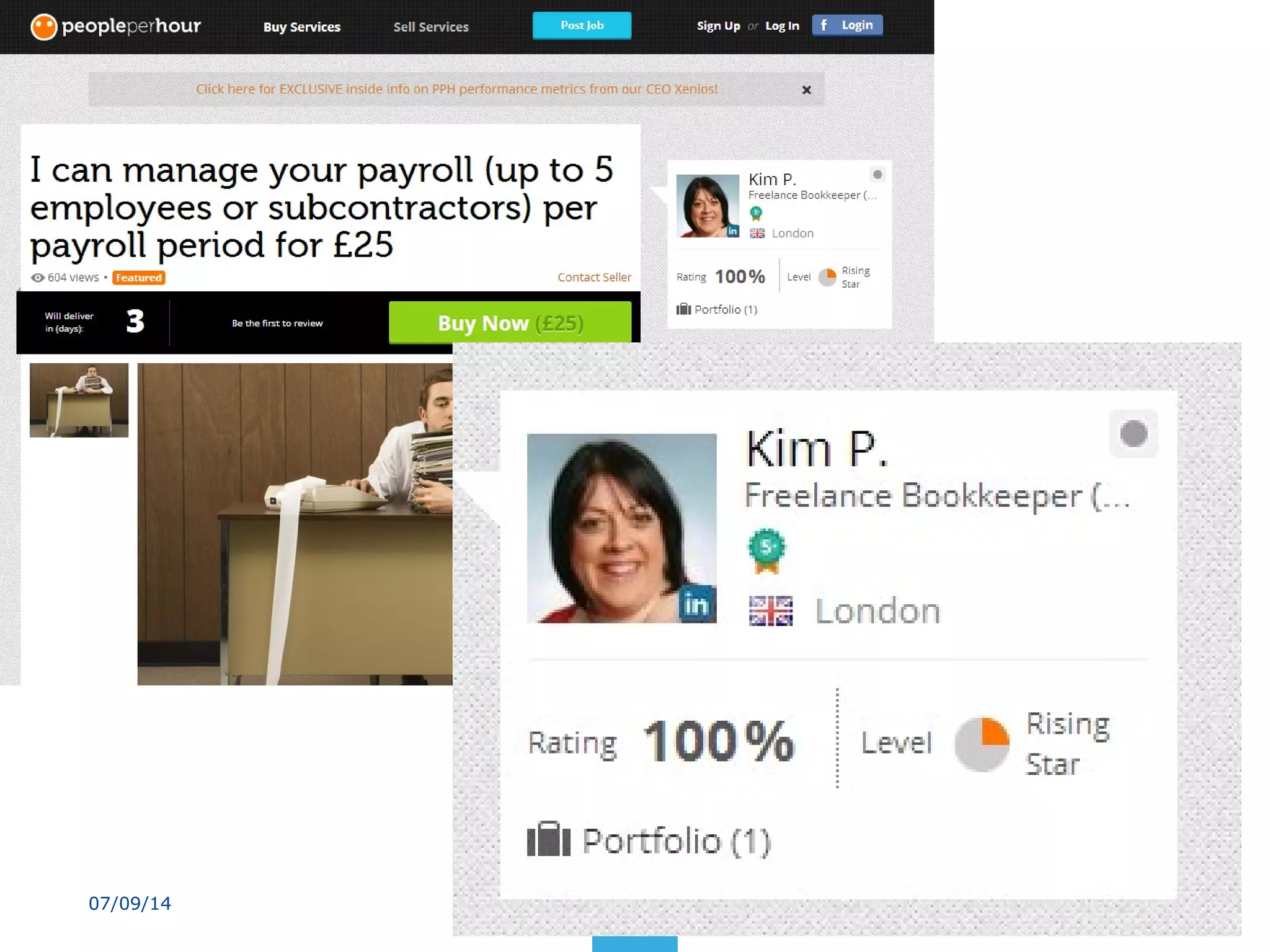
Online work exchanges:

New ways of finding work,
finding workers,
being employed
and getting work done
Not: ‘Telework’, ‘free labour’ etc
307/09/14
Potential Policy Opportunties
Employment-related
policy (such as labour market
reform, temporary work, youth
employment and training,
entrepreneurship, self-
employment, flexible working,
access to work),
•Balance of industry and welfare
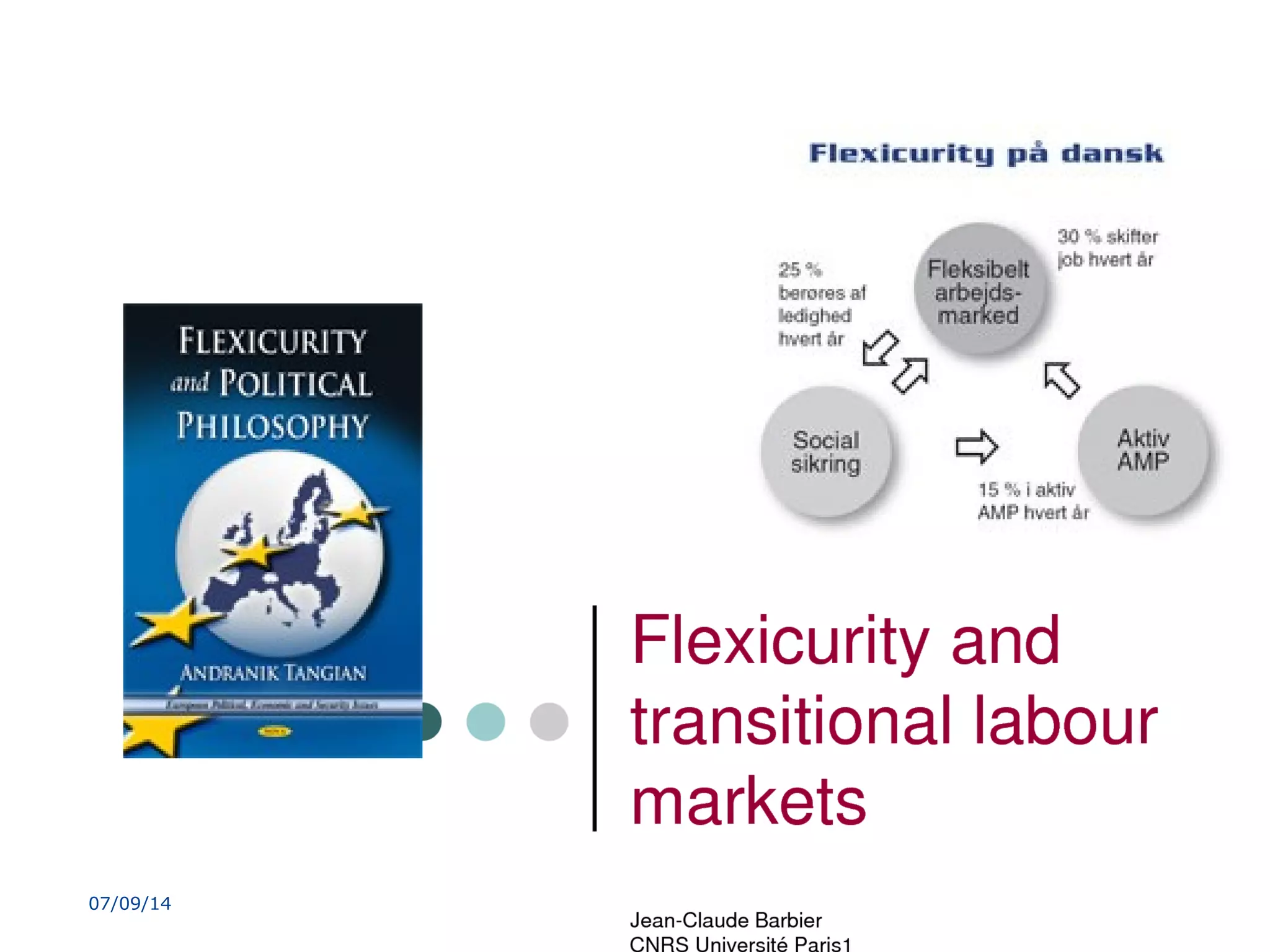
(e.g.flexicurity)
Skills policy
Digital skills and access,
•Mobility programmes
Enterprise and
Markets SMEs and
microenterprises, microfinance
•Regional Development,
•Financial regulation,
•The Single Market in services
and employment.
•Job Creation
Social Policy
•Social inclusion programmes
•Social cohesion programmes
•Public service delivery
International
development
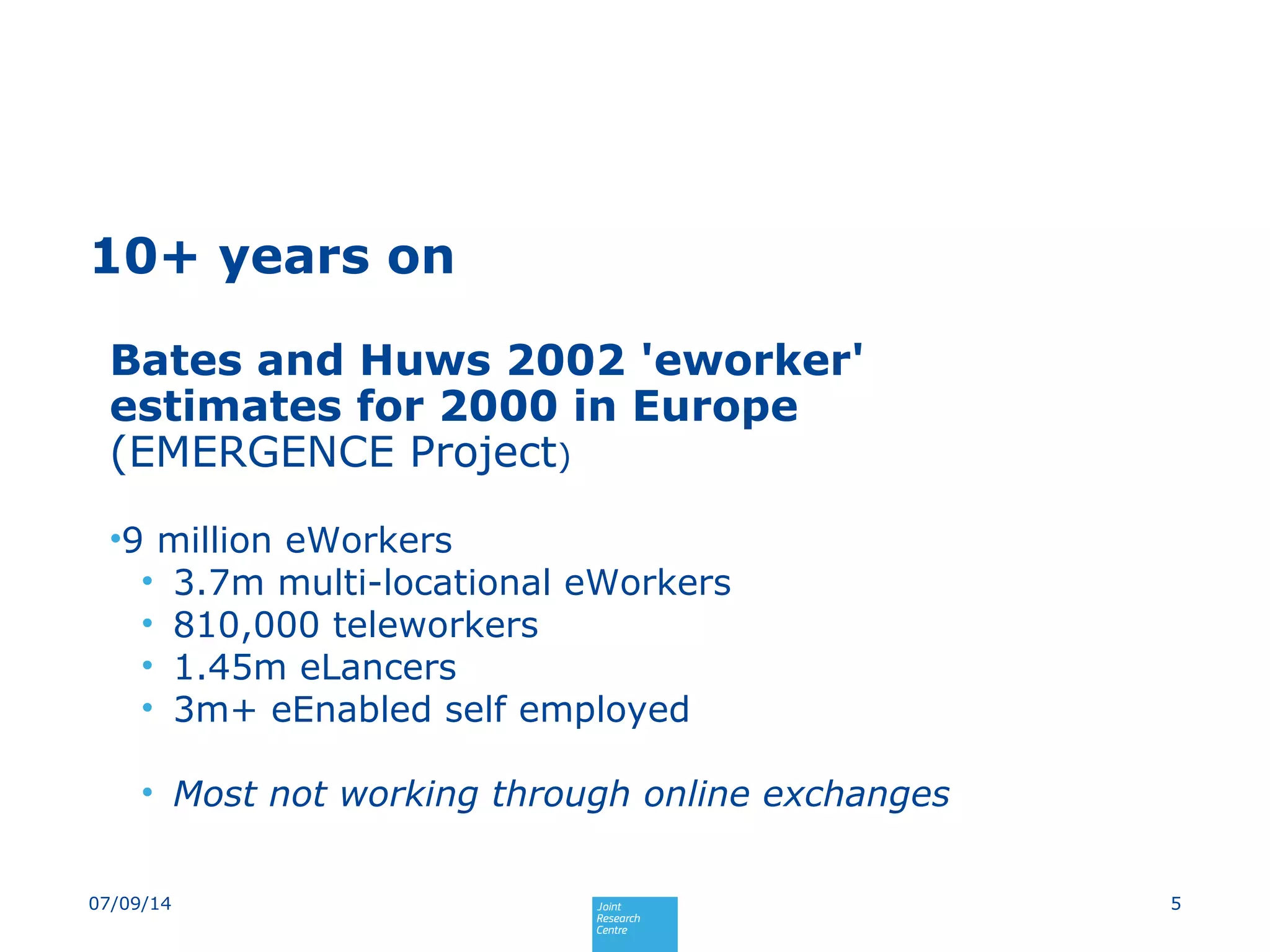
10+ years on
Bates and Huws 2002 'eworker'
estimates for 2000 in Europe
(EMERGENCE Project)
•9 million eWorkers
• 3.7m multi-locational eWorkers
• 810,000 teleworkers
• 1.45m eLancers
• 3m+ eEnabled self employed
• Most not working through online exchanges
507/09/14
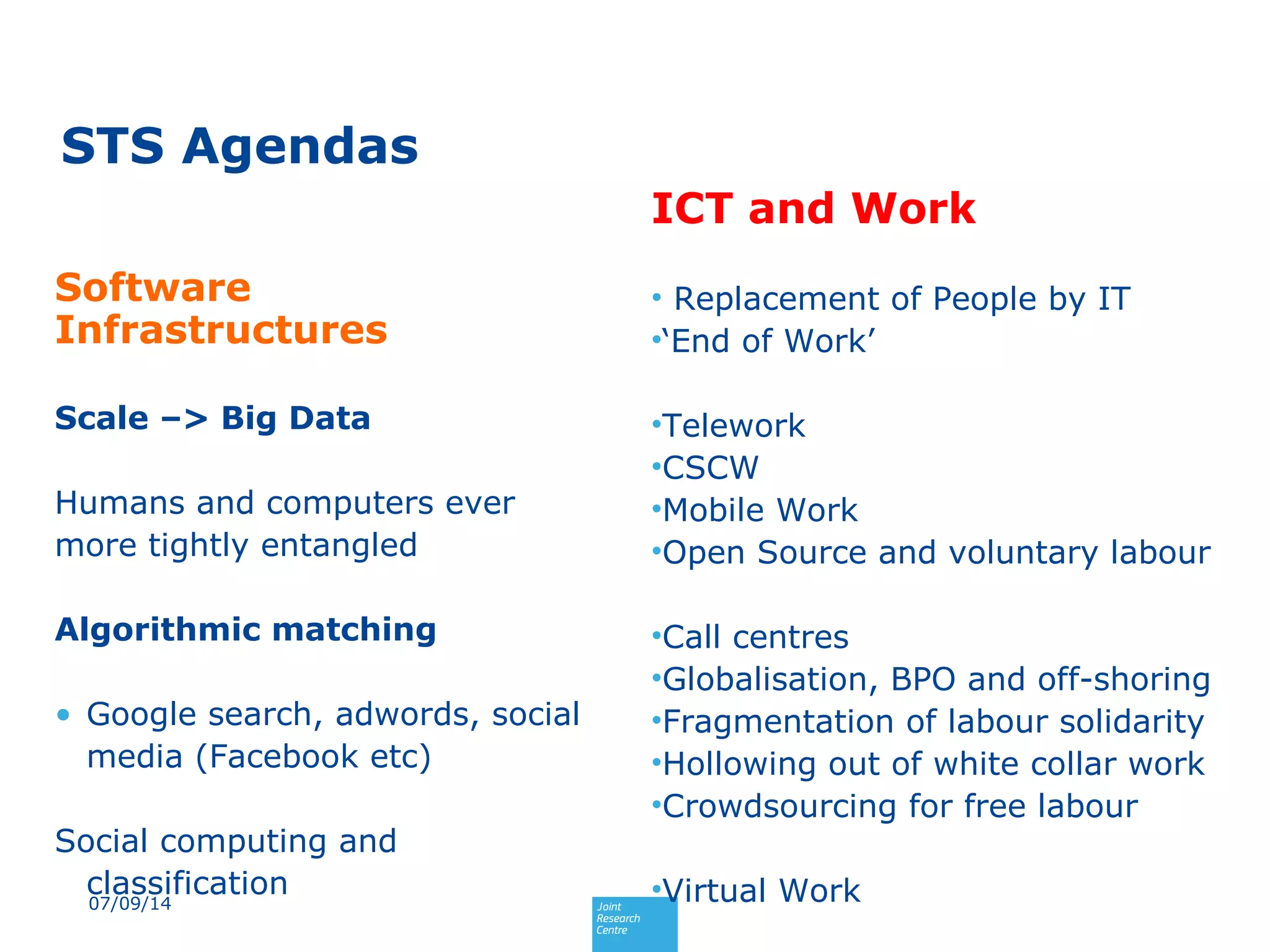
STS Agendas
Software
Infrastructures
Scale –> Big Data
Humans and computers ever
more tightly entangled
Algorithmic matching
• Google search, adwords, social
media (Facebook etc)
Social computing and
classification
ICT and Work
• Replacement of People by IT
•‘End of Work’
•Telework
•CSCW
•Mobile Work
•Open Source and voluntary labour
•Call centres
•Globalisation, BPO and off-shoring
•Fragmentation of labour solidarity
•Hollowing out of white collar work
•Crowdsourcing for free labour
•Virtual Work07/09/14
707/09/14
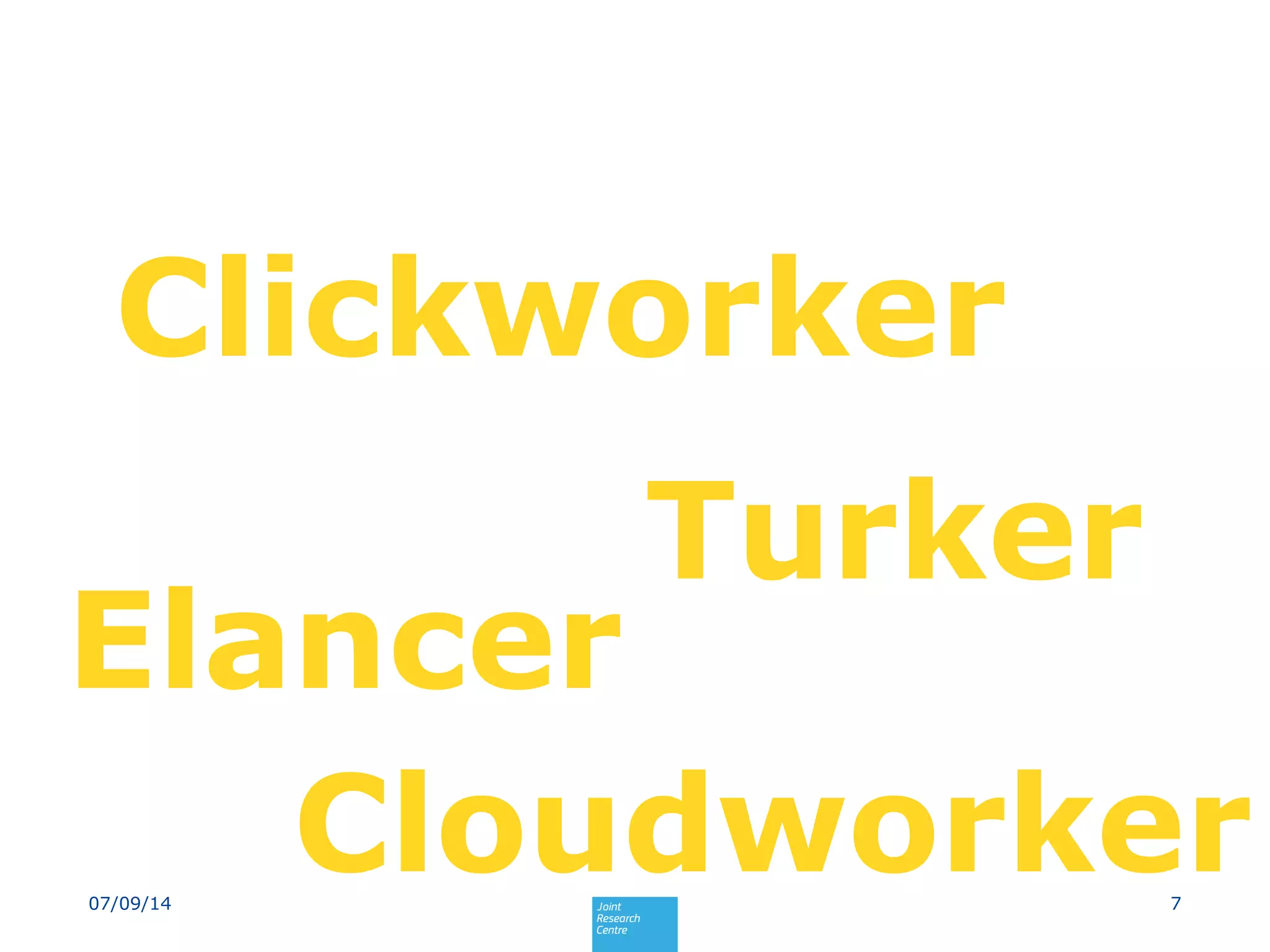
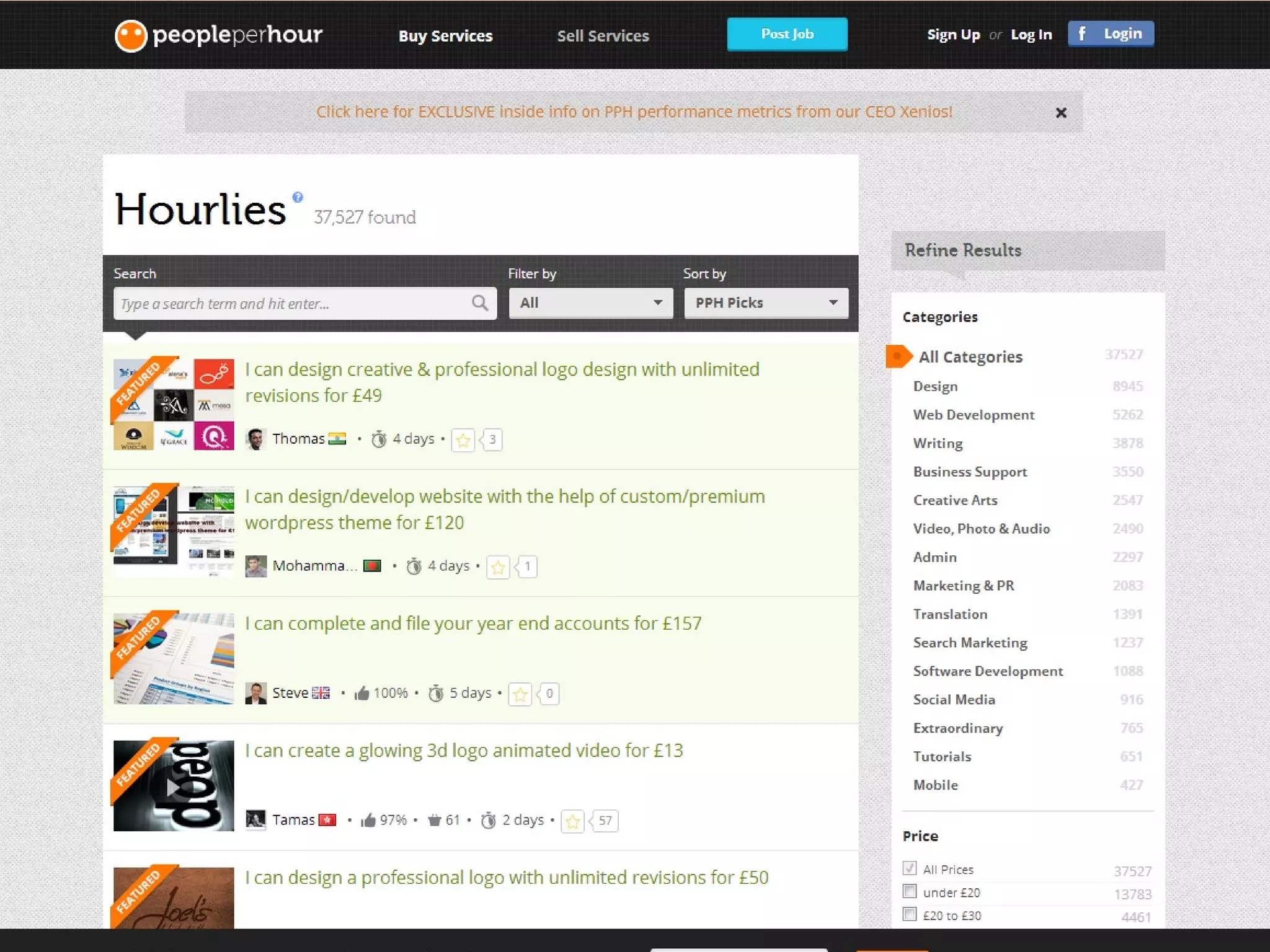
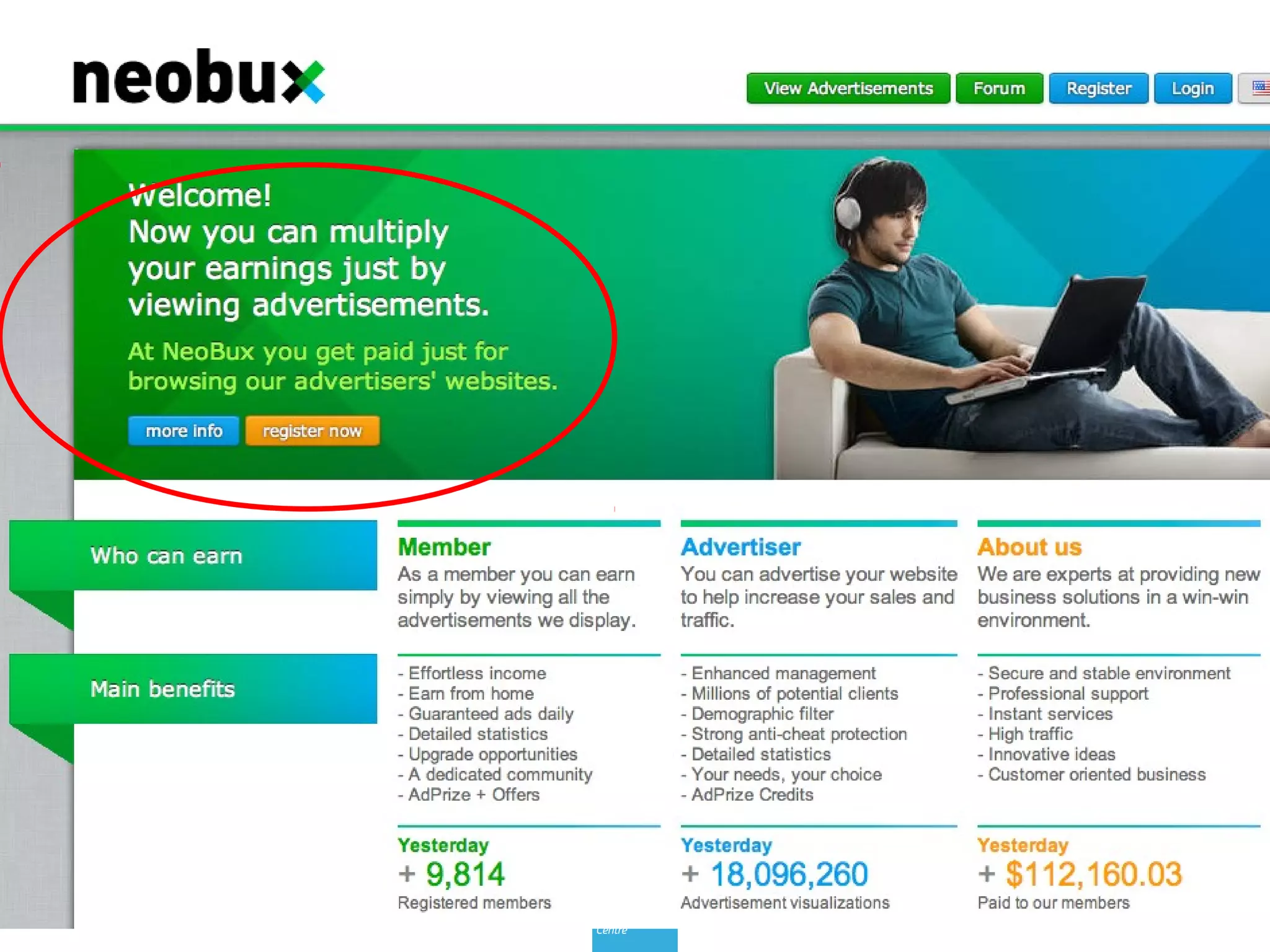
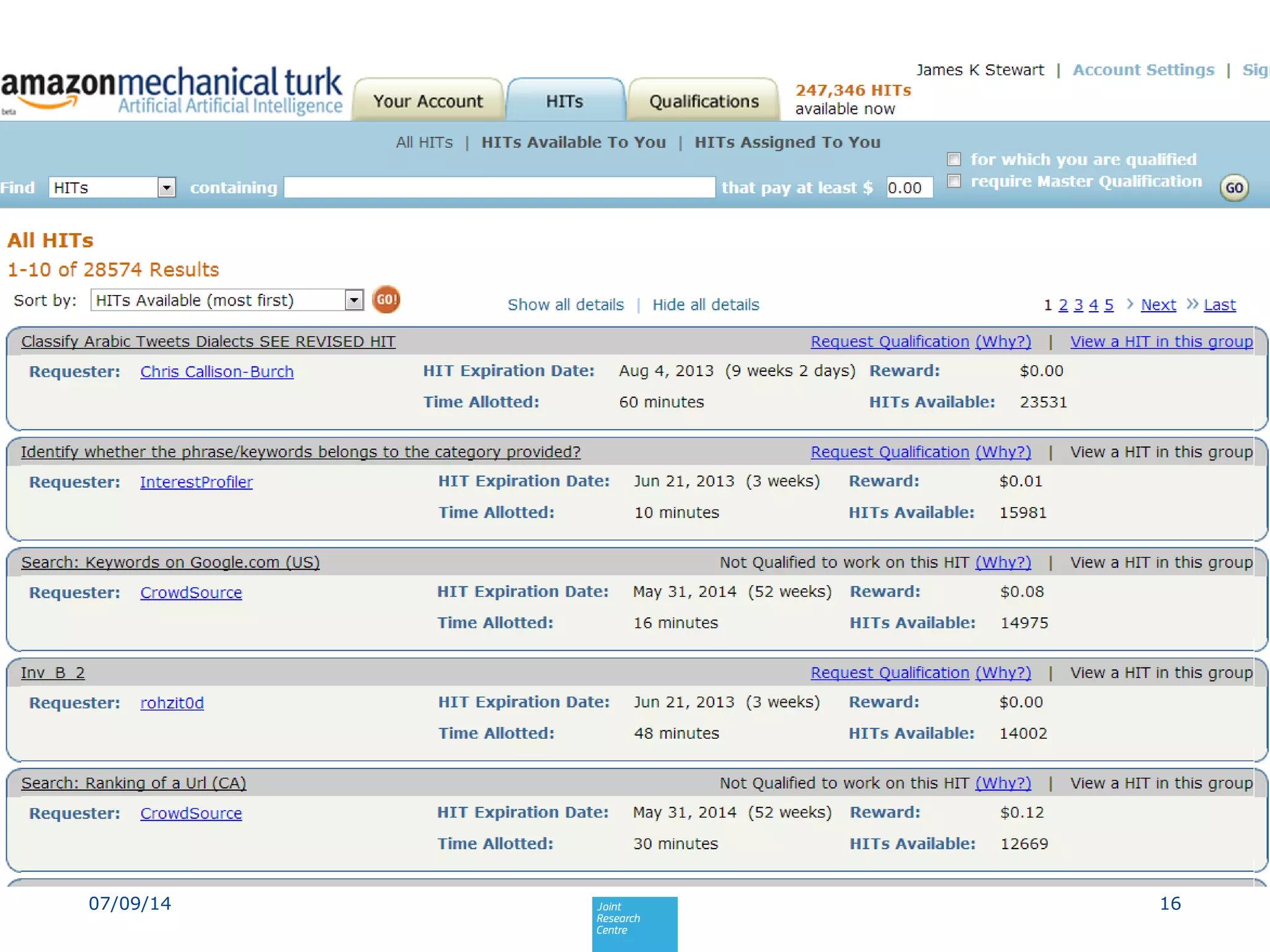
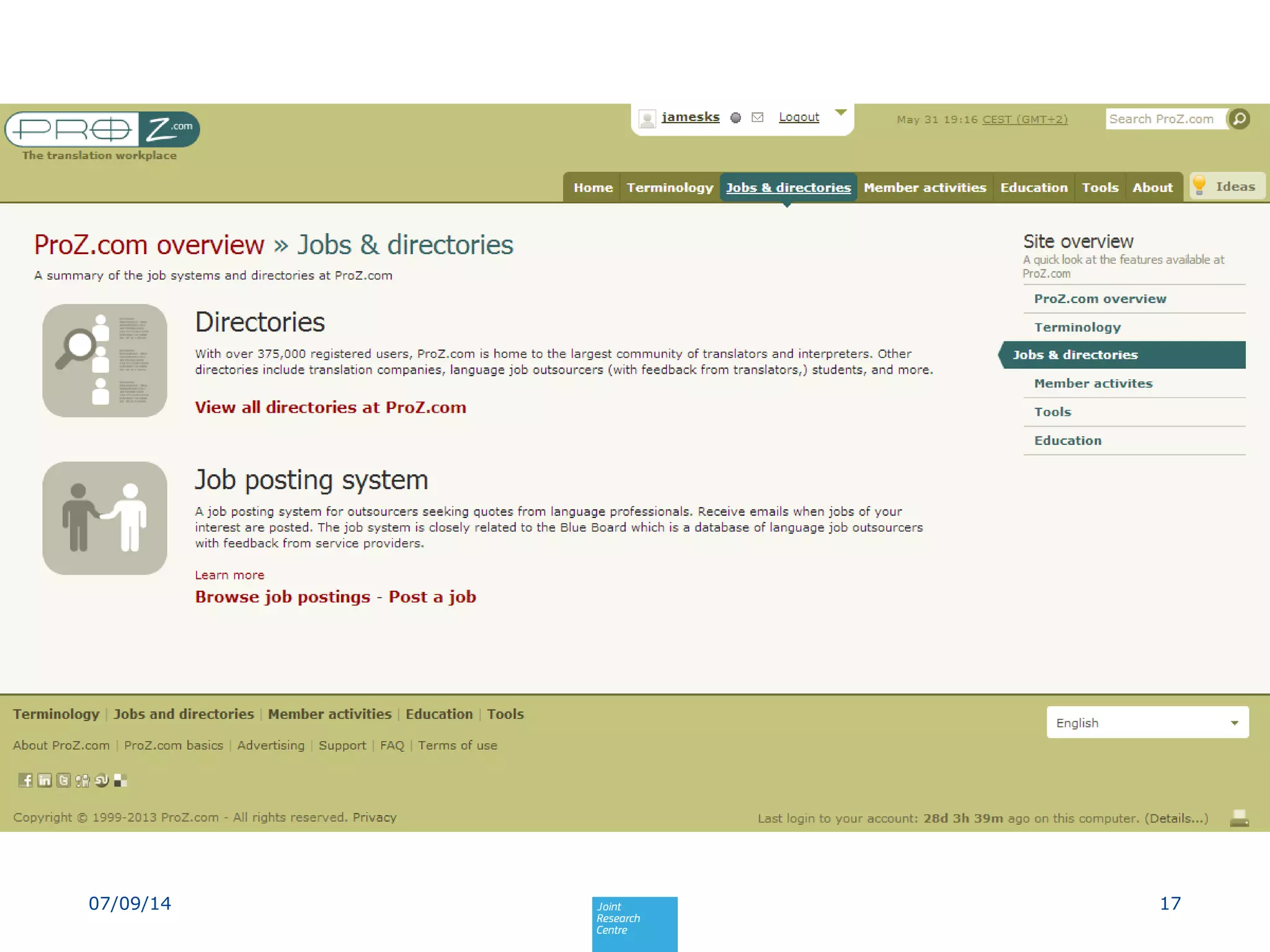
Clickworker
Elancer
Turker
Cloudworker
807/09/14
907/09/14
1007/09/14
1107/09/14
1207/09/14
1307/09/14
1407/09/14
1507/09/14
1607/09/14
1707/09/14
1807/09/14
1907/09/14
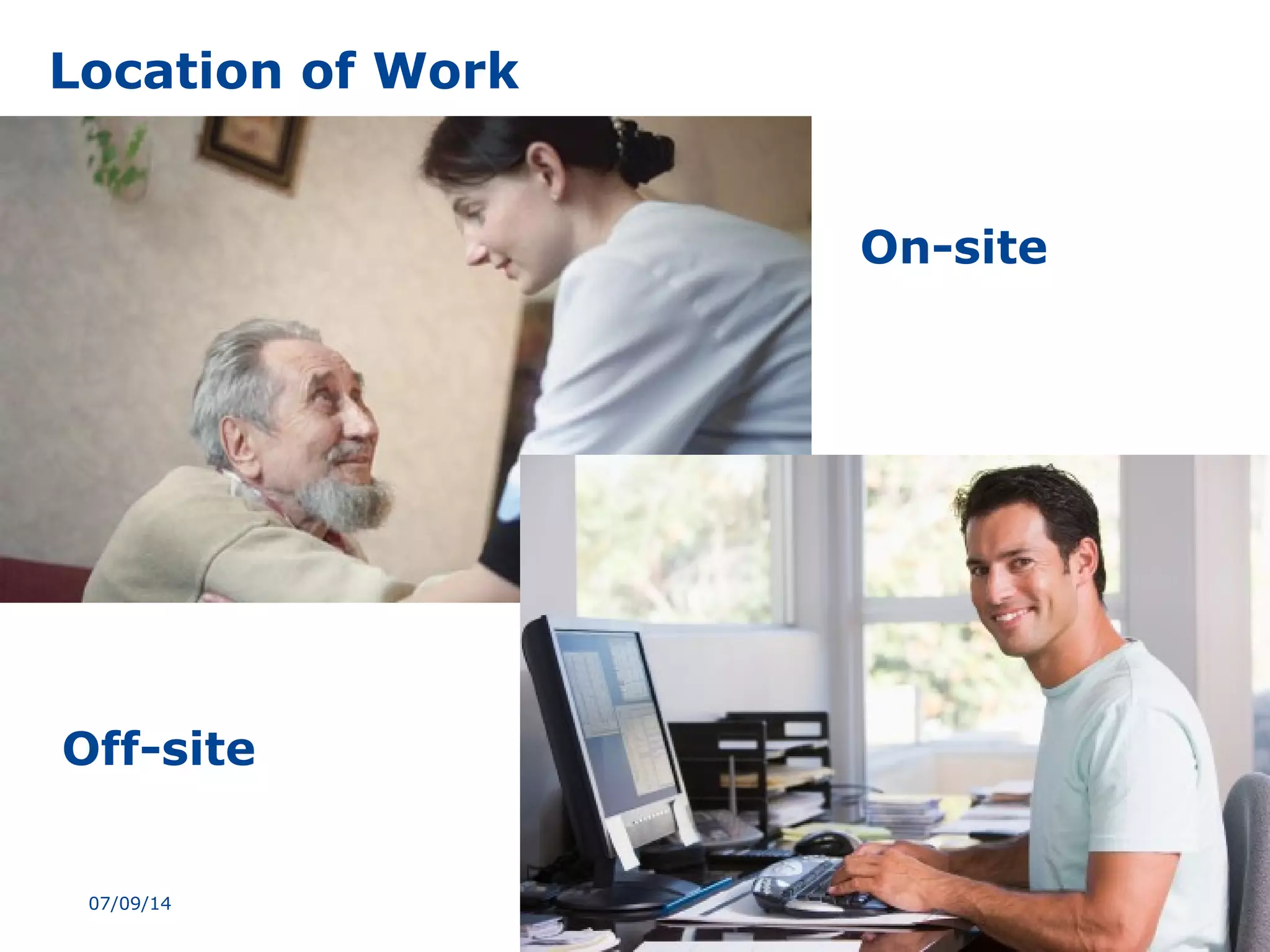
On-site
Location of Work
2007/09/14
Off-site
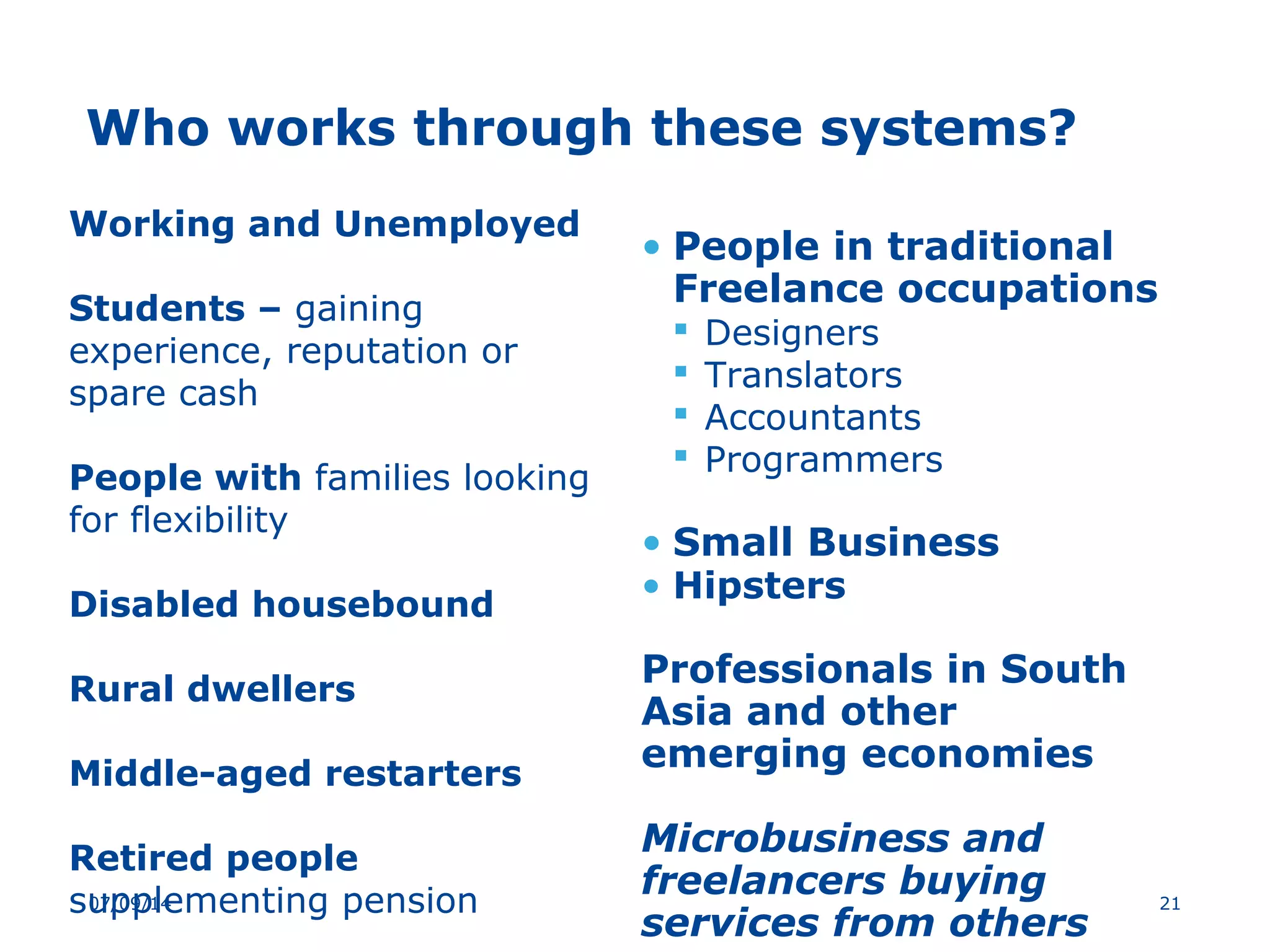
Who works through these systems?
Working and Unemployed
Students – gaining
experience, reputation or
spare cash
People with families looking
for flexibility
Disabled housebound
Rural dwellers
Middle-aged restarters
Retired people
supplementing pension
• People in traditional
Freelance occupations
 Designers
 Translators
 Accountants
 Programmers
• Small Business
• Hipsters
Professionals in South
Asia and other
emerging economies
Microbusiness and
freelancers buying
services from others
2107/09/14
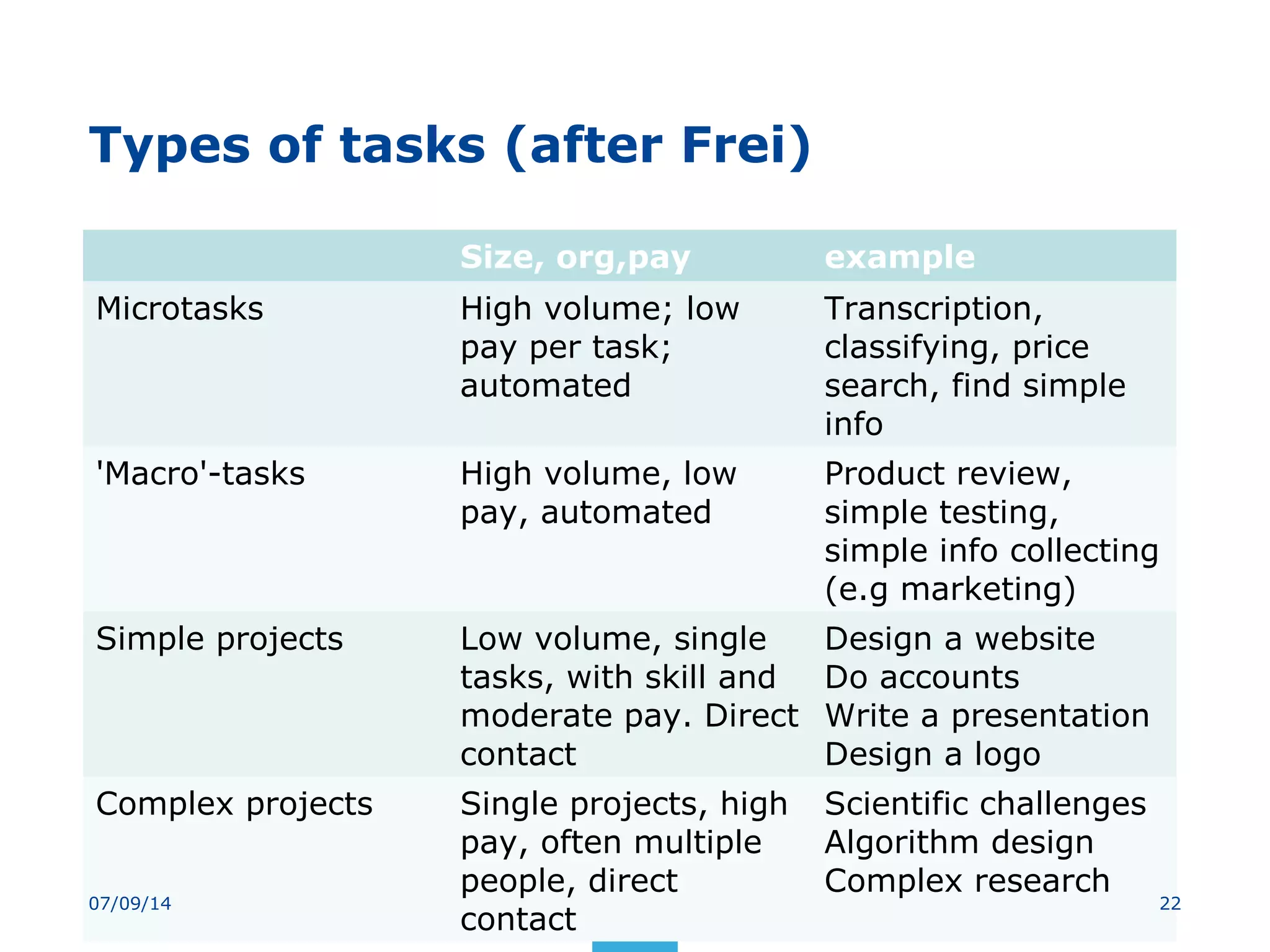
Types of tasks (after Frei)
Size, org,pay example
Microtasks High volume; low
pay per task;
automated
Transcription,
classifying, price
search, find simple
info
'Macro'-tasks High volume, low
pay, automated
Product review,
simple testing,
simple info collecting
(e.g marketing)
Simple projects Low volume, single
tasks, with skill and
moderate pay. Direct
contact
Design a website
Do accounts
Write a presentation
Design a logo
Complex projects Single projects, high
pay, often multiple
people, direct
contact
Scientific challenges
Algorithm design
Complex research
2207/09/14
TWO GENERIC OPERATING AND
BUSINESS MODELS
2307/09/14
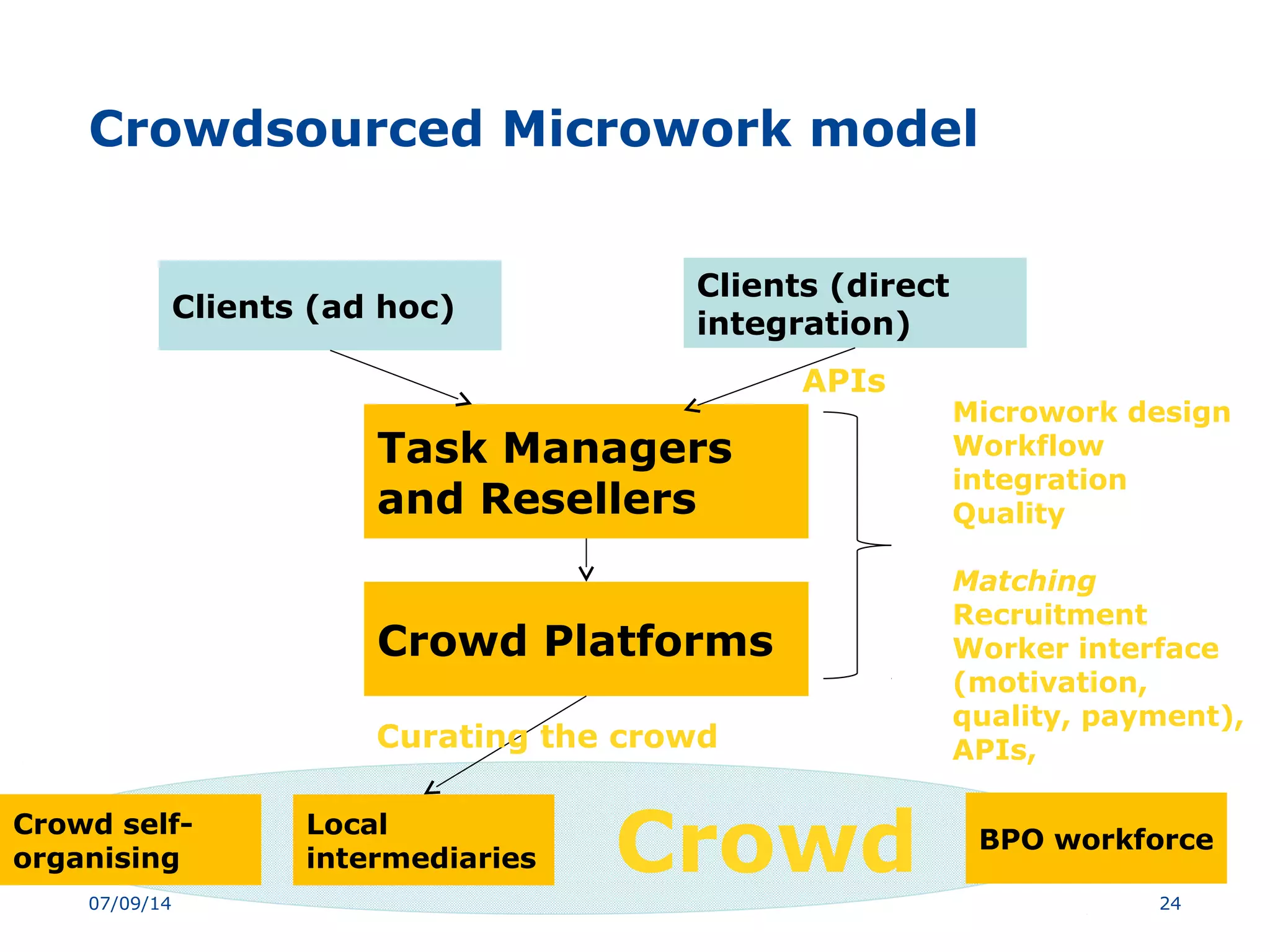
Crowd
Crowdsourced Microwork model
2407/09/14
Crowd Platforms
Task Managers
and Resellers
Local
intermediaries
Curating the crowd
Clients (direct
integration)
Clients (ad hoc)
APIs
Crowd self-
organising
Microwork design
Workflow
integration
Quality
Matching
Recruitment
Worker interface
(motivation,
quality, payment),
APIs,
BPO workforce
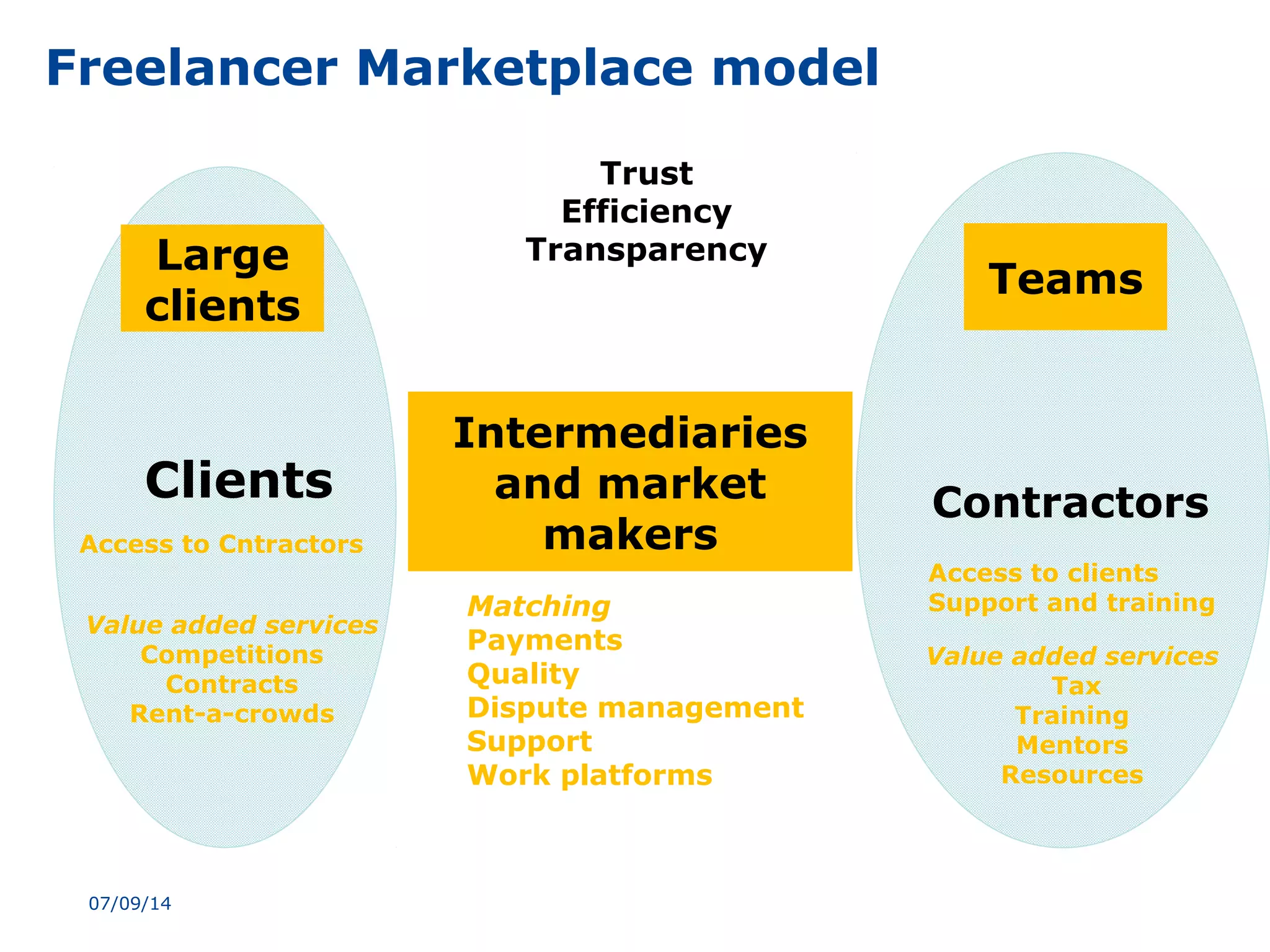
Freelancer Marketplace model
Trust
Efficiency
Transparency
07/09/14
ContractorsClients
Intermediaries
and market
makers
Large
clients
Matching
Payments
Quality
Dispute management
Support
Work platforms
Value added services
Competitions
Contracts
Rent-a-crowds
Teams
Access to clients
Support and training
Access to Cntractors
Value added services
Tax
Training
Mentors
Resources
Existing research concerns and results
2607/09/14
Research on online exchanges
Crowdsourcing – business
models +some critical user
studies (Brabham 2010, 2011,
2013).
Elancing’ from an HR
perspective (Aguinis and
Lawal 2013)
Microtask platform use –
e.g. in scientific experiments
(Iperitos 2008,210a, 2010b)
Labour economics
perspective (Agrawal et al 2013)
Virtual labour Huws 2003;
Scholz 2012; Kleemann and
Voß, 2008; Huws 2013; Holts
(2013) Caraway (2010) )
Legal issues (Felstiner (2011)
Microworker identity
(Lehdonvirta and Mezier (2013)
Microworker empowerment -
Turkopticon (Irani and
Silberman 2013).
2707/09/14
Open the black box of job search
(Petrongolo and Pissarides, 2001; Marchal et al 2007).
formal and informal information
channels (e.g. Granovetter 1974)
role of intermediaries whose work is
to match vacancies sellers and
buyers (see Marchal et al 2007).
2807/09/14
Literature
Practitioner Interviews
Short Cases
Inductive
In depth qualitative cases and analysis Outsourced to
Warwick university
2907/09/14
ICT4EMPL
3007/09/14
3107/09/14
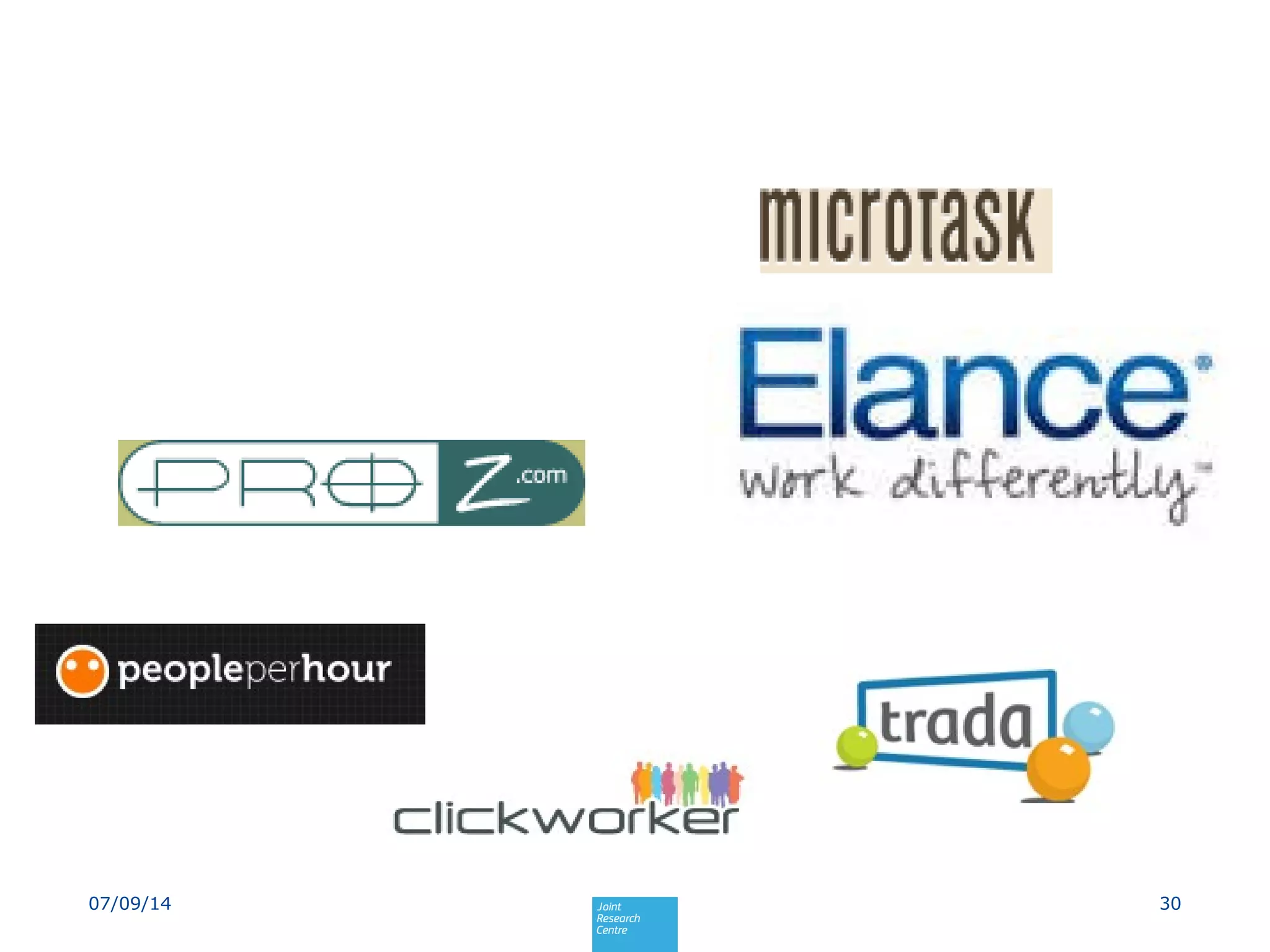
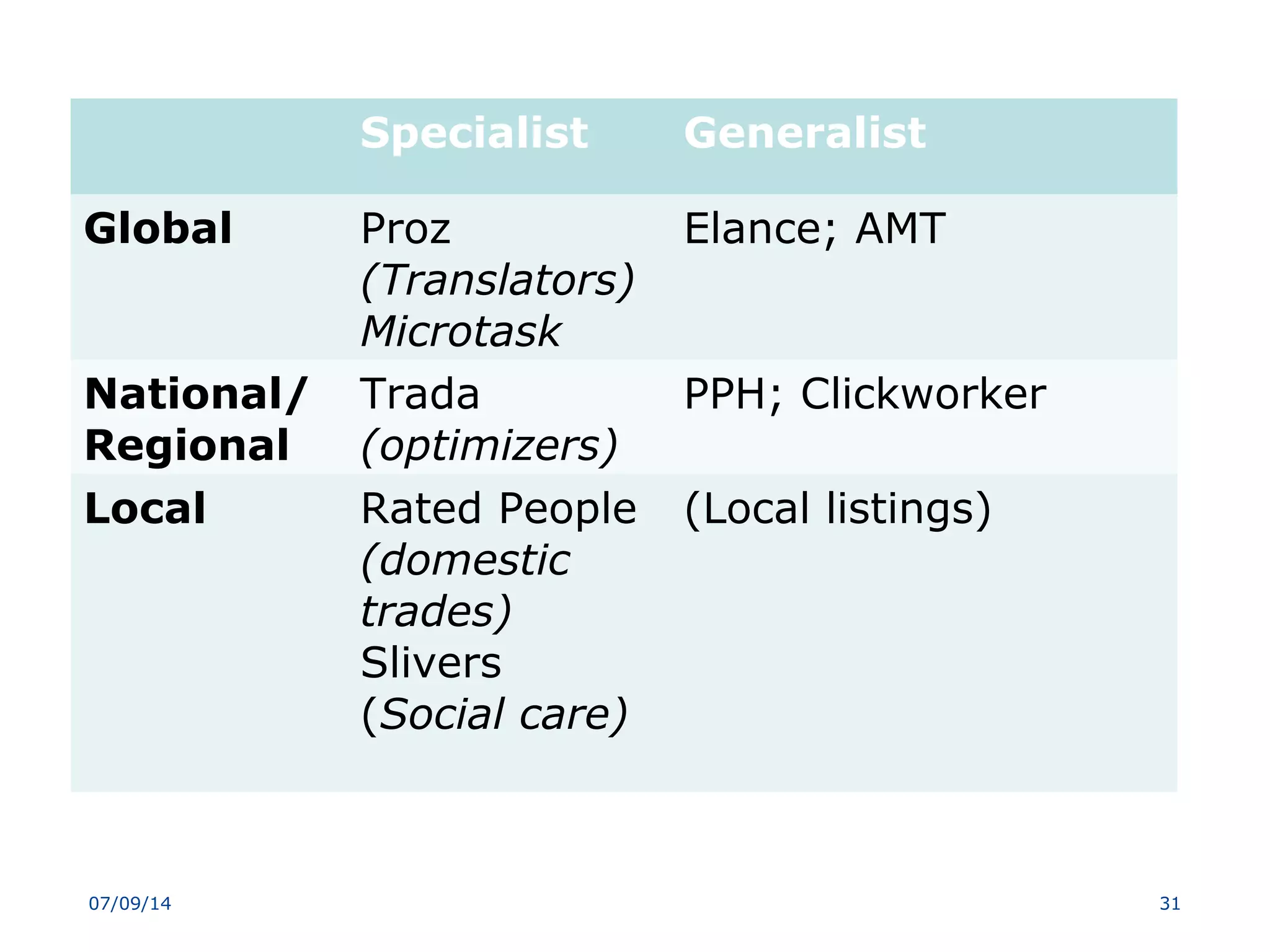
Specialist Generalist
Global Proz
(Translators)
Microtask
Elance; AMT
National/
Regional
Trada
(optimizers)
PPH; Clickworker
Local Rated People
(domestic
trades)
Slivers
(Social care)
(Local listings)
3207/09/14
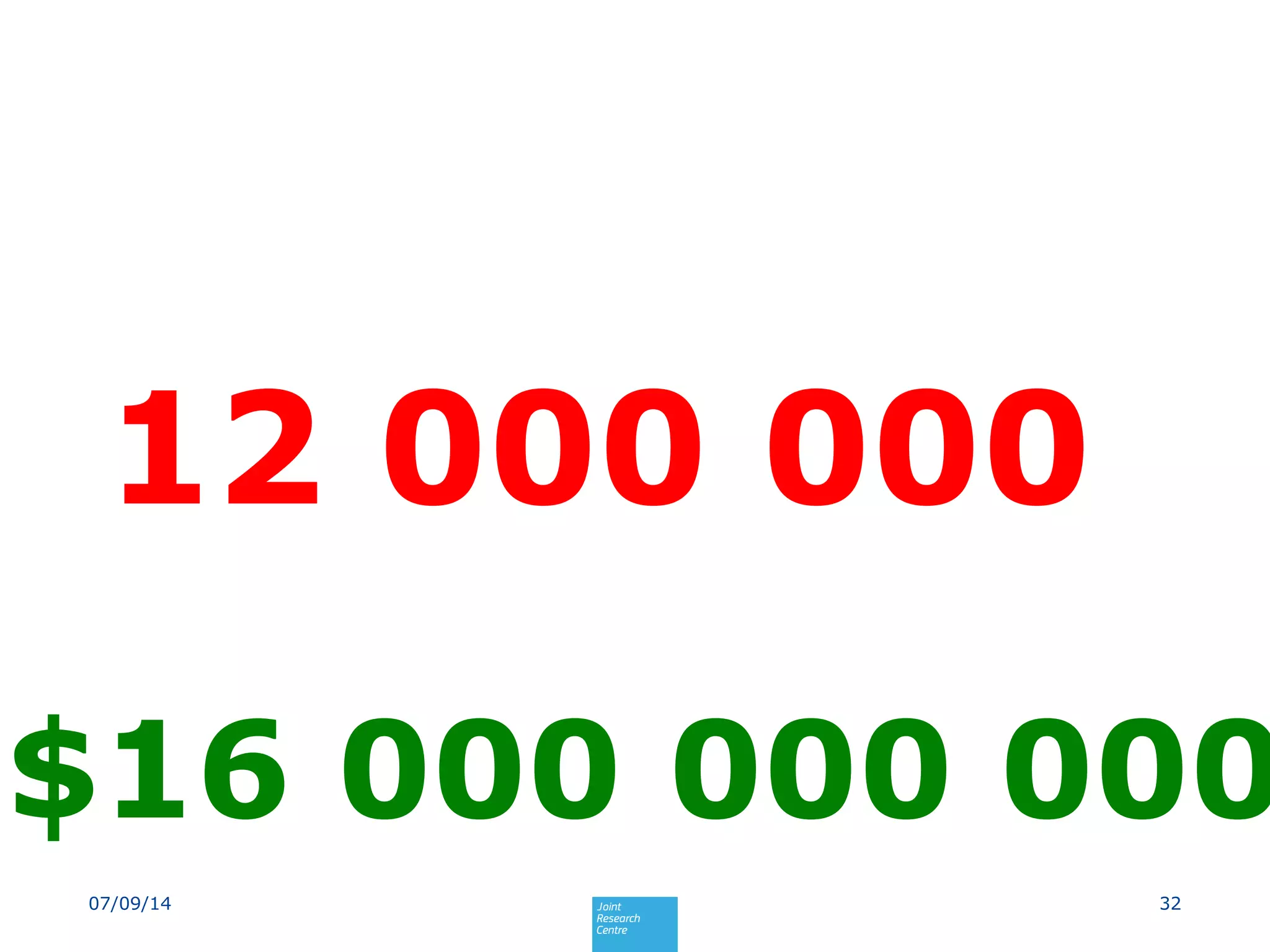
12 000 000
$16 000 000 000
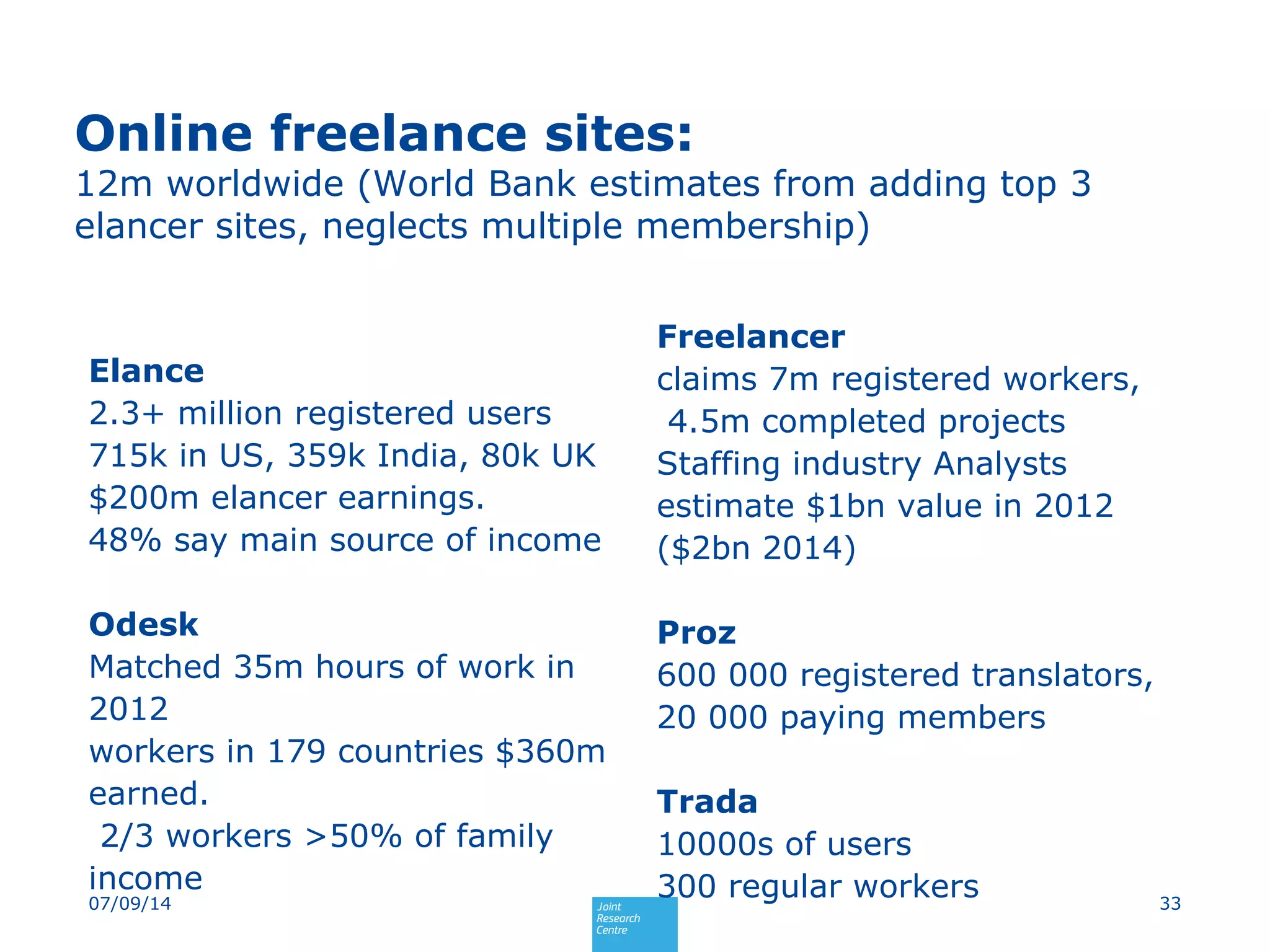
Online freelance sites:
12m worldwide (World Bank estimates from adding top 3
elancer sites, neglects multiple membership)
Elance
2.3+ million registered users
715k in US, 359k India, 80k UK
$200m elancer earnings.
48% say main source of income
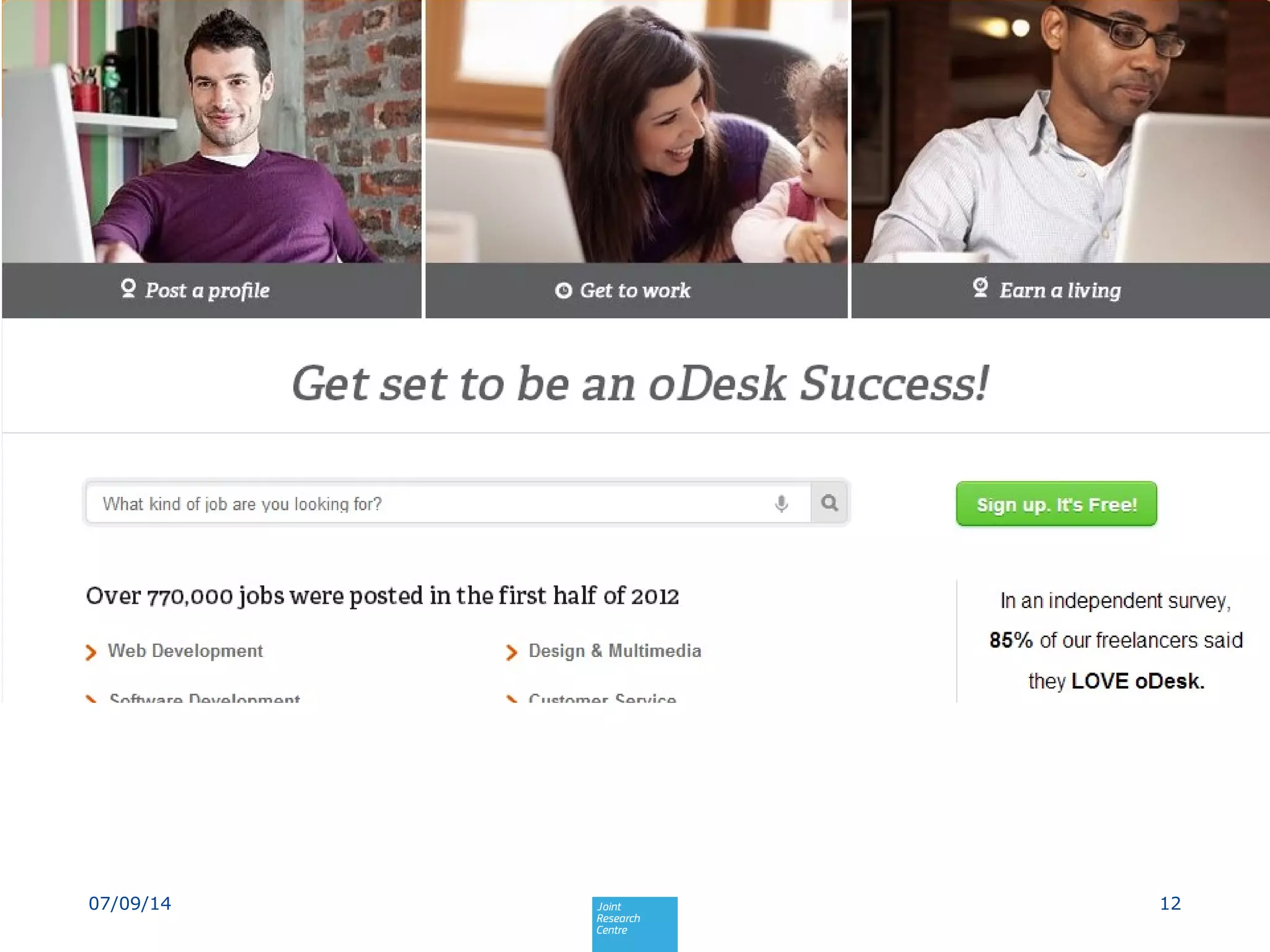
Odesk
Matched 35m hours of work in
2012
workers in 179 countries $360m
earned.
2/3 workers >50% of family
income
Freelancer
claims 7m registered workers,
4.5m completed projects
Staffing industry Analysts
estimate $1bn value in 2012
($2bn 2014)
Proz
600 000 registered translators,
20 000 paying members
Trada
10000s of users
300 regular workers 3307/09/14
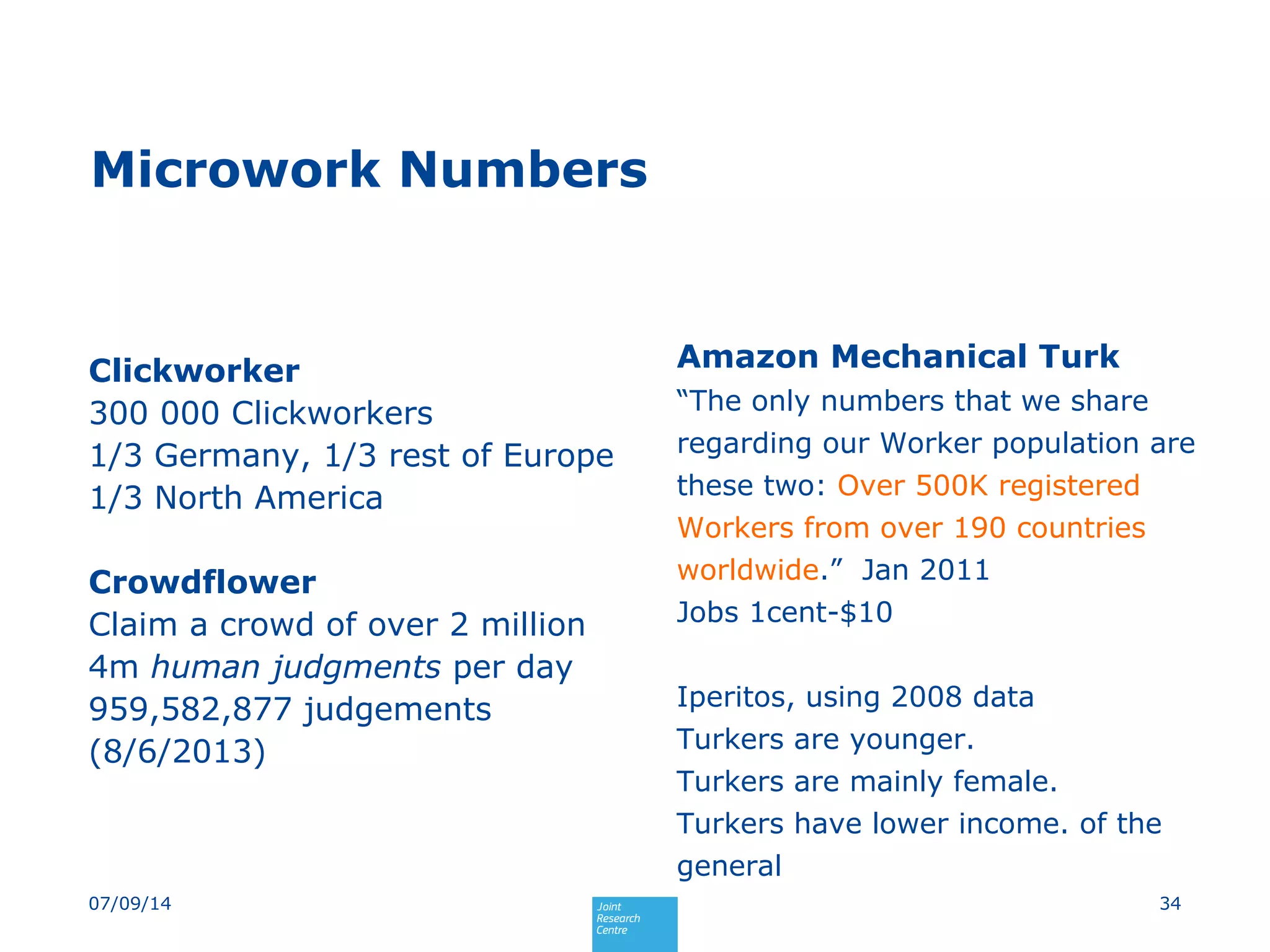
Microwork Numbers
Clickworker
300 000 Clickworkers
1/3 Germany, 1/3 rest of Europe
1/3 North America
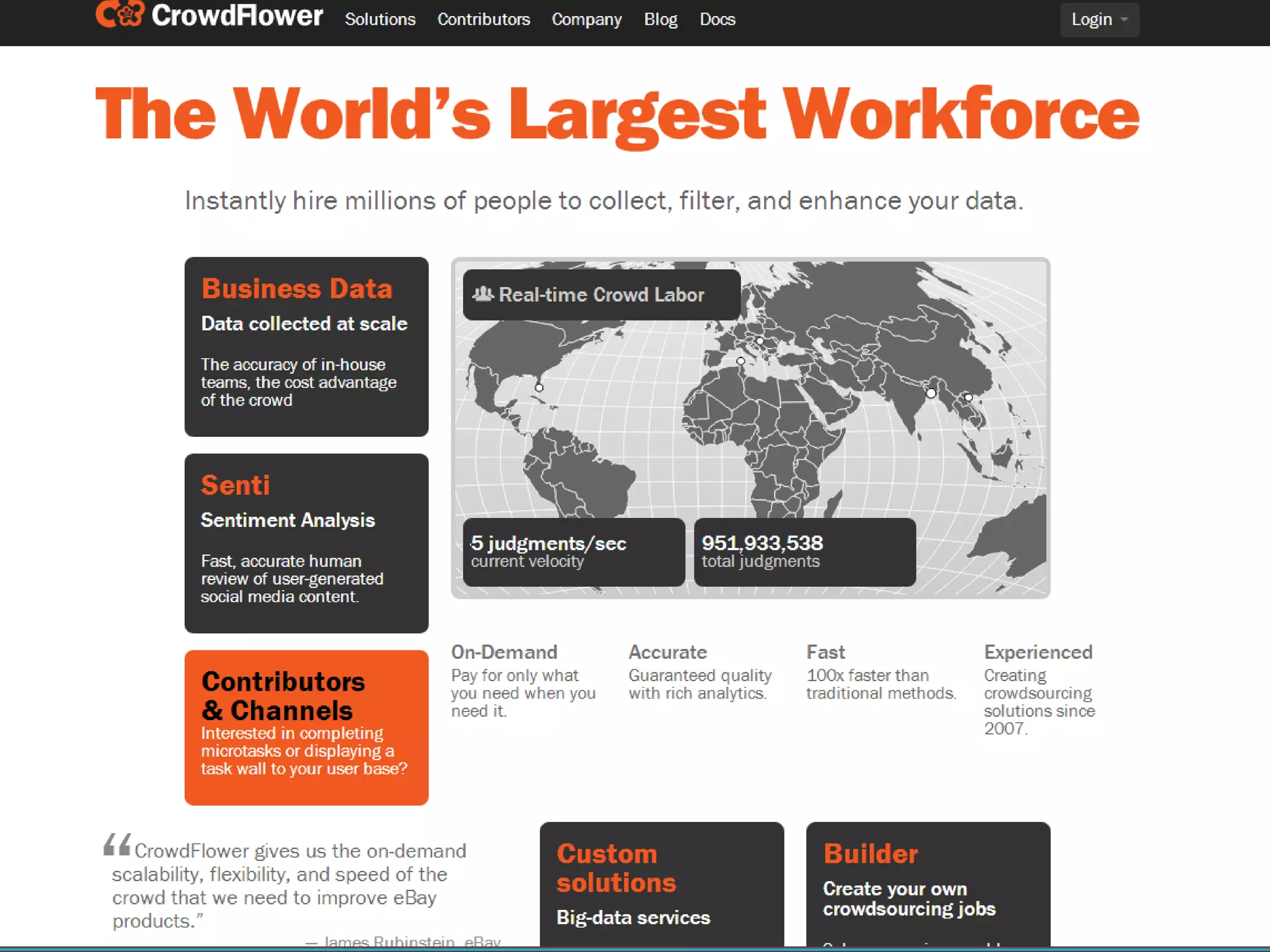
Crowdflower
Claim a crowd of over 2 million
4m human judgments per day
959,582,877 judgements
(8/6/2013)
Amazon Mechanical Turk
“The only numbers that we share
regarding our Worker population are
these two: Over 500K registered
Workers from over 190 countries
worldwide.” Jan 2011
Jobs 1cent-$10
Iperitos, using 2008 data
Turkers are younger.
Turkers are mainly female.
Turkers have lower income. of the
general
3407/09/14
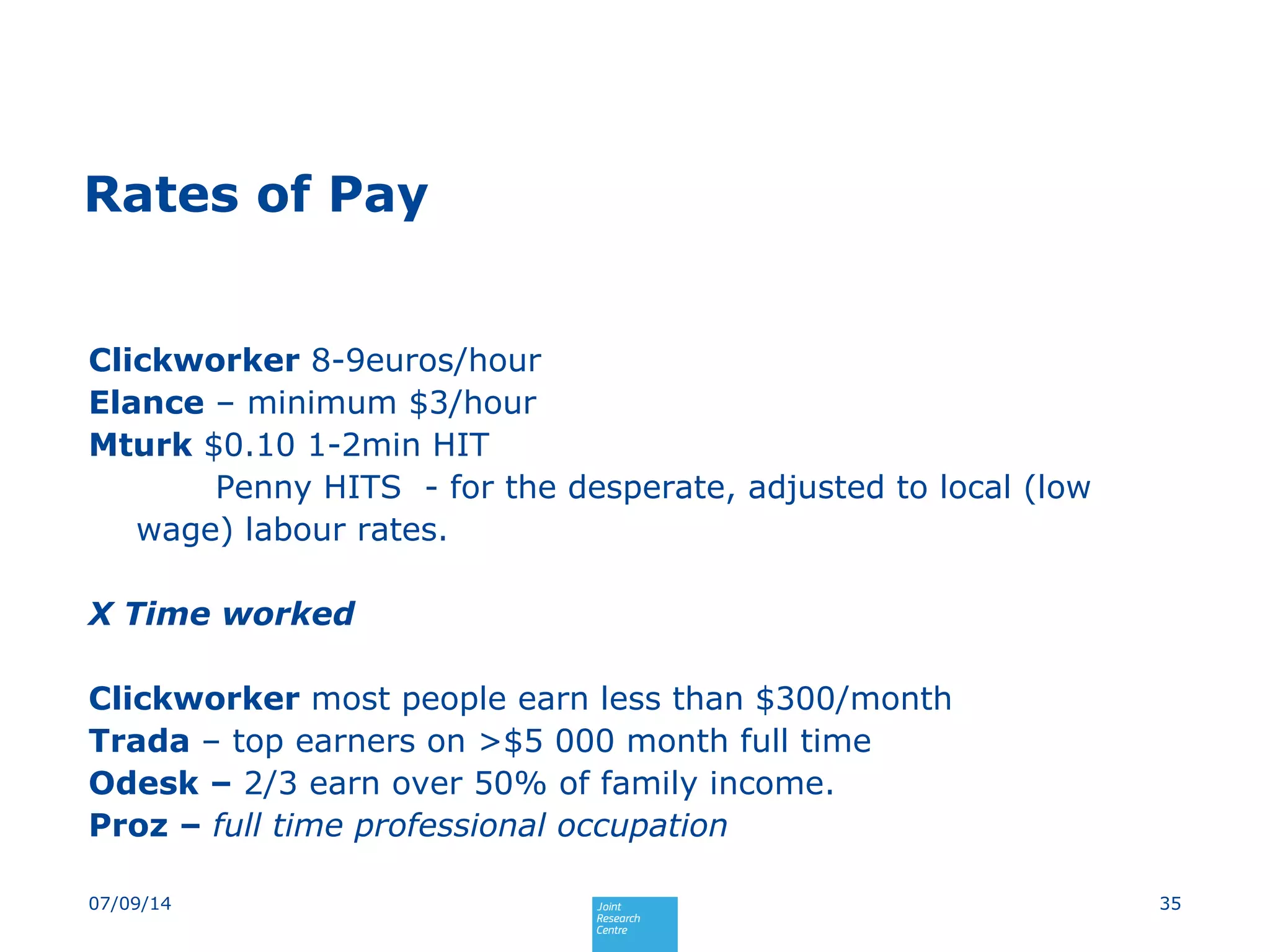
Rates of Pay
Clickworker 8-9euros/hour
Elance – minimum $3/hour
Mturk $0.10 1-2min HIT
Penny HITS - for the desperate, adjusted to local (low
wage) labour rates.
X Time worked
Clickworker most people earn less than $300/month
Trada – top earners on >$5 000 month full time
Odesk – 2/3 earn over 50% of family income.
Proz – full time professional occupation
3507/09/14
In Europe
There are microworkers (culturally specific
microtasks)
There are online freelancers etc
How many?
Millions
How could we count them?
3607/09/14
VALUE AND RISKS
3707/09/14
Value and risks for clients
New Value
Only solution
On demand
Speed
Scalable
•Exploit crowd effects
•Analytics
•Assured service
•High service quality for specific
work
HR
•Lower HR search costs
•No/low employment costs or
obligations
•Greater selection of workers
•Access to global pool of talent+
global wage rates
Risks
•Low control
•Too much choice
•Lower quality
•Disadvantages of non-
permanent staff
•Job specification
•Privacy and confidentiality
•Complexity of some microwork
38
07/09/14
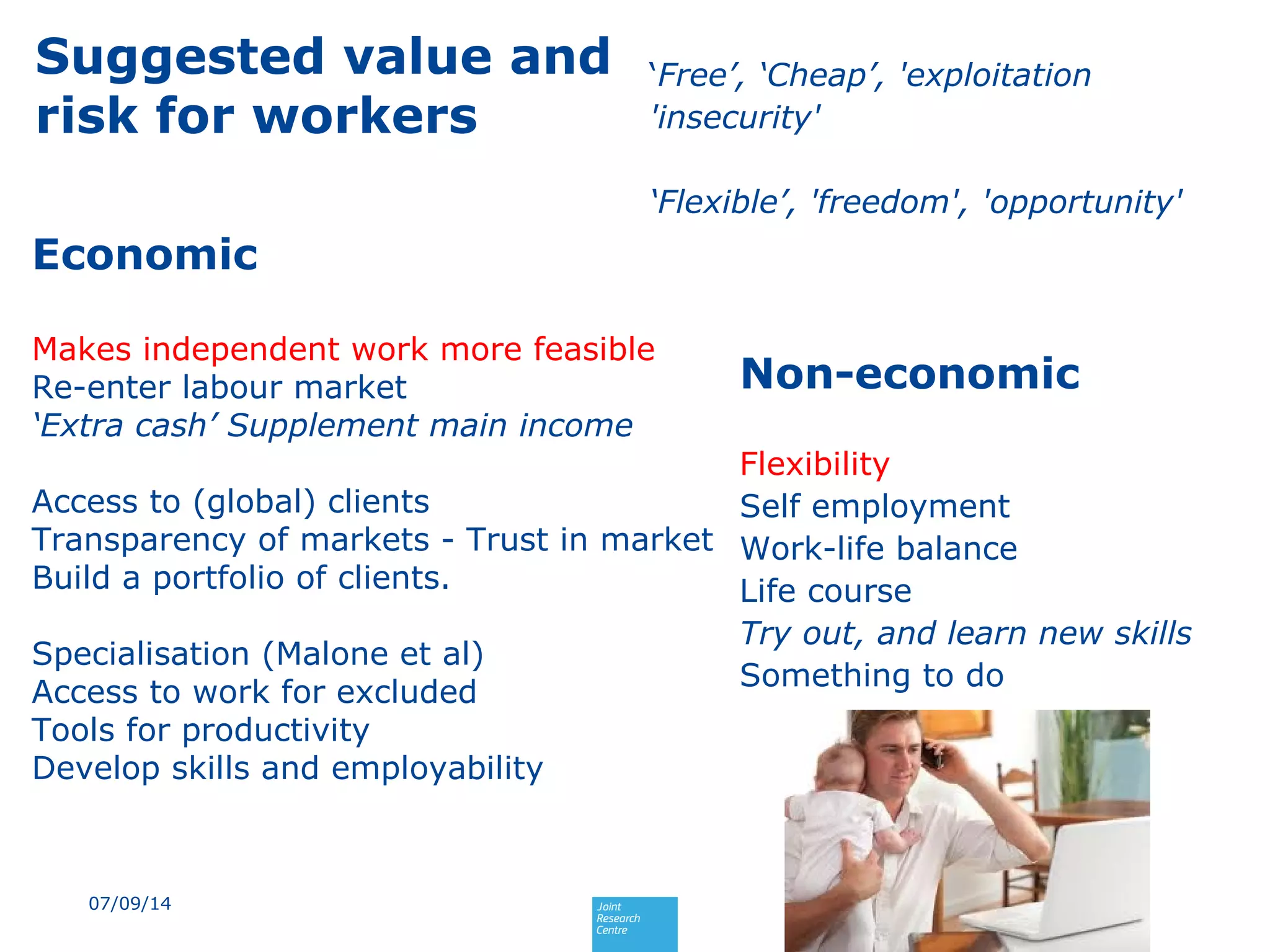
Suggested value and
risk for workers
‘Free’, ‘Cheap’, 'exploitation
'insecurity'
‘Flexible’, 'freedom', 'opportunity'
Non-economic
Flexibility
Self employment
Work-life balance
Life course
Try out, and learn new skills
Something to do
07/09/14
Economic
Makes independent work more feasible
Re-enter labour market
‘Extra cash’ Supplement main income
Access to (global) clients
Transparency of markets - Trust in market
Build a portfolio of clients.
Specialisation (Malone et al)
Access to work for excluded
Tools for productivity
Develop skills and employability
Key business innovations
How did these exchanges become this way and where are they
going?
4007/09/14
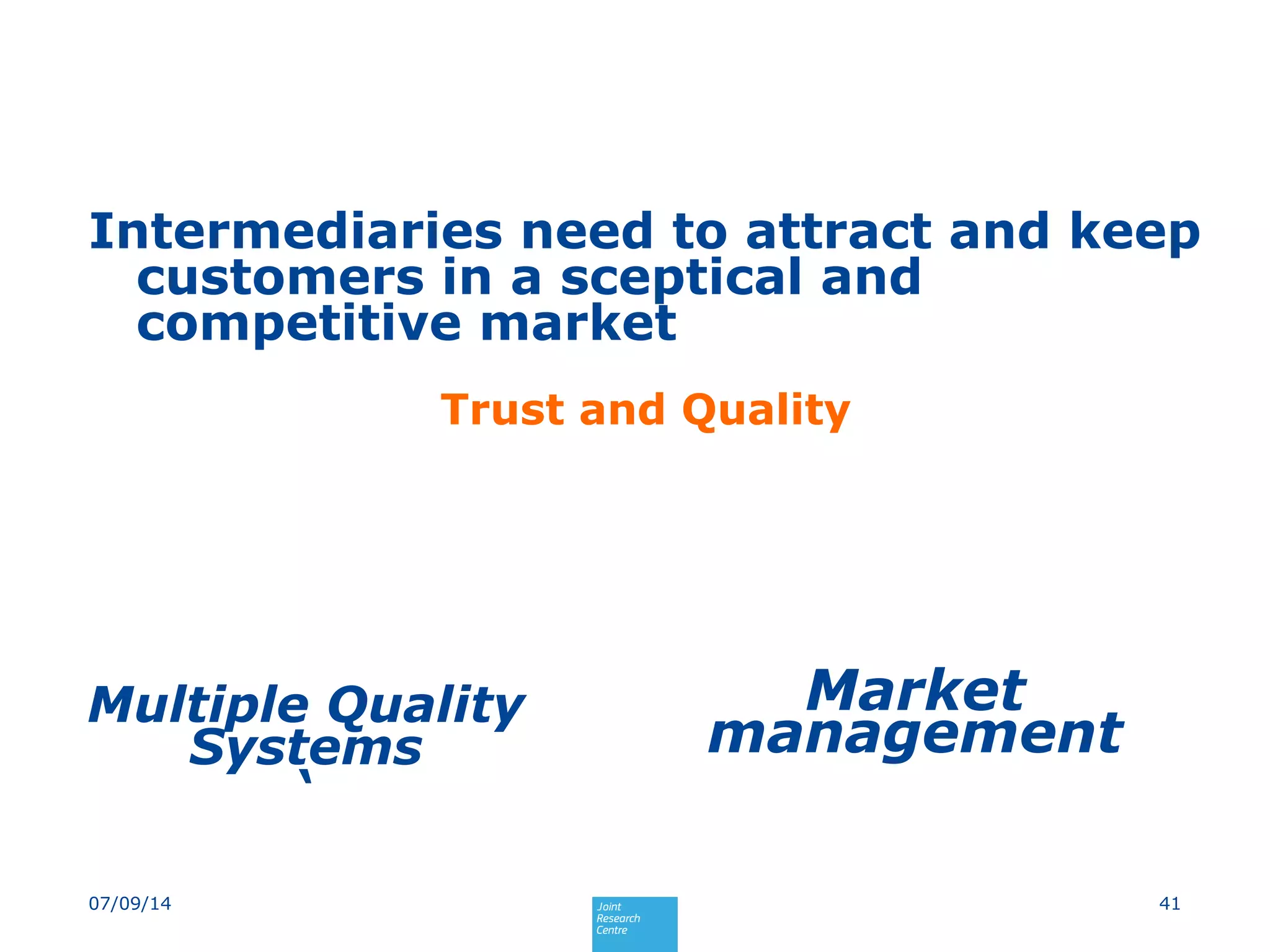
Intermediaries need to attract and keep
customers in a sceptical and
competitive market
Multiple Quality
Systems
‘
Market
management
4107/09/14
Trust and Quality
E-REPUTATION, RATINGS AND
QUALIFICATIONS
4207/09/14
4307/09/14
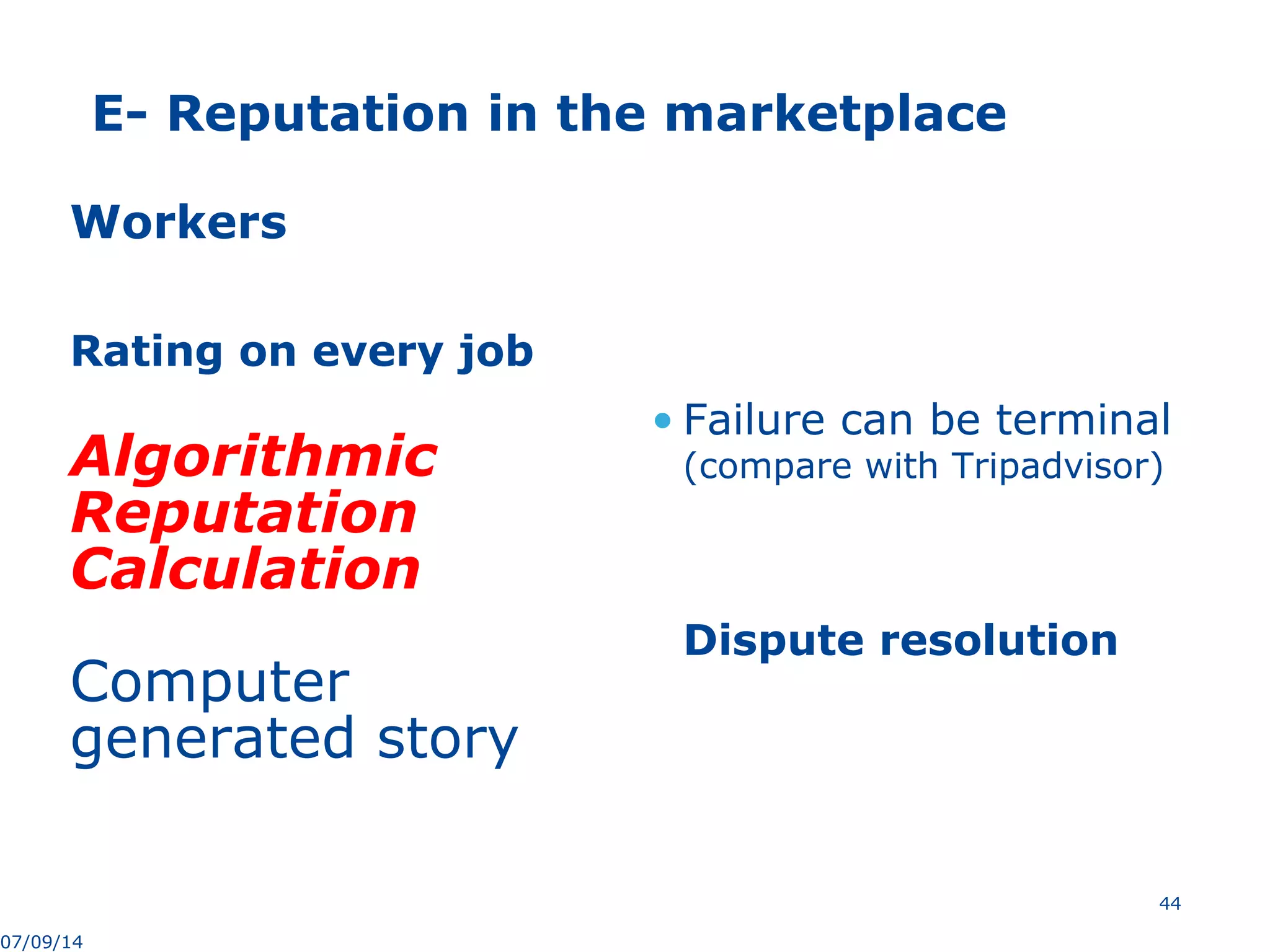
E- Reputation in the marketplace
Workers
Rating on every job
Algorithmic
Reputation
Calculation
Computer
generated story
44
07/09/14
• Failure can be terminal
(compare with Tripadvisor)
Dispute resolution
Reputation – the Client/Buyers
4507/09/14
A
Rating by supplier
Bluebook comments
B
No rating
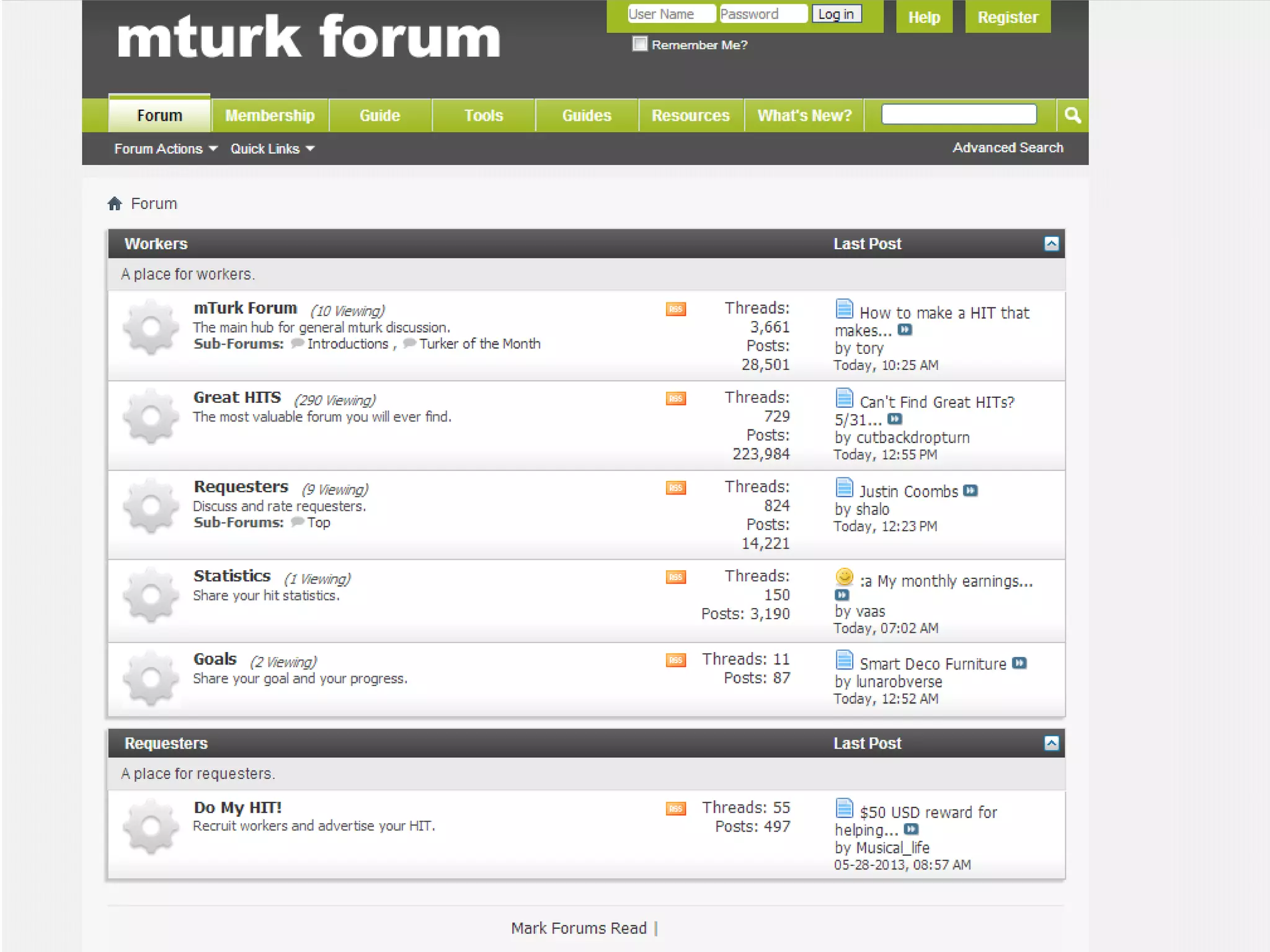
Off-platform fora or hacktivism (Turkopticon)
Depends on the business model of intermediary,
and the balance of the market.
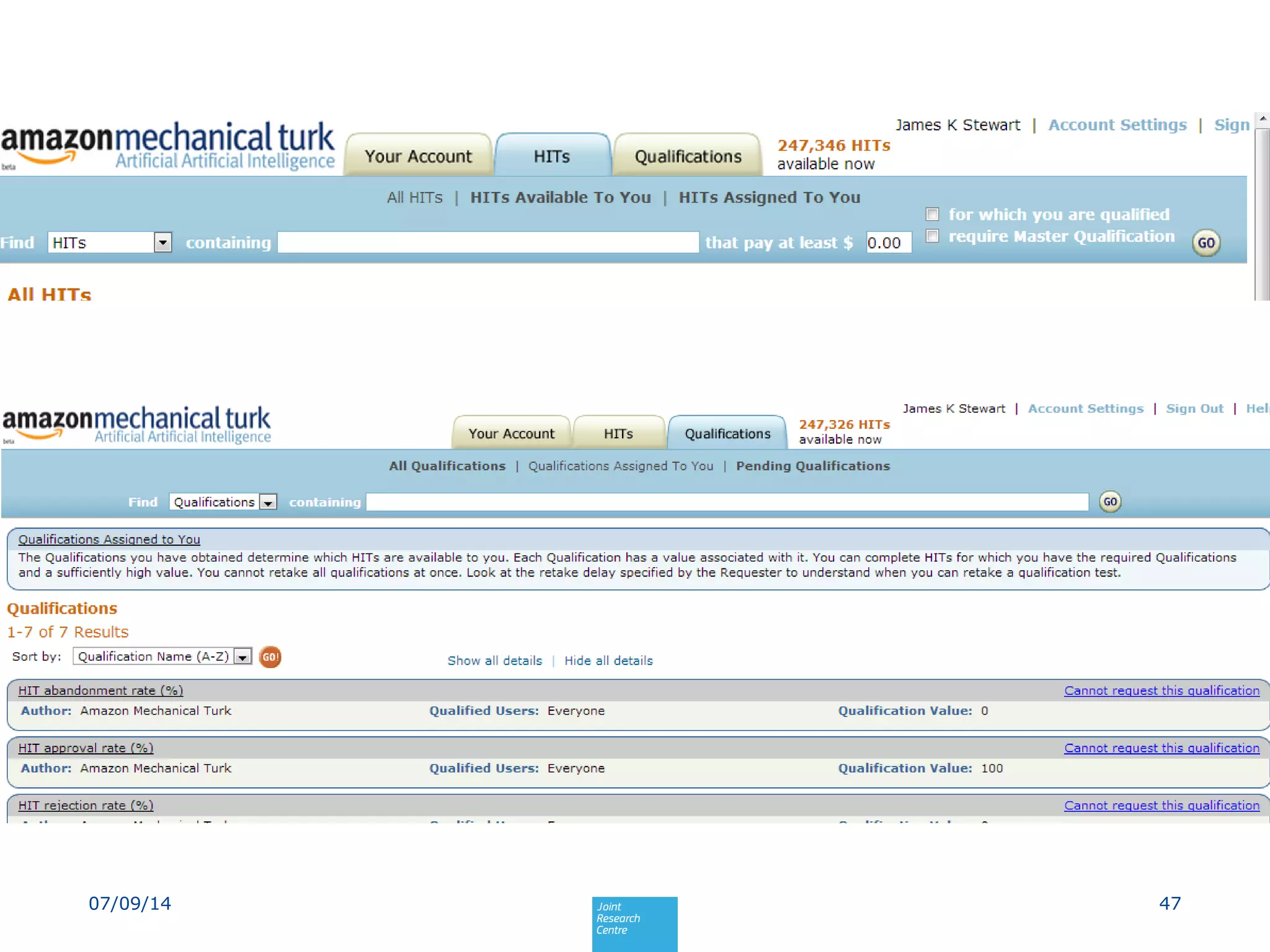
Qualifications and Validated workers
•Real-life Qualifications
•Virtual Qualification
•'Gold' tests
•Access to good work (promotion)
4607/09/14
4707/09/14
Disputes over qualification tests
“I was up until 1.00am completing the Qualify Author
section. This morning I checked and they only scored me
58%. I felt this was a good article which fitted the brief
and used SEO [Search engine optimization] words so I
have emailed them. I'm pretty sure it was because the
computer timed me (even though I didn't see anywhere
which said this was a timed section) out as I'm 4 stars on
text broker and got 100% on the 72 questions.”
“ Had an email back. They agreed the article was better than
the 58% and have changed my mark. He explained it was
a little off topic and doesn't need to have witty remarks
and more about keywords. At least I can work for them
now. (moneysavingexpert.com, 2012)
4807/09/14
Transferability
4907/09/14
Private marketplaces – privatised qualification &
reputation scores
Non-Transferable
Key to business model – keep workers on the
platform
BUT
User-driven portability
Posting reputation scores outside the site
(Linkedin)
Growing recognition.
THE CROWD: INDIVIDUALIST OR
COLLECTIVIST?
5007/09/14
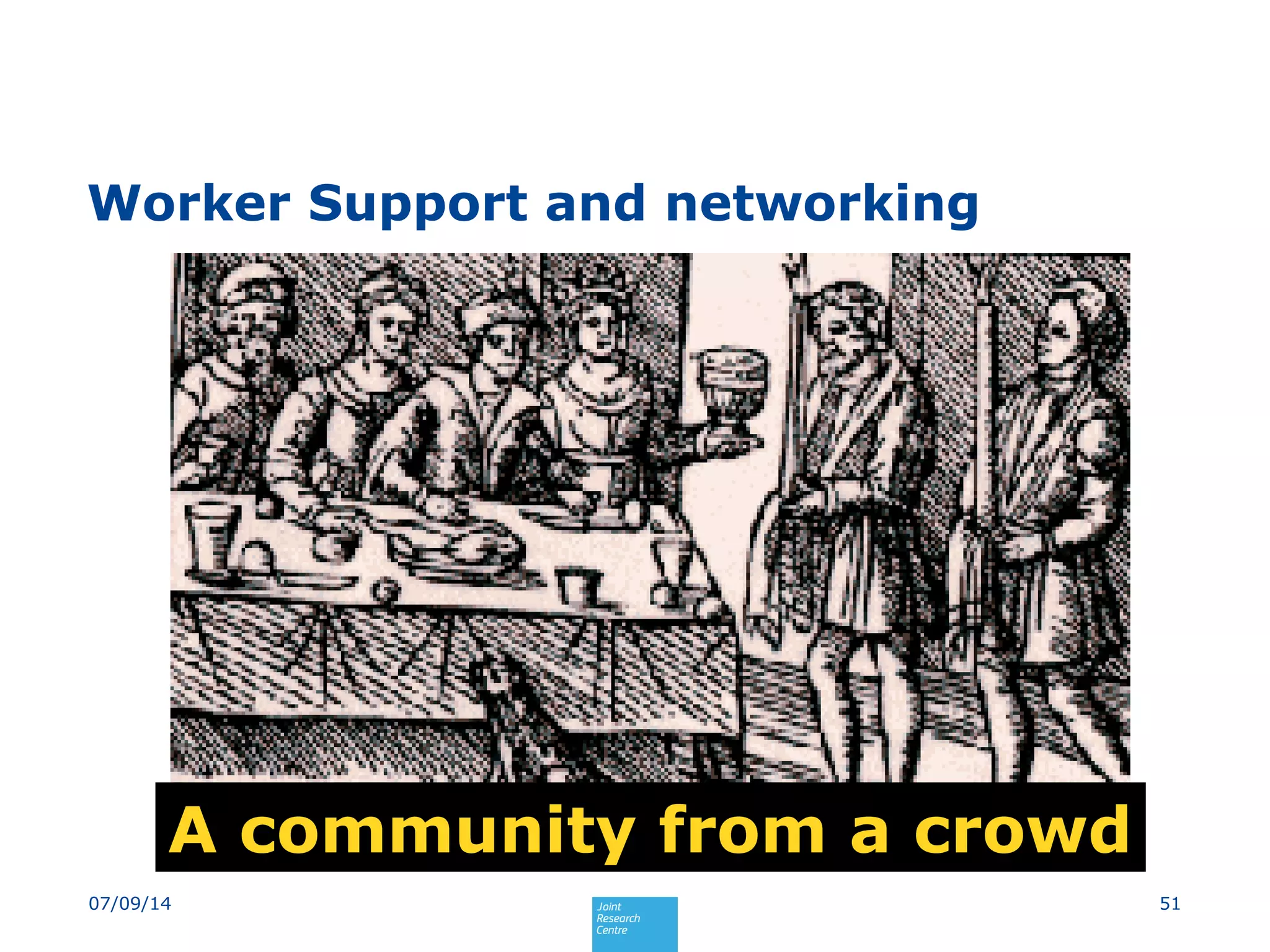
Worker Support and networking
5107/09/14
A community from a crowd
5207/09/14
Emerging e-working ecosystem
Ecosystem of competitive services and user-generated
support
User Organisation activities
• Worker support from the exchange
• Worker mutual support in third spaces (e.g.
http://cloudmebaby.com/mturkblog/ moneysavingexpert.com )
• Worker-led creation of closed shops
• Interventions to add support tools
• Platforms as tools for building teams, subcontracting and
building businesses
53
Crowds become communities
that:
Support techno-socialisation into
the practices and logic of work
though online exchanges – how to
perform in this new eco-system.
Subversion of exchange logic
5407/09/14
Policy Questions and Challenges
5507/09/14
Enterprise - SMEs
How much start-up, SME and microbusiness
growth will/could this type of work
exchange create?
In what sectors? Countries?
How many people might this growth provide
work for?
For how much of their time?
For what overall income?
In which sectors of the workforce
What kind of support could be given to
promote access to services through these
exchanges?
• Awareness; certification; Legal consistency across Europe?
Identity proof?
56
Employment and Employability
Does working through exchanges and
crowdsourcing platforms provide:
-Access to work
-Income
-Entry to work
-Opportunity to build skills
For whom, in what sectors, in what countries? Who does it
exclude?
Which sort of people are better prepared for
this work, and why?
How can we support people to develop freelance skills and work ?
Could this be integrated with public
employment services, how, where? 57
Export of Jobs?
5807/09/14
Welfare issues
Self-employed: low earnings, discontinuous work, low
skills, long and non-standard working hours, the high
incidence of industrial accidents and work-related
health problems
Do we want to encourage this?
Or do we just have to cope with this reality?
Policy concerns
-Policy barriers to autonomous workers
-The EES not adapting to atypical work
59
07/09/14
Platform Support?
Why do these platforms not exist in some
sectors/countries/regions?
Are what rate are they growing?
What would be the impact on employment (growth,
reduction) and wages if they did exist?
If they are desirable to support growth and/or employment,
What can public policy makers and public services do
to:
Stimulate growth in these platforms – focused in sectors,
regions that will most benefit/most in need?
Integration of e-government services with platforms.
What are the Risks of promoting this type of working?
Insecure work, exploitation, resistance from social partners
6007/09/14
6107/09/14
Potential policy interest
Reactive
Training and skills
Constraints on autonomous
workers in Europe
Protection of workers
Flexibility in hiring freelancers
Adapt e-gov systems
Long term Welfare and Economic
issues
Proactive
1.Model and ideas for social
innovation: Public services
 PES
• Public service ‘delivery’
2. Active promotion of work these
working patterns: opportunities for
• New jobs
• Entrepreneurs
• SMEs
• Digital economy
• Excluded citizens
• Employment transitions
6207/09/14
Discuss
6307/09/14
Summary
Explore:
Innovation and investment necessary to
build confidence in platforms, and attract
clients and contractors
Conditions of work, including the pressures
of working for and within software
machines
Potential socio-economic impact
6407/09/14
More info on the JRC-IPTS research
JRC-IPTS Employability-The Future of Work
6507/09/14
Or James Stewart j.k.stewart@ed.ac.uk

Cloud to crowd talk to COST Virtual work Bucharest 2014

  • 1.
    From Crowd toCloud: The Present and Future of Work in the Network Economy – the role of Online Work Exchanges James Stewart University of Edinburgh j.k.stewart@ed.ac.uk Virtual Work, Bucharest March 2014 This work was funded by and conducted at the JRC-IPTS, European Commission ICT4EMPL "The Future of Work" This presentation does not represent the views of the European Commission
  • 2.
    My concern frompolicy? 207/09/14
  • 3.
    Online work exchanges: Newways of finding work, finding workers, being employed and getting work done Not: ‘Telework’, ‘free labour’ etc 307/09/14
  • 4.
    Potential Policy Opportunties Employment-related policy(such as labour market reform, temporary work, youth employment and training, entrepreneurship, self- employment, flexible working, access to work), •Balance of industry and welfare (e.g.flexicurity) Skills policy Digital skills and access, •Mobility programmes Enterprise and Markets SMEs and microenterprises, microfinance •Regional Development, •Financial regulation, •The Single Market in services and employment. •Job Creation Social Policy •Social inclusion programmes •Social cohesion programmes •Public service delivery International development
  • 5.
    10+ years on Batesand Huws 2002 'eworker' estimates for 2000 in Europe (EMERGENCE Project) •9 million eWorkers • 3.7m multi-locational eWorkers • 810,000 teleworkers • 1.45m eLancers • 3m+ eEnabled self employed • Most not working through online exchanges 507/09/14
  • 6.
    STS Agendas Software Infrastructures Scale –>Big Data Humans and computers ever more tightly entangled Algorithmic matching • Google search, adwords, social media (Facebook etc) Social computing and classification ICT and Work • Replacement of People by IT •‘End of Work’ •Telework •CSCW •Mobile Work •Open Source and voluntary labour •Call centres •Globalisation, BPO and off-shoring •Fragmentation of labour solidarity •Hollowing out of white collar work •Crowdsourcing for free labour •Virtual Work07/09/14
  • 7.
  • 8.
  • 9.
  • 10.
  • 11.
  • 12.
  • 13.
  • 14.
  • 15.
  • 16.
  • 17.
  • 18.
  • 19.
  • 20.
  • 21.
    Who works throughthese systems? Working and Unemployed Students – gaining experience, reputation or spare cash People with families looking for flexibility Disabled housebound Rural dwellers Middle-aged restarters Retired people supplementing pension • People in traditional Freelance occupations  Designers  Translators  Accountants  Programmers • Small Business • Hipsters Professionals in South Asia and other emerging economies Microbusiness and freelancers buying services from others 2107/09/14
  • 22.
    Types of tasks(after Frei) Size, org,pay example Microtasks High volume; low pay per task; automated Transcription, classifying, price search, find simple info 'Macro'-tasks High volume, low pay, automated Product review, simple testing, simple info collecting (e.g marketing) Simple projects Low volume, single tasks, with skill and moderate pay. Direct contact Design a website Do accounts Write a presentation Design a logo Complex projects Single projects, high pay, often multiple people, direct contact Scientific challenges Algorithm design Complex research 2207/09/14
  • 23.
    TWO GENERIC OPERATINGAND BUSINESS MODELS 2307/09/14
  • 24.
    Crowd Crowdsourced Microwork model 2407/09/14 CrowdPlatforms Task Managers and Resellers Local intermediaries Curating the crowd Clients (direct integration) Clients (ad hoc) APIs Crowd self- organising Microwork design Workflow integration Quality Matching Recruitment Worker interface (motivation, quality, payment), APIs, BPO workforce
  • 25.
    Freelancer Marketplace model Trust Efficiency Transparency 07/09/14 ContractorsClients Intermediaries andmarket makers Large clients Matching Payments Quality Dispute management Support Work platforms Value added services Competitions Contracts Rent-a-crowds Teams Access to clients Support and training Access to Cntractors Value added services Tax Training Mentors Resources
  • 26.
    Existing research concernsand results 2607/09/14
  • 27.
    Research on onlineexchanges Crowdsourcing – business models +some critical user studies (Brabham 2010, 2011, 2013). Elancing’ from an HR perspective (Aguinis and Lawal 2013) Microtask platform use – e.g. in scientific experiments (Iperitos 2008,210a, 2010b) Labour economics perspective (Agrawal et al 2013) Virtual labour Huws 2003; Scholz 2012; Kleemann and Voß, 2008; Huws 2013; Holts (2013) Caraway (2010) ) Legal issues (Felstiner (2011) Microworker identity (Lehdonvirta and Mezier (2013) Microworker empowerment - Turkopticon (Irani and Silberman 2013). 2707/09/14
  • 28.
    Open the blackbox of job search (Petrongolo and Pissarides, 2001; Marchal et al 2007). formal and informal information channels (e.g. Granovetter 1974) role of intermediaries whose work is to match vacancies sellers and buyers (see Marchal et al 2007). 2807/09/14
  • 29.
    Literature Practitioner Interviews Short Cases Inductive Indepth qualitative cases and analysis Outsourced to Warwick university 2907/09/14 ICT4EMPL
  • 30.
  • 31.
    3107/09/14 Specialist Generalist Global Proz (Translators) Microtask Elance;AMT National/ Regional Trada (optimizers) PPH; Clickworker Local Rated People (domestic trades) Slivers (Social care) (Local listings)
  • 32.
  • 33.
    Online freelance sites: 12mworldwide (World Bank estimates from adding top 3 elancer sites, neglects multiple membership) Elance 2.3+ million registered users 715k in US, 359k India, 80k UK $200m elancer earnings. 48% say main source of income Odesk Matched 35m hours of work in 2012 workers in 179 countries $360m earned. 2/3 workers >50% of family income Freelancer claims 7m registered workers, 4.5m completed projects Staffing industry Analysts estimate $1bn value in 2012 ($2bn 2014) Proz 600 000 registered translators, 20 000 paying members Trada 10000s of users 300 regular workers 3307/09/14
  • 34.
    Microwork Numbers Clickworker 300 000Clickworkers 1/3 Germany, 1/3 rest of Europe 1/3 North America Crowdflower Claim a crowd of over 2 million 4m human judgments per day 959,582,877 judgements (8/6/2013) Amazon Mechanical Turk “The only numbers that we share regarding our Worker population are these two: Over 500K registered Workers from over 190 countries worldwide.” Jan 2011 Jobs 1cent-$10 Iperitos, using 2008 data Turkers are younger. Turkers are mainly female. Turkers have lower income. of the general 3407/09/14
  • 35.
    Rates of Pay Clickworker8-9euros/hour Elance – minimum $3/hour Mturk $0.10 1-2min HIT Penny HITS - for the desperate, adjusted to local (low wage) labour rates. X Time worked Clickworker most people earn less than $300/month Trada – top earners on >$5 000 month full time Odesk – 2/3 earn over 50% of family income. Proz – full time professional occupation 3507/09/14
  • 36.
    In Europe There aremicroworkers (culturally specific microtasks) There are online freelancers etc How many? Millions How could we count them? 3607/09/14
  • 37.
  • 38.
    Value and risksfor clients New Value Only solution On demand Speed Scalable •Exploit crowd effects •Analytics •Assured service •High service quality for specific work HR •Lower HR search costs •No/low employment costs or obligations •Greater selection of workers •Access to global pool of talent+ global wage rates Risks •Low control •Too much choice •Lower quality •Disadvantages of non- permanent staff •Job specification •Privacy and confidentiality •Complexity of some microwork 38 07/09/14
  • 39.
    Suggested value and riskfor workers ‘Free’, ‘Cheap’, 'exploitation 'insecurity' ‘Flexible’, 'freedom', 'opportunity' Non-economic Flexibility Self employment Work-life balance Life course Try out, and learn new skills Something to do 07/09/14 Economic Makes independent work more feasible Re-enter labour market ‘Extra cash’ Supplement main income Access to (global) clients Transparency of markets - Trust in market Build a portfolio of clients. Specialisation (Malone et al) Access to work for excluded Tools for productivity Develop skills and employability
  • 40.
    Key business innovations Howdid these exchanges become this way and where are they going? 4007/09/14
  • 41.
    Intermediaries need toattract and keep customers in a sceptical and competitive market Multiple Quality Systems ‘ Market management 4107/09/14 Trust and Quality
  • 42.
  • 43.
  • 44.
    E- Reputation inthe marketplace Workers Rating on every job Algorithmic Reputation Calculation Computer generated story 44 07/09/14 • Failure can be terminal (compare with Tripadvisor) Dispute resolution
  • 45.
    Reputation – theClient/Buyers 4507/09/14 A Rating by supplier Bluebook comments B No rating Off-platform fora or hacktivism (Turkopticon) Depends on the business model of intermediary, and the balance of the market.
  • 46.
    Qualifications and Validatedworkers •Real-life Qualifications •Virtual Qualification •'Gold' tests •Access to good work (promotion) 4607/09/14
  • 47.
  • 48.
    Disputes over qualificationtests “I was up until 1.00am completing the Qualify Author section. This morning I checked and they only scored me 58%. I felt this was a good article which fitted the brief and used SEO [Search engine optimization] words so I have emailed them. I'm pretty sure it was because the computer timed me (even though I didn't see anywhere which said this was a timed section) out as I'm 4 stars on text broker and got 100% on the 72 questions.” “ Had an email back. They agreed the article was better than the 58% and have changed my mark. He explained it was a little off topic and doesn't need to have witty remarks and more about keywords. At least I can work for them now. (moneysavingexpert.com, 2012) 4807/09/14
  • 49.
    Transferability 4907/09/14 Private marketplaces –privatised qualification & reputation scores Non-Transferable Key to business model – keep workers on the platform BUT User-driven portability Posting reputation scores outside the site (Linkedin) Growing recognition.
  • 50.
    THE CROWD: INDIVIDUALISTOR COLLECTIVIST? 5007/09/14
  • 51.
    Worker Support andnetworking 5107/09/14 A community from a crowd
  • 52.
  • 53.
    Emerging e-working ecosystem Ecosystemof competitive services and user-generated support User Organisation activities • Worker support from the exchange • Worker mutual support in third spaces (e.g. http://cloudmebaby.com/mturkblog/ moneysavingexpert.com ) • Worker-led creation of closed shops • Interventions to add support tools • Platforms as tools for building teams, subcontracting and building businesses 53
  • 54.
    Crowds become communities that: Supporttechno-socialisation into the practices and logic of work though online exchanges – how to perform in this new eco-system. Subversion of exchange logic 5407/09/14
  • 55.
    Policy Questions andChallenges 5507/09/14
  • 56.
    Enterprise - SMEs Howmuch start-up, SME and microbusiness growth will/could this type of work exchange create? In what sectors? Countries? How many people might this growth provide work for? For how much of their time? For what overall income? In which sectors of the workforce What kind of support could be given to promote access to services through these exchanges? • Awareness; certification; Legal consistency across Europe? Identity proof? 56
  • 57.
    Employment and Employability Doesworking through exchanges and crowdsourcing platforms provide: -Access to work -Income -Entry to work -Opportunity to build skills For whom, in what sectors, in what countries? Who does it exclude? Which sort of people are better prepared for this work, and why? How can we support people to develop freelance skills and work ? Could this be integrated with public employment services, how, where? 57
  • 58.
  • 59.
    Welfare issues Self-employed: lowearnings, discontinuous work, low skills, long and non-standard working hours, the high incidence of industrial accidents and work-related health problems Do we want to encourage this? Or do we just have to cope with this reality? Policy concerns -Policy barriers to autonomous workers -The EES not adapting to atypical work 59 07/09/14
  • 60.
    Platform Support? Why dothese platforms not exist in some sectors/countries/regions? Are what rate are they growing? What would be the impact on employment (growth, reduction) and wages if they did exist? If they are desirable to support growth and/or employment, What can public policy makers and public services do to: Stimulate growth in these platforms – focused in sectors, regions that will most benefit/most in need? Integration of e-government services with platforms. What are the Risks of promoting this type of working? Insecure work, exploitation, resistance from social partners 6007/09/14
  • 61.
  • 62.
    Potential policy interest Reactive Trainingand skills Constraints on autonomous workers in Europe Protection of workers Flexibility in hiring freelancers Adapt e-gov systems Long term Welfare and Economic issues Proactive 1.Model and ideas for social innovation: Public services  PES • Public service ‘delivery’ 2. Active promotion of work these working patterns: opportunities for • New jobs • Entrepreneurs • SMEs • Digital economy • Excluded citizens • Employment transitions 6207/09/14
  • 63.
  • 64.
    Summary Explore: Innovation and investmentnecessary to build confidence in platforms, and attract clients and contractors Conditions of work, including the pressures of working for and within software machines Potential socio-economic impact 6407/09/14
  • 65.
    More info onthe JRC-IPTS research JRC-IPTS Employability-The Future of Work 6507/09/14 Or James Stewart j.k.stewart@ed.ac.uk

Editor's Notes

  • #2 Funded and conducted by the JRC-IPTS, European Commission
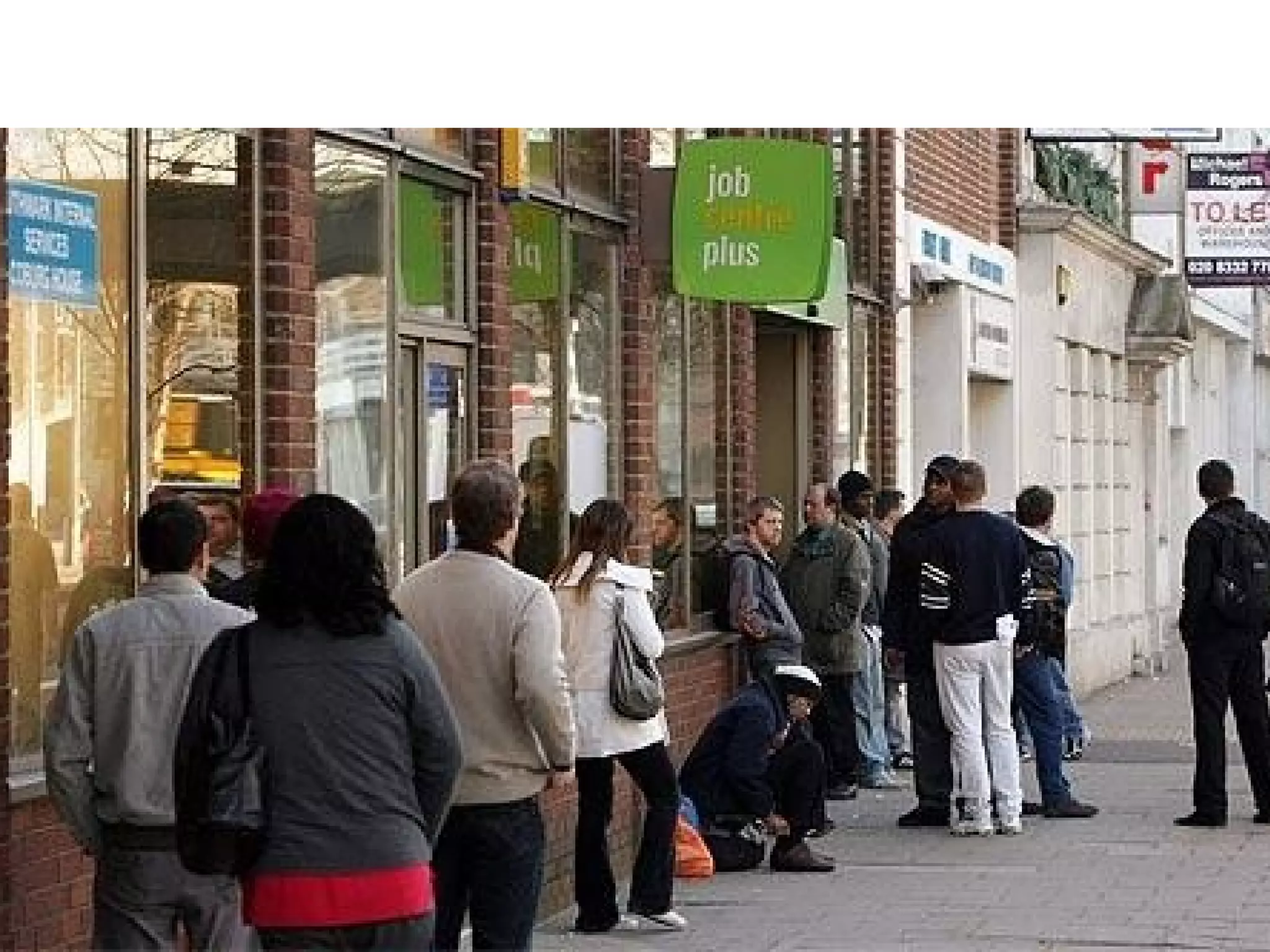
  • #3 High unemployment, Employment and employability? Quantity and quality of work over the life course? Power relationships Global employment
  • #4 Not just individualistic
  • #6 http://www.eric.ed.gov/ERICWebPortal/search/detailmini.jsp?_nfpb=true&_&ERICExtSearch_SearchValue_0=ED468227&ERICExtSearch_SearchType_0=no&accno=ED468227 Modelling eWork in Europe: Estimates, Models and Forecasts from the EMERGENCE Project. IES Report. Bates, P.; Huws, U. 2002, Grantham Book Services, Ltd Add Quote from ework 1999?
  • #7 Generic concern for algorithmic matching and need to conform or perform for the algorithm Economic sociology: Granovetter, Callon
  • #20 3 mins
  • #21 Work organised/scheduled online, but conducted at least partly face to face/on-site e.g. plumbers, social care, etc Work submitted on-line/off-site Information, data, knowledge, creative, software, organising
  • #25 Commerical users: ecommerce companies, directories, advertisers, specialist data processors, and organisations with specialist data sets, and scientists. Trip Advisor, Youtube, ebay, Groupon, Amazon, Apple, Google, Unilever etc second group of clients that are important online advertisers -optimisation, checking etc data intensive businesses also require a vast among of data to be checked, transcribed, translated etc. These include retailers such as Walmart, Libraries Directory companies Scientists
  • #29 Marchal et al 2007 using Callon Muniesa, the intermediaries allocate this calculative capacity to the different market actors in different ways Pn;ine v. newspaper ads. Online – info system – much more restrictive,
  • #30 4mins Little literature on how people work e.g. Brabham On the details On how and why the systems are changing Robertson (Trada) When we started we (the industry) though it would be crowds motivation by gamification. Learning by doing goes from vision to reality. We can understand trends, processes that make them happen.
  • #34 (1.5bn hrs/day in EU)
  • #35 Iperitos http://www.behind-the-enemy-lines.com/2009/03/turker-demographics-vs-internet.html mTurk https://forums.aws.amazon.com/thread.jspa?threadID=58891
  • #36 Various Sources
  • #37 14mins Compared to existing survey data New source of data on supply and demand.
  • #42 How to create their system as a desirable service, and their users a (workers and clients) as products?
  • #45 Numerated */% rating Written Feedback Jobs completed Completed jobs, 'qualifications' feedback, rating, number of jobs, size of jobs, premium member, contribution to the community etc Failure can be fatal (compare with Tripadvisor) Not offered (good) jobs by matching system Employers don’t select to invite for bidding Dispute resolution
  • #48 mTurk Qualificaitons Key Quality assurance tool for intermediary External qualification
  • #52 The Guild Elancing – Malone et al proposed a re-emergence guild. The 'elancing sites' – a community from a crowd The crowdsourcing sites too, even the microworkers – It is hard to work alone, at least seriously – the internet is there and people use it. Proz – primarily a worker resource Trada – bulletin board Elance – Resources, bulletin board, Bluebook mTurk online for a and Turkopticon Clickworker forums Topcode – virtual teams
  • #60 Legal status and responsibility Dependency and Tax Homeworker v Freelancer Contractor v. employee Limit of earnings per year Innovations in services to manage status though online platforms Degree of Dependency
  • #62 Flexicurity Employability Atypical work Freelancers, contractors, casual and atypical and independent workers Conditions of work Flexible work, gender, aging Flexible work contracts Zero hour contracts and a return to dock gate hiring
  • #63 Regulatory difficulties and challenges : labour law, single market. Political discourses and acceptability of these types of work