

Careers and Employability Centre
Making Successful
Applications
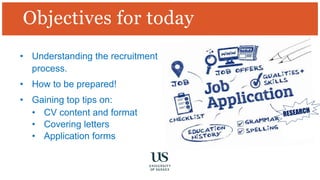
• Understanding the recruitment
process.
• How to be prepared!
• Gaining top tips on:
• CV content and format
• Covering letters
• Application forms
Objectives for today
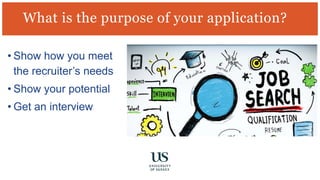
What is the purpose of your application?
• Show how you meet
the recruiter’s needs
• Show your potential
• Get an interview
Aim of the recruitment process is to find the best
talents in the job market.
The process varies between organisations.
Can include:
• Written application – CV and covering letter
and/OR application form
• Interview – telephone, video, 1-to-1, panel
interview
• Selection tests – psychometric, numerical, verbal,
reasoning etc
• Assessment Centre – group activities, interviews,
tests
The recruitment process
Preparation
• Be organised – keep a note of all your applications,
deadlines, dates submitted etc.
• Research the organisation
• Website “About Us” pages
• Who are they? What do they do? What current issues
are they facing? Who are their competitors?
• Research the job
• Job ad, website (Careers, Jobs pages), job description
• What are they looking for? What responsibilities does
the job involve?
• Carefully read and follow the application instructions and
guidelines
The key to success!
What are employers looking for?
To write a focused CV or application form you need to know what
the employer is looking for.
The skills you need to identify are in:
• Job advertisement
• Job description
• Person specification
• Other information about the organisation on their
website
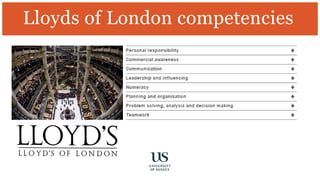
Lloyds of London competencies
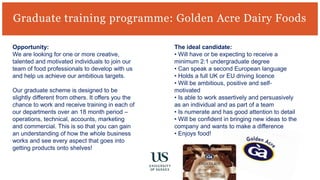
Graduate training programme: Golden Acre Dairy Foods
Opportunity:
We are looking for one or more creative,
talented and motivated individuals to join our
team of food professionals to develop with us
and help us achieve our ambitious targets.
Our graduate scheme is designed to be
slightly different from others. It offers you the
chance to work and receive training in each of
our departments over an 18 month period –
operations, technical, accounts, marketing
and commercial. This is so that you can gain
an understanding of how the whole business
works and see every aspect that goes into
getting products onto shelves!
The ideal candidate:
• Will have or be expecting to receive a
minimum 2:1 undergraduate degree
• Can speak a second European language
• Holds a full UK or EU driving licence
• Will be ambitious, positive and self-
motivated
• Is able to work assertively and persuasively
as an individual and as part of a team
• Is numerate and has good attention to detail
• Will be confident in bringing new ideas to the
company and wants to make a difference
• Enjoys food!
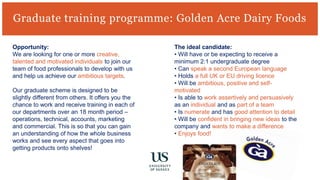
Graduate training programme: Golden Acre Dairy Foods
Opportunity:
We are looking for one or more creative,
talented and motivated individuals to join our
team of food professionals to develop with us
and help us achieve our ambitious targets.
Our graduate scheme is designed to be
slightly different from others. It offers you the
chance to work and receive training in each of
our departments over an 18 month period –
operations, technical, accounts, marketing
and commercial. This is so that you can gain
an understanding of how the whole business
works and see every aspect that goes into
getting products onto shelves!
The ideal candidate:
• Will have or be expecting to receive a
minimum 2:1 undergraduate degree
• Can speak a second European language
• Holds a full UK or EU driving licence
• Will be ambitious, positive and self-
motivated
• Is able to work assertively and persuasively
as an individual and as part of a team
• Is numerate and has good attention to detail
• Will be confident in bringing new ideas to the
company and wants to make a difference
• Enjoys food!
CVs and covering
letters
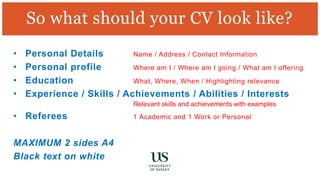
So what should your CV look like?
• Personal Details Name / Address / Contact Information
• Personal profile Where am I / Where am I going / What am I offering
• Education What, Where, When / Highlighting relevance
• Experience / Skills / Achievements / Abilities / Interests
Relevant skills and achievements with examples
• Referees 1 Academic and 1 Work or Personal
MAXIMUM 2 sides A4
Black text on white
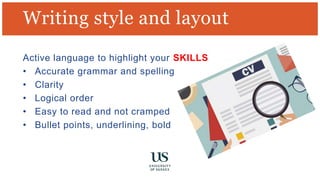
Writing style and layout
Active language to highlight your SKILLS
• Accurate grammar and spelling
• Clarity
• Logical order
• Easy to read and not cramped
• Bullet points, underlining, bold
Different types of CV
• Chronological / traditional
• Skills based / targeted / functional
• Creative
• Online
• Academic
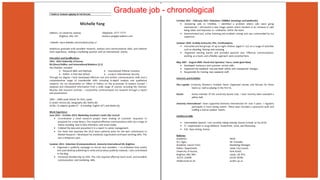
Graduate job - chronological
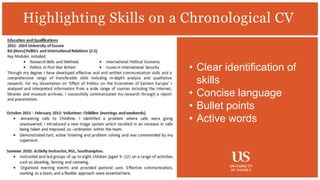
Highlighting Skills on a Chronological CV
• Clear identification of
skills
• Concise language
• Bullet points
• Active words
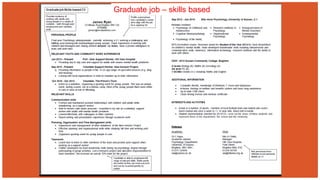
Graduate job – skills based
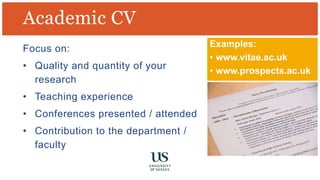
Academic CV
Examples:
• www.vitae.ac.uk
• www.prospects.ac.uk
Focus on:
• Quality and quantity of your
research
• Teaching experience
• Conferences presented / attended
• Contribution to the department /
faculty
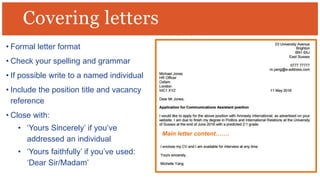
• Formal letter format
• Check your spelling and grammar
• If possible write to a named individual
• Include the position title and vacancy
reference
• Close with:
• ‘Yours Sincerely’ if you’ve
addressed an individual
• ‘Yours faithfully’ if you’ve used:
‘Dear Sir/Madam’
Covering letters
Main letter content…….
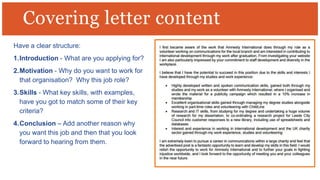
Have a clear structure:
1.Introduction - What are you applying for?
2.Motivation - Why do you want to work for
that organisation? Why this job role?
3.Skills - What key skills, with examples,
have you got to match some of their key
criteria?
4.Conclusion – Add another reason why
you want this job and then that you look
forward to hearing from them.
Covering letter content
Application forms
TOP TIPS Filling in application forms
1. Give yourself plenty of time – check the deadline
2. Research the organization, their requirements, their values etc
3. Follow their tips for online applications
4. Read the application form carefully
5. Work in draft first
6. Complete all the sections
7. Check you have answered each question
8. Check for spelling and grammar – CHECK, CHECK, CHECK!!
9. Print out a copy – so you can review it before interview
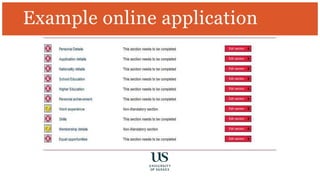
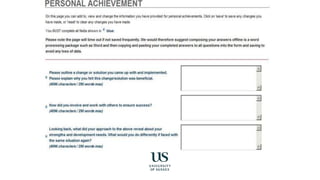
Example online application
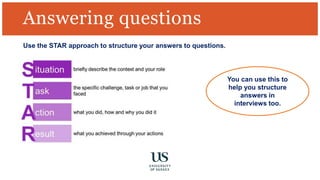
Answering questions
Use the STAR approach to structure your answers to questions.
You can use this to
help you structure
answers in
interviews too.
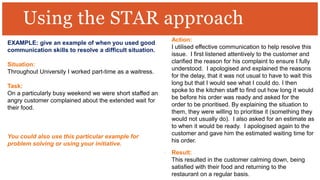
Using the STAR approach
EXAMPLE: give an example of when you used good
communication skills to resolve a difficult situation.
Situation:
Throughout University I worked part-time as a waitress.
Task:
On a particularly busy weekend we were short staffed an
angry customer complained about the extended wait for
their food.
You could also use this particular example for
problem solving or using your initiative.
Action:
I utilised effective communication to help resolve this
issue. I first listened attentively to the customer and
clarified the reason for his complaint to ensure I fully
understood. I apologised and explained the reasons
for the delay, that it was not usual to have to wait this
long but that I would see what I could do. I then
spoke to the kitchen staff to find out how long it would
be before his order was ready and asked for the
order to be prioritised. By explaining the situation to
them, they were willing to prioritise it (something they
would not usually do). I also asked for an estimate as
to when it would be ready. I apologised again to the
customer and gave him the estimated waiting time for
his order.
Result:
This resulted in the customer calming down, being
satisfied with their food and returning to the
restaurant on a regular basis.
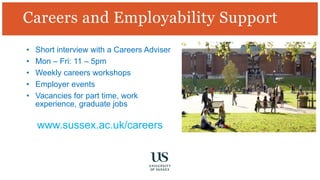
Careers and Employability Support
• Short interview with a Careers Adviser
• Mon – Fri: 11 – 5pm
• Weekly careers workshops
• Employer events
• Vacancies for part time, work
experience, graduate jobs
www.sussex.ac.uk/careers
Making Successful Applications

Making Successful Applications

  • 1.
    Careers and EmployabilityCentre Making Successful Applications
  • 2.
    • Understanding therecruitment process. • How to be prepared! • Gaining top tips on: • CV content and format • Covering letters • Application forms Objectives for today
  • 3.
    What is thepurpose of your application? • Show how you meet the recruiter’s needs • Show your potential • Get an interview
  • 4.
    Aim of therecruitment process is to find the best talents in the job market. The process varies between organisations. Can include: • Written application – CV and covering letter and/OR application form • Interview – telephone, video, 1-to-1, panel interview • Selection tests – psychometric, numerical, verbal, reasoning etc • Assessment Centre – group activities, interviews, tests The recruitment process
  • 5.
  • 6.
    • Be organised– keep a note of all your applications, deadlines, dates submitted etc. • Research the organisation • Website “About Us” pages • Who are they? What do they do? What current issues are they facing? Who are their competitors? • Research the job • Job ad, website (Careers, Jobs pages), job description • What are they looking for? What responsibilities does the job involve? • Carefully read and follow the application instructions and guidelines The key to success!
  • 7.
    What are employerslooking for? To write a focused CV or application form you need to know what the employer is looking for. The skills you need to identify are in: • Job advertisement • Job description • Person specification • Other information about the organisation on their website
  • 8.
    Lloyds of Londoncompetencies
  • 9.
    Graduate training programme:Golden Acre Dairy Foods Opportunity: We are looking for one or more creative, talented and motivated individuals to join our team of food professionals to develop with us and help us achieve our ambitious targets. Our graduate scheme is designed to be slightly different from others. It offers you the chance to work and receive training in each of our departments over an 18 month period – operations, technical, accounts, marketing and commercial. This is so that you can gain an understanding of how the whole business works and see every aspect that goes into getting products onto shelves! The ideal candidate: • Will have or be expecting to receive a minimum 2:1 undergraduate degree • Can speak a second European language • Holds a full UK or EU driving licence • Will be ambitious, positive and self- motivated • Is able to work assertively and persuasively as an individual and as part of a team • Is numerate and has good attention to detail • Will be confident in bringing new ideas to the company and wants to make a difference • Enjoys food!
  • 10.
    Graduate training programme:Golden Acre Dairy Foods Opportunity: We are looking for one or more creative, talented and motivated individuals to join our team of food professionals to develop with us and help us achieve our ambitious targets. Our graduate scheme is designed to be slightly different from others. It offers you the chance to work and receive training in each of our departments over an 18 month period – operations, technical, accounts, marketing and commercial. This is so that you can gain an understanding of how the whole business works and see every aspect that goes into getting products onto shelves! The ideal candidate: • Will have or be expecting to receive a minimum 2:1 undergraduate degree • Can speak a second European language • Holds a full UK or EU driving licence • Will be ambitious, positive and self- motivated • Is able to work assertively and persuasively as an individual and as part of a team • Is numerate and has good attention to detail • Will be confident in bringing new ideas to the company and wants to make a difference • Enjoys food!
  • 11.
  • 12.
    So what shouldyour CV look like? • Personal Details Name / Address / Contact Information • Personal profile Where am I / Where am I going / What am I offering • Education What, Where, When / Highlighting relevance • Experience / Skills / Achievements / Abilities / Interests Relevant skills and achievements with examples • Referees 1 Academic and 1 Work or Personal MAXIMUM 2 sides A4 Black text on white
  • 13.
    Writing style andlayout Active language to highlight your SKILLS • Accurate grammar and spelling • Clarity • Logical order • Easy to read and not cramped • Bullet points, underlining, bold
  • 14.
    Different types ofCV • Chronological / traditional • Skills based / targeted / functional • Creative • Online • Academic
  • 15.
    Graduate job -chronological
  • 16.
    Highlighting Skills ona Chronological CV • Clear identification of skills • Concise language • Bullet points • Active words
  • 17.
    Graduate job –skills based
  • 18.
    Academic CV Examples: • www.vitae.ac.uk •www.prospects.ac.uk Focus on: • Quality and quantity of your research • Teaching experience • Conferences presented / attended • Contribution to the department / faculty
  • 19.
    • Formal letterformat • Check your spelling and grammar • If possible write to a named individual • Include the position title and vacancy reference • Close with: • ‘Yours Sincerely’ if you’ve addressed an individual • ‘Yours faithfully’ if you’ve used: ‘Dear Sir/Madam’ Covering letters Main letter content…….
  • 20.
    Have a clearstructure: 1.Introduction - What are you applying for? 2.Motivation - Why do you want to work for that organisation? Why this job role? 3.Skills - What key skills, with examples, have you got to match some of their key criteria? 4.Conclusion – Add another reason why you want this job and then that you look forward to hearing from them. Covering letter content
  • 21.
  • 22.
    TOP TIPS Fillingin application forms 1. Give yourself plenty of time – check the deadline 2. Research the organization, their requirements, their values etc 3. Follow their tips for online applications 4. Read the application form carefully 5. Work in draft first 6. Complete all the sections 7. Check you have answered each question 8. Check for spelling and grammar – CHECK, CHECK, CHECK!! 9. Print out a copy – so you can review it before interview
  • 23.
  • 25.
    Answering questions Use theSTAR approach to structure your answers to questions. You can use this to help you structure answers in interviews too.
  • 26.
    Using the STARapproach EXAMPLE: give an example of when you used good communication skills to resolve a difficult situation. Situation: Throughout University I worked part-time as a waitress. Task: On a particularly busy weekend we were short staffed an angry customer complained about the extended wait for their food. You could also use this particular example for problem solving or using your initiative. Action: I utilised effective communication to help resolve this issue. I first listened attentively to the customer and clarified the reason for his complaint to ensure I fully understood. I apologised and explained the reasons for the delay, that it was not usual to have to wait this long but that I would see what I could do. I then spoke to the kitchen staff to find out how long it would be before his order was ready and asked for the order to be prioritised. By explaining the situation to them, they were willing to prioritise it (something they would not usually do). I also asked for an estimate as to when it would be ready. I apologised again to the customer and gave him the estimated waiting time for his order. Result: This resulted in the customer calming down, being satisfied with their food and returning to the restaurant on a regular basis.
  • 27.
    Careers and EmployabilitySupport • Short interview with a Careers Adviser • Mon – Fri: 11 – 5pm • Weekly careers workshops • Employer events • Vacancies for part time, work experience, graduate jobs www.sussex.ac.uk/careers