The Appointments
      Group
Starting Out / Staying Ahead
 How to acquire a job/career.
  - An active approach is best.
  - The Resume.
 Developing your career.
  - Holding onto your job.
  - Focus on career development opportunities.
  - Manage your career.
How to acquire a job/career.
   Be active – A career won’t just come to you.
   Set your goals. You can’t arrive unless you know
    where you are heading. Without a goal you have
    nothing to measure yourself against.
   Determine likely careers that will meet your goals,
    don’t confuse a job for a career. Avoid an
    accidental career.
   Develop a search strategy.
   Implement.
The Resume.
What is a resume and what will it do for you?
 - Short and simple is best.
Always send with an customised cover letter.
 - Be polite and write with humility.
 - Respond to the selection criteria.
 - Again keep it short and simple.
What is a resume and what will it
do for you?
  It provides context and showcases your
   skills/qualifications and experience.
  It enables potential employers to match their
   requirements against what you have to offer.
  You have about thirty seconds to catch the eye
   of the recruiter - so keep it short and simple.
  Take care to match your resume with the type
   of role your seeking.
Resume

     for

John J Citizen
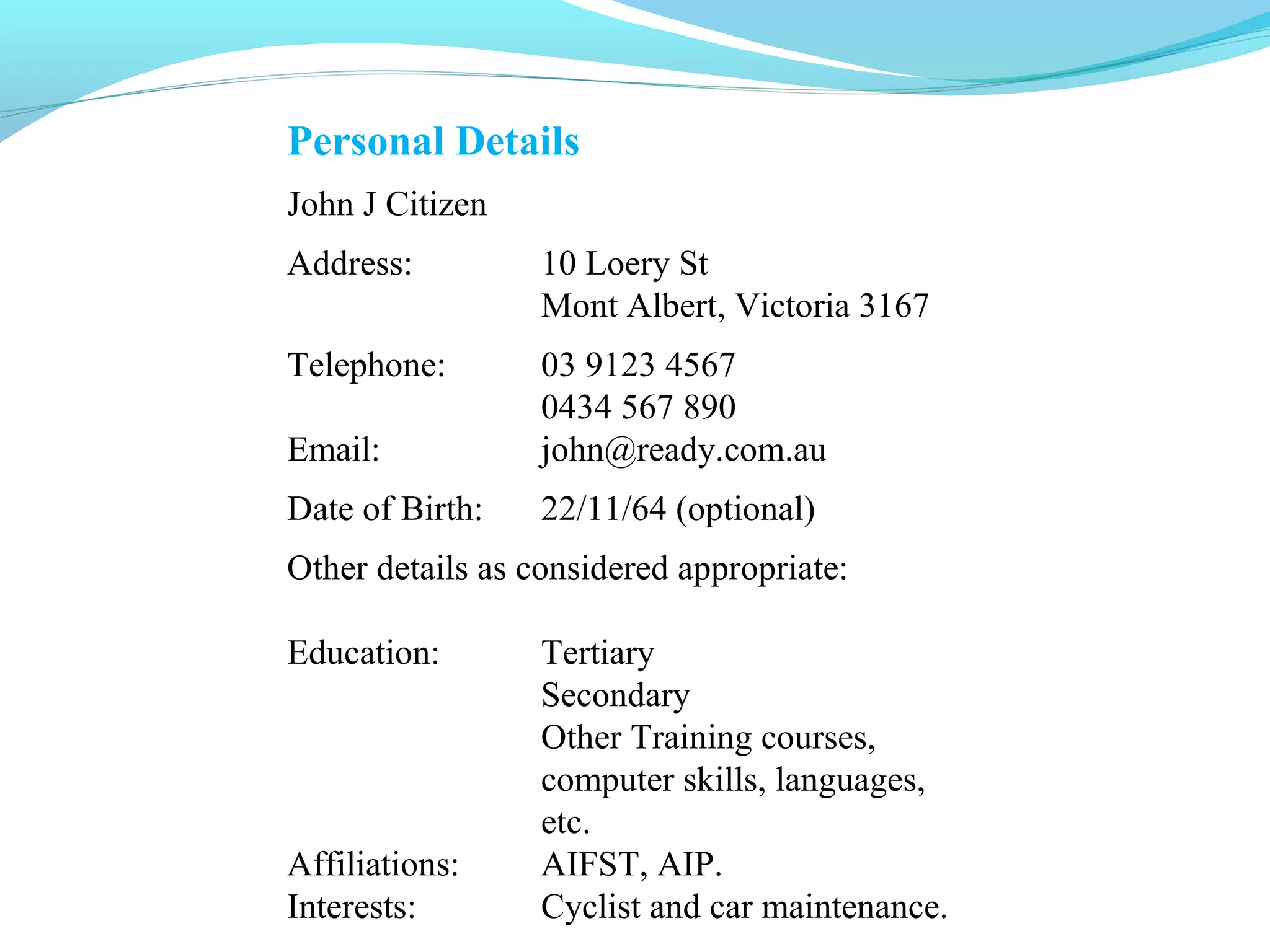
Personal Details
John J Citizen
Address:          10 Loery St
                  Mont Albert, Victoria 3167
Telephone:        03 9123 4567
                  0434 567 890
Email:            john@ready.com.au
Date of Birth:    22/11/64 (optional)
Other details as considered appropriate:

Education:        Tertiary
                  Secondary
                  Other Training courses,
                  computer skills, languages,
                  etc.
Affiliations:     AIFST, AIP.
Interests:        Cyclist and car maintenance.
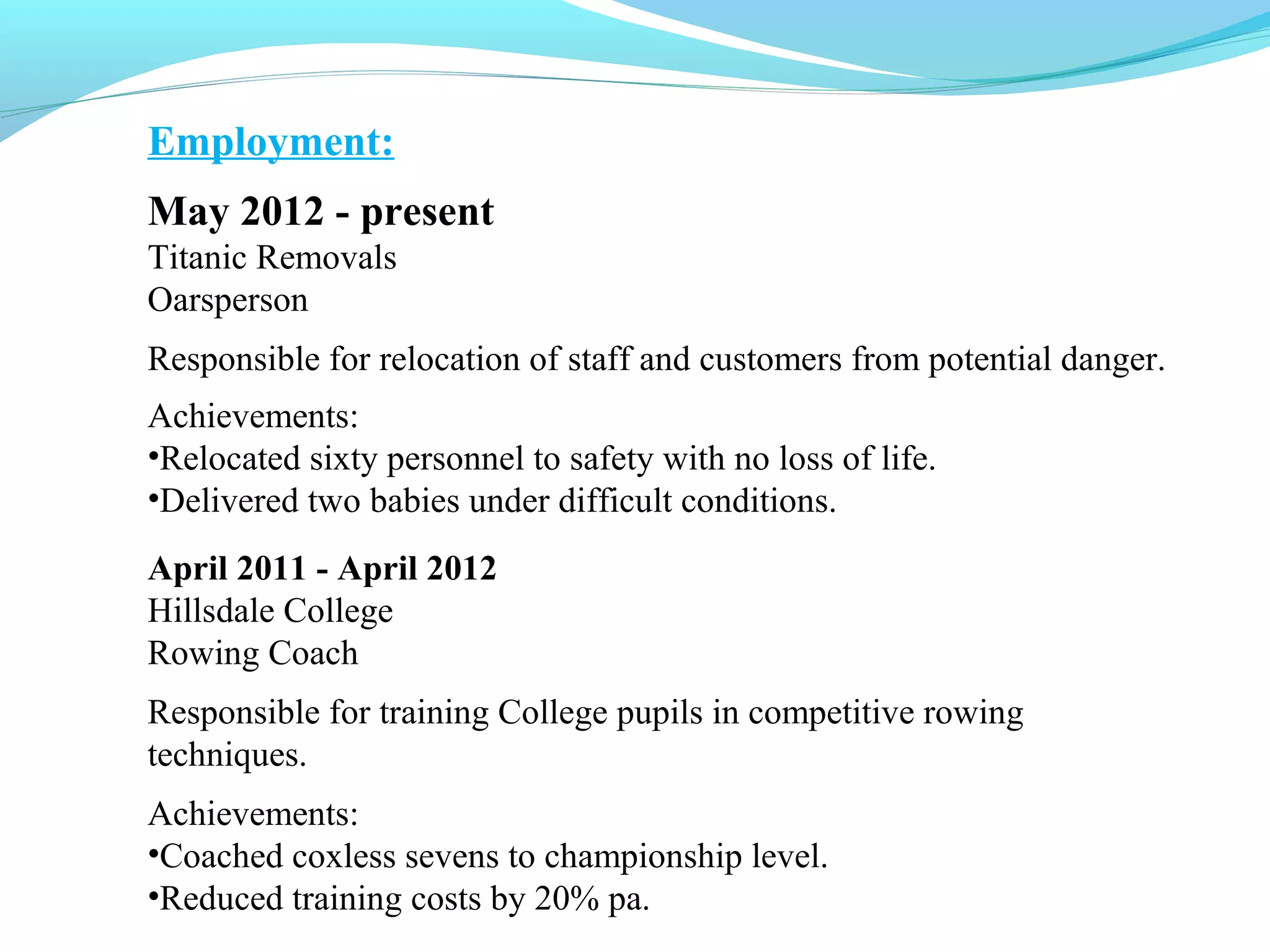
Employment:
May 2012 - present
Titanic Removals
Oarsperson
Responsible for relocation of staff and customers from potential danger.
Achievements:
•Relocated sixty personnel to safety with no loss of life.
•Delivered two babies under difficult conditions.
April 2011 - April 2012
Hillsdale College
Rowing Coach
Responsible for training College pupils in competitive rowing
techniques.
Achievements:
•Coached coxless sevens to championship level.
•Reduced training costs by 20% pa.
You may also like to list other information on the final
page.
For example:

• A list of your strengths, special skills or attributes,
particularly those relevant to the position applied for.

• A list of referees.
Cover letters.
 Why do you need one?
 Because it:
  - Conveys intent.
  - Allows you to match position criteria with your
  own qualifications and experience.
  - Gives you an opportunity to impress with
  your ability to write a succinct and to the point
  letter.
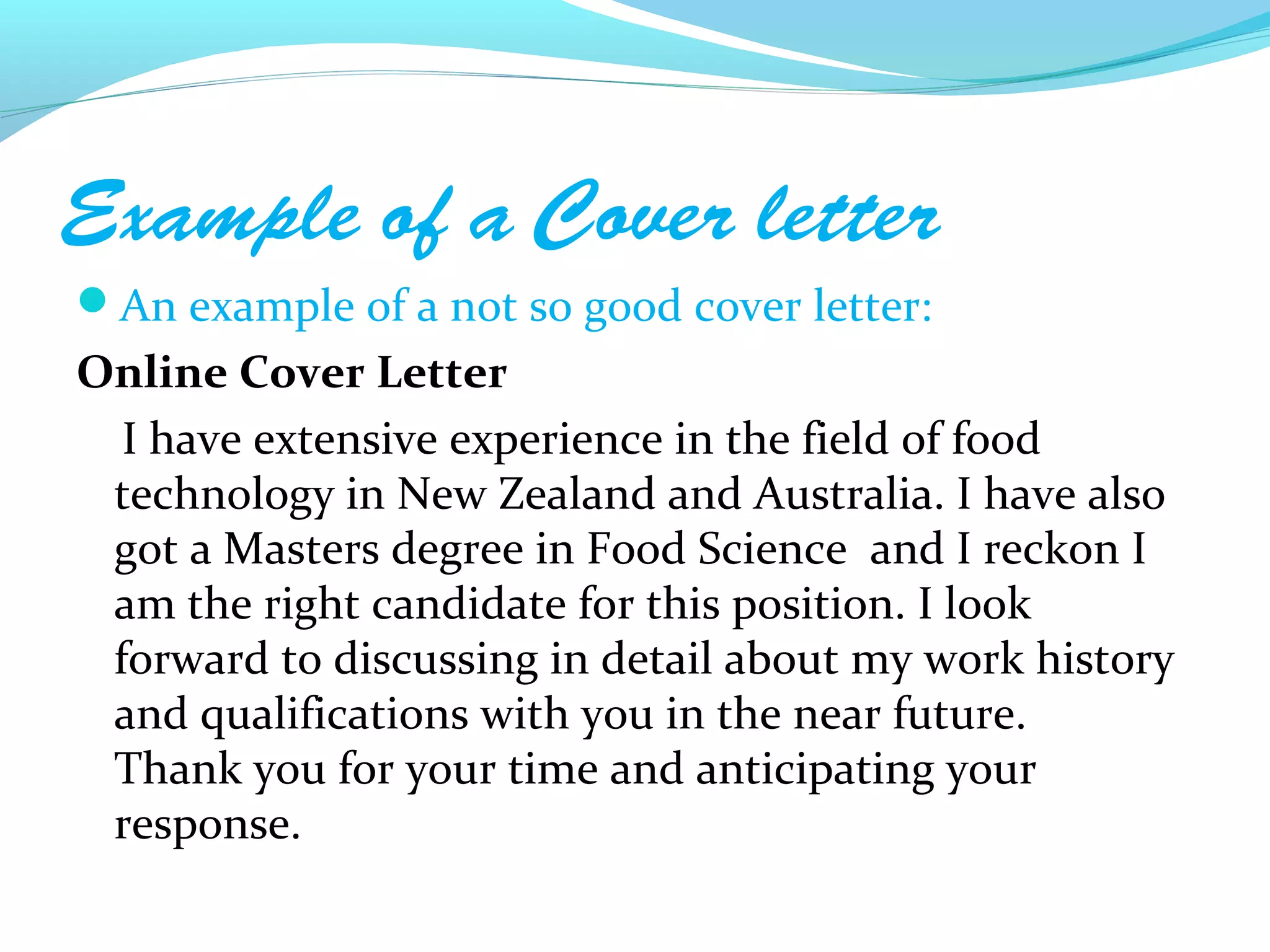
Example of a Cover letter
An example of a not so good cover letter:
Online Cover Letter
  I have extensive experience in the field of food
 technology in New Zealand and Australia. I have also
 got a Masters degree in Food Science and I reckon I
 am the right candidate for this position. I look
 forward to discussing in detail about my work history
 and qualifications with you in the near future.
 Thank you for your time and anticipating your
 response.
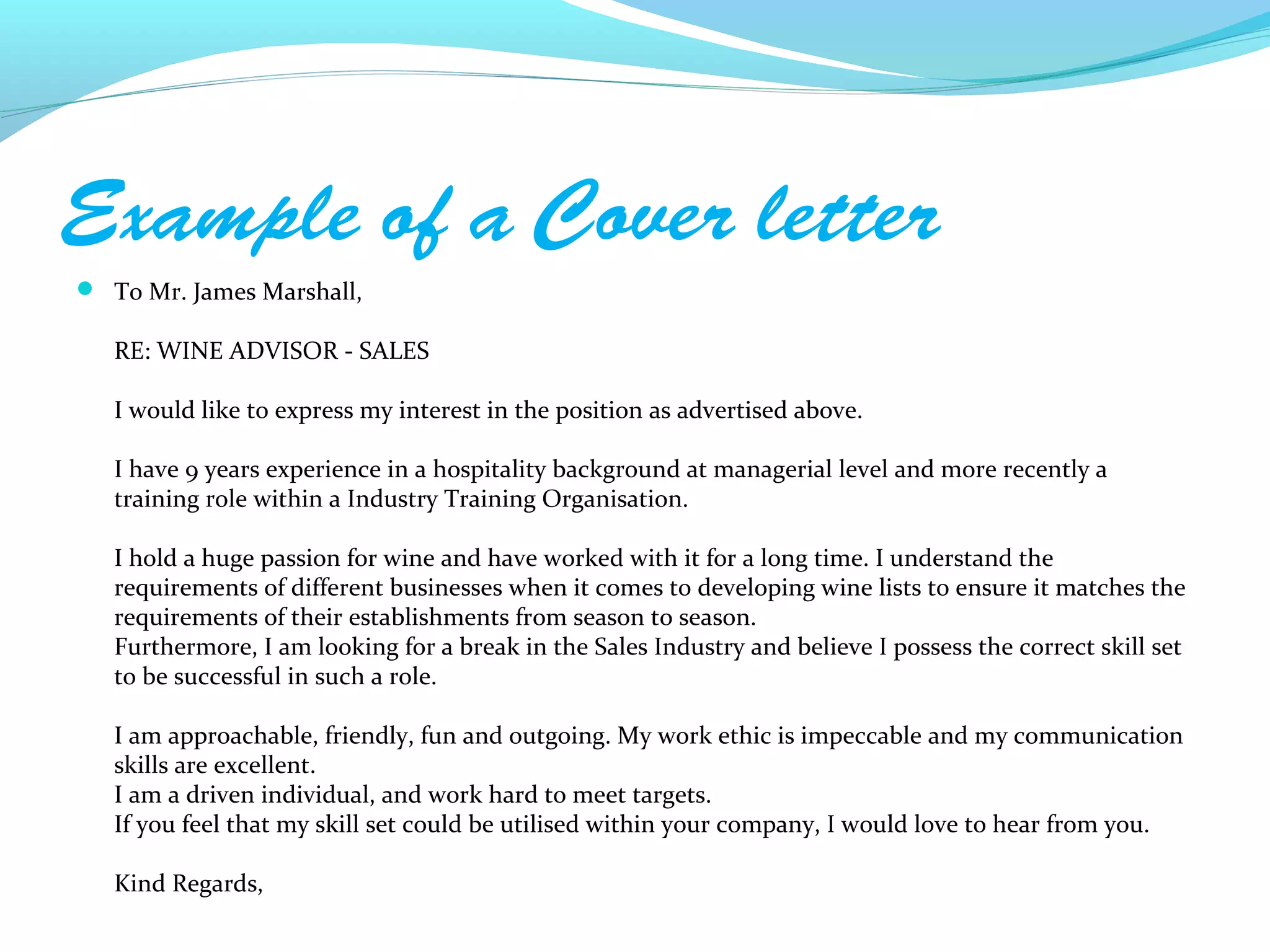
Example of a Cover letter
 To Mr. James Marshall,

   RE: WINE ADVISOR - SALES

   I would like to express my interest in the position as advertised above.

   I have 9 years experience in a hospitality background at managerial level and more recently a
   training role within a Industry Training Organisation.

   I hold a huge passion for wine and have worked with it for a long time. I understand the
   requirements of different businesses when it comes to developing wine lists to ensure it matches the
   requirements of their establishments from season to season.
   Furthermore, I am looking for a break in the Sales Industry and believe I possess the correct skill set
   to be successful in such a role.

   I am approachable, friendly, fun and outgoing. My work ethic is impeccable and my communication
   skills are excellent.
   I am a driven individual, and work hard to meet targets.
   If you feel that my skill set could be utilised within your company, I would love to hear from you.

   Kind Regards,
Developing your career
  Holding onto your job.


 Manage your career.


 Focus on development opportunities.
Holding onto your current job.
If you have a job, then ask yourself three questions:
  - Will my job be needed in five years time?
  - Will my current skills still be needed in five years time?
  - Do I want to do the same job in five years time?
If you answer no to any of these questions then you really
  ought to consider Active Career Management.
Another question to pose is:
- What would I rather be doing and what is stopping
  me doing it?
The solution is:
Constant development.
 - Just as companies can no longer rest on their
 laurels, neither can employees. Long gone is the
 idea of life-time employment.
Career Management is the process whereby the
 individual takes responsibility for the development
 of their own career. No-one else cares as much as
 you do.
The process may include:
 The setting of career goals.
 A personal stock-take to determine current skills,
  experience and qualifications. Do a SWOT.
 Mapping of the steps necessary in order to achieve
  these goals, including specific skills and experience.
 Determining the need for additional experience,
  training and/or academic qualifications.
 A broad brush plan that will act as a guide to
  acquiring those skills, experience and qualifications
  necessary in order to achieve the desired goal(s).
The alternative to Career
Management is:
At best - A career that “just happens”.
 - But you are not in control.
 - Other people decide for you.
At worst - Stagnation, a career going nowhere.
 - Perhaps even depreciation as an organisational
 asset.
 - Heading towards redundancy?
Do you want to be the boat without oars and a
 rudder?
Development opportunities.
When looking for a new position or reconsidering
 your current position, don’t just focus on:
 - Salary.
 - Benefits (company car etc) or the
 - Work environment or Company culture.
 but also carefully examine the Developmental
 Opportunities offered.
Developmental opportunities.
Smart employees are switching on to the reality that
 those companies that offer the opportunity to:
 - constantly learn,
 - to re-train,
 - and even to re-orient their careers in new directions,
 are their best chance to avoid career stagnation or loss of
 job opportunity in later life.
Real Life – industry trends
Food Technologists.
 - Education does not guarantee a job. Despite
 industry shortages there is still a lot of competition
 for good roles.
Serial re-structuring and serial redundancy.
 - Stay ahead of the management.
 - Don’t place too much store on managerial
 assurances, as often Managers are less in control of
 their own destiny than you might think, let alone
 your destiny.
More trends.
The shift to lightly processed food, from frozen and shelf
 stable to refrigerated technologies. This is a well
 established long-term trend. And is where the demand for
 technologists is. Along with Auditors for food safety.
The impact of MasterChef and cooking programs on TV,
 may drive customers in new directions.
From vertical career paths to horizontal. The flattening of
 organisational structures means reduced promotional
 opportunities.
 - Now is your chance to try something else.
1. Hands on work experience of some sort.
   Especially intern type experience.
2. Like them to be more extroverted than
   introverted. i.e. bright, confident and
   optimistic. With a degree of assertiveness for
   audit roles.
3. Team-players wanted, especially in
   development projects.
4. Keen, flexible, willing to adapt to and learn
   about a business.
Key trends in how jobs are accessed
Many jobs are still accessed via the bush telegraph.
Increasing use of in-terns especially by large
 employers. Often these roles are what used to be
 called vacation or work experience roles.
Organised employers will try and pick up promising
 grads at open days/graduate days, from as early as 2nd
 year. So make sure you attend these events.
Many graduate or near graduate roles are accessed via
 SEEK and other job boards.
Company job boards, especially by large companies.
 Who have the profile to get the hits.
Key trends in how jobs are accessed
Growing use of social media such as Twitter,
 Facebook and LinkedIn. Some companies use these
 media to advertise roles – but is a very cluttered and
 complicated area especially with proliferation of new
 social media entrants.
Very limited use of press/newspaper ads nowadays,
 but some employers (especially smaller ones) will still
 place a one column ad in the classifieds.
Now more than ever there is a great variety of ways to
 access candidates.
Tips for recent graduates applying for
their first job.
Why do you would want this role ?

• It’s a good idea to ask yourself the question: “Why do you want this role?”
before applying for any role.

• There is absolutely no point in applying for roles that you don’t really want –
some graduates do this, applying for every role they see, in a scatter gun
approach, hoping that they will land at least one role.

• If you do it too often, you just get a reputation as a serial applicant.

• You are far better being selective and only apply for those roles that will
point the way for the career you really want to develop.

• Think about what you want and ask questions of people already in these
careers, do some investigation, regard the process as a project and do some
planning.
What people typically do in this type of
role?
 • It is one thing to think that you want to be an astronaut, but for
 many jobs the reality is different to that of the outsider’s expectation.

 • So it really is a good idea to do some checking with people who are
 already working in the kind of role that you aspire to ensure that it
 really is your thing.

 • In addition the process of learning about a role will be beneficial
 when you come to a job interview, you will know what it takes to do
 the role and this is likely to impress the interviewer.
Research the employer.
• Employers vary greatly, in particular in their organisational
culture. There are some great employers out there, but equally
there are some awful employers too. So do your homework.

• It really is a good idea to get a handle on what an organisation is
like culturally as well as just knowing the nature of its business.

• In addition knowing about your potential future employer will
impress your interviewer when you are interviewed.

• Few candidates bother to learn anything about their potential
employer, so just doing some research will put you ahead of the
pack.
What do you bring to the role? –
 Put it down in a cover letter.
• A good thing to do whenever you apply for a role is to carefully
craft a cover letter that introduces you to a potential employer; it is
also an opportunity for you to address the key criteria in a role.

• And the process of doing a cover letter and answering the key
criteria will also alert you to whether you are at all suitable for the
role in terms of your experience and qualifications.

• It is good discipline to do a new cover letter for each new role that
you apply for.

• Now that you have put together a great cover letter, you need to
back your application with a brief and to the point Resume
(sometimes also referred to as a C.V.) that supports your contention
that you are the ideal person for this role.
Put together a resume of 2 – 3 pages
  and prepare a cover letter.
A resume should list:
• You name,
• Contact details,
• Education , (Academic)
• Training, (Vocational)
• Plus a list of your work experience that should not extend to anymore than 2
pages if you are a recent graduate.
• Your most recent experience should come first with earlier experience
following in order.
• Some people also like to put a Career Objective statement at the beginning of
their resume, this is entirely optional.

Much of the process of breaking into the workplace successfully is asking
questions, seeking answers and planning and the more you do, the
greater will be your “luck’ in landing that perfect first role.
Aifst2012

  • 1.
  • 2.
    Starting Out /Staying Ahead How to acquire a job/career. - An active approach is best. - The Resume. Developing your career. - Holding onto your job. - Focus on career development opportunities. - Manage your career.
  • 3.
    How to acquirea job/career. Be active – A career won’t just come to you. Set your goals. You can’t arrive unless you know where you are heading. Without a goal you have nothing to measure yourself against. Determine likely careers that will meet your goals, don’t confuse a job for a career. Avoid an accidental career. Develop a search strategy. Implement.
  • 4.
    The Resume. What isa resume and what will it do for you? - Short and simple is best. Always send with an customised cover letter. - Be polite and write with humility. - Respond to the selection criteria. - Again keep it short and simple.
  • 5.
    What is aresume and what will it do for you? It provides context and showcases your skills/qualifications and experience. It enables potential employers to match their requirements against what you have to offer. You have about thirty seconds to catch the eye of the recruiter - so keep it short and simple. Take care to match your resume with the type of role your seeking.
  • 6.
    Resume for John J Citizen
  • 7.
    Personal Details John JCitizen Address: 10 Loery St Mont Albert, Victoria 3167 Telephone: 03 9123 4567 0434 567 890 Email: john@ready.com.au Date of Birth: 22/11/64 (optional) Other details as considered appropriate: Education: Tertiary Secondary Other Training courses, computer skills, languages, etc. Affiliations: AIFST, AIP. Interests: Cyclist and car maintenance.
  • 8.
    Employment: May 2012 -present Titanic Removals Oarsperson Responsible for relocation of staff and customers from potential danger. Achievements: •Relocated sixty personnel to safety with no loss of life. •Delivered two babies under difficult conditions. April 2011 - April 2012 Hillsdale College Rowing Coach Responsible for training College pupils in competitive rowing techniques. Achievements: •Coached coxless sevens to championship level. •Reduced training costs by 20% pa.
  • 9.
    You may alsolike to list other information on the final page. For example: • A list of your strengths, special skills or attributes, particularly those relevant to the position applied for. • A list of referees.
  • 10.
    Cover letters. Whydo you need one? Because it: - Conveys intent. - Allows you to match position criteria with your own qualifications and experience. - Gives you an opportunity to impress with your ability to write a succinct and to the point letter.
  • 11.
    Example of aCover letter An example of a not so good cover letter: Online Cover Letter I have extensive experience in the field of food technology in New Zealand and Australia. I have also got a Masters degree in Food Science and I reckon I am the right candidate for this position. I look forward to discussing in detail about my work history and qualifications with you in the near future. Thank you for your time and anticipating your response.
  • 12.
    Example of aCover letter  To Mr. James Marshall, RE: WINE ADVISOR - SALES I would like to express my interest in the position as advertised above. I have 9 years experience in a hospitality background at managerial level and more recently a training role within a Industry Training Organisation. I hold a huge passion for wine and have worked with it for a long time. I understand the requirements of different businesses when it comes to developing wine lists to ensure it matches the requirements of their establishments from season to season. Furthermore, I am looking for a break in the Sales Industry and believe I possess the correct skill set to be successful in such a role. I am approachable, friendly, fun and outgoing. My work ethic is impeccable and my communication skills are excellent. I am a driven individual, and work hard to meet targets. If you feel that my skill set could be utilised within your company, I would love to hear from you. Kind Regards,
  • 13.
    Developing your career  Holding onto your job. Manage your career. Focus on development opportunities.
  • 14.
    Holding onto yourcurrent job. If you have a job, then ask yourself three questions: - Will my job be needed in five years time? - Will my current skills still be needed in five years time? - Do I want to do the same job in five years time? If you answer no to any of these questions then you really ought to consider Active Career Management. Another question to pose is: - What would I rather be doing and what is stopping me doing it?
  • 15.
    The solution is: Constantdevelopment. - Just as companies can no longer rest on their laurels, neither can employees. Long gone is the idea of life-time employment. Career Management is the process whereby the individual takes responsibility for the development of their own career. No-one else cares as much as you do.
  • 16.
    The process mayinclude: The setting of career goals. A personal stock-take to determine current skills, experience and qualifications. Do a SWOT. Mapping of the steps necessary in order to achieve these goals, including specific skills and experience. Determining the need for additional experience, training and/or academic qualifications. A broad brush plan that will act as a guide to acquiring those skills, experience and qualifications necessary in order to achieve the desired goal(s).
  • 17.
    The alternative toCareer Management is: At best - A career that “just happens”. - But you are not in control. - Other people decide for you. At worst - Stagnation, a career going nowhere. - Perhaps even depreciation as an organisational asset. - Heading towards redundancy? Do you want to be the boat without oars and a rudder?
  • 18.
    Development opportunities. When lookingfor a new position or reconsidering your current position, don’t just focus on: - Salary. - Benefits (company car etc) or the - Work environment or Company culture. but also carefully examine the Developmental Opportunities offered.
  • 19.
    Developmental opportunities. Smart employeesare switching on to the reality that those companies that offer the opportunity to: - constantly learn, - to re-train, - and even to re-orient their careers in new directions, are their best chance to avoid career stagnation or loss of job opportunity in later life.
  • 20.
    Real Life –industry trends Food Technologists. - Education does not guarantee a job. Despite industry shortages there is still a lot of competition for good roles. Serial re-structuring and serial redundancy. - Stay ahead of the management. - Don’t place too much store on managerial assurances, as often Managers are less in control of their own destiny than you might think, let alone your destiny.
  • 21.
    More trends. The shiftto lightly processed food, from frozen and shelf stable to refrigerated technologies. This is a well established long-term trend. And is where the demand for technologists is. Along with Auditors for food safety. The impact of MasterChef and cooking programs on TV, may drive customers in new directions. From vertical career paths to horizontal. The flattening of organisational structures means reduced promotional opportunities. - Now is your chance to try something else.
  • 22.
    1. Hands onwork experience of some sort. Especially intern type experience. 2. Like them to be more extroverted than introverted. i.e. bright, confident and optimistic. With a degree of assertiveness for audit roles. 3. Team-players wanted, especially in development projects. 4. Keen, flexible, willing to adapt to and learn about a business.
  • 23.
    Key trends inhow jobs are accessed Many jobs are still accessed via the bush telegraph. Increasing use of in-terns especially by large employers. Often these roles are what used to be called vacation or work experience roles. Organised employers will try and pick up promising grads at open days/graduate days, from as early as 2nd year. So make sure you attend these events. Many graduate or near graduate roles are accessed via SEEK and other job boards. Company job boards, especially by large companies. Who have the profile to get the hits.
  • 24.
    Key trends inhow jobs are accessed Growing use of social media such as Twitter, Facebook and LinkedIn. Some companies use these media to advertise roles – but is a very cluttered and complicated area especially with proliferation of new social media entrants. Very limited use of press/newspaper ads nowadays, but some employers (especially smaller ones) will still place a one column ad in the classifieds. Now more than ever there is a great variety of ways to access candidates.
  • 25.
    Tips for recentgraduates applying for their first job.
  • 26.
    Why do youwould want this role ? • It’s a good idea to ask yourself the question: “Why do you want this role?” before applying for any role. • There is absolutely no point in applying for roles that you don’t really want – some graduates do this, applying for every role they see, in a scatter gun approach, hoping that they will land at least one role. • If you do it too often, you just get a reputation as a serial applicant. • You are far better being selective and only apply for those roles that will point the way for the career you really want to develop. • Think about what you want and ask questions of people already in these careers, do some investigation, regard the process as a project and do some planning.
  • 27.
    What people typicallydo in this type of role? • It is one thing to think that you want to be an astronaut, but for many jobs the reality is different to that of the outsider’s expectation. • So it really is a good idea to do some checking with people who are already working in the kind of role that you aspire to ensure that it really is your thing. • In addition the process of learning about a role will be beneficial when you come to a job interview, you will know what it takes to do the role and this is likely to impress the interviewer.
  • 28.
    Research the employer. •Employers vary greatly, in particular in their organisational culture. There are some great employers out there, but equally there are some awful employers too. So do your homework. • It really is a good idea to get a handle on what an organisation is like culturally as well as just knowing the nature of its business. • In addition knowing about your potential future employer will impress your interviewer when you are interviewed. • Few candidates bother to learn anything about their potential employer, so just doing some research will put you ahead of the pack.
  • 29.
    What do youbring to the role? – Put it down in a cover letter. • A good thing to do whenever you apply for a role is to carefully craft a cover letter that introduces you to a potential employer; it is also an opportunity for you to address the key criteria in a role. • And the process of doing a cover letter and answering the key criteria will also alert you to whether you are at all suitable for the role in terms of your experience and qualifications. • It is good discipline to do a new cover letter for each new role that you apply for. • Now that you have put together a great cover letter, you need to back your application with a brief and to the point Resume (sometimes also referred to as a C.V.) that supports your contention that you are the ideal person for this role.
  • 30.
    Put together aresume of 2 – 3 pages and prepare a cover letter. A resume should list: • You name, • Contact details, • Education , (Academic) • Training, (Vocational) • Plus a list of your work experience that should not extend to anymore than 2 pages if you are a recent graduate. • Your most recent experience should come first with earlier experience following in order. • Some people also like to put a Career Objective statement at the beginning of their resume, this is entirely optional. Much of the process of breaking into the workplace successfully is asking questions, seeking answers and planning and the more you do, the greater will be your “luck’ in landing that perfect first role.