Stacked Ensembles in H2O
Erin LeDell Ph.D.

Machine Learning Scientist
February 2017
Agenda
• Who/What is H2O?
• Ensemble Learning Overview
• Stacking / Super Learner
• Why Stacking?
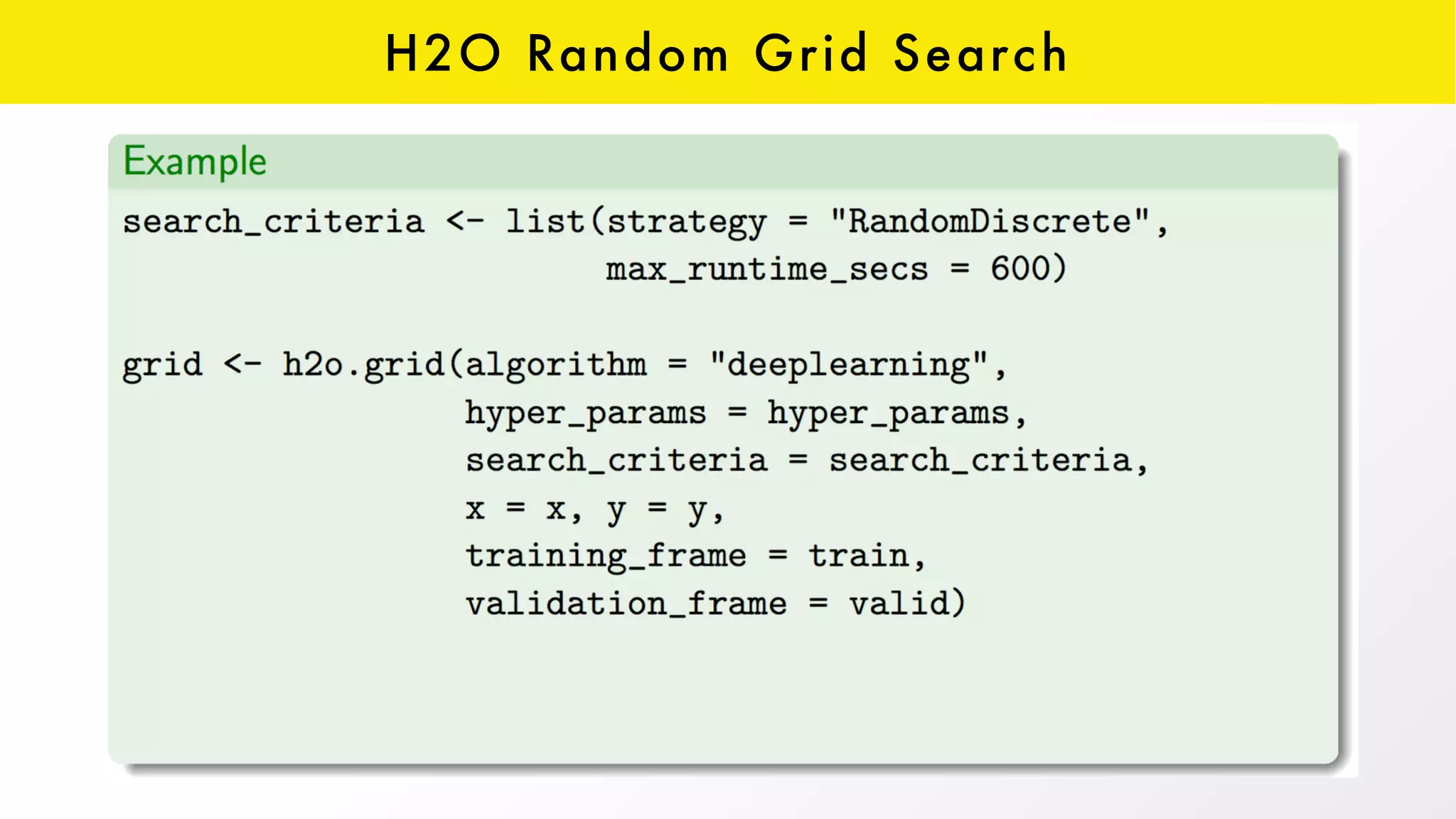
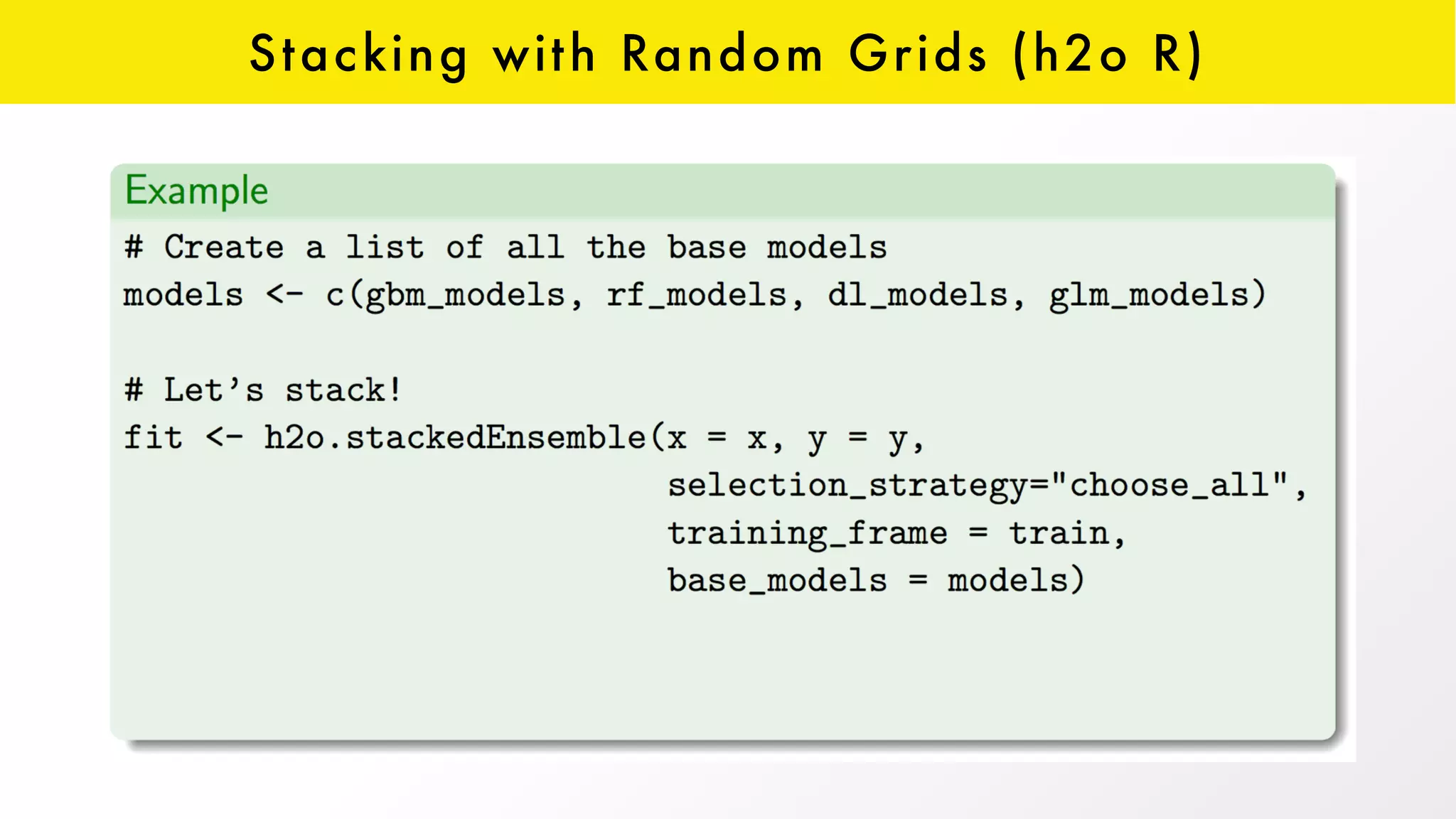
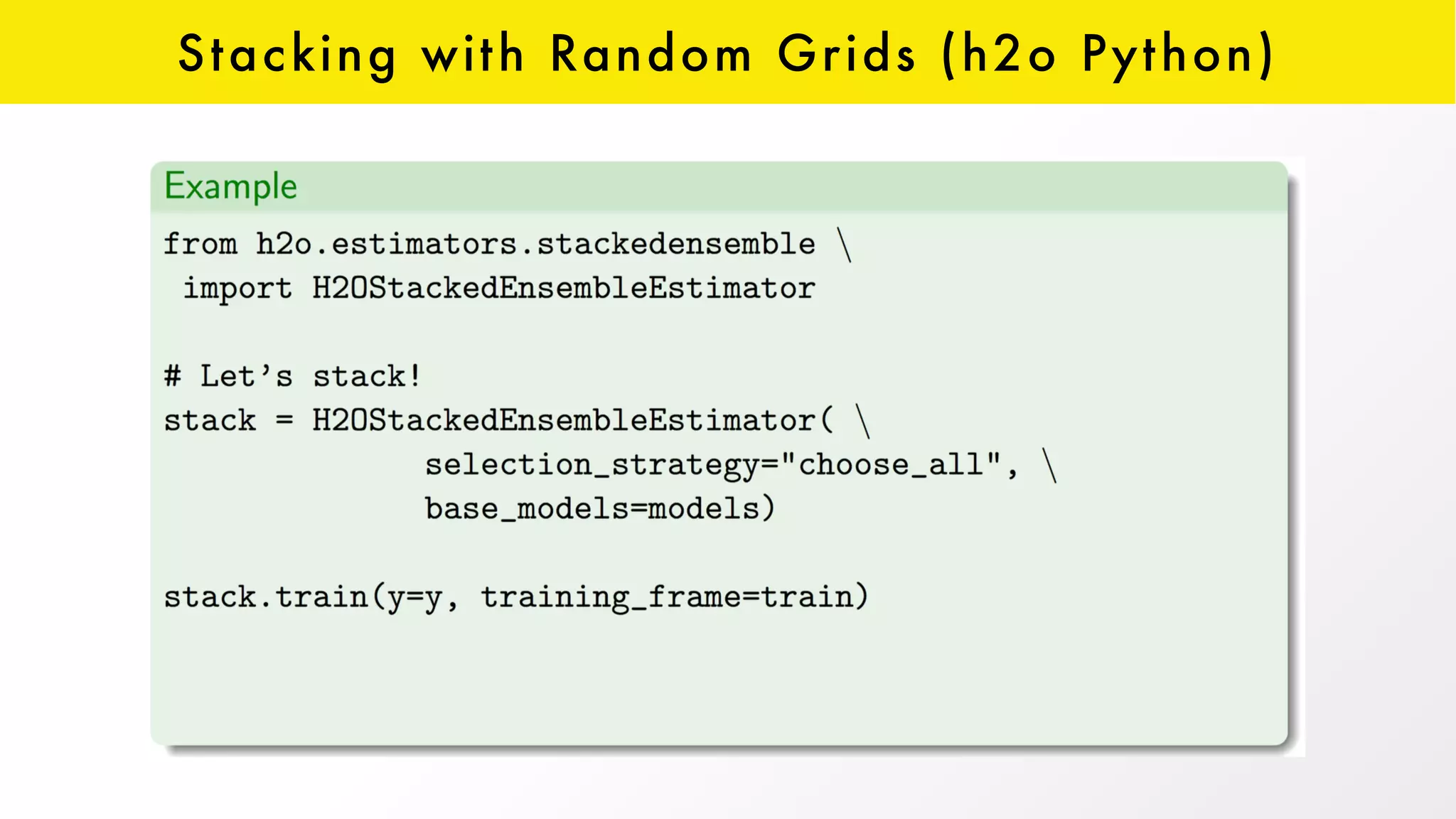
• Grid Search & Stacking
• Stacking with Third-party Algos
• AutoML and Stacking
H2O.ai
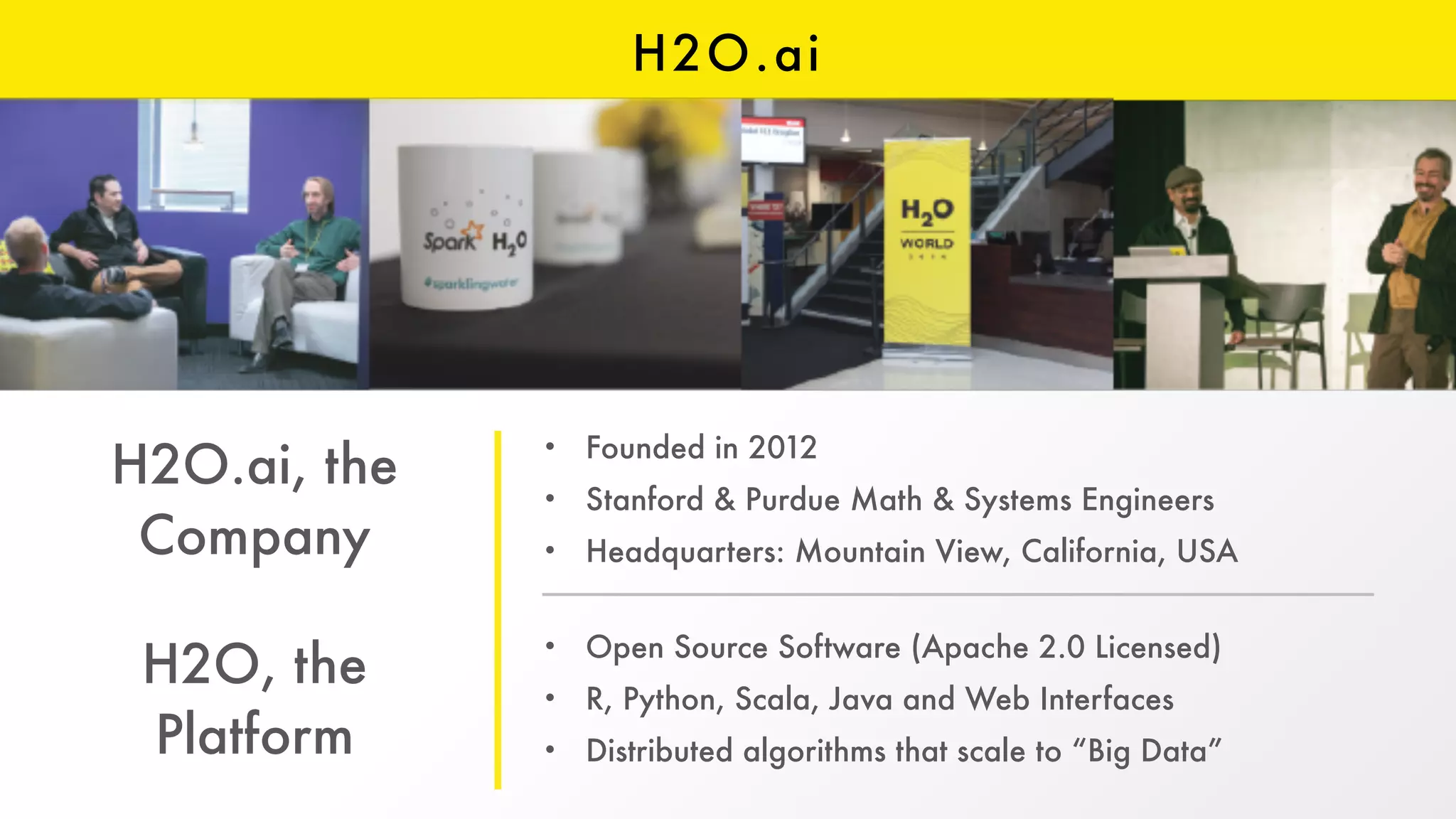
H2O.ai, the
Company
H2O, the
Platform
• Founded in 2012
• Stanford & Purdue Math & Systems Engineers
• Headquarters: Mountain View, California, USA
• Open Source Software (Apache 2.0 Licensed)
• R, Python, Scala, Java and Web Interfaces
• Distributed algorithms that scale to “Big Data”
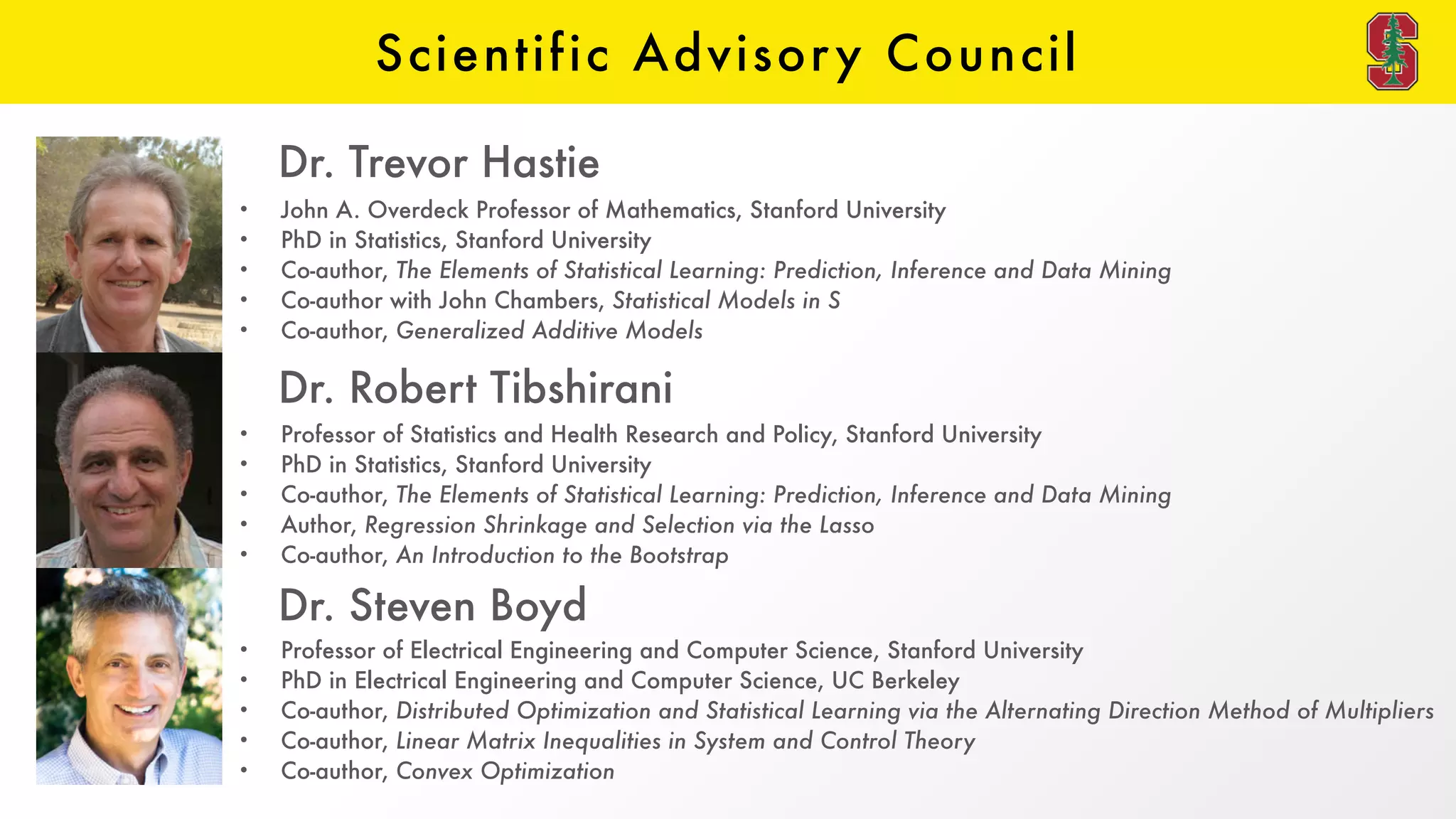
Scientific Advisory Council
• John A. Overdeck Professor of Mathematics, Stanford University
• PhD in Statistics, Stanford University
• Co-author, The Elements of Statistical Learning: Prediction, Inference and Data Mining
• Co-author with John Chambers, Statistical Models in S
• Co-author, Generalized Additive Models
Dr. Trevor Hastie
• Professor of Statistics and Health Research and Policy, Stanford University
• PhD in Statistics, Stanford University
• Co-author, The Elements of Statistical Learning: Prediction, Inference and Data Mining
• Author, Regression Shrinkage and Selection via the Lasso
• Co-author, An Introduction to the Bootstrap
Dr. Robert Tibshirani
• Professor of Electrical Engineering and Computer Science, Stanford University
• PhD in Electrical Engineering and Computer Science, UC Berkeley
• Co-author, Distributed Optimization and Statistical Learning via the Alternating Direction Method of Multipliers
• Co-author, Linear Matrix Inequalities in System and Control Theory
• Co-author, Convex Optimization
Dr. Steven Boyd
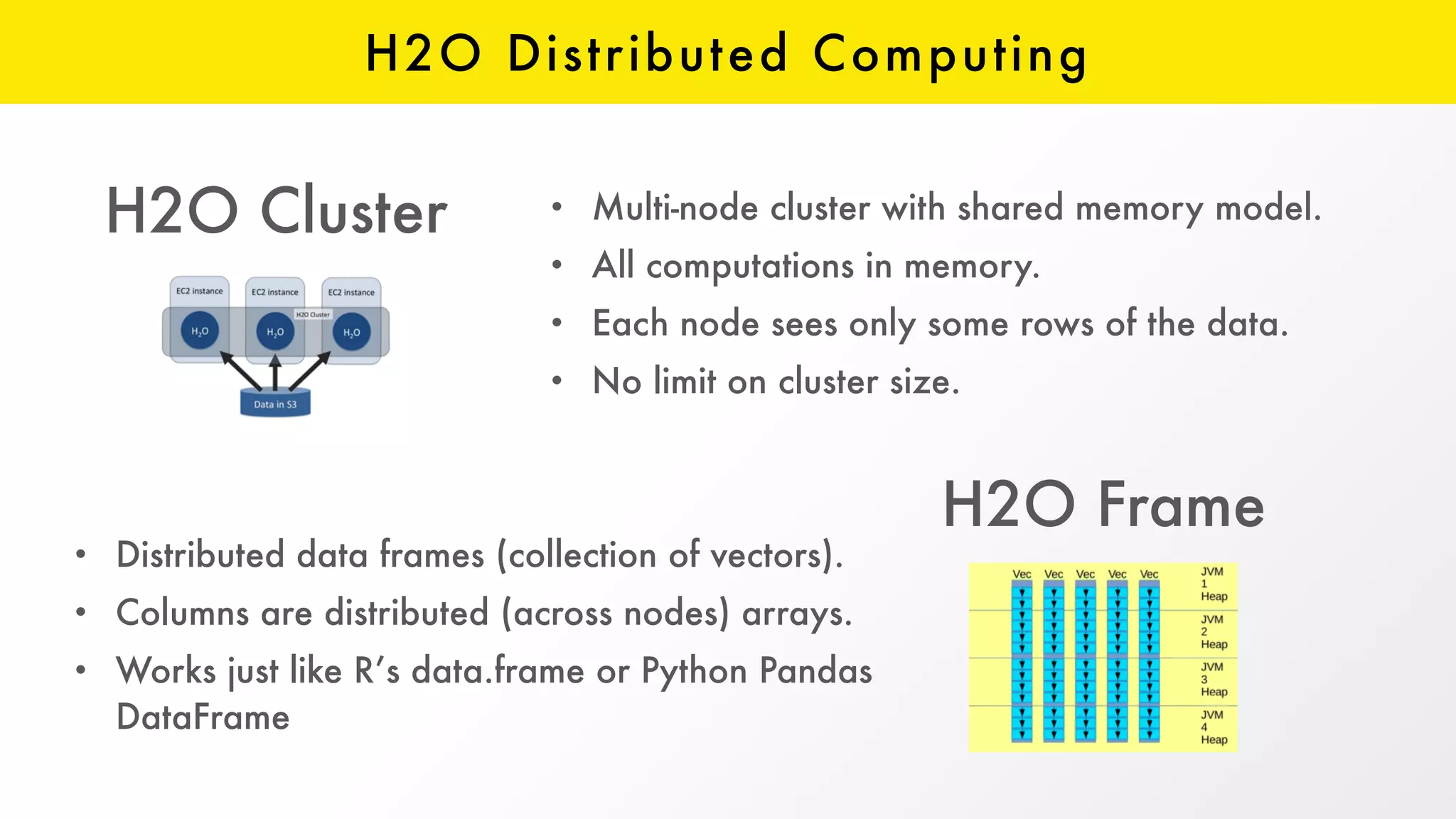
H2O Distributed Computing
H2O Cluster
H2O Frame
• Multi-node cluster with shared memory model.
• All computations in memory.
• Each node sees only some rows of the data.
• No limit on cluster size.
• Distributed data frames (collection of vectors).
• Columns are distributed (across nodes) arrays.
• Works just like R’s data.frame or Python Pandas
DataFrame
Introduction to Stacking
Ensemble Learning
In statistics and machine learning,
ensemble methods use multiple
learning algorithms to obtain
better predictive performance
than could be obtained by any of
the constituent algorithms.


— Wikipedia
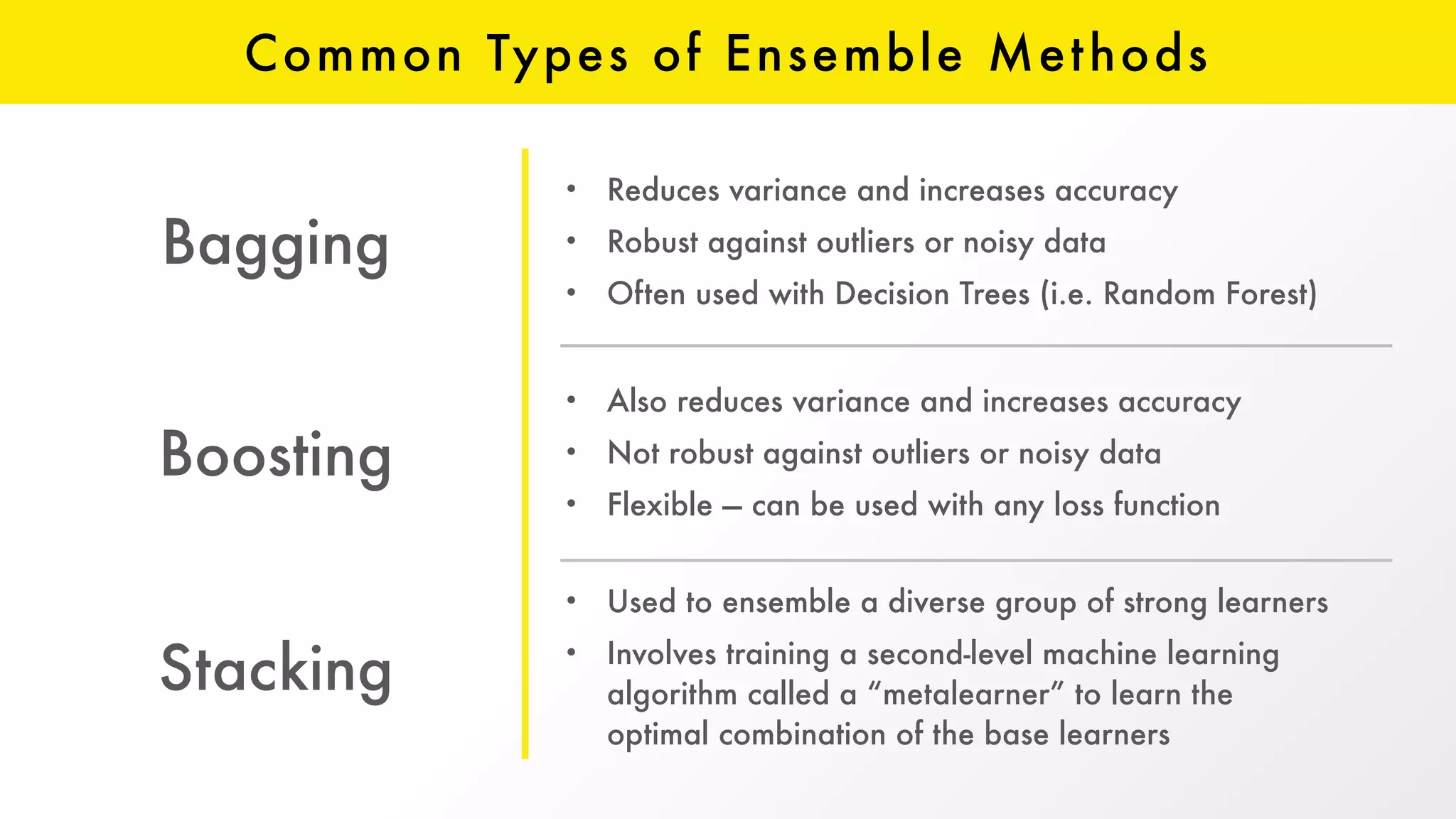
Common Types of Ensemble Methods
• Also reduces variance and increases accuracy
• Not robust against outliers or noisy data
• Flexible — can be used with any loss function
Bagging
Boosting
Stacking
• Reduces variance and increases accuracy
• Robust against outliers or noisy data
• Often used with Decision Trees (i.e. Random Forest)
• Used to ensemble a diverse group of strong learners
• Involves training a second-level machine learning
algorithm called a “metalearner” to learn the 

optimal combination of the base learners
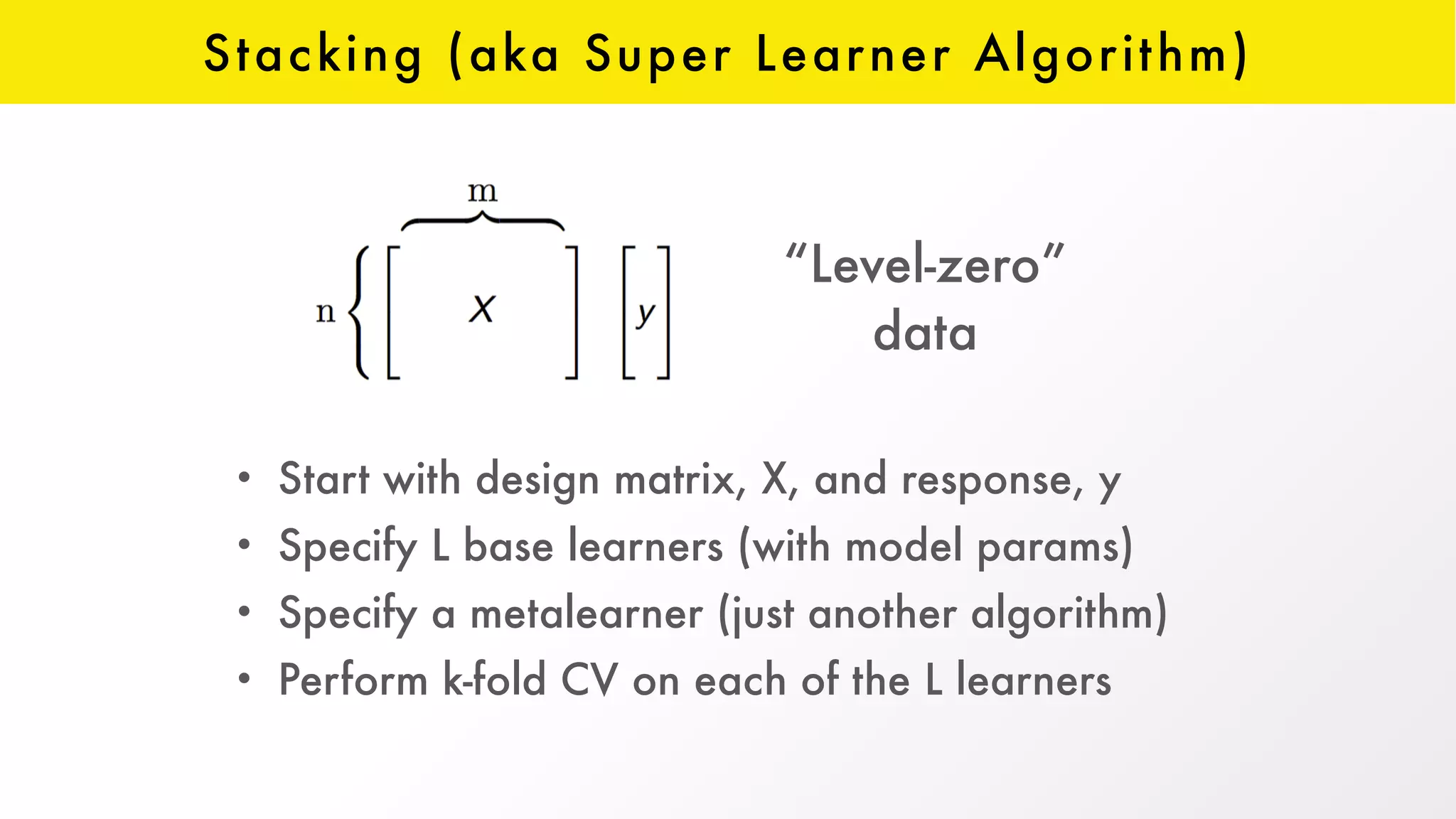
Stacking (aka Super Learner Algorithm)
• Start with design matrix, X, and response, y
• Specify L base learners (with model params)
• Specify a metalearner (just another algorithm)
• Perform k-fold CV on each of the L learners
“Level-zero” 

data
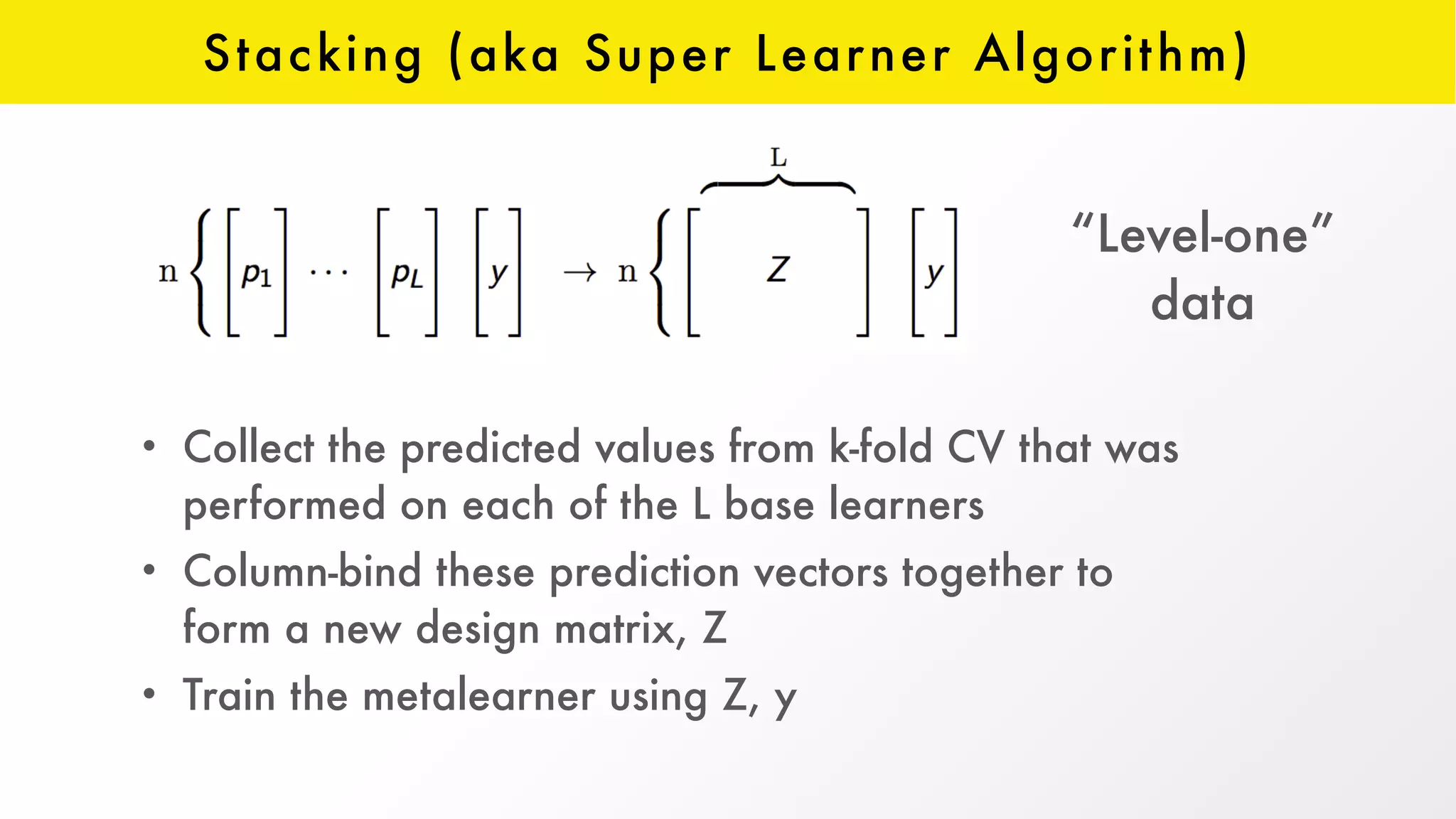
Stacking (aka Super Learner Algorithm)
• Collect the predicted values from k-fold CV that was
performed on each of the L base learners
• Column-bind these prediction vectors together to
form a new design matrix, Z
• Train the metalearner using Z, y
“Level-one” 

data
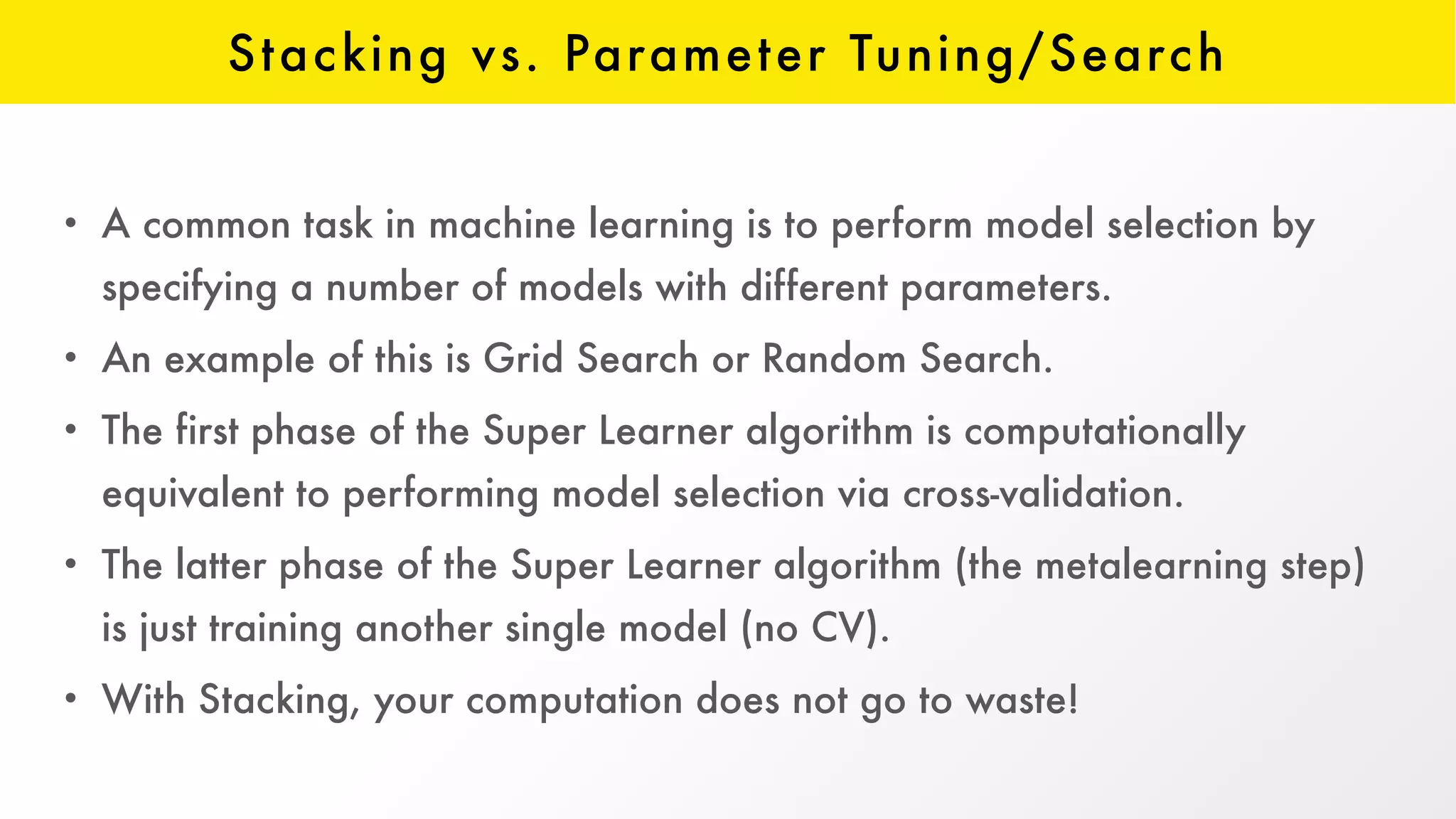
Stacking vs. Parameter Tuning/Search
• A common task in machine learning is to perform model selection by
specifying a number of models with different parameters.
• An example of this is Grid Search or Random Search.
• The first phase of the Super Learner algorithm is computationally
equivalent to performing model selection via cross-validation.
• The latter phase of the Super Learner algorithm (the metalearning step)
is just training another single model (no CV).
• With Stacking, your computation does not go to waste!
Why Stacked Ensembles?
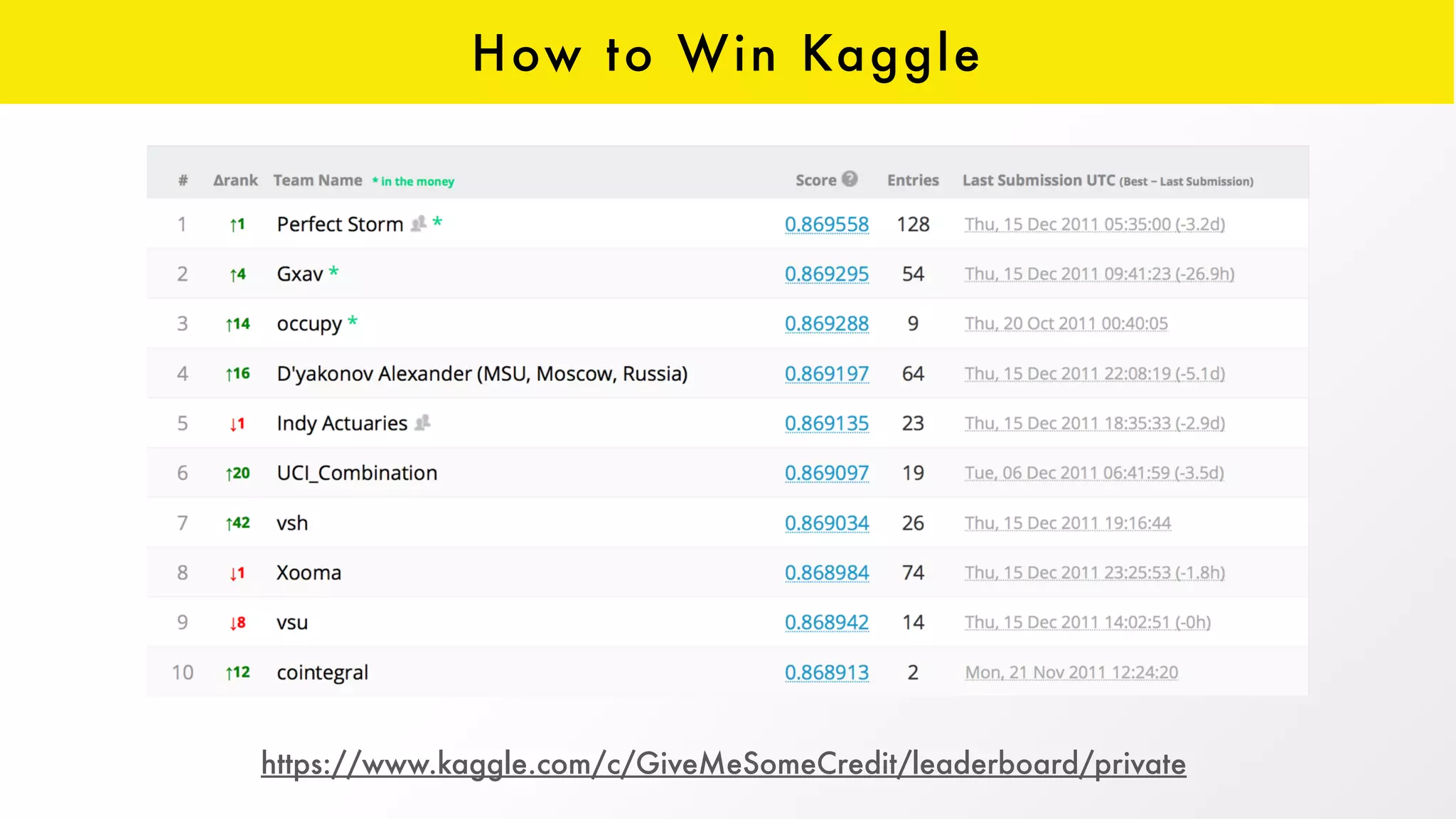
How to Win Kaggle
https://www.kaggle.com/c/GiveMeSomeCredit/leaderboard/private
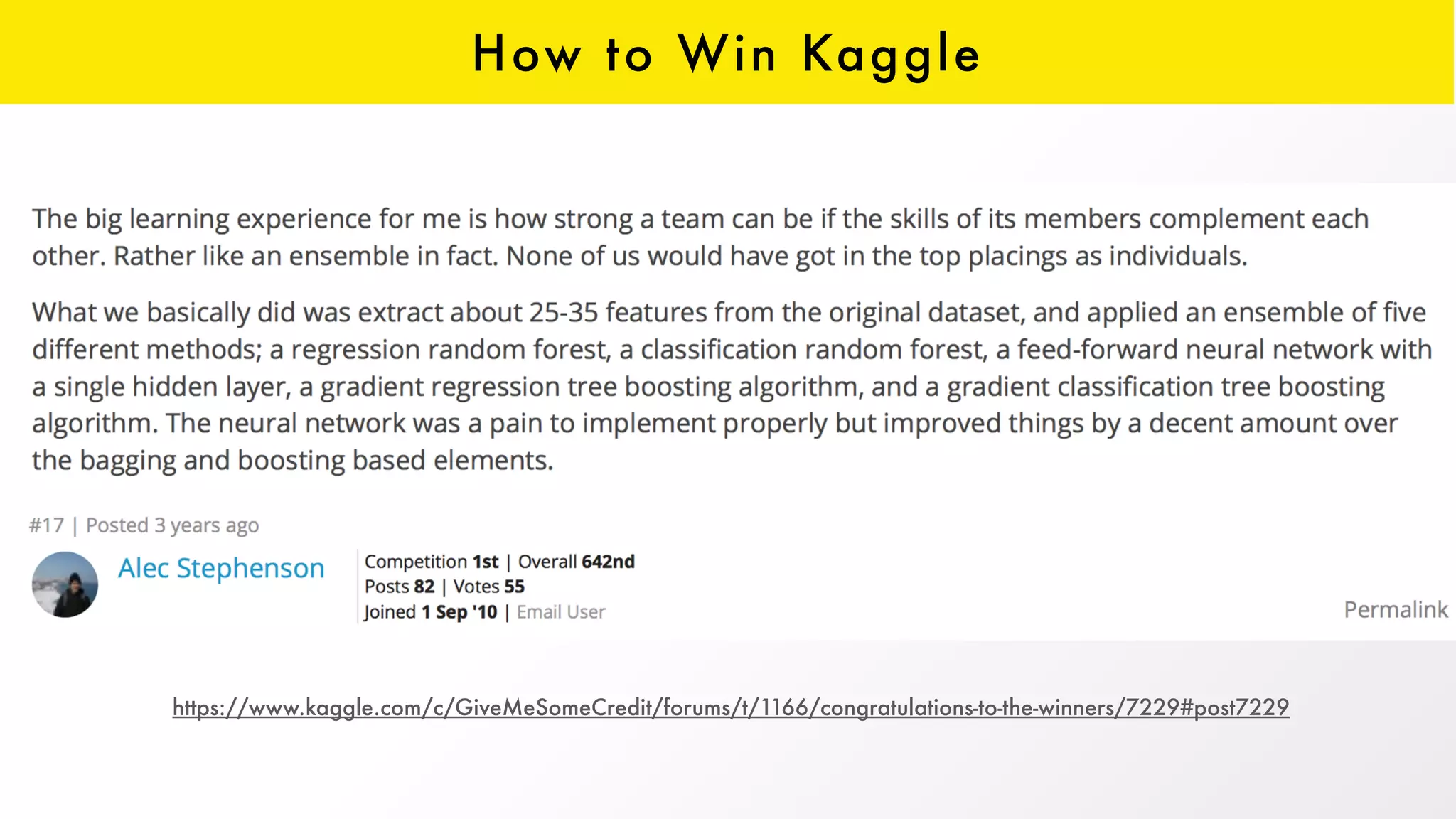
How to Win Kaggle
https://www.kaggle.com/c/GiveMeSomeCredit/forums/t/1166/congratulations-to-the-winners/7229#post7229
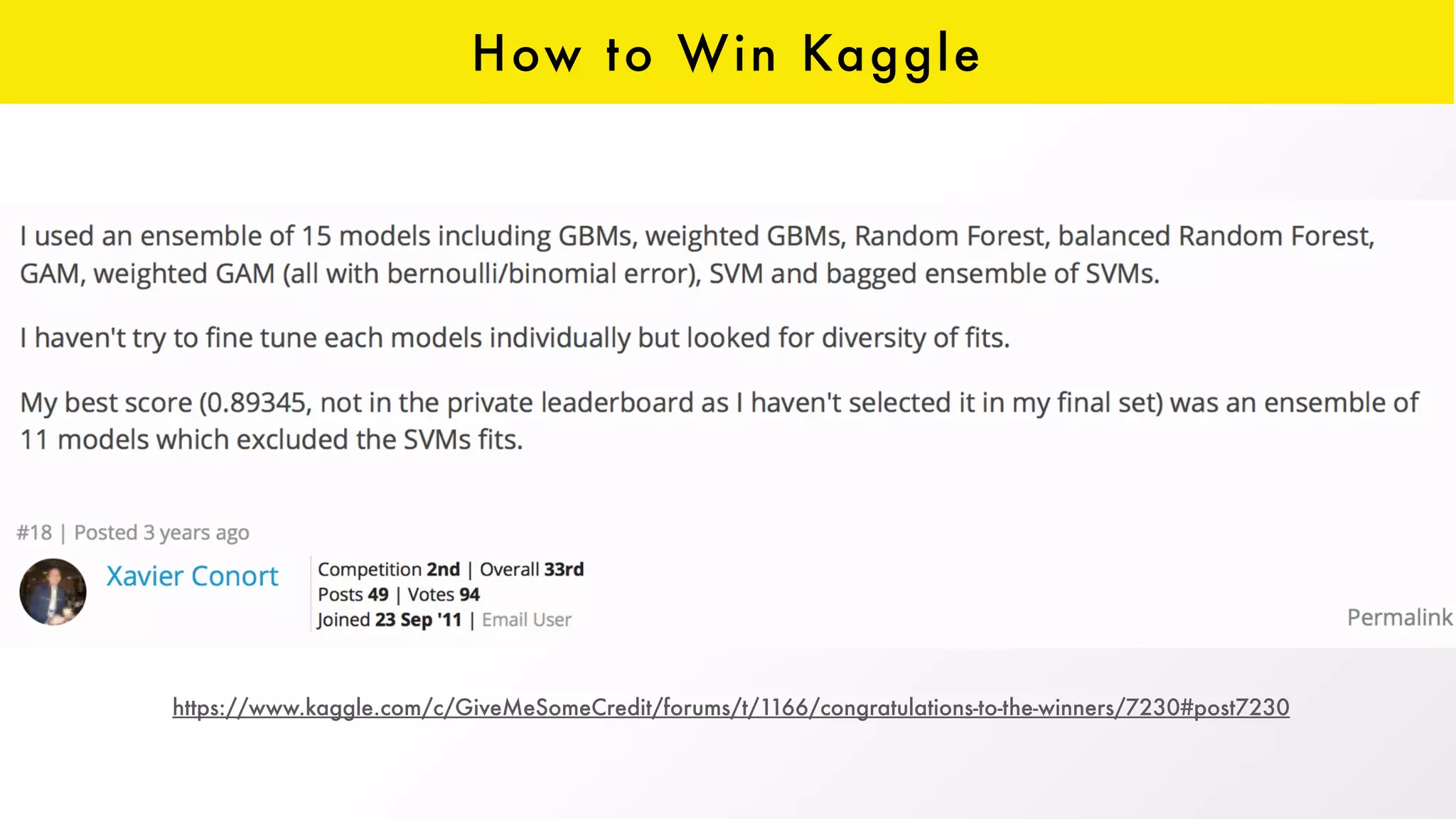
How to Win Kaggle
https://www.kaggle.com/c/GiveMeSomeCredit/forums/t/1166/congratulations-to-the-winners/7230#post7230
h2oEnsemble R package
& Stacked Ensemble in h2o
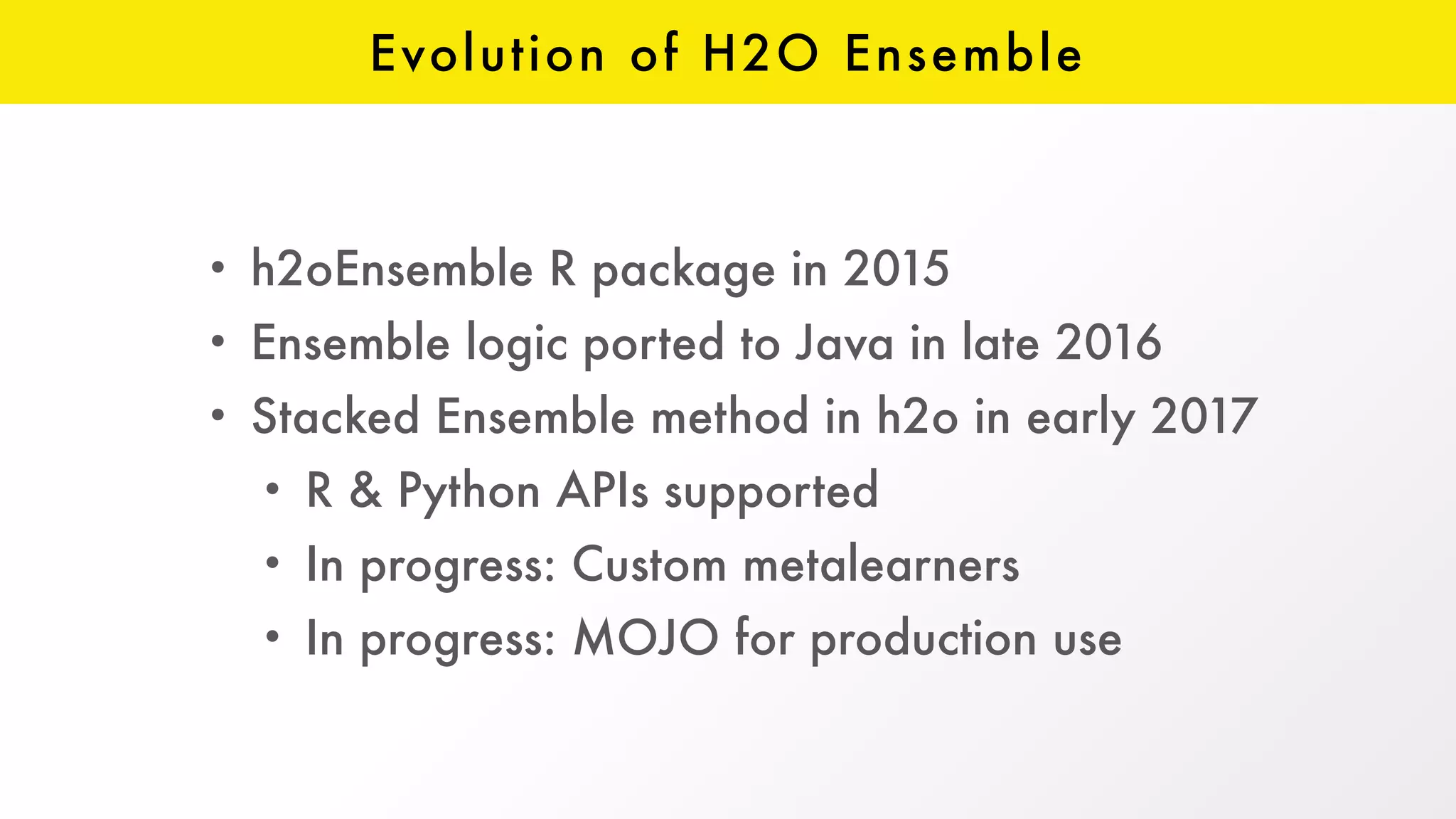
Evolution of H2O Ensemble
• h2oEnsemble R package in 2015
• Ensemble logic ported to Java in late 2016
• Stacked Ensemble method in h2o in early 2017
• R & Python APIs supported
• In progress: Custom metalearners
• In progress: MOJO for production use
Stacking with 

Random Grids
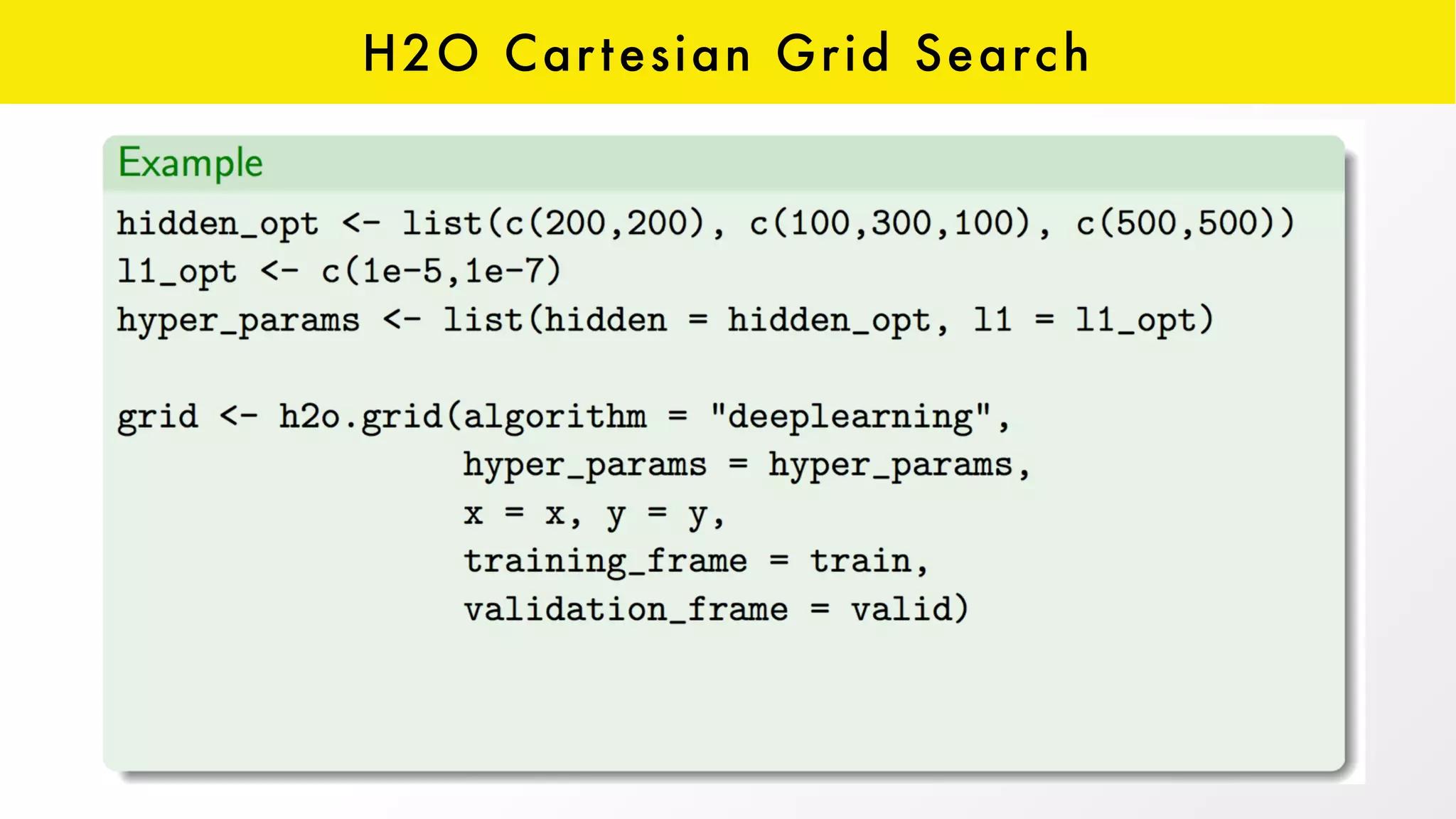
H2O Cartesian Grid Search
H2O Random Grid Search
Stacking with Random Grids (h2o R)
Stacking with Random Grids (h2o Python)
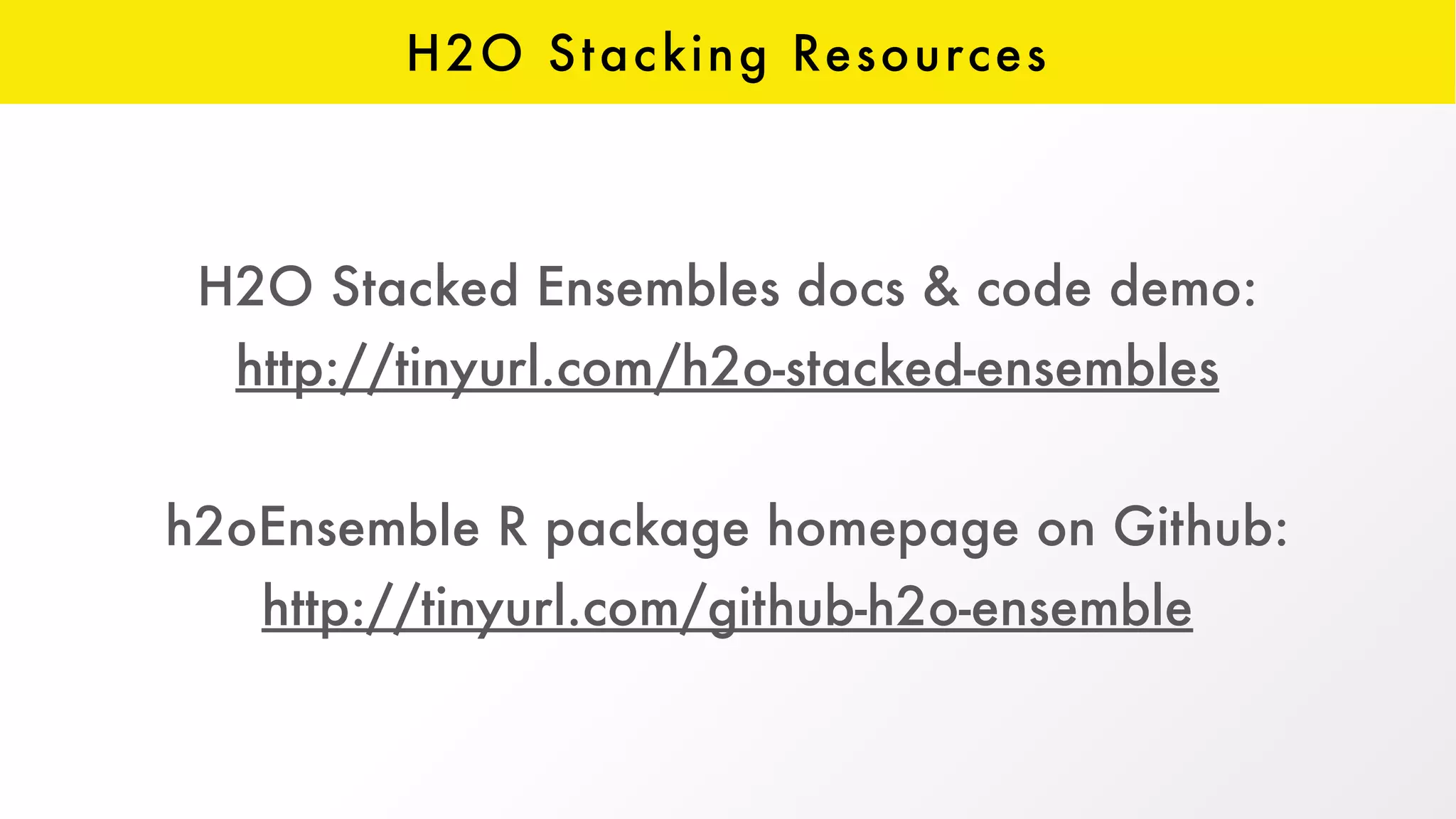
H2O Stacking Resources
H2O Stacked Ensembles docs & code demo:
http://tinyurl.com/h2o-stacked-ensembles
h2oEnsemble R package homepage on Github:
http://tinyurl.com/github-h2o-ensemble
Third-Party Integrations
Ensemble H2O with Anything
• XGBoost will be available in the next major
release of H2O, so you can use it with the
Stacked Ensemble method
• https://github.com/h2oai/h2o-3/pull/699
A powerful combo: H2O + XGBoost
Third party stacking with H2O:
• SuperLearner, subsemble, mlr & caret R packages
support stacking with H2O for small/medium data
AutoML
H2O AutoML
Public code coming soon!
• AutoML stands for “Automatic Machine Learning”
• The idea here is to remove most (or all) of the parameters
from the algorithm, as well as automatically generate
derived features that will aid in learning.
• Single algorithms are tuned automatically using a
carefully constructed random grid search.
• Optionally, a Stacked Ensemble can be constructed.
H2O Resources
• H2O Online Training: http://learn.h2o.ai
• H2O Tutorials: https://github.com/h2oai/h2o-tutorials
• H2O Meetup Materials: https://github.com/h2oai/h2o-meetups
• H2O Video Presentations: https://www.youtube.com/user/0xdata
• H2O Community Events & Meetups: https://h2o.ai/events
Thank you!
@ledell on Github, Twitter
erin@h2o.ai
http://www.stat.berkeley.edu/~ledell

Stacked Ensembles in H2O

  • 1.
    Stacked Ensembles inH2O Erin LeDell Ph.D.
 Machine Learning Scientist February 2017
  • 2.
    Agenda • Who/What isH2O? • Ensemble Learning Overview • Stacking / Super Learner • Why Stacking? • Grid Search & Stacking • Stacking with Third-party Algos • AutoML and Stacking
  • 3.
    H2O.ai H2O.ai, the Company H2O, the Platform •Founded in 2012 • Stanford & Purdue Math & Systems Engineers • Headquarters: Mountain View, California, USA • Open Source Software (Apache 2.0 Licensed) • R, Python, Scala, Java and Web Interfaces • Distributed algorithms that scale to “Big Data”
  • 4.
    Scientific Advisory Council •John A. Overdeck Professor of Mathematics, Stanford University • PhD in Statistics, Stanford University • Co-author, The Elements of Statistical Learning: Prediction, Inference and Data Mining • Co-author with John Chambers, Statistical Models in S • Co-author, Generalized Additive Models Dr. Trevor Hastie • Professor of Statistics and Health Research and Policy, Stanford University • PhD in Statistics, Stanford University • Co-author, The Elements of Statistical Learning: Prediction, Inference and Data Mining • Author, Regression Shrinkage and Selection via the Lasso • Co-author, An Introduction to the Bootstrap Dr. Robert Tibshirani • Professor of Electrical Engineering and Computer Science, Stanford University • PhD in Electrical Engineering and Computer Science, UC Berkeley • Co-author, Distributed Optimization and Statistical Learning via the Alternating Direction Method of Multipliers • Co-author, Linear Matrix Inequalities in System and Control Theory • Co-author, Convex Optimization Dr. Steven Boyd
  • 5.
    H2O Distributed Computing H2OCluster H2O Frame • Multi-node cluster with shared memory model. • All computations in memory. • Each node sees only some rows of the data. • No limit on cluster size. • Distributed data frames (collection of vectors). • Columns are distributed (across nodes) arrays. • Works just like R’s data.frame or Python Pandas DataFrame
  • 6.
  • 7.
    Ensemble Learning In statisticsand machine learning, ensemble methods use multiple learning algorithms to obtain better predictive performance than could be obtained by any of the constituent algorithms. 
 — Wikipedia
  • 8.
    Common Types ofEnsemble Methods • Also reduces variance and increases accuracy • Not robust against outliers or noisy data • Flexible — can be used with any loss function Bagging Boosting Stacking • Reduces variance and increases accuracy • Robust against outliers or noisy data • Often used with Decision Trees (i.e. Random Forest) • Used to ensemble a diverse group of strong learners • Involves training a second-level machine learning algorithm called a “metalearner” to learn the 
 optimal combination of the base learners
  • 9.
    Stacking (aka SuperLearner Algorithm) • Start with design matrix, X, and response, y • Specify L base learners (with model params) • Specify a metalearner (just another algorithm) • Perform k-fold CV on each of the L learners “Level-zero” 
 data
  • 10.
    Stacking (aka SuperLearner Algorithm) • Collect the predicted values from k-fold CV that was performed on each of the L base learners • Column-bind these prediction vectors together to form a new design matrix, Z • Train the metalearner using Z, y “Level-one” 
 data
  • 11.
    Stacking vs. ParameterTuning/Search • A common task in machine learning is to perform model selection by specifying a number of models with different parameters. • An example of this is Grid Search or Random Search. • The first phase of the Super Learner algorithm is computationally equivalent to performing model selection via cross-validation. • The latter phase of the Super Learner algorithm (the metalearning step) is just training another single model (no CV). • With Stacking, your computation does not go to waste!
  • 12.
  • 13.
    How to WinKaggle https://www.kaggle.com/c/GiveMeSomeCredit/leaderboard/private
  • 14.
    How to WinKaggle https://www.kaggle.com/c/GiveMeSomeCredit/forums/t/1166/congratulations-to-the-winners/7229#post7229
  • 15.
    How to WinKaggle https://www.kaggle.com/c/GiveMeSomeCredit/forums/t/1166/congratulations-to-the-winners/7230#post7230
  • 16.
    h2oEnsemble R package &Stacked Ensemble in h2o
  • 17.
    Evolution of H2OEnsemble • h2oEnsemble R package in 2015 • Ensemble logic ported to Java in late 2016 • Stacked Ensemble method in h2o in early 2017 • R & Python APIs supported • In progress: Custom metalearners • In progress: MOJO for production use
  • 18.
  • 19.
  • 20.
  • 21.
    Stacking with RandomGrids (h2o R)
  • 22.
    Stacking with RandomGrids (h2o Python)
  • 23.
    H2O Stacking Resources H2OStacked Ensembles docs & code demo: http://tinyurl.com/h2o-stacked-ensembles h2oEnsemble R package homepage on Github: http://tinyurl.com/github-h2o-ensemble
  • 24.
  • 25.
    Ensemble H2O withAnything • XGBoost will be available in the next major release of H2O, so you can use it with the Stacked Ensemble method • https://github.com/h2oai/h2o-3/pull/699 A powerful combo: H2O + XGBoost Third party stacking with H2O: • SuperLearner, subsemble, mlr & caret R packages support stacking with H2O for small/medium data
  • 26.
  • 27.
    H2O AutoML Public codecoming soon! • AutoML stands for “Automatic Machine Learning” • The idea here is to remove most (or all) of the parameters from the algorithm, as well as automatically generate derived features that will aid in learning. • Single algorithms are tuned automatically using a carefully constructed random grid search. • Optionally, a Stacked Ensemble can be constructed.
  • 28.
    H2O Resources • H2OOnline Training: http://learn.h2o.ai • H2O Tutorials: https://github.com/h2oai/h2o-tutorials • H2O Meetup Materials: https://github.com/h2oai/h2o-meetups • H2O Video Presentations: https://www.youtube.com/user/0xdata • H2O Community Events & Meetups: https://h2o.ai/events
  • 29.
    Thank you! @ledell onGithub, Twitter erin@h2o.ai http://www.stat.berkeley.edu/~ledell