1
Building Competitiveness-2
Ron McFarland, Tokyo, Japan
2
Global Strategies
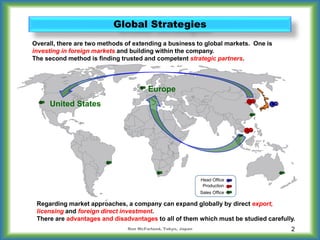
Regarding market approaches, a company can expand globally by direct export,
licensing and foreign direct investment.
There are advantages and disadvantages to all of them which must be studied carefully.
Production
Sales Office
Head Office
United States
Europe
Overall, there are two methods of extending a business to global markets. One is
investing in foreign markets and building within the company.
The second method is finding trusted and competent strategic partners.
Ron McFarland, Tokyo, Japan
3
Vertical Integration Strategies
Raw materials
Backward
integration
End user
Forward
integration
No
integration
Component
manufacturing
Raw materials
Assembly
&
Distribution
(your business)Distribution
End user
Component
manufacturing
Raw materials
Distribution
End user
Assembly
(your business)
Component
manufacturing
&
Assembly
(your business)
- Vertical integration benefits: 1-Improve trust level, 2-increase communication,
3-Increase awareness of impact of others in the chain and 4-create
commitment to others in the chain. All this leads to efficiencies.
- Vertical integration risks: 1-Higher exit barriers, 2-Increased fixed costs, 3-
Decreased flexibility, 4-Higher capital required, 5-Captive market dulls
incentives, 6-Different management skills required.
Ron McFarland, Tokyo, Japan
4
New Business Entry
& Capacity Expansion Strategies
Benefit
Risk
There are two issues that must be explored when entering
a new market or expanding capacity within the current market.
- Future demand: Is the market underserved with your current capacity?
Will the market grow in the future? How will technology change?
- Competitors’ behavior: Are the competitors preparing for added capacity
too? How will they respond if one company increases capacity?
Risk of
expanding
or entering
new
market
Value of
expanding
capacity or
entering new
market now.
Ron McFarland, Tokyo, Japan
1-Determine the
size/type of capacity
options
5
Capacity Expansion Strategies
3-Assess probable
technological changes
and obsolescence
2-Project future demand
and costs required
5-Based on the above, determine
industry supply/demand balance
and the resulting costs/prices
6-Determine the cash flow
from expanded capacity
7-Test analysis
for consistency
8-Request third party to
confirm expectations
4-Project additions by
competitors based on
their expectations
Expansion
process
Conduct in several business terms to confirm trend.
Ron McFarland, Tokyo, Japan
6
Entering into New Businesses
Quite often companies enter very large,
healthy markets, but this might be a mistake.
Market with
underserved section
Healthy, large, growing
and attractive industry
There are two ways to enter a new business and market. 1- Acquire a business
in the industry. 2-Internally develop a new operation to enter the market.
It is usually best to enter an underserved, less
obvious market, where your company
expertise would be very new and valuable.
Ron McFarland, Tokyo, Japan
7
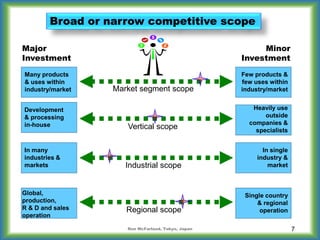
Broad or narrow competitive scope
Minor
Investment
In many
industries &
markets
Major
Investment
In single
industry &
marketIndustrial scope
Regional scope
Market segment scope
Vertical scope
Many products
& uses within
industry/market
Few products &
few uses within
industry/market
Global,
production,
R & D and sales
operation
Single country
& regional
operation
Development
& processing
in-house
Heavily use
outside
companies &
specialists
Ron McFarland, Tokyo, Japan
8
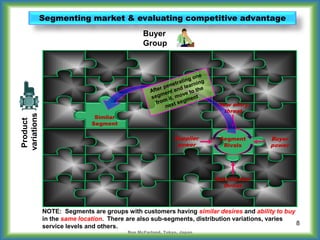
Supplier
power
Segment
Rivals
Buyer
power
Substitution
threat
New entry
threat
Buyer
Group
NOTE: Segments are groups with customers having similar desires and ability to buy
in the same location. There are also sub-segments, distribution variations, varies
service levels and others.
Product
variations
Similar
Segment
Ron McFarland, Tokyo, Japan
Segmenting market & evaluating competitive advantage
9
Value Chain and Competitive Advantage
Operations
&
processing
Outbound
items
&
services
Marketing
&
sales
After
sales
support
(Processing)
End Users
Technology Development
Direct Activities
Suppliers
Human Resource Management
Infrastructure
Procurement
Support
Activities
Inbound
items
&
services
(Shipping) (Marketing) (Service)(Receiving)
Value Chain Activities
Valued added, cost incurred
over time and a profit margin
Ron McFarland, Tokyo, Japan
10
Generic Value Chain and Competitive Advantage
Operations
&
processing
Outbound
items
&
services
Marketing
&
sales
After
sales
support
Inbound
items
&
services
Direct Activities
End UsersSuppliers
(Processing) (Shipping) (Marketing) (Service)(Receiving)
Valued added, cost incurred
over time and a profit margin
Supply Chain
Management
Information System
Customer Relations
Management
Information System
The value chain is more efficient if …….
- The goods are pulled through the chain by the end user. Less efficient if
they are pushed through the chain by the suppliers.
- There is detailed communication throughout the chain.
- There is a high level of trust and close human relations along the value
chain.
Ron McFarland, Tokyo, Japan
11
Value Chain and Competitive Advantage
Operations
&
processing
Outbound
items
&
services
Marketing
&
sales
After
sales
support
(Processing)
End Users
Technology Development
Direct Activities
Suppliers
Human Resource Management
Infrastructure
Procurement
Support
Activities
Inbound
items
&
services
(Shipping) (Marketing) (Service)(Receiving)
Overhead,
fixed asset control,
management expertise
and information
systems
Valued added, cost incurred
over time and a profit margin
Ron McFarland, Tokyo, Japan
Customer’s Value chain
Firm’s Value chain
12
Value Chain and Competitive Advantage
Operations&
processing
Outbounditems&
services
Marketing&
sales
Aftersales
support
Inbounditems
&services
End UsersSuppliers Valued added, cost incurred
over time and a profit marginOperations&
processing
Outbounditems&
services
Marketing&
sales
Aftersales
support
Inbounditems
&services
Ron McFarland, Tokyo, Japan
Firm’s Value chain
13
Value Chain and Competitive Advantage
Operations&
processing
Outbounditems&
services
Marketing&
sales
Aftersales
support
Inbounditems
&services
End UsersSuppliers Valued added, cost incurred
over time and a profit margin
Operations&
processing
Outbounditems&
services
Marketing&
sales
Aftersales
support
Inbounditems
&services
Customer’s Value chain
Ron McFarland, Tokyo, Japan
14
Operations
&
processing
Outbound
items
&
services
Marketing
&
sales
After
sales
support
(Processing)
Technology Development
Direct Activities
Human Resource Management
Infrastructure
Procurement
Support
Activities
Inbound
items
&
services
(Shipping) (Marketing) (Service)(Receiving)
Creating competitive advantage within the value chain
Unique and
valuable item
or service
offered
Very available
commodity
items &
services
inbound
Uniqueness or low cost creating factors ….
Products easy to learn how to use
Special assortment only you can offer
Convenient location
Valued advice
Technical support
Sales and product training
Exceptional delivery time
Special after sales support
Attractive design-image
Inquiry response time
Power
over end
users
Power
over
suppliers
Ron McFarland, Tokyo, Japan
15
Shared functions to create competitive advantage
Operations
&
processing
Outbound
items &
services
Marketing
&
sales
After
sales
support
Inbound
items &
services
Company “A” Direct Activities
Operations
&
processing
Outbound
items &
services
Marketing
&
sales
After
sales
support
(Processing) (Shipping) (Marketing) (Service)(Receiving)
Company “B” Direct Activities
(Processing) (Shipping) (Marketing)(Receiving)
Inbound
items &
services
(Service)
Ron McFarland, Tokyo, Japan
16
Shared functions to create competitive advantage
Operations
&
processing
Outbound
items &
services
Marketing
&
sales
After
sales
support
Inbound
items &
services
Company “A” Direct Activities
Operations
&
processing
Outbound
items &
services
Marketing
&
sales
After
sales
support
(Processing) (Shipping) (Marketing) (Service)(Receiving)
Company “B” Direct Activities
Shared Logistics
(Processing) (Shipping) (Marketing)(Receiving)
Inbound
items &
services
Shared Sales
Activities/Sales Staff
Shared Production
Shared Service
(Service)
Ron McFarland, Tokyo, Japan
17
Shared functions to create competitive advantage
Company “B”
Support
Activities
Technology Development
Human Resource Management
Infrastructure
Procurement
Company “A”
Support
Activities
Technology Development
Human Resource Management
Infrastructure
Procurement
Shared buildings
and facilities
Shared personnel
activities
Shared
purchasing
Shared research
projects
Ron McFarland, Tokyo, Japan
Sharing activities or not
18
Company “A” & “B”
shared activities
Company “B”
separate activities
Company “A”
separate activities
Activities good atDoubtful sharing successActivities good at
Company “A” poor at Activities good at
Activities poor atActivities good at
Sharing
Success!
Strengths: It is not wise to have two organizations share activities in which both are strong and successful.
Strengths/Weaknesses: It is wise to use strengths to support another’s weakness and have that
organization support your areas of weakness. Or, you could pay for the use of their strengths.
Value: The value of sharing coming in three forms: (1) when economies of scale get more output for the
same process, (2) when there is learning of better ways to do things, (3) when there is increased utilization
and reduced downtime of existing assets.
Ron McFarland, Tokyo, Japan
Cost incurred along the value chain
19
15% of
total cost
10% of
total cost
10% of
total cost
5% of
total cost
If the burden of an activity is not great, the cost of sharing must be kept very low,
unless it offers strong differentiation of the product to competitors’ which will
result in reduced customer price resistance.
Along the value chain, where is the most cost incurred?
As there will be some degree of costs incurred to share an activity, choose an
activities that offers value over the total of all processes.
Operations
& processing
Outbound
items & services
Marketing
& sales
After sales
support
(Processing)
Technology Development
Direct Activities
Human Resource Management
Infrastructure
Procurement
Support
Activities
Inbound items
& services
(Shipping) (Marketing) (Service)
2% of total cost
5% of total cost
1% of total cost
2% of total cost
50% of
total cost
(Receiving)
Ron McFarland, Tokyo, Japan
20
Balancing cost of sharing with value
Cost
Value
In considering sharing, for each activity studied, the cost of time, personnel and money must
be weighed against the value achieved. In many cases the cost and resistance to change is
so great that they out-weigh any benefit of working together.
Cost of Coordination: Businesses must coordinate scheduling and setting priorities. It
must set up and modify for joint operations. There could be added cost in time required,
personnel needed and perhaps direct funds assigned.
Cost of Compromise: Shared activities require modifications of current activities which
may require some sacrifice for the overall good.
Cost of Inflexibility: There may be added difficulties in responding to market changes and
competitor moves. Also, it might be difficult to divest from a shared project.
Cost
incurred
in sharing
the activity
Ron McFarland, Tokyo, Japan
21
Sharing sales activities of several departments
#1#2 #3#4
- Vehicle sales
- Maintenance
- Spare parts
More efficient
customer contact
Cost: Salesman
must learn other
departments’
products and
services, etc.
Ron McFarland, Tokyo, Japan
22
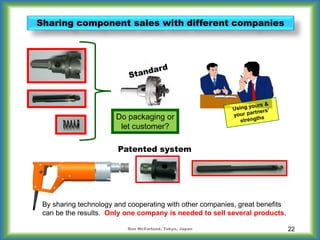
Sharing component sales with different companies
Patented system
By sharing technology and cooperating with other companies, great benefits
can be the results. Only one company is needed to sell several products.
Do packaging or
let customer?
Ron McFarland, Tokyo, Japan
You
23
What do you like about the
product? What would you like
added? What do you think is
not needed?
“A” feature
“C” service
“B” feature
Deciding what to sell as standard
One of several hundred
users of your product
Keep
Delete
Add
Decision to
offer as standard
A study of the competitors’ assortment and the ability of the user
to select his own specifications must be determined.
Ron McFarland, Tokyo, Japan
Benefits of Competitors
Are all
competitors
bad?
24
Competitors
can increase a
company’s
competitive
advantage.
Competitors
can improve
current
industry
structure.
Competitors
can aid market
development.
Competitors
can deter new
entries.
A good competitor is one that challenges the firm not to be complacent but
maintains a stable and profitable industry equilibrium without damaging the
whole industry.
Ron McFarland, Tokyo, Japan
25
Extremes of competition
Healthy competition
Where there is learning,
product development,
personnel development,
long-term strategy
development and
low stress working
environments
Fierce fighting
Where there is
discounting,
damaging
competitor
moves, high
stress, and an
overall
unattractive
image
No
competition
Where there is
complacence,
no stress,
and no
development
activities
Ron McFarland, Tokyo, Japan
26
Test of a good competitor Definitely
not
Very
much so
Clear, self-perceived weaknesses: Knows areas where it is weak and accepts it,
while concentrating only on its strengths.
Rules of competition: Knows rules to aid in the development of the whole market
and avoids behavior that would be damaging to all.
Realistic Assumption: Knows the sizes of the market and does not over-invest
and become threatening or under-invest and encourage new competitors.
Knowledge of costs: Does not cross-subsidize product lines and sets reasonable
prices that cover all costs including overhead.
Creates Entry Barriers: Creates entry barriers that discourage new competitors
but does not lock itself into the industry.
Credible & Viable: Has sufficient resources/abilities to be a motivator to other
firms in lowering cost and improving differentiation.
Limits market segments: Is active in market segments it is most comfortable
with. In other segments, participates at lesser degree or not at all.
Ron McFarland, Tokyo, Japan
27
Recognizing bad competitors for an industry
1. They will do anything they can to do damage to all their competitors and have
no cooperative spirit. They go farther than just challenging competitors. They
hope the competitors will feel they have no choice but to give up.
2. They consider market share a very high priority.
3. They do not consider product development a high priority and will copy when
they can.
4. They do not consider long-term customer service a high priority but quick sales.
5. They poorly forecast both high and low demand, which leads to over-investment
in production capacity. This often leaves them with massive excess production
capacity.
6. They put little attention on training and learning.
7. They do not consider themselves a part of the entire industry and have no
problems making disruptive, damaging moves.
Ron McFarland, Tokyo, Japan
28
Defending against bad competitors
Extent of differentiation & segmentation
HighLow
Good
Competitors
Bad
Their goal is a
large share which
causes instability
in the industry. It
could also be
costly.
The goal is a
modest share
difference from
leader and others
to maintain
stability in the
industry.
Convince the competitor that a large share in many segments is
not required or profitable. If forced, compete closely in prices, but
put major effort in differentiation or segmentation.
Ron McFarland, Tokyo, Japan
29
There are tactics to discourage new competitors.
1. Keep good product assortment and quick deliveries.
2. Block access to strongest supply channels with distributor
agreements.
3. Raise customer switching costs with training, joint activities and
special support that others cannot match.
4. Advertise when other companies are considering entering the
market.
5. Introduce new products when other companies are considering
entering the market.
6. Make exclusive agreements with major suppliers.
7. Signal commitment to defend market in press, to distributors, etc.
8. Prepare funds to counter any new competitor consideration.
Ron McFarland, Tokyo, Japan
Action plan to defend market from new entry
30
Challenging a leader
Some questions to ask when attaching a leader in the industry.
High
Returnoninvestment
Market share and volume
High
Low
Low
Has the leader slipped into
the middle
with raising costs?
Has the leader’s products
lost their special
differentiation?
Nothing special
No cost advantage
1. Are customers unhappy with the leader?
2. Has there been technical changes that influence cost and differentiation?
3. Is the leader making abnormally high profits?
4. Does the leader have problems on profit with its parent company?
Ron McFarland, Tokyo, Japan
31
BuyersSuppliers
Competitors
Rivalry
Industrial Evolution, Change and Uncertainty
Bargaining
Power of
Buyers
Threats of
Entrants
Threats of
Substitutes
Bargaining
Power of
Suppliers
Company “B”
Company “C”
Company “A”
New
Entrants
Substitutes
Ron McFarland, Tokyo, Japan
32
Value chain and change influencing factors
Operations
&
processing
Outbound
items
&
services
Marketing
&
sales
After
sales
support
(Processing)
Technology Development
Direct Activities
Human Resource Management
Infrastructure
Procurement
Support
Activities
Inbound
items
&
services
(Shipping) (Marketing) (Service)(Receiving)
Ron McFarland, Tokyo, Japan
Industrial change scenarios & possible action plans
33
First determine the factors that will influence change in the
industry and develop possible scenarios.
Based on market research and data gathered from questions
asked in many of the slides in this presentation, here are
actions that a company can take:
1. Plan for the most probable scenario and invests accordingly.
2. Invest in the best scenario for the company’s situation.
3. Hope for the best but prepare for the worst to set a maximum level
of risk considering all the factors.
4. Preserve flexibility by waiting for the last possible moment before
making the final decision.
5. Apply resources to try to influence the scenario that is most
advantageous to the organization.
Ron McFarland, Tokyo, Japan
34
Deciding for future – Scenario Action Plan
#3
Worst case
scenario
preparation
#4
Wait & be
flexibility
as long as
possible
#5
Influence
future in
any way
possible
#1
Most
probable
scenario
Chanceofimproving
companyposition
Company
weakens
Company
strengthens
High riskLow risk
Risk level of action plan
#2
Best
scenario
for
company
1. Probable scenario – High risk if not well researched for details but high chance of
strengthening position.
2. Best scenario – Very high risk for the company if not reading the market carefully
but high chance of improving position.
3. Worst – Consider all possible crises and prepare for all better than others.
4. Waits as long as possible – Low risk, but chance of company being left behind.
5. Influence the scenario – High risk but could be profitable if successful.
Also, a combination of all five can be the action plan.
What is important is understanding all risks and advance planning. If a crisis comes,
decisions and an action plan can be put in place with low stress.
Ron McFarland, Tokyo, Japan
35
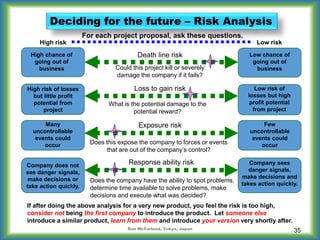
Deciding for the future – Risk Analysis
Low risk
Many
uncontrollable
events could
occur
High risk
Few
uncontrollable
events could
occurDoes this expose the company to forces or events
that are out of the company’s control?
Does the company have the ability to spot problems,
determine time available to solve problems, make
decisions and execute what was decided?
Could this project kill or severely
damage the company if it fails?
What is the potential damage to the
potential reward?
High chance of
going out of
business
Low chance of
going out of
business
Company does not
see danger signals,
make decisions or
take action quickly.
Company sees
danger signals,
make decisions and
takes action quickly.
High risk of losses
but little profit
potential from
project
Low risk of
losses but high
profit potential
from project
For each project proposal, ask these questions.
Loss to gain risk
Exposure risk
Response ability risk
Death line risk
If after doing the above analysis for a very new product, you feel the risk is too high,
consider not being the first company to introduce the product. Let someone else
introduce a similar product, learn from them and introduce your version very shortly after.
Ron McFarland, Tokyo, Japan
36
Thank you
Building Competitiveness
This presentation gives many suggestions on how to expand
your business. Whatever method you choose, it is vital to
start with a project that is low risk, low cost and low
distraction to your current operation. Then, expand gradually.
Ron McFarland, Tokyo, Japan

Competitive strategy b

  • 1.
  • 2.
    2 Global Strategies Regarding marketapproaches, a company can expand globally by direct export, licensing and foreign direct investment. There are advantages and disadvantages to all of them which must be studied carefully. Production Sales Office Head Office United States Europe Overall, there are two methods of extending a business to global markets. One is investing in foreign markets and building within the company. The second method is finding trusted and competent strategic partners. Ron McFarland, Tokyo, Japan
  • 3.
    3 Vertical Integration Strategies Rawmaterials Backward integration End user Forward integration No integration Component manufacturing Raw materials Assembly & Distribution (your business)Distribution End user Component manufacturing Raw materials Distribution End user Assembly (your business) Component manufacturing & Assembly (your business) - Vertical integration benefits: 1-Improve trust level, 2-increase communication, 3-Increase awareness of impact of others in the chain and 4-create commitment to others in the chain. All this leads to efficiencies. - Vertical integration risks: 1-Higher exit barriers, 2-Increased fixed costs, 3- Decreased flexibility, 4-Higher capital required, 5-Captive market dulls incentives, 6-Different management skills required. Ron McFarland, Tokyo, Japan
  • 4.
    4 New Business Entry &Capacity Expansion Strategies Benefit Risk There are two issues that must be explored when entering a new market or expanding capacity within the current market. - Future demand: Is the market underserved with your current capacity? Will the market grow in the future? How will technology change? - Competitors’ behavior: Are the competitors preparing for added capacity too? How will they respond if one company increases capacity? Risk of expanding or entering new market Value of expanding capacity or entering new market now. Ron McFarland, Tokyo, Japan
  • 5.
    1-Determine the size/type ofcapacity options 5 Capacity Expansion Strategies 3-Assess probable technological changes and obsolescence 2-Project future demand and costs required 5-Based on the above, determine industry supply/demand balance and the resulting costs/prices 6-Determine the cash flow from expanded capacity 7-Test analysis for consistency 8-Request third party to confirm expectations 4-Project additions by competitors based on their expectations Expansion process Conduct in several business terms to confirm trend. Ron McFarland, Tokyo, Japan
  • 6.
    6 Entering into NewBusinesses Quite often companies enter very large, healthy markets, but this might be a mistake. Market with underserved section Healthy, large, growing and attractive industry There are two ways to enter a new business and market. 1- Acquire a business in the industry. 2-Internally develop a new operation to enter the market. It is usually best to enter an underserved, less obvious market, where your company expertise would be very new and valuable. Ron McFarland, Tokyo, Japan
  • 7.
    7 Broad or narrowcompetitive scope Minor Investment In many industries & markets Major Investment In single industry & marketIndustrial scope Regional scope Market segment scope Vertical scope Many products & uses within industry/market Few products & few uses within industry/market Global, production, R & D and sales operation Single country & regional operation Development & processing in-house Heavily use outside companies & specialists Ron McFarland, Tokyo, Japan
  • 8.
    8 Supplier power Segment Rivals Buyer power Substitution threat New entry threat Buyer Group NOTE: Segmentsare groups with customers having similar desires and ability to buy in the same location. There are also sub-segments, distribution variations, varies service levels and others. Product variations Similar Segment Ron McFarland, Tokyo, Japan Segmenting market & evaluating competitive advantage
  • 9.
    9 Value Chain andCompetitive Advantage Operations & processing Outbound items & services Marketing & sales After sales support (Processing) End Users Technology Development Direct Activities Suppliers Human Resource Management Infrastructure Procurement Support Activities Inbound items & services (Shipping) (Marketing) (Service)(Receiving) Value Chain Activities Valued added, cost incurred over time and a profit margin Ron McFarland, Tokyo, Japan
  • 10.
    10 Generic Value Chainand Competitive Advantage Operations & processing Outbound items & services Marketing & sales After sales support Inbound items & services Direct Activities End UsersSuppliers (Processing) (Shipping) (Marketing) (Service)(Receiving) Valued added, cost incurred over time and a profit margin Supply Chain Management Information System Customer Relations Management Information System The value chain is more efficient if ……. - The goods are pulled through the chain by the end user. Less efficient if they are pushed through the chain by the suppliers. - There is detailed communication throughout the chain. - There is a high level of trust and close human relations along the value chain. Ron McFarland, Tokyo, Japan
  • 11.
    11 Value Chain andCompetitive Advantage Operations & processing Outbound items & services Marketing & sales After sales support (Processing) End Users Technology Development Direct Activities Suppliers Human Resource Management Infrastructure Procurement Support Activities Inbound items & services (Shipping) (Marketing) (Service)(Receiving) Overhead, fixed asset control, management expertise and information systems Valued added, cost incurred over time and a profit margin Ron McFarland, Tokyo, Japan
  • 12.
    Customer’s Value chain Firm’sValue chain 12 Value Chain and Competitive Advantage Operations& processing Outbounditems& services Marketing& sales Aftersales support Inbounditems &services End UsersSuppliers Valued added, cost incurred over time and a profit marginOperations& processing Outbounditems& services Marketing& sales Aftersales support Inbounditems &services Ron McFarland, Tokyo, Japan
  • 13.
    Firm’s Value chain 13 ValueChain and Competitive Advantage Operations& processing Outbounditems& services Marketing& sales Aftersales support Inbounditems &services End UsersSuppliers Valued added, cost incurred over time and a profit margin Operations& processing Outbounditems& services Marketing& sales Aftersales support Inbounditems &services Customer’s Value chain Ron McFarland, Tokyo, Japan
  • 14.
    14 Operations & processing Outbound items & services Marketing & sales After sales support (Processing) Technology Development Direct Activities HumanResource Management Infrastructure Procurement Support Activities Inbound items & services (Shipping) (Marketing) (Service)(Receiving) Creating competitive advantage within the value chain Unique and valuable item or service offered Very available commodity items & services inbound Uniqueness or low cost creating factors …. Products easy to learn how to use Special assortment only you can offer Convenient location Valued advice Technical support Sales and product training Exceptional delivery time Special after sales support Attractive design-image Inquiry response time Power over end users Power over suppliers Ron McFarland, Tokyo, Japan
  • 15.
    15 Shared functions tocreate competitive advantage Operations & processing Outbound items & services Marketing & sales After sales support Inbound items & services Company “A” Direct Activities Operations & processing Outbound items & services Marketing & sales After sales support (Processing) (Shipping) (Marketing) (Service)(Receiving) Company “B” Direct Activities (Processing) (Shipping) (Marketing)(Receiving) Inbound items & services (Service) Ron McFarland, Tokyo, Japan
  • 16.
    16 Shared functions tocreate competitive advantage Operations & processing Outbound items & services Marketing & sales After sales support Inbound items & services Company “A” Direct Activities Operations & processing Outbound items & services Marketing & sales After sales support (Processing) (Shipping) (Marketing) (Service)(Receiving) Company “B” Direct Activities Shared Logistics (Processing) (Shipping) (Marketing)(Receiving) Inbound items & services Shared Sales Activities/Sales Staff Shared Production Shared Service (Service) Ron McFarland, Tokyo, Japan
  • 17.
    17 Shared functions tocreate competitive advantage Company “B” Support Activities Technology Development Human Resource Management Infrastructure Procurement Company “A” Support Activities Technology Development Human Resource Management Infrastructure Procurement Shared buildings and facilities Shared personnel activities Shared purchasing Shared research projects Ron McFarland, Tokyo, Japan
  • 18.
    Sharing activities ornot 18 Company “A” & “B” shared activities Company “B” separate activities Company “A” separate activities Activities good atDoubtful sharing successActivities good at Company “A” poor at Activities good at Activities poor atActivities good at Sharing Success! Strengths: It is not wise to have two organizations share activities in which both are strong and successful. Strengths/Weaknesses: It is wise to use strengths to support another’s weakness and have that organization support your areas of weakness. Or, you could pay for the use of their strengths. Value: The value of sharing coming in three forms: (1) when economies of scale get more output for the same process, (2) when there is learning of better ways to do things, (3) when there is increased utilization and reduced downtime of existing assets. Ron McFarland, Tokyo, Japan
  • 19.
    Cost incurred alongthe value chain 19 15% of total cost 10% of total cost 10% of total cost 5% of total cost If the burden of an activity is not great, the cost of sharing must be kept very low, unless it offers strong differentiation of the product to competitors’ which will result in reduced customer price resistance. Along the value chain, where is the most cost incurred? As there will be some degree of costs incurred to share an activity, choose an activities that offers value over the total of all processes. Operations & processing Outbound items & services Marketing & sales After sales support (Processing) Technology Development Direct Activities Human Resource Management Infrastructure Procurement Support Activities Inbound items & services (Shipping) (Marketing) (Service) 2% of total cost 5% of total cost 1% of total cost 2% of total cost 50% of total cost (Receiving) Ron McFarland, Tokyo, Japan
  • 20.
    20 Balancing cost ofsharing with value Cost Value In considering sharing, for each activity studied, the cost of time, personnel and money must be weighed against the value achieved. In many cases the cost and resistance to change is so great that they out-weigh any benefit of working together. Cost of Coordination: Businesses must coordinate scheduling and setting priorities. It must set up and modify for joint operations. There could be added cost in time required, personnel needed and perhaps direct funds assigned. Cost of Compromise: Shared activities require modifications of current activities which may require some sacrifice for the overall good. Cost of Inflexibility: There may be added difficulties in responding to market changes and competitor moves. Also, it might be difficult to divest from a shared project. Cost incurred in sharing the activity Ron McFarland, Tokyo, Japan
  • 21.
    21 Sharing sales activitiesof several departments #1#2 #3#4 - Vehicle sales - Maintenance - Spare parts More efficient customer contact Cost: Salesman must learn other departments’ products and services, etc. Ron McFarland, Tokyo, Japan
  • 22.
    22 Sharing component saleswith different companies Patented system By sharing technology and cooperating with other companies, great benefits can be the results. Only one company is needed to sell several products. Do packaging or let customer? Ron McFarland, Tokyo, Japan
  • 23.
    You 23 What do youlike about the product? What would you like added? What do you think is not needed? “A” feature “C” service “B” feature Deciding what to sell as standard One of several hundred users of your product Keep Delete Add Decision to offer as standard A study of the competitors’ assortment and the ability of the user to select his own specifications must be determined. Ron McFarland, Tokyo, Japan
  • 24.
    Benefits of Competitors Areall competitors bad? 24 Competitors can increase a company’s competitive advantage. Competitors can improve current industry structure. Competitors can aid market development. Competitors can deter new entries. A good competitor is one that challenges the firm not to be complacent but maintains a stable and profitable industry equilibrium without damaging the whole industry. Ron McFarland, Tokyo, Japan
  • 25.
    25 Extremes of competition Healthycompetition Where there is learning, product development, personnel development, long-term strategy development and low stress working environments Fierce fighting Where there is discounting, damaging competitor moves, high stress, and an overall unattractive image No competition Where there is complacence, no stress, and no development activities Ron McFarland, Tokyo, Japan
  • 26.
    26 Test of agood competitor Definitely not Very much so Clear, self-perceived weaknesses: Knows areas where it is weak and accepts it, while concentrating only on its strengths. Rules of competition: Knows rules to aid in the development of the whole market and avoids behavior that would be damaging to all. Realistic Assumption: Knows the sizes of the market and does not over-invest and become threatening or under-invest and encourage new competitors. Knowledge of costs: Does not cross-subsidize product lines and sets reasonable prices that cover all costs including overhead. Creates Entry Barriers: Creates entry barriers that discourage new competitors but does not lock itself into the industry. Credible & Viable: Has sufficient resources/abilities to be a motivator to other firms in lowering cost and improving differentiation. Limits market segments: Is active in market segments it is most comfortable with. In other segments, participates at lesser degree or not at all. Ron McFarland, Tokyo, Japan
  • 27.
    27 Recognizing bad competitorsfor an industry 1. They will do anything they can to do damage to all their competitors and have no cooperative spirit. They go farther than just challenging competitors. They hope the competitors will feel they have no choice but to give up. 2. They consider market share a very high priority. 3. They do not consider product development a high priority and will copy when they can. 4. They do not consider long-term customer service a high priority but quick sales. 5. They poorly forecast both high and low demand, which leads to over-investment in production capacity. This often leaves them with massive excess production capacity. 6. They put little attention on training and learning. 7. They do not consider themselves a part of the entire industry and have no problems making disruptive, damaging moves. Ron McFarland, Tokyo, Japan
  • 28.
    28 Defending against badcompetitors Extent of differentiation & segmentation HighLow Good Competitors Bad Their goal is a large share which causes instability in the industry. It could also be costly. The goal is a modest share difference from leader and others to maintain stability in the industry. Convince the competitor that a large share in many segments is not required or profitable. If forced, compete closely in prices, but put major effort in differentiation or segmentation. Ron McFarland, Tokyo, Japan
  • 29.
    29 There are tacticsto discourage new competitors. 1. Keep good product assortment and quick deliveries. 2. Block access to strongest supply channels with distributor agreements. 3. Raise customer switching costs with training, joint activities and special support that others cannot match. 4. Advertise when other companies are considering entering the market. 5. Introduce new products when other companies are considering entering the market. 6. Make exclusive agreements with major suppliers. 7. Signal commitment to defend market in press, to distributors, etc. 8. Prepare funds to counter any new competitor consideration. Ron McFarland, Tokyo, Japan Action plan to defend market from new entry
  • 30.
    30 Challenging a leader Somequestions to ask when attaching a leader in the industry. High Returnoninvestment Market share and volume High Low Low Has the leader slipped into the middle with raising costs? Has the leader’s products lost their special differentiation? Nothing special No cost advantage 1. Are customers unhappy with the leader? 2. Has there been technical changes that influence cost and differentiation? 3. Is the leader making abnormally high profits? 4. Does the leader have problems on profit with its parent company? Ron McFarland, Tokyo, Japan
  • 31.
    31 BuyersSuppliers Competitors Rivalry Industrial Evolution, Changeand Uncertainty Bargaining Power of Buyers Threats of Entrants Threats of Substitutes Bargaining Power of Suppliers Company “B” Company “C” Company “A” New Entrants Substitutes Ron McFarland, Tokyo, Japan
  • 32.
    32 Value chain andchange influencing factors Operations & processing Outbound items & services Marketing & sales After sales support (Processing) Technology Development Direct Activities Human Resource Management Infrastructure Procurement Support Activities Inbound items & services (Shipping) (Marketing) (Service)(Receiving) Ron McFarland, Tokyo, Japan
  • 33.
    Industrial change scenarios& possible action plans 33 First determine the factors that will influence change in the industry and develop possible scenarios. Based on market research and data gathered from questions asked in many of the slides in this presentation, here are actions that a company can take: 1. Plan for the most probable scenario and invests accordingly. 2. Invest in the best scenario for the company’s situation. 3. Hope for the best but prepare for the worst to set a maximum level of risk considering all the factors. 4. Preserve flexibility by waiting for the last possible moment before making the final decision. 5. Apply resources to try to influence the scenario that is most advantageous to the organization. Ron McFarland, Tokyo, Japan
  • 34.
    34 Deciding for future– Scenario Action Plan #3 Worst case scenario preparation #4 Wait & be flexibility as long as possible #5 Influence future in any way possible #1 Most probable scenario Chanceofimproving companyposition Company weakens Company strengthens High riskLow risk Risk level of action plan #2 Best scenario for company 1. Probable scenario – High risk if not well researched for details but high chance of strengthening position. 2. Best scenario – Very high risk for the company if not reading the market carefully but high chance of improving position. 3. Worst – Consider all possible crises and prepare for all better than others. 4. Waits as long as possible – Low risk, but chance of company being left behind. 5. Influence the scenario – High risk but could be profitable if successful. Also, a combination of all five can be the action plan. What is important is understanding all risks and advance planning. If a crisis comes, decisions and an action plan can be put in place with low stress. Ron McFarland, Tokyo, Japan
  • 35.
    35 Deciding for thefuture – Risk Analysis Low risk Many uncontrollable events could occur High risk Few uncontrollable events could occurDoes this expose the company to forces or events that are out of the company’s control? Does the company have the ability to spot problems, determine time available to solve problems, make decisions and execute what was decided? Could this project kill or severely damage the company if it fails? What is the potential damage to the potential reward? High chance of going out of business Low chance of going out of business Company does not see danger signals, make decisions or take action quickly. Company sees danger signals, make decisions and takes action quickly. High risk of losses but little profit potential from project Low risk of losses but high profit potential from project For each project proposal, ask these questions. Loss to gain risk Exposure risk Response ability risk Death line risk If after doing the above analysis for a very new product, you feel the risk is too high, consider not being the first company to introduce the product. Let someone else introduce a similar product, learn from them and introduce your version very shortly after. Ron McFarland, Tokyo, Japan
  • 36.
    36 Thank you Building Competitiveness Thispresentation gives many suggestions on how to expand your business. Whatever method you choose, it is vital to start with a project that is low risk, low cost and low distraction to your current operation. Then, expand gradually. Ron McFarland, Tokyo, Japan