1
IPO companies with
Growth potential
2
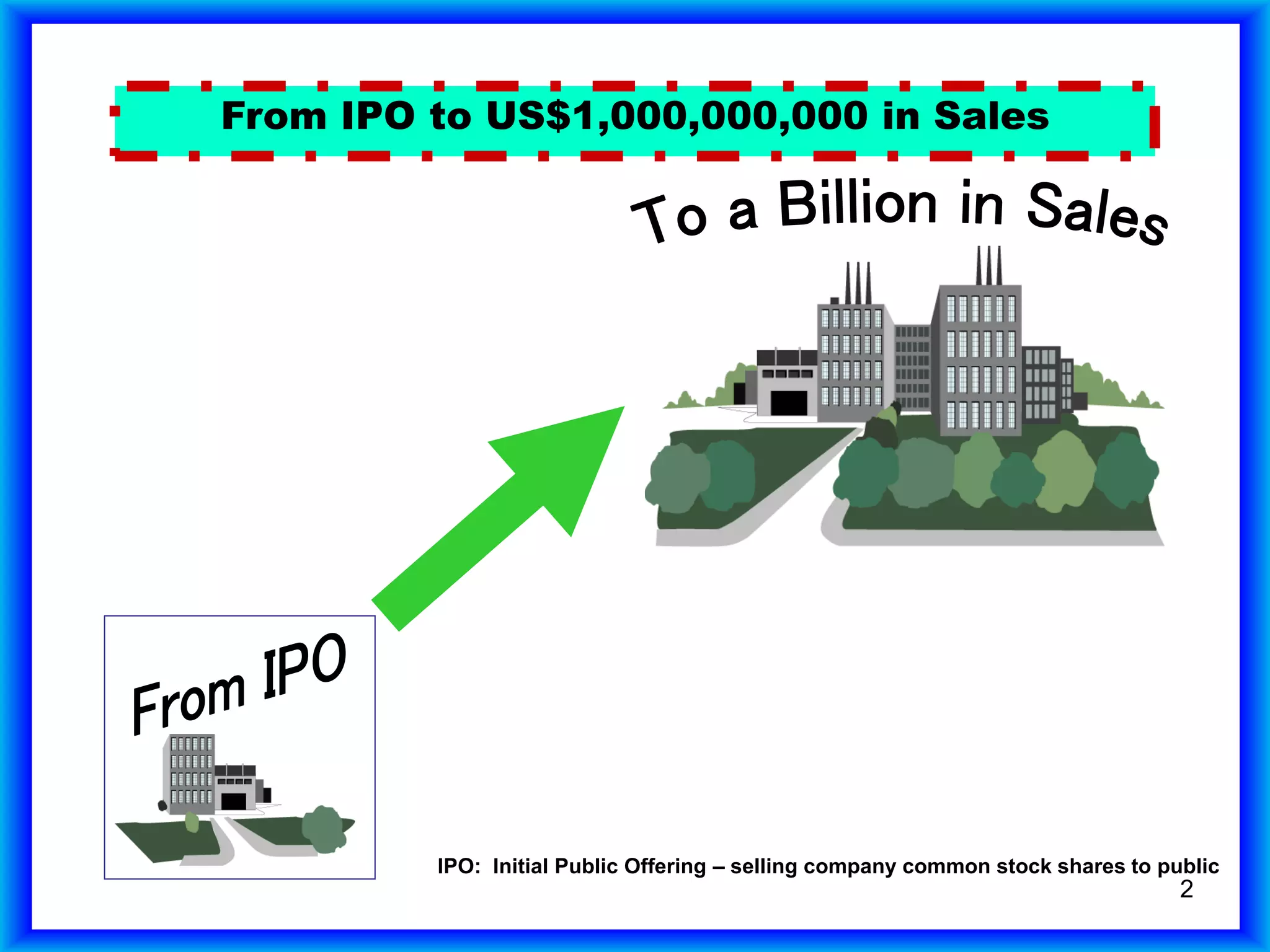
From IPO to US$1,000,000,000 in Sales
IPO: Initial Public Offering – selling company common stock shares to public
3
From IPO to US$1,000,000,000 in Sales
Who makes it……who doesn’t?
http://www.blueprintgrowth.com/, David G. Thomson
Based on a multi-year study from 1980 on growth:
1. One in twenty private companies in the US submitted an IPO.
Based on a multi-year study from 1980 on growth:
1. One in twenty private companies in the US submitted an IPO.
2. At the time of the IPO, these companies’ sales were less than
US$170,000,000 sales.
Average
sales US$170M
5% of private
companies to IPO
Based on a multi-year study from 1980 on growth:
1. One in twenty private companies in the US submitted an IPO.
2. At the time of the IPO, these companies’ sales were less than
US$170,000,000 sales.
4
From IPO to US$1,000,000,000 in Sales
http://www.blueprintgrowth.com/, David G. Thomson
387 companies
achieved US$1Billion
IPO submitted (7,454 companies)
Based on a multi-year study from 1980 on growth:
1. Of those that submitted an IPO, one in twenty reach sales of
US$1Billion (around 600% growth).
Based on a multi-year study from 1980 on growth:
1. Of those that submitted an IPO, one in twenty reach sales of
US$1Billion (around 600% growth).
2. That is one in 400 companies from start-up to sales of US$1
billion.
Based on a multi-year study from 1980 on growth:
1. Of those that submitted an IPO, one in twenty reach sales of
US$1Billion (around 600% growth).
2. That is one in 400 companies from start-up to sales of US$1
billion.
3. Of 7,454 companies studied for 1980 IPO, only 387 companies
(5%) achieved that sales amount (exponential growth).
Based on a multi-year study from 1980 on growth:
1. Of those that submitted an IPO, one in twenty reach sales of
US$1Billion (around 600% growth).
2. That is one in 400 companies from start-up to sales of US$1
billion.
3. Of 7,454 companies studied for 1980 IPO, only 387 companies
(5%) achieved that sales amount (exponential growth).
4. These 387 companies’ strategies are what was studied.
Based on a multi-year study from 1980 on growth:
1. Of those that submitted an IPO, one in twenty reach sales of
US$1Billion (around 600% growth).
2. That is one in 400 companies from start-up to sales of US$1
billion.
3. Of 7,454 companies studied for 1980 IPO, only 387 companies
(5%) achieved that sales amount (exponential growth).
4. These 387 companies’ strategies are what was studied.
5. 25% of those that made an IPO failed during the study.
1/400
Based on a multi-year study from 1980 on growth:
1. Of those that submitted an IPO, one in twenty reach sales of
US$1Billion (around 600% growth).
2. That is one in 400 companies from start-up to sales of US$1
billion.
3. Of 7,454 companies studied for 1980 IPO, only 387 companies
(5%) achieved that sales amount (exponential growth).
4. These 387 companies’ strategies are what was studied.
5. 25% of those that made an IPO failed during the study.
5
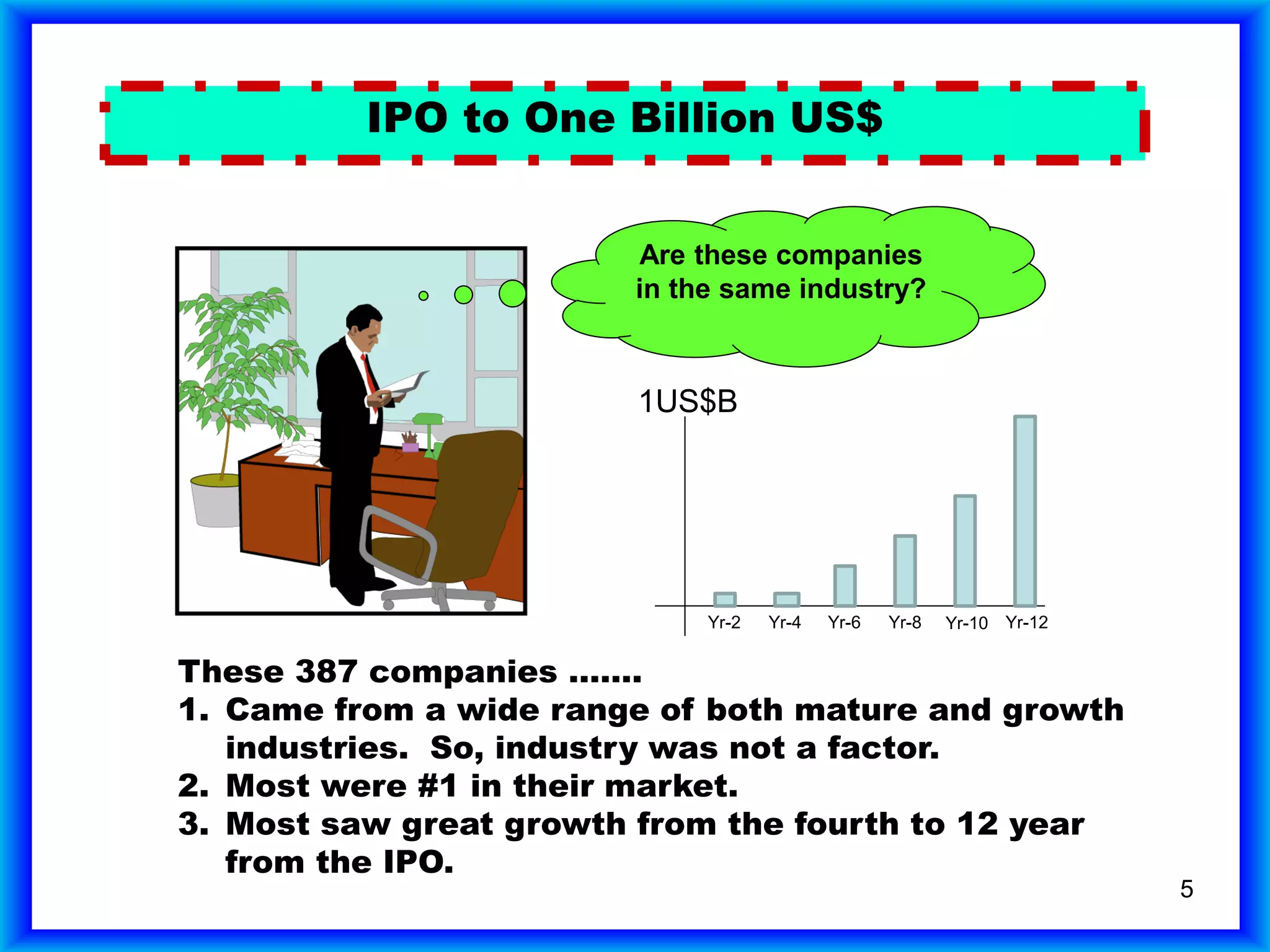
IPO to One Billion US$
Are these companies
in the same industry?
These 387 companies …….
1. Came from a wide range of both mature and growth
industries. So, industry was not a factor.
These 387 companies …….
1. Came from a wide range of both mature and growth
industries. So, industry was not a factor.
2. Most were #1 in their market.
These 387 companies …….
1. Came from a wide range of both mature and growth
industries. So, industry was not a factor.
2. Most were #1 in their market.
3. Most saw great growth from the fourth to 12 year
from the IPO.
1US$B
Yr-4 Yr-6 Yr-8 Yr-10 Yr-12
Yr-2
These 387 companies …….
1. Came from a wide range of both mature and growth
industries. So, industry was not a factor.
2. Most were #1 in their market.
3. Most saw great growth from the fourth to 12 year
from the IPO.
6
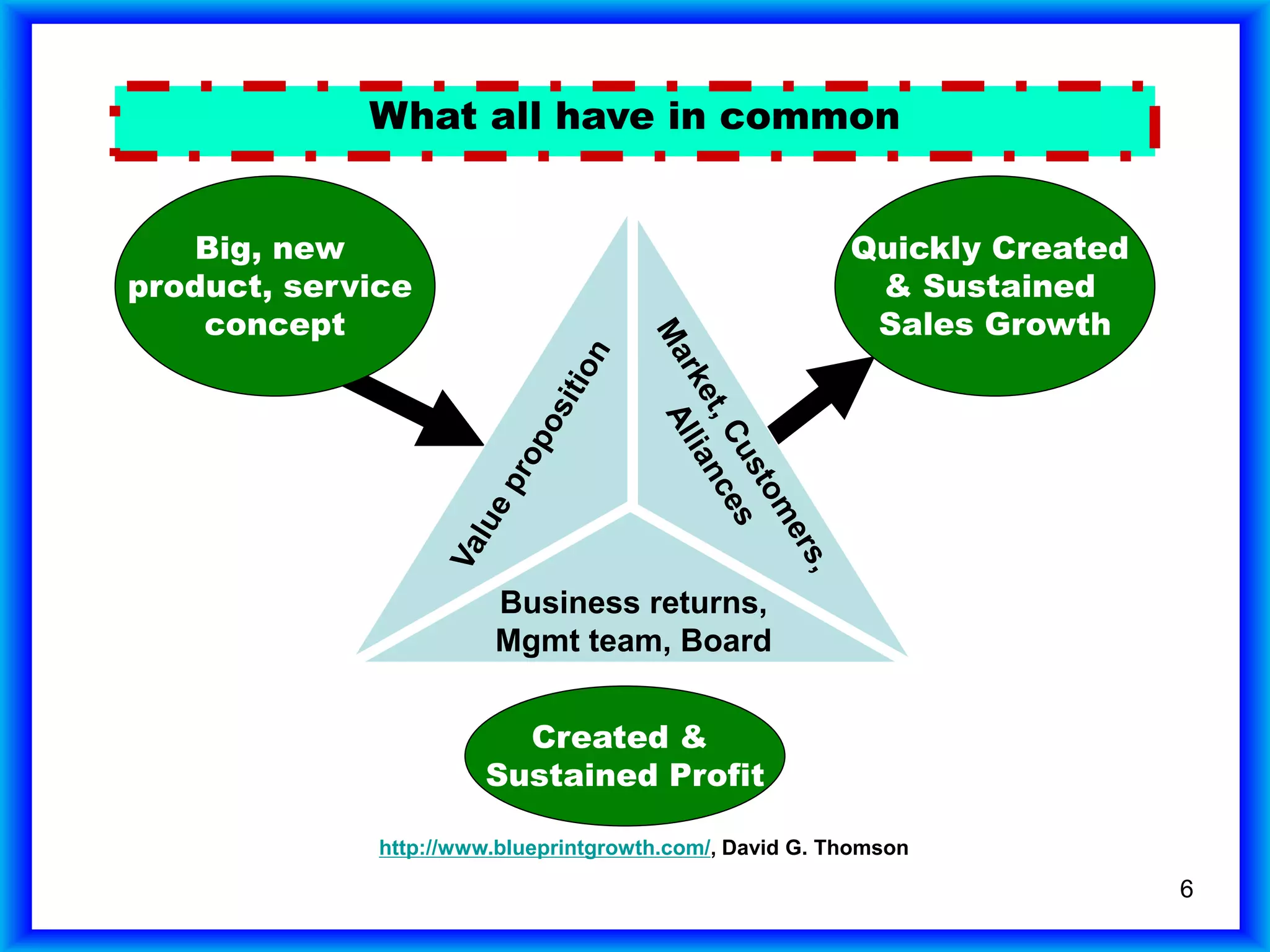
What all have in common
http://www.blueprintgrowth.com/, David G. Thomson
Business returns,
Mgmt team, Board
Big, new
product, service
concept
Quickly Created
& Sustained
Sales Growth
Created &
Sustained Profit
7
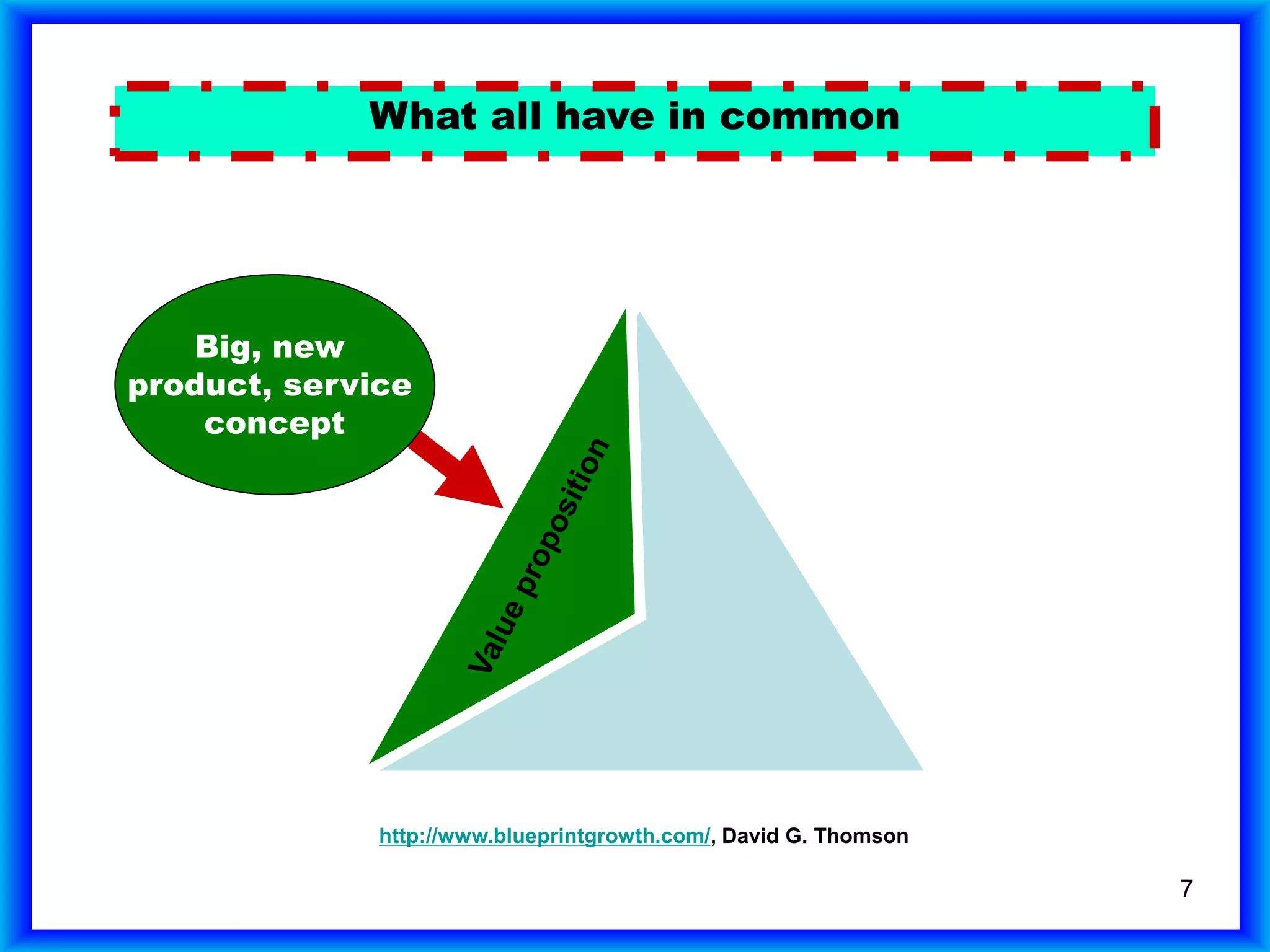
What all have in common
http://www.blueprintgrowth.com/, David G. Thomson
Big, new
product, service
concept
8
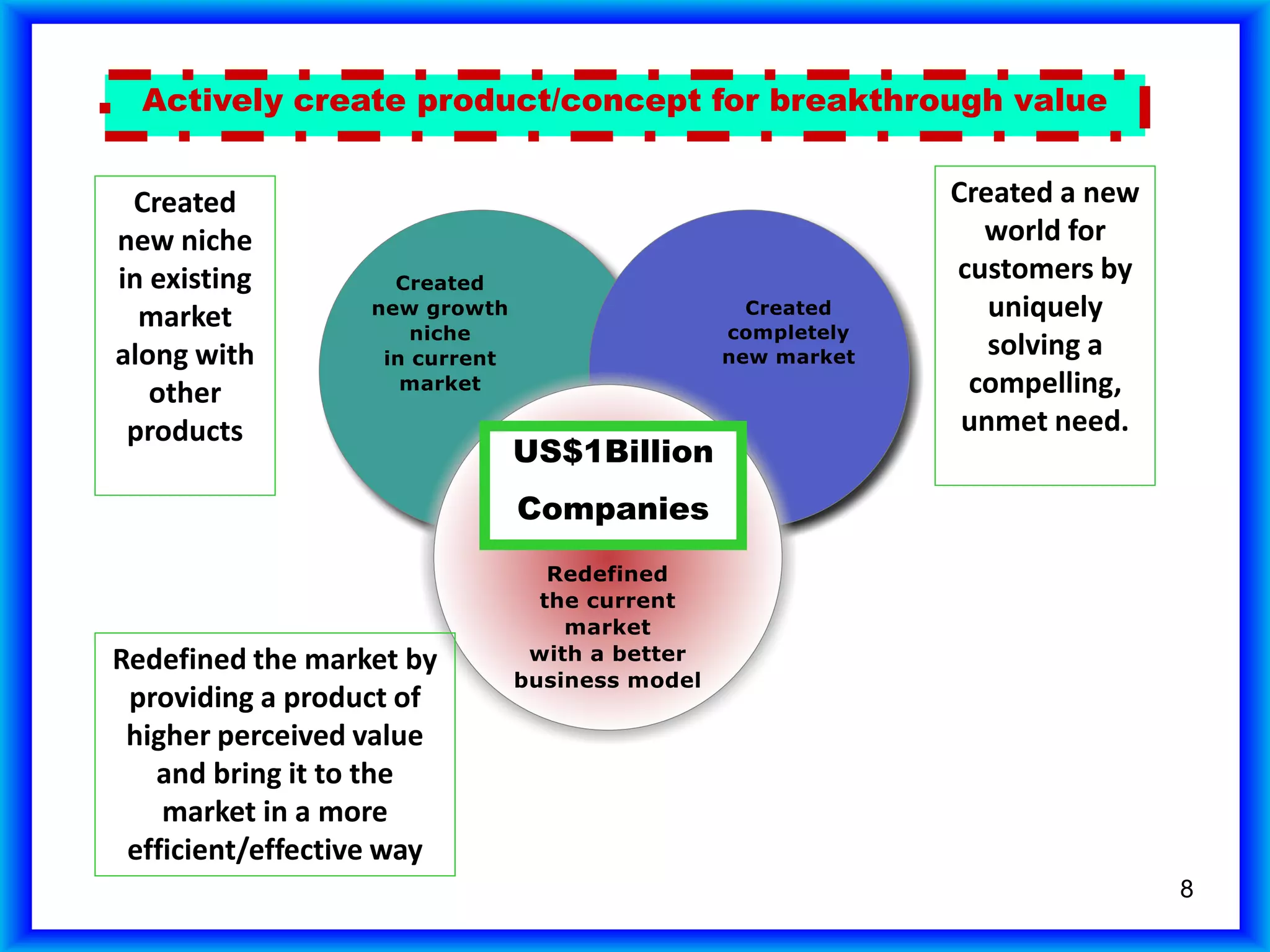
US$1Billion
Companies
Actively create product/concept for breakthrough value
Created a new
world for
customers by
uniquely
solving a
compelling,
unmet need.
Created
new niche
in existing
market
along with
other
products
Redefined the market by
providing a product of
higher perceived value
and bring it to the
market in a more
efficient/effective way
9
Breakthrough value in several areas for exponential growth
Breakthrough
value
10
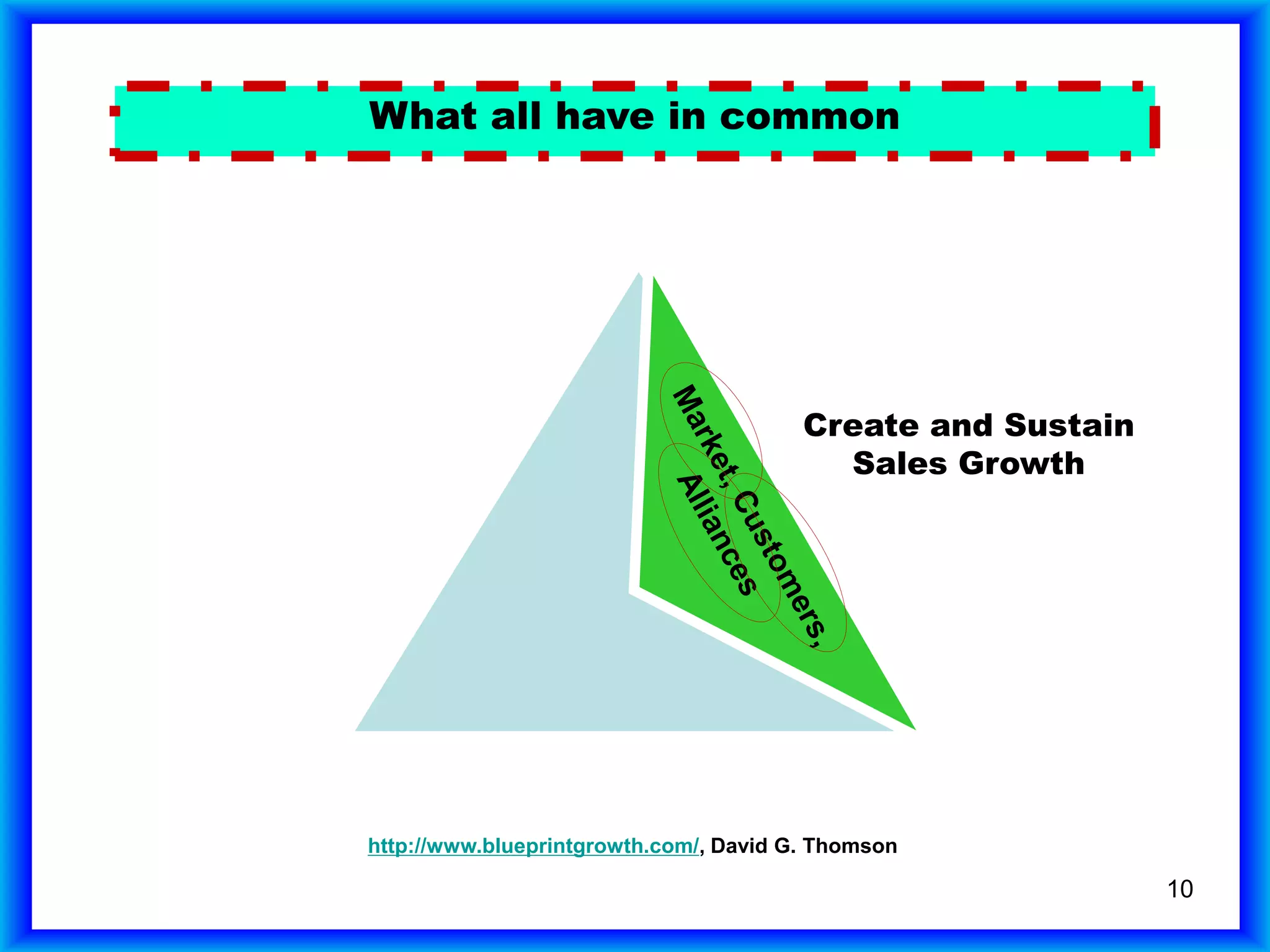
What all have in common
http://www.blueprintgrowth.com/, David G. Thomson
Create and Sustain
Sales Growth
11
Working in and penetrating markets with high-growth
12
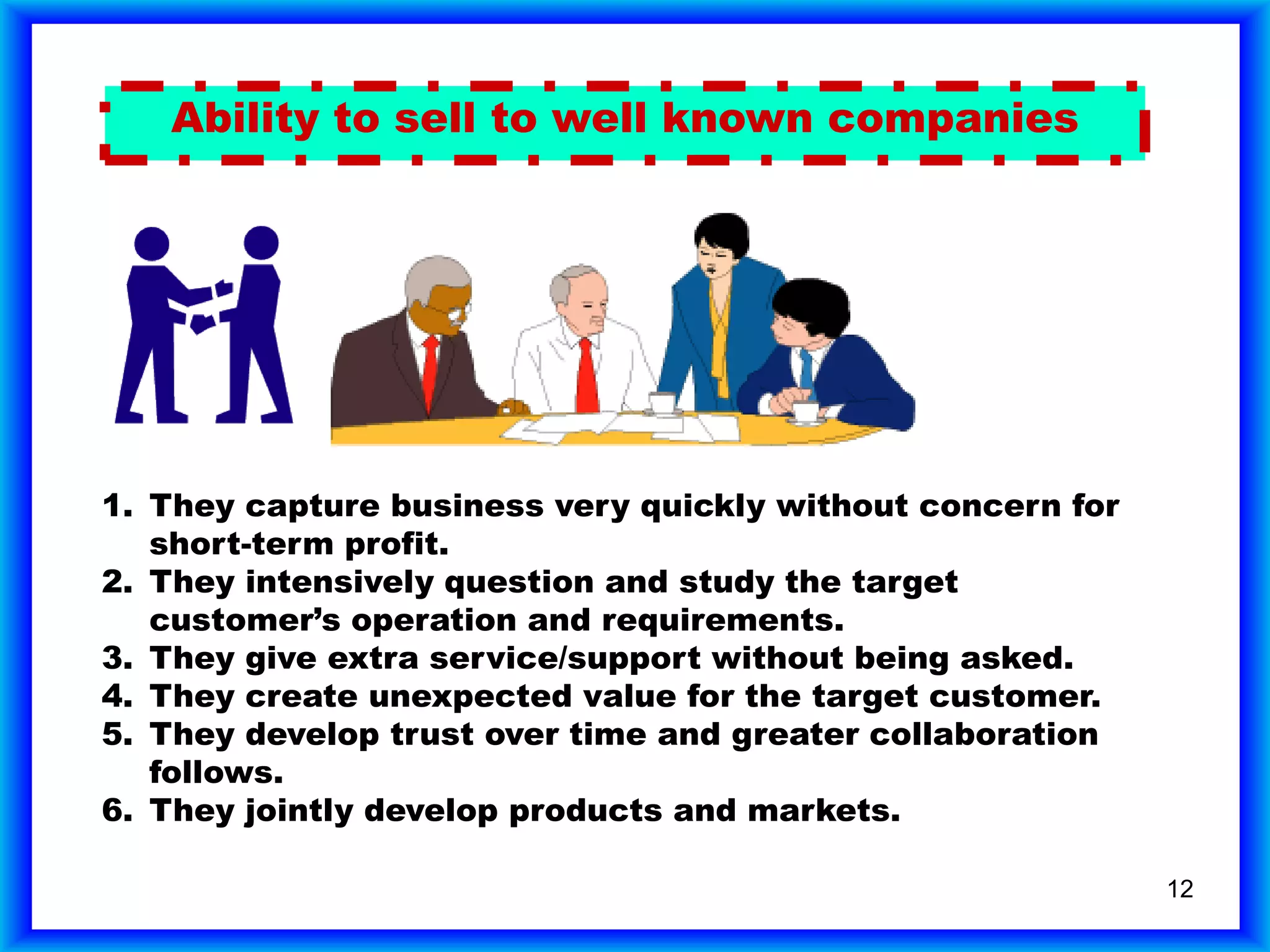
Ability to sell to well known companies
1. They capture business very quickly without concern for
short-term profit.
1. They capture business very quickly without concern for
short-term profit.
2. They intensively question and study the target
customer’s operation and requirements.
1. They capture business very quickly without concern for
short-term profit.
2. They intensively question and study the target
customer’s operation and requirements.
3. They give extra service/support without being asked.
1. They capture business very quickly without concern for
short-term profit.
2. They intensively question and study the target
customer’s operation and requirements.
3. They give extra service/support without being asked.
4. They create unexpected value for the target customer.
1. They capture business very quickly without concern for
short-term profit.
2. They intensively question and study the target
customer’s operation and requirements.
3. They give extra service/support without being asked.
4. They create unexpected value for the target customer.
5. They develop trust over time and greater collaboration
follows.
1. They capture business very quickly without concern for
short-term profit.
2. They intensively question and study the target
customer’s operation and requirements.
3. They give extra service/support without being asked.
4. They create unexpected value for the target customer.
5. They develop trust over time and greater collaboration
follows.
6. They jointly develop products and markets.
1. They capture business very quickly without concern for
short-term profit.
2. They intensively question and study the target
customer’s operation and requirements.
3. They give extra service/support without being asked.
4. They create unexpected value for the target customer.
5. They develop trust over time and greater collaboration
follows.
6. They jointly develop products and markets.
13
1. They offer speed in activities the larger company is slow at.
2. They offer flexibility where the larger company has rigid narrow
procedures.
1. They offer speed in activities the larger company is slow at.
2. They offer flexibility where the larger company has rigid narrow
procedures.
3. They offer motivation in activities where the larger company
does not want to get involved (de-motivated to perform).
1. They offer speed in activities the larger company is slow at.
2. They offer flexibility where the larger company has rigid narrow
procedures.
3. They offer motivation in activities where the larger company
does not want to get involved (de-motivated to perform).
4. They offer a low-risk, low-cost solution to something outside of
the larger company’s core business.
1. They offer speed in activities the larger company is slow at.
2. They offer flexibility where the larger company has rigid narrow
procedures.
3. They offer motivation in activities where the larger company
does not want to get involved (de-motivated to perform).
4. They offer a low-risk, low-cost solution to something outside of
the larger company’s core business.
5. They build a trustworthy win-win partner relationship.
1. They offer speed in activities the larger company is slow at.
2. They offer flexibility where the larger company has rigid narrow
procedures.
3. They offer motivation in activities where the larger company
does not want to get involved (de-motivated to perform).
4. They offer a low-risk, low-cost solution to something outside of
the larger company’s core business.
5. They build a trustworthy win-win partner relationship.
6. They create an environment of sharing and giving of vital
information freely.
1. They offer speed in activities the larger company is slow at.
2. They offer flexibility where the larger company has rigid narrow
procedures.
3. They offer motivation in activities where the larger company
does not want to get involved (de-motivated to perform)
4. They offer a low-risk, low-cost solution to something outside of
the larger company’s core business.
5. They build a trustworthy win-win partner relationship.
6. They create an environment of sharing and giving of vital
information freely.
7. They can generate interdependence without feeling vulnerable.
1. They offer speed in activities the larger company is slow at.
2. They offer flexibility where the larger company has rigid narrow
procedures.
3. They offer motivation in activities where the larger company
does not want to get involved (de-motivated to perform).
4. They offer a low-risk, low-cost solution to something outside of
the larger company’s core business.
5. They build a trustworthy win-win partner relationship.
6. They create an environment of sharing and giving of vital
information freely.
7. They can generate interdependence without feeling vulnerable.
8. They can match partners’ culture, capacity and goals.
Ability to form strategic alliances with large corporations
Small Company
Strengths
1. They offer speed in activities the larger company is slow at.
2. They offer flexibility where the larger company has rigid narrow
procedures.
3. They offer motivation in activities where the larger company
does not want to get involved (de-motivated to perform).
4. They offer a low-risk, low-cost solution to something outside of
the larger company’s core business.
5. They build a trustworthy win-win partner relationship.
6. They create an environment of sharing and giving of vital
information freely.
7. They can generate interdependence without feeling vulnerable.
8. They can match partners’ culture, capacity and goals.
14
Masters of financial controls
Create and Sustain Profit
Business returns,
Mgmt team, Board
They generate and sustain profit by….…
1. Being transparent to their shareholders and employees about their
financial situation.
They generate and sustain profit by….…
1. Being transparent to their shareholders and employees about their
financial situation.
2. Implementing a quick action plan when targets are off.
They generate and sustain profit by….…
1. Being transparent to their shareholders and employees about their
financial situation.
2. Implementing a quick action plan when targets are off.
3. Giving a great deal of in-company and in partner training.
They generate and sustain profit by….…
1. Being transparent to their shareholders and employees about their
financial situation.
2. Implementing a quick action plan when targets are off.
3. Giving a great deal of in-company and in partner training.
4. Insuring they offer dependable service.
They generate and sustain profit by….…
1. Being transparent to their shareholders and employees about their
financial situation.
2. Implementing a quick action plan when targets are off.
3. Giving a great deal of in-company and in partner training.
4. Insuring they offer dependable service.
5. Being to the market quickly and showing an early profit.
They generate and sustain profit by….…
1. Being transparent to their shareholders and employees about their
financial situation.
2. Implementing a quick action plan when targets are off.
3. Giving a great deal of in-company and in partner training.
4. Insuring they offer dependable service.
5. Being to the market quickly and showing an early profit.
6. Balancing investment decisions in R & D, sales and other activities
with earnings through honest discussions and clearly stated goals.
They generate and sustain profit by….…
1. Being transparent to their shareholders and employees about their
financial situation.
2. Implementing a quick action plan when targets are off.
3. Giving a great deal of in-company and in partner training.
4. Insuring they offer dependable service.
5. Being to the market quickly and showing an early profit.
6. Balancing investment decisions in R & D, sales and other activities
with earnings through honest discussions and clearly stated goals.
15
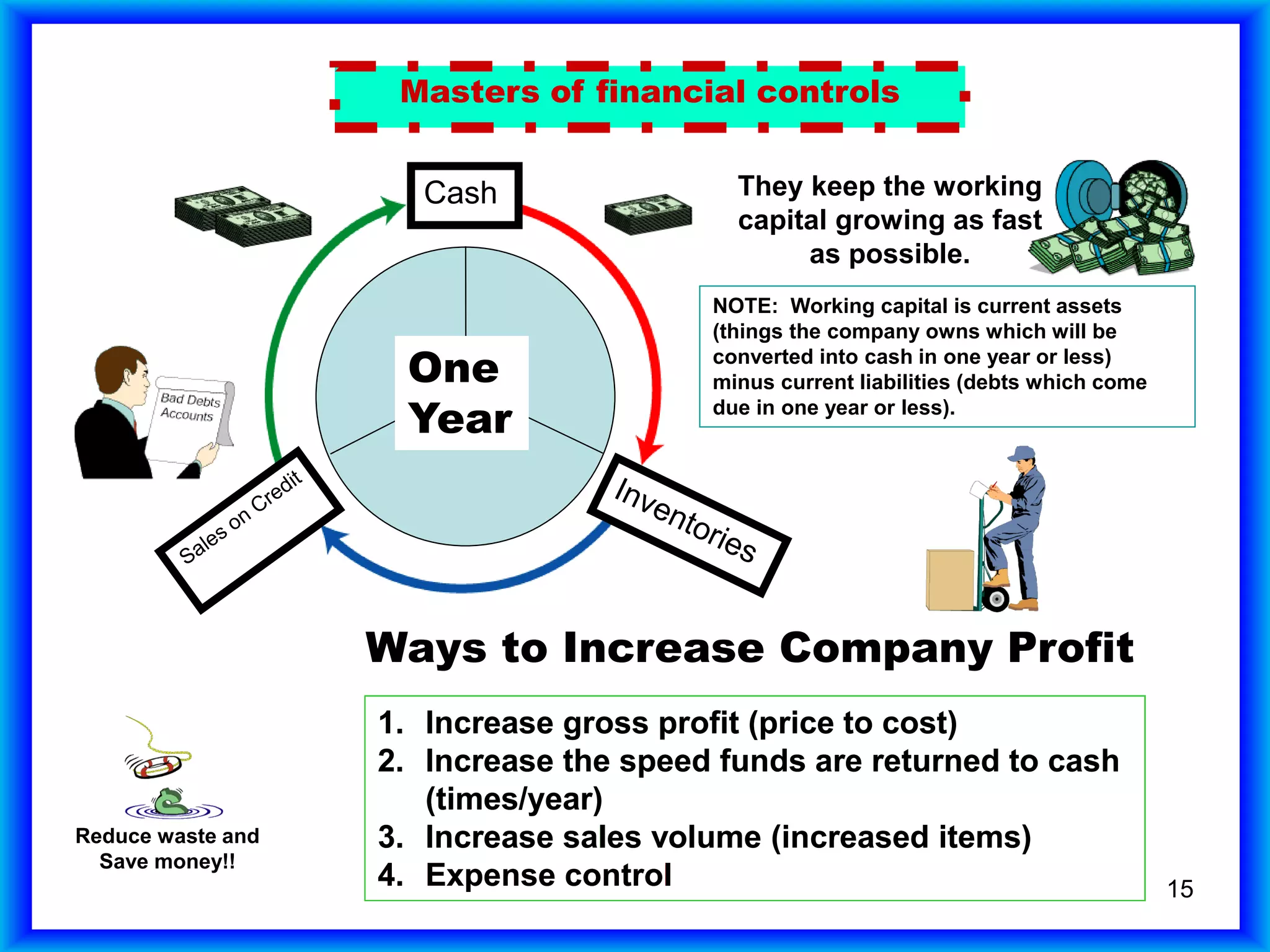
Cash They keep the working
capital growing as fast
as possible.
NOTE: Working capital is current assets
(things the company owns which will be
converted into cash in one year or less)
minus current liabilities (debts which come
due in one year or less).
Ways to Increase Company Profit
Reduce waste and
Save money!!
One
Year
Masters of financial controls
1. Increase gross profit (price to cost)
2. Increase the speed funds are returned to cash
(times/year)
1. Increase gross profit (price to cost)
2. Increase the speed funds are returned to cash
(times/year)
3. Increase sales volume (increased items)
1. Increase gross profit (price to cost)
2. Increase the speed funds are returned to cash
(times/year)
3. Increase sales volume (increased items)
4. Expense control
1. Increase gross profit (price to cost)
2. Increase the speed funds are returned to cash
(times/year)
3. Increase sales volume (increased items)
4. Expense control
16
Have strong inside-outside leadership
The leadership has a dynamic duo pair of CEO and COO with a high level of
trust and communication between them.
The leadership has a dynamic duo pair of CEO and COO with a high level of
trust and communication between them.
One is mostly outside facing toward the public and market, and the other is
mostly inside facing toward the operations and employees.
The leadership has a dynamic duo pair of CEO and COO with a high level of
trust and communication between them.
One is mostly outside facing toward the public and market, and the other is
mostly inside facing toward the operations and employees.
The culture is based on exploration and innovation in a way that is distinctive to
the company and employees.
The leadership has a dynamic duo pair of CEO and COO with a high level of
trust and communication between them.
One is mostly outside facing toward the public and market, and the other is
mostly inside facing toward the operations and employees.
The culture is based on exploration and innovation in a way that is distinctive to
the company and employees.
Leadership takes an active role in problem solving as well as decision making.
The leadership has a dynamic duo pair of CEO and COO with a high level of
trust and communication between them.
One is mostly outside facing toward the public and market, and the other is
mostly inside facing toward the operations and employees.
The culture is based on exploration and innovation in a way that is distinctive to
the company and employees.
Leadership takes an active role in problem solving as well as decision making.
Leadership speaks a common language of innovation and avoids thinking that
limits growth.
The leadership has a dynamic duo pair of CEO and COO with a high level of
trust and communication between them.
One is mostly outside facing toward the public and market, and the other is
mostly inside facing toward the operations and employees.
The culture is based on exploration and innovation in a way that is distinctive to
the company and employees.
Leadership takes an active role in problem solving as well as decision making.
Leadership speaks a common language of innovation and avoids thinking that
limits growth.
The management team is quick to self-correct and tries to do so effectively and
with teamwork and execute cross-functional initiatives well.
The leadership has a dynamic duo pair of CEO and COO with a high level of
trust and communication between them.
One is mostly outside facing toward the public and market, and the other is
mostly inside facing toward the operations and employees.
The culture is based on exploration and innovation in a way that is distinctive to
the company and employees.
Leadership takes an active role in problem solving as well as decision making.
Leadership speaks a common language of innovation and avoids thinking that
limits growth.
The management team is quick to self-correct and tries to do so effectively and
with teamwork and execute cross-functional initiatives well.
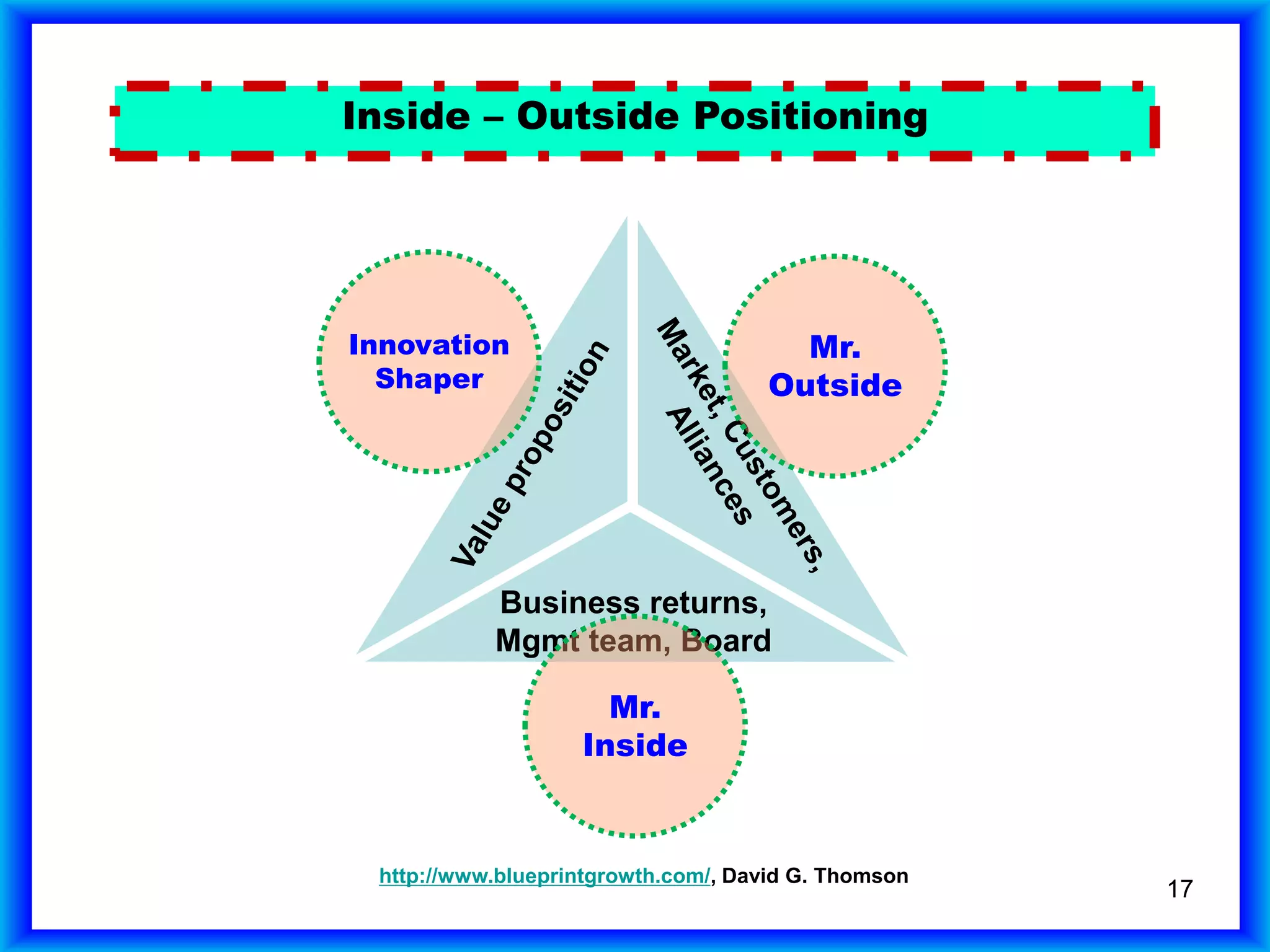
17
Inside – Outside Positioning
http://www.blueprintgrowth.com/, David G. Thomson
Business returns,
Mgmt team, Board
Mr.
Outside
Innovation
Shaper
Mr.
Inside
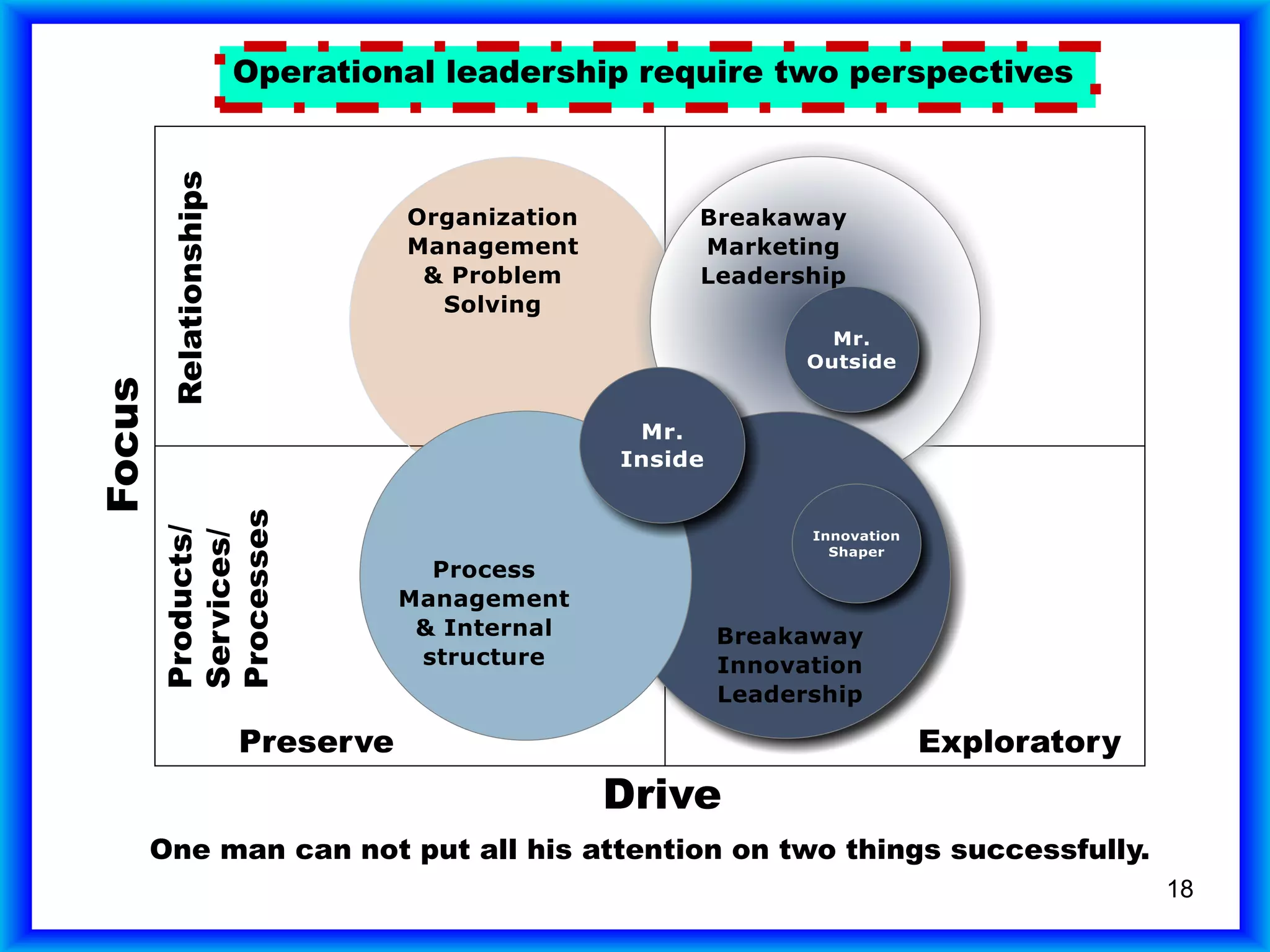
18
Drive
Operational leadership require two perspectives
Products/
Services/
Processes
Preserve
Relationships
Focus
Exploratory
One man can not put all his attention on two things successfully.
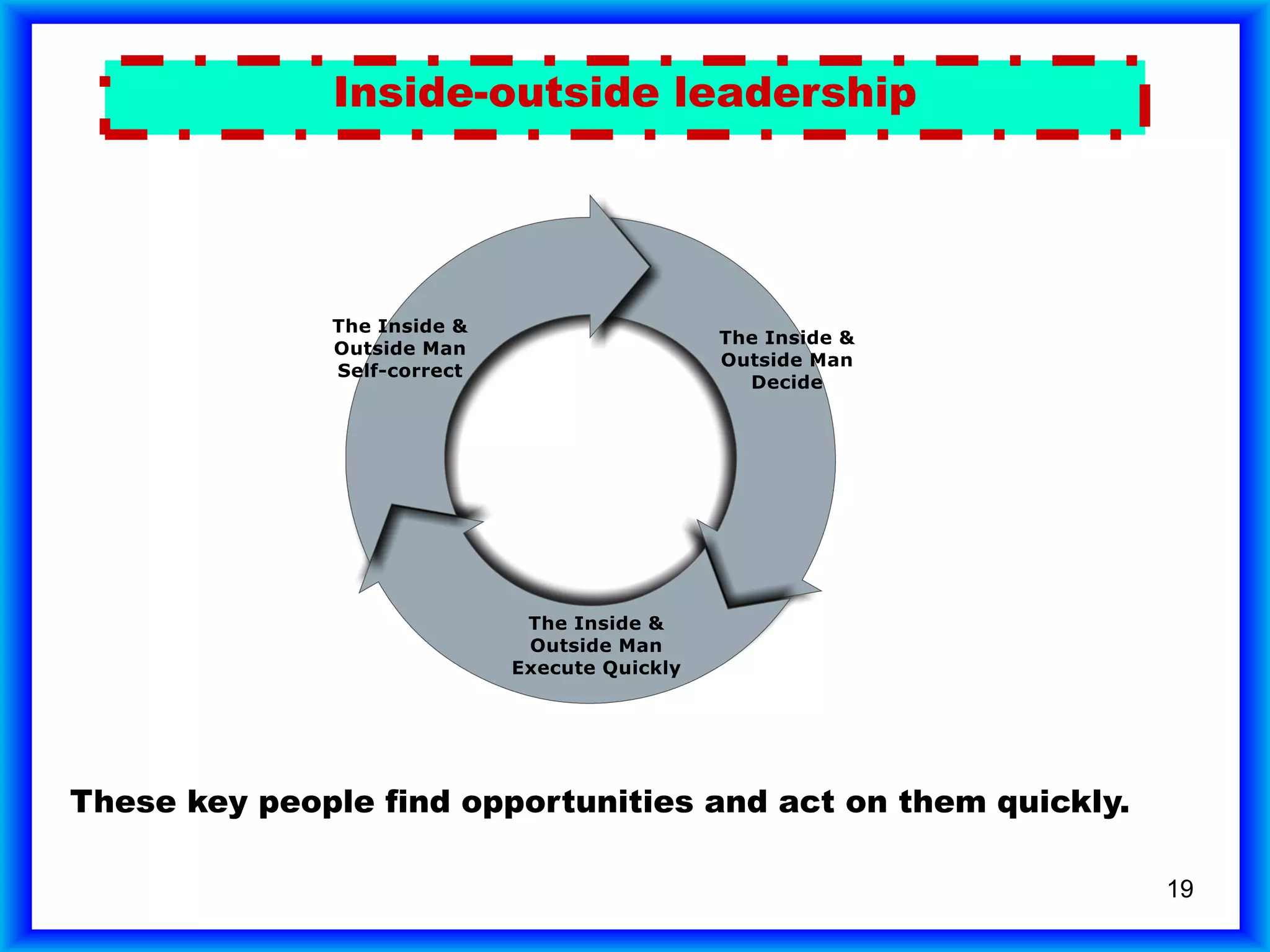
19
Inside-outside leadership
These key people find opportunities and act on them quickly.
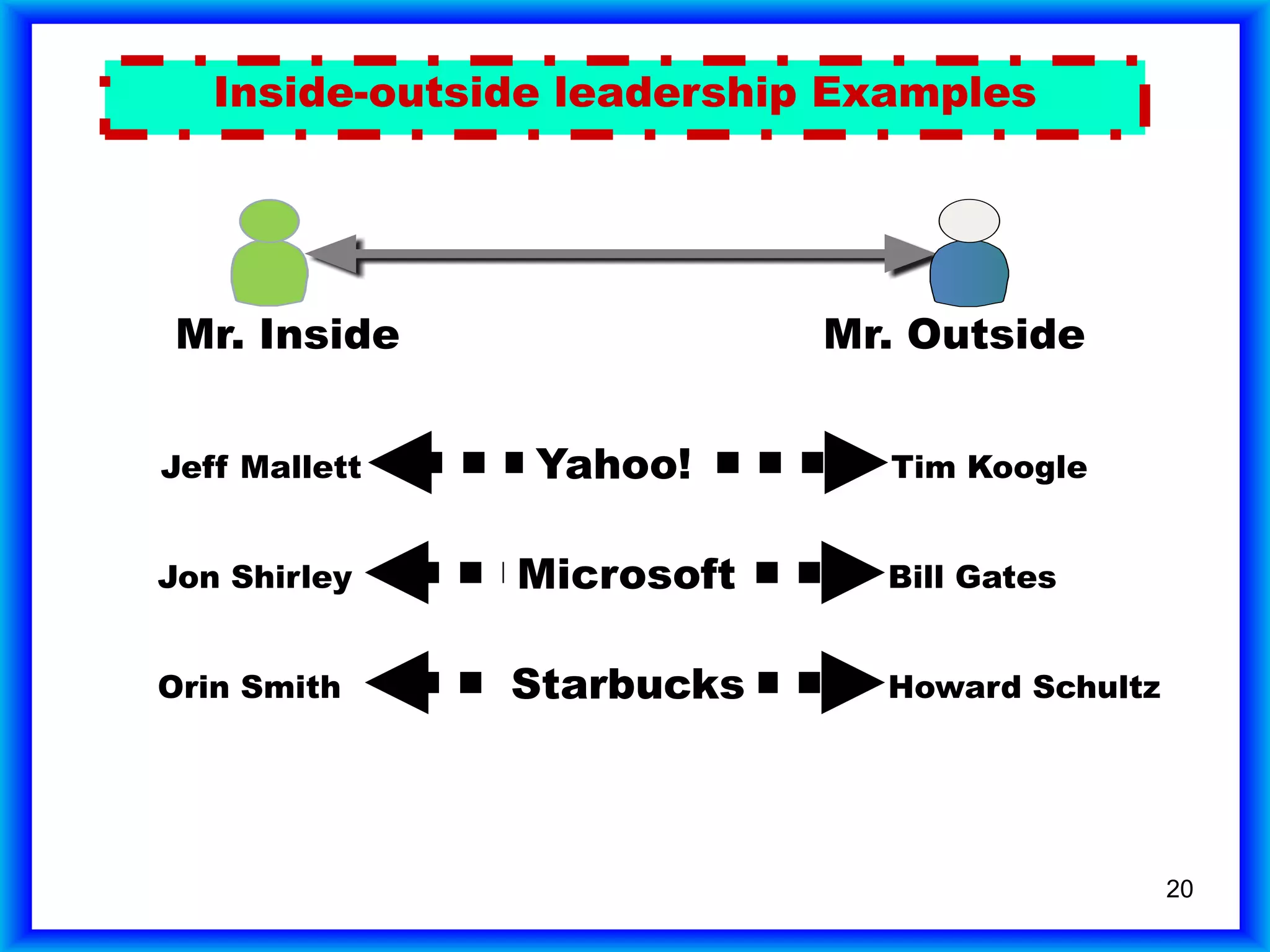
20
Mr. Inside Mr. Outside
Tim Koogle
Jeff Mallett Yahoo!
Bill Gates
Jon Shirley Microsoft
Howard Schultz
Orin Smith Starbucks
Inside-outside leadership Examples
21
The Board of Directors: Comprised of Business Experts
The board is not dominated by investors and management team members.
There is often a CEO from another company that has grown that company
exponentially.
The board is not dominated by investors and management team members.
There is often a CEO from another company that has grown that company
exponentially.
There is a board member that knows the market and customer requirements.
The board is not dominated by investors and management team members.
There is often a CEO from another company that has grown that company
exponentially.
There is a board member that knows the market and customer requirements.
Strategic alliance employees are on the board.
The board is not dominated by investors and management team members.
There is often a CEO from another company that has grown that company
exponentially.
There is a board member that knows the market and customer requirements.
Strategic alliance employees are on the board.
Well respected community members are often on the board.
The board is not dominated by investors and management team members.
There is often a CEO from another company that has grown that company
exponentially.
There is a board member that knows the market and customer requirements.
Strategic alliance employees are on the board.
Well respected community members are often on the board.
Board members have a long-terms growth attitude.
The board is not dominated by investors and management team members.
There is often a CEO from another company that has grown that company
exponentially.
There is a board member that knows the market and customer requirements.
Strategic alliance employees are on the board.
Well respected community members are often on the board.
Board members have a long-terms growth attitude.
Management prepares well for board meetings as the directors know the
business.
The board is not dominated by investors and management team members.
There is often a CEO from another company that has grown that company
exponentially.
There is a board member that knows the market and customer requirements.
Strategic alliance employees are on the board.
Well respected community members are often on the board.
Board members have a long-terms growth attitude.
Management prepares well for board meetings as the directors know the
business.
ESOP (employee share ownership plan) companies were common.
The board is not dominated by investors and management team members.
There is often a CEO from another company that has grown that company
exponentially.
There is a board member that knows the market and customer requirements.
Strategic alliance employees are on the board.
Well respected community members are often on the board.
Board members have a long-terms growth attitude.
Management prepares well for board meetings as the directors know the
business.
ESOP (employee share ownership plan) companies were common.
22
The board members know how to analyze risk to
return on investment from many perspectives.
The Board of Directors: Comprised of Business Experts
23
In Review - common operation of billion dollar companies
What is common in many of these companies:
1. They have active R & D for breakthrough value to
customers.
What is common in many of these companies:
1. They have active R & D for breakthrough value to
customers.
2. They working in and penetrating markets with high-
growth.
What is common in many of these companies:
1. They have active R & D for breakthrough value to
customers.
2. They working in and penetrating markets with high-
growth.
3. They have the ability to penetrate and sell to well
known companies building special relationships.
What is common in many of these companies:
1. They have active R & D for breakthrough value to
customers.
2. They working in and penetrating markets with high-
growth.
3. They have the ability to penetrate and sell to well
known companies building special relationships.
4. They have the ability to form strategic alliances with
large corporations.
What is common in many of these companies:
1. They have active R & D for breakthrough value to
customers.
2. They working in and penetrating markets with high-
growth.
3. They have the ability to penetrate and sell to well
known companies building special relationships.
4. They have the ability to form strategic alliances with
large corporations.
5. They are masters in financial controls.
What is common in many of these companies:
1. They have active R & D for breakthrough value to
customers.
2. They working in and penetrating markets with high-
growth.
3. They have the ability to penetrate and sell to well
known companies building special relationships.
4. They have the ability to form strategic alliances with
large corporations.
5. They are masters in financial controls.
6. They have a strong inside-outside leadership style.
What is common in many of these companies:
1. They have active R & D for breakthrough value to
customers.
2. They working in and penetrating markets with high-
growth.
3. They have the ability to penetrate and sell to well
known companies building special relationships.
4. They have the ability to form strategic alliances with
large corporations.
5. They are masters in financial controls.
6. They have a strong inside-outside leadership style.
7. They have a board with key expert members.
What is common in many of these companies:
1. They have active R & D for breakthrough value to
customers.
2. They working in and penetrating markets with high-
growth.
3. They have the ability to penetrate and sell to well
known companies building special relationships.
4. They have the ability to form strategic alliances with
large corporations.
5. They are masters in financial controls.
6. They have a strong inside-outside leadership style.
7. They have a board with key expert members.
24
Thank you

High growth company esentials

  • 1.
  • 2.
    2 From IPO toUS$1,000,000,000 in Sales IPO: Initial Public Offering – selling company common stock shares to public
  • 3.
    3 From IPO toUS$1,000,000,000 in Sales Who makes it……who doesn’t? http://www.blueprintgrowth.com/, David G. Thomson Based on a multi-year study from 1980 on growth: 1. One in twenty private companies in the US submitted an IPO. Based on a multi-year study from 1980 on growth: 1. One in twenty private companies in the US submitted an IPO. 2. At the time of the IPO, these companies’ sales were less than US$170,000,000 sales. Average sales US$170M 5% of private companies to IPO Based on a multi-year study from 1980 on growth: 1. One in twenty private companies in the US submitted an IPO. 2. At the time of the IPO, these companies’ sales were less than US$170,000,000 sales.
  • 4.
    4 From IPO toUS$1,000,000,000 in Sales http://www.blueprintgrowth.com/, David G. Thomson 387 companies achieved US$1Billion IPO submitted (7,454 companies) Based on a multi-year study from 1980 on growth: 1. Of those that submitted an IPO, one in twenty reach sales of US$1Billion (around 600% growth). Based on a multi-year study from 1980 on growth: 1. Of those that submitted an IPO, one in twenty reach sales of US$1Billion (around 600% growth). 2. That is one in 400 companies from start-up to sales of US$1 billion. Based on a multi-year study from 1980 on growth: 1. Of those that submitted an IPO, one in twenty reach sales of US$1Billion (around 600% growth). 2. That is one in 400 companies from start-up to sales of US$1 billion. 3. Of 7,454 companies studied for 1980 IPO, only 387 companies (5%) achieved that sales amount (exponential growth). Based on a multi-year study from 1980 on growth: 1. Of those that submitted an IPO, one in twenty reach sales of US$1Billion (around 600% growth). 2. That is one in 400 companies from start-up to sales of US$1 billion. 3. Of 7,454 companies studied for 1980 IPO, only 387 companies (5%) achieved that sales amount (exponential growth). 4. These 387 companies’ strategies are what was studied. Based on a multi-year study from 1980 on growth: 1. Of those that submitted an IPO, one in twenty reach sales of US$1Billion (around 600% growth). 2. That is one in 400 companies from start-up to sales of US$1 billion. 3. Of 7,454 companies studied for 1980 IPO, only 387 companies (5%) achieved that sales amount (exponential growth). 4. These 387 companies’ strategies are what was studied. 5. 25% of those that made an IPO failed during the study. 1/400 Based on a multi-year study from 1980 on growth: 1. Of those that submitted an IPO, one in twenty reach sales of US$1Billion (around 600% growth). 2. That is one in 400 companies from start-up to sales of US$1 billion. 3. Of 7,454 companies studied for 1980 IPO, only 387 companies (5%) achieved that sales amount (exponential growth). 4. These 387 companies’ strategies are what was studied. 5. 25% of those that made an IPO failed during the study.
  • 5.
    5 IPO to OneBillion US$ Are these companies in the same industry? These 387 companies ……. 1. Came from a wide range of both mature and growth industries. So, industry was not a factor. These 387 companies ……. 1. Came from a wide range of both mature and growth industries. So, industry was not a factor. 2. Most were #1 in their market. These 387 companies ……. 1. Came from a wide range of both mature and growth industries. So, industry was not a factor. 2. Most were #1 in their market. 3. Most saw great growth from the fourth to 12 year from the IPO. 1US$B Yr-4 Yr-6 Yr-8 Yr-10 Yr-12 Yr-2 These 387 companies ……. 1. Came from a wide range of both mature and growth industries. So, industry was not a factor. 2. Most were #1 in their market. 3. Most saw great growth from the fourth to 12 year from the IPO.
  • 6.
    6 What all havein common http://www.blueprintgrowth.com/, David G. Thomson Business returns, Mgmt team, Board Big, new product, service concept Quickly Created & Sustained Sales Growth Created & Sustained Profit
  • 7.
    7 What all havein common http://www.blueprintgrowth.com/, David G. Thomson Big, new product, service concept
  • 8.
    8 US$1Billion Companies Actively create product/conceptfor breakthrough value Created a new world for customers by uniquely solving a compelling, unmet need. Created new niche in existing market along with other products Redefined the market by providing a product of higher perceived value and bring it to the market in a more efficient/effective way
  • 9.
    9 Breakthrough value inseveral areas for exponential growth Breakthrough value
  • 10.
    10 What all havein common http://www.blueprintgrowth.com/, David G. Thomson Create and Sustain Sales Growth
  • 11.
    11 Working in andpenetrating markets with high-growth
  • 12.
    12 Ability to sellto well known companies 1. They capture business very quickly without concern for short-term profit. 1. They capture business very quickly without concern for short-term profit. 2. They intensively question and study the target customer’s operation and requirements. 1. They capture business very quickly without concern for short-term profit. 2. They intensively question and study the target customer’s operation and requirements. 3. They give extra service/support without being asked. 1. They capture business very quickly without concern for short-term profit. 2. They intensively question and study the target customer’s operation and requirements. 3. They give extra service/support without being asked. 4. They create unexpected value for the target customer. 1. They capture business very quickly without concern for short-term profit. 2. They intensively question and study the target customer’s operation and requirements. 3. They give extra service/support without being asked. 4. They create unexpected value for the target customer. 5. They develop trust over time and greater collaboration follows. 1. They capture business very quickly without concern for short-term profit. 2. They intensively question and study the target customer’s operation and requirements. 3. They give extra service/support without being asked. 4. They create unexpected value for the target customer. 5. They develop trust over time and greater collaboration follows. 6. They jointly develop products and markets. 1. They capture business very quickly without concern for short-term profit. 2. They intensively question and study the target customer’s operation and requirements. 3. They give extra service/support without being asked. 4. They create unexpected value for the target customer. 5. They develop trust over time and greater collaboration follows. 6. They jointly develop products and markets.
  • 13.
    13 1. They offerspeed in activities the larger company is slow at. 1. They offer speed in activities the larger company is slow at. 2. They offer flexibility where the larger company has rigid narrow procedures. 1. They offer speed in activities the larger company is slow at. 2. They offer flexibility where the larger company has rigid narrow procedures. 3. They offer motivation in activities where the larger company does not want to get involved (de-motivated to perform). 1. They offer speed in activities the larger company is slow at. 2. They offer flexibility where the larger company has rigid narrow procedures. 3. They offer motivation in activities where the larger company does not want to get involved (de-motivated to perform). 4. They offer a low-risk, low-cost solution to something outside of the larger company’s core business. 1. They offer speed in activities the larger company is slow at. 2. They offer flexibility where the larger company has rigid narrow procedures. 3. They offer motivation in activities where the larger company does not want to get involved (de-motivated to perform). 4. They offer a low-risk, low-cost solution to something outside of the larger company’s core business. 5. They build a trustworthy win-win partner relationship. 1. They offer speed in activities the larger company is slow at. 2. They offer flexibility where the larger company has rigid narrow procedures. 3. They offer motivation in activities where the larger company does not want to get involved (de-motivated to perform). 4. They offer a low-risk, low-cost solution to something outside of the larger company’s core business. 5. They build a trustworthy win-win partner relationship. 6. They create an environment of sharing and giving of vital information freely. 1. They offer speed in activities the larger company is slow at. 2. They offer flexibility where the larger company has rigid narrow procedures. 3. They offer motivation in activities where the larger company does not want to get involved (de-motivated to perform) 4. They offer a low-risk, low-cost solution to something outside of the larger company’s core business. 5. They build a trustworthy win-win partner relationship. 6. They create an environment of sharing and giving of vital information freely. 7. They can generate interdependence without feeling vulnerable. 1. They offer speed in activities the larger company is slow at. 2. They offer flexibility where the larger company has rigid narrow procedures. 3. They offer motivation in activities where the larger company does not want to get involved (de-motivated to perform). 4. They offer a low-risk, low-cost solution to something outside of the larger company’s core business. 5. They build a trustworthy win-win partner relationship. 6. They create an environment of sharing and giving of vital information freely. 7. They can generate interdependence without feeling vulnerable. 8. They can match partners’ culture, capacity and goals. Ability to form strategic alliances with large corporations Small Company Strengths 1. They offer speed in activities the larger company is slow at. 2. They offer flexibility where the larger company has rigid narrow procedures. 3. They offer motivation in activities where the larger company does not want to get involved (de-motivated to perform). 4. They offer a low-risk, low-cost solution to something outside of the larger company’s core business. 5. They build a trustworthy win-win partner relationship. 6. They create an environment of sharing and giving of vital information freely. 7. They can generate interdependence without feeling vulnerable. 8. They can match partners’ culture, capacity and goals.
  • 14.
    14 Masters of financialcontrols Create and Sustain Profit Business returns, Mgmt team, Board They generate and sustain profit by….… 1. Being transparent to their shareholders and employees about their financial situation. They generate and sustain profit by….… 1. Being transparent to their shareholders and employees about their financial situation. 2. Implementing a quick action plan when targets are off. They generate and sustain profit by….… 1. Being transparent to their shareholders and employees about their financial situation. 2. Implementing a quick action plan when targets are off. 3. Giving a great deal of in-company and in partner training. They generate and sustain profit by….… 1. Being transparent to their shareholders and employees about their financial situation. 2. Implementing a quick action plan when targets are off. 3. Giving a great deal of in-company and in partner training. 4. Insuring they offer dependable service. They generate and sustain profit by….… 1. Being transparent to their shareholders and employees about their financial situation. 2. Implementing a quick action plan when targets are off. 3. Giving a great deal of in-company and in partner training. 4. Insuring they offer dependable service. 5. Being to the market quickly and showing an early profit. They generate and sustain profit by….… 1. Being transparent to their shareholders and employees about their financial situation. 2. Implementing a quick action plan when targets are off. 3. Giving a great deal of in-company and in partner training. 4. Insuring they offer dependable service. 5. Being to the market quickly and showing an early profit. 6. Balancing investment decisions in R & D, sales and other activities with earnings through honest discussions and clearly stated goals. They generate and sustain profit by….… 1. Being transparent to their shareholders and employees about their financial situation. 2. Implementing a quick action plan when targets are off. 3. Giving a great deal of in-company and in partner training. 4. Insuring they offer dependable service. 5. Being to the market quickly and showing an early profit. 6. Balancing investment decisions in R & D, sales and other activities with earnings through honest discussions and clearly stated goals.
  • 15.
    15 Cash They keepthe working capital growing as fast as possible. NOTE: Working capital is current assets (things the company owns which will be converted into cash in one year or less) minus current liabilities (debts which come due in one year or less). Ways to Increase Company Profit Reduce waste and Save money!! One Year Masters of financial controls 1. Increase gross profit (price to cost) 1. Increase gross profit (price to cost) 2. Increase the speed funds are returned to cash (times/year) 1. Increase gross profit (price to cost) 2. Increase the speed funds are returned to cash (times/year) 3. Increase sales volume (increased items) 1. Increase gross profit (price to cost) 2. Increase the speed funds are returned to cash (times/year) 3. Increase sales volume (increased items) 4. Expense control 1. Increase gross profit (price to cost) 2. Increase the speed funds are returned to cash (times/year) 3. Increase sales volume (increased items) 4. Expense control
  • 16.
    16 Have strong inside-outsideleadership The leadership has a dynamic duo pair of CEO and COO with a high level of trust and communication between them. The leadership has a dynamic duo pair of CEO and COO with a high level of trust and communication between them. One is mostly outside facing toward the public and market, and the other is mostly inside facing toward the operations and employees. The leadership has a dynamic duo pair of CEO and COO with a high level of trust and communication between them. One is mostly outside facing toward the public and market, and the other is mostly inside facing toward the operations and employees. The culture is based on exploration and innovation in a way that is distinctive to the company and employees. The leadership has a dynamic duo pair of CEO and COO with a high level of trust and communication between them. One is mostly outside facing toward the public and market, and the other is mostly inside facing toward the operations and employees. The culture is based on exploration and innovation in a way that is distinctive to the company and employees. Leadership takes an active role in problem solving as well as decision making. The leadership has a dynamic duo pair of CEO and COO with a high level of trust and communication between them. One is mostly outside facing toward the public and market, and the other is mostly inside facing toward the operations and employees. The culture is based on exploration and innovation in a way that is distinctive to the company and employees. Leadership takes an active role in problem solving as well as decision making. Leadership speaks a common language of innovation and avoids thinking that limits growth. The leadership has a dynamic duo pair of CEO and COO with a high level of trust and communication between them. One is mostly outside facing toward the public and market, and the other is mostly inside facing toward the operations and employees. The culture is based on exploration and innovation in a way that is distinctive to the company and employees. Leadership takes an active role in problem solving as well as decision making. Leadership speaks a common language of innovation and avoids thinking that limits growth. The management team is quick to self-correct and tries to do so effectively and with teamwork and execute cross-functional initiatives well. The leadership has a dynamic duo pair of CEO and COO with a high level of trust and communication between them. One is mostly outside facing toward the public and market, and the other is mostly inside facing toward the operations and employees. The culture is based on exploration and innovation in a way that is distinctive to the company and employees. Leadership takes an active role in problem solving as well as decision making. Leadership speaks a common language of innovation and avoids thinking that limits growth. The management team is quick to self-correct and tries to do so effectively and with teamwork and execute cross-functional initiatives well.
  • 17.
    17 Inside – OutsidePositioning http://www.blueprintgrowth.com/, David G. Thomson Business returns, Mgmt team, Board Mr. Outside Innovation Shaper Mr. Inside
  • 18.
    18 Drive Operational leadership requiretwo perspectives Products/ Services/ Processes Preserve Relationships Focus Exploratory One man can not put all his attention on two things successfully.
  • 19.
    19 Inside-outside leadership These keypeople find opportunities and act on them quickly.
  • 20.
    20 Mr. Inside Mr.Outside Tim Koogle Jeff Mallett Yahoo! Bill Gates Jon Shirley Microsoft Howard Schultz Orin Smith Starbucks Inside-outside leadership Examples
  • 21.
    21 The Board ofDirectors: Comprised of Business Experts The board is not dominated by investors and management team members. The board is not dominated by investors and management team members. There is often a CEO from another company that has grown that company exponentially. The board is not dominated by investors and management team members. There is often a CEO from another company that has grown that company exponentially. There is a board member that knows the market and customer requirements. The board is not dominated by investors and management team members. There is often a CEO from another company that has grown that company exponentially. There is a board member that knows the market and customer requirements. Strategic alliance employees are on the board. The board is not dominated by investors and management team members. There is often a CEO from another company that has grown that company exponentially. There is a board member that knows the market and customer requirements. Strategic alliance employees are on the board. Well respected community members are often on the board. The board is not dominated by investors and management team members. There is often a CEO from another company that has grown that company exponentially. There is a board member that knows the market and customer requirements. Strategic alliance employees are on the board. Well respected community members are often on the board. Board members have a long-terms growth attitude. The board is not dominated by investors and management team members. There is often a CEO from another company that has grown that company exponentially. There is a board member that knows the market and customer requirements. Strategic alliance employees are on the board. Well respected community members are often on the board. Board members have a long-terms growth attitude. Management prepares well for board meetings as the directors know the business. The board is not dominated by investors and management team members. There is often a CEO from another company that has grown that company exponentially. There is a board member that knows the market and customer requirements. Strategic alliance employees are on the board. Well respected community members are often on the board. Board members have a long-terms growth attitude. Management prepares well for board meetings as the directors know the business. ESOP (employee share ownership plan) companies were common. The board is not dominated by investors and management team members. There is often a CEO from another company that has grown that company exponentially. There is a board member that knows the market and customer requirements. Strategic alliance employees are on the board. Well respected community members are often on the board. Board members have a long-terms growth attitude. Management prepares well for board meetings as the directors know the business. ESOP (employee share ownership plan) companies were common.
  • 22.
    22 The board membersknow how to analyze risk to return on investment from many perspectives. The Board of Directors: Comprised of Business Experts
  • 23.
    23 In Review -common operation of billion dollar companies What is common in many of these companies: 1. They have active R & D for breakthrough value to customers. What is common in many of these companies: 1. They have active R & D for breakthrough value to customers. 2. They working in and penetrating markets with high- growth. What is common in many of these companies: 1. They have active R & D for breakthrough value to customers. 2. They working in and penetrating markets with high- growth. 3. They have the ability to penetrate and sell to well known companies building special relationships. What is common in many of these companies: 1. They have active R & D for breakthrough value to customers. 2. They working in and penetrating markets with high- growth. 3. They have the ability to penetrate and sell to well known companies building special relationships. 4. They have the ability to form strategic alliances with large corporations. What is common in many of these companies: 1. They have active R & D for breakthrough value to customers. 2. They working in and penetrating markets with high- growth. 3. They have the ability to penetrate and sell to well known companies building special relationships. 4. They have the ability to form strategic alliances with large corporations. 5. They are masters in financial controls. What is common in many of these companies: 1. They have active R & D for breakthrough value to customers. 2. They working in and penetrating markets with high- growth. 3. They have the ability to penetrate and sell to well known companies building special relationships. 4. They have the ability to form strategic alliances with large corporations. 5. They are masters in financial controls. 6. They have a strong inside-outside leadership style. What is common in many of these companies: 1. They have active R & D for breakthrough value to customers. 2. They working in and penetrating markets with high- growth. 3. They have the ability to penetrate and sell to well known companies building special relationships. 4. They have the ability to form strategic alliances with large corporations. 5. They are masters in financial controls. 6. They have a strong inside-outside leadership style. 7. They have a board with key expert members. What is common in many of these companies: 1. They have active R & D for breakthrough value to customers. 2. They working in and penetrating markets with high- growth. 3. They have the ability to penetrate and sell to well known companies building special relationships. 4. They have the ability to form strategic alliances with large corporations. 5. They are masters in financial controls. 6. They have a strong inside-outside leadership style. 7. They have a board with key expert members.
  • 24.