Forecasting
•  Why Forecasting?
•  What is Forecasting?
•  The 7 Steps of Forecasting
•  Calculating Breakeven
•  Breakeven Chart
Why Forecasting?
•  Forecasting is the core of
any business plan
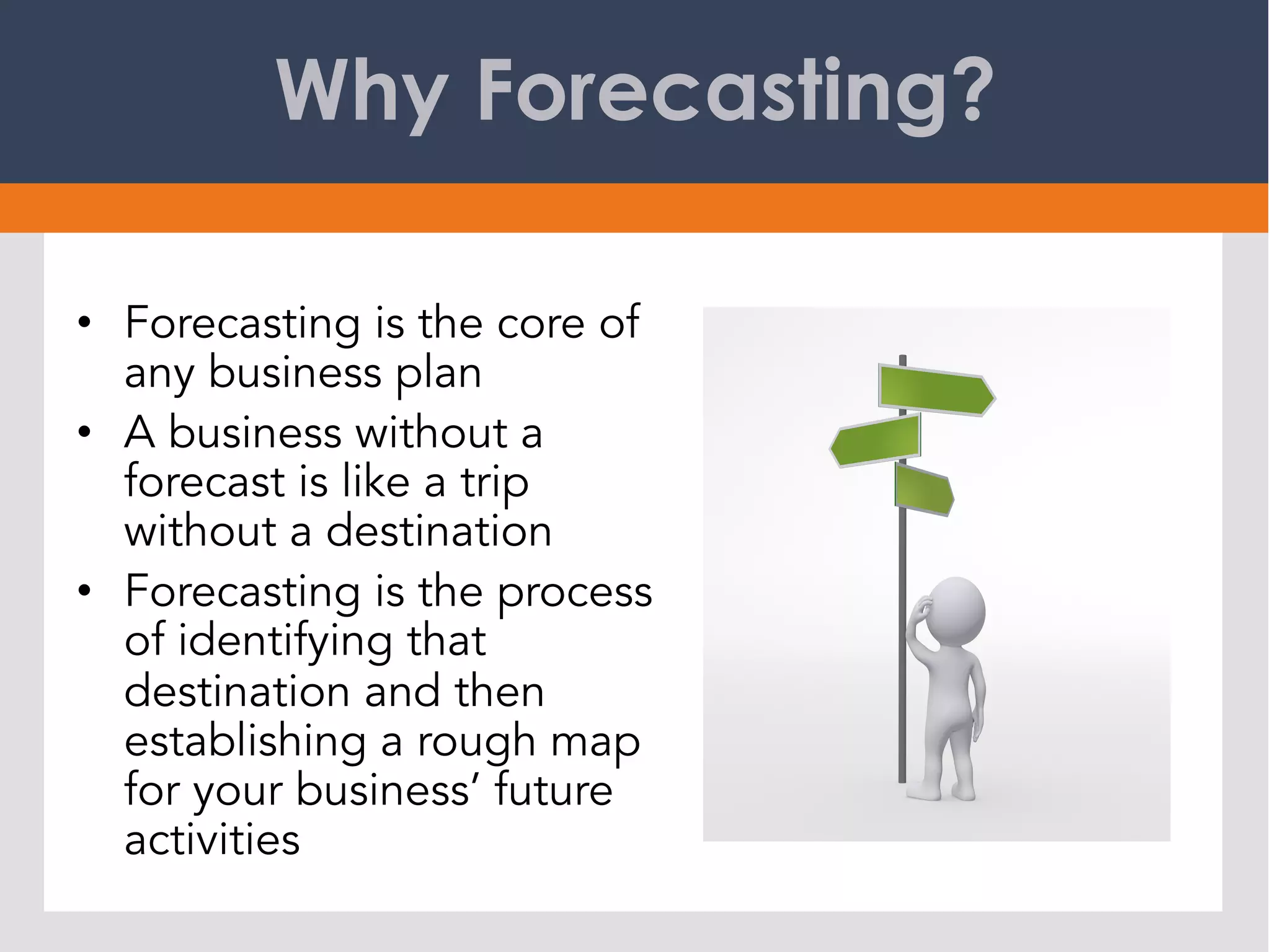
•  A business without a
forecast is like a trip
without a destination
•  Forecasting is the process
of identifying that
destination and then
establishing a rough map
for your business’ future
activities
Why Forecasting?
•  Advantages of careful forecasting:
–  Attain profit targets
–  Prevent problems
–  Identify better ways to operate
–  Spark new ideas
–  Achieve your destination
Why Forecasting?
Objective
Profit & Setting Meaningful Planning Objectives
•  Systematic approach
–  Carefully reasoned assumptions
–  Evaluating business practices
–  Conscious planning and forethought
•  The final product of your forecasting effort is your
projected cash flow
What Is Forecasting?
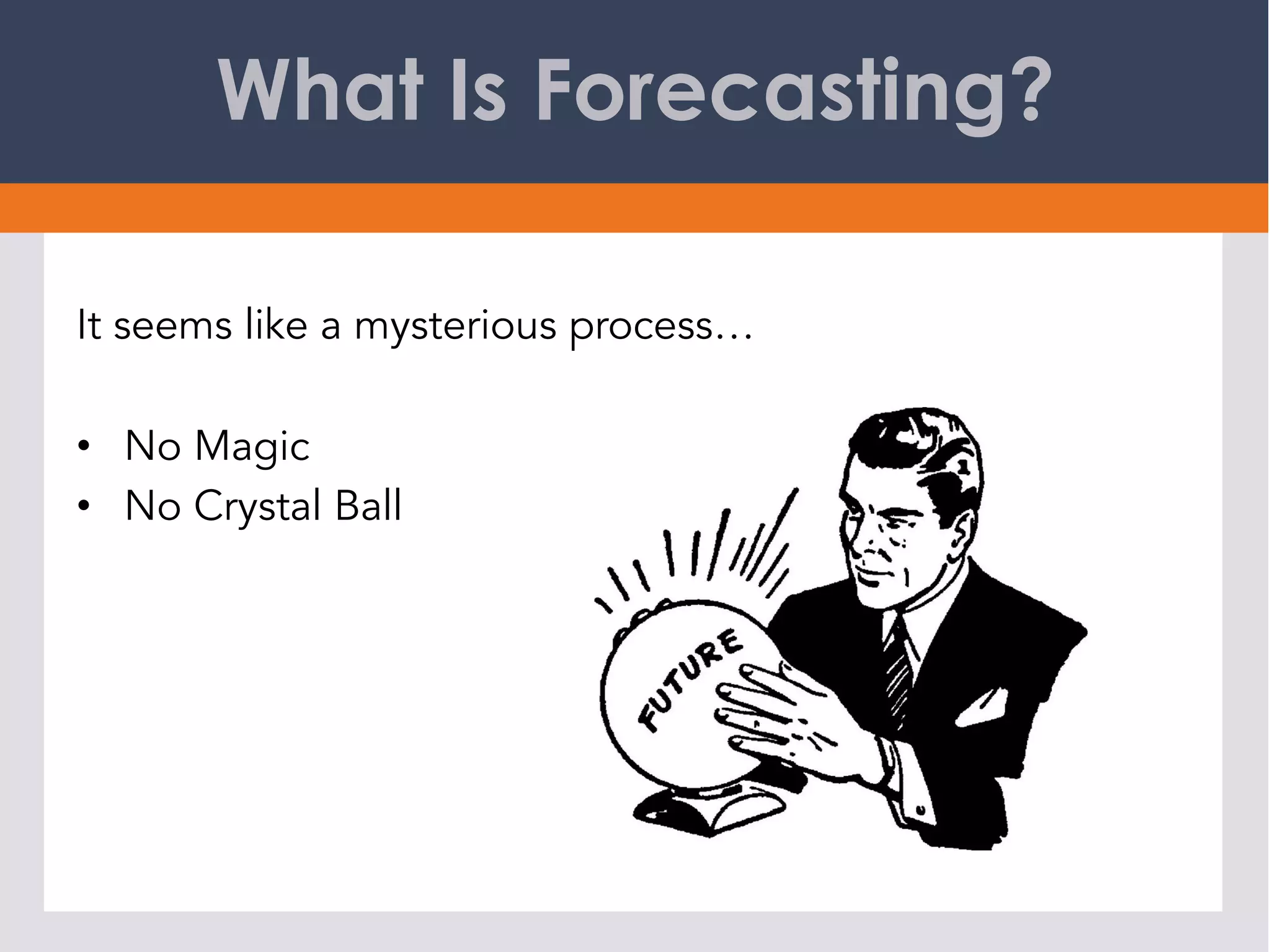
It seems like a mysterious process…
•  No Magic
•  No Crystal Ball
What Is Forecasting?
•  Careful analysis of past & current business practices
•  Extrapolation of current trends
–  Sales
–  Expenses
–  Major economic shifts such as inflation
•  Creative examination, evaluation, and revision of the
assumptions you use to operate your business
Analysis takes time – invest the time for a more
profitable future.
Forecasting – The Seven Steps
1.  Identify all fixed and variable costs
2.  Determine your breakeven sales level
3.  Evaluate the odds of reaching breakeven
4.  Determine when you will reach breakeven
5.  Plot the breakeven level on a graph against two curves:
reasonable growth and pessimistic growth
6.  Translate graphs into an income forecast
7.  Translate the income forecast into a cash flow
Step #1: Identify all Fixed and
Variable Costs
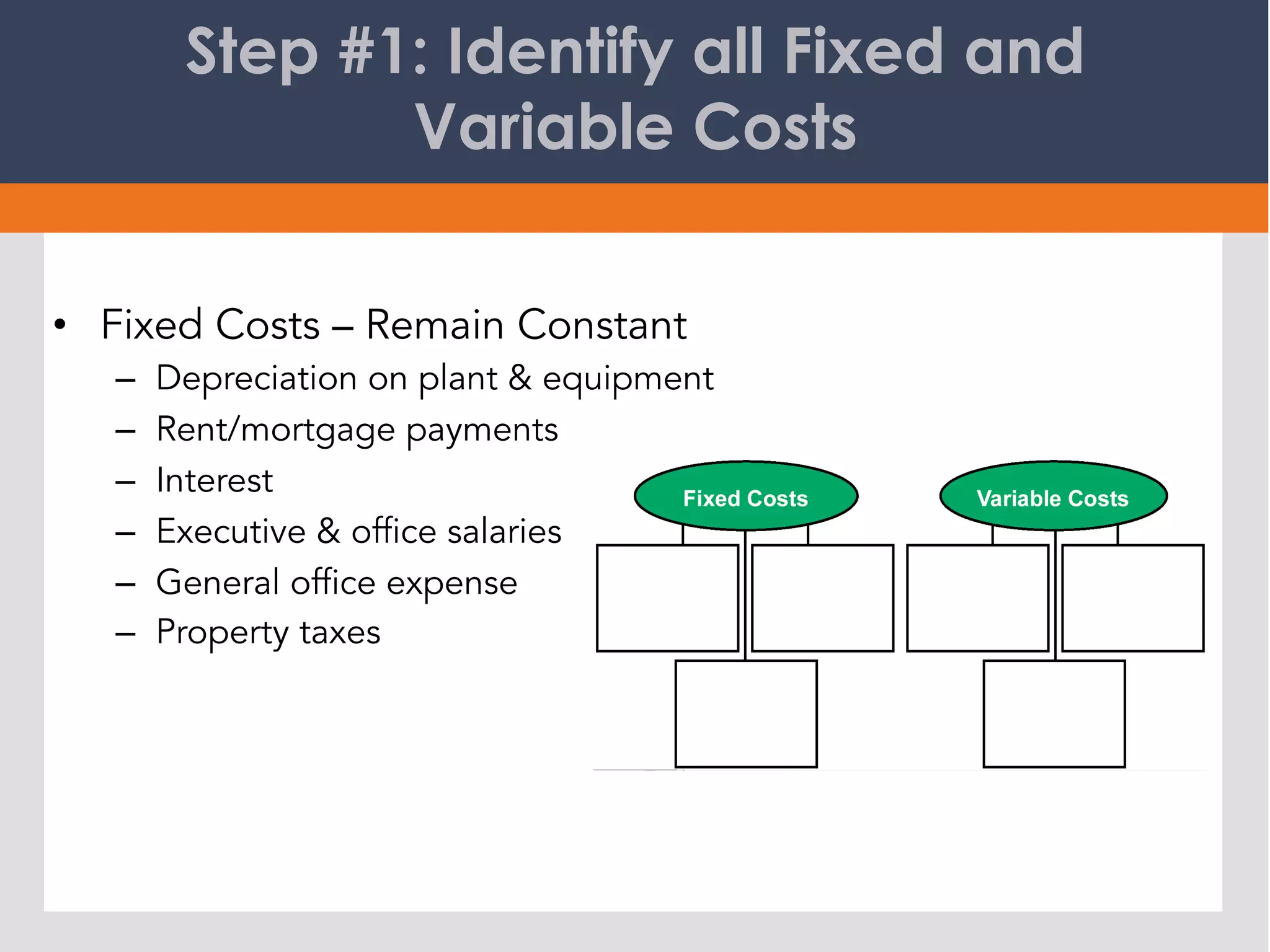
•  Fixed Costs – Remain Constant
–  Depreciation on plant & equipment
–  Rent/mortgage payments
–  Interest
–  Executive & office salaries
–  General office expense
–  Property taxes
Step #1: Identify all Fixed and
Variable Costs
•  Variable Costs – Change With Output
–  Cost of goods sold
–  Factory labor
–  Sales commissions
–  Material
–  Freight-in (and out)
–  Variable factory expenses
•  Heat
–  Direct labor
–  Sales expense
Step #2: Breakeven Analysis
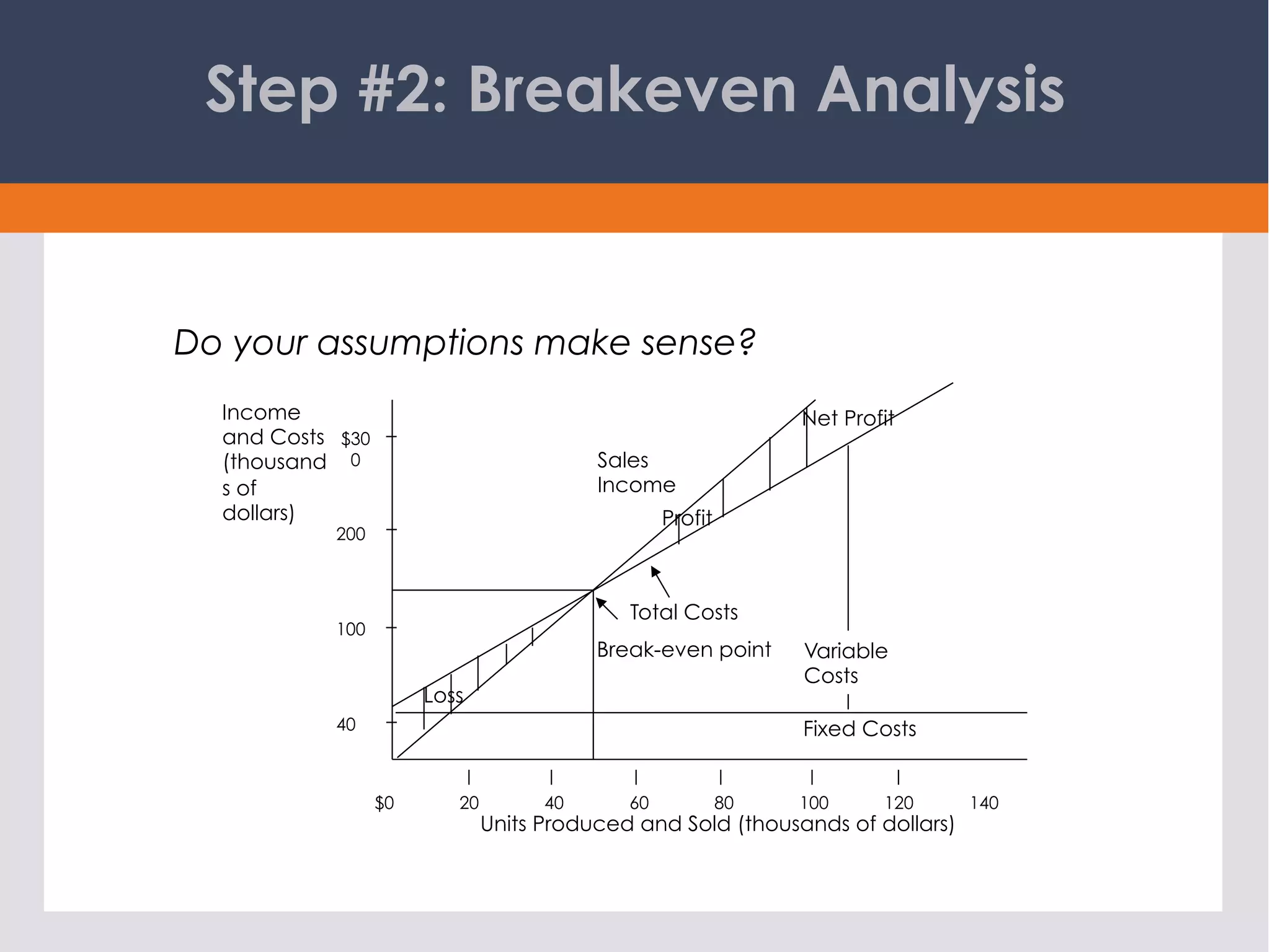
•  Breakeven refers to the level of sales necessary
to cover all of the fixed and variable costs
•  The point where the business neither makes a
profit or a loss
•  Increased sales do not necessarily mean
increased profit
–  If the selling prices is reduced to stimulate sales, the breakeven point
may be forced upward
–  The business could never achieve sufficient sales to break even
Step #2: Breakeven Analysis
•  Breakeven Analysis:
–  A planning tool
–  A decision tool
–  A pricing tool
–  An expense tool
Step #2: Breakeven Analysis
KEY:
FC = Total Fixed Costs in Dollars
VC = Total Variable Costs in Dollars
S = Total Sales in Dollars
GM = Gross Margin
GP = Gross Profit (or Sales minus Variable Costs
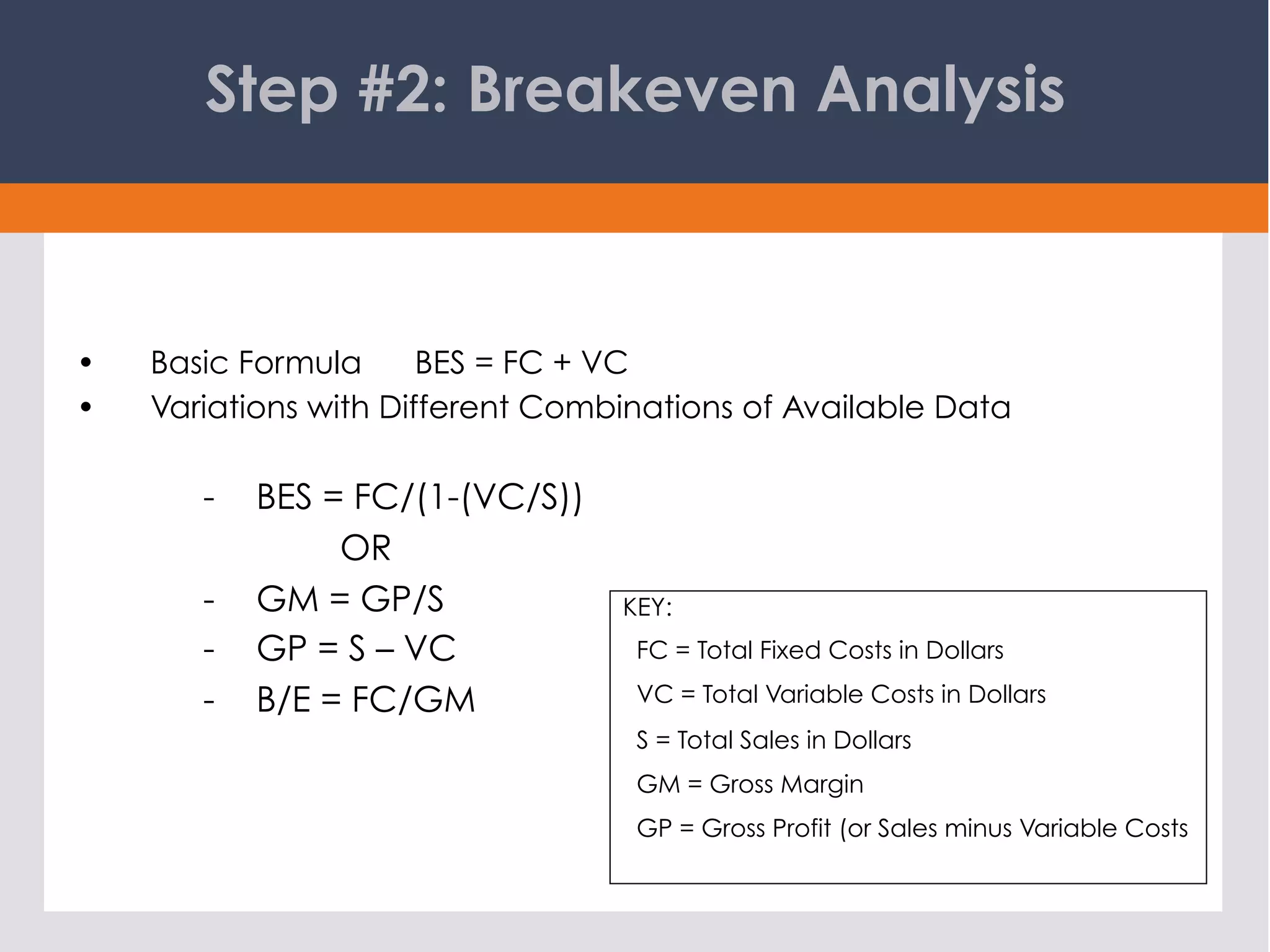
•  Basic Formula BES = FC + VC
•  Variations with Different Combinations of Available Data
-  BES = FC/(1-(VC/S))
OR
-  GM = GP/S
-  GP = S – VC
-  B/E = FC/GM
Step #2: Breakeven Analysis
Total Costs
Break-even point
Net Profit
40
200
$30
0
100
$0 20 40 60 80 120100 140
Loss
Sales
Income
Profit
Variable
Costs
Fixed Costs
Income
and Costs
(thousand
s of
dollars)
Units Produced and Sold (thousands of dollars)
Do your assumptions make sense?
Step #3: Evaluate the Odds of
Reaching Breakeven
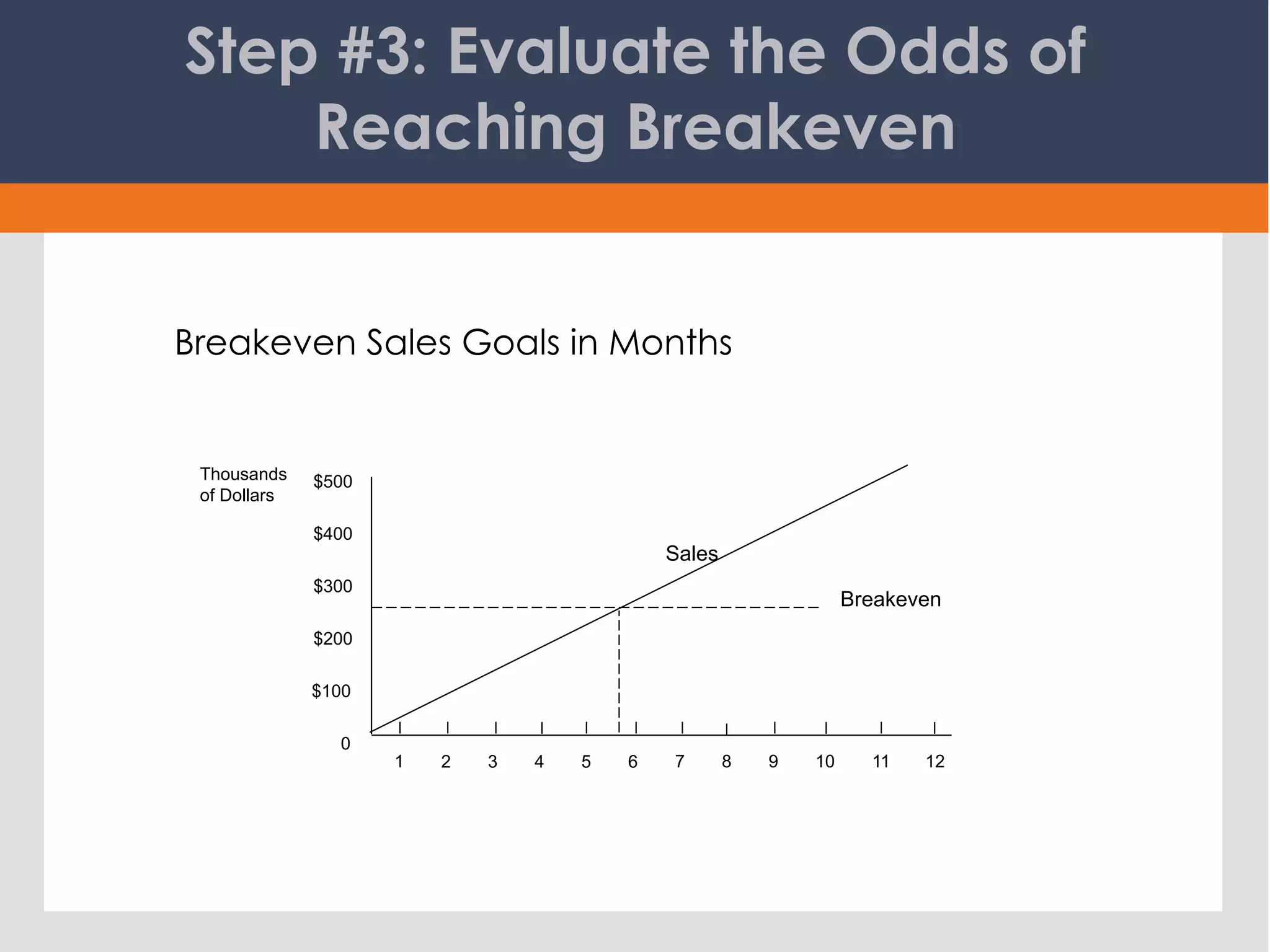
Breakeven Sales Goals in Months
1 2 53 4 6 7 8 9 10 11 12
Breakeven
0
$100
$200
$300
$400
$500
Sales
Thousands
of Dollars
Step #4: When Will You Reach
Breakeven?
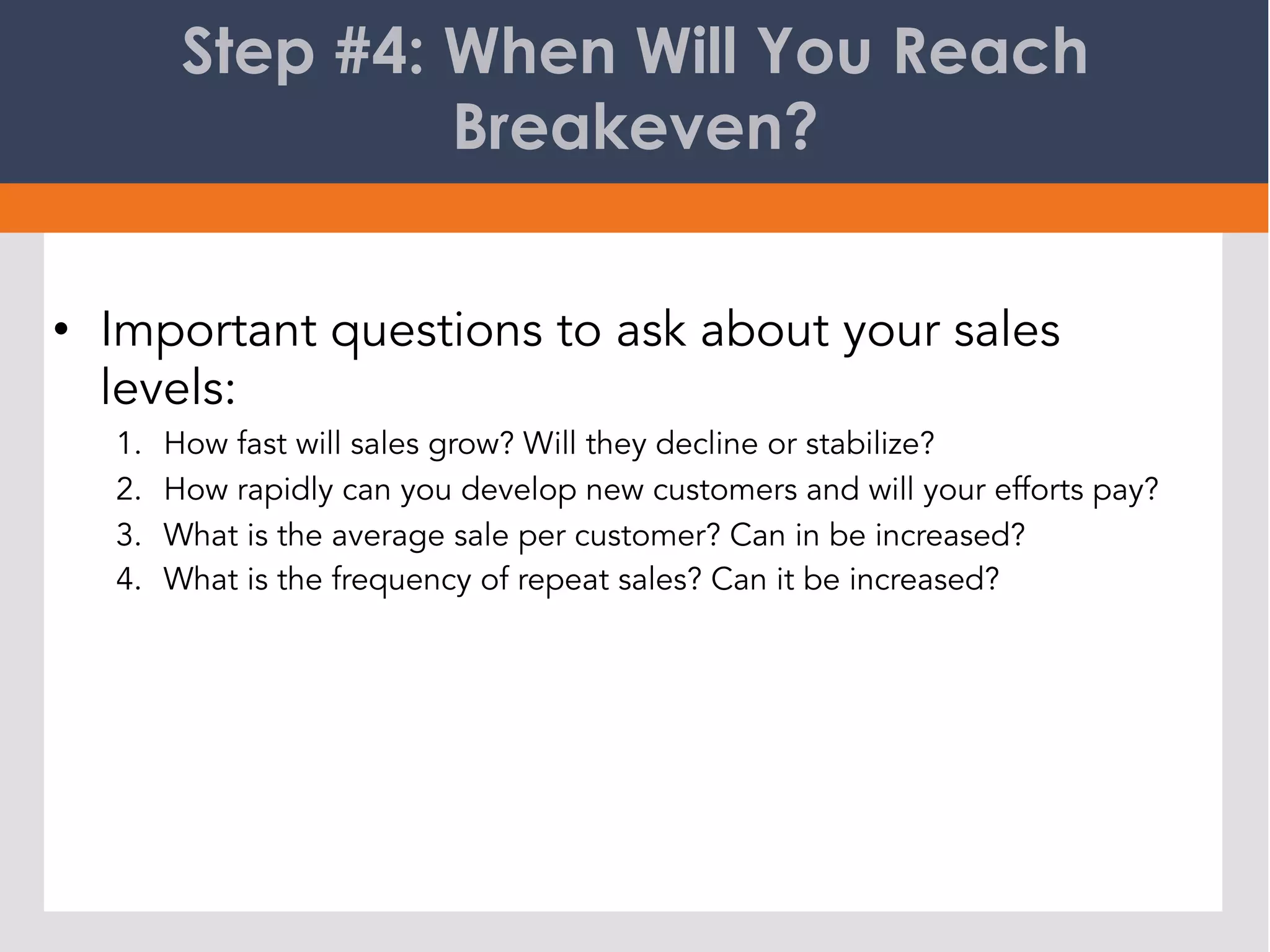
•  Important questions to ask about your sales
levels:
1.  How fast will sales grow? Will they decline or stabilize?
2.  How rapidly can you develop new customers and will your efforts pay?
3.  What is the average sale per customer? Can in be increased?
4.  What is the frequency of repeat sales? Can it be increased?
Step #4: When Will You Reach
Breakeven?
Continued… Important questions to ask about your sales levels:
5.  What is the state of the economy in general? In your
industry?
6.  Are there cyclical trends in your industry? How can they (and
how do they) affect you?
7.  What is the nature of your competition? Is it getting
stronger or declining, or is new competition entering the
market?
Step #5: Plot the breakeven level on
a graph against TWO curves
•  Reasonable growth vs. pessimistic growth
–  Curve 1 – Reasonable sales assumptions
–  Curve 2 – Worst case sales assumptions
•  The area between the two sales lines will indicate the
amount of contingency reserves you would be wise to
carry.
Step #6: Income Forecasting
•  In Step # 1, you identified your fixed and
variable expenses
•  In Steps # 2 through # 6, you experimented with
different ways of constructing sales forecasts
•  Now: Inspect the changes that you expect in
your business month by month
–  This will show the actual profit or loss to expect from
your venture
–  Becomes your projected or pro forma income
statement
Step #7: Cash Flow
•  Single most important part of the forecasting
process
•  Projected cash flow is the basis of your cash
budget
–  Shows the timing of cash flows
–  Enables you to ensure adequate cash reserves and
working capital
•  Profitability does not necessarily equal liquidity
–  Some ventures making profits go out of business
because they run out of cash
–  Anticipate problems and plan strategies in advance
Forecasting
~ Q & A ~

Propel forecasting

  • 2.
    Forecasting •  Why Forecasting? • What is Forecasting? •  The 7 Steps of Forecasting •  Calculating Breakeven •  Breakeven Chart
  • 3.
    Why Forecasting? •  Forecastingis the core of any business plan •  A business without a forecast is like a trip without a destination •  Forecasting is the process of identifying that destination and then establishing a rough map for your business’ future activities
  • 4.
    Why Forecasting? •  Advantagesof careful forecasting: –  Attain profit targets –  Prevent problems –  Identify better ways to operate –  Spark new ideas –  Achieve your destination
  • 5.
    Why Forecasting? Objective Profit &Setting Meaningful Planning Objectives •  Systematic approach –  Carefully reasoned assumptions –  Evaluating business practices –  Conscious planning and forethought •  The final product of your forecasting effort is your projected cash flow
  • 6.
    What Is Forecasting? Itseems like a mysterious process… •  No Magic •  No Crystal Ball
  • 7.
    What Is Forecasting? • Careful analysis of past & current business practices •  Extrapolation of current trends –  Sales –  Expenses –  Major economic shifts such as inflation •  Creative examination, evaluation, and revision of the assumptions you use to operate your business Analysis takes time – invest the time for a more profitable future.
  • 8.
    Forecasting – The SevenSteps 1.  Identify all fixed and variable costs 2.  Determine your breakeven sales level 3.  Evaluate the odds of reaching breakeven 4.  Determine when you will reach breakeven 5.  Plot the breakeven level on a graph against two curves: reasonable growth and pessimistic growth 6.  Translate graphs into an income forecast 7.  Translate the income forecast into a cash flow
  • 9.
    Step #1: Identifyall Fixed and Variable Costs •  Fixed Costs – Remain Constant –  Depreciation on plant & equipment –  Rent/mortgage payments –  Interest –  Executive & office salaries –  General office expense –  Property taxes
  • 10.
    Step #1: Identifyall Fixed and Variable Costs •  Variable Costs – Change With Output –  Cost of goods sold –  Factory labor –  Sales commissions –  Material –  Freight-in (and out) –  Variable factory expenses •  Heat –  Direct labor –  Sales expense
  • 11.
    Step #2: BreakevenAnalysis •  Breakeven refers to the level of sales necessary to cover all of the fixed and variable costs •  The point where the business neither makes a profit or a loss •  Increased sales do not necessarily mean increased profit –  If the selling prices is reduced to stimulate sales, the breakeven point may be forced upward –  The business could never achieve sufficient sales to break even
  • 12.
    Step #2: BreakevenAnalysis •  Breakeven Analysis: –  A planning tool –  A decision tool –  A pricing tool –  An expense tool
  • 13.
    Step #2: BreakevenAnalysis KEY: FC = Total Fixed Costs in Dollars VC = Total Variable Costs in Dollars S = Total Sales in Dollars GM = Gross Margin GP = Gross Profit (or Sales minus Variable Costs •  Basic Formula BES = FC + VC •  Variations with Different Combinations of Available Data -  BES = FC/(1-(VC/S)) OR -  GM = GP/S -  GP = S – VC -  B/E = FC/GM
  • 14.
    Step #2: BreakevenAnalysis Total Costs Break-even point Net Profit 40 200 $30 0 100 $0 20 40 60 80 120100 140 Loss Sales Income Profit Variable Costs Fixed Costs Income and Costs (thousand s of dollars) Units Produced and Sold (thousands of dollars) Do your assumptions make sense?
  • 15.
    Step #3: Evaluatethe Odds of Reaching Breakeven Breakeven Sales Goals in Months 1 2 53 4 6 7 8 9 10 11 12 Breakeven 0 $100 $200 $300 $400 $500 Sales Thousands of Dollars
  • 16.
    Step #4: WhenWill You Reach Breakeven? •  Important questions to ask about your sales levels: 1.  How fast will sales grow? Will they decline or stabilize? 2.  How rapidly can you develop new customers and will your efforts pay? 3.  What is the average sale per customer? Can in be increased? 4.  What is the frequency of repeat sales? Can it be increased?
  • 17.
    Step #4: WhenWill You Reach Breakeven? Continued… Important questions to ask about your sales levels: 5.  What is the state of the economy in general? In your industry? 6.  Are there cyclical trends in your industry? How can they (and how do they) affect you? 7.  What is the nature of your competition? Is it getting stronger or declining, or is new competition entering the market?
  • 18.
    Step #5: Plotthe breakeven level on a graph against TWO curves •  Reasonable growth vs. pessimistic growth –  Curve 1 – Reasonable sales assumptions –  Curve 2 – Worst case sales assumptions •  The area between the two sales lines will indicate the amount of contingency reserves you would be wise to carry.
  • 19.
    Step #6: IncomeForecasting •  In Step # 1, you identified your fixed and variable expenses •  In Steps # 2 through # 6, you experimented with different ways of constructing sales forecasts •  Now: Inspect the changes that you expect in your business month by month –  This will show the actual profit or loss to expect from your venture –  Becomes your projected or pro forma income statement
  • 20.
    Step #7: CashFlow •  Single most important part of the forecasting process •  Projected cash flow is the basis of your cash budget –  Shows the timing of cash flows –  Enables you to ensure adequate cash reserves and working capital •  Profitability does not necessarily equal liquidity –  Some ventures making profits go out of business because they run out of cash –  Anticipate problems and plan strategies in advance
  • 21.