INTRODUCTION
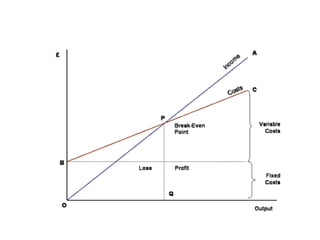
• The break-even point is the point at which
revenue is exactly equal to costs. At this point,
no profit is made and no losses are incurred.
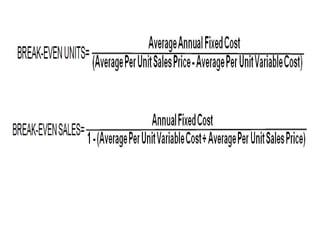
• The break-even point can be expressed in
terms of unit sales
• That is, the break-even units indicate the level
of sales that are required to cover costs. Sales
above that number result in profit and sales
below that number result in a loss.
BREAK-EVEN ANALYSIS IS BASED ON
TWO TYPES OF COSTS:
Fixed costs
Variable costs
FIXED COSTS:-
• Fixed costs are those business costs that are not
directly related to the level of production or
output.
• In other words, even if the business has a zero
output or high output, the level of fixed costs will
remain broadly the same.
• In the long term fixed costs can alter - perhaps as
a result of investment in production capacity (e.g.
adding a new factory unit) or through the growth
in overheads required to support a larger, more
complex business.
EXAMPLES OF FIXED COSTS:
Rent and rates
Depreciation
Research and Development
Marketing costs (non- revenue related)
Administration costs
VARIABLE COSTS:-
• Variable costs are those costs which vary
directly with the level of output.
• They represent payment output-related inputs
such as raw materials, direct labour, fuel and
revenue-related costs such as commission.
IMPORTANCE:-
• Break-even analysis can be very helpful in the
evaluation of a new venture.
• Many new enterprises and products actually operate at
a loss (at a point below break-even) in the early stages
of development.
• Knowing the price or volume necessary to break-even
is critical to evaluating the time-frame in which losses
are permissible.
• The break-even is also an excellent benchmark by
which a company’s short-term goals can be
measured/tracked.
• It also keeps a focus on the connection between
production and marketing.

Break even analysis

  • 1.
    INTRODUCTION • The break-evenpoint is the point at which revenue is exactly equal to costs. At this point, no profit is made and no losses are incurred. • The break-even point can be expressed in terms of unit sales • That is, the break-even units indicate the level of sales that are required to cover costs. Sales above that number result in profit and sales below that number result in a loss.
  • 3.
    BREAK-EVEN ANALYSIS ISBASED ON TWO TYPES OF COSTS: Fixed costs Variable costs
  • 4.
    FIXED COSTS:- • Fixedcosts are those business costs that are not directly related to the level of production or output. • In other words, even if the business has a zero output or high output, the level of fixed costs will remain broadly the same. • In the long term fixed costs can alter - perhaps as a result of investment in production capacity (e.g. adding a new factory unit) or through the growth in overheads required to support a larger, more complex business.
  • 5.
    EXAMPLES OF FIXEDCOSTS: Rent and rates Depreciation Research and Development Marketing costs (non- revenue related) Administration costs
  • 6.
    VARIABLE COSTS:- • Variablecosts are those costs which vary directly with the level of output. • They represent payment output-related inputs such as raw materials, direct labour, fuel and revenue-related costs such as commission.
  • 8.
    IMPORTANCE:- • Break-even analysiscan be very helpful in the evaluation of a new venture. • Many new enterprises and products actually operate at a loss (at a point below break-even) in the early stages of development. • Knowing the price or volume necessary to break-even is critical to evaluating the time-frame in which losses are permissible. • The break-even is also an excellent benchmark by which a company’s short-term goals can be measured/tracked. • It also keeps a focus on the connection between production and marketing.