• A transfer is the safe movement of the patient from one place
to another, like from eg. bed to wheelchair and by the used of
assistive devices, But the active participation from patient side
is also important.
• There are many methods of transfer, Depends upon the
patients disability and capability of performing task.
• Transfer activity becomes more challenging in patients with
high spinal cord injury.
Dependent transfers
• The patient does not participate actively, or
• only very minimally and the clinician(s)
• perform all aspects of the transfer
Assisted transfers
• The patient actively participates, but also
• requires assistance by a clinician(s).
Independent transfers
• The patient consistently performs all aspects
of the transfer, including setup, in a safe manner and without
assistance.
• Stand-by assist (supervision)
• Close guarding
• Contact guarding
• Minimal assist
• Moderate assist
• Maximal assist
• Plan the activity
• Maintain neutral spine
• Brace abdominals, keep head and shoulders up
• Get as close to patient as possible
• Get help or assistive equipment whenever
possible
• Pivot or side step-Do Not Twist
• Make sure path is clear
• Properly position chair/bed/equipment
• Transfer patient to stronger side unless otherwise
instructed
• Bend your knees, use your legs when lifting. Do not
lift with straight legs
• Have the patient assist you as much as possible.
Know their status
• Provide clear directions and PROPER COMMAND
to patient on what you are about to do, and their role
assisting.
• Use a draw sheet for bed mobility if patient can only
minimally assist.
• Adjust the bed to make transfers easier
• Communication
• Cognition
• Medical Status
• Physical Status
• Emotional and Behavioral Status
• Environment
• Equipment
The Therapist must assess the patient’s ability
or inability to communicate.
The risk of injury increases if the patient:
Does not speak/understand the same
• language of the therapist
• Does not understand speech
• Does not understand non-verbal communication
• Can not follow simple commands
• Communicates with sign language
• assistive communication devices
• Has a hearing impairment
• Has a speech problem
• Has a low level of consciousness
• Often hospitalized patients have an altered level
of cognition affecting their ability to participate in
lifts/transfers.
• Short term memory loss, poor judgment, and
difficulty making decisions can all be
manifestations of altered cognition.
• Questions testing the short term memory can
often give some indication of the level of
• Signs and symptoms of various medical conditions
can impact on a patient’s ability to transfer i.e. the
tremors and movement initiation problems
associated with Parkinson’s disease.
• Medications can also affect the patient’s ability to
transfer. Fatigue, pain and stiffness will affect the
quality of the transfer.
• The medical status can change Dramatically during
a shift and caregivers need to observe these
changes and Modify the lift/transfer as necessary.
A physical assessment should
include:
• Weight bearing status
• Weight
• Height
• Range of motion (ROM)
• Strength
Balance
Coordination
Sensation
Clothing
Footwear
• Anxiety
• Aggression
• Agitation
• Combativeness
• Confusion
• Depression
• Hostility
• Impulsiveness
Therapist Must be aware of patients psychological
status it may, change throughout the day.
• Low tolerance
• Low self esteem
• Rejection
• Resistive
• Self Destructive
• Unpredictable
• Layout
• Space
• Lighting
• Colour
• Temperature
• Obstacles
• Floor
Draw sheets
Slider sheets
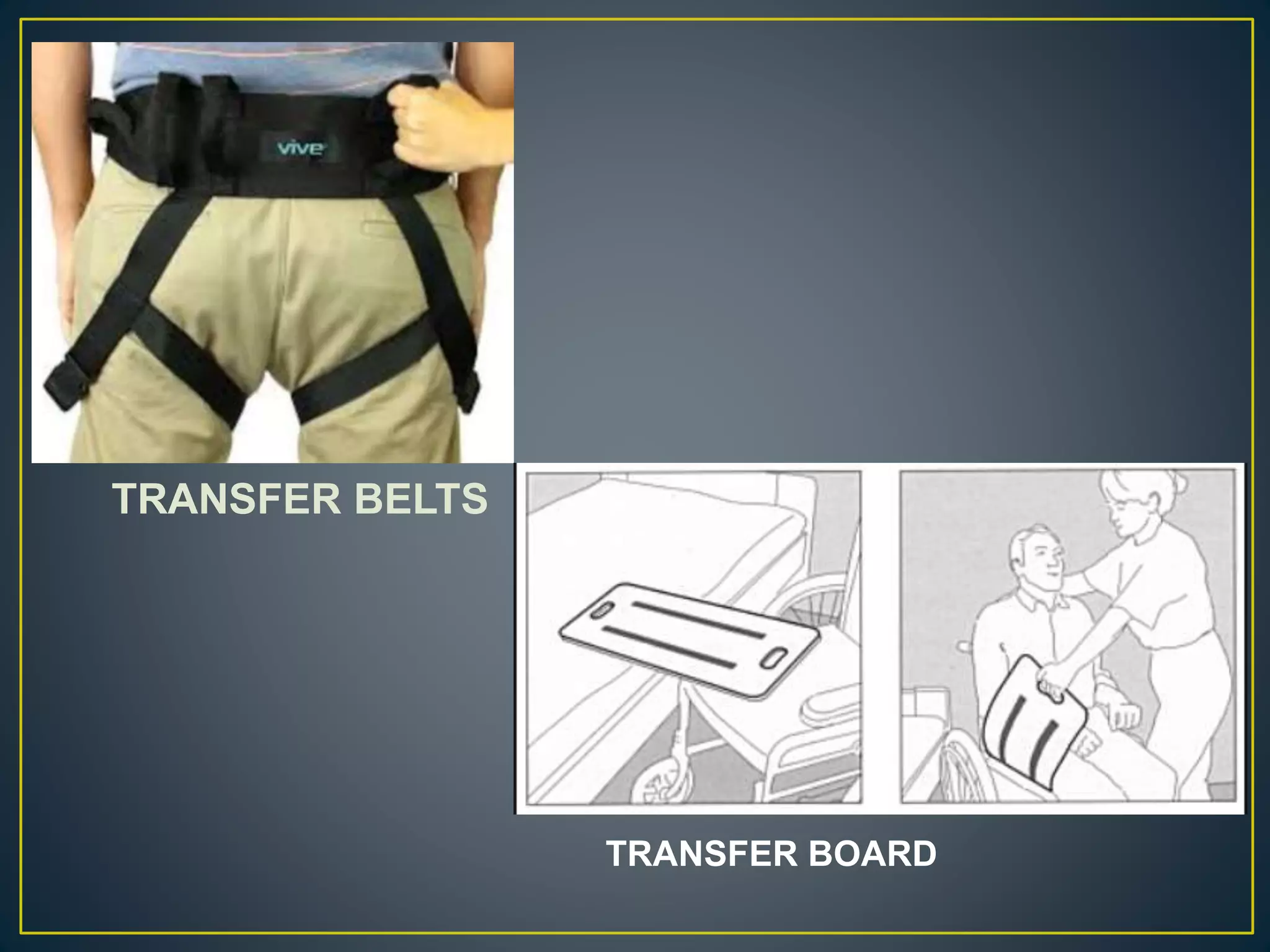
TRANSFER BELTS
SLIDE/TRANSFER BOARDS
SMALLER SLIDE/TRANSFER BOARDS
TURNING DISCS
Draw sheet
Slider
TRANSFER BELTS
TRANSFER BOARD
SLIDER BOARD
TURNING DISK
• Independent
• One or Two person
• Supine to sit
• Stand Pivot
• Slide board
• Mechanical lift
• Slide Sheet
• Bathroom: commode or tub transfers
• Put the head of the bed down and adjust the top of the
bed to waist- or hip level of the shorter person.
• Grasp the draw sheet pointing on foot in the direction
you’re moving the patient
• Lean in the direction of the move, using your legs and
body weight.
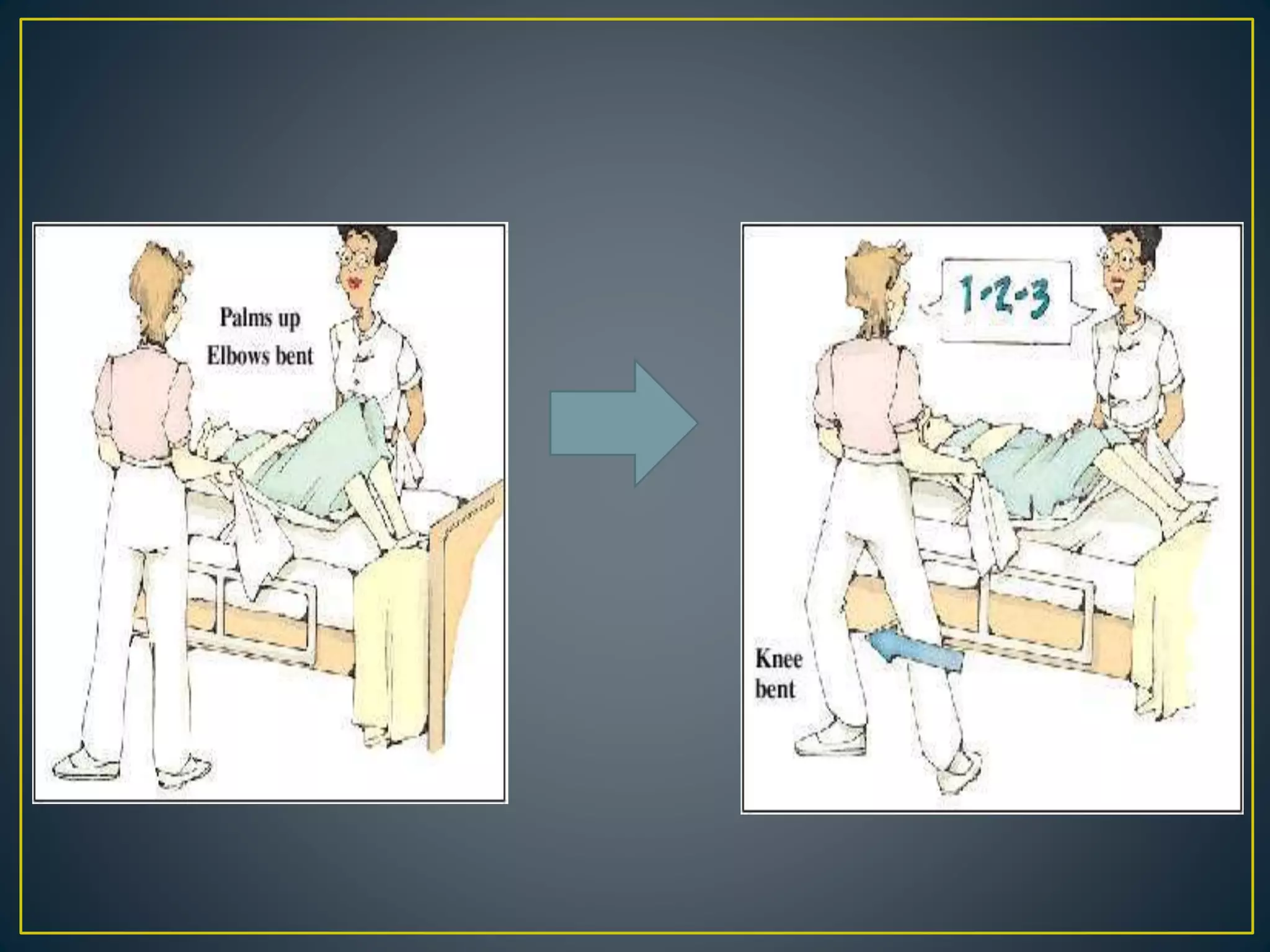
• On the count of three, lift and pull the patient up. Repeat
this step as many times as needed to position the patient.
• Also, patients can bend their knees, push down with their
feet, and pull up
• Put the bed rail and head of the bed down;
adjust the top of the bed to waist- or hip-level
• Put one hand behind the patient’s far shoulder.
• Put your other hand behind the patient’s hip
• Patient safety is often the main concern when
moving patients from bed. But remember not to
lift at the expense of your own back. And, never
move a patient by yourself.
• Two people usually can do this move safely. The
leader, who pulls, should be the stronger of the
two. The helper holds the draw-sheet, neither
pushing nor lifting
1.Prepare to Move
• Put the head of the bed down and adjust the bed height.
• Move the patient’s legs closer to the edge of the bed
Instruct patient to cross arms across chest and explain
move to patient
2. Pull to Edge of Bed
• Grasp the draw-sheet on both sides of the bed. On the
count of three, lean back and shift your weight, sliding
the patient to the edge of the bed. The helper holds the
sheet, keeping it from slipping
3.Position Stretcher
• Adjust the bed to be slightly higher than the stretcher.
Then, position the stretcher, locking it in place. Move the
patient’s legs onto the stretcher
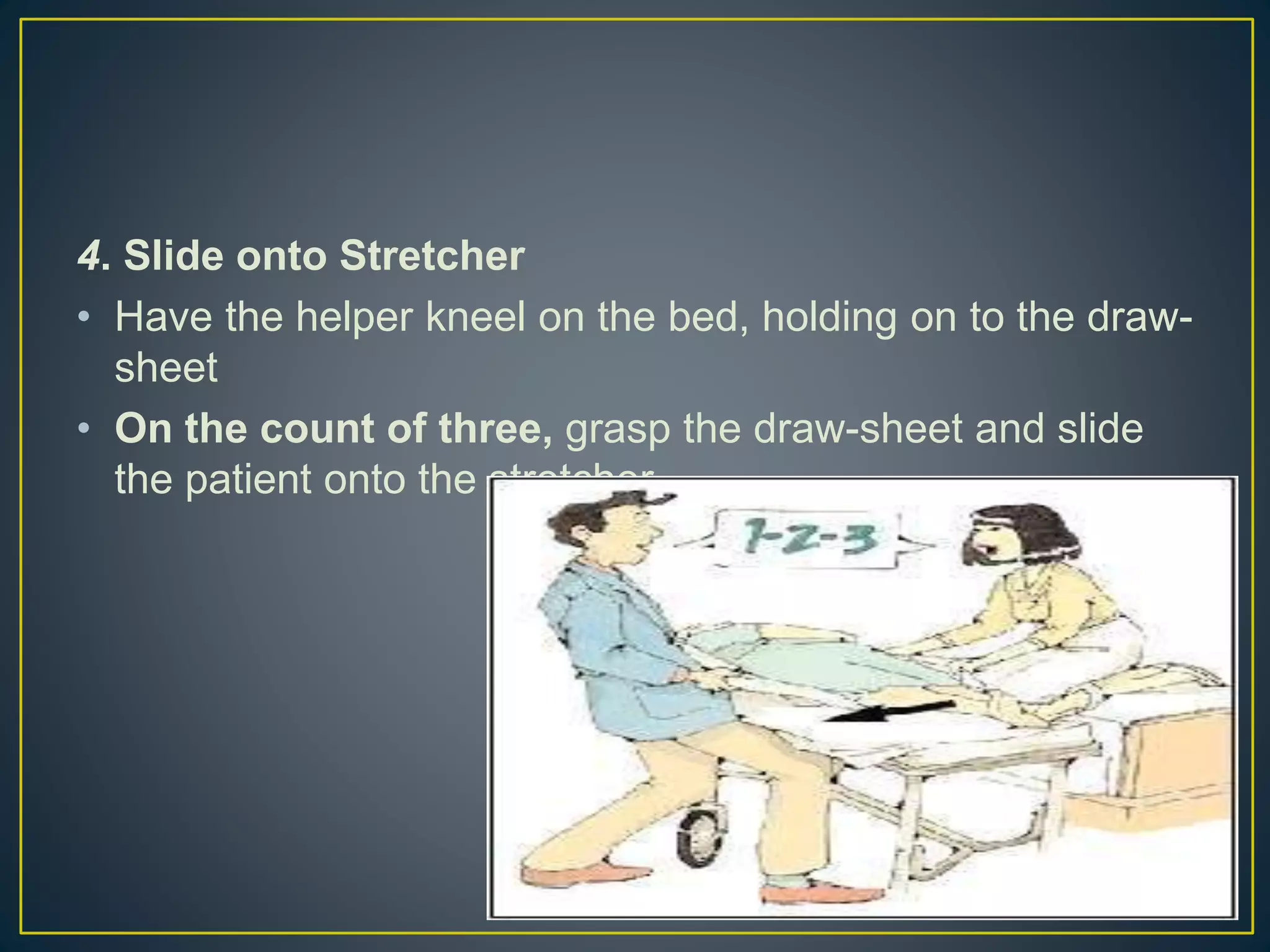
4. Slide onto Stretcher
• Have the helper kneel on the bed, holding on to the draw-
sheet
• On the count of three, grasp the draw-sheet and slide
the patient onto the stretcher
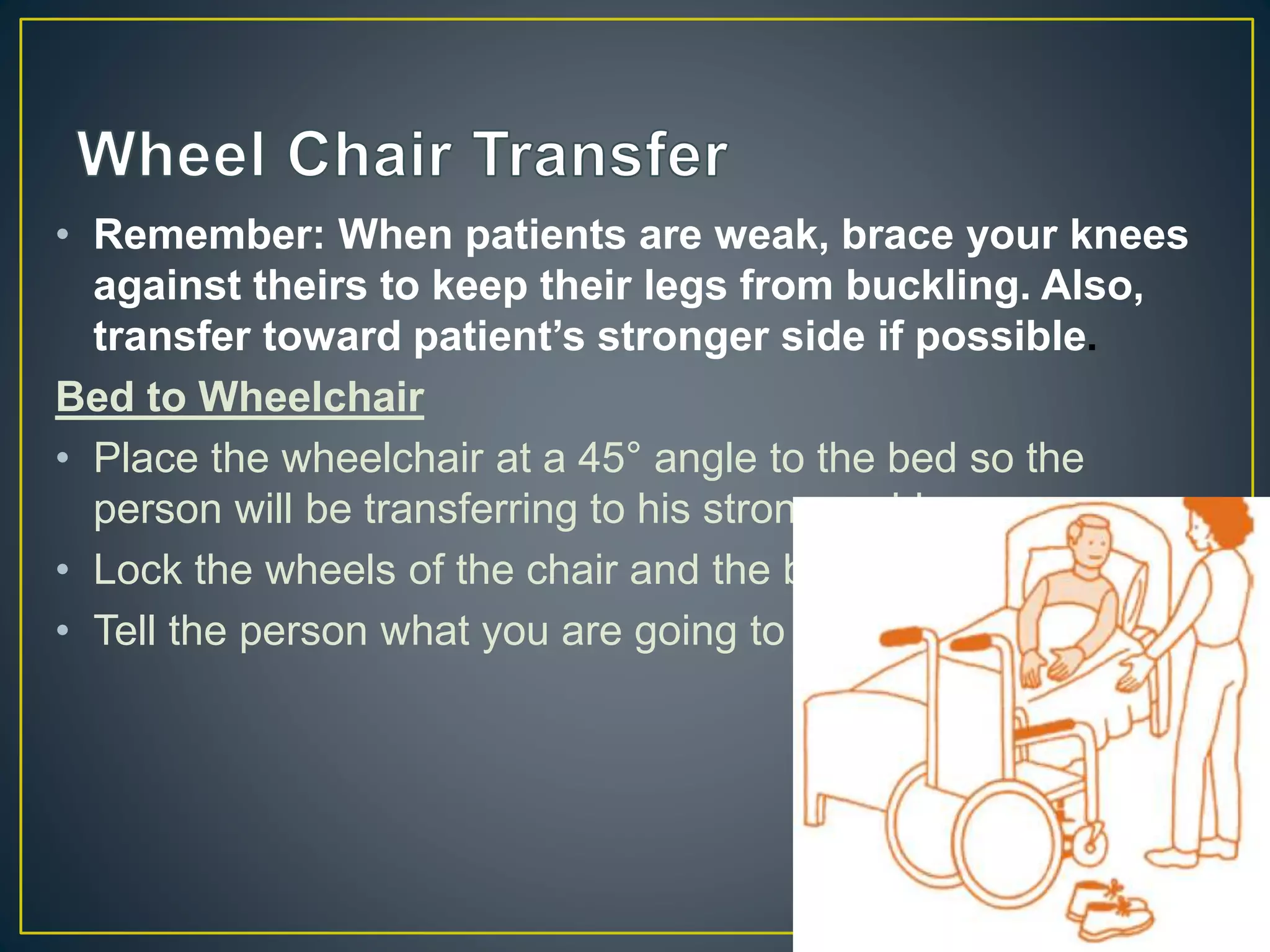
• Remember: When patients are weak, brace your knees
against theirs to keep their legs from buckling. Also,
transfer toward patient’s stronger side if possible.
Bed to Wheelchair
• Place the wheelchair at a 45° angle to the bed so the
person will be transferring to his stronger side.
• Lock the wheels of the chair and the bed.
• Tell the person what you are going to do.
• Bring him to a sitting position with his legs over the edge
of the bed
• Let him rest a moment if he feels dizzy
• Put his shoes on if possible
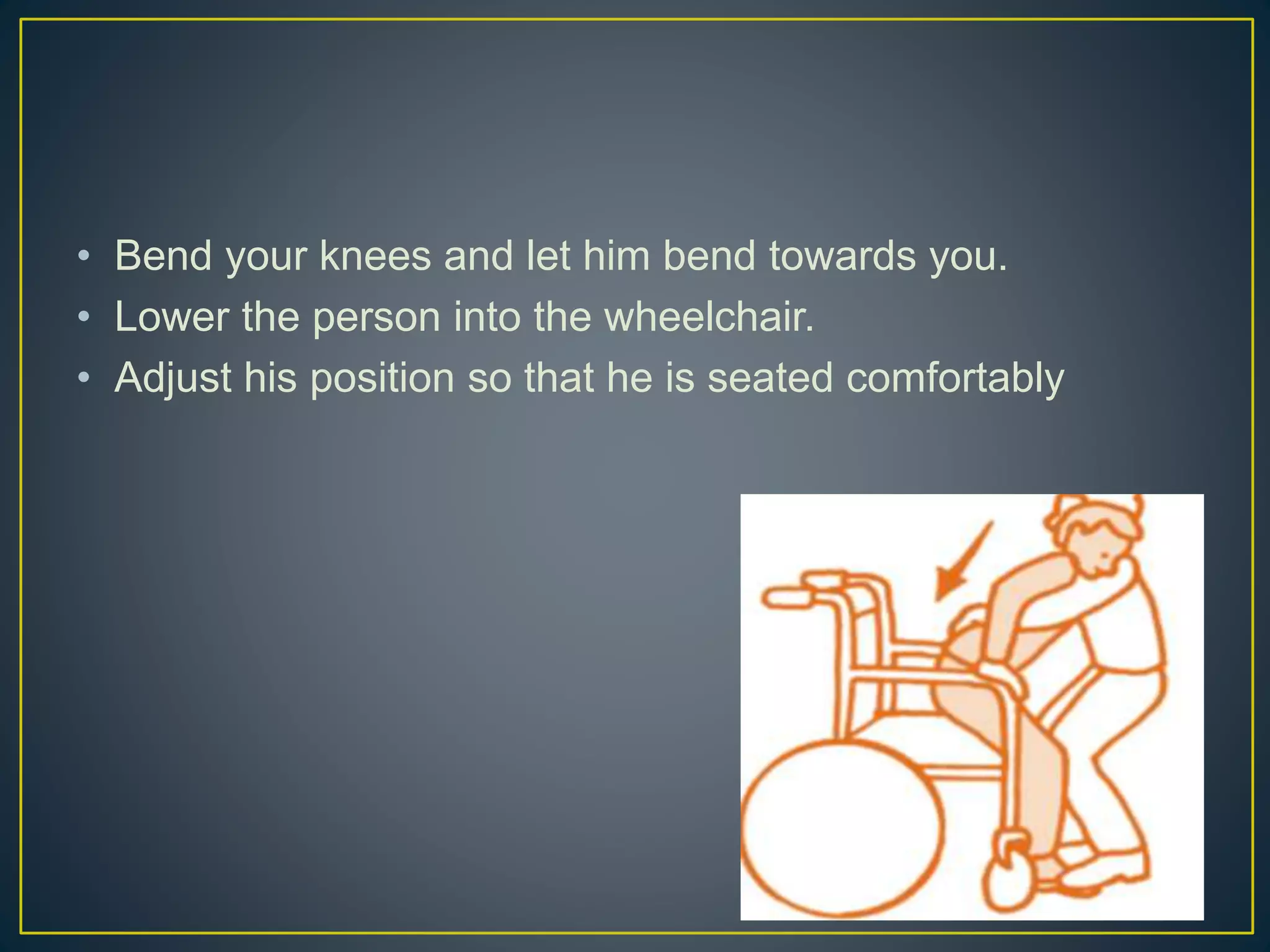
• Put your arms around his chest and hold your hands
together behind his back.
• Support the leg that is farther from the wheelchair
between your legs.
• Pivot your body towards the chair.
• Bend your knees and let him bend towards you.
• Lower the person into the wheelchair.
• Adjust his position so that he is seated comfortably
1. Try to adjust the bed and the chair to the same height if
possible.
2. Place the wheelchair at a 45° angle to the bed so that
the person will be transferring to his stronger side.
3. Lock the wheels of the chair and bed, or use a wheel
block.
4. Tell the person what you are going to do.
5. Remove the armrest nearest the bed.
6. Remove his feet from the footrests and swing the
footrests out of the way.
7. Have the person lift his hip and place the board
under the hip with the other end of the board on the
bed. IMPORTANT: MAKE SURE THE PERSON DOESN’T
PUT HIS FINGERS UNDER THE BOARD.
8. Ask him to put his hands on the board with hands close
to his sides.
9. Ask him to lean slightly forward and make a series of
small pushes off the board by straightening his elbows, and
inching along the board towards the bed.
10. When he is on the bed, ask him to lean over onto his
elbow and pull the transfer board out from under his
bottom.
11. Adjust him comfortably in the bed
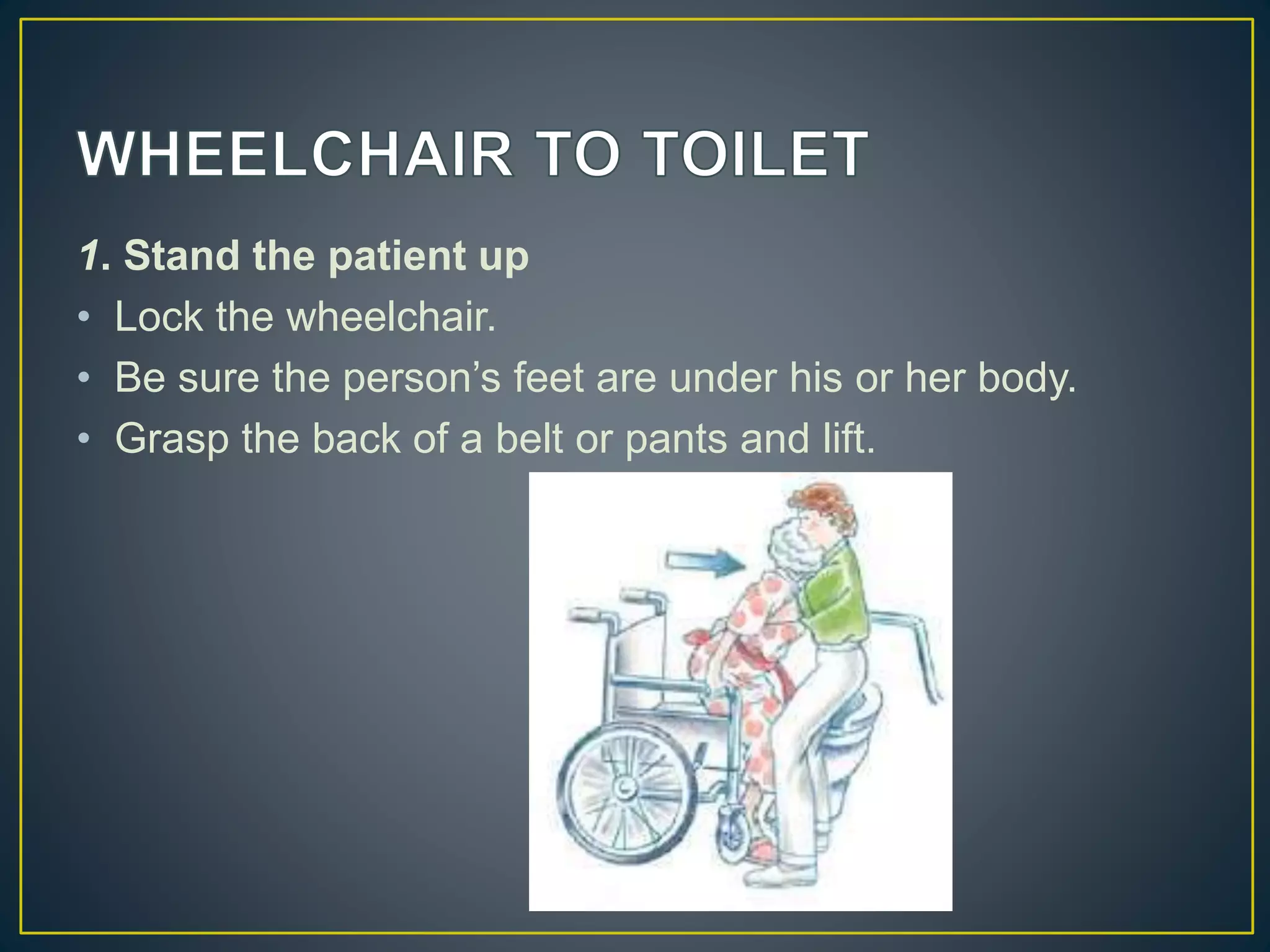
1. Stand the patient up
• Lock the wheelchair.
• Be sure the person’s feet are under his or her body.
• Grasp the back of a belt or pants and lift.
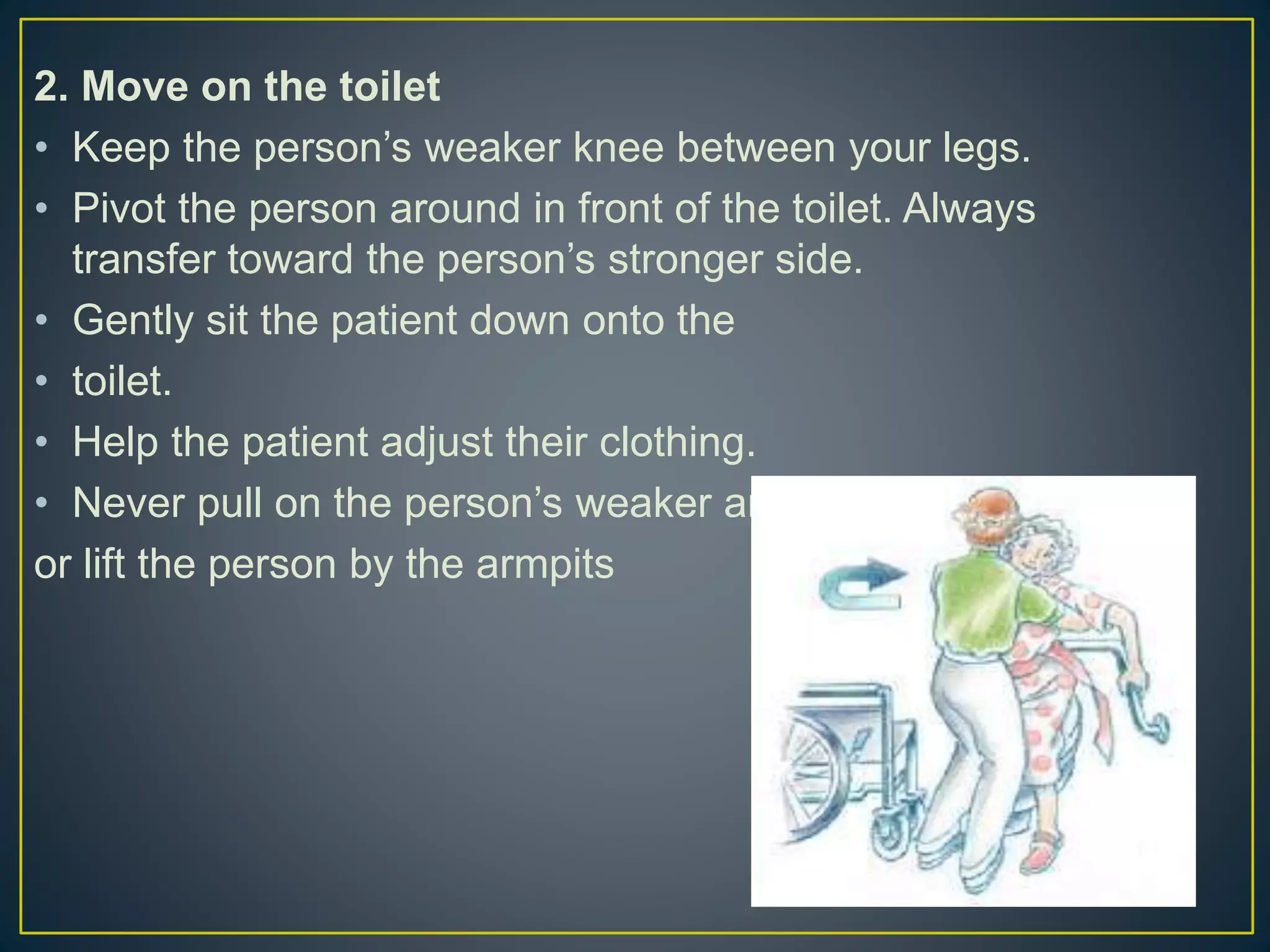
2. Move on the toilet
• Keep the person’s weaker knee between your legs.
• Pivot the person around in front of the toilet. Always
transfer toward the person’s stronger side.
• Gently sit the patient down onto the
• toilet.
• Help the patient adjust their clothing.
• Never pull on the person’s weaker arm
or lift the person by the armpits
Total Hip Replacement
Low back trauma or LBP
SCI -Spinal Cord Injury
Burns
Hemiplegia
Quadriplegia
• Subluxation occurs when the bone in your upper arm
“falls out” of the shoulder joint.
• A normal shoulder joint is held together by muscles.
These muscles may be weak on the side of the body
affected by a stroke.
• When a stroke survivor’s weak arm is pulled during
transferring, it can cause subluxation
• Proper lifting techniques and transfer training
• Proper body mechanics can greatly decrease
the risk for injury for both health care worker
and the patient
• B.A.C.K
• Back Straight
Avoid Twisting
Close to Body
Keep Smooth
Rules of Body Mechanics
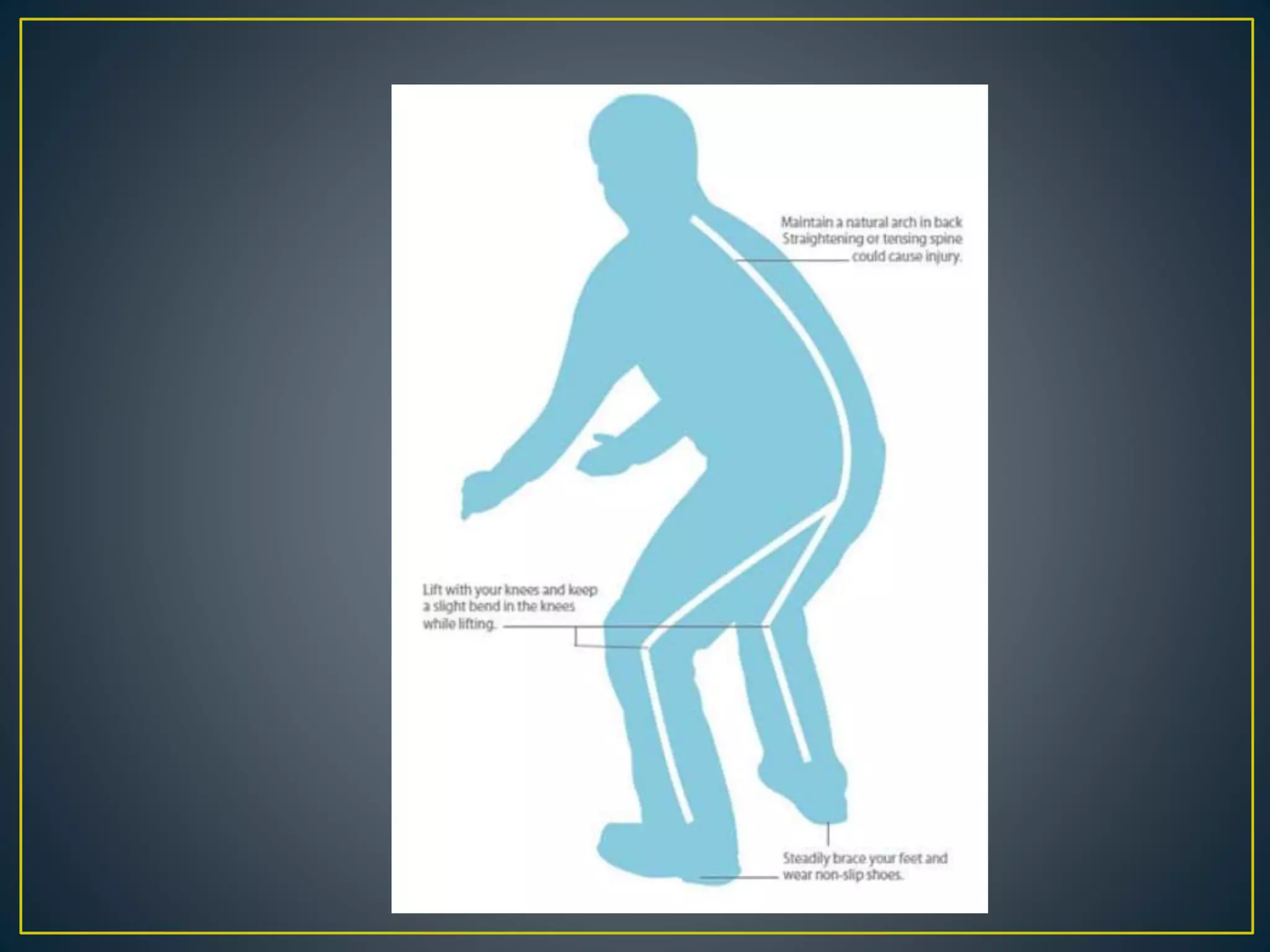
• Provide wide base of support.
• Lift from a comfortable height.
• Bend your knees and keep your back straight.
• Avoid Twisting.
• Keep Load Close to you Body. Avoid Pulling
Ref Book.
• Physical Rehab By O.Sullivan
• Body mechanics: positioning, moving and transfers by.
Silver Pages.
• Principal Of exercise therapy by.Dina Gardiner

Transfer Training in Physiotherapy

  • 2.
    • A transferis the safe movement of the patient from one place to another, like from eg. bed to wheelchair and by the used of assistive devices, But the active participation from patient side is also important. • There are many methods of transfer, Depends upon the patients disability and capability of performing task. • Transfer activity becomes more challenging in patients with high spinal cord injury.
  • 3.
    Dependent transfers • Thepatient does not participate actively, or • only very minimally and the clinician(s) • perform all aspects of the transfer Assisted transfers • The patient actively participates, but also • requires assistance by a clinician(s). Independent transfers • The patient consistently performs all aspects of the transfer, including setup, in a safe manner and without assistance.
  • 4.
    • Stand-by assist(supervision) • Close guarding • Contact guarding • Minimal assist • Moderate assist • Maximal assist
  • 5.
    • Plan theactivity • Maintain neutral spine • Brace abdominals, keep head and shoulders up • Get as close to patient as possible • Get help or assistive equipment whenever possible
  • 6.
    • Pivot orside step-Do Not Twist • Make sure path is clear • Properly position chair/bed/equipment • Transfer patient to stronger side unless otherwise instructed • Bend your knees, use your legs when lifting. Do not lift with straight legs
  • 7.
    • Have thepatient assist you as much as possible. Know their status • Provide clear directions and PROPER COMMAND to patient on what you are about to do, and their role assisting. • Use a draw sheet for bed mobility if patient can only minimally assist. • Adjust the bed to make transfers easier
  • 8.
    • Communication • Cognition •Medical Status • Physical Status • Emotional and Behavioral Status • Environment • Equipment
  • 9.
    The Therapist mustassess the patient’s ability or inability to communicate. The risk of injury increases if the patient: Does not speak/understand the same • language of the therapist • Does not understand speech • Does not understand non-verbal communication • Can not follow simple commands
  • 10.
    • Communicates withsign language • assistive communication devices • Has a hearing impairment • Has a speech problem • Has a low level of consciousness
  • 11.
    • Often hospitalizedpatients have an altered level of cognition affecting their ability to participate in lifts/transfers. • Short term memory loss, poor judgment, and difficulty making decisions can all be manifestations of altered cognition. • Questions testing the short term memory can often give some indication of the level of
  • 12.
    • Signs andsymptoms of various medical conditions can impact on a patient’s ability to transfer i.e. the tremors and movement initiation problems associated with Parkinson’s disease. • Medications can also affect the patient’s ability to transfer. Fatigue, pain and stiffness will affect the quality of the transfer. • The medical status can change Dramatically during a shift and caregivers need to observe these changes and Modify the lift/transfer as necessary.
  • 13.
    A physical assessmentshould include: • Weight bearing status • Weight • Height • Range of motion (ROM) • Strength Balance Coordination Sensation Clothing Footwear
  • 14.
    • Anxiety • Aggression •Agitation • Combativeness • Confusion • Depression • Hostility • Impulsiveness Therapist Must be aware of patients psychological status it may, change throughout the day. • Low tolerance • Low self esteem • Rejection • Resistive • Self Destructive • Unpredictable
  • 15.
    • Layout • Space •Lighting • Colour • Temperature • Obstacles • Floor
  • 16.
    Draw sheets Slider sheets TRANSFERBELTS SLIDE/TRANSFER BOARDS SMALLER SLIDE/TRANSFER BOARDS TURNING DISCS
  • 17.
  • 18.
  • 19.
  • 20.
    • Independent • Oneor Two person • Supine to sit • Stand Pivot • Slide board • Mechanical lift • Slide Sheet • Bathroom: commode or tub transfers
  • 21.
    • Put thehead of the bed down and adjust the top of the bed to waist- or hip level of the shorter person. • Grasp the draw sheet pointing on foot in the direction you’re moving the patient • Lean in the direction of the move, using your legs and body weight. • On the count of three, lift and pull the patient up. Repeat this step as many times as needed to position the patient. • Also, patients can bend their knees, push down with their feet, and pull up
  • 23.
    • Put thebed rail and head of the bed down; adjust the top of the bed to waist- or hip-level • Put one hand behind the patient’s far shoulder. • Put your other hand behind the patient’s hip
  • 24.
    • Patient safetyis often the main concern when moving patients from bed. But remember not to lift at the expense of your own back. And, never move a patient by yourself. • Two people usually can do this move safely. The leader, who pulls, should be the stronger of the two. The helper holds the draw-sheet, neither pushing nor lifting
  • 25.
    1.Prepare to Move •Put the head of the bed down and adjust the bed height. • Move the patient’s legs closer to the edge of the bed Instruct patient to cross arms across chest and explain move to patient 2. Pull to Edge of Bed • Grasp the draw-sheet on both sides of the bed. On the count of three, lean back and shift your weight, sliding the patient to the edge of the bed. The helper holds the sheet, keeping it from slipping 3.Position Stretcher • Adjust the bed to be slightly higher than the stretcher. Then, position the stretcher, locking it in place. Move the patient’s legs onto the stretcher
  • 26.
    4. Slide ontoStretcher • Have the helper kneel on the bed, holding on to the draw- sheet • On the count of three, grasp the draw-sheet and slide the patient onto the stretcher
  • 28.
    • Remember: Whenpatients are weak, brace your knees against theirs to keep their legs from buckling. Also, transfer toward patient’s stronger side if possible. Bed to Wheelchair • Place the wheelchair at a 45° angle to the bed so the person will be transferring to his stronger side. • Lock the wheels of the chair and the bed. • Tell the person what you are going to do.
  • 29.
    • Bring himto a sitting position with his legs over the edge of the bed • Let him rest a moment if he feels dizzy • Put his shoes on if possible • Put your arms around his chest and hold your hands together behind his back. • Support the leg that is farther from the wheelchair between your legs. • Pivot your body towards the chair.
  • 30.
    • Bend yourknees and let him bend towards you. • Lower the person into the wheelchair. • Adjust his position so that he is seated comfortably
  • 31.
    1. Try toadjust the bed and the chair to the same height if possible. 2. Place the wheelchair at a 45° angle to the bed so that the person will be transferring to his stronger side. 3. Lock the wheels of the chair and bed, or use a wheel block. 4. Tell the person what you are going to do. 5. Remove the armrest nearest the bed. 6. Remove his feet from the footrests and swing the footrests out of the way.
  • 32.
    7. Have theperson lift his hip and place the board under the hip with the other end of the board on the bed. IMPORTANT: MAKE SURE THE PERSON DOESN’T PUT HIS FINGERS UNDER THE BOARD. 8. Ask him to put his hands on the board with hands close to his sides. 9. Ask him to lean slightly forward and make a series of small pushes off the board by straightening his elbows, and inching along the board towards the bed. 10. When he is on the bed, ask him to lean over onto his elbow and pull the transfer board out from under his bottom. 11. Adjust him comfortably in the bed
  • 34.
    1. Stand thepatient up • Lock the wheelchair. • Be sure the person’s feet are under his or her body. • Grasp the back of a belt or pants and lift.
  • 35.
    2. Move onthe toilet • Keep the person’s weaker knee between your legs. • Pivot the person around in front of the toilet. Always transfer toward the person’s stronger side. • Gently sit the patient down onto the • toilet. • Help the patient adjust their clothing. • Never pull on the person’s weaker arm or lift the person by the armpits
  • 36.
    Total Hip Replacement Lowback trauma or LBP SCI -Spinal Cord Injury Burns Hemiplegia Quadriplegia
  • 37.
    • Subluxation occurswhen the bone in your upper arm “falls out” of the shoulder joint. • A normal shoulder joint is held together by muscles. These muscles may be weak on the side of the body affected by a stroke. • When a stroke survivor’s weak arm is pulled during transferring, it can cause subluxation
  • 38.
    • Proper liftingtechniques and transfer training • Proper body mechanics can greatly decrease the risk for injury for both health care worker and the patient • B.A.C.K • Back Straight Avoid Twisting Close to Body Keep Smooth
  • 39.
    Rules of BodyMechanics • Provide wide base of support. • Lift from a comfortable height. • Bend your knees and keep your back straight. • Avoid Twisting. • Keep Load Close to you Body. Avoid Pulling
  • 41.
    Ref Book. • PhysicalRehab By O.Sullivan • Body mechanics: positioning, moving and transfers by. Silver Pages. • Principal Of exercise therapy by.Dina Gardiner