Differential Scanning
calorimetry
Presented By- Idrish Ansari
M.Pharm 1st year
Pharmaceutical
chemistry
Hygia Institute of
Pharmaceutical Education and
Research
Content
Introduction
History
Principle
Types of DSC
Instrumentation
Advantages
Disadvantages
Application
Introduction
Calorimetry is a primary technique for
measuring the thermal properties of sample
and inert reference material.
It is Used to study thermal transition of polymer
or sample on heating.
DSC is the only method for direct
determination of the enthalpy.
DSC is measure the heat of the sample and
relate the inert reference material.
History
The technique was developed by E. S.
Watson and M. J. O'Neill in 1962.
It’s introduced commercially at the 1963
Pittsburgh Conference on Analytical
Chemistry and Applied Spectroscopy.
Principle
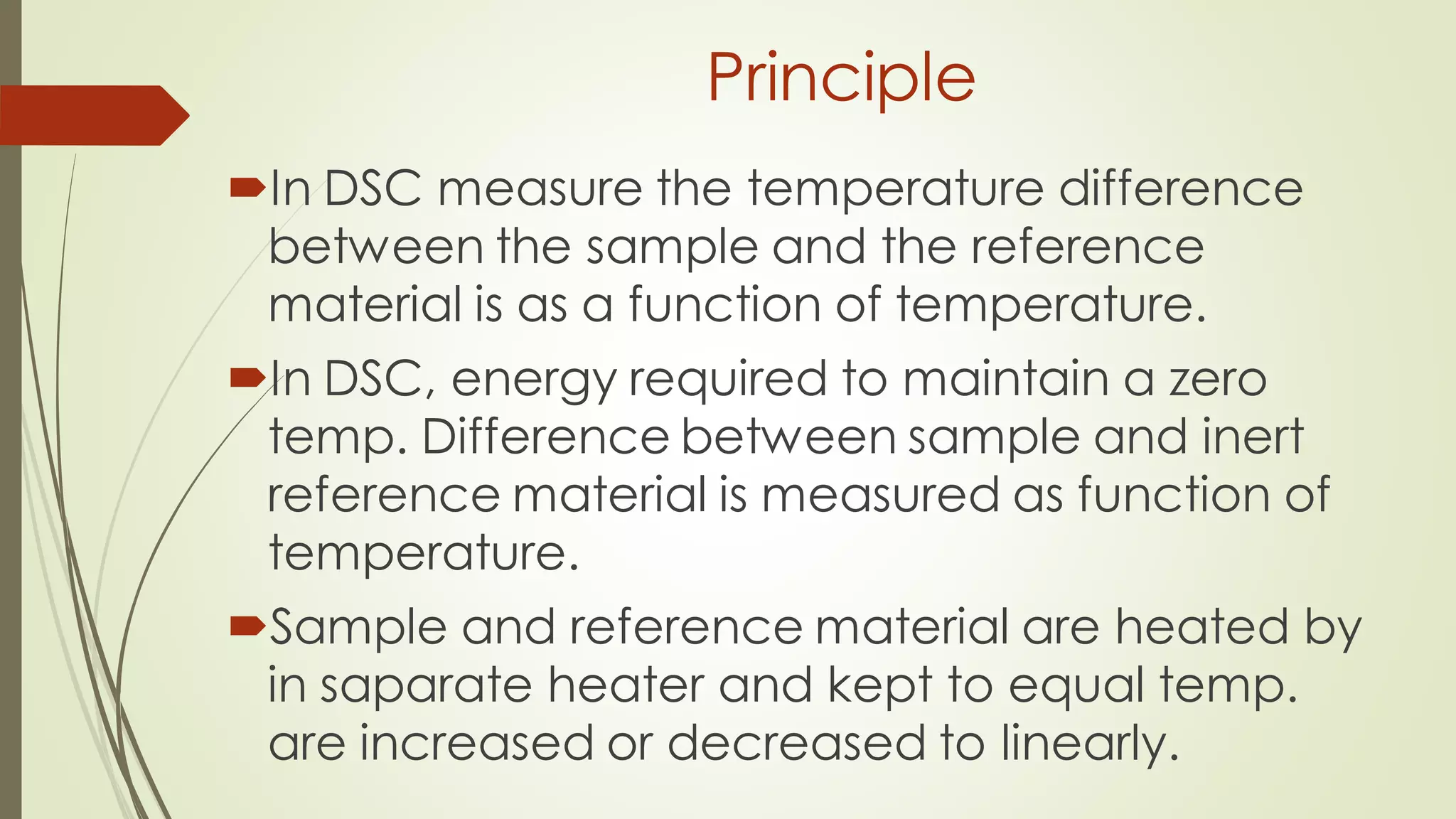
In DSC measure the temperature difference
between the sample and the reference
material is as a function of temperature.
In DSC, energy required to maintain a zero
temp. Difference between sample and inert
reference material is measured as function of
temperature.
Sample and reference material are heated by
in saparate heater and kept to equal temp.
are increased or decreased to linearly.
Continue....
Endothermic reaction
If sample absorb some amount of heat
during phase transition is called
endothermic reaction.
eg. Melting, boiling,
sublimation,vaporization.
Continue.....
Exothermic reaction
If sample released some amount of heat
during phase transition,then reaction is
called exothermic.
eg. Crystallization, degradation,
polymerization etc.
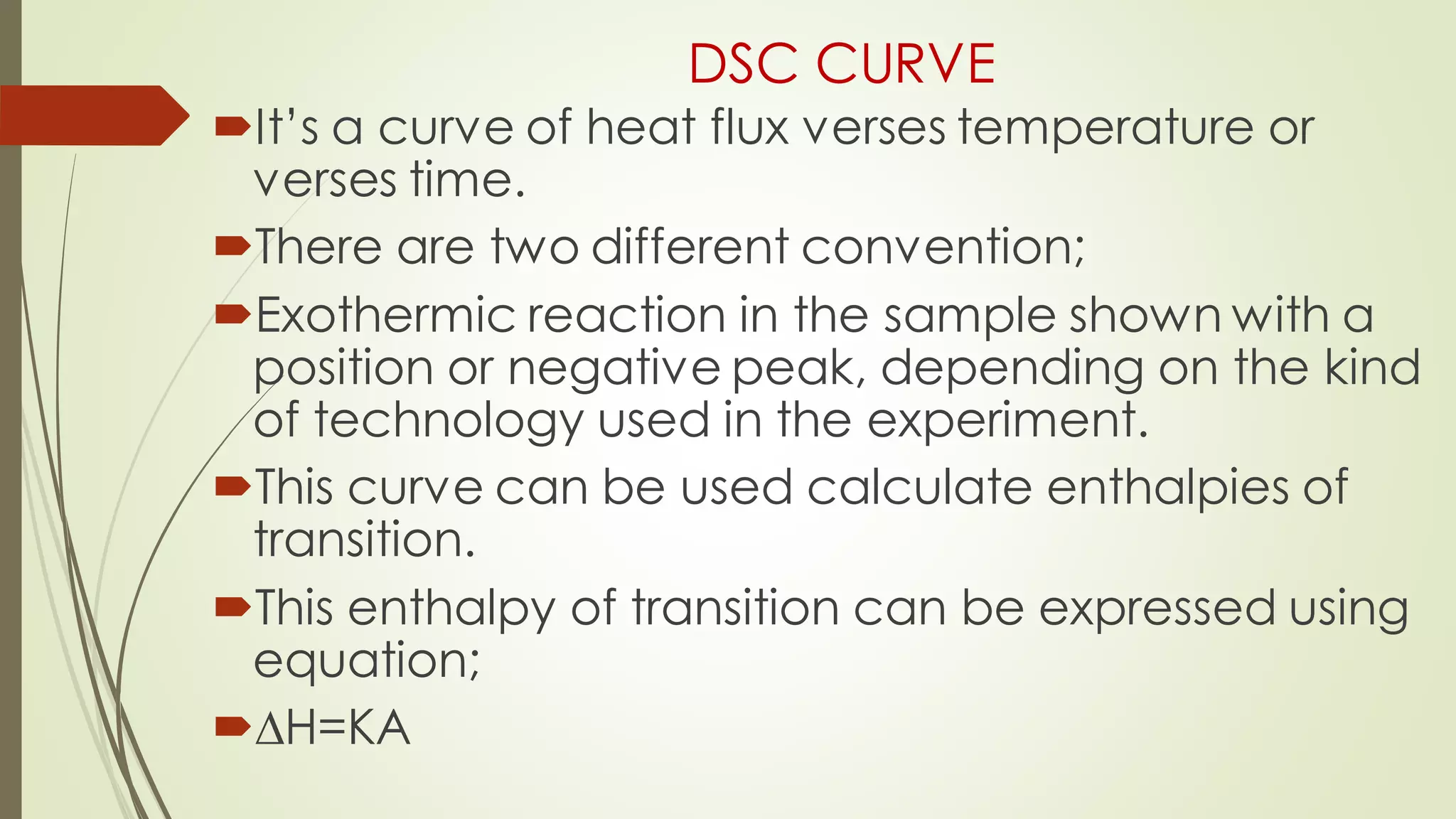
DSC CURVE
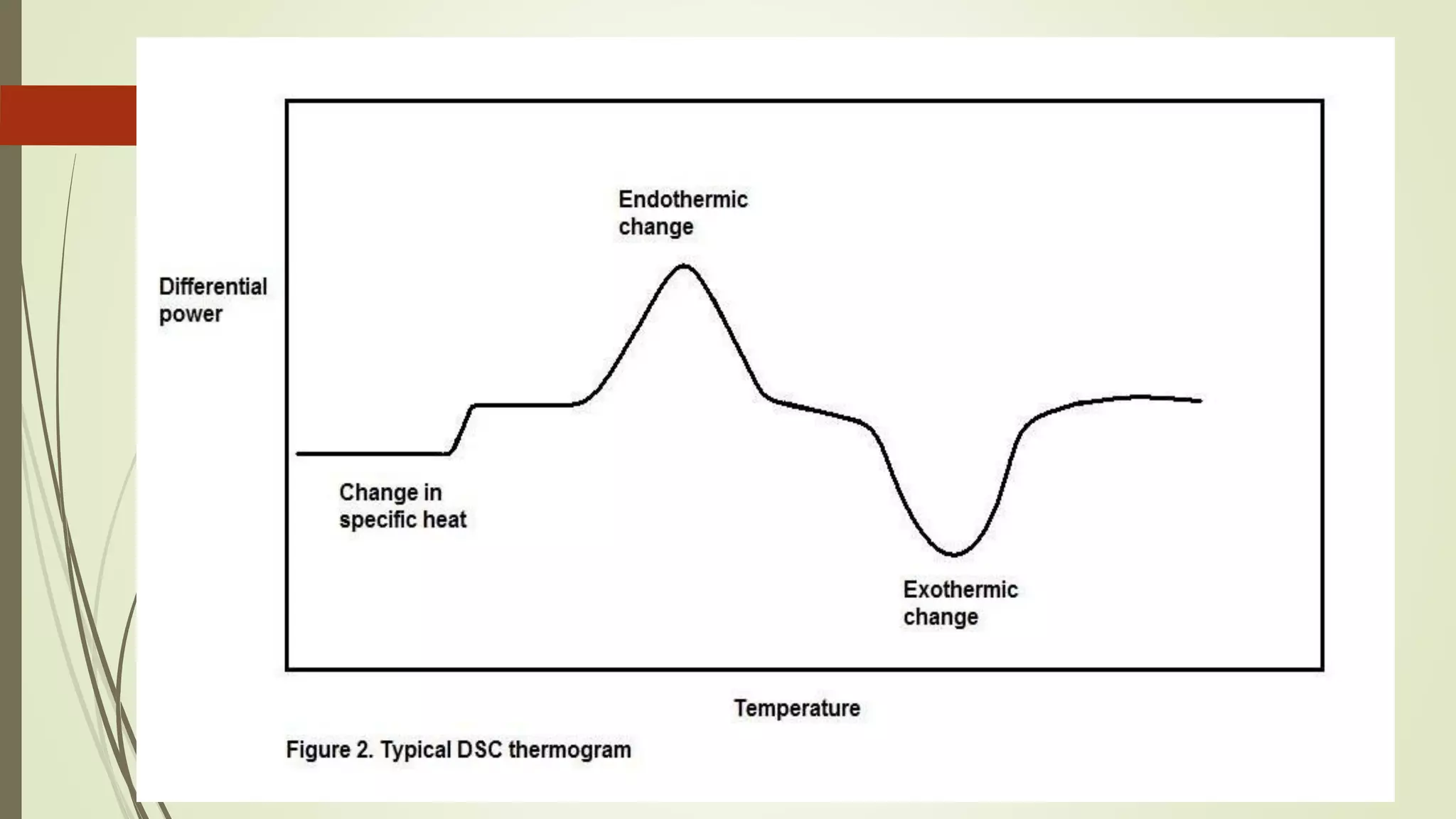
It’s a curve of heat flux verses temperature or
verses time.
There are two different convention;
Exothermic reaction in the sample shown with a
position or negative peak, depending on the kind
of technology used in the experiment.
This curve can be used calculate enthalpies of
transition.
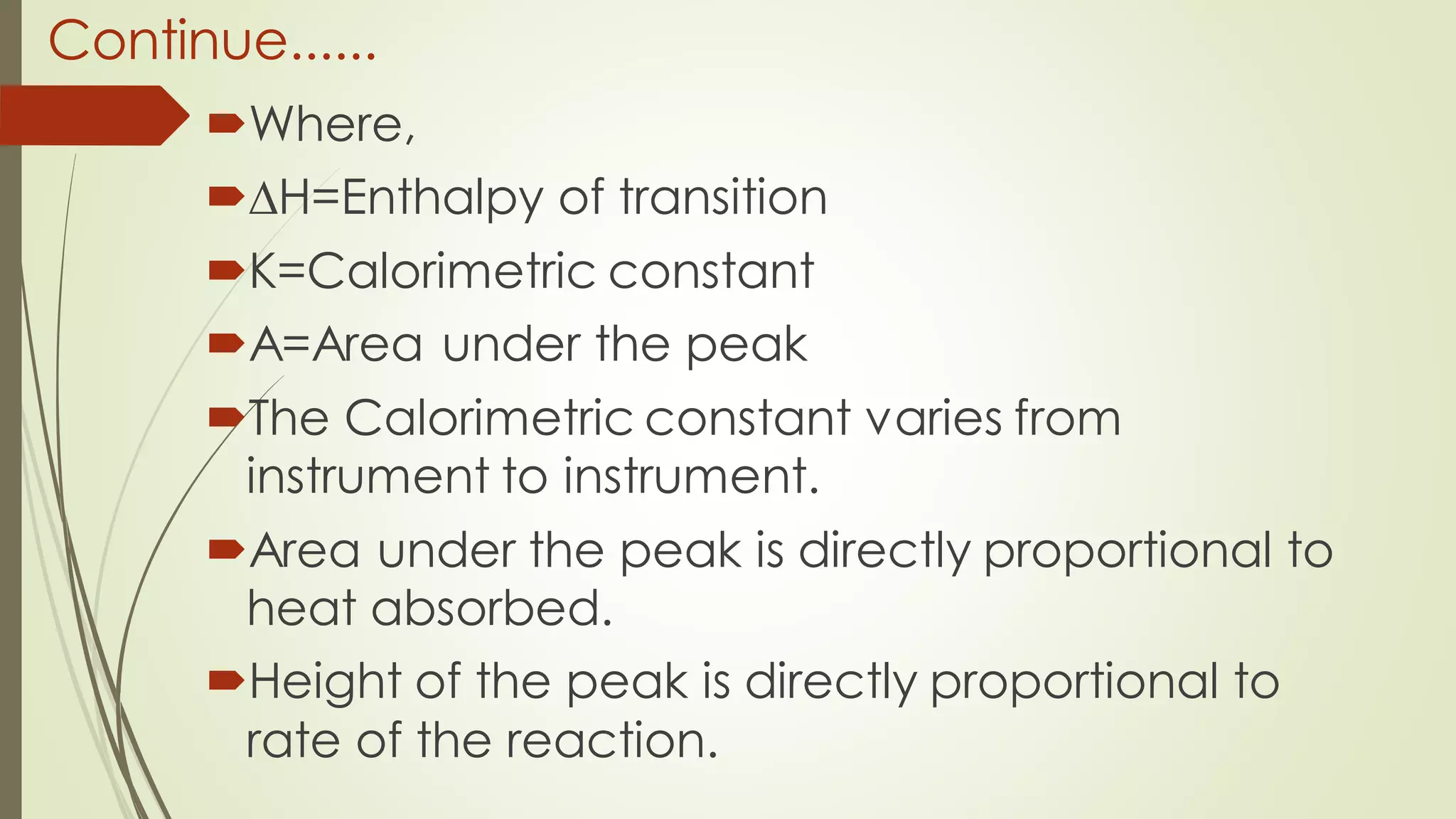
This enthalpy of transition can be expressed using
equation;
∆H=KA
Continue......
Where,
∆H=Enthalpy of transition
K=Calorimetric constant
A=Area under the peak
The Calorimetric constant varies from
instrument to instrument.
Area under the peak is directly proportional to
heat absorbed.
Height of the peak is directly proportional to
rate of the reaction.
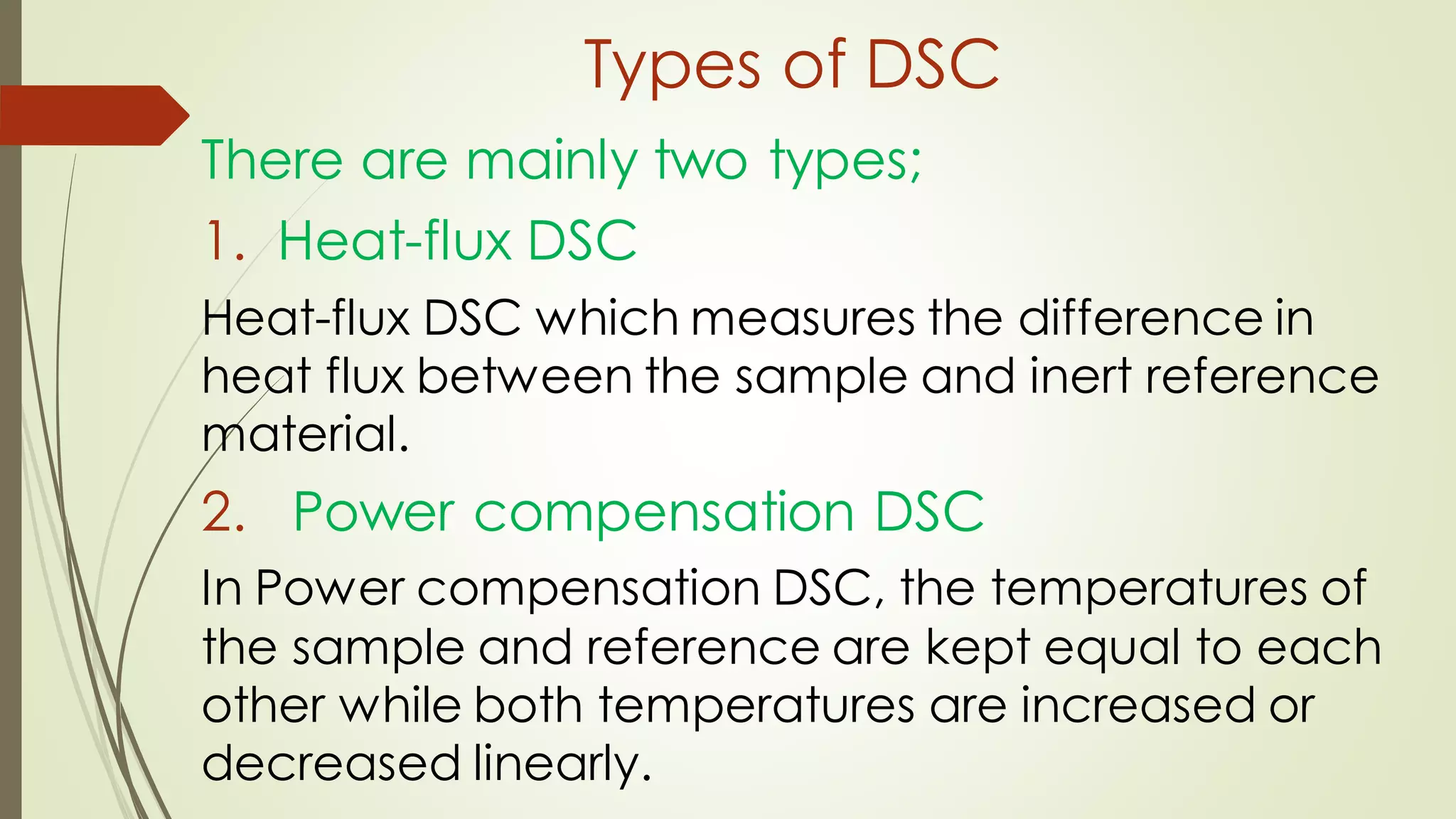
Types of DSC
There are mainly two types;
1. Heat-flux DSC
Heat-flux DSC which measures the difference in
heat flux between the sample and inert reference
material.
2. Power compensation DSC
In Power compensation DSC, the temperatures of
the sample and reference are kept equal to each
other while both temperatures are increased or
decreased linearly.
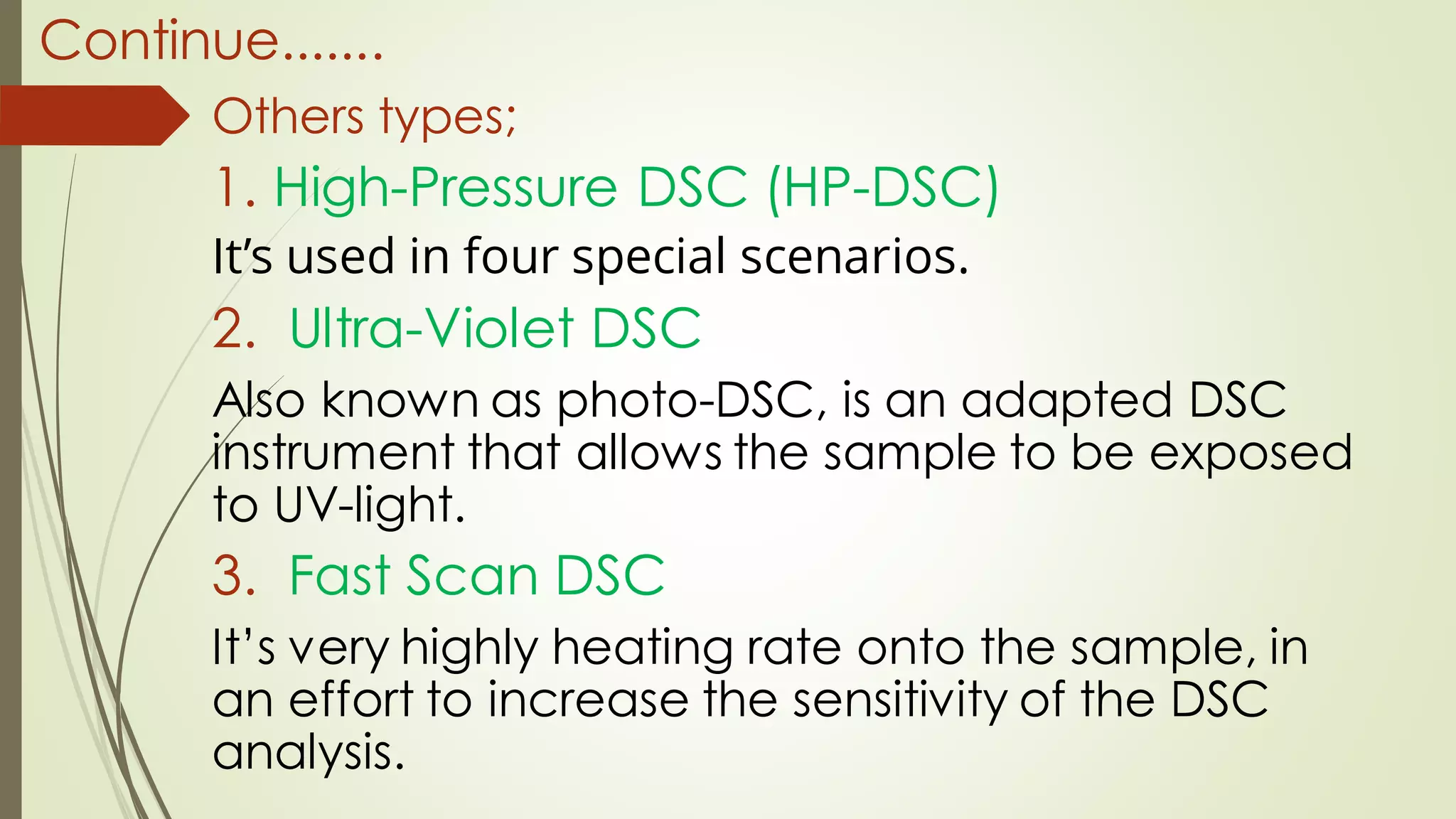
Continue.......
Others types;
1. High-Pressure DSC (HP-DSC)
It’s used in four special scenarios.
2. Ultra-Violet DSC
Also known as photo-DSC, is an adapted DSC
instrument that allows the sample to be exposed
to UV-light.
3. Fast Scan DSC
It’s very highly heating rate onto the sample, in
an effort to increase the sensitivity of the DSC
analysis.
Continue......
4. Modulated Temperature DSC
(MT-DSC)
It’s describe a technique as such when
a non-linear heating or cooling rate is
applied to the sample to separate the
kinetic and thermodynamic data.
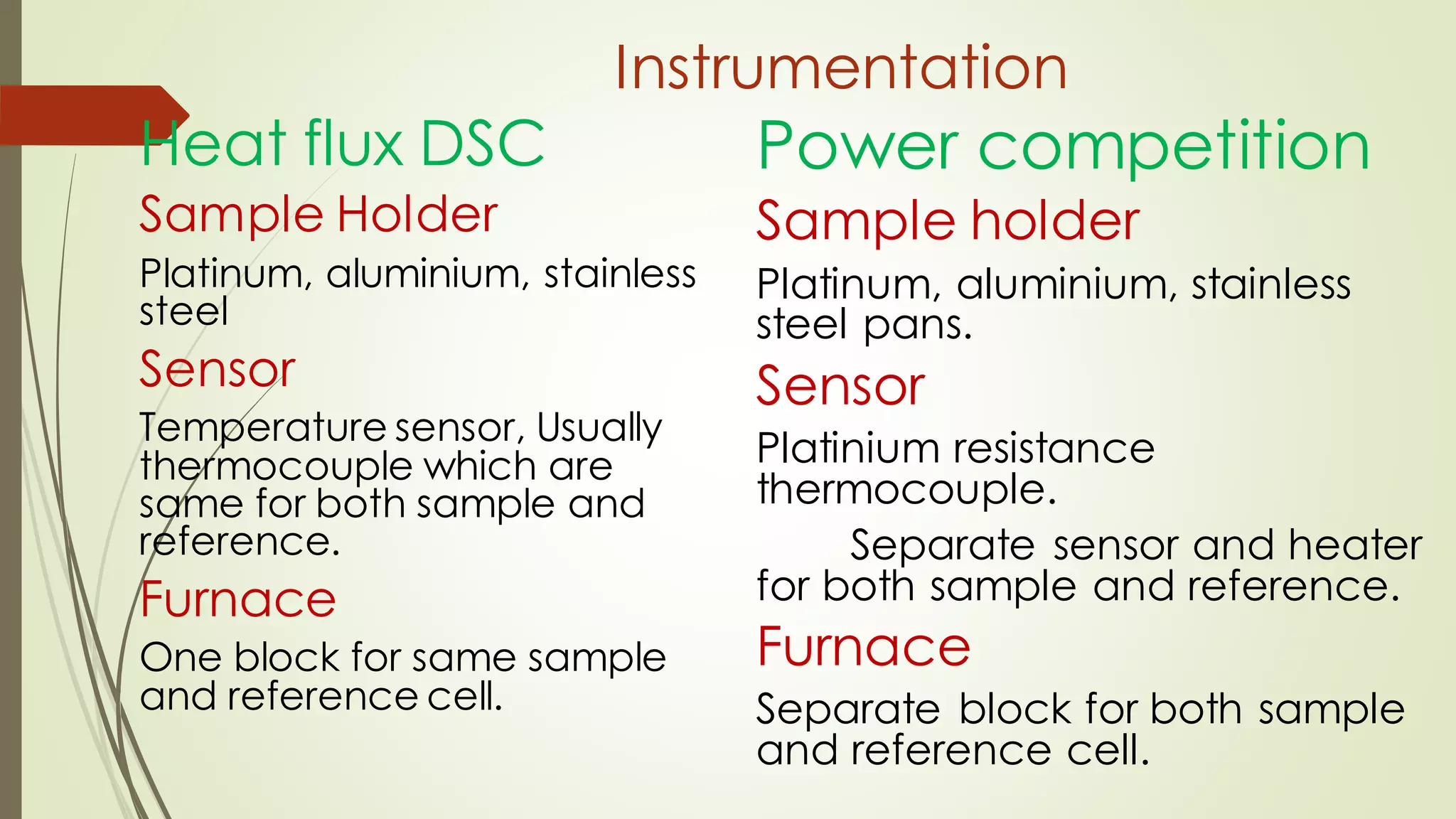
Instrumentation
Heat flux DSC
Sample Holder
Platinum, aluminium, stainless
steel
Sensor
Temperature sensor, Usually
thermocouple which are
same for both sample and
reference.
Furnace
One block for same sample
and reference cell.
Power competition
Sample holder
Platinum, aluminium, stainless
steel pans.
Sensor
Platinium resistance
thermocouple.
Separate sensor and heater
for both sample and reference.
Furnace
Separate block for both sample
and reference cell.
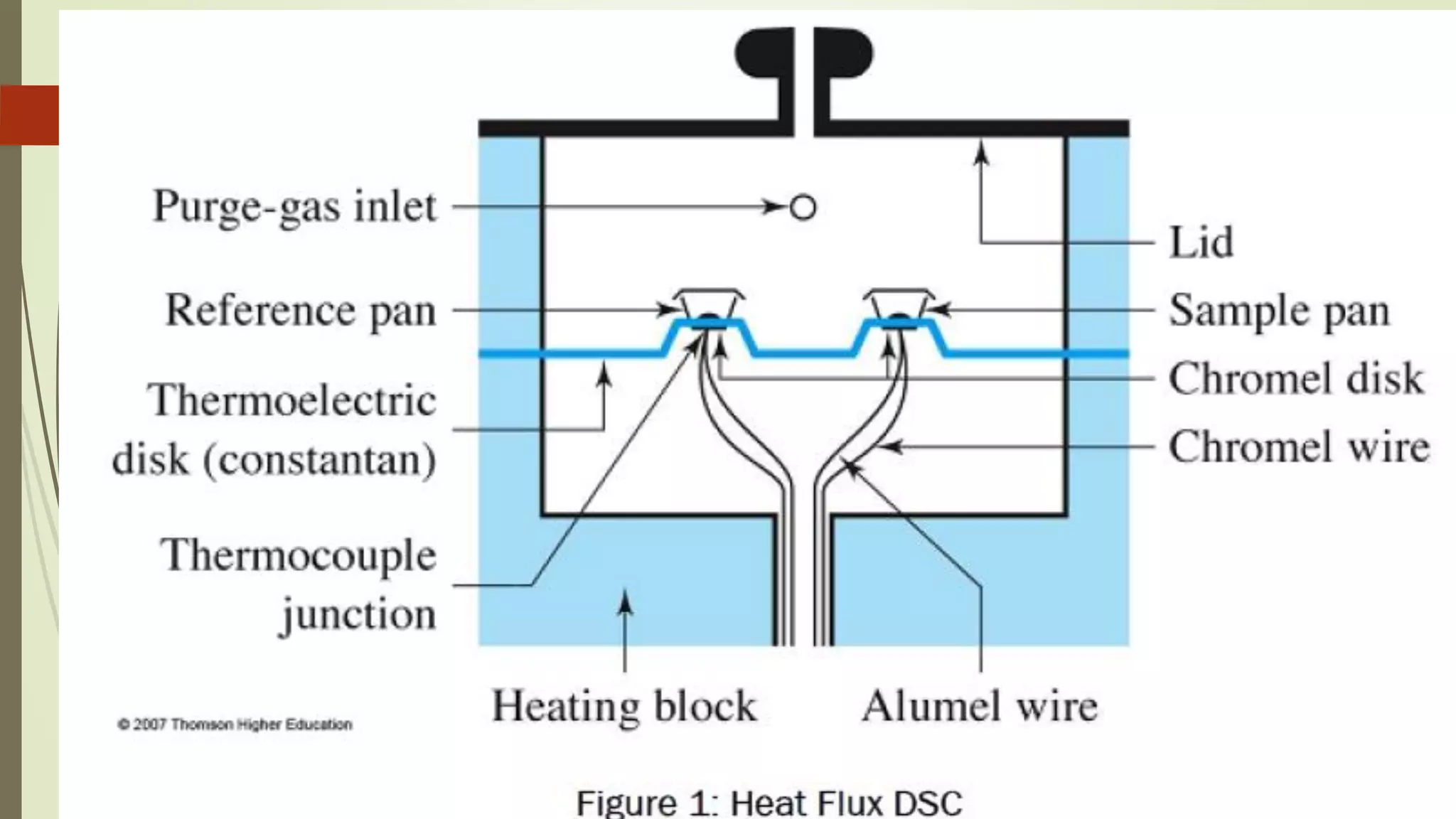
Heat flux DSC
In heat flux DSC,the difference in heat flow into the
sample and reference is measured while the
sample temperature is changed at the constant
rate.
 The main assembly of the DSC cell is enclosed in a
cylindrical and silver heating black.
The disk has two raised platforms on which the
sample and reference pans are placed.
Inert gas is passed through the cell at a constant
flow rate of about 40 ml/min.
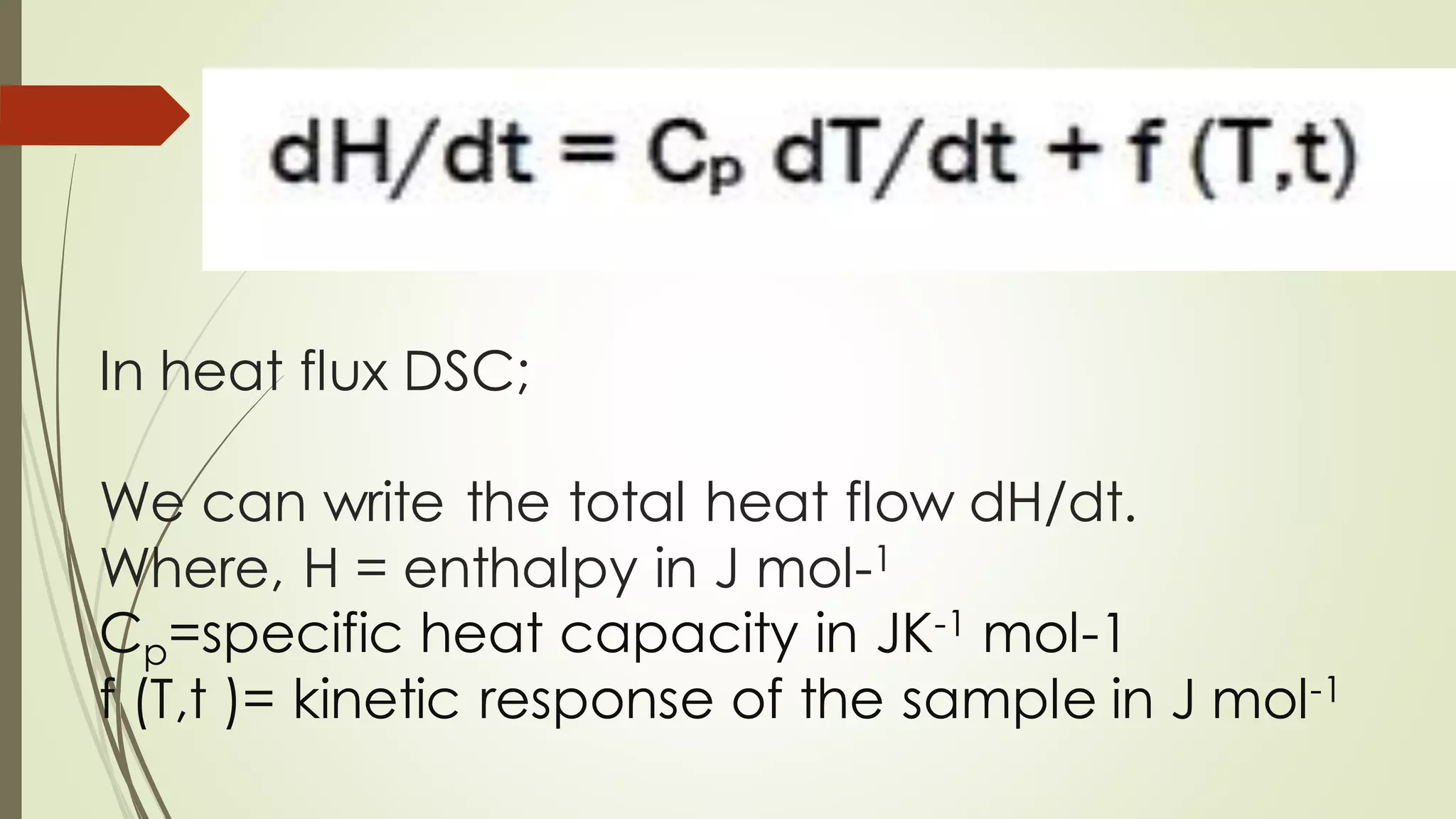
In heat flux DSC;
We can write the total heat flow dH/dt.
Where, H = enthalpy in J mol-1
Cp=specific heat capacity in JK-1 mol-1
f (T,t )= kinetic response of the sample in J mol-1
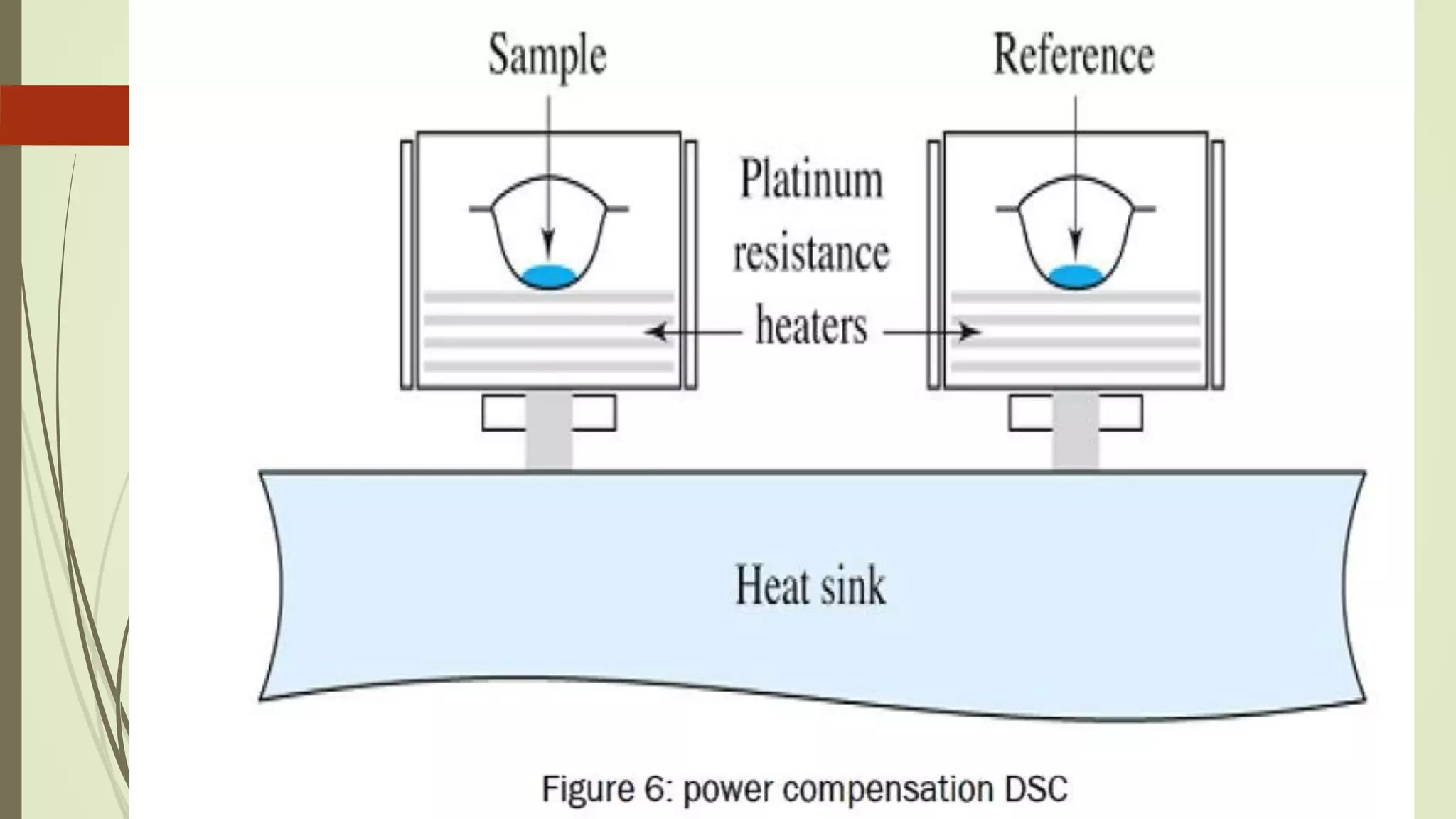
Power compensation DSC
In power compensation DSC, the temperatures of the
sample and reference are kept equal to each other
while both temperatures are increased or decreased
linearly.
 In power compensation DSC two independent
heating units are employed.
These heating units are quite small, allowing for rapid
rates of heating, cooling and equilibration.
DSC is up to 500K/min and the maximum cooling rate
is up to 400 K/min. Temperature range of
measurement is up to 400 °C with time constant of
only 1.5 s or lower
Factor affecting DSC curve
Instrumental factor
• Furnace heating rate
• Recording or chart
speed
• Furnace atmosphere
• Geometry of sample
holder/location of
sensors
• Sensitivity of the
recording system
• Composition of
sample containers
Sample
characteristics
• Amount of sample
• Nature of sample
• Sample packing
• Solubility of evolved
gases in the sample
• Particle size
• Heat of reaction
• Thermal conductivity
Determination of Heat
Capacity
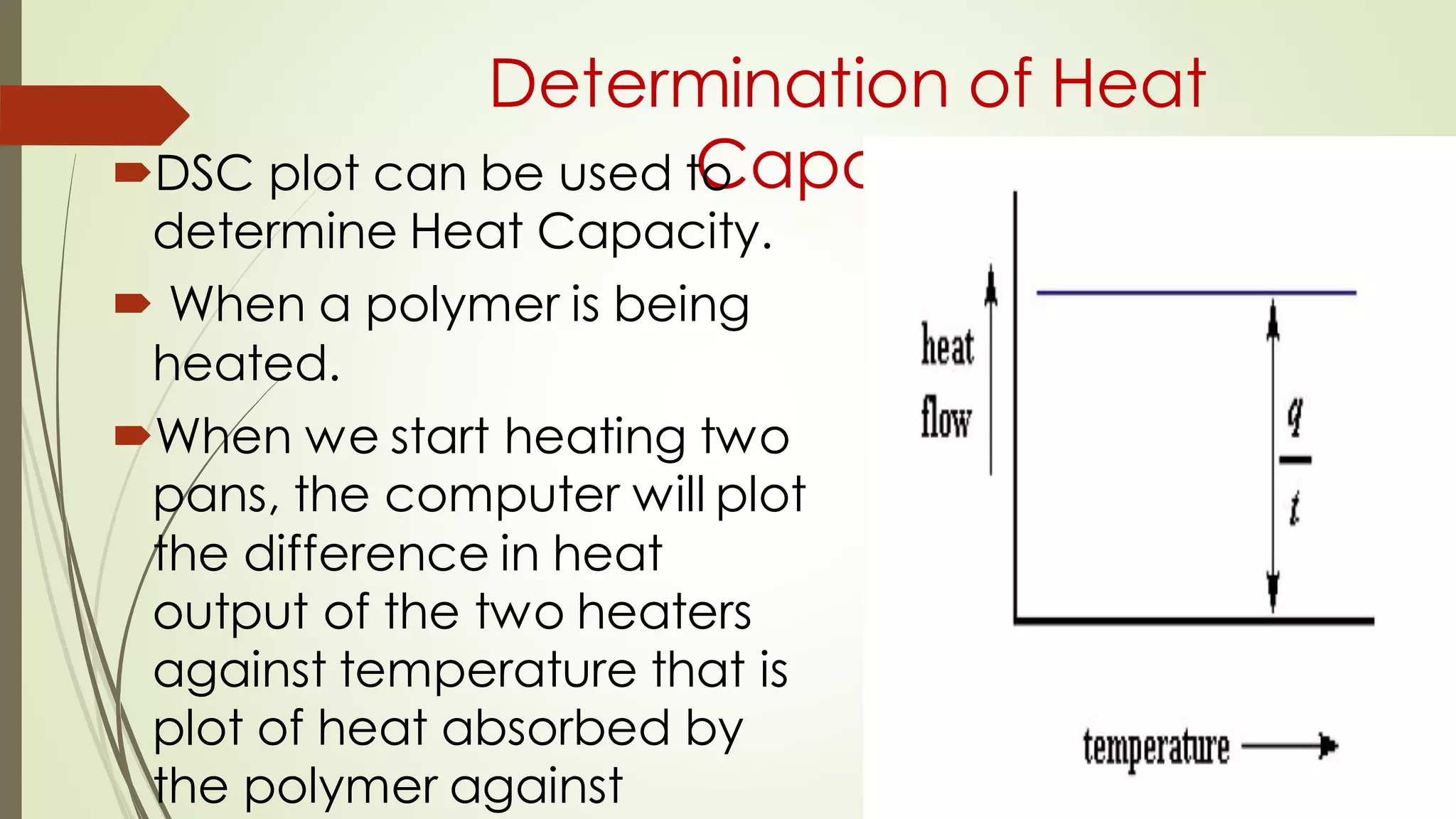
DSC plot can be used to
determine Heat Capacity.
 When a polymer is being
heated.
When we start heating two
pans, the computer will plot
the difference in heat
output of the two heaters
against temperature that is
plot of heat absorbed by
the polymer against
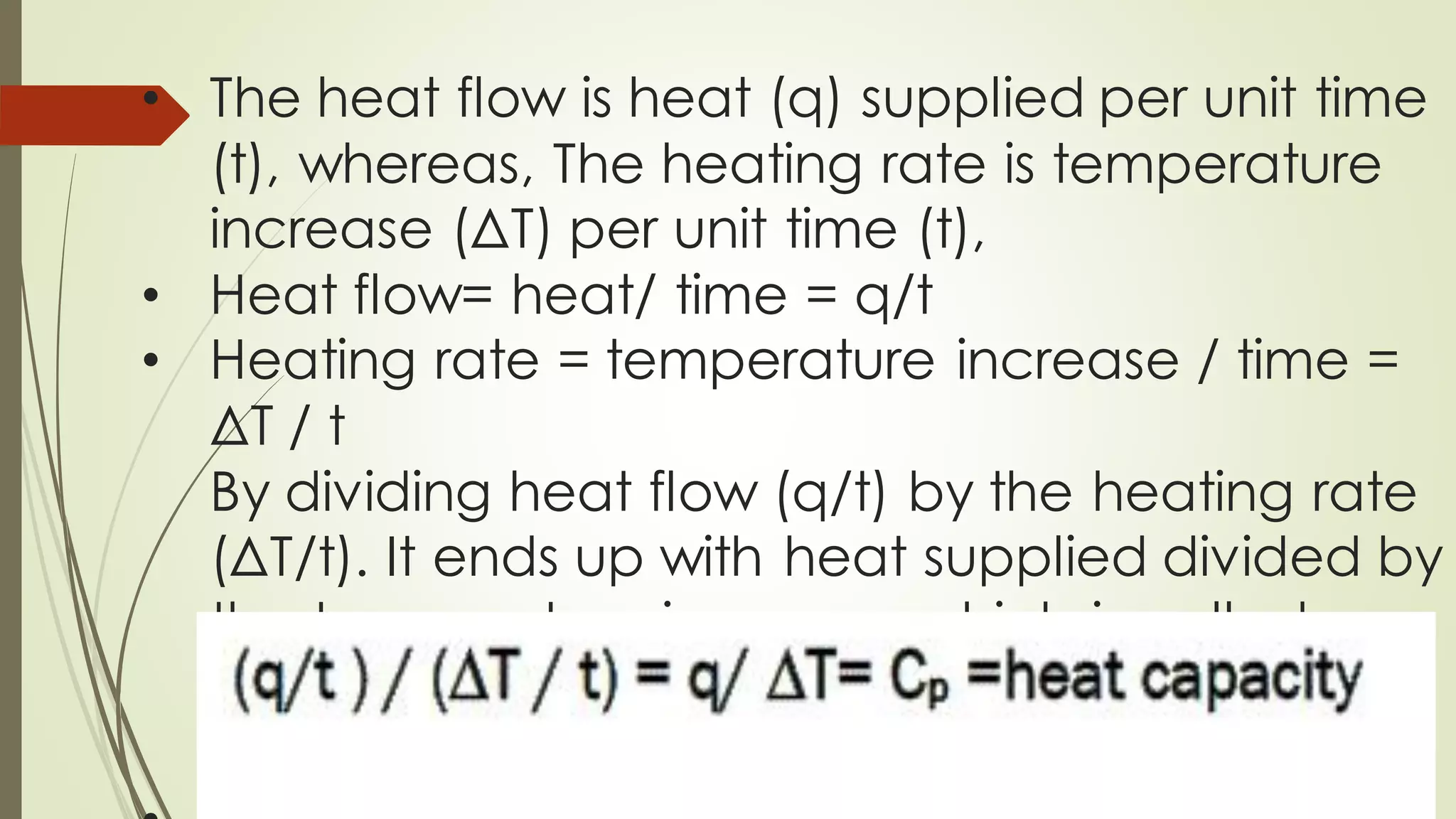
• The heat flow is heat (q) supplied per unit time
(t), whereas, The heating rate is temperature
increase (ΔT) per unit time (t),
• Heat flow= heat/ time = q/t
• Heating rate = temperature increase / time =
ΔT / t
By dividing heat flow (q/t) by the heating rate
(ΔT/t). It ends up with heat supplied divided by
the temperature increase, which is called
heat capacity.
Advantages
1. Rapidity of the determination.
2. Applicable
3. Simplicity
4. Versatility
5. Small sample masses
6. Study many times of chemical reaction
7. No of need calibration over the entire temperature of
DSC
8. High sensitivity
9. High resolution obtained
10.Stability of the material
Disadvantages
Relative low accuracy
Not be used for overlapping reaction
Difficulties in test cell preparation in
avoiding evaporation of volatile solvent.
Does not detect gas generation.
Measured by DSC
1. Glass transition
2. Melting and boiling point
3. Crystallisation time and temperature
4. Heat of fusion and reaction
5. Specific heat capacity
6. Oxadative/thermal stability
7. Reaction kinetics
8. Purity
9. Percentage crystallinity
Application
1.Finger printing
2.Choosing better solvent
3.Lyophilisation studies
4.Compatibility studies
5.Detection of isomerism
6.Detection of meta stable polymorph
7.Detection of polymorphism
8.Purity determination of sample directly
9.Safty screening
Continue....
Drug analysis
General chemical analysis
Food science
Polymer
Metals
Protein analysis
Liquid crystal
Oxidative stability
Reference
Ermal Methods. In: Chatwal GR, Anand SK.
Instrumental Methods of Chemical Analysis. Fifth
Edition: Himalaya Publication House, 2002.
P.2.701 2.749-2.751
Thermal Analysis. In:Willard HH, Merritt LL, Dean
JA, Settle FA. Instrumental Methods of Analysis.
Seventh edition: CBS publishers,2012.p. 761.
Molecular biology (in Russian). 6. Moscow. 1975.
pp. 7–33.
 Wunderlich B (1990). Thermal Analysis. New York:
Academic Press. pp. 137–140. ISBN 0-12-765605-7.
''Differential scanning calorimetry by Idrish Ansari''.pdf

''Differential scanning calorimetry by Idrish Ansari''.pdf

  • 1.
    Differential Scanning calorimetry Presented By-Idrish Ansari M.Pharm 1st year Pharmaceutical chemistry Hygia Institute of Pharmaceutical Education and Research
  • 2.
  • 3.
    Introduction Calorimetry is aprimary technique for measuring the thermal properties of sample and inert reference material. It is Used to study thermal transition of polymer or sample on heating. DSC is the only method for direct determination of the enthalpy. DSC is measure the heat of the sample and relate the inert reference material.
  • 4.
    History The technique wasdeveloped by E. S. Watson and M. J. O'Neill in 1962. It’s introduced commercially at the 1963 Pittsburgh Conference on Analytical Chemistry and Applied Spectroscopy.
  • 5.
    Principle In DSC measurethe temperature difference between the sample and the reference material is as a function of temperature. In DSC, energy required to maintain a zero temp. Difference between sample and inert reference material is measured as function of temperature. Sample and reference material are heated by in saparate heater and kept to equal temp. are increased or decreased to linearly.
  • 6.
    Continue.... Endothermic reaction If sampleabsorb some amount of heat during phase transition is called endothermic reaction. eg. Melting, boiling, sublimation,vaporization.
  • 7.
    Continue..... Exothermic reaction If samplereleased some amount of heat during phase transition,then reaction is called exothermic. eg. Crystallization, degradation, polymerization etc.
  • 9.
    DSC CURVE It’s acurve of heat flux verses temperature or verses time. There are two different convention; Exothermic reaction in the sample shown with a position or negative peak, depending on the kind of technology used in the experiment. This curve can be used calculate enthalpies of transition. This enthalpy of transition can be expressed using equation; ∆H=KA
  • 10.
    Continue...... Where, ∆H=Enthalpy of transition K=Calorimetricconstant A=Area under the peak The Calorimetric constant varies from instrument to instrument. Area under the peak is directly proportional to heat absorbed. Height of the peak is directly proportional to rate of the reaction.
  • 11.
    Types of DSC Thereare mainly two types; 1. Heat-flux DSC Heat-flux DSC which measures the difference in heat flux between the sample and inert reference material. 2. Power compensation DSC In Power compensation DSC, the temperatures of the sample and reference are kept equal to each other while both temperatures are increased or decreased linearly.
  • 12.
    Continue....... Others types; 1. High-PressureDSC (HP-DSC) It’s used in four special scenarios. 2. Ultra-Violet DSC Also known as photo-DSC, is an adapted DSC instrument that allows the sample to be exposed to UV-light. 3. Fast Scan DSC It’s very highly heating rate onto the sample, in an effort to increase the sensitivity of the DSC analysis.
  • 13.
    Continue...... 4. Modulated TemperatureDSC (MT-DSC) It’s describe a technique as such when a non-linear heating or cooling rate is applied to the sample to separate the kinetic and thermodynamic data.
  • 14.
    Instrumentation Heat flux DSC SampleHolder Platinum, aluminium, stainless steel Sensor Temperature sensor, Usually thermocouple which are same for both sample and reference. Furnace One block for same sample and reference cell. Power competition Sample holder Platinum, aluminium, stainless steel pans. Sensor Platinium resistance thermocouple. Separate sensor and heater for both sample and reference. Furnace Separate block for both sample and reference cell.
  • 15.
    Heat flux DSC Inheat flux DSC,the difference in heat flow into the sample and reference is measured while the sample temperature is changed at the constant rate.  The main assembly of the DSC cell is enclosed in a cylindrical and silver heating black. The disk has two raised platforms on which the sample and reference pans are placed. Inert gas is passed through the cell at a constant flow rate of about 40 ml/min.
  • 17.
    In heat fluxDSC; We can write the total heat flow dH/dt. Where, H = enthalpy in J mol-1 Cp=specific heat capacity in JK-1 mol-1 f (T,t )= kinetic response of the sample in J mol-1
  • 18.
    Power compensation DSC Inpower compensation DSC, the temperatures of the sample and reference are kept equal to each other while both temperatures are increased or decreased linearly.  In power compensation DSC two independent heating units are employed. These heating units are quite small, allowing for rapid rates of heating, cooling and equilibration. DSC is up to 500K/min and the maximum cooling rate is up to 400 K/min. Temperature range of measurement is up to 400 °C with time constant of only 1.5 s or lower
  • 20.
    Factor affecting DSCcurve Instrumental factor • Furnace heating rate • Recording or chart speed • Furnace atmosphere • Geometry of sample holder/location of sensors • Sensitivity of the recording system • Composition of sample containers Sample characteristics • Amount of sample • Nature of sample • Sample packing • Solubility of evolved gases in the sample • Particle size • Heat of reaction • Thermal conductivity
  • 21.
    Determination of Heat Capacity DSCplot can be used to determine Heat Capacity.  When a polymer is being heated. When we start heating two pans, the computer will plot the difference in heat output of the two heaters against temperature that is plot of heat absorbed by the polymer against
  • 22.
    • The heatflow is heat (q) supplied per unit time (t), whereas, The heating rate is temperature increase (ΔT) per unit time (t), • Heat flow= heat/ time = q/t • Heating rate = temperature increase / time = ΔT / t By dividing heat flow (q/t) by the heating rate (ΔT/t). It ends up with heat supplied divided by the temperature increase, which is called heat capacity.
  • 23.
    Advantages 1. Rapidity ofthe determination. 2. Applicable 3. Simplicity 4. Versatility 5. Small sample masses 6. Study many times of chemical reaction 7. No of need calibration over the entire temperature of DSC 8. High sensitivity 9. High resolution obtained 10.Stability of the material
  • 24.
    Disadvantages Relative low accuracy Notbe used for overlapping reaction Difficulties in test cell preparation in avoiding evaporation of volatile solvent. Does not detect gas generation.
  • 25.
    Measured by DSC 1.Glass transition 2. Melting and boiling point 3. Crystallisation time and temperature 4. Heat of fusion and reaction 5. Specific heat capacity 6. Oxadative/thermal stability 7. Reaction kinetics 8. Purity 9. Percentage crystallinity
  • 26.
    Application 1.Finger printing 2.Choosing bettersolvent 3.Lyophilisation studies 4.Compatibility studies 5.Detection of isomerism 6.Detection of meta stable polymorph 7.Detection of polymorphism 8.Purity determination of sample directly 9.Safty screening
  • 27.
    Continue.... Drug analysis General chemicalanalysis Food science Polymer Metals Protein analysis Liquid crystal Oxidative stability
  • 28.
    Reference Ermal Methods. In:Chatwal GR, Anand SK. Instrumental Methods of Chemical Analysis. Fifth Edition: Himalaya Publication House, 2002. P.2.701 2.749-2.751 Thermal Analysis. In:Willard HH, Merritt LL, Dean JA, Settle FA. Instrumental Methods of Analysis. Seventh edition: CBS publishers,2012.p. 761. Molecular biology (in Russian). 6. Moscow. 1975. pp. 7–33.  Wunderlich B (1990). Thermal Analysis. New York: Academic Press. pp. 137–140. ISBN 0-12-765605-7.