THERMAL
ANALYTICAL METHODS
INTRODUCTION
 Thermal analytical methods monitor
differences in some sample property as the
temperature increases, or
 Differences in temperature between a sample
and a standard as a function of added heat.
 These methods are usually applied to solids to
characterize the materials.
THERMAL METHODS
 A Group of techniques in which some physical
parameters of the system is determined .
 The method of analysis of compounds by
means of these techniques is said to be
thermal analysis.
THERMAL METHODS
Thermal methods of analysis is based upon the
measurement of the dynamic relationship b/w temp
and mass Δm, heat of reaction ΔH etc.
The change in Mass is due to
 Dehydration
 Decomposition
 Dissociation
 Vaporization
 Oxidation
 Reduction.
There are more than 12 thermal techniques for
analysation of compounds, which includes,
1. Thermo gravimetry (TG)
2. Derivative thermo gravimetry (DTG).
3. Differential thermal analysis (DTA).
4. Differential scanning calorimetry (DSC).
5. Thermometric titrymetry (TT)
6. Dynamic reflectance spectroscopy(DRS).
7. Evolved gas detection.
8. Dialotometry. (TMA)
9. Electrical conductivity (EC).
10.Emanation thermal analysis (ETA).
11. Pyrolysis – gas chromatography.
12. Isothermal titration calorimetry.
13. Dielectric thermal Analysis.
14. Dynamic Mechanical Analysis.
THERMOGRAVIMETRY
 Thermogravimetry is the measurement of the
mass of a sample as the temperature
increases.
 This method is useful for determining sample
purity and water, carbonate, and organic
content; and for studying decomposition
reactions.
TYPES
There are three types of Thermogravimetry:
1. Isothermal Thermogravimetry
The sample wt is recorded as a function of time @ constant
temp.
2. Quasistatic Thermogravimetry
The sample is heated to constant weight by increasing
temp.
3. Dynamic Thermogravimetry
The sample is heated @ a linear rate.
INSTRUMENTATION
The instrument used in thermogravimetry is said
to be Thermo balance.
The following main parts present in thermo
balance:
1. The balance.
2. Sample holder.
3. Furnace.
4. Temperature measurement.
5. Recorder.
ATMOSPHERIC
CONTROL
FURNACE
TEMPERATURE
SENSOR
RECORDER
BALANCE
CONTROL
RECORDING
BALANCE
FURNACE
SAMPLE HOLDER
TEMPERATURE
SENSOR
THE BALANCE
Very important part in the instrument.
 It must consist the following ideal characteristics.
 Accuracy, sensitivity, reproducibility and capacity should be
identical to the analytical balance.
 Should have adequate range of automatic weight adjustment.
 High degree of mechanical and electronic stability.
 Should have rapid response to weight changes.
 Should be unaffected by vibrations.
 Balance should be simple and versatile
.
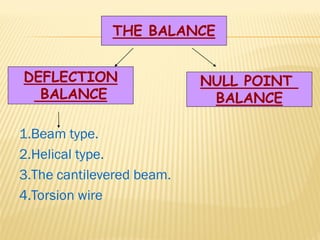
1.Beam type.
2.Helical type.
3.The cantilevered beam.
4.Torsion wire
THE BALANCE
DEFLECTION
BALANCE
NULL POINT
BALANCE
SAMPLE HOLDER
The geometry, size and material of the sample
holder have an important effect on the shape of a
TG curve.
The size and shape of the sample holder depends
upon the nature , sample weight and maximum
temperature range to be employed.
Materials for construction of the sample holder are,
glass, quartz, alumina, stainless steel, platinum,
graphite, etc.
Following types are available:
Shallow pans:
Used where it is necessary to eliminate diffusion as rate
limiting step.
Deep crucibles:
Used where side reaction and/or partial equilibrium is to
be desired.
Used in the study of industrial scale calcinations and surface
area measurements.
Loosely curved crucibles:
Used in self generated atmospheric studies.
Retort cups:
Used in boiling point studies.
THE FURNACE
Furnace is the closed chamber where substance is
heated to a high temperature.
The furnace and Control system should be designed to
produce a Linear heating rate.
The choice of furnace heating element and furnace
depends upon the temperature range being
employing.
For 1100˚C kanthal / Nichrome
For 1100-1500˚C Platinum/ alloy of platinum and
rhodium
For 1500-1750˚C Rhodium and platinum( 40:60)
For above 1750˚C Tungsten / molybdenum.
TEMPERATURE MEASUREMENT
 This is done in many methods but usually
thermocouple is used.
1. Thermocouple near to the sample.
2. Thermocouple inside the sample holder.
3. Thermocouple is placed either in contact with
sample or with the sample holder-this is best
arrangement of sample temperature detection.
THE RECORDER
This system records the weight losses of the
substance which subjected to high
temperature, there by we can determine the
substances.
 A) Time – base potentiometric strip chart
recorder.
 B) X – Y recorder.
TYPICAL TG CURVE
A A’
B
B’
Horizontal portion
Procedural decomposition temp
Curved portion
Tf True temperature
Weight
Temp
Ti
TYPICAL TG CURVE
By means of we can conclude the following things:
 Horizontal points AA’ and B’B indicates no change in the
weight of the substance .i.e. the sample is stable in that
temperature region.
 The curved points A’B’ indicates weight lose.
 How much weight lost by heat @ given temp can determine by
this curve.
 To determine composition of the sample.
 Procedural decomposition temperature It is neither a
transition temp nor a true temp below the reaction rate is zero.
 True temperature It is a temp @ which the cumulative weight
change reaches its maximum value.
 Reaction interval The difference b/w Tf and Ti (Tf – Ti)
FACTORS AFFECTING THE TG CURVE
 Instrumental factors
 a) Heating rate
 b) Effect of furnace temperature
 c) Sample holder
 Sample characteristics
 a) sample weight
 b) Particle size
 c) Heat of reaction
 d) Compactness of the sample
 e) Source of the sample
APPLICATIONS
 Automatic thermogravimetry analysis- To estimate calcium
and magnesium ions in a mixture
 To determine various metals in alloys
 Identification of gases given off while a sample’s temperature
increases.
 Composition of residue can determine.by this information we
can determine the chemical decomposition of the heated
material.
 Testing purity of the samples.
 Identification of the composition of the mixture of the
materials and also quantitative estimation of the component
is also possible by this method.
 Determination of correct drying temperatures for precipitates
used in gravimetric analysis.
 Curie point determination.
 To study the reaction b/w certain oxides.
 To study the volatilization in glass technology.
DIFFERENTIAL THERMAL ANALYSIS
 Differential thermal analysis is the measurement of
the difference in temperature between a sample
and a reference as heat is applied to the system.
 This method is sensitive to endothermic and
exothermic processes including: phase transitions,
dehydration, and decomposition, redox, or solid-
state reactions.
DIFFERENTIAL THERMAL ANALYSIS
 This is widely used along thermogravimetry.
 This is more efficient and versatile than the
thermogravimetry.
 This method provide more fundamental information
than the information obtained with
thermogravimetry.
PRINCIPLE
This technique involves the recording of the
difference in temperature between a substance and a
reference material against either time or temperature
as the two specimens are subjected to identical
temperature regimes in an environment heated or
cooled at a controlled rate.
Thus a differential thermogram consists of
difference in sample and reference temperature Vs
time or temperature.
Both exothermic and endothermic regions or
found in the thermogram.
INSTRUMENTATION
 The instrument used in this technique is said to be
DTA apparatus.
 This consists of the following parts:
1. The furnace.
2. The sample holder.
3. Differential temperature detector.
4. Furnace temperature programmer.
5. Recorder.
6. control equipment.
THE FURNACE
 In DTA apparatus tubular furnace is used widely.
 material used to construct the furnace is based on
the temperature employing and the material is
going to heat.
 Material used are as follows;
 For 1200°C nichrome V / chromel C
 For 1400°C kanthal A / kanthal A1
 For 1700°C silicon carbide.
 For 1800°C kanthal super.
 For 2900°C tungsten.
SAMPLE HOLDER
 we have to consider cost , ease fabrication,
inertness towards the reactants and
products temperature range.
 Both metallic and non-metallic materials
are employed.
 Selection of material to fabricate sample
holder is very important.
 1. Metallic material eg: nickel, stainless
steel, platinum and its alloys.
 2. Non-metallic alloys eg: glass,sintered
alumina.
FURNACE TEMPERATURE PROGRAMMER
 The main function is to increase the temp of
the furnace @ a steady rate
 Recorder this is to record the DTA curve,
 Control Equipment To maintain a suitable
atmospheric in the furnace and the sample
holder.
TEMPERATURE CONTROLLER
 Temperature is controlled by means of
three elements.
 1. Sensor,
 2. Control element,
 3. Heater.
 There are two methods for controlling
temperature.
 1. On-off control.
 2. Proportional control.
THERMOCOUPLES
 Temperature sensors are Thermocouples.
 Temperature up to 1100°C alumel wires are used.
 Above 1100°C thermocouple made from the pure
platinum or platinum – rhodium alloys is used.
 The following points must consider while selecting
the thermocouple.
 Thermoelectric coefficient.
 Chemical compatibility with the sample.
 Chemical gaseous environment.
 Availability and cost.
APPLICATIONS
 In analytical chemistry we can
 1. Identify the substances bcoz the DTA curve for two
substances are not identical.it is finger print for
substances.
 2. Identification of products. The products formed in
any reaction can determined by the DTA curve.
 3.melting point of the substances can easily
determined by this technique.by this we can identify the
purity of the compounds.
 4. DTA technique used for quality control of a large
number of substances like cement, glass, soil, textiles,
resins, etc.
 5. identification of purity determination and
quantitative analysation of the polymers , explosives,
pharmaceuticals, oils, fats,etc.
DIFFERENTIAL SCANNING CALORIMETRY
 Differential scanning calorimetry
independently measures the rate of heat
flow to a sample and a standard that are
at the same temperature
INSTRUMENTATION
Types
 1. Power compensated DSC.
 2. Heat flux DSC.
 3. Modulated DSC.
TYPICAL POWER COMPENSATION DSC CELL
DT (DP)
Insulating Heat Sink
Sample Furnace Reference Furnace
Sample Reference
Platinum Resistance
Thermometers (PRT)
DSC: What DSC Can Tell You
Glass Transitions
Melting and Boiling Points
Crystallization time and temperature
Percent Crystallinity
Heats of Fusion and Reactions
Specific Heat
Oxidative/Thermal Stability
Rate and Degree of Cure
Reaction Kinetics
Purity
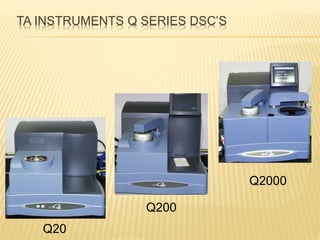
INSTRUMENT
Q2000
Q200
Q20
TA INSTRUMENTS Q SERIES DSC’S
DIFFERENTIAL SCANNING CALORIMETRY
PRINCIPLE
DSC PLOT
APPLICATIONS
 DSC can be used for all application of
conventional DTA.
 Quantitative analysis by using transition points
eg; crystal structures of polymers.
 This technique can be used as a direct check of
purity of compound by using melting points.
 in quality control of a large number of
substances like catalyst, resins glass
,explosives.
 Identification of substances by using DTA
CURVE eg; clays
 It is also used in the study of amines ,
carbohydrates, polymers.
Thermal analysis

Thermal analysis

  • 1.
  • 2.
    INTRODUCTION  Thermal analyticalmethods monitor differences in some sample property as the temperature increases, or  Differences in temperature between a sample and a standard as a function of added heat.  These methods are usually applied to solids to characterize the materials.
  • 3.
    THERMAL METHODS  AGroup of techniques in which some physical parameters of the system is determined .  The method of analysis of compounds by means of these techniques is said to be thermal analysis.
  • 4.
    THERMAL METHODS Thermal methodsof analysis is based upon the measurement of the dynamic relationship b/w temp and mass Δm, heat of reaction ΔH etc. The change in Mass is due to  Dehydration  Decomposition  Dissociation  Vaporization  Oxidation  Reduction.
  • 5.
    There are morethan 12 thermal techniques for analysation of compounds, which includes, 1. Thermo gravimetry (TG) 2. Derivative thermo gravimetry (DTG). 3. Differential thermal analysis (DTA). 4. Differential scanning calorimetry (DSC). 5. Thermometric titrymetry (TT) 6. Dynamic reflectance spectroscopy(DRS). 7. Evolved gas detection. 8. Dialotometry. (TMA) 9. Electrical conductivity (EC). 10.Emanation thermal analysis (ETA). 11. Pyrolysis – gas chromatography. 12. Isothermal titration calorimetry. 13. Dielectric thermal Analysis. 14. Dynamic Mechanical Analysis.
  • 6.
    THERMOGRAVIMETRY  Thermogravimetry isthe measurement of the mass of a sample as the temperature increases.  This method is useful for determining sample purity and water, carbonate, and organic content; and for studying decomposition reactions.
  • 7.
    TYPES There are threetypes of Thermogravimetry: 1. Isothermal Thermogravimetry The sample wt is recorded as a function of time @ constant temp. 2. Quasistatic Thermogravimetry The sample is heated to constant weight by increasing temp. 3. Dynamic Thermogravimetry The sample is heated @ a linear rate.
  • 8.
    INSTRUMENTATION The instrument usedin thermogravimetry is said to be Thermo balance. The following main parts present in thermo balance: 1. The balance. 2. Sample holder. 3. Furnace. 4. Temperature measurement. 5. Recorder.
  • 9.
  • 10.
    THE BALANCE Very importantpart in the instrument.  It must consist the following ideal characteristics.  Accuracy, sensitivity, reproducibility and capacity should be identical to the analytical balance.  Should have adequate range of automatic weight adjustment.  High degree of mechanical and electronic stability.  Should have rapid response to weight changes.  Should be unaffected by vibrations.  Balance should be simple and versatile
  • 11.
    . 1.Beam type. 2.Helical type. 3.Thecantilevered beam. 4.Torsion wire THE BALANCE DEFLECTION BALANCE NULL POINT BALANCE
  • 12.
    SAMPLE HOLDER The geometry,size and material of the sample holder have an important effect on the shape of a TG curve. The size and shape of the sample holder depends upon the nature , sample weight and maximum temperature range to be employed. Materials for construction of the sample holder are, glass, quartz, alumina, stainless steel, platinum, graphite, etc.
  • 13.
    Following types areavailable: Shallow pans: Used where it is necessary to eliminate diffusion as rate limiting step. Deep crucibles: Used where side reaction and/or partial equilibrium is to be desired. Used in the study of industrial scale calcinations and surface area measurements. Loosely curved crucibles: Used in self generated atmospheric studies. Retort cups: Used in boiling point studies.
  • 14.
    THE FURNACE Furnace isthe closed chamber where substance is heated to a high temperature. The furnace and Control system should be designed to produce a Linear heating rate. The choice of furnace heating element and furnace depends upon the temperature range being employing. For 1100˚C kanthal / Nichrome For 1100-1500˚C Platinum/ alloy of platinum and rhodium For 1500-1750˚C Rhodium and platinum( 40:60) For above 1750˚C Tungsten / molybdenum.
  • 15.
    TEMPERATURE MEASUREMENT  Thisis done in many methods but usually thermocouple is used. 1. Thermocouple near to the sample. 2. Thermocouple inside the sample holder. 3. Thermocouple is placed either in contact with sample or with the sample holder-this is best arrangement of sample temperature detection.
  • 16.
    THE RECORDER This systemrecords the weight losses of the substance which subjected to high temperature, there by we can determine the substances.  A) Time – base potentiometric strip chart recorder.  B) X – Y recorder.
  • 17.
    TYPICAL TG CURVE AA’ B B’ Horizontal portion Procedural decomposition temp Curved portion Tf True temperature Weight Temp Ti
  • 18.
    TYPICAL TG CURVE Bymeans of we can conclude the following things:  Horizontal points AA’ and B’B indicates no change in the weight of the substance .i.e. the sample is stable in that temperature region.  The curved points A’B’ indicates weight lose.  How much weight lost by heat @ given temp can determine by this curve.  To determine composition of the sample.  Procedural decomposition temperature It is neither a transition temp nor a true temp below the reaction rate is zero.  True temperature It is a temp @ which the cumulative weight change reaches its maximum value.  Reaction interval The difference b/w Tf and Ti (Tf – Ti)
  • 19.
    FACTORS AFFECTING THETG CURVE  Instrumental factors  a) Heating rate  b) Effect of furnace temperature  c) Sample holder  Sample characteristics  a) sample weight  b) Particle size  c) Heat of reaction  d) Compactness of the sample  e) Source of the sample
  • 20.
    APPLICATIONS  Automatic thermogravimetryanalysis- To estimate calcium and magnesium ions in a mixture  To determine various metals in alloys  Identification of gases given off while a sample’s temperature increases.  Composition of residue can determine.by this information we can determine the chemical decomposition of the heated material.  Testing purity of the samples.  Identification of the composition of the mixture of the materials and also quantitative estimation of the component is also possible by this method.  Determination of correct drying temperatures for precipitates used in gravimetric analysis.  Curie point determination.  To study the reaction b/w certain oxides.  To study the volatilization in glass technology.
  • 21.
    DIFFERENTIAL THERMAL ANALYSIS Differential thermal analysis is the measurement of the difference in temperature between a sample and a reference as heat is applied to the system.  This method is sensitive to endothermic and exothermic processes including: phase transitions, dehydration, and decomposition, redox, or solid- state reactions.
  • 22.
    DIFFERENTIAL THERMAL ANALYSIS This is widely used along thermogravimetry.  This is more efficient and versatile than the thermogravimetry.  This method provide more fundamental information than the information obtained with thermogravimetry.
  • 23.
    PRINCIPLE This technique involvesthe recording of the difference in temperature between a substance and a reference material against either time or temperature as the two specimens are subjected to identical temperature regimes in an environment heated or cooled at a controlled rate. Thus a differential thermogram consists of difference in sample and reference temperature Vs time or temperature. Both exothermic and endothermic regions or found in the thermogram.
  • 24.
    INSTRUMENTATION  The instrumentused in this technique is said to be DTA apparatus.  This consists of the following parts: 1. The furnace. 2. The sample holder. 3. Differential temperature detector. 4. Furnace temperature programmer. 5. Recorder. 6. control equipment.
  • 25.
    THE FURNACE  InDTA apparatus tubular furnace is used widely.  material used to construct the furnace is based on the temperature employing and the material is going to heat.  Material used are as follows;  For 1200°C nichrome V / chromel C  For 1400°C kanthal A / kanthal A1  For 1700°C silicon carbide.  For 1800°C kanthal super.  For 2900°C tungsten.
  • 26.
    SAMPLE HOLDER  wehave to consider cost , ease fabrication, inertness towards the reactants and products temperature range.  Both metallic and non-metallic materials are employed.  Selection of material to fabricate sample holder is very important.  1. Metallic material eg: nickel, stainless steel, platinum and its alloys.  2. Non-metallic alloys eg: glass,sintered alumina.
  • 27.
    FURNACE TEMPERATURE PROGRAMMER The main function is to increase the temp of the furnace @ a steady rate  Recorder this is to record the DTA curve,  Control Equipment To maintain a suitable atmospheric in the furnace and the sample holder.
  • 28.
    TEMPERATURE CONTROLLER  Temperatureis controlled by means of three elements.  1. Sensor,  2. Control element,  3. Heater.  There are two methods for controlling temperature.  1. On-off control.  2. Proportional control.
  • 29.
    THERMOCOUPLES  Temperature sensorsare Thermocouples.  Temperature up to 1100°C alumel wires are used.  Above 1100°C thermocouple made from the pure platinum or platinum – rhodium alloys is used.  The following points must consider while selecting the thermocouple.  Thermoelectric coefficient.  Chemical compatibility with the sample.  Chemical gaseous environment.  Availability and cost.
  • 30.
    APPLICATIONS  In analyticalchemistry we can  1. Identify the substances bcoz the DTA curve for two substances are not identical.it is finger print for substances.  2. Identification of products. The products formed in any reaction can determined by the DTA curve.  3.melting point of the substances can easily determined by this technique.by this we can identify the purity of the compounds.  4. DTA technique used for quality control of a large number of substances like cement, glass, soil, textiles, resins, etc.  5. identification of purity determination and quantitative analysation of the polymers , explosives, pharmaceuticals, oils, fats,etc.
  • 31.
    DIFFERENTIAL SCANNING CALORIMETRY Differential scanning calorimetry independently measures the rate of heat flow to a sample and a standard that are at the same temperature
  • 32.
    INSTRUMENTATION Types  1. Powercompensated DSC.  2. Heat flux DSC.  3. Modulated DSC.
  • 33.
    TYPICAL POWER COMPENSATIONDSC CELL DT (DP) Insulating Heat Sink Sample Furnace Reference Furnace Sample Reference Platinum Resistance Thermometers (PRT)
  • 34.
    DSC: What DSCCan Tell You Glass Transitions Melting and Boiling Points Crystallization time and temperature Percent Crystallinity Heats of Fusion and Reactions Specific Heat Oxidative/Thermal Stability Rate and Degree of Cure Reaction Kinetics Purity
  • 35.
  • 36.
  • 37.
  • 38.
  • 39.
  • 40.
    APPLICATIONS  DSC canbe used for all application of conventional DTA.  Quantitative analysis by using transition points eg; crystal structures of polymers.  This technique can be used as a direct check of purity of compound by using melting points.  in quality control of a large number of substances like catalyst, resins glass ,explosives.  Identification of substances by using DTA CURVE eg; clays  It is also used in the study of amines , carbohydrates, polymers.