WELCOME
Solar Energy:
The Ultimate Renewable
Resource
The nonrenewable sources we use today – including coal, oil,
kerosene, diesel, propane and natural gas – are all limited in
availability, and are also partly to blame
4Solar Wonders, ©2007 Florida Solar Energy Center
© 2007 Florida Solar Energy Center (FSEC), a research institute of the University of Central Florida.
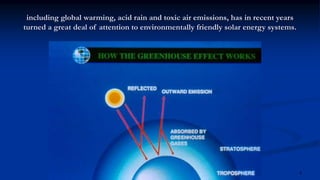
including global warming, acid rain and toxic air emissions, has in recent years
turned a great deal of attention to environmentally friendly solar energy systems.
5Solar Wonders, ©2007 Florida Solar Energy Center
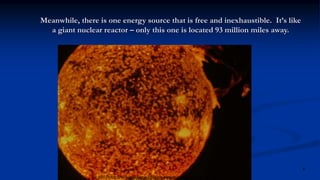
Meanwhile, there is one energy source that is free and inexhaustible. It’s like
a giant nuclear reactor – only this one is located 93 million miles away.
Solar Wonders, ©2007 Florida Solar Energy Center
6
© 2007 Florida Solar Energy Center (FSEC), a research institute of the University of Central Florida.
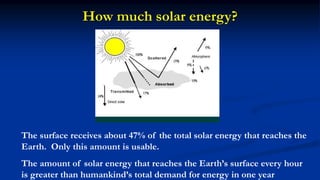
How much solar energy?
The surface receives about 47% of the total solar energy that reaches the
Earth. Only this amount is usable.
The amount of solar energy that reaches the Earth’s surface every hour
is greater than humankind’s total demand for energy in one year
Solar Energy Basics
Thermal and PV
Overview
 Solar Energy Potential
 Non-Electric Solar Power
 Solar Generated Electricity
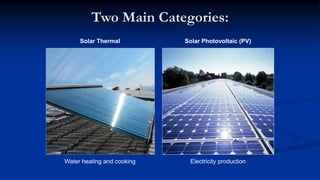
Two Main Categories:
Solar Thermal Solar Photovoltaic (PV)
Water heating and cooking Electricity production
Non-Electric Solar Power
Solar Water Heating
Passive Solar Heating/Lighting
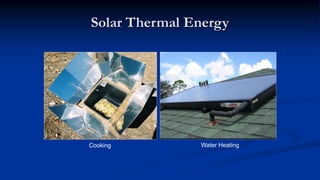
Solar Thermal Energy
Cooking Water Heating
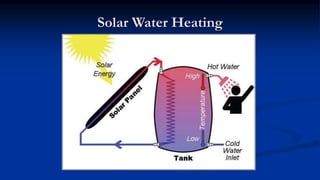
Solar Water Heating
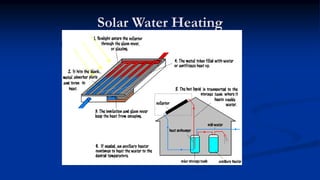
Solar Water Heating
Solar Water Heating
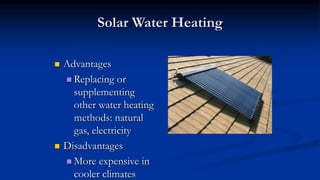
 Advantages
 Replacing or
supplementing
other water heating
methods: natural
gas, electricity
 Disadvantages
 More expensive in
cooler climates
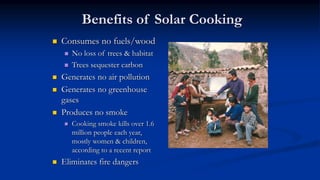
Benefits of Solar Cooking
 Consumes no fuels/wood
 No loss of trees & habitat
 Trees sequester carbon
 Generates no air pollution
 Generates no greenhouse
gases
 Produces no smoke
 Cooking smoke kills over 1.6
million people each year,
mostly women & children,
according to a recent report
 Eliminates fire dangers
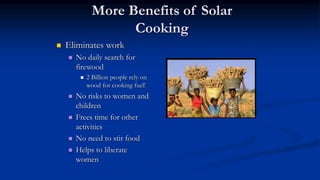
More Benefits of Solar
Cooking
 Eliminates work
 No daily search for
firewood
 2 Billion people rely on
wood for cooking fuel!
 No risks to women and
children
 Frees time for other
activities
 No need to stir food
 Helps to liberate
women
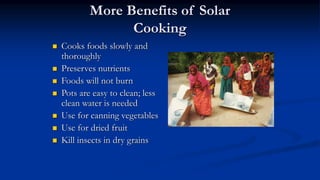
More Benefits of Solar
Cooking
 Cooks foods slowly and
thoroughly
 Preserves nutrients
 Foods will not burn
 Pots are easy to clean; less
clean water is needed
 Use for canning vegetables
 Use for dried fruit
 Kill insects in dry grains
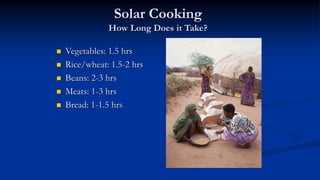
Solar Cooking
How Long Does it Take?
 Vegetables: 1.5 hrs
 Rice/wheat: 1.5-2 hrs
 Beans: 2-3 hrs
 Meats: 1-3 hrs
 Bread: 1-1.5 hrs
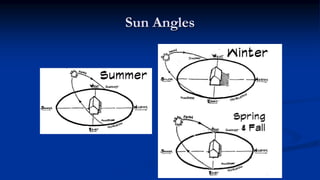
Sun Angles
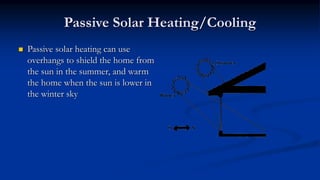
Passive Solar Heating/Cooling
 Passive solar heating can use
overhangs to shield the home from
the sun in the summer, and warm
the home when the sun is lower in
the winter sky
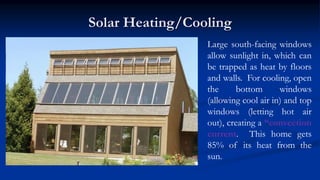
Solar Heating/Cooling
Large south-facing windows
allow sunlight in, which can
be trapped as heat by floors
and walls. For cooling, open
the bottom windows
(allowing cool air in) and top
windows (letting hot air
out), creating a “convection
current. This home gets
85% of its heat from the
sun.
Non-Electric Solar Power &
Energy Independence
 Lowered Energy Consumption
 Broadening of Energy Portfolio
 Reduced Need for Fossil Fuel Imports
Solar Generated Electricity
Concentrating Solar Power
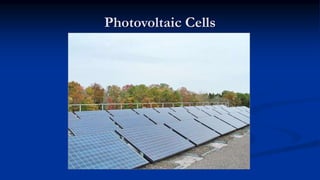
Photovoltaic (PV) Cells
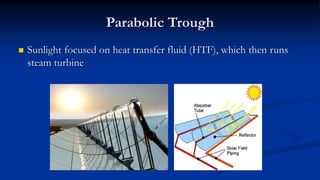
Parabolic Trough
 Sunlight focused on heat transfer fluid (HTF), which then runs
steam turbine
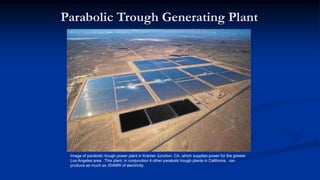
Parabolic Trough Generating Plant
Image of parabolic trough power plant in Kramer Junction, CA, which supplies power for the greater
Los Angeles area. This plant, in conjunction 4 other parabolic trough plants in California, can
produce as much as 354MW of electricity.
Photovoltaic Cells
How Does it Work?
 Sunlight is composed of photons, or bundles of radiant
energy. When photons strike a PV cell, they may be
reflected or absorbed (transmitted through the cell). Only
the absorbed photons generate electricity. When the
photons are absorbed, the energy of the photons is
transferred to electrons in the atoms of the solar cell.
How Does it Work?
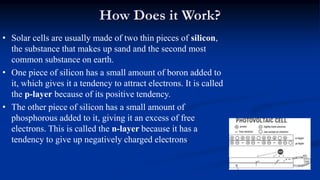
• Solar cells are usually made of two thin pieces of silicon,
the substance that makes up sand and the second most
common substance on earth.
• One piece of silicon has a small amount of boron added to
it, which gives it a tendency to attract electrons. It is called
the p-layer because of its positive tendency.
• The other piece of silicon has a small amount of
phosphorous added to it, giving it an excess of free
electrons. This is called the n-layer because it has a
tendency to give up negatively charged electrons.
How Does it Work?
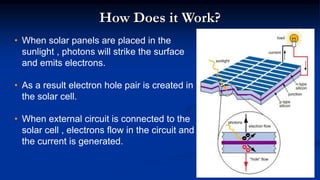
• When solar panels are placed in the
sunlight , photons will strike the surface
and emits electrons.
• As a result electron hole pair is created in
the solar cell.
• When external circuit is connected to the
solar cell , electrons flow in the circuit and
the current is generated.
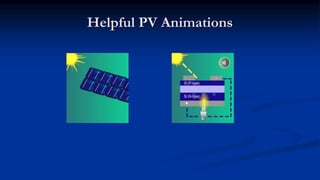
Helpful PV Animations
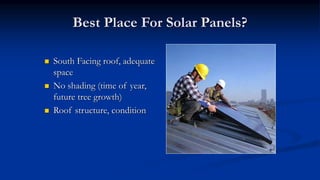
Best Place For Solar Panels?
 South Facing roof, adequate
space
 No shading (time of year,
future tree growth)
 Roof structure, condition
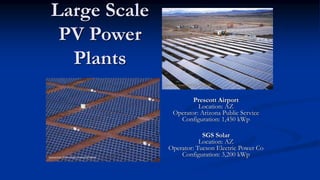
Large Scale
PV Power
Plants
Prescott Airport
Location: AZ
Operator: Arizona Public Service
Configuration: 1,450 kWp
SGS Solar
Location: AZ
Operator: Tucson Electric Power Co
Configuration: 3,200 kWp
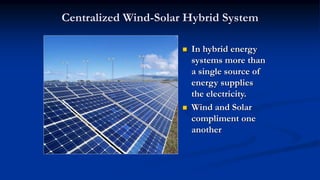
Centralized Wind-Solar Hybrid System
 In hybrid energy
systems more than
a single source of
energy supplies
the electricity.
 Wind and Solar
compliment one
another
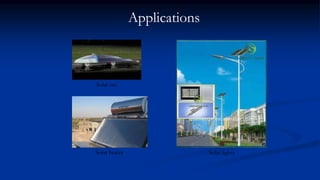
Solar car
Solar heater Solar lights
Applications
Hydrogen
 Hydrogen can be used as an energy carrier
 Hydrogen can be created from water through a process called “electrolysis”
 DC current is used to split water into hydrogen and oxygen
 Energy from renewable sources, like solar power, can be used to
manufacture hydrogen
 Commercial feasibility of solar generated hydrogen is far off
USES OF SOLAR ENERGY
• Heaters Green houses
• Cars water pumps
• Lights Desalination
• Satellites Chilling
• Dryers Solar ponds
• Calculators Thermal
• Commercial use
On an office building , roof areas can be covered with solar
panels .
• Remote buildings such as schools , communities can
make use of solar energy.
• In developing countries , this solar panels are very much
useful.
• Even on the highways , for every five kilometres ,solar
telephones are used.
BETTER WAYS OF USAGE
• Government should take measures and see
that solar lights are used as street lights in all
the areas.
• We can place solar panels in the barren lands
instead of keeping it away uselessly.
• We can also keep these solar panels in the
deserts , where we can make use of this
energy with the help of a rechargeable battery.
• Building a new home is the best time to
design and orient the home to take the
advantage of the sun’s rays.
Distributed Solar Power and Energy
Independence
 The ultimate in Energy Independence – self-sufficiency
 Consumers becoming “producers”
Price
 Still not “price-competitive” with traditional sources of electricity
 “If you don't include the environmental costs of coal-fired electricity when comparing them with
solar, it becomes very difficult. [Saving money] is not what motivates me and if that's all that
motivates the consumer, then perhaps solar isn't for them.”
 Dr. Richard Corkish, University of New South Wales, School of Photovoltaic and Renewable Energy
Engineering
 “Paying for Itself ”
 Ability of a PV system to “pay for itself” depends on the size of the installation, electricity demands
it is meeting.
 Residential PV system may “pay for itself” within first half of its estimated lifespan (30 years)
The End
Solar energy ppt

Solar energy ppt

  • 1.
  • 3.
    Solar Energy: The UltimateRenewable Resource
  • 4.
    The nonrenewable sourceswe use today – including coal, oil, kerosene, diesel, propane and natural gas – are all limited in availability, and are also partly to blame 4Solar Wonders, ©2007 Florida Solar Energy Center © 2007 Florida Solar Energy Center (FSEC), a research institute of the University of Central Florida.
  • 5.
    including global warming,acid rain and toxic air emissions, has in recent years turned a great deal of attention to environmentally friendly solar energy systems. 5Solar Wonders, ©2007 Florida Solar Energy Center
  • 6.
    Meanwhile, there isone energy source that is free and inexhaustible. It’s like a giant nuclear reactor – only this one is located 93 million miles away. Solar Wonders, ©2007 Florida Solar Energy Center 6 © 2007 Florida Solar Energy Center (FSEC), a research institute of the University of Central Florida.
  • 7.
    How much solarenergy? The surface receives about 47% of the total solar energy that reaches the Earth. Only this amount is usable. The amount of solar energy that reaches the Earth’s surface every hour is greater than humankind’s total demand for energy in one year
  • 9.
  • 10.
    Overview  Solar EnergyPotential  Non-Electric Solar Power  Solar Generated Electricity
  • 11.
    Two Main Categories: SolarThermal Solar Photovoltaic (PV) Water heating and cooking Electricity production
  • 14.
    Non-Electric Solar Power SolarWater Heating Passive Solar Heating/Lighting
  • 15.
  • 16.
  • 17.
  • 18.
    Solar Water Heating Advantages  Replacing or supplementing other water heating methods: natural gas, electricity  Disadvantages  More expensive in cooler climates
  • 19.
    Benefits of SolarCooking  Consumes no fuels/wood  No loss of trees & habitat  Trees sequester carbon  Generates no air pollution  Generates no greenhouse gases  Produces no smoke  Cooking smoke kills over 1.6 million people each year, mostly women & children, according to a recent report  Eliminates fire dangers
  • 20.
    More Benefits ofSolar Cooking  Eliminates work  No daily search for firewood  2 Billion people rely on wood for cooking fuel!  No risks to women and children  Frees time for other activities  No need to stir food  Helps to liberate women
  • 21.
    More Benefits ofSolar Cooking  Cooks foods slowly and thoroughly  Preserves nutrients  Foods will not burn  Pots are easy to clean; less clean water is needed  Use for canning vegetables  Use for dried fruit  Kill insects in dry grains
  • 22.
    Solar Cooking How LongDoes it Take?  Vegetables: 1.5 hrs  Rice/wheat: 1.5-2 hrs  Beans: 2-3 hrs  Meats: 1-3 hrs  Bread: 1-1.5 hrs
  • 23.
  • 24.
    Passive Solar Heating/Cooling Passive solar heating can use overhangs to shield the home from the sun in the summer, and warm the home when the sun is lower in the winter sky
  • 25.
    Solar Heating/Cooling Large south-facingwindows allow sunlight in, which can be trapped as heat by floors and walls. For cooling, open the bottom windows (allowing cool air in) and top windows (letting hot air out), creating a “convection current. This home gets 85% of its heat from the sun.
  • 26.
    Non-Electric Solar Power& Energy Independence  Lowered Energy Consumption  Broadening of Energy Portfolio  Reduced Need for Fossil Fuel Imports
  • 27.
    Solar Generated Electricity ConcentratingSolar Power Photovoltaic (PV) Cells
  • 28.
    Parabolic Trough  Sunlightfocused on heat transfer fluid (HTF), which then runs steam turbine
  • 29.
    Parabolic Trough GeneratingPlant Image of parabolic trough power plant in Kramer Junction, CA, which supplies power for the greater Los Angeles area. This plant, in conjunction 4 other parabolic trough plants in California, can produce as much as 354MW of electricity.
  • 30.
  • 31.
    How Does itWork?  Sunlight is composed of photons, or bundles of radiant energy. When photons strike a PV cell, they may be reflected or absorbed (transmitted through the cell). Only the absorbed photons generate electricity. When the photons are absorbed, the energy of the photons is transferred to electrons in the atoms of the solar cell.
  • 32.
    How Does itWork? • Solar cells are usually made of two thin pieces of silicon, the substance that makes up sand and the second most common substance on earth. • One piece of silicon has a small amount of boron added to it, which gives it a tendency to attract electrons. It is called the p-layer because of its positive tendency. • The other piece of silicon has a small amount of phosphorous added to it, giving it an excess of free electrons. This is called the n-layer because it has a tendency to give up negatively charged electrons.
  • 33.
    How Does itWork? • When solar panels are placed in the sunlight , photons will strike the surface and emits electrons. • As a result electron hole pair is created in the solar cell. • When external circuit is connected to the solar cell , electrons flow in the circuit and the current is generated.
  • 34.
  • 35.
    Best Place ForSolar Panels?  South Facing roof, adequate space  No shading (time of year, future tree growth)  Roof structure, condition
  • 36.
    Large Scale PV Power Plants PrescottAirport Location: AZ Operator: Arizona Public Service Configuration: 1,450 kWp SGS Solar Location: AZ Operator: Tucson Electric Power Co Configuration: 3,200 kWp
  • 37.
    Centralized Wind-Solar HybridSystem  In hybrid energy systems more than a single source of energy supplies the electricity.  Wind and Solar compliment one another
  • 38.
    Solar car Solar heaterSolar lights Applications
  • 39.
    Hydrogen  Hydrogen canbe used as an energy carrier  Hydrogen can be created from water through a process called “electrolysis”  DC current is used to split water into hydrogen and oxygen  Energy from renewable sources, like solar power, can be used to manufacture hydrogen  Commercial feasibility of solar generated hydrogen is far off
  • 40.
    USES OF SOLARENERGY • Heaters Green houses • Cars water pumps • Lights Desalination • Satellites Chilling • Dryers Solar ponds • Calculators Thermal • Commercial use On an office building , roof areas can be covered with solar panels . • Remote buildings such as schools , communities can make use of solar energy. • In developing countries , this solar panels are very much useful. • Even on the highways , for every five kilometres ,solar telephones are used.
  • 41.
    BETTER WAYS OFUSAGE • Government should take measures and see that solar lights are used as street lights in all the areas. • We can place solar panels in the barren lands instead of keeping it away uselessly. • We can also keep these solar panels in the deserts , where we can make use of this energy with the help of a rechargeable battery. • Building a new home is the best time to design and orient the home to take the advantage of the sun’s rays.
  • 42.
    Distributed Solar Powerand Energy Independence  The ultimate in Energy Independence – self-sufficiency  Consumers becoming “producers”
  • 43.
    Price  Still not“price-competitive” with traditional sources of electricity  “If you don't include the environmental costs of coal-fired electricity when comparing them with solar, it becomes very difficult. [Saving money] is not what motivates me and if that's all that motivates the consumer, then perhaps solar isn't for them.”  Dr. Richard Corkish, University of New South Wales, School of Photovoltaic and Renewable Energy Engineering  “Paying for Itself ”  Ability of a PV system to “pay for itself” depends on the size of the installation, electricity demands it is meeting.  Residential PV system may “pay for itself” within first half of its estimated lifespan (30 years)
  • 44.