Nov 27, 2019
Mechanics of Blasting
MECHANICS OF BLASTING
Presented By :
Sudhan Kumar Subedi (Roll. No: 09)
Yuvaraj Poudel (Roll. No : 19 )
Babita Rupakheti (Roll. No: 18 )
Theory of
Rock
Breakage
Using
Explosives
EGE 556
3
Crater
Theory &
its
Application
EGE 556
2
Factors
Affecting
Rock
Breakage
EGE 556
1
Nov 27, 2019
Mechanics of Blasting
Mechanics
of
Blasting
EGE 556
07
Sudhan
Yuvaraj
Babita
90
10
Nov 27, 2019
Mechanics of Blasting
In Rock Drilling, It is estimated
that only 10 % of the input
energy is used to fracture the
rock, while most of the input
energy is wasted as heat or
other forms of energy.
Background
In rock drilling, blasting, crushing and grinding, the effective energy used in rock breakage
is found to be quite small in comparison with total input energy.
97
3
Nov 27, 2019
Mechanics of Blasting
In Comminution, including
the crushing and grinding,
the energy used in the rock
fracture and fragmentation
is 3 % at maximum.
Background
85
15
Nov 27, 2019
Mechanics of Blasting
In Blasting, the energy
used in the rock fracture
and fragmentation varies
from 5 to 15%.
Background
Nov 27, 2019
Mechanics of Blasting
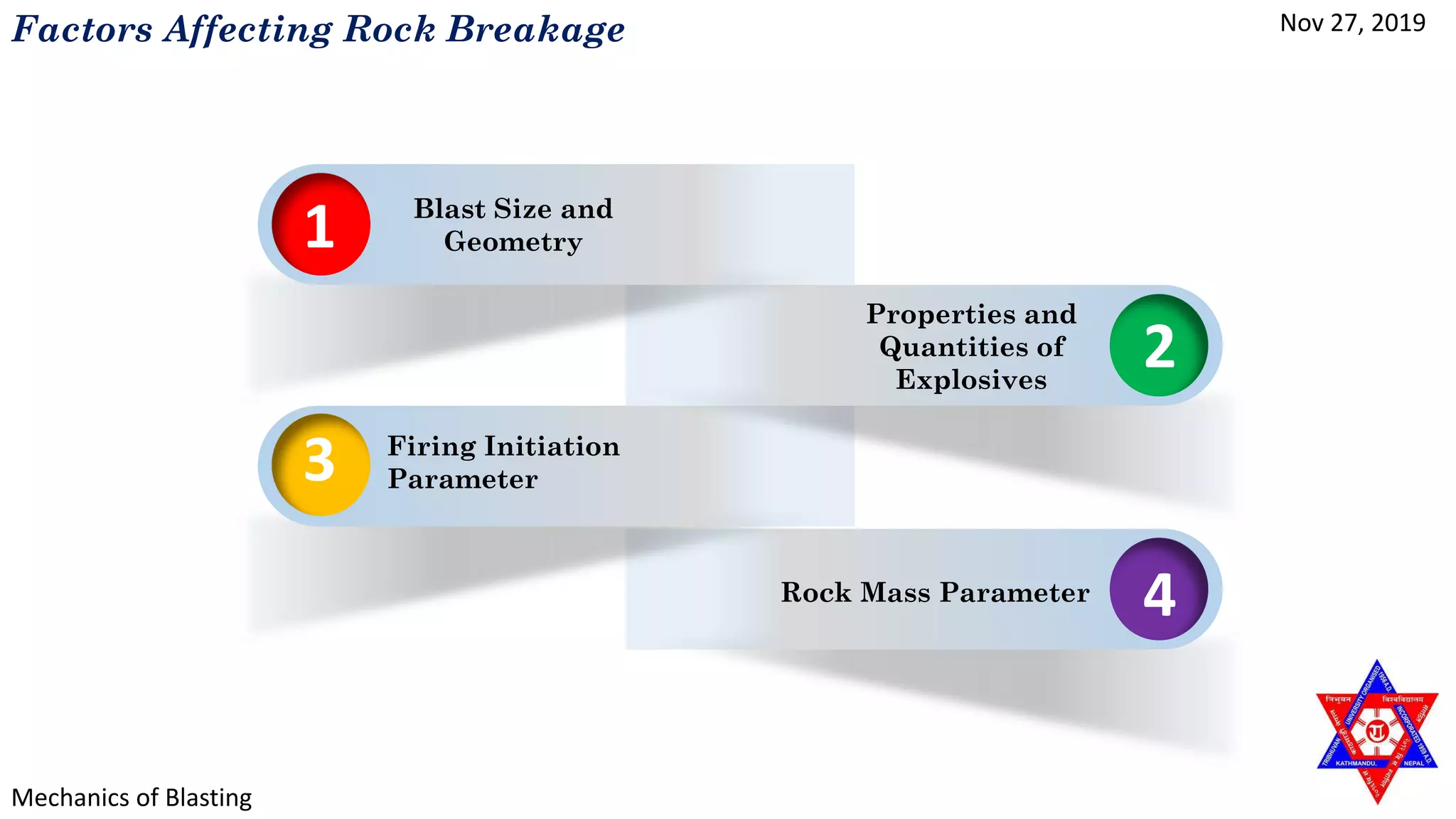
Factors Affecting Rock Breakage
1
4
2
3
Blast Size and
Geometry
Properties and
Quantities of
Explosives
Firing Initiation
Parameter
Rock Mass Parameter
Nov 27, 2019
Mechanics of Blasting
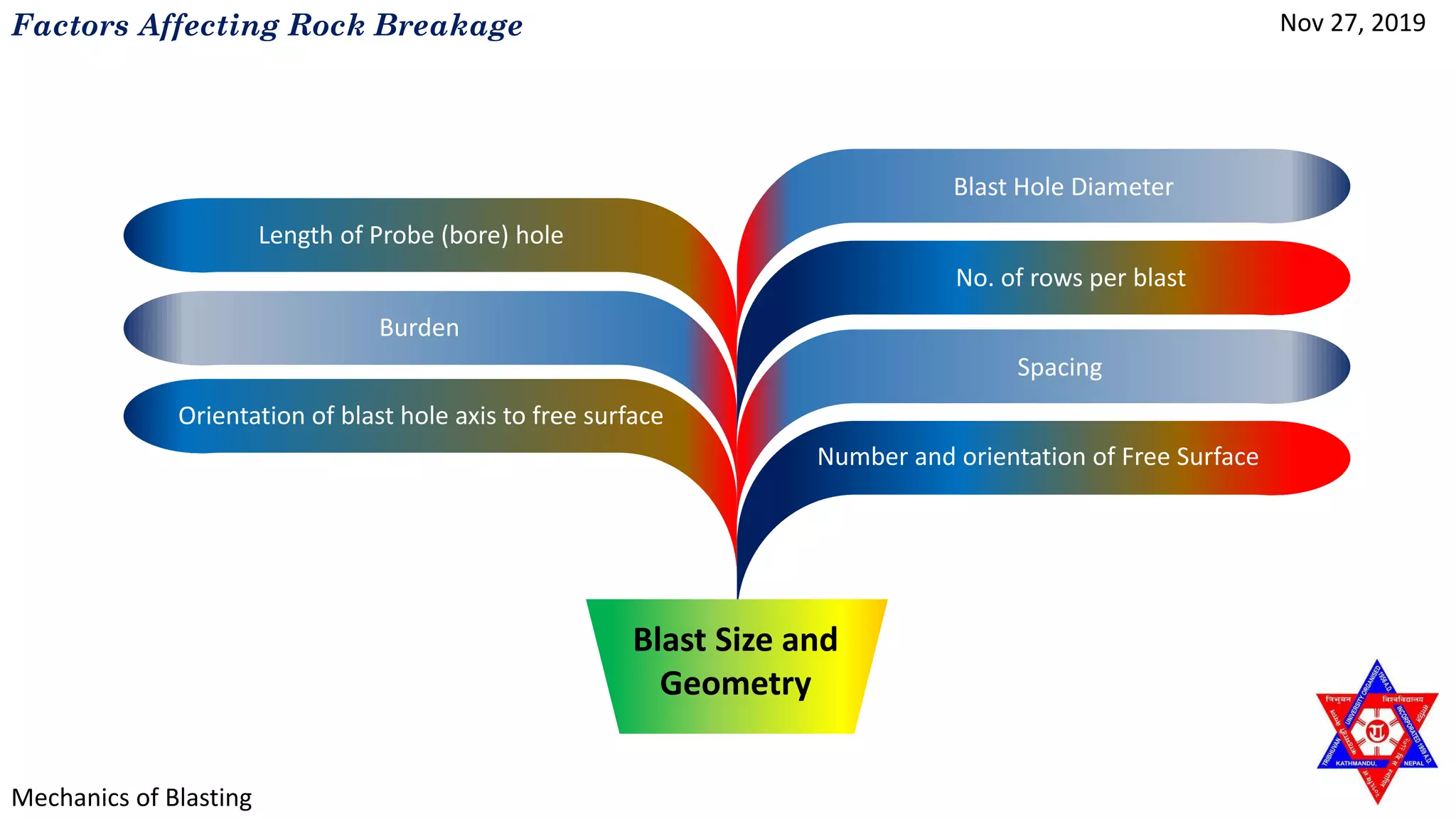
Factors Affecting Rock Breakage
Blast Size and
Geometry
Number and orientation of Free Surface
Orientation of blast hole axis to free surface
Spacing
Burden
No. of rows per blast
Blast Hole Diameter
Number and orientation of Free Surface
Length of Probe (bore) hole
Charged Length of Blast hole
Nov 27, 2019
Mechanics of Blasting
Factors Affecting Rock Breakage
Blast Size and Geometry
Free Surface or Free Face : This is an exposed rock surface towards which the explosive charge can break out. It
resembles a wall. Greater the number of the free surface, more is the fragmentation.
Orientation of Blast hole Axis to Free Surface : resembles the
hole angle. Inclined blast holes allow better distribution of
explosives. Inclined Blast holes are very effective in eliminating
toe (which is a hump of solid rock between the free face and the
bench floor), and back break.
Nov 27, 2019
Mechanics of Blasting
Factors Affecting Rock Breakage
Blast Size and Geometry
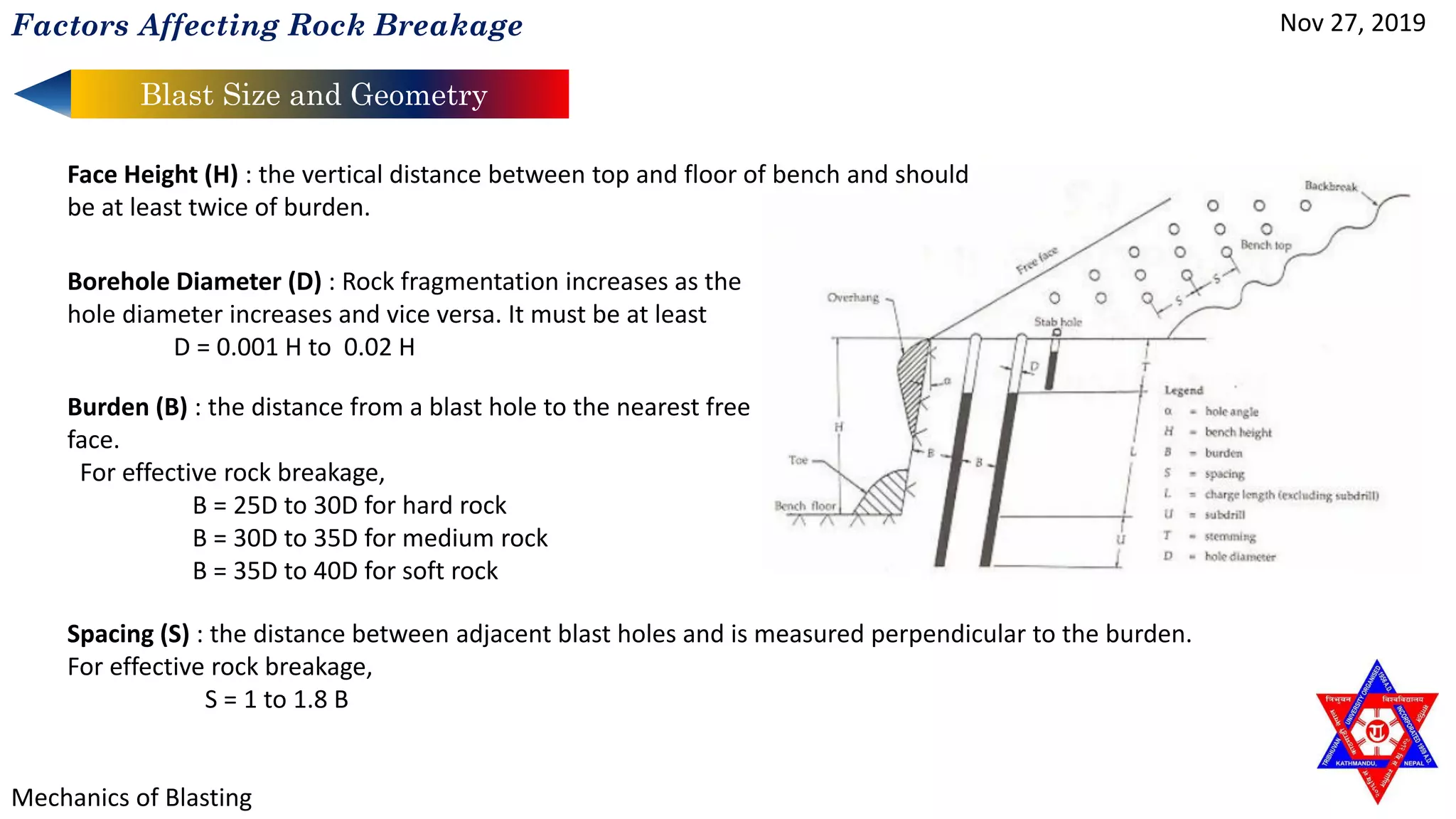
Burden (B) : the distance from a blast hole to the nearest free
face.
For effective rock breakage,
B = 25D to 30D for hard rock
B = 30D to 35D for medium rock
B = 35D to 40D for soft rock
Spacing (S) : the distance between adjacent blast holes and is measured perpendicular to the burden.
For effective rock breakage,
S = 1 to 1.8 B
Face Height (H) : the vertical distance between top and floor of bench and should
be at least twice of burden.
Borehole Diameter (D) : Rock fragmentation increases as the
hole diameter increases and vice versa. It must be at least
D = 0.001 H to 0.02 H
Nov 27, 2019
Mechanics of Blasting
Factors Affecting Rock Breakage
Blast Size and Geometry
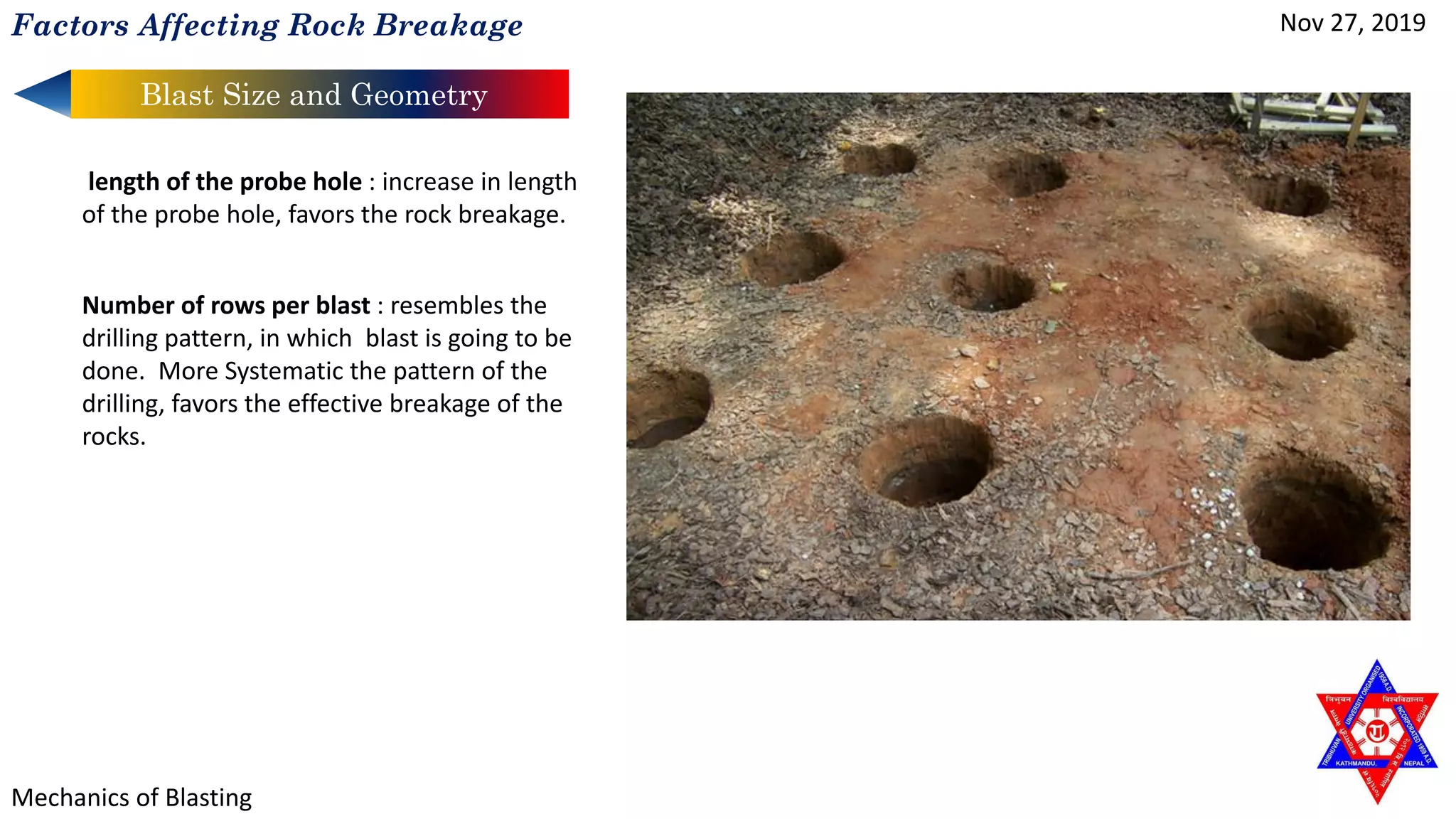
length of the probe hole : increase in length
of the probe hole, favors the rock breakage.
Number of rows per blast : resembles the
drilling pattern, in which blast is going to be
done. More Systematic the pattern of the
drilling, favors the effective breakage of the
rocks.
Nov 27, 2019
Mechanics of Blasting
Factors Affecting Rock Breakage
Blast Size and Geometry
Nov 27, 2019
Mechanics of Blasting
Factors Affecting Rock Breakage
Blast Size and Geometry
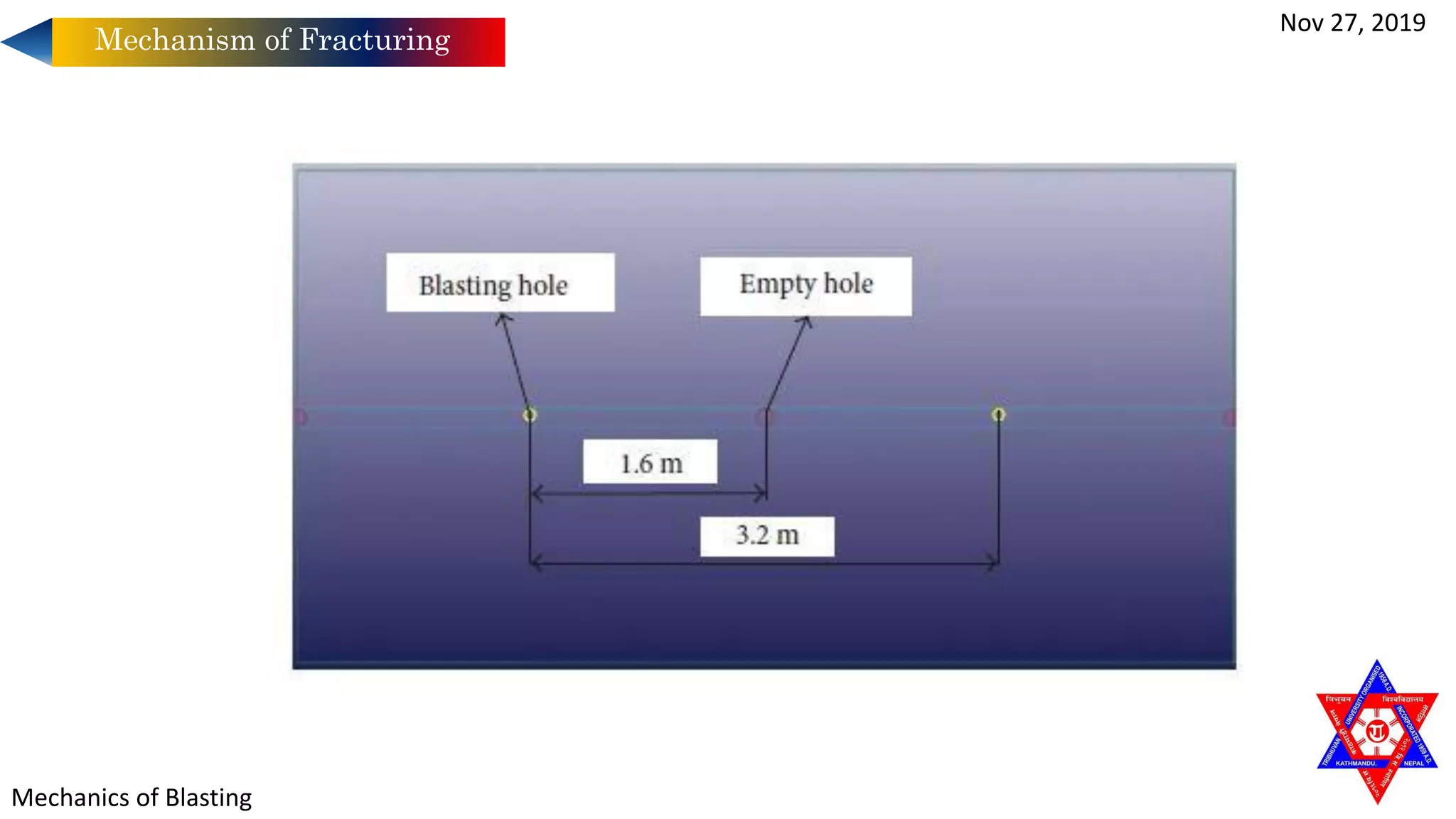
Diameter of empty holes
Larger diameter empty holes provide sufficient space for rock
movement. The empty holes were found to be able to enhance the
effectiveness of pre-split blasting by improving the distribution of
tensile stress in surrounding rocks and guiding the initiation and
growth of the cracks.
Nov 27, 2019
Mechanics of Blasting
Factors Affecting Rock Breakage
Properties and
Quantities of
Explosives
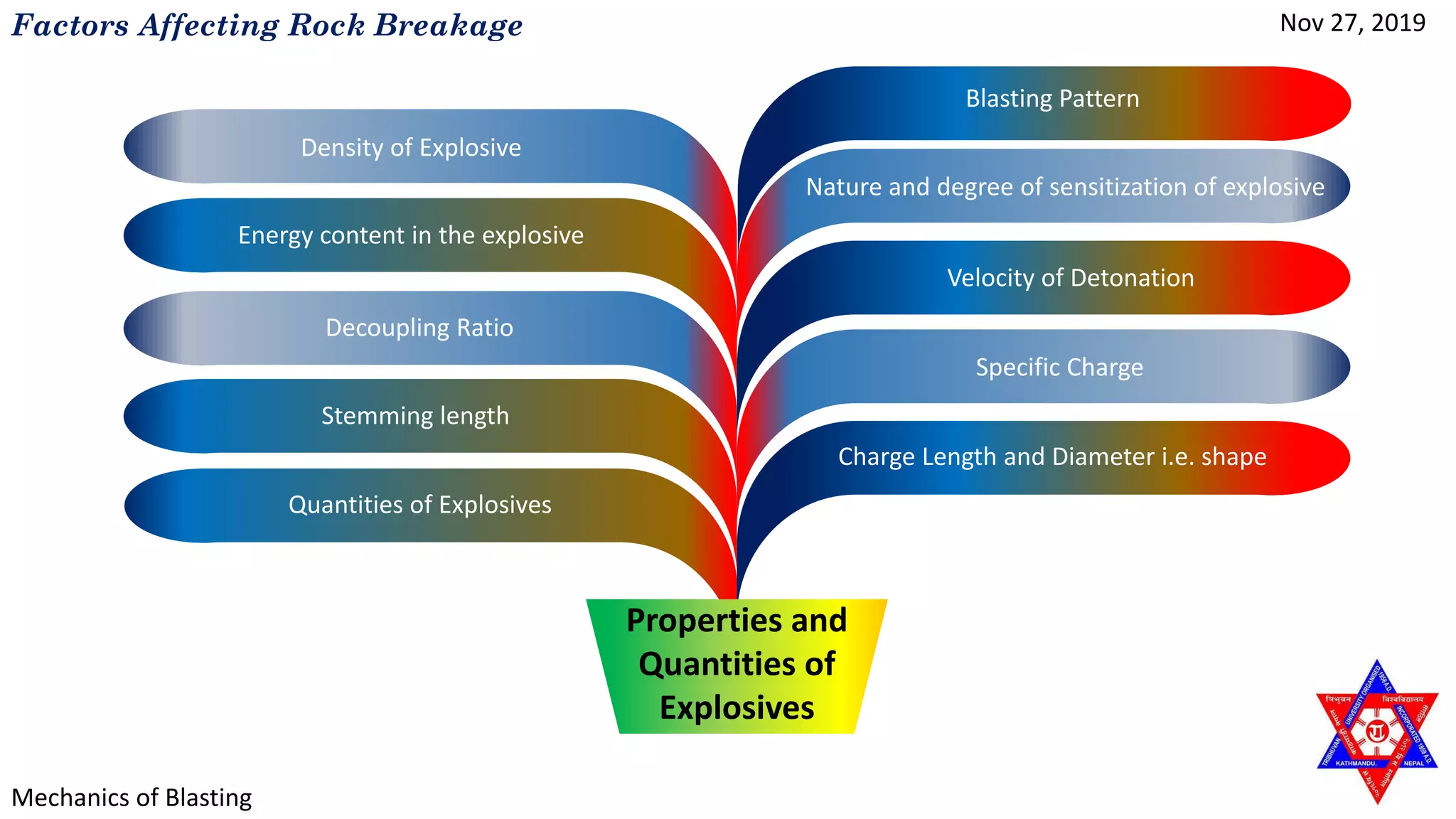
Charge Length and Diameter i.e. shape
Stemming length
Specific Charge
Decoupling Ratio
Velocity of Detonation
Nature and degree of sensitization of explosive
Number and orientation of Free Surface
Energy content in the explosive
Charged Length of Blast holeDensity of Explosive
Blasting Pattern
Quantities of Explosives
Nov 27, 2019
Mechanics of Blasting
Factors Affecting Rock Breakage
Properties and Quantities of Explosives
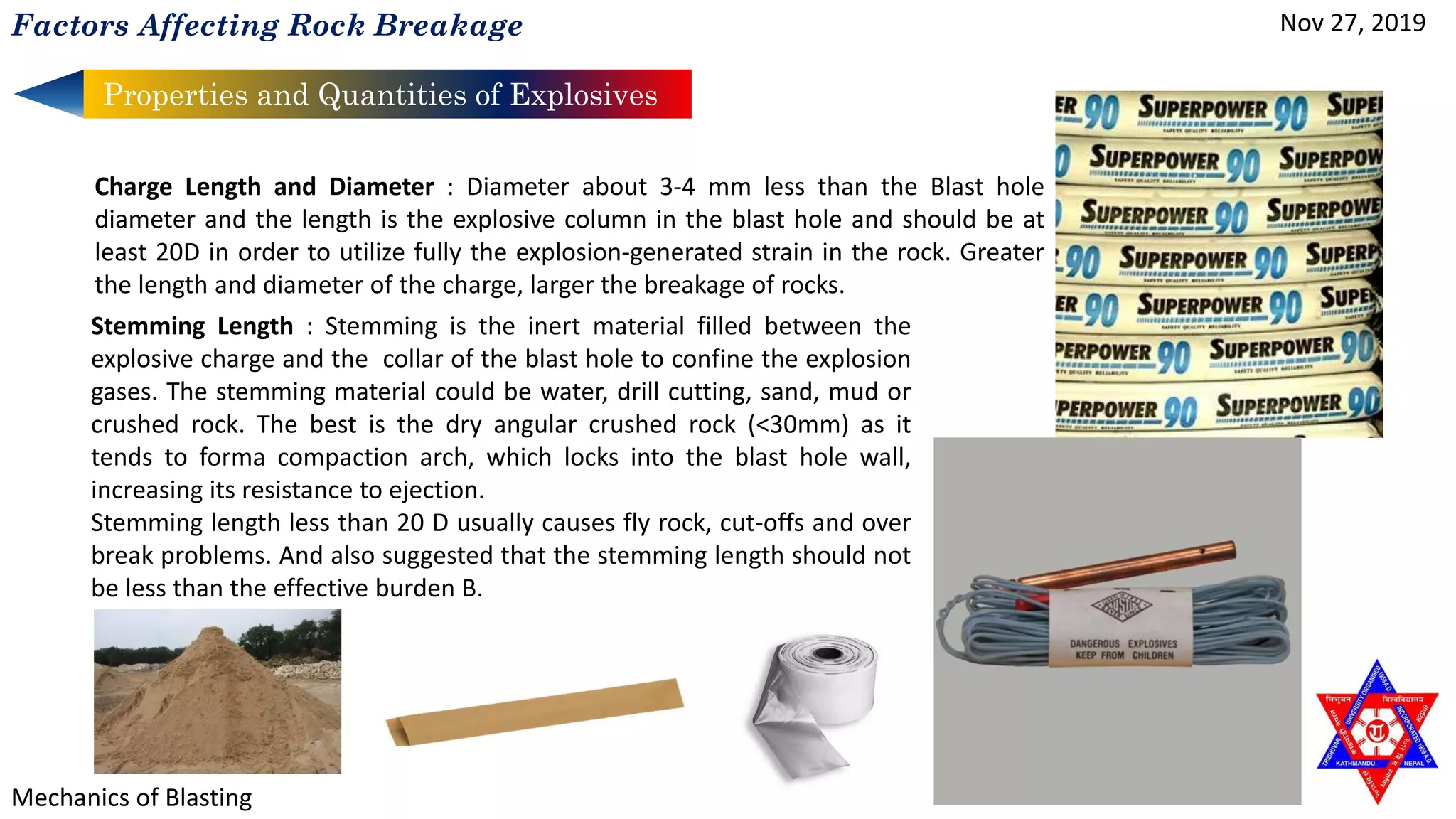
Charge Length and Diameter : Diameter about 3-4 mm less than the Blast hole
diameter and the length is the explosive column in the blast hole and should be at
least 20D in order to utilize fully the explosion-generated strain in the rock. Greater
the length and diameter of the charge, larger the breakage of rocks.
Stemming Length : Stemming is the inert material filled between the
explosive charge and the collar of the blast hole to confine the explosion
gases. The stemming material could be water, drill cutting, sand, mud or
crushed rock. The best is the dry angular crushed rock (<30mm) as it
tends to forma compaction arch, which locks into the blast hole wall,
increasing its resistance to ejection.
Stemming length less than 20 D usually causes fly rock, cut-offs and over
break problems. And also suggested that the stemming length should not
be less than the effective burden B.
Nov 27, 2019
Mechanics of Blasting
Factors Affecting Rock Breakage
Properties and Quantities of Explosives
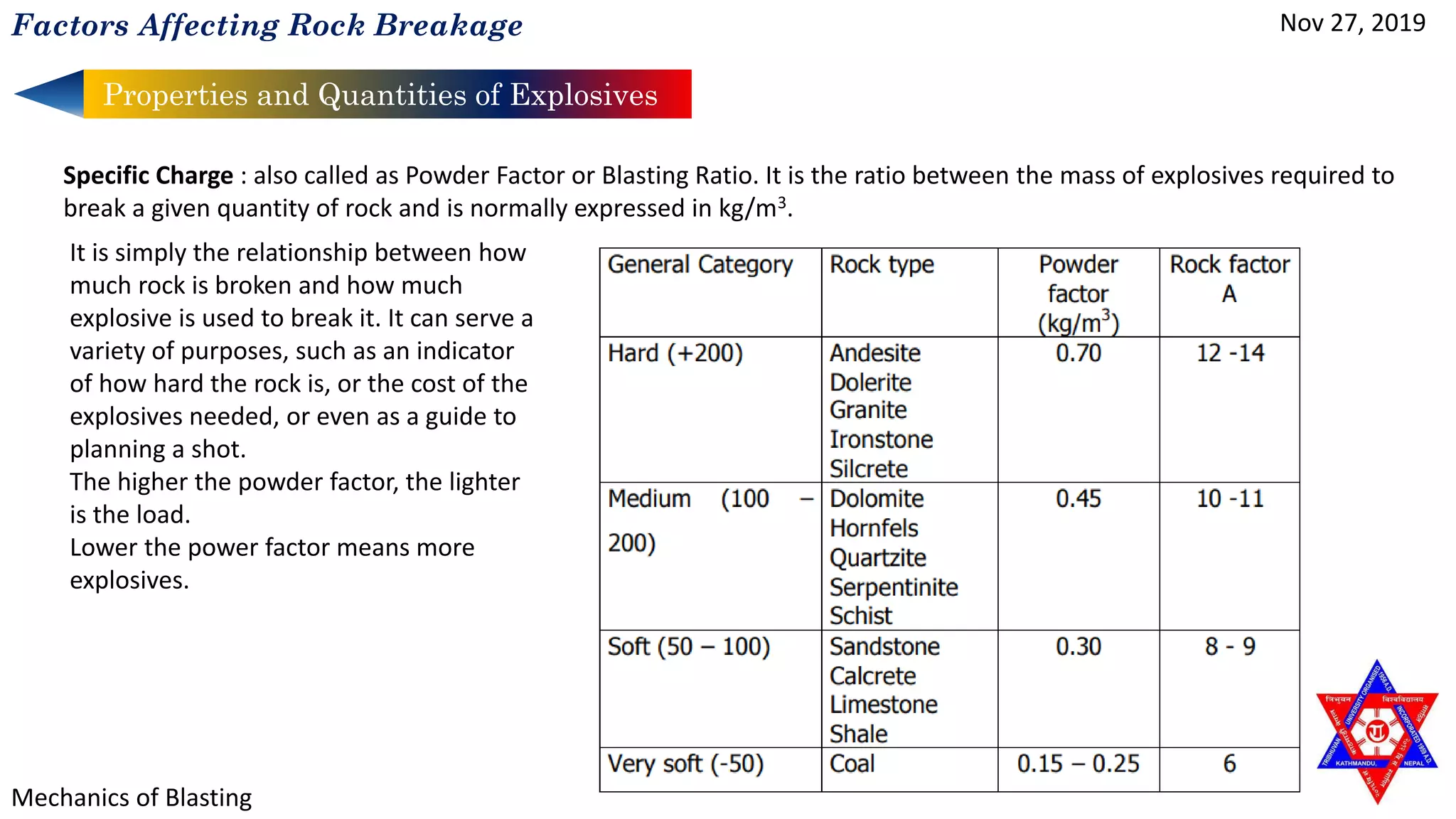
Specific Charge : also called as Powder Factor or Blasting Ratio. It is the ratio between the mass of explosives required to
break a given quantity of rock and is normally expressed in kg/m3.
It is simply the relationship between how
much rock is broken and how much
explosive is used to break it. It can serve a
variety of purposes, such as an indicator
of how hard the rock is, or the cost of the
explosives needed, or even as a guide to
planning a shot.
The higher the powder factor, the lighter
is the load.
Lower the power factor means more
explosives.
Nov 27, 2019
Mechanics of Blasting
Factors Affecting Rock Breakage
Properties and Quantities of Explosives
Decoupling Ratio : Ratio of the diameters of an explosive columns and the blast hole and is usually expressed as
percentage.
For example, if an 88 mm diameter hole is charged with 64 mm diameter cartridges, decoupling ratio is 73 %.
Greater the decoupling ratio, greater the fragmentation of the rocks.
Velocity of Detonation
Energy content of the explosives
Sensitization of explosives
Density of the Explosives
Degree of Rock Fragmentation/Breakage
Nov 27, 2019
Mechanics of Blasting
Factors Affecting Rock Breakage
Properties and Quantities of Explosives
Blasting Pattern
Nov 27, 2019
Mechanics of Blasting
Factors Affecting Rock Breakage
Properties and Quantities of Explosives
Nov 27, 2019
Mechanics of Blasting
Factors Affecting Rock Breakage
Properties and Quantities of Explosives
Quantities of Explosives
When Borehole Diameter is known, the charge can be calculated as :
Q = π (
𝑑
2
)2
(𝑙 𝑏 𝜌 𝑒𝑏+𝑙 𝑐 𝜌 𝑒𝑐)
Where,
Q = total Charge
d = borehole diameter
Lb = length of bottom charge
Lc = length of column charge
Ρeb = density of explosive in the bottom charge
Pec = density of explosive in the column charge
Nov 27, 2019
Mechanics of Blasting
Factors Affecting Rock Breakage
Properties and Quantities of Explosives
Quantities of Explosives
Nov 27, 2019
Mechanics of Blasting
Factors Affecting Rock Breakage
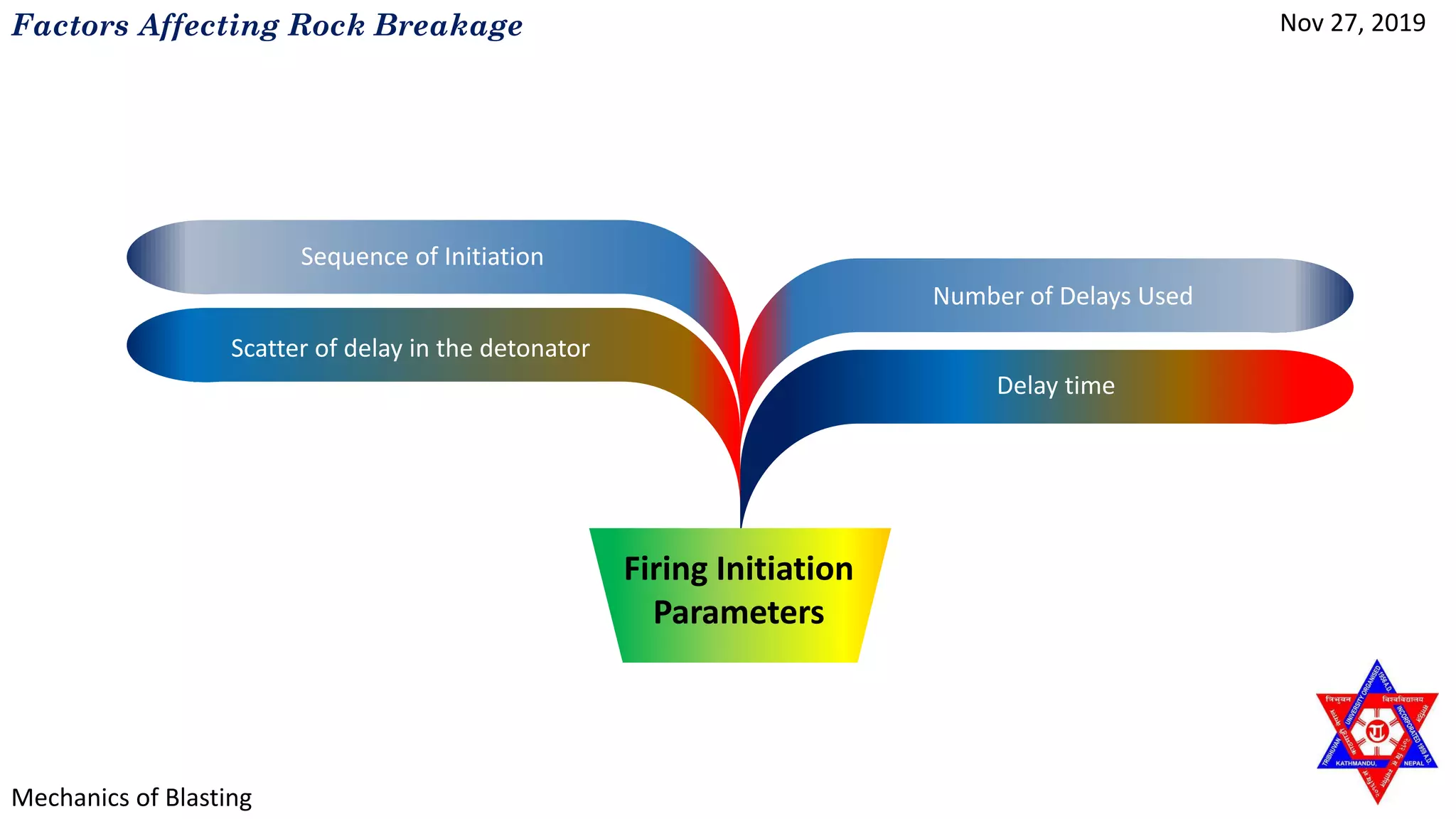
Firing Initiation
Parameters
Delay time
Scatter of delay in the detonator
Number of Delays Used
Sequence of Initiation
Number and orientation of Free Surface
Nov 27, 2019
Mechanics of Blasting
Factors Affecting Rock Breakage
Firing Initiation Parameters
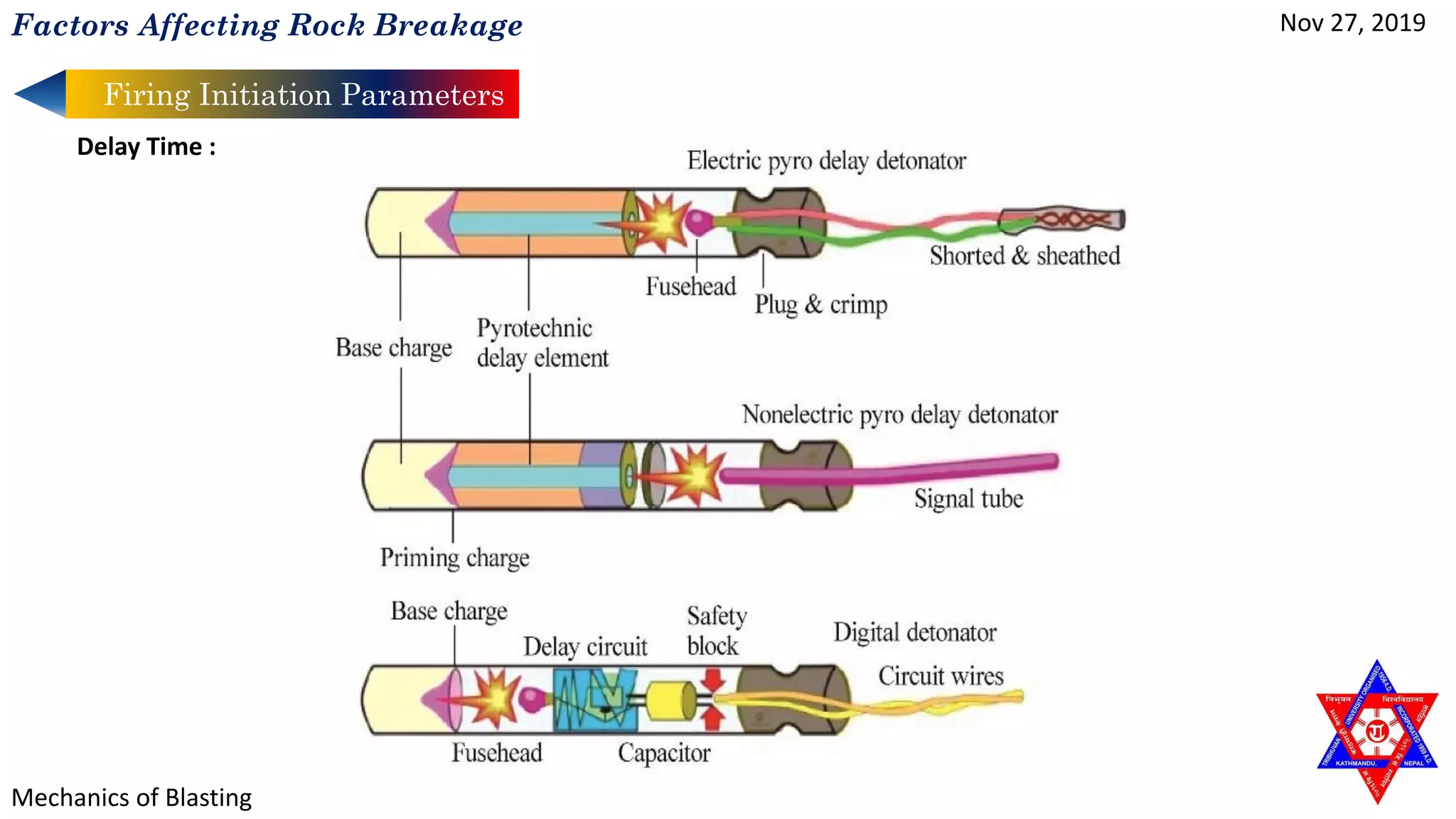
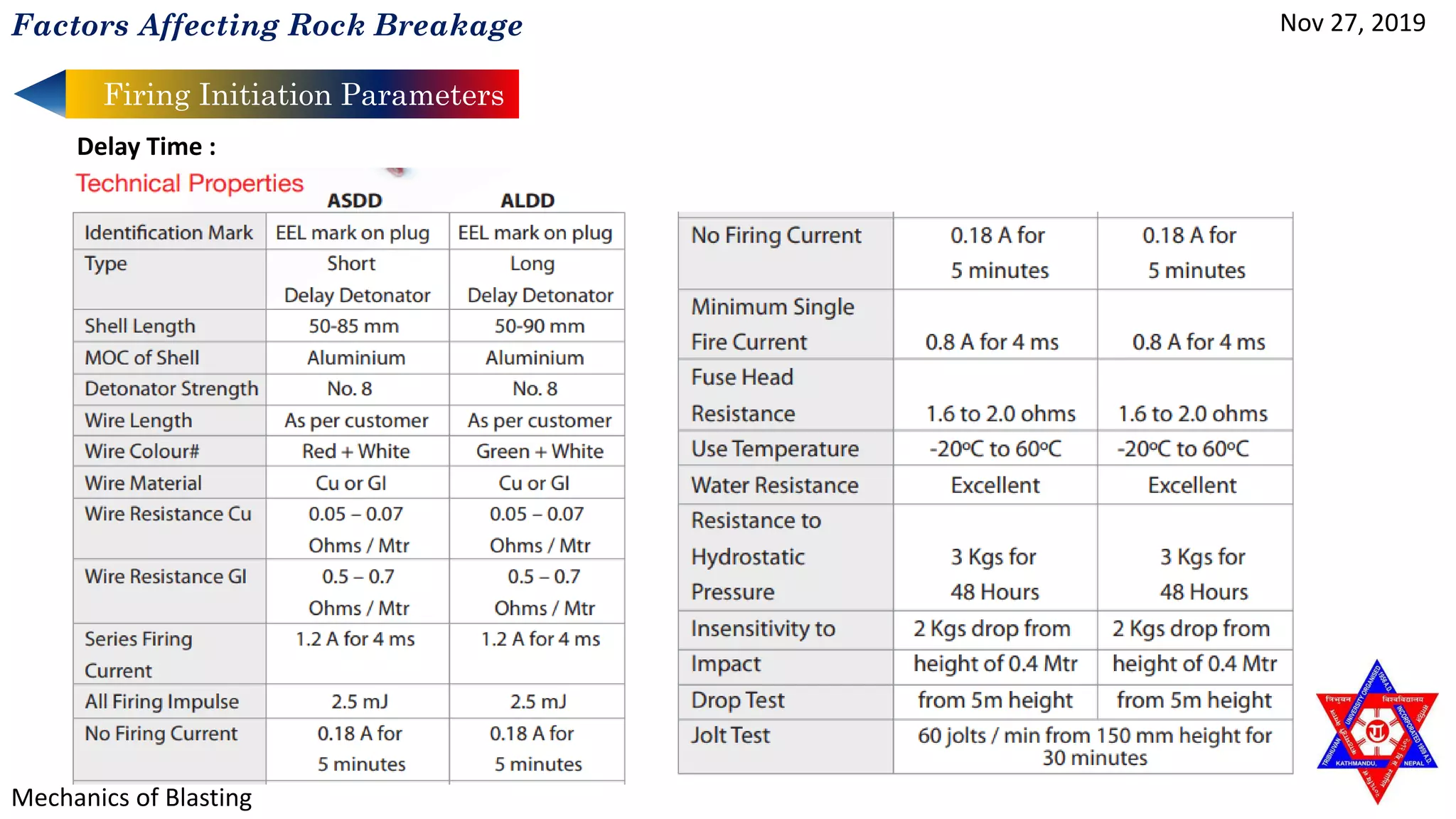
Delay Time :
Nov 27, 2019
Mechanics of Blasting
Factors Affecting Rock Breakage
Firing Initiation Parameters
Delay Time :
Nov 27, 2019
Mechanics of Blasting
Factors Affecting Rock Breakage
Firing Initiation Parameters
Delay Time :
Nov 27, 2019
Mechanics of Blasting
Factors Affecting Rock Breakage
Firing Initiation Parameters
Scatter of Delay in the detonator :
Delay Detonator , detonate after sometimes depending
upon the delay elements introduced inside the
detonators. Due to some practical limitations, all the
delay detonators show some amount scatter in the
detonating time from their specified delay time.
Changes of timing between charges may result in altered
firing order and failure of the blasting sequence, which
can cause high vibration levels, poor fragmentation,
and/or an undesirable rock mass movement direction.
Number of Delays Used
Sequence of Initiation
Nov 27, 2019
Mechanics of Blasting
Factors Affecting Rock Breakage
Firing Initiation Parameters
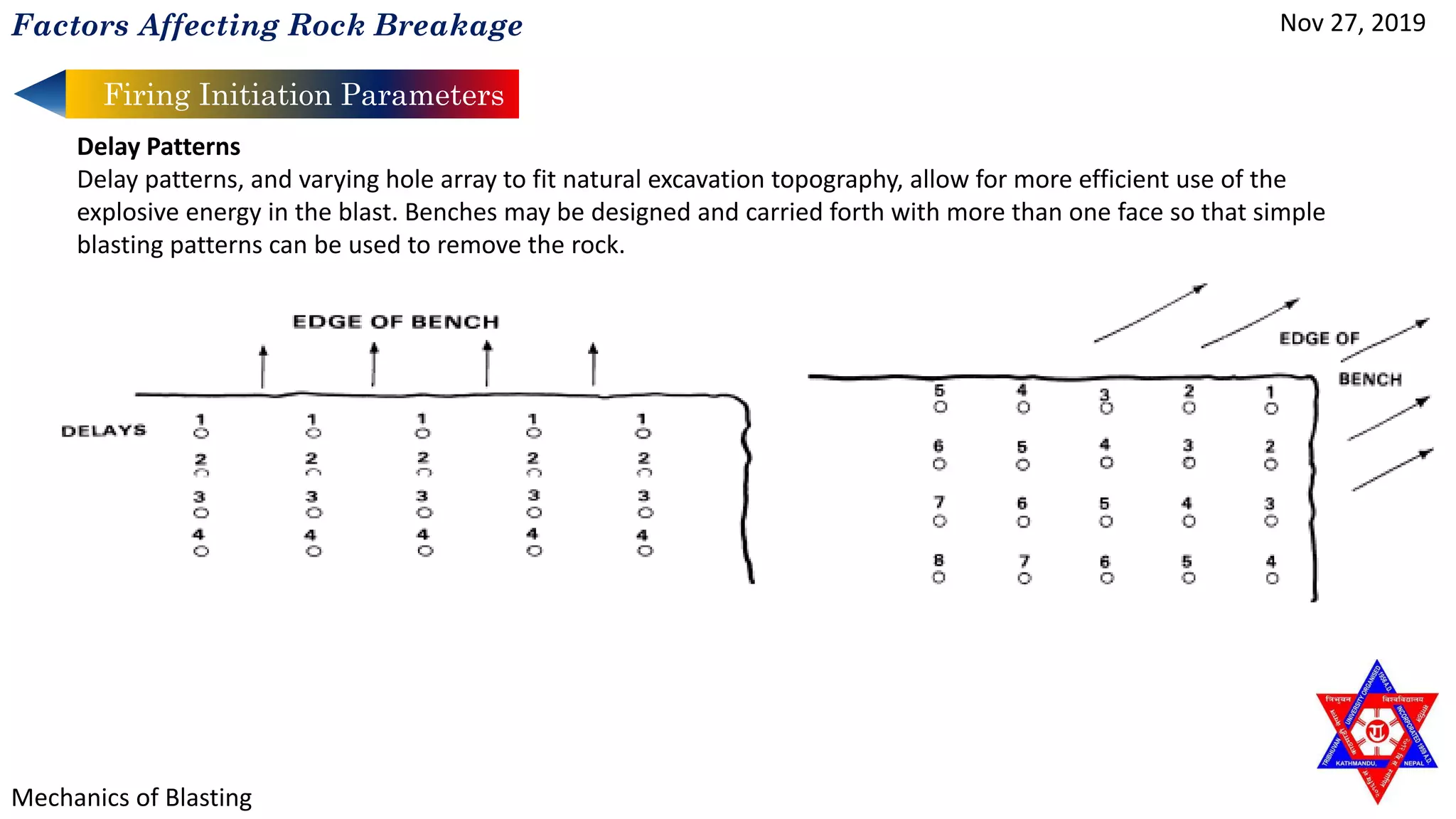
Delay Patterns
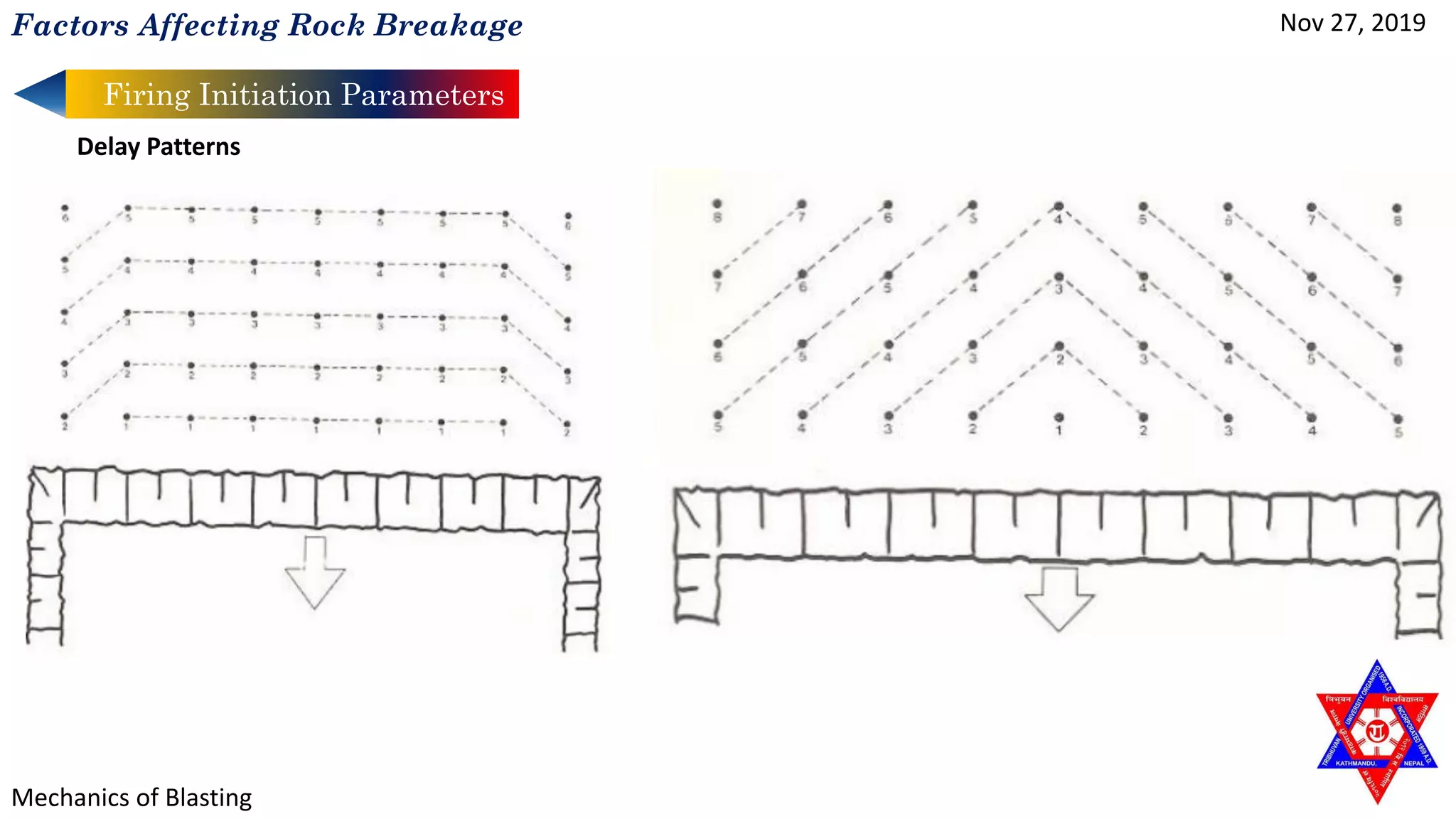
Delay patterns, and varying hole array to fit natural excavation topography, allow for more efficient use of the
explosive energy in the blast. Benches may be designed and carried forth with more than one face so that simple
blasting patterns can be used to remove the rock.
Nov 27, 2019
Mechanics of Blasting
Factors Affecting Rock Breakage
Firing Initiation Parameters
Delay Patterns
Nov 27, 2019
Mechanics of Blasting
Factors Affecting Rock Breakage
Rock Mass
Parameters
Dynamic Tensile Strength
Young’s Modulus, Poisson’s Ratio
Fracture Toughness
Number of Discontinuities
Orientation of Discontinuities
Joint Filling Materials
Number and orientation of Free Surface
Joint Frequency
Charged Length of Blast holeFault or Crushing zones, directions and
weathering
Shear Strength, Cohesion, ɸ
Dynamic Compressive Strength
Nov 27, 2019
Mechanics of Blasting
Mechanism of Fracturing
After Deep-hole Blasting of rock mass
Results
Stress near a blast hole, that exceeds the rock dynamics compressive strength that combined with high strain rate
Creates
Crushed Zone
This process can consume the majority of the energy released by blasting. Meanwhile, the stress waves decay into compression
waves along the boundary of the crushed zone and reverse stress relief produces a tangential force, which then induces radial
cracks. As wing crack develop, the main and wing cracks will form an initial concentric fracture network (fractured zone, Stage I).
Nov 27, 2019
Mechanics of Blasting
Mechanism of Fracturing
After Initial Cracks formation
The products of detonation fill space in the fracture network and exert quasi-static loads on fracture tips leading to
Secondary fracture extension (fractured zone, Stage II).
At same time ,
Stress waves reflected from the free surface of empty hole induce tensile stress and thus stimulate the formation and transfixion
of complex fractures including the tensile main cracks and annular wing cracks. The complex fractures then interconnect with the
cracks induced by detonation gas to form the pre-splitting cracks and a fracture network between blasting holes.
Nov 27, 2019
Mechanics of Blasting
Mechanism of Fracturing
Nov 27, 2019
Mechanics of Blasting
Mechanism of Fracturing
Nov 27, 2019
Mechanics of Blasting
Mechanism of Fracturing
109.3 microsecond
Nov 27, 2019
Mechanics of Blasting
Mechanism of Fracturing
199.2 microseconds
Nov 27, 2019
Mechanics of Blasting
Mechanism of Fracturing
449.8 microsecond
Nov 27, 2019
Mechanics of Blasting
Mechanism of Fracturing
552.5 microseconds
Nov 27, 2019
Mechanics of Blasting
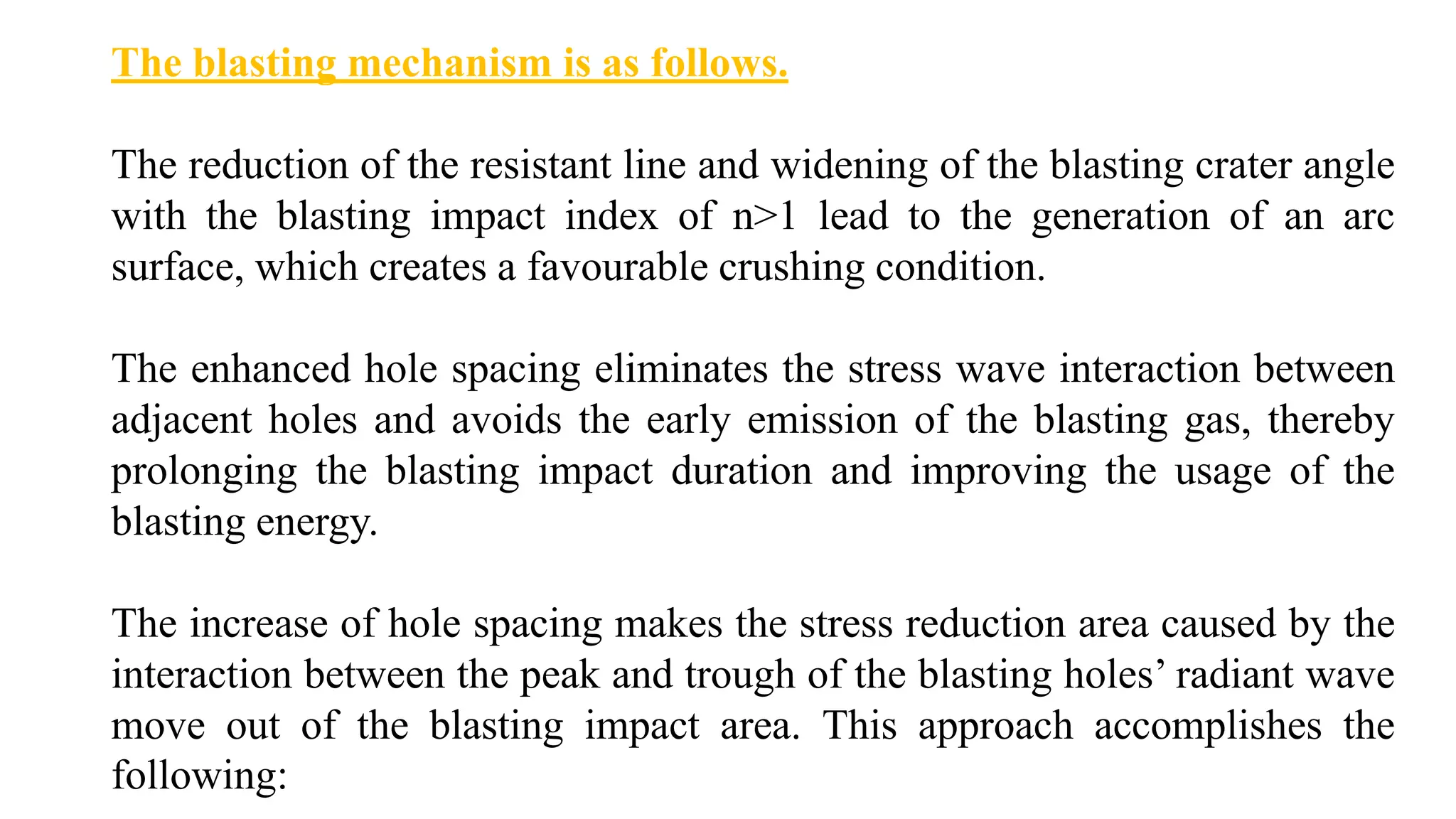
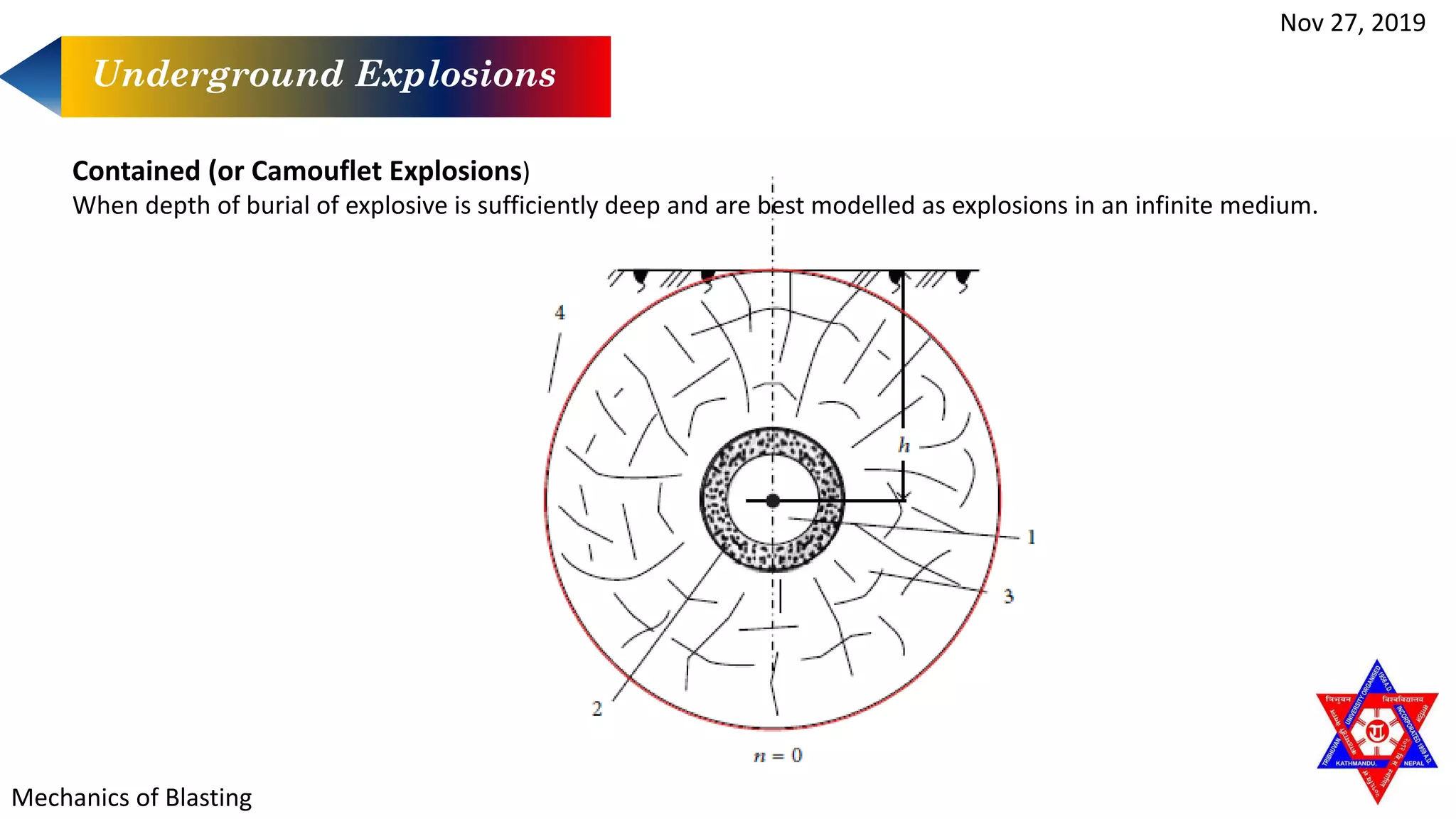
Underground Explosions
1
2
3
Contained (or Camouflet
explosions)
Bulging Explosions
Cratering Explosions
(Contained in Syllabus)
Nov 27, 2019
Mechanics of Blasting
Underground Explosions
Contained (or Camouflet Explosions)
When depth of burial of explosive is sufficiently deep and are best modelled as explosions in an infinite medium.
Nov 27, 2019
Mechanics of Blasting
Underground Explosions
Bulging Explosions
Occurs when the depth of burial of the explosive is within a certain range and are best modelled as
explosions in a semi-infinite medium.
Nov 27, 2019
Mechanics of Blasting
Underground Explosions
Cratering Explosions
It may occurs in various ways when the depth of burial of the explosive is relatively shallow and they are best modelled
as explosions in a semi-infinite medium.
Second Critical Depth of Burial (FCDOB) : critical depth which forms the dividing line between a bulging
explosion and cratering explosions
First Critical Depth of Burial (FCDOB) : critical depth which forms the dividing line between a contained
explosion and bulging explosions
Nov 27, 2019
Mechanics of Blasting
Thank You ! Now,
Let’s WELCOME TO
Mr. Yuvaraj Poudel
CRATER THEORY AND ITS APPLICATION
• A crater is formed by an explosive event through the displacement and
ejection of material from the ground. It is typically bowl-shaped.
• The blasting quality and the rock volume blasted directly affect the cost
of mines.
• A small charge-forward blast crater experiment was conducted to study
the relationships between the rock volume blasted, the explosive unit
consumption, the bulk yield, and the depth ratio.
• The results showed that the explosive charge depth should be 0.86 times
the optimal resistant line.
• Based on theoretical analysis of the large spacing of the holes and the
small resistance line, the uniform design method was used to conduct
the lateral blasting crater tests.
• The relationship equations among the blasting parameters, the blasting
volume, and the bulk yield were obtained by regression analysis.
• The results illustrated that the rock volume blasted was negatively
correlated with the bulk yield.
• The contribution rates of the resistance lines and the spacing of the
holes to the blasting volume regression were 32.4% and 13.9%,
respectively, and to the bulk yield regression were 65.0% and 0.256%.
• The impact of the resistance line on the blasting volume and the bulk
yield was more significant than that of the spacing of the holes.
• The blasting technology of large hole spacing and a small resistance line
could achieve a better blasting effect while ensuring a higher rock volume
blasted.
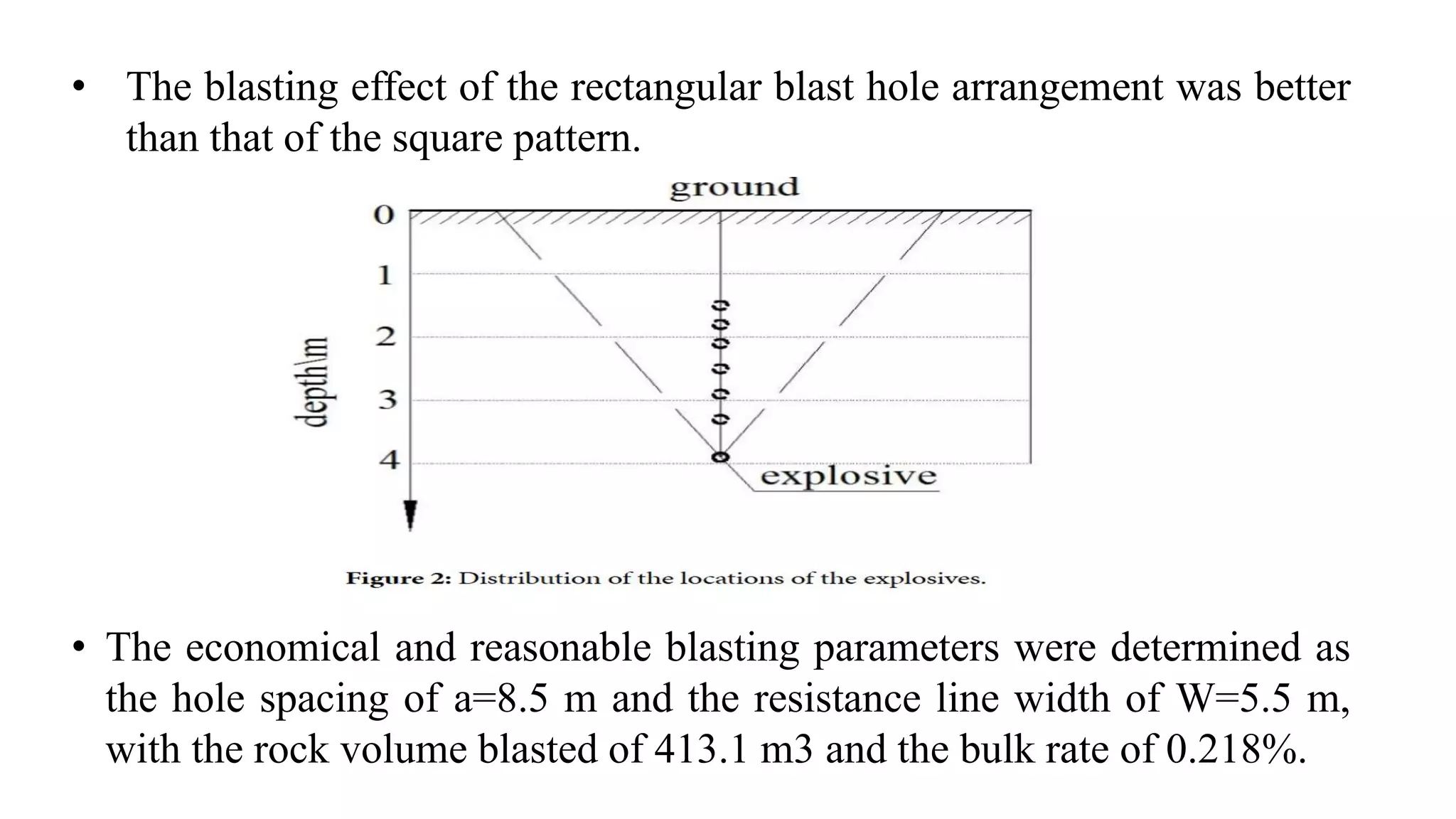
• The blasting effect of the rectangular blast hole arrangement was better
than that of the square pattern.
• The economical and reasonable blasting parameters were determined as
the hole spacing of a=8.5 m and the resistance line width of W=5.5 m,
with the rock volume blasted of 413.1 m3 and the bulk rate of 0.218%.
The blasting mechanism is as follows.
The reduction of the resistant line and widening of the blasting crater angle
with the blasting impact index of n>1 lead to the generation of an arc
surface, which creates a favourable crushing condition.
The enhanced hole spacing eliminates the stress wave interaction between
adjacent holes and avoids the early emission of the blasting gas, thereby
prolonging the blasting impact duration and improving the usage of the
blasting energy.
The increase of hole spacing makes the stress reduction area caused by the
interaction between the peak and trough of the blasting holes’ radiant wave
move out of the blasting impact area. This approach accomplishes the
following:
• makes full use of the role of explosion stress,
• increases the uniformity of the block,
• reduces the bulk rate, and
• improves the blasting crushing quality.
Nov 27, 2019
Mechanics of Blasting
Thank You ! Now,
Let’s WELCOME TO
Babita Rupakheti
Theories of rock breakage using explosives
• Theory of Breakage;
- Purpose of Blasting
oOne solid piece- smaller pieces (fragmentation)- to be move or
excavated (movement).
oUnderground blasting, for example, requires greater fragmentation
than surface blasting because of the size of the equipment that can
be used and the difficulty of access.
oGet the desired results with a minimum cost.
Theory of breakage
• Involves two basic processes:
Radial cracking
Flexural rupture
• Rock is stronger in compression than in tension. Therefore, the
easiest way to break rock is to subject it to a tensile stress greater
than its ultimate strength in tension.
• Rocks are heterogenous. They differ in their density.
Theory of Breakage
• The denser the rock the faster the waves.
• Proper fragmentation when enough to travel to the face and back
overcoming the tensile strength of the rock.
• Along the face the outermost edge is stretched in tension which
causes cracks.
Flexural Rupture
 The second process in breaking rock by bending the rock to the point
where the outside edge, the side in tension, breaks.
 Caused by the rapid expansion of gases in borehole.
 Analogous to the bending and breaking of a beam.
 Movement or displacement are required in addition to cracking.
 After detonation the redial cracks expands and the gas starts to the
movement against the borehole wall causing its bending.
Explosives
• Generally explosives are:
Commercial explosives
Military explosives.
 Generally explosives are chemically composed which is capable of
undergoing extremely rapid decomposition.
 An explosion can be broken down into four phases;
Release of gas
Intense heat
Extreme pressure and
The explosion
Chemical explosives
When explosive is detonated,
• Gas released
• Temperature of gas increases
• Pressure also increases
• Move and break the rock.
We should consider following things when using explosives on rock
breakage;
oStrength: % of active material
oVelocity of detonating: is the velocity at which the detonation wave
moves through the explosive.
oFume class: the amount of toxic fumes which determine its safety to be
used in particular situation such as underground operation.
oEnergy: the minimum energy/pressure needed for detonation.
oSensitivity: measure of explosion wave spreading from one stick to another.
oFlammability: easiness to ignite by flame or heat.
oWater resistance: is the ability to resist contamination or a reduction in
strength when exposed to water.
oDensity: is the explosive wt per given volume aid in the blast design.
oPhysical characteristics: commercial explosives can take three basic forms;
granular, gelatin, slurry and emulsion. The choice of form depends on the
usage required.
oFreezing: important for safety and performance especially in cold climate.
Antifreezing additives may be used.
Theory of
Rock
Breakage
Using
Explosives
EGE 556
3
Crater
Theory &
its
Application
EGE 556
2
Factors
Affecting
Rock
Breakage
EGE 556
1
Mechanics
of
Blasting
EGE 556
07
Sudhan
Yuvaraj
Babita

Mechanics of blasting

  • 1.
    Nov 27, 2019 Mechanicsof Blasting MECHANICS OF BLASTING Presented By : Sudhan Kumar Subedi (Roll. No: 09) Yuvaraj Poudel (Roll. No : 19 ) Babita Rupakheti (Roll. No: 18 )
  • 2.
    Theory of Rock Breakage Using Explosives EGE 556 3 Crater Theory& its Application EGE 556 2 Factors Affecting Rock Breakage EGE 556 1 Nov 27, 2019 Mechanics of Blasting Mechanics of Blasting EGE 556 07 Sudhan Yuvaraj Babita
  • 3.
    90 10 Nov 27, 2019 Mechanicsof Blasting In Rock Drilling, It is estimated that only 10 % of the input energy is used to fracture the rock, while most of the input energy is wasted as heat or other forms of energy. Background In rock drilling, blasting, crushing and grinding, the effective energy used in rock breakage is found to be quite small in comparison with total input energy.
  • 4.
    97 3 Nov 27, 2019 Mechanicsof Blasting In Comminution, including the crushing and grinding, the energy used in the rock fracture and fragmentation is 3 % at maximum. Background
  • 5.
    85 15 Nov 27, 2019 Mechanicsof Blasting In Blasting, the energy used in the rock fracture and fragmentation varies from 5 to 15%. Background
  • 6.
    Nov 27, 2019 Mechanicsof Blasting Factors Affecting Rock Breakage 1 4 2 3 Blast Size and Geometry Properties and Quantities of Explosives Firing Initiation Parameter Rock Mass Parameter
  • 7.
    Nov 27, 2019 Mechanicsof Blasting Factors Affecting Rock Breakage Blast Size and Geometry Number and orientation of Free Surface Orientation of blast hole axis to free surface Spacing Burden No. of rows per blast Blast Hole Diameter Number and orientation of Free Surface Length of Probe (bore) hole Charged Length of Blast hole
  • 8.
    Nov 27, 2019 Mechanicsof Blasting Factors Affecting Rock Breakage Blast Size and Geometry Free Surface or Free Face : This is an exposed rock surface towards which the explosive charge can break out. It resembles a wall. Greater the number of the free surface, more is the fragmentation. Orientation of Blast hole Axis to Free Surface : resembles the hole angle. Inclined blast holes allow better distribution of explosives. Inclined Blast holes are very effective in eliminating toe (which is a hump of solid rock between the free face and the bench floor), and back break.
  • 9.
    Nov 27, 2019 Mechanicsof Blasting Factors Affecting Rock Breakage Blast Size and Geometry Burden (B) : the distance from a blast hole to the nearest free face. For effective rock breakage, B = 25D to 30D for hard rock B = 30D to 35D for medium rock B = 35D to 40D for soft rock Spacing (S) : the distance between adjacent blast holes and is measured perpendicular to the burden. For effective rock breakage, S = 1 to 1.8 B Face Height (H) : the vertical distance between top and floor of bench and should be at least twice of burden. Borehole Diameter (D) : Rock fragmentation increases as the hole diameter increases and vice versa. It must be at least D = 0.001 H to 0.02 H
  • 10.
    Nov 27, 2019 Mechanicsof Blasting Factors Affecting Rock Breakage Blast Size and Geometry length of the probe hole : increase in length of the probe hole, favors the rock breakage. Number of rows per blast : resembles the drilling pattern, in which blast is going to be done. More Systematic the pattern of the drilling, favors the effective breakage of the rocks.
  • 11.
    Nov 27, 2019 Mechanicsof Blasting Factors Affecting Rock Breakage Blast Size and Geometry
  • 12.
    Nov 27, 2019 Mechanicsof Blasting Factors Affecting Rock Breakage Blast Size and Geometry Diameter of empty holes Larger diameter empty holes provide sufficient space for rock movement. The empty holes were found to be able to enhance the effectiveness of pre-split blasting by improving the distribution of tensile stress in surrounding rocks and guiding the initiation and growth of the cracks.
  • 13.
    Nov 27, 2019 Mechanicsof Blasting Factors Affecting Rock Breakage Properties and Quantities of Explosives Charge Length and Diameter i.e. shape Stemming length Specific Charge Decoupling Ratio Velocity of Detonation Nature and degree of sensitization of explosive Number and orientation of Free Surface Energy content in the explosive Charged Length of Blast holeDensity of Explosive Blasting Pattern Quantities of Explosives
  • 14.
    Nov 27, 2019 Mechanicsof Blasting Factors Affecting Rock Breakage Properties and Quantities of Explosives Charge Length and Diameter : Diameter about 3-4 mm less than the Blast hole diameter and the length is the explosive column in the blast hole and should be at least 20D in order to utilize fully the explosion-generated strain in the rock. Greater the length and diameter of the charge, larger the breakage of rocks. Stemming Length : Stemming is the inert material filled between the explosive charge and the collar of the blast hole to confine the explosion gases. The stemming material could be water, drill cutting, sand, mud or crushed rock. The best is the dry angular crushed rock (<30mm) as it tends to forma compaction arch, which locks into the blast hole wall, increasing its resistance to ejection. Stemming length less than 20 D usually causes fly rock, cut-offs and over break problems. And also suggested that the stemming length should not be less than the effective burden B.
  • 15.
    Nov 27, 2019 Mechanicsof Blasting Factors Affecting Rock Breakage Properties and Quantities of Explosives Specific Charge : also called as Powder Factor or Blasting Ratio. It is the ratio between the mass of explosives required to break a given quantity of rock and is normally expressed in kg/m3. It is simply the relationship between how much rock is broken and how much explosive is used to break it. It can serve a variety of purposes, such as an indicator of how hard the rock is, or the cost of the explosives needed, or even as a guide to planning a shot. The higher the powder factor, the lighter is the load. Lower the power factor means more explosives.
  • 16.
    Nov 27, 2019 Mechanicsof Blasting Factors Affecting Rock Breakage Properties and Quantities of Explosives Decoupling Ratio : Ratio of the diameters of an explosive columns and the blast hole and is usually expressed as percentage. For example, if an 88 mm diameter hole is charged with 64 mm diameter cartridges, decoupling ratio is 73 %. Greater the decoupling ratio, greater the fragmentation of the rocks. Velocity of Detonation Energy content of the explosives Sensitization of explosives Density of the Explosives Degree of Rock Fragmentation/Breakage
  • 17.
    Nov 27, 2019 Mechanicsof Blasting Factors Affecting Rock Breakage Properties and Quantities of Explosives Blasting Pattern
  • 18.
    Nov 27, 2019 Mechanicsof Blasting Factors Affecting Rock Breakage Properties and Quantities of Explosives
  • 19.
    Nov 27, 2019 Mechanicsof Blasting Factors Affecting Rock Breakage Properties and Quantities of Explosives Quantities of Explosives When Borehole Diameter is known, the charge can be calculated as : Q = π ( 𝑑 2 )2 (𝑙 𝑏 𝜌 𝑒𝑏+𝑙 𝑐 𝜌 𝑒𝑐) Where, Q = total Charge d = borehole diameter Lb = length of bottom charge Lc = length of column charge Ρeb = density of explosive in the bottom charge Pec = density of explosive in the column charge
  • 20.
    Nov 27, 2019 Mechanicsof Blasting Factors Affecting Rock Breakage Properties and Quantities of Explosives Quantities of Explosives
  • 21.
    Nov 27, 2019 Mechanicsof Blasting Factors Affecting Rock Breakage Firing Initiation Parameters Delay time Scatter of delay in the detonator Number of Delays Used Sequence of Initiation Number and orientation of Free Surface
  • 22.
    Nov 27, 2019 Mechanicsof Blasting Factors Affecting Rock Breakage Firing Initiation Parameters Delay Time :
  • 23.
    Nov 27, 2019 Mechanicsof Blasting Factors Affecting Rock Breakage Firing Initiation Parameters Delay Time :
  • 24.
    Nov 27, 2019 Mechanicsof Blasting Factors Affecting Rock Breakage Firing Initiation Parameters Delay Time :
  • 25.
    Nov 27, 2019 Mechanicsof Blasting Factors Affecting Rock Breakage Firing Initiation Parameters Scatter of Delay in the detonator : Delay Detonator , detonate after sometimes depending upon the delay elements introduced inside the detonators. Due to some practical limitations, all the delay detonators show some amount scatter in the detonating time from their specified delay time. Changes of timing between charges may result in altered firing order and failure of the blasting sequence, which can cause high vibration levels, poor fragmentation, and/or an undesirable rock mass movement direction. Number of Delays Used Sequence of Initiation
  • 26.
    Nov 27, 2019 Mechanicsof Blasting Factors Affecting Rock Breakage Firing Initiation Parameters Delay Patterns Delay patterns, and varying hole array to fit natural excavation topography, allow for more efficient use of the explosive energy in the blast. Benches may be designed and carried forth with more than one face so that simple blasting patterns can be used to remove the rock.
  • 27.
    Nov 27, 2019 Mechanicsof Blasting Factors Affecting Rock Breakage Firing Initiation Parameters Delay Patterns
  • 28.
    Nov 27, 2019 Mechanicsof Blasting Factors Affecting Rock Breakage Rock Mass Parameters Dynamic Tensile Strength Young’s Modulus, Poisson’s Ratio Fracture Toughness Number of Discontinuities Orientation of Discontinuities Joint Filling Materials Number and orientation of Free Surface Joint Frequency Charged Length of Blast holeFault or Crushing zones, directions and weathering Shear Strength, Cohesion, ɸ Dynamic Compressive Strength
  • 29.
    Nov 27, 2019 Mechanicsof Blasting Mechanism of Fracturing After Deep-hole Blasting of rock mass Results Stress near a blast hole, that exceeds the rock dynamics compressive strength that combined with high strain rate Creates Crushed Zone This process can consume the majority of the energy released by blasting. Meanwhile, the stress waves decay into compression waves along the boundary of the crushed zone and reverse stress relief produces a tangential force, which then induces radial cracks. As wing crack develop, the main and wing cracks will form an initial concentric fracture network (fractured zone, Stage I).
  • 30.
    Nov 27, 2019 Mechanicsof Blasting Mechanism of Fracturing After Initial Cracks formation The products of detonation fill space in the fracture network and exert quasi-static loads on fracture tips leading to Secondary fracture extension (fractured zone, Stage II). At same time , Stress waves reflected from the free surface of empty hole induce tensile stress and thus stimulate the formation and transfixion of complex fractures including the tensile main cracks and annular wing cracks. The complex fractures then interconnect with the cracks induced by detonation gas to form the pre-splitting cracks and a fracture network between blasting holes.
  • 31.
    Nov 27, 2019 Mechanicsof Blasting Mechanism of Fracturing
  • 32.
    Nov 27, 2019 Mechanicsof Blasting Mechanism of Fracturing
  • 33.
    Nov 27, 2019 Mechanicsof Blasting Mechanism of Fracturing 109.3 microsecond
  • 34.
    Nov 27, 2019 Mechanicsof Blasting Mechanism of Fracturing 199.2 microseconds
  • 35.
    Nov 27, 2019 Mechanicsof Blasting Mechanism of Fracturing 449.8 microsecond
  • 36.
    Nov 27, 2019 Mechanicsof Blasting Mechanism of Fracturing 552.5 microseconds
  • 37.
    Nov 27, 2019 Mechanicsof Blasting Underground Explosions 1 2 3 Contained (or Camouflet explosions) Bulging Explosions Cratering Explosions (Contained in Syllabus)
  • 38.
    Nov 27, 2019 Mechanicsof Blasting Underground Explosions Contained (or Camouflet Explosions) When depth of burial of explosive is sufficiently deep and are best modelled as explosions in an infinite medium.
  • 39.
    Nov 27, 2019 Mechanicsof Blasting Underground Explosions Bulging Explosions Occurs when the depth of burial of the explosive is within a certain range and are best modelled as explosions in a semi-infinite medium.
  • 40.
    Nov 27, 2019 Mechanicsof Blasting Underground Explosions Cratering Explosions It may occurs in various ways when the depth of burial of the explosive is relatively shallow and they are best modelled as explosions in a semi-infinite medium. Second Critical Depth of Burial (FCDOB) : critical depth which forms the dividing line between a bulging explosion and cratering explosions First Critical Depth of Burial (FCDOB) : critical depth which forms the dividing line between a contained explosion and bulging explosions
  • 41.
    Nov 27, 2019 Mechanicsof Blasting Thank You ! Now, Let’s WELCOME TO Mr. Yuvaraj Poudel
  • 42.
    CRATER THEORY ANDITS APPLICATION • A crater is formed by an explosive event through the displacement and ejection of material from the ground. It is typically bowl-shaped. • The blasting quality and the rock volume blasted directly affect the cost of mines. • A small charge-forward blast crater experiment was conducted to study the relationships between the rock volume blasted, the explosive unit consumption, the bulk yield, and the depth ratio.
  • 43.
    • The resultsshowed that the explosive charge depth should be 0.86 times the optimal resistant line.
  • 44.
    • Based ontheoretical analysis of the large spacing of the holes and the small resistance line, the uniform design method was used to conduct the lateral blasting crater tests. • The relationship equations among the blasting parameters, the blasting volume, and the bulk yield were obtained by regression analysis. • The results illustrated that the rock volume blasted was negatively correlated with the bulk yield. • The contribution rates of the resistance lines and the spacing of the holes to the blasting volume regression were 32.4% and 13.9%, respectively, and to the bulk yield regression were 65.0% and 0.256%.
  • 45.
    • The impactof the resistance line on the blasting volume and the bulk yield was more significant than that of the spacing of the holes. • The blasting technology of large hole spacing and a small resistance line could achieve a better blasting effect while ensuring a higher rock volume blasted.
  • 46.
    • The blastingeffect of the rectangular blast hole arrangement was better than that of the square pattern. • The economical and reasonable blasting parameters were determined as the hole spacing of a=8.5 m and the resistance line width of W=5.5 m, with the rock volume blasted of 413.1 m3 and the bulk rate of 0.218%.
  • 47.
    The blasting mechanismis as follows. The reduction of the resistant line and widening of the blasting crater angle with the blasting impact index of n>1 lead to the generation of an arc surface, which creates a favourable crushing condition. The enhanced hole spacing eliminates the stress wave interaction between adjacent holes and avoids the early emission of the blasting gas, thereby prolonging the blasting impact duration and improving the usage of the blasting energy. The increase of hole spacing makes the stress reduction area caused by the interaction between the peak and trough of the blasting holes’ radiant wave move out of the blasting impact area. This approach accomplishes the following:
  • 48.
    • makes fulluse of the role of explosion stress, • increases the uniformity of the block, • reduces the bulk rate, and • improves the blasting crushing quality.
  • 49.
    Nov 27, 2019 Mechanicsof Blasting Thank You ! Now, Let’s WELCOME TO Babita Rupakheti
  • 50.
    Theories of rockbreakage using explosives • Theory of Breakage; - Purpose of Blasting oOne solid piece- smaller pieces (fragmentation)- to be move or excavated (movement). oUnderground blasting, for example, requires greater fragmentation than surface blasting because of the size of the equipment that can be used and the difficulty of access. oGet the desired results with a minimum cost.
  • 51.
    Theory of breakage •Involves two basic processes: Radial cracking Flexural rupture • Rock is stronger in compression than in tension. Therefore, the easiest way to break rock is to subject it to a tensile stress greater than its ultimate strength in tension. • Rocks are heterogenous. They differ in their density.
  • 53.
    Theory of Breakage •The denser the rock the faster the waves. • Proper fragmentation when enough to travel to the face and back overcoming the tensile strength of the rock. • Along the face the outermost edge is stretched in tension which causes cracks.
  • 54.
    Flexural Rupture  Thesecond process in breaking rock by bending the rock to the point where the outside edge, the side in tension, breaks.  Caused by the rapid expansion of gases in borehole.  Analogous to the bending and breaking of a beam.  Movement or displacement are required in addition to cracking.  After detonation the redial cracks expands and the gas starts to the movement against the borehole wall causing its bending.
  • 55.
    Explosives • Generally explosivesare: Commercial explosives Military explosives.  Generally explosives are chemically composed which is capable of undergoing extremely rapid decomposition.  An explosion can be broken down into four phases; Release of gas Intense heat Extreme pressure and The explosion
  • 56.
    Chemical explosives When explosiveis detonated, • Gas released • Temperature of gas increases • Pressure also increases • Move and break the rock. We should consider following things when using explosives on rock breakage; oStrength: % of active material oVelocity of detonating: is the velocity at which the detonation wave moves through the explosive.
  • 57.
    oFume class: theamount of toxic fumes which determine its safety to be used in particular situation such as underground operation. oEnergy: the minimum energy/pressure needed for detonation. oSensitivity: measure of explosion wave spreading from one stick to another. oFlammability: easiness to ignite by flame or heat. oWater resistance: is the ability to resist contamination or a reduction in strength when exposed to water. oDensity: is the explosive wt per given volume aid in the blast design. oPhysical characteristics: commercial explosives can take three basic forms; granular, gelatin, slurry and emulsion. The choice of form depends on the usage required. oFreezing: important for safety and performance especially in cold climate. Antifreezing additives may be used.
  • 58.
    Theory of Rock Breakage Using Explosives EGE 556 3 Crater Theory& its Application EGE 556 2 Factors Affecting Rock Breakage EGE 556 1 Mechanics of Blasting EGE 556 07 Sudhan Yuvaraj Babita