MAGNETIC CIRCUITS
EEC
EEE Department
GP Malvan
Unit Outcomes (UOs)
1. Describe the silent feature of the given circuit
2. Apply Flemings right hand rule and Lenz law to
determine direction of induced emf
3. Explain the types of induced emfs
4. Interpret the BH curve and hysteresis loop
FIELDS
MAGNETIC
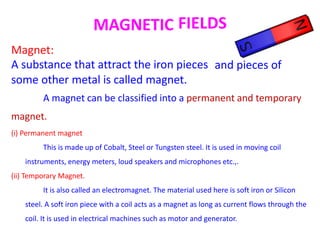
Magnet:
A substance that attract the iron pieces
some other metal is called magnet.
and pieces of
A magnet can be classified into a permanent and temporary
magnet.
(i) Permanent magnet
This is made up of Cobalt, Steel or Tungsten steel. It is used in moving coil
instruments, energy meters, loud speakers and microphones etc.,.
(ii) Temporary Magnet.
It is also called an electromagnet. The material used here is soft iron or Silicon
steel. A soft iron piece with a coil acts as a magnet as long as current flows through the
coil. It is used in electrical machines such as motor and generator.
MAGNETIC FIELDS
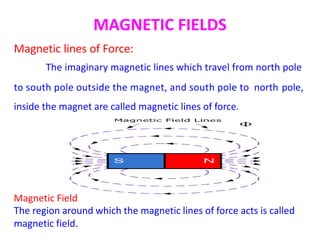
Magnetic lines of Force:
The imaginary magnetic lines which travel from north pole
to south pole outside the magnet, and south pole to north pole,
inside the magnet are called magnetic lines of force.
Magnetic Field
The region around which the magnetic lines of force acts is called
magnetic field.
MAGNETIC FIELDS
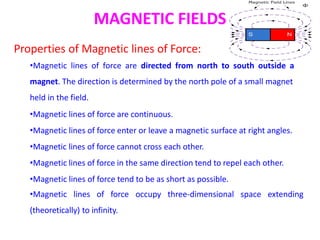
Properties of Magnetic lines of Force:
•Magnetic lines of force are directed from north to south outside a
magnet. The direction is determined by the north pole of a small magnet
held in the field.
•Magnetic lines of force are continuous.
•Magnetic lines of force enter or leave a magnetic surface at right angles.
•Magnetic lines of force cannot cross each other.
•Magnetic lines of force in the same direction tend to repel each other.
•Magnetic lines of force tend to be as short as possible.
•Magnetic lines of force occupy three-dimensional space extending
(theoretically) to infinity.
MAGNETIC FIELDS
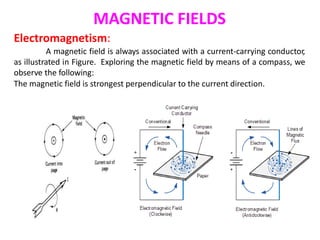
Electromagnetism:
A magnetic field is always associated with a current-carrying conductor,
as illustrated in Figure. Exploring the magnetic field by means of a compass, we
observe the following:
The magnetic field is strongest perpendicular to the current direction.
MAGNETIC FIELDS
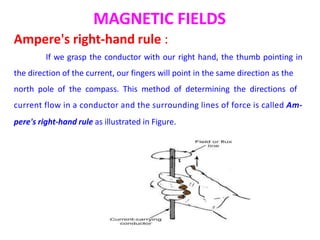
Ampere's right-hand rule :
If we grasp the conductor with our right hand, the thumb pointing in
the direction of the current, our fingers will point in the same direction as the
north pole of the compass. This method of determining the directions of
current flow in a conductor and the surrounding lines of force is called Am-
pere's right-hand rule as illustrated in Figure.
MAGNETIC FIELDS
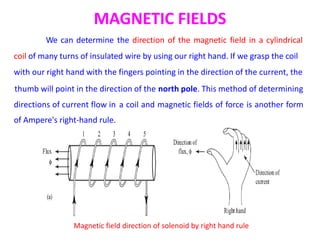
We can determine the direction of the magnetic field in a cylindrical
coil of many turns of insulated wire by using our right hand. If we grasp the coil
with our right hand with the fingers pointing in the direction of the current, the
thumb will point in the direction of the north pole. This method of determining
directions of current flow in
of Ampere's right-hand rule.
a coil and magnetic fields of force is another form
Magnetic field direction of solenoid by right hand rule
ELECTROMAGNETIC RELATIONSHIPS
Magnetic Flux (Φ)
The total number of lines of force in the magnetic field is called
magnetic flux. It is denoted by ‘Φ’, and its unit is Weber.
Magnetic Flux Density (B)
The magnetic flux passing through unit cross
density. It is denoted by ‘B’.
If ‘Φ’ is magnetic flux in Webers
B is flux density in Wb/m2.
then B = Φ/A Wb/m2
Magneto-Motive Force (MMF)
section is called flux
It is the driving force required to drive the magnetic flux through a
magnetic circuit.
The product NI is called magneto-motive force. Its unit is Ampere turns.
MMF = NI (AT)
1. moving coil instruments, energy meters uses _________ magnet.
Ans: Permanent
2. The imaginary magnetic lines which travel from north pole to south
pole are called__________
Ans: magnetic lines
3. Magnetic lines of force _________cross each other.
Ans: never
4. Magnetic lines of force enter or leave a magnetic surface at acute
angles. (True/False)
Ans: False
5. If Ampere rule apply to the current carrying conductor then, thumb will
show_______
Ans: direction of current
ELECTROMAGNETIC RELATIONSHIPS
Magnetic field strength: (H)
The magneto motive force per meter length of the magnetic circuit
H = (N I) / L
Unit is AT / meter
Permeability [μ]
A property of a magnetic material which indicates the ability of
magnetic circuit to carry electromagnetic flux.
Ratio of flux density to the magnetizing force,
μ = B / H
Unit: henry / meter
Permeability of free space or air or non magnetic material
μ0=4π*10-7
Relative permeability [μr ]
μ = μ0μr
ELECTROMAGNETIC RELATIONSHIPS
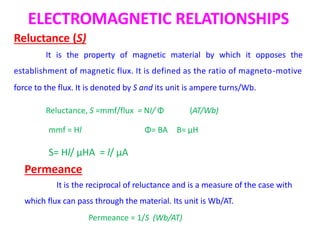
Reluctance (S)
It is the property of magnetic material by which it opposes the
establishment of magnetic flux. It is defined as the ratio of magneto-motive
force to the flux. It is denoted by S and its unit is ampere turns/Wb.
Reluctance, S =mmf/flux = NI/ Φ (AT/Wb)
Permeance
It is the reciprocal of reluctance and is a measure of the case with
which flux can pass through the material. Its unit is Wb/AT.
Permeance = 1/S (Wb/AT)
mmf = Hl Φ= BA B= μH
S= Hl/ μHA = l/ μA
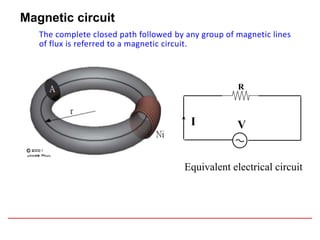
Magnetic circuit
The complete closed path followed by any group of magnetic lines
of flux is referred to a magnetic circuit.
R
Equivalent electrical circuit
I V
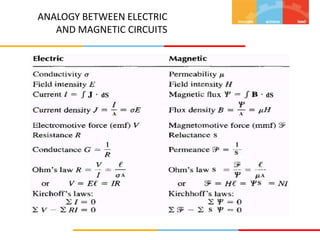
ANALOGY BETWEEN ELECTRIC
AND MAGNETIC CIRCUITS
IRON CORES WITH AN AIR GAP
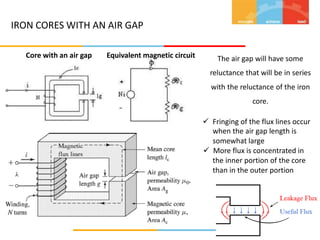
Core with an air gap Equivalent magnetic circuit The air gap will have some
reluctance that will be in series
with the reluctance of the iron
core.
 Fringing of the flux lines occur
when the air gap length is
somewhat large
 More flux is concentrated in
the inner portion of the core
than in the outer portion
MAGNETIZATION CURVES
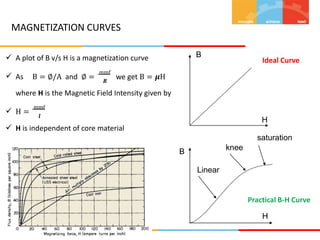
B
 A plot of B v/s H is a magnetization curve Ideal Curve
mmf
we get B = 𝝁H
 As B = ∅/A and ∅ = 𝑹
where H is the Magnetic Field Intensity given by
mmf
 H = 𝒍
H
 H is independent of core material
saturation
knee
B
Linear
Practical B-H Curve
H
HYSTERESIS
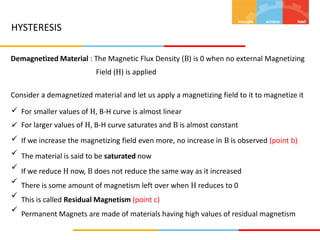
Demagnetized Material : The Magnetic Flux Density (B) is 0 when no external Magnetizing
Field (H) is applied
Consider a demagnetized material and let us apply a magnetizing field to it to magnetize it
 For smaller values of H, B-H curve is almost linear
For larger values of H, B-H curve saturates and B is almost constant
If we increase the magnetizing field even more, no increase in B is observed (point b)
The material is said to be saturated now
If we reduce H now, B does not reduce the same way as it increased
There is some amount of magnetism left over when H reduces to 0
This is called Residual Magnetism (point c)
Permanent Magnets are made of materials having high values of residual magnetism







HYSTERESIS
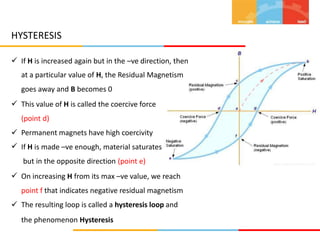
 If H is increased again but in the –ve direction, then
at a particular value of H, the Residual Magnetism
goes away and B becomes 0
This value of H is called the coercive force
(point d)
Permanent magnets have high coercivity
If H is made –ve enough, material saturates
but in the opposite direction (point e)
On increasing H from its max –ve value, we reach
point f that indicates negative residual magnetism
The resulting loop is called a hysteresis loop and
the phenomenon Hysteresis





HYSTERESIS
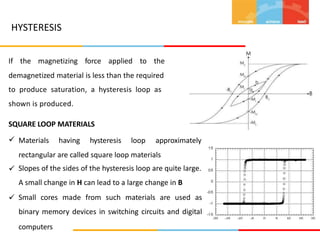
If the magnetizing force applied to the
demagnetized material is less than the required
to produce saturation, a hysteresis loop as
shown is produced.
SQUARE LOOP MATERIALS
 Materials having hysteresis loop approximately
rectangular are called square loop materials
Slopes of the sides of the hysteresis loop are quite large.
A small change in H can lead to a large change in B
Small cores made from such materials are used as
binary memory devices in switching circuits and digital


computers
HYSTERESIS LOSS
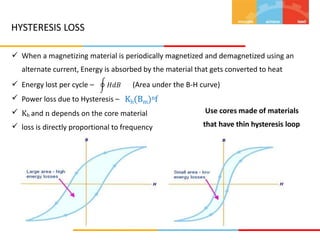
 When a magnetizing material is periodically magnetized and demagnetized using an
alternate current, Energy is absorbed by the material that gets converted to heat




Energy lost per cycle – 𝐻𝑑𝐵 (Area under the B-H curve)
Kh(Bm)nf
Power loss due to Hysteresis –
Use cores made of materials
that have thin hysteresis loop
Kh and n depends on the core material
loss is directly proportional to frequency
ELECTROMAGNETIC INDUCTION
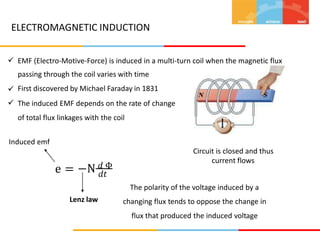
 EMF (Electro-Motive-Force) is induced in a multi-turn coil when the magnetic flux
passing through the coil varies with time
First discovered by Michael Faraday in 1831
The induced EMF depends on the rate of change
of total flux linkages with the coil


Induced emf
Circuit is closed and thus
current flows
−N 𝑑 Φ
e = 𝑑𝑡
The polarity of the voltage induced by a
changing flux tends to oppose the change in
flux that produced the induced voltage
Lenz law
ELECTROMAGNETIC INDUCTION
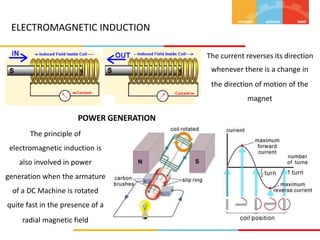
The current reverses its direction
whenever there is a change in
the direction of motion of the
magnet
POWER GENERATION
The principle of
electromagnetic induction is
also involved in power
generation when the armature
of a DC Machine is rotated
quite fast in the presence of a
radial magnetic field
MAGNETIC CIRCUIT
Analysis of Magnetic Circuit
A magnetic circuit is defined as, the closed
the magnetic lines of force.
path traced by
The magnetic circuit can be sub divided into,
(i) Simple magnetic circuit
(ii) Composite magnetic circuit
(iii) Parallel magnetic circuit
MAGNETIC CIRCUITS
(i) Simple Magnetic Circuit
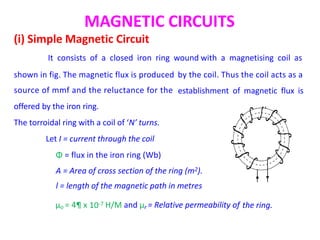
It consists of a closed iron ring wound with a magnetising coil as
shown in fig. The magnetic flux is produced
source of mmf and the reluctance for the
offered by the iron ring.
The torroidal ring with a coil of ‘N’ turns.
Let I = current through the coil
Φ = flux in the iron ring (Wb)
by the coil. Thus the coil acts as a
establishment of magnetic flux is
A = Area of cross section of the ring (m2).
l = length of the magnetic path in metres
10-7
µo = 4¶ x H/M and µr = Relative permeability of the ring.
…
MAGNETIC CIRCUITS
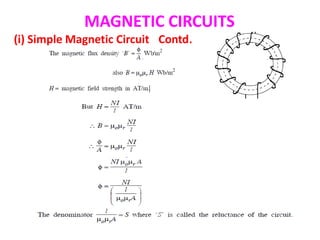
(i) Simple Magnetic Circuit Contd
MAGNETIC CIRCUITS
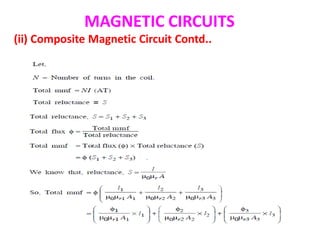
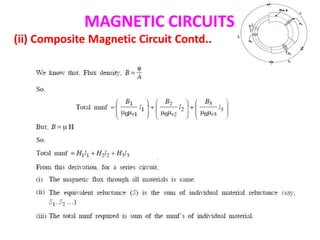
(ii) Composite Magnetic Circuit
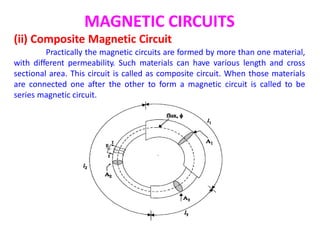
Practically the magnetic circuits are formed by more than one material,
with different permeability. Such materials can have various length and cross
sectional area. This circuit is called as composite circuit. When those materials
are connected one after the other to form a magnetic circuit is called to be
series magnetic circuit.
MAGNETIC CIRCUITS
(ii) Composite Magnetic Circuit Contd..
MAGNETIC CIRCUITS
(ii) Composite Magnetic Circuit Contd..
MAGNETIC CIRCUITS
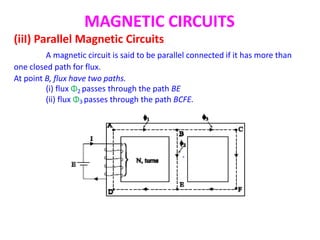
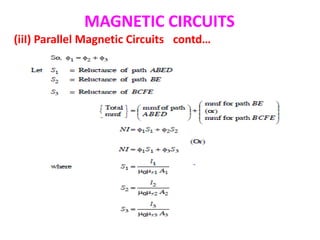
(iiI) Parallel Magnetic Circuits
A magnetic circuit is said to be parallel connected if it has more than
one closed path for flux.
At point B, flux have two paths.
(i) flux Φ2 passes through the path BE
(ii) flux Φ3 passes through the path BCFE.
MAGNETIC CIRCUITS
(iiI) Parallel Magnetic Circuits contd…
MAGNETIC CIRCUITS
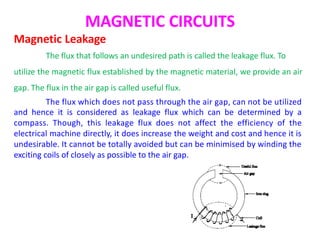
Magnetic Leakage
The flux that follows an undesired path is called the leakage flux. To
utilize the magnetic flux established by the magnetic material, we provide an air
gap. The flux in the air gap is called useful flux.
The flux which does not pass through the air gap, can not be utilized
and hence it is considered as leakage flux which can be determined by a
compass. Though, this leakage flux does not affect the efficiency of the
electrical machine directly, it does increase the weight and cost and hence it is
undesirable. It cannot be totally avoided but can be minimised by winding the
exciting coils of closely as possible to the air gap.
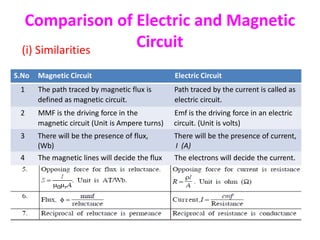
Comparison of Electric and Magnetic
Circuit
(i) Similarities
S.No Magnetic Circuit Electric Circuit
1 The path traced by magnetic flux is Path traced by the current is called as
defined as magnetic circuit. electric circuit.
2 MMF is the driving force in the Emf is the driving force in an electric
magnetic circuit (Unit is Ampere turns) circuit. (Unit is volts)
3 There will be the presence of flux, There will be the presence of current,
(Wb) I (A)
4 The magnetic lines will decide the flux The electrons will decide the current.
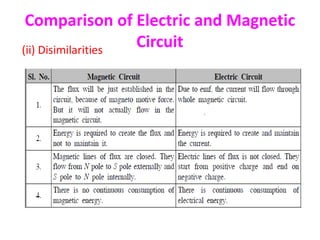
Comparison of Electric and Magnetic
Circuit
(ii) Disimilarities
ELECTROMAGNETIC INDUCTION
We have seen the magnetic effects of an electric current. Then it was
Michael Faraday who made attempts, to get emf from magnetic flux. This is
called to be electromagnetic induction.
Law of Electromagnetic Induction
(i) Faraday’s law
Whenever the magnetic flux linking a conductor changes, an emf is
always induced in it. The magnitude
of change of flux linkages.
e=N dΦ/dt
of induced emf is proportional to the rate
Where e= induced emf in V
N= Number of turns
dΦ/dt = Rate of change of flux.
ELECTROMAGNETIC INDUCTION
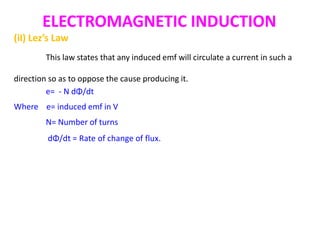
(iI) Lez’s Law
This law states that any induced emf will circulate a current in such a
direction so as to oppose the cause producing it.
e= - N dΦ/dt
Where e= induced emf in V
N= Number of turns
dΦ/dt = Rate of change of flux.
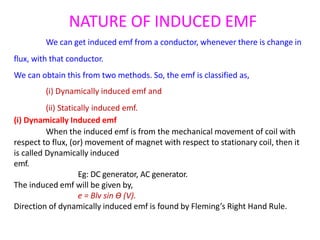
NATURE OF INDUCED EMF
We can get induced emf from a conductor, whenever there is change in
flux, with that conductor.
We can obtain this from two methods. So, the emf is classified as,
(i) Dynamically induced emf and
(ii) Statically induced emf.
(i) Dynamically Induced emf
When the induced emf is from the mechanical movement of coil with
respect to flux, (or) movement of magnet with respect to stationary coil, then it
is called Dynamically induced
emf.
Eg: DC generator, AC generator.
The induced emf will be given by,
e = Blv sin Ɵ (V).
Direction of dynamically induced emf is found by Fleming’s Right Hand Rule.
NATURE OF INDUCED EMF
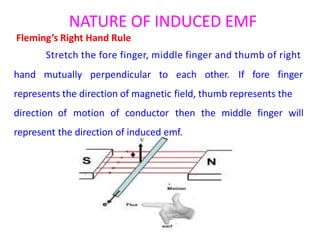
Fleming’s Right Hand Rule
Stretch the fore finger, middle finger and thumb of right
hand mutually perpendicular to each other. If fore finger
represents the direction of magnetic field, thumb represents the
direction of motion of conductor then the middle finger will
represent the direction of induced emf.
NATURE OF INDUCED EMF
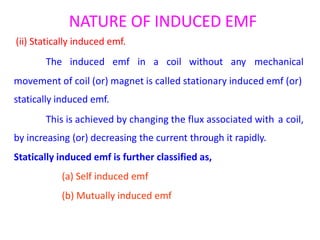
(ii) Statically induced emf.
The induced emf in a coil without any mechanical
movement of coil (or) magnet is called stationary induced emf (or)
statically induced emf.
This is achieved by changing the flux associated with
by increasing (or) decreasing the current through it rapidly.
Statically induced emf is further classified as,
(a) Self induced emf
(b) Mutually induced emf
a coil,
NATURE OF INDUCED EMF
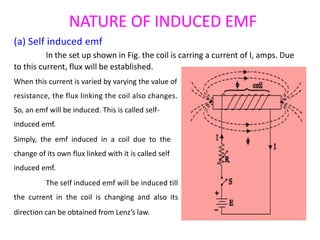
(a) Self induced emf
In the set up shown in Fig. the coil is carring a current of I, amps. Due
to this current, flux will be established.
When this current is varied by varying the value of
resistance, the flux linking the coil also changes.
So, an emf will be induced. This is called self-
induced emf.
Simply, the emf induced in a coil due to the
change of its own flux linked with it is called self
induced emf.
The self induced emf will be induced till
the current in the coil is changing and also its
direction can be obtained from Lenz’s law.
NATURE OF INDUCED EMF
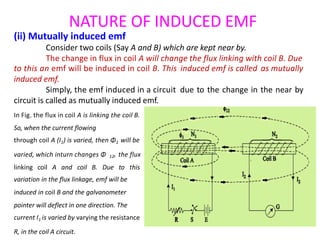
(ii) Mutually induced emf
Consider two coils (Say A and B) which are kept near by.
The change in flux in coil A will change the flux linking with coil B. Due
to this an emf will be induced in coil B. This
induced emf.
Simply, the emf induced in a circuit
circuit is called as mutually induced emf.
In Fig. the flux in coil A is linking the coil B.
So, when the current flowing
through coil A (I1) is varied, then Φ1 will be
induced emf is called as mutually
due to the change in the near by
varied, which inturn changes Φ 12, the flux
linking coil A and coil B. Due to this
variation in the flux linkage, emf will be
induced in coil B and the galvanometer
pointer will deflect in one direction. The
current I1 is varied by varying the resistance
R, in the coil A circuit.
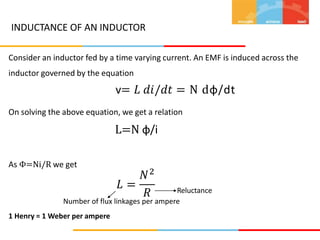
INDUCTANCE OF AN INDUCTOR
Consider an inductor fed by a time varying current. An EMF is induced across the
inductor governed by the equation
v= 𝐿 𝑑𝑖/𝑑𝑡 = N dφ/dt
On solving the above equation, we get a relation
L=N φ/i
As Φ=Ni/R we get
Reluctance
𝐿 =
𝑁2
𝑅
Number of flux linkages per ampere
1 Henry = 1 Weber per ampere
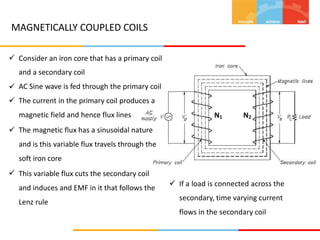
MAGNETICALLY COUPLED COILS
 Consider an iron core that has a primary coil
and a secondary coil
AC Sine wave is fed through the primary coil
The current in the primary coil produces a
magnetic field and hence flux lines
The magnetic flux has a sinusoidal nature
and is this variable flux travels through the
soft iron core
This variable flux cuts the secondary coil
and induces and EMF in it that follows the
Lenz rule


N1 N2


 If a load is connected across the
secondary, time varying current
flows in the secondary coil
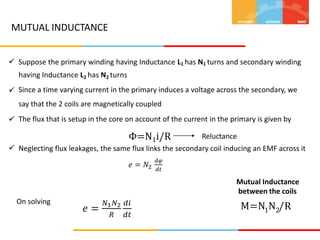
MUTUAL INDUCTANCE
 Suppose the primary winding having Inductance L1 has N1 turns and secondary winding
having Inductance L2 has N2 turns
Since a time varying current in the primary induces a voltage across the secondary, we
say that the 2 coils are magnetically coupled
The flux that is setup in the core on account of the current in the primary is given by
Φ=N1i/R


Reluctance
 Neglecting flux leakages, the same flux links the secondary coil inducing an EMF across it
𝑒 = 𝑁2
𝑑𝜑
𝑑𝑡
Mutual Inductance
between the coils
M=N N /R
On solving
𝑒 =
𝑁1𝑁2
𝑅
𝑑𝑖
𝑑𝑡
1 2
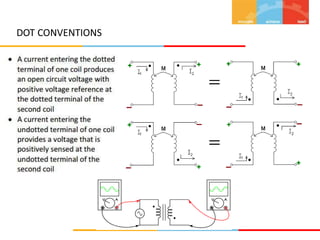
DOT CONVENTIONS
TRANSFORMERS









A transformer is a magnetic circuit consisting of 2 coils wound on a common iron core
More than 2 windings can also be used
Used in efficient transfer of Electric Power from the Generating station to our homes
2 types – Step Up and Step down
Step Up : Steps up the voltage at lower currents ( v x I = constant ) ( Neglecting leakage flux)
Step Down : Steps down the voltage but at a higher current
Voltages are stepped up prior to transmission so that the Copper losses are minimal
Used in Electronic, Control and Communication systems
Used for isolating 2 circuits as there is a magnetic coupling between the two and no
physical contact
Used for impedance matching to have maximum power transfer from source to load

TRANSFORMERS
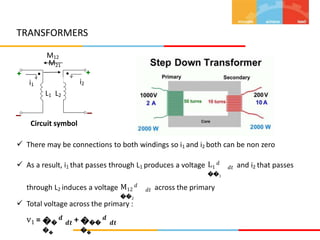
M12
M21
i2
i1
L1 L2
Circuit symbol
 There may be connections to both windings so i1 and i2 both can be non zero
L1
𝑑
��1
 As a result, i1 that passes through L1 produces a voltage and i2 that passes
𝑑𝑡
M12
𝑑
��2
through L2 induces a voltage across the primary
𝑑𝑡
 Total voltage across the primary :
��
𝒅
��
���
𝒅
��
v1 = +
𝒅𝒕 𝒅𝒕
TRANSFORMERS
��
𝒅
��
���
𝒅
��



Similarly the voltage across the secondary winding is
��� = ��� = M = N1N2 / R
v2 = +
𝒅𝒕 𝒅𝒕
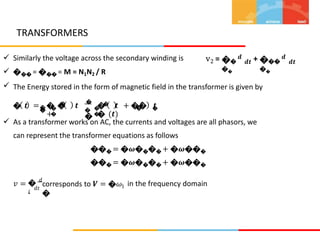
The Energy stored in the form of magnetic field in the transformer is given by
�
�
�
� �
� 𝒕 = � � 𝒕
+
� 𝒕 + �� 𝒕
� (𝒕)
�
�
�
�
� �
� �
 As a transformer works on AC, the currents and voltages are all phasors, we
can represent the transformer equations as follows
��� = �𝝎���� + �𝝎���
� 𝑑
𝑖
𝑣 = corresponds to 𝑽 = �𝜔
�
in the frequency domain
1
𝑑𝑡
TRANSFORMER CIRCUIT REPRESENTATION
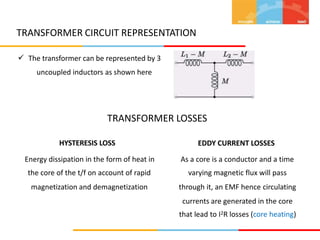
 The transformer can be represented by 3
uncoupled inductors as shown here
TRANSFORMER LOSSES
HYSTERESIS LOSS EDDY CURRENT LOSSES
Energy dissipation in the form of heat in
the core of the t/f on account of rapid
magnetization and demagnetization
As a core is a conductor and a time
varying magnetic flux will pass
through it, an EMF hence circulating
currents are generated in the core
that lead to I2R losses (core heating)
COUPLING COEFFICIENT



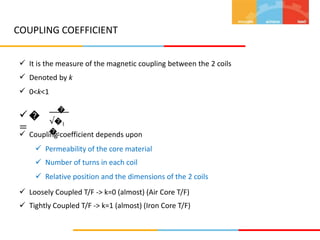
It is the measure of the magnetic coupling between the 2 coils
Denoted by k
0<k<1
�
 �
=
√�1
�2
 Coupling coefficient depends upon



Permeability of the core material
Number of turns in each coil
Relative position and the dimensions of the 2 coils


Loosely Coupled T/F -> k=0 (almost) (Air Core T/F)
Tightly Coupled T/F -> k=1 (almost) (Iron Core T/F)
i1 i2
k=1 perfect coupling
L1 , L2 = ∞
no losses
IDEAL TRANSFORMER


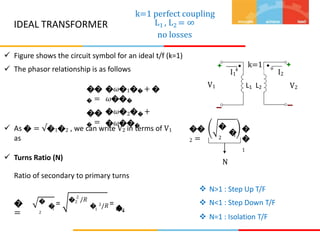
Figure shows the circuit symbol for an ideal t/f (k=1)
The phasor relationship is as follows
k=1
I1 I2
V1 L1 L2 V2
��
� =
��
� =
�𝜔�1�� + �
𝜔���
�𝜔�2�� +
�𝜔��� �
2
 As � = √�1�2 , we can write V2 in terms of V1
as
��
2 =
�
�
1
�
1
 Turns Ratio (N)
N
Ratio of secondary to primary turns



N>1 : Step Up T/F
N<1 : Step Down T/F
N=1 : Isolation T/F
2
�2 /𝑅
�2
�
2
�
=
= =
� 2/𝑅
� �1
1 1
IDEAL TRANSFORMER MODEL
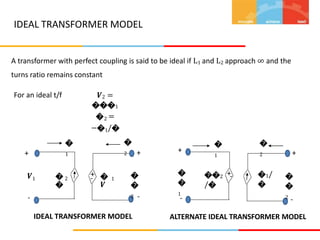
A transformer with perfect coupling is said to be ideal if L1 and L2 approach ∞ and the
turns ratio remains constant
For an ideal t/f 𝑽2 =
���1
�2 =
−�1/�
�
2
�
1
�
2
�
1
+
+ +
+
�
�
1
+-
+ �1/
�
��2
/�
�
�
2
𝑽 �
�
�
𝑽
�
�
2
-
1 2 1
-
- - -
IDEAL TRANSFORMER MODEL ALTERNATE IDEAL TRANSFORMER MODEL
IDEAL TRANSFORMER AS A LOSSLESS DEVICE
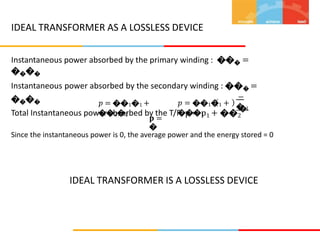
Instantaneous power absorbed by the primary winding : ��� =
����
Instantaneous power absorbed by the secondary winding : ��� =
����
Total Instantaneous power absorbed by the T/F: p = p1 + ��2
−
� 1
𝑝 = ��1�1 +
���1
𝑝 = ��1�1 +
��2�2
�
𝐩 =
�
Since the instantaneous power is 0, the average power and the energy stored = 0
IDEAL TRANSFORMER IS A LOSSLESS DEVICE

magnetic circuits

  • 1.
  • 2.
    Unit Outcomes (UOs) 1.Describe the silent feature of the given circuit 2. Apply Flemings right hand rule and Lenz law to determine direction of induced emf 3. Explain the types of induced emfs 4. Interpret the BH curve and hysteresis loop
  • 3.
    FIELDS MAGNETIC Magnet: A substance thatattract the iron pieces some other metal is called magnet. and pieces of A magnet can be classified into a permanent and temporary magnet. (i) Permanent magnet This is made up of Cobalt, Steel or Tungsten steel. It is used in moving coil instruments, energy meters, loud speakers and microphones etc.,. (ii) Temporary Magnet. It is also called an electromagnet. The material used here is soft iron or Silicon steel. A soft iron piece with a coil acts as a magnet as long as current flows through the coil. It is used in electrical machines such as motor and generator.
  • 4.
    MAGNETIC FIELDS Magnetic linesof Force: The imaginary magnetic lines which travel from north pole to south pole outside the magnet, and south pole to north pole, inside the magnet are called magnetic lines of force. Magnetic Field The region around which the magnetic lines of force acts is called magnetic field.
  • 5.
    MAGNETIC FIELDS Properties ofMagnetic lines of Force: •Magnetic lines of force are directed from north to south outside a magnet. The direction is determined by the north pole of a small magnet held in the field. •Magnetic lines of force are continuous. •Magnetic lines of force enter or leave a magnetic surface at right angles. •Magnetic lines of force cannot cross each other. •Magnetic lines of force in the same direction tend to repel each other. •Magnetic lines of force tend to be as short as possible. •Magnetic lines of force occupy three-dimensional space extending (theoretically) to infinity.
  • 6.
    MAGNETIC FIELDS Electromagnetism: A magneticfield is always associated with a current-carrying conductor, as illustrated in Figure. Exploring the magnetic field by means of a compass, we observe the following: The magnetic field is strongest perpendicular to the current direction.
  • 7.
    MAGNETIC FIELDS Ampere's right-handrule : If we grasp the conductor with our right hand, the thumb pointing in the direction of the current, our fingers will point in the same direction as the north pole of the compass. This method of determining the directions of current flow in a conductor and the surrounding lines of force is called Am- pere's right-hand rule as illustrated in Figure.
  • 8.
    MAGNETIC FIELDS We candetermine the direction of the magnetic field in a cylindrical coil of many turns of insulated wire by using our right hand. If we grasp the coil with our right hand with the fingers pointing in the direction of the current, the thumb will point in the direction of the north pole. This method of determining directions of current flow in of Ampere's right-hand rule. a coil and magnetic fields of force is another form Magnetic field direction of solenoid by right hand rule
  • 9.
    ELECTROMAGNETIC RELATIONSHIPS Magnetic Flux(Φ) The total number of lines of force in the magnetic field is called magnetic flux. It is denoted by ‘Φ’, and its unit is Weber. Magnetic Flux Density (B) The magnetic flux passing through unit cross density. It is denoted by ‘B’. If ‘Φ’ is magnetic flux in Webers B is flux density in Wb/m2. then B = Φ/A Wb/m2 Magneto-Motive Force (MMF) section is called flux It is the driving force required to drive the magnetic flux through a magnetic circuit. The product NI is called magneto-motive force. Its unit is Ampere turns. MMF = NI (AT)
  • 10.
    1. moving coilinstruments, energy meters uses _________ magnet. Ans: Permanent 2. The imaginary magnetic lines which travel from north pole to south pole are called__________ Ans: magnetic lines 3. Magnetic lines of force _________cross each other. Ans: never 4. Magnetic lines of force enter or leave a magnetic surface at acute angles. (True/False) Ans: False 5. If Ampere rule apply to the current carrying conductor then, thumb will show_______ Ans: direction of current
  • 11.
    ELECTROMAGNETIC RELATIONSHIPS Magnetic fieldstrength: (H) The magneto motive force per meter length of the magnetic circuit H = (N I) / L Unit is AT / meter Permeability [μ] A property of a magnetic material which indicates the ability of magnetic circuit to carry electromagnetic flux. Ratio of flux density to the magnetizing force, μ = B / H Unit: henry / meter Permeability of free space or air or non magnetic material μ0=4π*10-7 Relative permeability [μr ] μ = μ0μr
  • 12.
    ELECTROMAGNETIC RELATIONSHIPS Reluctance (S) Itis the property of magnetic material by which it opposes the establishment of magnetic flux. It is defined as the ratio of magneto-motive force to the flux. It is denoted by S and its unit is ampere turns/Wb. Reluctance, S =mmf/flux = NI/ Φ (AT/Wb) Permeance It is the reciprocal of reluctance and is a measure of the case with which flux can pass through the material. Its unit is Wb/AT. Permeance = 1/S (Wb/AT) mmf = Hl Φ= BA B= μH S= Hl/ μHA = l/ μA
  • 13.
    Magnetic circuit The completeclosed path followed by any group of magnetic lines of flux is referred to a magnetic circuit. R Equivalent electrical circuit I V
  • 14.
  • 15.
    IRON CORES WITHAN AIR GAP Core with an air gap Equivalent magnetic circuit The air gap will have some reluctance that will be in series with the reluctance of the iron core.  Fringing of the flux lines occur when the air gap length is somewhat large  More flux is concentrated in the inner portion of the core than in the outer portion
  • 16.
    MAGNETIZATION CURVES B  Aplot of B v/s H is a magnetization curve Ideal Curve mmf we get B = 𝝁H  As B = ∅/A and ∅ = 𝑹 where H is the Magnetic Field Intensity given by mmf  H = 𝒍 H  H is independent of core material saturation knee B Linear Practical B-H Curve H
  • 17.
    HYSTERESIS Demagnetized Material :The Magnetic Flux Density (B) is 0 when no external Magnetizing Field (H) is applied Consider a demagnetized material and let us apply a magnetizing field to it to magnetize it  For smaller values of H, B-H curve is almost linear For larger values of H, B-H curve saturates and B is almost constant If we increase the magnetizing field even more, no increase in B is observed (point b) The material is said to be saturated now If we reduce H now, B does not reduce the same way as it increased There is some amount of magnetism left over when H reduces to 0 This is called Residual Magnetism (point c) Permanent Magnets are made of materials having high values of residual magnetism       
  • 18.
    HYSTERESIS  If His increased again but in the –ve direction, then at a particular value of H, the Residual Magnetism goes away and B becomes 0 This value of H is called the coercive force (point d) Permanent magnets have high coercivity If H is made –ve enough, material saturates but in the opposite direction (point e) On increasing H from its max –ve value, we reach point f that indicates negative residual magnetism The resulting loop is called a hysteresis loop and the phenomenon Hysteresis     
  • 19.
    HYSTERESIS If the magnetizingforce applied to the demagnetized material is less than the required to produce saturation, a hysteresis loop as shown is produced. SQUARE LOOP MATERIALS  Materials having hysteresis loop approximately rectangular are called square loop materials Slopes of the sides of the hysteresis loop are quite large. A small change in H can lead to a large change in B Small cores made from such materials are used as binary memory devices in switching circuits and digital   computers
  • 20.
    HYSTERESIS LOSS  Whena magnetizing material is periodically magnetized and demagnetized using an alternate current, Energy is absorbed by the material that gets converted to heat     Energy lost per cycle – 𝐻𝑑𝐵 (Area under the B-H curve) Kh(Bm)nf Power loss due to Hysteresis – Use cores made of materials that have thin hysteresis loop Kh and n depends on the core material loss is directly proportional to frequency
  • 21.
    ELECTROMAGNETIC INDUCTION  EMF(Electro-Motive-Force) is induced in a multi-turn coil when the magnetic flux passing through the coil varies with time First discovered by Michael Faraday in 1831 The induced EMF depends on the rate of change of total flux linkages with the coil   Induced emf Circuit is closed and thus current flows −N 𝑑 Φ e = 𝑑𝑡 The polarity of the voltage induced by a changing flux tends to oppose the change in flux that produced the induced voltage Lenz law
  • 22.
    ELECTROMAGNETIC INDUCTION The currentreverses its direction whenever there is a change in the direction of motion of the magnet POWER GENERATION The principle of electromagnetic induction is also involved in power generation when the armature of a DC Machine is rotated quite fast in the presence of a radial magnetic field
  • 23.
    MAGNETIC CIRCUIT Analysis ofMagnetic Circuit A magnetic circuit is defined as, the closed the magnetic lines of force. path traced by The magnetic circuit can be sub divided into, (i) Simple magnetic circuit (ii) Composite magnetic circuit (iii) Parallel magnetic circuit
  • 24.
    MAGNETIC CIRCUITS (i) SimpleMagnetic Circuit It consists of a closed iron ring wound with a magnetising coil as shown in fig. The magnetic flux is produced source of mmf and the reluctance for the offered by the iron ring. The torroidal ring with a coil of ‘N’ turns. Let I = current through the coil Φ = flux in the iron ring (Wb) by the coil. Thus the coil acts as a establishment of magnetic flux is A = Area of cross section of the ring (m2). l = length of the magnetic path in metres 10-7 µo = 4¶ x H/M and µr = Relative permeability of the ring.
  • 25.
    … MAGNETIC CIRCUITS (i) SimpleMagnetic Circuit Contd
  • 26.
    MAGNETIC CIRCUITS (ii) CompositeMagnetic Circuit Practically the magnetic circuits are formed by more than one material, with different permeability. Such materials can have various length and cross sectional area. This circuit is called as composite circuit. When those materials are connected one after the other to form a magnetic circuit is called to be series magnetic circuit.
  • 27.
    MAGNETIC CIRCUITS (ii) CompositeMagnetic Circuit Contd..
  • 28.
    MAGNETIC CIRCUITS (ii) CompositeMagnetic Circuit Contd..
  • 29.
    MAGNETIC CIRCUITS (iiI) ParallelMagnetic Circuits A magnetic circuit is said to be parallel connected if it has more than one closed path for flux. At point B, flux have two paths. (i) flux Φ2 passes through the path BE (ii) flux Φ3 passes through the path BCFE.
  • 30.
    MAGNETIC CIRCUITS (iiI) ParallelMagnetic Circuits contd…
  • 31.
    MAGNETIC CIRCUITS Magnetic Leakage Theflux that follows an undesired path is called the leakage flux. To utilize the magnetic flux established by the magnetic material, we provide an air gap. The flux in the air gap is called useful flux. The flux which does not pass through the air gap, can not be utilized and hence it is considered as leakage flux which can be determined by a compass. Though, this leakage flux does not affect the efficiency of the electrical machine directly, it does increase the weight and cost and hence it is undesirable. It cannot be totally avoided but can be minimised by winding the exciting coils of closely as possible to the air gap.
  • 32.
    Comparison of Electricand Magnetic Circuit (i) Similarities S.No Magnetic Circuit Electric Circuit 1 The path traced by magnetic flux is Path traced by the current is called as defined as magnetic circuit. electric circuit. 2 MMF is the driving force in the Emf is the driving force in an electric magnetic circuit (Unit is Ampere turns) circuit. (Unit is volts) 3 There will be the presence of flux, There will be the presence of current, (Wb) I (A) 4 The magnetic lines will decide the flux The electrons will decide the current.
  • 33.
    Comparison of Electricand Magnetic Circuit (ii) Disimilarities
  • 34.
    ELECTROMAGNETIC INDUCTION We haveseen the magnetic effects of an electric current. Then it was Michael Faraday who made attempts, to get emf from magnetic flux. This is called to be electromagnetic induction. Law of Electromagnetic Induction (i) Faraday’s law Whenever the magnetic flux linking a conductor changes, an emf is always induced in it. The magnitude of change of flux linkages. e=N dΦ/dt of induced emf is proportional to the rate Where e= induced emf in V N= Number of turns dΦ/dt = Rate of change of flux.
  • 35.
    ELECTROMAGNETIC INDUCTION (iI) Lez’sLaw This law states that any induced emf will circulate a current in such a direction so as to oppose the cause producing it. e= - N dΦ/dt Where e= induced emf in V N= Number of turns dΦ/dt = Rate of change of flux.
  • 36.
    NATURE OF INDUCEDEMF We can get induced emf from a conductor, whenever there is change in flux, with that conductor. We can obtain this from two methods. So, the emf is classified as, (i) Dynamically induced emf and (ii) Statically induced emf. (i) Dynamically Induced emf When the induced emf is from the mechanical movement of coil with respect to flux, (or) movement of magnet with respect to stationary coil, then it is called Dynamically induced emf. Eg: DC generator, AC generator. The induced emf will be given by, e = Blv sin Ɵ (V). Direction of dynamically induced emf is found by Fleming’s Right Hand Rule.
  • 37.
    NATURE OF INDUCEDEMF Fleming’s Right Hand Rule Stretch the fore finger, middle finger and thumb of right hand mutually perpendicular to each other. If fore finger represents the direction of magnetic field, thumb represents the direction of motion of conductor then the middle finger will represent the direction of induced emf.
  • 38.
    NATURE OF INDUCEDEMF (ii) Statically induced emf. The induced emf in a coil without any mechanical movement of coil (or) magnet is called stationary induced emf (or) statically induced emf. This is achieved by changing the flux associated with by increasing (or) decreasing the current through it rapidly. Statically induced emf is further classified as, (a) Self induced emf (b) Mutually induced emf a coil,
  • 39.
    NATURE OF INDUCEDEMF (a) Self induced emf In the set up shown in Fig. the coil is carring a current of I, amps. Due to this current, flux will be established. When this current is varied by varying the value of resistance, the flux linking the coil also changes. So, an emf will be induced. This is called self- induced emf. Simply, the emf induced in a coil due to the change of its own flux linked with it is called self induced emf. The self induced emf will be induced till the current in the coil is changing and also its direction can be obtained from Lenz’s law.
  • 40.
    NATURE OF INDUCEDEMF (ii) Mutually induced emf Consider two coils (Say A and B) which are kept near by. The change in flux in coil A will change the flux linking with coil B. Due to this an emf will be induced in coil B. This induced emf. Simply, the emf induced in a circuit circuit is called as mutually induced emf. In Fig. the flux in coil A is linking the coil B. So, when the current flowing through coil A (I1) is varied, then Φ1 will be induced emf is called as mutually due to the change in the near by varied, which inturn changes Φ 12, the flux linking coil A and coil B. Due to this variation in the flux linkage, emf will be induced in coil B and the galvanometer pointer will deflect in one direction. The current I1 is varied by varying the resistance R, in the coil A circuit.
  • 41.
    INDUCTANCE OF ANINDUCTOR Consider an inductor fed by a time varying current. An EMF is induced across the inductor governed by the equation v= 𝐿 𝑑𝑖/𝑑𝑡 = N dφ/dt On solving the above equation, we get a relation L=N φ/i As Φ=Ni/R we get Reluctance 𝐿 = 𝑁2 𝑅 Number of flux linkages per ampere 1 Henry = 1 Weber per ampere
  • 42.
    MAGNETICALLY COUPLED COILS Consider an iron core that has a primary coil and a secondary coil AC Sine wave is fed through the primary coil The current in the primary coil produces a magnetic field and hence flux lines The magnetic flux has a sinusoidal nature and is this variable flux travels through the soft iron core This variable flux cuts the secondary coil and induces and EMF in it that follows the Lenz rule   N1 N2    If a load is connected across the secondary, time varying current flows in the secondary coil
  • 43.
    MUTUAL INDUCTANCE  Supposethe primary winding having Inductance L1 has N1 turns and secondary winding having Inductance L2 has N2 turns Since a time varying current in the primary induces a voltage across the secondary, we say that the 2 coils are magnetically coupled The flux that is setup in the core on account of the current in the primary is given by Φ=N1i/R   Reluctance  Neglecting flux leakages, the same flux links the secondary coil inducing an EMF across it 𝑒 = 𝑁2 𝑑𝜑 𝑑𝑡 Mutual Inductance between the coils M=N N /R On solving 𝑒 = 𝑁1𝑁2 𝑅 𝑑𝑖 𝑑𝑡 1 2
  • 44.
  • 45.
    TRANSFORMERS          A transformer isa magnetic circuit consisting of 2 coils wound on a common iron core More than 2 windings can also be used Used in efficient transfer of Electric Power from the Generating station to our homes 2 types – Step Up and Step down Step Up : Steps up the voltage at lower currents ( v x I = constant ) ( Neglecting leakage flux) Step Down : Steps down the voltage but at a higher current Voltages are stepped up prior to transmission so that the Copper losses are minimal Used in Electronic, Control and Communication systems Used for isolating 2 circuits as there is a magnetic coupling between the two and no physical contact Used for impedance matching to have maximum power transfer from source to load 
  • 46.
    TRANSFORMERS M12 M21 i2 i1 L1 L2 Circuit symbol There may be connections to both windings so i1 and i2 both can be non zero L1 𝑑 ��1  As a result, i1 that passes through L1 produces a voltage and i2 that passes 𝑑𝑡 M12 𝑑 ��2 through L2 induces a voltage across the primary 𝑑𝑡  Total voltage across the primary : �� 𝒅 �� ��� 𝒅 �� v1 = + 𝒅𝒕 𝒅𝒕
  • 47.
    TRANSFORMERS �� 𝒅 �� ��� 𝒅 ��    Similarly the voltageacross the secondary winding is ��� = ��� = M = N1N2 / R v2 = + 𝒅𝒕 𝒅𝒕 The Energy stored in the form of magnetic field in the transformer is given by � � � � � � 𝒕 = � � 𝒕 + � 𝒕 + �� 𝒕 � (𝒕) � � � � � � � �  As a transformer works on AC, the currents and voltages are all phasors, we can represent the transformer equations as follows ��� = �𝝎���� + �𝝎��� ��� = �𝝎���� + �𝝎��� � 𝑑 𝑖 𝑣 = corresponds to 𝑽 = �𝜔 � in the frequency domain 1 𝑑𝑡
  • 48.
    TRANSFORMER CIRCUIT REPRESENTATION The transformer can be represented by 3 uncoupled inductors as shown here TRANSFORMER LOSSES HYSTERESIS LOSS EDDY CURRENT LOSSES Energy dissipation in the form of heat in the core of the t/f on account of rapid magnetization and demagnetization As a core is a conductor and a time varying magnetic flux will pass through it, an EMF hence circulating currents are generated in the core that lead to I2R losses (core heating)
  • 49.
    COUPLING COEFFICIENT    It isthe measure of the magnetic coupling between the 2 coils Denoted by k 0<k<1 �  � = √�1 �2  Coupling coefficient depends upon    Permeability of the core material Number of turns in each coil Relative position and the dimensions of the 2 coils   Loosely Coupled T/F -> k=0 (almost) (Air Core T/F) Tightly Coupled T/F -> k=1 (almost) (Iron Core T/F)
  • 50.
    i1 i2 k=1 perfectcoupling L1 , L2 = ∞ no losses IDEAL TRANSFORMER   Figure shows the circuit symbol for an ideal t/f (k=1) The phasor relationship is as follows k=1 I1 I2 V1 L1 L2 V2 �� � = �� � = �𝜔�1�� + � 𝜔��� �𝜔�2�� + �𝜔��� � 2  As � = √�1�2 , we can write V2 in terms of V1 as �� 2 = � � 1 � 1  Turns Ratio (N) N Ratio of secondary to primary turns    N>1 : Step Up T/F N<1 : Step Down T/F N=1 : Isolation T/F 2 �2 /𝑅 �2 � 2 � = = = � 2/𝑅 � �1 1 1
  • 51.
    IDEAL TRANSFORMER MODEL Atransformer with perfect coupling is said to be ideal if L1 and L2 approach ∞ and the turns ratio remains constant For an ideal t/f 𝑽2 = ���1 �2 = −�1/� � 2 � 1 � 2 � 1 + + + + � � 1 +- + �1/ � ��2 /� � � 2 𝑽 � � � 𝑽 � � 2 - 1 2 1 - - - - IDEAL TRANSFORMER MODEL ALTERNATE IDEAL TRANSFORMER MODEL
  • 52.
    IDEAL TRANSFORMER ASA LOSSLESS DEVICE Instantaneous power absorbed by the primary winding : ��� = ���� Instantaneous power absorbed by the secondary winding : ��� = ���� Total Instantaneous power absorbed by the T/F: p = p1 + ��2 − � 1 𝑝 = ��1�1 + ���1 𝑝 = ��1�1 + ��2�2 � 𝐩 = � Since the instantaneous power is 0, the average power and the energy stored = 0 IDEAL TRANSFORMER IS A LOSSLESS DEVICE